

What to Avoid Before Dermal Fillers: Alcohol, Blood Thinners and Supplements That Bruise

Key Takeaways
- Alcohol widens skin vessels, so most injectors ask for a drink-free 24 hours before fillers, an interval based on clinical convention rather than controlled trials.
- Aspirin's effect on a platelet lasts for that platelet's lifetime, which is why an occasional tablet taken a day or two earlier can still increase bruising.
- Prescribed daily aspirin or anticoagulants should never be stopped for a cosmetic injection without the prescriber's explicit agreement.
- The NIH Office of Dietary Supplements notes that high intakes of omega-3 fatty acids and vitamin E can reduce platelet aggregation, which is why fish oil and vitamin E capsules are commonly paused for about a week.
- An active cold sore or skin infection over the treatment area is a reason to postpone, and a history of cold sores is worth mentioning before any lip treatment.
- Pale, mottled or dusky skin with unusual pain after fillers can signal a blocked vessel and needs same-day contact with your clinician.
Before dermal fillers, most injectors ask you to avoid alcohol for about a day, to swap aspirin or ibuprofen taken for minor aches for a different painkiller, and to pause supplements such as fish oil, vitamin E, ginkgo and garlic for roughly a week, because each can increase bruising. Prescribed blood thinners should never be stopped without the prescriber's advice. An active cold sore, skin infection or pregnancy is a reason to postpone.
The night before her appointment, a reader wrote to us with a half-finished glass of wine on the table and a question she felt silly asking: would this one drink show up on her cheeks tomorrow? She had already dug out her fish oil capsules and read the back of a painkiller box twice.
It is a good question, and the answer is more nuanced than the lists that circulate online. Knowing what to avoid before fillers is mostly about one thing: giving your skin the best chance of not bruising, and giving your injector a calm, uninflamed face to work with. Some items on the list rest on solid pharmacology. Others are tradition dressed up as rules.
This guide separates the two, explains the mechanisms, and is honest about where the evidence is thin, so you can walk into the room prepared rather than anxious.
What to avoid before fillers, and why the list is mostly about bruising
Dermal fillers are gels, most commonly made of hyaluronic acid (a sugar molecule your skin already produces to hold water), injected under the skin to restore volume or soften lines. Every injection, however fine the needle, passes through a layer of skin laced with tiny blood vessels. Nick one, and blood leaks into the surrounding tissue. That leak is a bruise.
Almost everything on the avoid list earns its place by making that leak bigger or slower to stop. Alcohol widens blood vessels. Aspirin and ibuprofen interfere with platelets, the cell fragments that plug a damaged vessel within seconds. Fish oil, vitamin E and several herbal extracts do something similar, more gently. None of them make the filler itself behave differently; they change how your tissue responds to being punctured.
A second group of items concerns infection and inflammation rather than bleeding. Active acne over the treatment area, a cold sore flare or a recent skin procedure can introduce bacteria or inflammation into tissue that is about to receive a foreign gel. The NHS lists infection, lumps and filler moving from where it was placed among the recognized risks, and a calm skin surface lowers the odds of the first of these.
The third group is about you rather than your skin: pregnancy, breastfeeding, a current illness or an unstable medical condition are reasons an injector may ask you to wait, not because the procedure is dramatically dangerous but because evidence in those groups is largely absent.
Hold those three categories in mind, bleeding, inflammation and timing, and the long lists online suddenly become easier to sort.
What actually happens during a filler appointment, and where bruising starts
The appointment itself is usually shorter than the consultation before it. After cleaning the skin and often applying a numbing cream, the injector places small amounts of gel with either a needle or a cannula, a blunt-tipped tube that slides through tissue rather than cutting it, which some clinicians use to reduce vessel injury. Pressure is applied, the area may be gently molded, and you leave with an ice pack and a sheet of instructions.
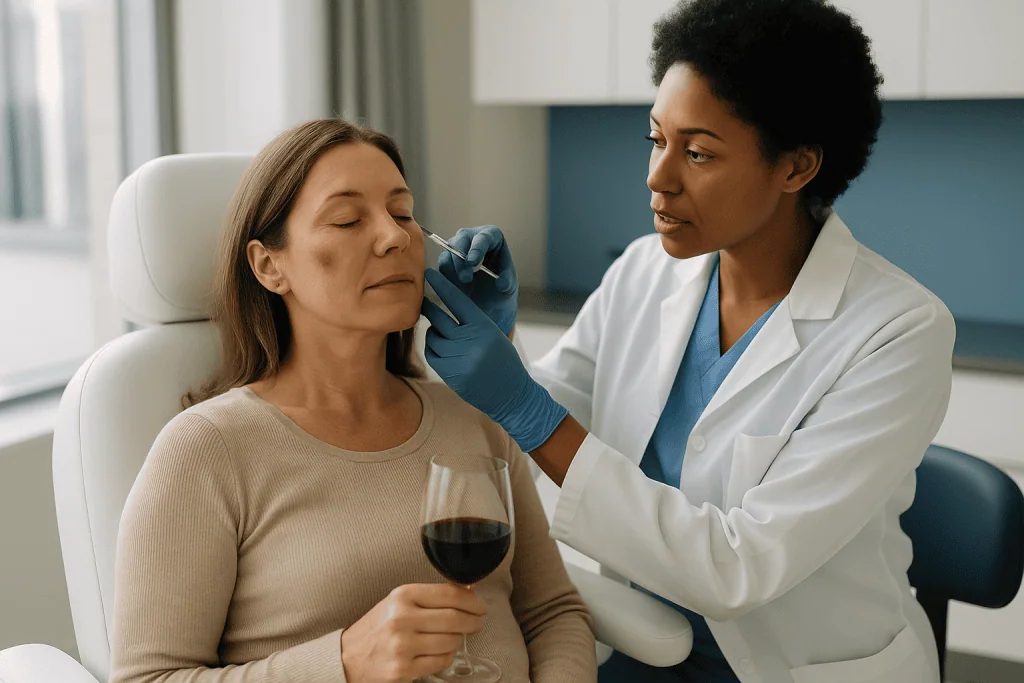
Think of the skin’s blood supply as a sprinkler system laid just under a lawn. Needles are placed to avoid the main pipes, but the fine branch lines are everywhere and invisible. Hitting one is not a mistake; it is a statistical certainty over enough injections. Cleveland Clinic lists bruising, swelling, redness and tenderness as the most common after-effects for exactly this reason.
When a vessel is breached, three things happen in sequence. The vessel wall constricts. Platelets arrive and stick together. A fibrin mesh then reinforces the plug. Alcohol works against the first step by relaxing vessel walls. Aspirin, ibuprofen and high-dose supplements act on the second. Prescribed anticoagulants such as warfarin or the direct oral anticoagulants act on the third, which is why they sit in a category of their own.
The filler is not involved in any of this. Hyaluronic acid gel sits where it is placed and draws in water over the following days; NHS guidance notes that results typically last between 6 and 18 months depending on the product and the site. What the pre-treatment list changes is the size of the bruise you carry out of the room, not the result you carry for the next year.
How long before fillers should you stop drinking alcohol?
Alcohol earns its reputation honestly. It dilates the small vessels in the skin, which is why faces flush after a drink, and a dilated vessel leaks more when punctured. It also has a modest, short-lived effect on platelet stickiness, and it dehydrates, which can make swelling look more pronounced the following morning.
How long to abstain is where the evidence gets thin. The NHS and Cleveland Clinic patient pages describe the risks but do not set a fixed number of hours; most injectors ask for a drink-free 24 hours, and some prefer 48, drawn from clinical experience rather than trials. Alcohol’s direct effect on vessel tone fades within hours of the last drink, so a single glass several days earlier is unlikely to matter. A heavy evening the night before is a different story, and so is turning up with a hangover, when the skin is dehydrated and more reactive.
Regular heavy drinking matters in a separate way. The CDC defines moderate drinking as up to one drink a day for women and two for men; sustained intake above that affects liver production of clotting proteins and can slow healing generally. If that describes you, it is worth saying so at the consultation, not because you will be judged but because it changes how your injector plans and advises.
Caffeine is often lumped in with alcohol on social media lists. The mechanism is unconvincing: coffee narrows vessels rather than widening them, and there is no good evidence that a morning cup increases filler bruising. Skipping it is harmless if it calms your nerves, but it is not a medical necessity.
The honest summary: avoid alcohol the day before, be candid about your usual intake, and do not reschedule over a glass of wine earlier in the week.
Medications to avoid before fillers: aspirin, ibuprofen and the painkiller trap
The painkiller aisle is where most people stumble. Aspirin and non-steroidal anti-inflammatory drugs (NSAIDs, the family that includes ibuprofen and naproxen) both block an enzyme platelets use to clump. Aspirin does this permanently for each platelet it touches, so its effect lasts until the body replaces those platelets, a process measured in days rather than hours. Ibuprofen’s effect is reversible and wears off far sooner.

The practical consequence is that a tablet taken for a headache a day or two before your appointment is likely still working against your clotting when the needle goes in. Many injectors therefore ask patients who use these only occasionally, for aches and pains, to choose a different painkiller for the week beforehand. Acetaminophen (paracetamol) does not affect platelets and is the usual alternative suggested, though whether it suits you is a conversation for your clinician, particularly if you have liver concerns.
There is a trap here, and it matters. Some people take a daily low-dose aspirin because a doctor prescribed it after a heart attack, stroke or stent. That is not a casual painkiller; it is a protective medicine, and stopping it to shave a bruise off a cheek is not a trade any reputable injector will ask you to make on your own. The same applies to NSAIDs prescribed for an inflammatory condition.
The rule of thumb that holds up under scrutiny: over-the-counter use for a minor ache can usually be paused and swapped; anything prescribed for a medical reason stays unless the prescriber says otherwise. Your injector may contact that prescriber or simply proceed with extra care, a cannula and firm pressure. A visible bruise is inconvenient. A clot is not.
Prescribed blood thinners: why you should never stop them on your own
Anticoagulants are a different class from aspirin. Warfarin, the direct oral anticoagulants and injectable heparins act on clotting proteins rather than platelets, and MedlinePlus is unambiguous that they should be taken exactly as prescribed, because missed doses raise the risk of the very clot they were prescribed to prevent. People take them for atrial fibrillation, previous deep vein thrombosis or pulmonary embolism, artificial heart valves and other conditions where a clot can be life-threatening.
Being on one of these medicines is not an automatic bar to fillers. It is a reason for a more careful conversation. Expect to be asked why you take it, how stable your condition is, and whether your prescribing clinician knows about the planned procedure. Some injectors proceed with technique adjustments, accepting that bruising is likelier and may last longer. Others prefer written confirmation from the prescriber. Both approaches are reasonable; the one that is not reasonable is a patient quietly skipping doses to feel safer for the appointment.
Bruising on an anticoagulant tends to be larger and slower to fade, because the fibrin mesh that normally locks a platelet plug in place forms less readily. The bruise is still self-limiting. What it is not is dangerous in the way an untreated clot can be.
If you have been told to pause an anticoagulant for a surgical procedure in the past, do not assume the same plan applies to a cosmetic injection. Surgical bridging decisions weigh major bleeding against clot risk; a filler appointment does not carry major bleeding risk, so the balance is different and usually favors continuing. That judgment belongs to the prescriber and the injector together, never to a patient alone.
Supplements to avoid before fillers: fish oil, vitamin E, ginkgo and garlic
Supplements are the part of the list people forget, partly because natural sounds harmless and partly because they rarely live in the bathroom cabinet with the medicines. Several of them have measurable effects on platelets or vessel walls.
Fish oil is the most common. The NIH Office of Dietary Supplements notes that high intakes of omega-3 fatty acids can reduce platelet aggregation and may increase bleeding time, precisely the effect you do not want on injection day. The same office describes a similar concern for high-dose vitamin E. Ginkgo biloba and garlic extracts have been associated with increased bleeding in case reports, and ginseng, ginger and turmeric are often included on precautionary grounds with weaker evidence. St John’s wort is sometimes listed too, though its concern is drug interaction rather than bruising.
How long to stop? The honest answer is that no major patient-facing guideline sets a number for cosmetic injections. Common injector practice is to pause these for about a week, borrowed from pre-surgical advice. That window is a convention, not a measured threshold, and the harm of pausing a supplement for a week is close to zero, so it is an easy ask.
Two caveats. First, a prescribed omega-3 medicine for high triglycerides is a medicine, not a supplement, and belongs in the ask-the-prescriber column. Second, eating oily fish, cooking with garlic or drinking a turmeric latte is not the same as taking concentrated capsules; dietary amounts are far lower and there is no reason to change what you eat.
A useful habit: photograph every bottle you take, including gummies and powders, and show the pictures at your consultation. Injectors ask about supplements routinely, and the answer of just vitamins is rarely accurate.
What to pause, what to keep and what the evidence actually says
The table below sorts the items people ask about most into practical columns. The time windows are those commonly used in clinical practice; as noted throughout, patient-facing guidance from the NHS and Cleveland Clinic describes the risks but does not prescribe fixed intervals, so treat these as typical conventions rather than measured thresholds.
| Item | Mechanism | Typical practice before fillers | Evidence strength |
|---|---|---|---|
| Alcohol | Dilates skin vessels, mild platelet effect, dehydration | Avoid for roughly 24 hours | Sound mechanism; interval is convention |
| Aspirin or ibuprofen taken occasionally for aches | Blocks platelet clumping | Often swapped for acetaminophen for about a week | Strong mechanism; interval is convention |
| Prescribed daily aspirin or anticoagulant | Prevents clots in heart or vessel disease | Continue unless the prescriber says otherwise | Strong: stopping carries real risk |
| Fish oil, vitamin E, ginkgo, garlic capsules | Reduce platelet aggregation at high intakes | Commonly paused for about a week | Moderate for fish oil and vitamin E; weaker for herbs |
| Caffeine | Narrows vessels; no bruising link shown | No change needed | No evidence of harm |
| Active cold sore or skin infection at the site | Risk of carrying infection into treated tissue | Postpone until fully healed | Strong |
| Pregnancy or breastfeeding | Safety data largely absent | Usually asked to wait | Precautionary |
Two patterns stand out. The strongest evidence sits with the items you should keep taking, not the ones you should stop. And the about-a-week intervals cluster not because a trial measured them but because they are long enough for platelet function to recover and short enough to be practical. If something you take is missing from this table, that is a reason to ask, not to assume it is fine.
Cold sores, acne and recent procedures: when the skin surface is not ready
Bleeding gets most of the attention, but the surface of the skin deserves equal scrutiny. Fillers are placed into tissue sealed off from the outside world; the needle briefly opens that seal, and whatever is on or in the skin can travel with it.
A cold sore is the classic example. The herpes simplex virus lives in nerve tissue and reactivates under stress, including the physical stress of injections around the mouth. An active sore is a firm reason to postpone, and a history of frequent cold sores is something to mention, because clinicians sometimes consider preventive antiviral treatment before lip work. Whether that is appropriate for you is the prescriber’s call.
Active acne, a rash, an eczema flare or any broken skin over the treatment area carries a similar logic: bacteria or inflammation introduced into tissue alongside a gel can lead to infection, which the NHS lists among the recognized complications of fillers. Flaring rosacea can also make bruising and redness harder to interpret afterwards.
Recent procedures matter too. Laser resurfacing, chemical peels, microneedling and some professional facials leave the skin inflamed for days to weeks, and most practitioners prefer the surface to have settled fully before injecting. Dental work is a quieter concern: procedures that disturb the gums can release oral bacteria into the bloodstream, and some injectors ask for a gap of a couple of weeks on either side of dental treatment, a precaution borrowed from the wider literature on implanted materials rather than from filler-specific trials.
Recent vaccination is a frequent question. There is no established interaction, but a sore arm or a short feverish reaction is a reasonable reason to delay a few days, simply because a fever muddies any assessment of the treated area.
Who dermal fillers are usually for, and who is usually asked to wait
Fillers are a treatment for adults with a specific, realistic goal: restoring volume lost from cheeks or temples, softening deep folds beside the nose, refining lip shape, or correcting asymmetry. The best candidates understand that the gel is temporary, that it changes contour rather than skin quality, and that the result depends heavily on the skill of the person placing it.
Several groups are routinely asked to wait or to have a different conversation first. Pregnancy and breastfeeding head the list, not because harm has been shown but because no one has studied it, and precaution is the only responsible position. Anyone under 18 is generally excluded. A current infection anywhere, a fever, or an acute flare of an autoimmune condition is a reason to delay until things are settled.
A known allergy to any filler ingredient, including the local anesthetic lidocaine that many gels contain, needs careful discussion. So does a history of severe allergic reactions in general. People with bleeding disorders or on anticoagulants are not necessarily excluded but need the planning described earlier.
Two further groups deserve a frank word. Someone with a permanent filler already in the area may be advised against layering a new product over it, because mixed materials behave unpredictably. And anyone who feels pressured, or is chasing a rapidly changing goal, may benefit from pausing, not because fillers are wrong for them but because the consultation is the right place to talk that through.
Every one of these judgments sits with the treating clinician, who should take a full medical history before any needle is opened. If that history is not taken, that itself is information.
What not to do before fillers on the day of treatment
The morning of the appointment is less about pharmacology and more about arriving in good condition. Eat normally; a skipped breakfast makes some people light-headed during injections, and a faint is far more disruptive than a bruise. Drink water. Dehydrated skin is less forgiving, and bruises are often described as looking worse against it, though that observation is anecdotal rather than measured.
Arrive with a clean face if you can. Makeup will be removed anyway, and heavy foundation over the treatment area means more rubbing before the skin is cleaned. Skip strenuous exercise beforehand; a hard workout raises blood flow and skin temperature, and a flushed, sweaty face is harder to assess and mark up accurately.
Do not take an extra painkiller just in case. Numbing cream and the lidocaine inside most hyaluronic acid gels are the usual approach to comfort. If you are anxious about pain, say so; it is a common concern and clinicians have ways to manage it that do not involve you self-medicating with an NSAID.
Bring your medication list, including anything you paused and when. Bring your questions written down; the treatment room is a poor place to remember them. If you wear contact lenses and are having treatment near the eyes, ask whether to remove them.
Plan the rest of the day as a quiet one. Many people assume they can go straight back to a long lunch or a gym class. The after-care list, covered next, asks for the opposite, and it helps to have cleared the diary in advance rather than negotiating it afterwards with an ice pack in hand.
Do's and don'ts after fillers: what the following days usually look like
The first evening is usually the least glamorous. Expect some swelling, tenderness and possibly small bruises at the injection points; Cleveland Clinic lists these as the most common after-effects, and the NHS describes swelling and bruising that typically settle over the following days. Lips swell most noticeably and can look uneven for a day or two; that is swelling, not the final shape.
The after-care list mirrors the pre-treatment one, because the same vessels are still healing. Alcohol and anti-inflammatory painkillers are generally avoided for the first day or so for the same bruising reasons. Heat is the other common advice: saunas, hot yoga, steam rooms and vigorous exercise all dilate vessels and are usually paused for about a day. Cold compresses, applied gently and briefly, do the opposite.
Touching is the item people find hardest. Pressing, massaging or checking the area can move gel before it has settled, and most practitioners ask you not to manipulate it unless they have specifically shown you how. Sleeping slightly propped up the first night helps swelling drain. Makeup is often fine once the injection points have closed, though timing varies by injector.
Over the next one to two weeks the gel integrates and swelling resolves, and most clinicians prefer to assess the final result at a review appointment rather than on day two. Bruises follow their own timetable regardless of fillers, shifting from purple to green to yellow as the leaked blood is broken down and reabsorbed.
What should not happen is increasing pain, spreading redness, or skin that changes color in a patch. Those are not after-effects; they are reasons to pick up the phone, and they are described in the section on when to call your doctor.
What people often get wrong about preparing for fillers
Myth one: a bruise means the injector was careless. Bruising reflects anatomy and chance as much as technique. A skilled injector reduces the odds; nobody eliminates them.
Myth two: stopping daily aspirin for a few days is harmless. For someone prescribed it after a cardiac event, it is not. The protection it provides is the point, and the decision to pause it belongs to the prescriber. Fillers are elective; a clot is not.
Myth three: natural supplements do not count. Fish oil and high-dose vitamin E have documented effects on platelets according to NIH Office of Dietary Supplements fact sheets. Gummies, powders and wellness blends can contain the same ingredients under friendlier names.
Myth four: more days of abstinence is always better. The common one-week window for supplements and occasional painkillers is already long enough for platelet function to recover; stretching it to a month achieves nothing and can disrupt medicines you genuinely need.
Myth five: caffeine, salt and sugar must be cut. There is no good evidence that a morning coffee or a normal meal changes filler bruising. These appear on lists because they sound disciplined, not because they have been tested.
Myth six: arnica, bromelain and pineapple will prevent bruising. The evidence for arnica and bromelain is mixed and of low quality; some small studies suggest a modest effect on bruise color, others show none. They are reasonable to try if your clinician is comfortable, but they are not a substitute for the avoidance list, and nobody should present them as proven.
Myth seven: the pre-treatment list is the same for everyone. A person on an anticoagulant, a person with frequent cold sores and a person with no medical history will each receive different instructions, and that variability is a sign of a thorough consultation, not an inconsistent one.
Questions to ask your care team before your appointment
A good consultation leaves you knowing not just what to avoid but why, and what the plan is if something goes wrong. These questions tend to produce the most useful answers.
- Which of my current medicines and supplements would you like me to pause, for how long, and have you checked with the clinician who prescribes them?
- I take daily aspirin or an anticoagulant for a medical reason. How do you adjust your technique, and do you want to speak to my prescriber first?
- I get cold sores. Does that change the plan for lip treatment?
- Which product are you using, is it reversible, and do you keep the dissolving enzyme on site in case of a blocked vessel?
- What are the signs of a vascular occlusion, and who do I contact, including outside working hours, if I notice them?
- How much bruising and swelling is typical for this area, and when will the final result be assessed?
- What training and emergency protocols do you have for complications?
- Is there anything in my history that would make you advise me to wait?
The question about the dissolving enzyme deserves a sentence of explanation. Hyaluronidase is an enzyme that breaks down hyaluronic acid filler, and it is the main tool for managing the rare but serious complication of filler entering a blood vessel. Asking whether it is immediately available is not rude; it is the single most practical safety question in aesthetic injecting. A clinician who welcomes the question is telling you something about how they work.
Write the answers down. Pre-treatment instructions are easy to misremember, and a vague recollection that someone said a week is not a plan.
When to call your doctor: red flags after dermal fillers
Most after-effects are mild and settle on their own. A small number of signs need same-day contact with the clinician who treated you, or emergency care if they cannot be reached, because they can point to filler blocking a blood vessel, a complication the NHS lists among the serious risks.
- Skin that turns white, blotchy, dusky or purple in a patch, especially if it looks net-like or spreads beyond the injection site.
- Pain that is severe, increasing, or out of proportion to what you were told to expect.
- Any change in vision, eye pain, or a drooping eyelid; this is an emergency and needs immediate care.
- Spreading redness, warmth, pus or a fever in the days afterwards, which can indicate infection.
- Swelling of the lips, tongue or throat, difficulty breathing, or widespread hives, which suggest an allergic reaction.
- A lump, hardness or persistent swelling that appears weeks later rather than settling.
Timing matters most for the first item. Filler in a vessel starves tissue of blood, and the window in which the dissolving enzyme can help is short, which is why practitioners ask you to contact them rather than wait and see. Do not assume a strange color is just a bruise; a bruise is usually purple and tender, whereas a blocked vessel often produces pale or mottled skin with pain that feels wrong.
If you cannot reach your injector, go to an emergency department and tell them exactly what was injected and where. Take the aftercare sheet or product information with you if you have it. Every decision about treating a complication sits with the clinicians who see you; your job is only to get seen quickly.
Frequently asked questions
What should I avoid before dermal fillers?
Alcohol, aspirin or ibuprofen taken for minor aches, and supplements such as fish oil, vitamin E, ginkgo and garlic are the usual items, because each can increase bruising. Prescribed blood thinners stay unless your prescriber says otherwise. Postpone if you have an active cold sore, skin infection or broken skin at the site, and tell your injector if you are pregnant or breastfeeding.
How long before fillers should I stop drinking alcohol?
Most injectors ask for at least 24 hours without alcohol, and some prefer 48. Patient guidance from the NHS and Cleveland Clinic describes bruising risk without setting a fixed interval, so these windows come from clinical practice. Alcohol’s effect on vessel tone fades within hours, so a drink several days earlier is unlikely to matter.
What medications should not be taken before Botox or fillers?
The same bruising logic applies to botulinum toxin injections and fillers: aspirin and NSAIDs such as ibuprofen taken for aches are commonly swapped for acetaminophen for about a week, because they reduce platelet clumping. Prescribed aspirin or anticoagulants should not be stopped without the prescriber’s agreement. Always give your full medication list at the consultation.
Which supplements should I stop before fillers?
Fish oil, high-dose vitamin E, ginkgo and garlic capsules are the ones with the clearest platelet effects, according to NIH Office of Dietary Supplements fact sheets. Ginseng, ginger and turmeric are often included on weaker, precautionary evidence. Pausing them for about a week is common practice. Food amounts of these ingredients do not need to change.
Can I have fillers if I take blood thinners?
Often yes, with planning. Anticoagulants such as warfarin or the direct oral anticoagulants are continued because stopping them risks a serious clot; MedlinePlus advises taking them exactly as prescribed. Your injector may adjust technique, use a cannula and warn you that bruises will be larger and slower to fade. The decision involves both your prescriber and injector.
What are the do's and don'ts after fillers?
Keep the area clean and untouched, sleep slightly propped up, and use brief cold compresses for swelling. Avoid alcohol, anti-inflammatory painkillers, saunas, hot yoga and hard exercise for about a day, since heat and vessel dilation worsen bruising. Do not massage the area unless shown how. Call your clinician for pale or mottled skin, severe pain or vision changes.
Is pain normal after chin filler injections?
Mild tenderness, swelling and a dull ache are expected after chin filler and usually ease over a few days, as Cleveland Clinic and the NHS describe for fillers generally. Pain that is severe, worsening, or accompanied by white, dusky or mottled skin is not normal and can signal a blocked vessel; contact your injector the same day or seek emergency care.
What are the potential side effects of hip fillers?
Body fillers in the hips carry the same recognized risks as facial fillers, including bruising, swelling, lumps, infection and filler moving from where it was placed, but the larger volumes raise concerns about infection and migration, and the evidence base is thinner than for facial use. Discuss product, regulatory status and complication plans in detail with a qualified clinician.
Can I drink coffee before fillers?
Yes, in normal amounts. Caffeine narrows blood vessels rather than widening them, and there is no good evidence that it increases filler bruising. It appears on some lists by association with alcohol rather than because of any tested mechanism. If skipping it helps you feel calmer, that is fine, but it is not a medical requirement.
Does arnica prevent bruising from fillers?
The evidence is mixed and of low quality. Some small studies suggest arnica or bromelain may modestly reduce bruise color, while others show no effect. Neither is a substitute for avoiding alcohol, aspirin and platelet-affecting supplements. If you want to try one, mention it to your injector first, since it should be treated like any other supplement.
References
- NHS: Dermal fillers
- Cleveland Clinic: Dermal Fillers
- MedlinePlus: Blood Thinners
- CDC: About Alcohol Use
This article is for general information only and is not a substitute for professional medical advice. Please consult a qualified doctor about your individual situation.

More from the Blog

Tissue Expansion Timeline: Weekly Fills, the Stretching Phase and Second-Stage Reconstruction
A tissue expander timeline usually runs in three phases. The expander is placed in a first operation; once the incision has healed over the…

How Long Do Mesotherapy Results Last and Why Sessions Are Spaced Weeks Apart
Mesotherapy results are temporary. Small studies and practice protocols generally describe visible skin changes lasting a few weeks to a few months after a…

What Buccal Fat Removal Is: The Procedure, Who It Suits and What to Expect
Buccal fat removal is a cosmetic surgery that takes out part of the buccal fat pad, a pocket of deep fat in the lower…
Before Mole Removal: Why Bleeding History and Past Scars Matter to Your Dermatologist
Before mole removal, tell your doctor about any bleeding tendency, past heavy bleeding after cuts or dental work, every blood thinner, antiplatelet medicine or…

Cryoablation Recovery: Monitoring on Day One, Light Activity and When Exercise Resumes
Cryoablation recovery time is usually short compared with open surgery. Most people go home the same day or after one night of monitoring, feel…
What a Healed Skin Graft Looks Like: Color, Texture and How the Area Changes Over Years
A healed skin graft usually settles into a patch that stays slightly different from the surrounding skin: often paler or darker, smoother or thinner,…