

What to Eat After Food Poisoning: Bland Foods, Fluids and Pacing Your Return to Normal
Key Takeaways
- Dehydration, not the infection itself, is the main danger in otherwise healthy adults, so fluids come before any decision about food.
- Oral rehydration solutions replace sodium and water more effectively than sports drinks, whose higher sugar content can prolong diarrhea.
- Appetite returning is the body's signal that the gut lining is ready for small, bland, low-fat meals, usually within a day of vomiting stopping.
- The BRAT diet is a reasonable list of first bites but too low in protein to live on; guidance now favors returning to a normal diet as tolerated.
- Temporary lactose intolerance after food poisoning happens because the cells producing lactase are damaged, which is why milk often disagrees for about a week.
- The NHS advises staying away from work or school until 48 hours after the last episode of vomiting or diarrhea, because many of these infections remain contagious.
After food poisoning, start with fluids, not food: small, frequent sips of water or an oral rehydration solution once vomiting settles. When appetite returns, usually within a day, add small portions of bland, low-fat foods such as toast, rice, bananas, plain potatoes or scrambled eggs. Widen the menu over several days, holding back on fatty, very sugary, spicy or dairy-heavy foods, alcohol and caffeine until the gut is calm.
It is the second morning. The worst of it has passed, the bathroom trips have slowed to something survivable, and you are standing in front of an open refrigerator feeling two things at once: hunger, faintly, and a deep suspicion of everything on the shelves. The leftover pasta looks like a threat. The yogurt looks like a gamble. You close the door and eat nothing, which, as it turns out, is not quite the right answer either.
Working out what to eat after food poisoning is a question millions of people face every year, and the folklore around it is thick. Starve it out. Burn the toast. Drink flat soda. Live on bananas for a week. Almost none of that holds up to the evidence, and some of it slows recovery.
What follows is the honest version: how a gut recovers from an infection, why fluids matter more than any particular food, what the first meals should look like, and how to pace the return to a normal plate without setbacks.
What food poisoning actually does to your gut
Food poisoning is an infection or toxin-driven illness picked up from contaminated food or drink. The culprits are most often bacteria such as Salmonella, Campylobacter or certain strains of E. coli, viruses such as norovirus, or toxins that bacteria leave behind in food before it is eaten, according to the CDC. Symptoms can begin within hours or take several days to appear, depending on the organism.
Whatever the cause, the body’s response follows a similar script. The lining of the stomach and small intestine becomes inflamed. Inflammation is the immune system’s local fire alarm: blood flow increases, fluid pours into the tissue, and the nerves that signal nausea become far easier to trigger. The gut wall, which normally absorbs water and nutrients, temporarily reverses course and secretes fluid into the bowel instead. That is diarrhea, and it is not a malfunction so much as a flush.
Vomiting works the same way, clearing the stomach quickly. Appetite disappears because the brain, sensing inflammation, deliberately turns hunger down. This is why the idea of eating during the acute phase feels not just unappealing but almost impossible.
Two consequences shape everything about recovery. First, you lose water and salts faster than you can replace them, which is why dehydration, not the infection itself, is the main danger in otherwise healthy adults, as the NHS and Mayo Clinic both emphasize. Second, the cells that line the small intestine, including the ones that produce lactase, the enzyme that digests milk sugar, are damaged and need days to regrow. That is the biological reason dairy so often disagrees with people in the week after a stomach bug, and it is the reason bland foods earn their reputation.
How long after food poisoning should I eat?
The short answer: sooner than most people think, but later than your first pang of hunger might suggest. There is no fixed number of hours. Mayo Clinic’s guidance is to stop eating and drinking for a few hours to let the stomach settle, then begin sipping fluids, and to ease back into food only when you feel you can. The NIDDK, part of the NIH, puts it plainly: eat when your appetite returns.
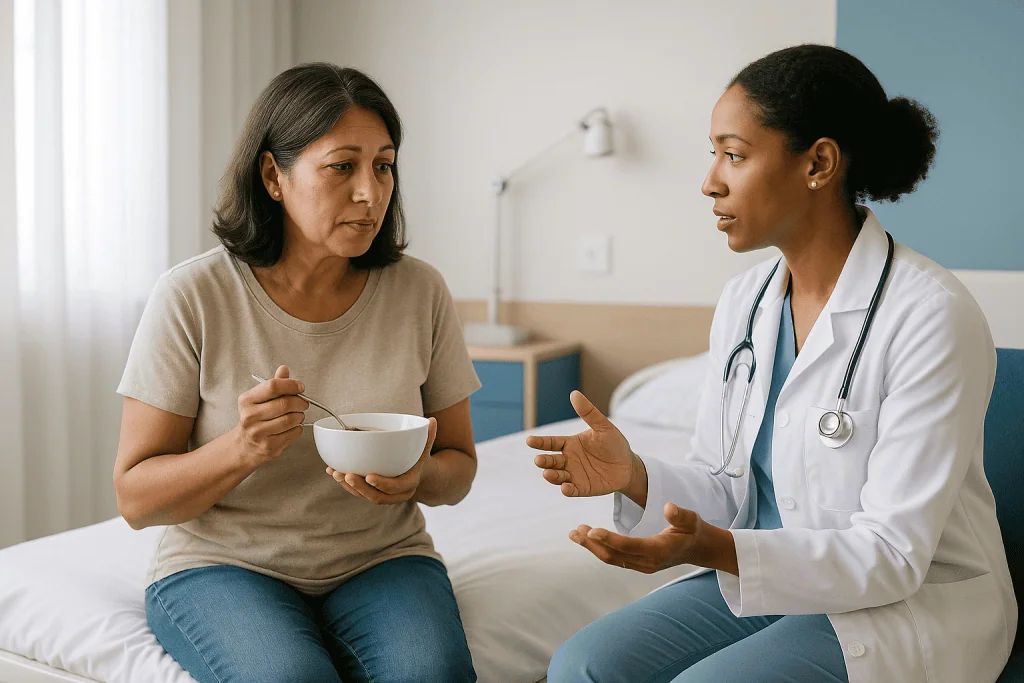
That appetite is a reliable signal. When the gut is still actively inflamed, the brain suppresses hunger. When hunger creeps back, usually within a day of the vomiting stopping, it is the body reporting that the lining has calmed enough to handle small amounts of simple food. Pushing food in before that point tends to bring it straight back up, which costs you more fluid.
Equally, waiting too long has a cost. Prolonged fasting leaves you weak, prolongs the low-energy fog that follows a bout of illness, and may actually delay the gut’s recovery, because intestinal cells regrow faster when they have nutrients to work with. The old advice to rest the bowel for days has been quietly retired; the NHS now tells adults with diarrhea and vomiting to eat small, light meals as soon as they feel able.
A practical rhythm that fits the guidance:
- While vomiting: nothing by mouth for a short spell, then sips of fluid.
- Once vomiting has stopped for a few hours and fluids stay down: continue fluids, try a few plain crackers or a slice of toast if you want them.
- Once genuine hunger returns: small bland meals every two to three hours rather than three large ones.
Think of it as testing the ground with each step rather than following a clock.
Fluids first: what to drink after food poisoning
If you remember one thing from this article, make it this: what you drink in the first two days matters more than anything you eat. Vomiting and diarrhea strip out water along with sodium, potassium and other electrolytes, the dissolved salts that keep nerves firing and muscles, including the heart, working properly. Replacing water alone does not fully fix the problem.
Plain water is a fine start and the NHS’s first recommendation. For anyone with heavy diarrhea, an oral rehydration solution, a measured mix of glucose and salts sold as sachets or ready-made drinks, does a better job, because the small amount of sugar actively helps the gut pull sodium and water back across its wall. The NIDDK and CDC both recommend these solutions for adults and children who are losing significant fluid.
Sports drinks are the popular substitute, and here the evidence is less kind than the marketing. They contain far more sugar and less sodium than a rehydration solution, and concentrated sugar in the bowel draws water in, which can worsen diarrhea. Diluting them by half with water is a reasonable compromise if nothing else is available. Fruit juice and regular soda have the same problem, and flat cola, a long-lived piece of household wisdom, has no evidence behind it.
Broth, clear soups and weak herbal teas count toward fluid intake and add a little salt. Caffeinated drinks and alcohol do not help: both increase urine output, and alcohol irritates an already inflamed stomach lining, as Mayo Clinic notes.
Technique matters as much as content. Small, frequent sips, a mouthful every few minutes, stay down far better than a large glass gulped at once. Sucking ice chips works when even sips are hard. Pale-yellow urine and a moist mouth are the everyday signs that you are keeping up.
What to eat after food poisoning: the first bland meals
Once fluids are staying down and hunger has returned, the goal of the first meals is modest: deliver energy and salt without demanding much from a bruised digestive system. In practice that means foods that are low in fat, low in fiber, gently seasoned and served in small portions. Mayo Clinic’s list is a useful starting point: soda crackers, toast, gelatin, bananas and rice. The NHS advice is similar and simpler: small, light meals.
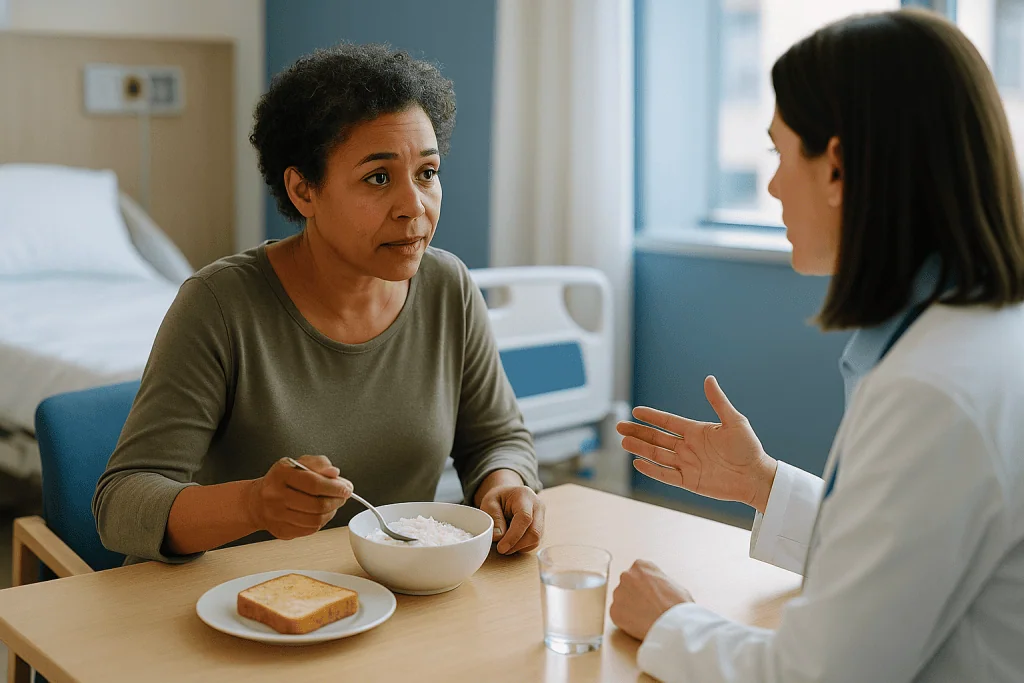
Why these particular foods? Fat slows stomach emptying and triggers bile release, both of which can renew nausea. Insoluble fiber, the roughage in raw vegetables and whole grains, speeds the bowel along when you want it to slow down. Strong spices and acids irritate an inflamed lining. Bland starchy foods sidestep all three problems while offering easily absorbed carbohydrate, and a pinch of salt on them helps replace what was lost.
| Category | Gentle first choices | Why they help |
|---|---|---|
| Starches | White rice, white toast, plain crackers, boiled or mashed potato, plain pasta, oatmeal | Easily digested carbohydrate; low fiber; soaks up salt |
| Fruit | Banana, applesauce, canned peaches or pears | Soft, low acid; banana supplies potassium |
| Protein | Scrambled or boiled egg, poached chicken breast, white fish, tofu | Low fat; supports repair of the gut lining |
| Vegetables | Well-cooked carrot, zucchini, squash; clear vegetable broth | Cooking breaks down fiber; broth adds fluid and salt |
| Drinks | Water, oral rehydration solution, clear broth, weak tea | Replace water and electrolytes without excess sugar |
Portion size is the lever people forget. Half a slice of toast, a few spoonfuls of rice, a quarter of a banana. If that sits comfortably for an hour or two, have a little more. Warm foods are often tolerated better than cold, and strong smells, even from otherwise safe foods, can bring nausea back, so eat away from the cooking.
Is the BRAT diet still recommended after food poisoning?
Bananas, rice, applesauce, toast. For decades the BRAT diet was the standard prescription for anyone recovering from a stomach bug, and it still circulates widely. The four foods are all reasonable choices, which is why the acronym has survived. The problem is what happens when people treat it as a complete diet for several days.
The BRAT foods are almost entirely carbohydrate. They contain very little protein, almost no fat, and few of the vitamins and minerals a recovering body needs. Protein in particular matters: the cells lining the small intestine turn over rapidly, and rebuilding them after an infection requires amino acids. A person eating only bananas and toast for four days is well hydrated and calorically underfed, and often feels weaker for longer than necessary.
Mainstream guidance has moved on. The NIDDK now advises returning to a normal, balanced diet as soon as it can be tolerated rather than restricting to a handful of foods. MedlinePlus describes bland eating as a short bridge, not a destination. Pediatric guidance shifted earlier still, because children on restrictive diets lose weight quickly.
A fairer way to use the acronym is as a list of first bites, not a rulebook. Bananas, rice, applesauce and toast are excellent for the first several hours of eating. From the next meal onward, the aim is to widen the plate: add an egg, some poached chicken, cooked vegetables, oatmeal, plain yogurt if dairy is tolerated. Most people can be eating something close to their usual diet within two to three days of symptoms settling, and there is no evidence that staying bland for longer speeds recovery.
The one situation where a bland approach reasonably lasts longer is ongoing loose stools. Even then, protein and cooked vegetables belong on the plate; only the fat, fiber and sugar stay low until the bowel has settled.
Can I eat eggs after food poisoning?
Yes, and for many people a plainly scrambled or boiled egg is one of the best second-day foods available. This surprises people, partly because eggs carry an association with Salmonella and partly because they feel richer than toast. Both concerns deserve a straight answer.
On safety: a thoroughly cooked egg, with a firm white and no runny yolk, carries no meaningful infection risk, according to the CDC’s food safety guidance. Undercooked or raw eggs are the concern, and after a bout of food poisoning is not the moment to test that.
On digestibility: eggs are a compact source of complete protein with a modest amount of fat concentrated in the yolk. Protein is exactly what the recovering intestinal lining needs, and the fat content of a single egg is low enough that most people tolerate it well once nausea has passed. The way it is cooked matters more than the egg itself. Scrambled in a dry pan or with a small amount of water, poached or boiled, an egg is gentle. Fried in butter, folded into a cheesy omelet or served with bacon, it becomes a high-fat meal that can restart nausea.
Timing is the other variable. An egg on the first day, while vomiting is still recent, is likely to be too much. Once you have kept down toast or crackers for a few hours and feel hungry rather than queasy, an egg is a sensible next step. If it sits well, that is a good sign the gut is ready for other lean proteins: poached chicken, white fish, tofu.
The people who should be more cautious are those with a known egg allergy or intolerance, which does not change because of a stomach bug, and anyone whose diarrhea is still frequent and watery, for whom fluids remain the priority.
Foods to avoid after food poisoning
The list of foods to hold back on for a few days is shorter than most people expect, and each item has a mechanism behind it rather than a superstition. Mayo Clinic and the NIDDK broadly agree on the categories.
- Dairy, especially milk and ice cream. The enzyme that digests lactose lives in the cells at the tips of the intestinal lining, the very cells most damaged by infection. For a week or so, milk sugar can pass undigested into the large bowel, where bacteria ferment it into gas and draw in water: bloating, cramps and looser stools. Hard cheese and plain yogurt contain far less lactose and are often fine.
- Fatty and fried foods. Fat delays stomach emptying and stimulates bile, both of which provoke nausea in a sensitive gut.
- Very sugary foods and drinks. Concentrated sugar in the bowel pulls water in osmotically and can prolong diarrhea. This includes fruit juice, regular soda and candy.
- Spicy and heavily seasoned dishes. Capsaicin and strong acids irritate an inflamed lining.
- High-fiber foods. Raw vegetables, bran, beans and whole nuts speed transit and increase gas. They return to the plate once stools have firmed.
- Caffeine and alcohol. Both increase fluid loss; alcohol also irritates the stomach directly.
Sugar-free products deserve a special mention. Sweeteners such as sorbitol and other sugar alcohols are poorly absorbed and act as laxatives even in healthy people. Sugar-free gum, mints and diet desserts can quietly keep diarrhea going.
None of these foods is dangerous after food poisoning; they are simply uncomfortable and can extend symptoms. The sensible approach is to reintroduce them one at a time once stools are normal, noticing how each one sits. Dairy is usually the last to return smoothly, and it does return.
How do I heal my gut after food poisoning?
The search phrase suggests a project, something requiring supplements and a plan. The evidence points somewhere quieter: the gut lining repairs itself remarkably well, and the best support you can offer is water, salt, protein and time. Intestinal cells are among the fastest-renewing in the body, with the lining largely replaced over a period of days, which is why most people are eating normally within a week.
The gut microbiome, the community of trillions of bacteria living in the large intestine, takes a knock during an infection and the diarrhea that follows it. It also recovers, mostly by itself, once normal eating resumes. Fiber from fruit, vegetables, oats and whole grains feeds the beneficial species, so the return of these foods after the first bland days is part of recovery rather than something to postpone indefinitely.
Probiotics, live bacteria taken as supplements or in fermented foods, are the most-asked-about intervention. The honest reading of the research is mixed. Some trials suggest certain strains may shorten infectious diarrhea by about a day; others, including large, well-designed studies in children, found no benefit. The NIDDK describes the evidence as still under study and suggests discussing probiotics with a clinician rather than assuming they help. Plain yogurt with live cultures is a reasonable food to reintroduce if dairy sits well, but it is food, not treatment.
What about the fashionable additions, bone broth, collagen, glutamine, apple cider vinegar, activated charcoal? Broth is useful for fluid and salt. The others have no convincing evidence for speeding recovery from food poisoning in otherwise healthy people, and charcoal can interfere with the absorption of prescribed medicines. Money spent on them is better spent on groceries.
Rest belongs on this list too. Sleep and a reduced load on the body free up resources for repair, and Mayo Clinic lists rest alongside fluids as the core of home treatment.
What the following days and weeks usually look like
Recovery from food poisoning is rarely a straight line, and knowing the typical shape helps you tell an ordinary wobble from a warning sign. The NHS notes that most people feel better within a week; the CDC frames the illness in most healthy adults as lasting a few days, with some organisms, such as Campylobacter, producing longer courses.
The first one to two days are dominated by vomiting, cramping and diarrhea, low appetite and often a mild fever. Fluids are the whole task. Eating is optional and usually unwelcome.
Days two to four typically bring the turn. Vomiting stops first; diarrhea eases more gradually. Appetite returns, often suddenly, and this is when bland foods begin and portions grow from a few bites to small meals. Fatigue is common and out of proportion to how little you have done, which is the body diverting energy to repair.
Days four to seven see most people back to something close to normal eating, with stools firming and energy returning. Loose stools after fatty or dairy-rich meals are common in this window and do not mean the infection has returned.
Weeks two to four occasionally involve lingering sensitivity: mild bloating, a dislike of rich food, or a temporary intolerance of milk. This usually settles on its own. A small proportion of people go on to develop post-infectious irritable bowel syndrome, a pattern of ongoing cramping and altered bowel habit after the infection has cleared. Symptoms persisting well beyond two weeks deserve a conversation with a clinician.
Two practical notes. The NHS advises staying away from work, school or childcare until 48 hours after the last episode of vomiting or diarrhea, because many of these infections spread easily to others. And avoid preparing food for other people during that same window.
Who should take extra care before returning to normal eating
For a healthy adult, the pacing described so far is enough, and the decisions can safely be made at the kitchen table. Several groups face higher risks from dehydration or from the infection itself, and for them the same principles apply with a lower threshold for calling a clinician. The CDC identifies four groups in particular.
Infants and young children lose fluid proportionally faster than adults and can become dehydrated within hours. Oral rehydration solutions designed for children are the standard, and breastfeeding or formula should continue rather than be paused. Watery diarrhea with few wet diapers, a dry mouth, no tears when crying or unusual drowsiness are reasons to seek care promptly, not to wait for appetite to return.
Adults over 65 often have a blunted thirst signal, take medicines that affect fluid balance, and have less physiological reserve. Confusion or dizziness on standing can be the first sign of dehydration in this group.
People who are pregnant are more susceptible to certain infections, notably Listeria, and should let their maternity team know about any food poisoning episode, especially one with fever.
People with weakened immune systems, including those on chemotherapy, taking immunosuppressants after a transplant, or living with advanced HIV, are at higher risk of the infection spreading beyond the gut. They are usually asked to contact their care team early rather than manage at home.
Two further groups deserve mention. People with diabetes need to watch blood glucose closely, because vomiting disrupts the balance between food, insulin and other medicines, and their diabetes team will usually have sick-day guidance. People with inflammatory bowel disease or a history of bowel surgery may find symptoms harder to interpret and recovery slower.
In every one of these situations, the treating clinician decides how quickly to reintroduce food and whether any additional treatment is needed. The general guidance here is a framework, not a substitute for that conversation.
Do medicines help you recover from food poisoning?
Most cases of food poisoning need no medicine at all; the body clears the infection and the job of treatment is to keep fluid levels up while that happens. Still, people reasonably ask about the options, so here is what each class does and does not do, with the decision left where it belongs, with the prescribing clinician.
Antidiarrheal medicines such as loperamide work by slowing the movement of the bowel, which reduces the number of loose stools. They can be useful for an adult who needs to travel or work, but they carry a caveat that both Mayo Clinic and the NHS highlight: they should not be used when there is blood in the stool or a high fever, because slowing the bowel may keep certain bacteria and their toxins in contact with the gut wall for longer. They are also not recommended for young children without medical advice.
Anti-nausea medicines act on the brain’s vomiting center or on receptors in the gut. They are sometimes prescribed when vomiting is preventing fluid intake, particularly in children, and are a prescribing decision rather than an over-the-counter choice.
Antibiotics are used only for specific bacterial infections identified by stool testing, or for people at high risk of complications. For the most common causes they offer no benefit, and for certain E. coli strains they may increase the risk of a serious complication, according to the CDC. Viral food poisoning does not respond to antibiotics at all.
Intravenous fluids are the treatment for dehydration that cannot be corrected by drinking, delivered in an emergency department or hospital.
One easily overlooked point: anyone taking regular prescribed medicines who has been vomiting should ask their clinician or pharmacist whether doses have been missed or poorly absorbed. Oral contraceptives, blood pressure medicines and diabetes medicines are common examples where a few days of illness can matter.
What people often get wrong about eating after food poisoning
Recovery advice passed around kitchens and group chats contains a surprising amount of confident error. Here are the myths that cause the most trouble, and what the evidence says instead.
“Starve it out.” Prolonged fasting does not shorten the illness and leaves you weaker. Current guidance from the NHS and NIDDK is to eat small light meals as soon as appetite allows.
“You need to reset your body” with a detox, cleanse or fast. There is no evidence that juice cleanses, detox teas or extended fasting help the gut recover, and several of these approaches deliver the concentrated sugar or laxative herbs that prolong diarrhea. The reset the body needs is water, salt, protein and sleep.
“Sports drinks are the best way to rehydrate.” They are better than nothing, but they contain more sugar and less sodium than an oral rehydration solution, and the excess sugar can worsen loose stools.
“Burnt toast absorbs toxins.” Charring bread creates compounds you would rather not eat and does nothing useful. Plain toast is fine; burnt toast is just burnt.
“Flat cola settles the stomach.” A cultural favorite with no supporting evidence. It is sugar water with a little caffeine.
“If food makes the diarrhea worse, stop eating.” A slight increase in bowel activity after meals is normal and reflects the gut waking up. Persistent worsening after a specific food, usually dairy or fat, means holding that food for a few days, not stopping food altogether.
“Antibiotics will clear it faster.” For most causes they do nothing, and for some they may do harm. They are a targeted decision made by a clinician, usually after a stool test.
“Once I feel better I am no longer contagious.” Many of these infections shed for days after symptoms end, which is why the NHS 48-hour rule exists.
Questions to ask your care team
Most people recover from food poisoning without ever speaking to a clinician. If you do end up in a consultation, whether because symptoms have lingered, because you belong to a higher-risk group, or because something worried you, a short list of questions makes the appointment far more useful. Bring a rough record of what you have eaten in the past few days, when symptoms started, how often you are passing stool and whether you have managed to keep fluids down.
- Do my symptoms suggest a cause that needs a stool test, or is this likely to settle on its own?
- How will I know if I am becoming dehydrated, and at what point should I come back or go to an emergency department?
- Is an oral rehydration solution right for me, and how should I use it alongside water and food?
- Are any of my regular medicines affected by vomiting or diarrhea, and do I need to adjust anything while I am unwell?
- Is it safe for me to take an antidiarrheal or anti-nausea medicine, given my symptoms and other conditions?
- Which foods should I reintroduce first, and is there anything I should avoid for longer than usual?
- How long should I stay away from work, school or preparing food for others?
- If my bowel habit has not returned to normal in two weeks, what should I do?
- Should this case be reported, for example if it came from a restaurant or a shared meal where others were also unwell?
For parents, add: what are the specific signs in my child that mean I should not wait? For anyone pregnant or immunosuppressed: does my situation change the usual advice? The answers will be tailored to you, which is exactly why they are worth asking rather than relying on general reading, this article included.
When to call your doctor
Most food poisoning is miserable but self-limiting, and the home plan of fluids, rest and gentle food is all that is needed. A minority of cases turn serious, usually through dehydration or a more invasive infection, and the signs are recognizable. The CDC, NHS and Mayo Clinic converge on the following red flags. Seek medical advice the same day, or go to an emergency department if symptoms are severe, for any of these:
- Signs of dehydration: passing little or no urine, or dark urine; a very dry mouth; dizziness or lightheadedness on standing; a racing heartbeat; confusion or unusual drowsiness.
- Vomiting so frequent that you cannot keep any fluid down for more than a day.
- Diarrhea lasting more than three days without improvement.
- Blood in the stool, or stools that are black and tarry.
- A fever above 102°F (about 39°C).
- Severe or worsening abdominal pain, especially if it localizes to one area.
- Neurological symptoms such as blurred or double vision, muscle weakness, tingling or difficulty swallowing or speaking, which can indicate botulism or certain shellfish toxins and are an emergency.
- Symptoms in an infant, an older adult, someone pregnant or someone with a weakened immune system, where the threshold for calling is lower.
Call sooner rather than later if you suspect a specific source, such as undercooked poultry, raw shellfish, unpasteurized dairy or a meal that has made several people ill; a stool sample may help identify the organism and guide treatment.
Lingering symptoms matter too. Bowel habit that has not returned to normal after two weeks, unexplained weight loss, or ongoing cramping and bloating are reasons to book a routine appointment rather than to keep waiting. Every decision about testing, medicines and follow-up rests with the clinician who sees you and knows your history.
Frequently asked questions
How long after food poisoning should I eat?
Eat when your appetite returns, which for most people is within a day of the vomiting stopping. Mayo Clinic suggests pausing food and drink for a few hours while the stomach settles, then starting with small sips of fluid. Once fluids stay down and you feel hungry rather than queasy, begin with a few bites of bland, low-fat food and build up gradually over the next day or two.
Can I eat scrambled eggs after food poisoning?
Yes, once nausea has passed and you have kept simple foods like toast or crackers down. A thoroughly cooked egg, scrambled without butter or boiled, is low in fat and rich in the protein a recovering gut lining needs. Avoid runny yolks, fried preparations and cheese-heavy omelets for the first few days, since undercooking carries infection risk and fat can bring nausea back.
How do I heal my gut after food poisoning?
Mostly by giving it water, salt, protein and time. The intestinal lining renews itself within days, and the gut bacteria recover as normal eating, including fiber, resumes. Evidence that probiotics speed recovery is mixed, and there is no convincing evidence for detoxes, collagen, charcoal or cleanses. Most people are eating normally within about a week; symptoms lasting beyond two weeks warrant a clinician’s review.
How do you reset your body after food poisoning?
There is no reset button, and the products marketed as one, juice cleanses, detox teas and extended fasts, tend to deliver sugar or laxative herbs that make diarrhea worse. What actually restores the body is steady rehydration with water or an oral rehydration solution, sleep, and a gradual return to a balanced diet with protein and cooked vegetables over several days.
Is the BRAT diet good for food poisoning?
Bananas, rice, applesauce and toast are all sensible first foods, so the acronym is a fine list of starting bites. As a diet for several days it falls short, providing almost no protein, fat or micronutrients. The NIDDK now recommends returning to a normal balanced diet as soon as you can tolerate it, adding eggs, lean chicken, oatmeal and cooked vegetables after the first bland meals.
What are the main foods to avoid after food poisoning?
For a few days, hold back on milk and ice cream, fried and fatty foods, very sugary foods and drinks, spicy dishes, raw high-fiber vegetables, caffeine and alcohol. Each has a mechanism: lactose is temporarily hard to digest, fat and spice provoke nausea, concentrated sugar pulls water into the bowel, and caffeine and alcohol increase fluid loss. Reintroduce them one at a time as stools return to normal.
Why does milk upset my stomach after a stomach bug?
The enzyme lactase, which digests milk sugar, is made by cells at the surface of the small intestine, the same cells most damaged by infection. Until they regrow, lactose passes undigested into the large bowel, where bacteria ferment it, causing gas, cramping and loose stools. This usually settles within a week or two. Hard cheese and plain yogurt contain much less lactose and are often tolerated sooner.
Are sports drinks good for rehydrating after food poisoning?
They are better than nothing but not the best choice. Sports drinks contain more sugar and less sodium than oral rehydration solutions, and concentrated sugar in the bowel can draw in water and prolong diarrhea. The NIDDK and CDC recommend oral rehydration solutions for significant fluid loss. Diluting a sports drink half and half with water is a reasonable fallback if nothing else is available.
How long does food poisoning usually last?
Most people feel better within a week, according to the NHS, and many healthy adults recover within a few days. The timeline depends on the organism: some viral infections pass in a day or two, while certain bacteria such as Campylobacter can cause symptoms for longer. Diarrhea lasting more than three days without improvement, or any bowel change persisting beyond two weeks, should be checked by a clinician.
When should I go back to work after food poisoning?
The NHS advises staying away from work, school or childcare until 48 hours after your last episode of vomiting or diarrhea, and avoiding preparing food for others during that time. Many of the responsible organisms continue to shed after symptoms improve, so feeling better is not the same as no longer being contagious. Careful handwashing with soap and water remains essential for several days afterward.
References
- NIDDK (NIH) – Eating, Diet, & Nutrition for Food Poisoning
- NHS – Food poisoning
- CDC – Symptoms of Food Poisoning
- MedlinePlus – When you have diarrhea
This article is for general information only and is not a substitute for professional medical advice. Please consult a qualified doctor about your individual situation.

More from the Blog
Food Poisoning in Pregnancy, Older Adults and People With Chronic Illness: Why Care Differs
Food poisoning in pregnancy, older age or chronic illness is managed more cautiously because the same germ behaves differently: Listeria can cross the placenta,…

Low Stomach Acid and Betaine HCl: A Popular Theory Meets the Evidence
Betaine HCl is a supplement that releases hydrochloric acid in the stomach. A small randomized study in healthy volunteers showed it can briefly lower…

Endoscopy and Colonoscopy on the Same Day: How Combined Procedures Are Planned
An endoscopy and colonoscopy on the same day means a gastroenterologist examines the upper digestive tract and the large bowel during one sedated session,…

Cirrhosis Complications: Swelling, Confusion or Bleeding and Why They Need Urgent Care
Swelling of the abdomen or legs, new confusion or drowsiness, and any bleeding or black stools are the main cirrhosis complications warning signs. Each…

The Bristol Stool Chart: What Your Stool Type Says About Your Gut
The Bristol stool chart sorts stool into seven types by shape and firmness. Types 1 and 2 (hard lumps or lumpy sausages) usually signal…

Do All Hepatitis B Patients Need Antiviral Medicine? How Specialists Decide
Not everyone with hepatitis B needs antiviral medicine. Most adults who catch it acutely clear the virus on their own, and many people with…