

When a Household Member Is Treated for Tuberculosis: Contact Screening and Everyday Precautions
Key Takeaways
- Tuberculosis spreads only through the air from someone with TB disease of the lungs or throat, never through shared dishes, bedding or bathrooms.
- Most people on effective treatment stop being infectious after about two weeks, but only the care team's sputum results and assessment end isolation.
- A skin test is read 48–72 hours after placement, while a blood test needs one visit and is not affected by prior BCG vaccination.
- A negative first test can turn positive up to 8–10 weeks after the last exposure, which is why household contacts are usually tested twice.
- About a quarter of the world's population carries latent TB infection, and the lifetime risk of it becoming disease is roughly 5 to 10 percent.
- Children under five and people with weakened immunity are evaluated within days and are often started on preventive treatment before the repeat test.
Living with someone with tuberculosis usually means the local health department or care team will offer you a TB skin or blood test, often repeated 8–10 weeks after your last exposure. Most household members never become ill. Until a clinician confirms the person is no longer infectious, good ventilation, covered coughs, a separate room and keeping the patient at home reduce airborne spread.
The phone call comes on an ordinary weekday evening. Your father, whose cough you had blamed on a damp winter, has been diagnosed with tuberculosis and started on treatment that same afternoon. The doctor’s words were calm, but the questions arrive faster than the answers. Is everyone in the house at risk? The baby? Do we need masks at dinner? Can he still sit in the living room?
Living with someone with tuberculosis is a situation thousands of American families enter each year, usually without warning and usually with a head full of half-remembered images from old films. The reality is both more manageable and more precise than those images suggest. TB is a bacterial infection with a well-mapped route of spread, a clear set of tests, and a public health system built specifically to check on households like yours.
What follows is the sequence that system will walk you through, why each step exists, and where the real risks and the imagined ones part ways.
How does tuberculosis actually spread inside a home?
Tuberculosis is caused by a slow-growing bacterium, Mycobacterium tuberculosis, that travels between people only through the air. When someone with TB disease in the lungs or throat coughs, sneezes, laughs, sings or simply talks, they release microscopic particles that can hang suspended in a room for hours, especially where windows stay shut and air barely moves. Another person breathes those particles in, and the bacteria settle deep in the lungs. That is the whole route. According to the CDC, TB does not spread by shaking hands, sharing food or drink, touching bed linens or toilet seats, or kissing.
Homes concentrate the risk for one reason: time. A household shares the same air for eight or more hours a night, often in small bedrooms and living rooms. Prolonged, repeated exposure in an enclosed space is what turns a brief encounter into a meaningful one, which is why contact investigations start at home before moving outward to workplaces and schools.
Two distinctions shape everything that follows. First, exposure is not infection. Many people who share a home with someone who has TB never pick up the bacteria at all. Second, infection is not disease. Most people who do inhale the bacteria have immune systems that wall them off, leaving what clinicians call latent (or inactive) TB infection: bacteria present, but no symptoms and no ability to infect others.
The form of TB also matters. Only TB disease in the lungs or airways is contagious. TB that has settled in lymph nodes, the spine, kidneys or other organs (extrapulmonary TB) generally does not pass to others, although the person with it still needs full treatment. Fresh air and daylight are genuine allies here: ventilation thins airborne particles, and ultraviolet light in sunlight damages the bacteria.
Is tuberculosis contagious at home once treatment starts?
The reassuring pattern, described by the NHS, is that most people with TB in the lungs stop being infectious after about two weeks of effective treatment. Coughing eases, the number of bacteria in the sputum falls, and the air in the house becomes far safer. That two-week figure is a typical range, though, not a switch that flips on a set day.
TB clinicians and public health teams decide when someone can safely return to work, school and ordinary social life by weighing several things together: how long treatment has continued without missed doses, whether symptoms have clearly improved, and whether laboratory tests on coughed-up sputum no longer show bacteria. Many programs look for a series of negative sputum samples before lifting isolation. Someone whose TB is resistant to the usual medicines, or whose treatment was interrupted, may remain infectious longer and will be reassessed on a different timeline.
Until the care team says otherwise, the household should assume the air can still carry bacteria. In practice, that means the person being treated stays home, skips visitors, avoids public transportation, and sleeps in a separate room if the home allows it. Household members who were already sharing that air for weeks before the diagnosis have, in most cases, already had the exposure that matters; the precautions now are about limiting any further dose and protecting anyone new who walks through the door.
One useful reframing: the person with TB is not a hazard to be avoided but a patient in the most effective phase of treatment. Every day of medicine taken on schedule shrinks the risk to everyone under the roof. Only clinical clearance ends isolation, not a calendar or a feeling of being better.
TB contact screening: who in the household gets evaluated first
In the United States, the local or state health department usually leads what is called a contact investigation: a structured effort to find everyone who shared air with the person during the period they were likely infectious, and to offer them evaluation. Household members are always the first circle. Close contacts outside the home, such as coworkers who share an office or classmates in the same room, come next. Casual contacts, like fellow shoppers, are rarely tested because the exposure is too brief to matter.
Expect a phone call or a visit from a nurse or public health worker. The conversation covers how many hours you spend with the person, which rooms you share, whether you have had TB or a positive test before, whether you received the BCG vaccine as a child (a TB vaccine used in many countries outside the United States), and whether you have any condition or medicine that weakens the immune system. Your name and results are confidential; the person with TB is not told who tested positive, and you are not told details about anyone else.
Screening itself has three parts. A symptom review asks about cough, fever, night sweats and weight change. A test for infection follows, either a skin test or a blood test. Anyone with symptoms or a positive test is then sent for a chest X-ray, and sometimes sputum samples, to rule out active disease.
Two groups are pulled to the front of the line: children under five and anyone with a weakened immune system. Both can progress from infection to serious disease quickly, so health departments evaluate them within days rather than weeks. If no one has contacted you within a week or two of the diagnosis, ask the treating clinic to connect you with the responsible health department.
Latent TB infection test: skin test or blood test?
Two tests detect whether your immune system has met TB bacteria. Neither can tell latent infection from active disease, and neither says when the infection happened; they only open the door to the next step.
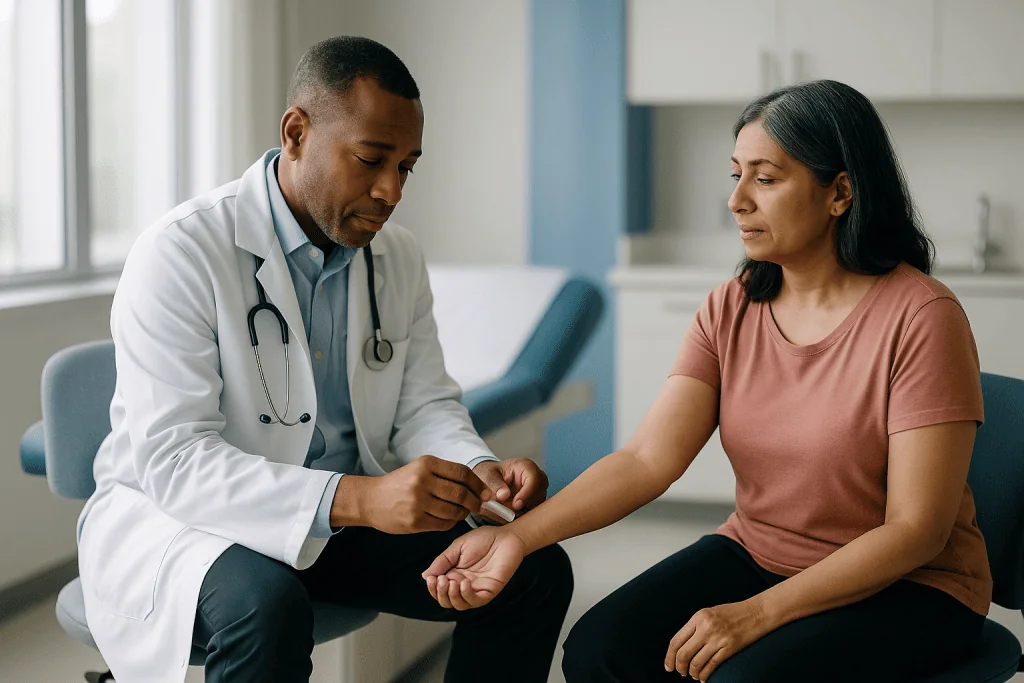
The tuberculin skin test, often called a TST or Mantoux test, places a tiny amount of purified protein just under the skin of the forearm. You return 48 to 72 hours later, per CDC guidance, so a trained reader can measure any firm raised swelling (induration). Redness alone does not count. The cutoff for a positive result varies with your risk: a smaller swelling counts as positive in a recent household contact than in a person with no exposure.
The blood test, called an interferon-gamma release assay (IGRA), measures how immune cells in a blood sample respond to TB proteins. One visit, one blood draw, results within a few days. Because IGRAs use proteins absent from the BCG vaccine strain, they are less likely to give a false positive in people vaccinated abroad, which is why many US clinics prefer them for adults with a BCG history.
| Feature | Skin test (TST) | Blood test (IGRA) |
|---|---|---|
| Visits needed | Two (placement, then reading at 48–72 hours) | One blood draw |
| Affected by prior BCG vaccine | Yes, can cause a false positive | Generally no |
| Commonly used for | Children under 5 | Adults, especially with BCG history |
| Distinguishes latent from active TB | No | No |
| Next step if positive | Symptom review and chest X-ray | Symptom review and chest X-ray |
Which one you receive depends on age, vaccine history, local availability and clinician judgment. If either result is positive, a chest X-ray checks for changes in the lungs; if the X-ray is abnormal or you have symptoms, sputum goes to the laboratory. Only that full sequence separates infection from disease.
Why your test may be repeated 8–10 weeks later
A negative test soon after exposure is welcome news, but it is not the final word. The immune system needs time to build the response that either test detects. According to the CDC, that window can last up to eight to ten weeks after the last day you shared air with the person while they were infectious. A test taken inside that window can be negative even when the bacteria have already taken hold.
The standard approach is therefore two tests. The first is done as soon as the contact investigation reaches you, mainly to find people who were infected some time ago and may already have disease. The second is scheduled roughly 8–10 weeks after your last exposure. If the person you live with is still infectious, that clock starts when the care team declares them no longer infectious, not from the day of diagnosis.
A first negative that turns positive on the second test is called a conversion. It signals a recent infection, which matters because the chance of progressing to disease is highest in the years right after infection. People who convert are usually offered preventive treatment; adults whose second test is also negative are generally considered uninfected, and their follow-up ends there.
Children under five and people with weakened immune systems are the exception to waiting. Their tests are less reliable and their risk higher, so clinicians often begin preventive medicine after a negative first test and decide at the second test whether to continue. Between the two tests, carry on with normal life unless you develop symptoms, and keep the second appointment even if you feel entirely well. It is the appointment people most often skip, and the one most likely to change a plan.
What a positive test means: latent infection, not TB disease
A positive result on a skin or blood test, together with a normal chest X-ray and no symptoms, adds up to a diagnosis of latent TB infection. The words are worth unpacking. The bacteria are alive but held in check, sealed inside small clusters of immune cells in the lungs. You feel nothing, you cannot pass the infection to anyone, and you can go to work, hug your children and share meals exactly as before.
You are also in enormous company. The WHO estimates that about a quarter of the world’s population carries this kind of infection. For most, it stays quiet for life. The WHO also puts the lifetime risk of latent infection progressing to active TB disease at roughly 5 to 10 percent, with the odds higher for people with HIV, diabetes, undernutrition or immune-suppressing treatment, and higher in the first years after infection.
Active TB disease is the other outcome, and the reason screening exists. Here the bacteria multiply, damage tissue, and produce symptoms such as a cough lasting weeks, fever, drenching night sweats and weight loss. Disease in the lungs is contagious; latent infection is not. Treatment for the two conditions differs sharply, which is why the chest X-ray and symptom review after a positive test are not optional extras.
Two practical points follow. A positive test will usually stay positive for life, even after preventive treatment, so keep a record of the result and tell future clinicians; repeating the test later adds nothing. And a positive test in a household member does not tell you who infected whom or when. Contact investigations sometimes find that infection happened years earlier and only came to light because of the current diagnosis.
Who is usually offered preventive treatment, and who is asked to wait
Preventive treatment, sometimes called treatment for latent TB infection, aims to clear the dormant bacteria before they have a chance to cause disease. Because there are far fewer bacteria than in active disease, it uses fewer medicines for a shorter time. The CDC lists several rifamycin-based regimens lasting three to four months, alongside older regimens lasting six to nine months, and describes the shorter courses as easier to complete. The choice, schedule and monitoring are decisions for the prescribing clinician, weighed against your liver health, other medicines and preferences.
The people usually offered it are those most likely to progress: household contacts with a newly positive test, children under five who were exposed even if their test is negative, anyone living with HIV, people on immune-suppressing medicines such as those used after transplants or for autoimmune disease, and people whose test converted from negative to positive.
Others are usually asked to wait, for good reasons rather than neglect. Anyone with symptoms or an abnormal chest X-ray must first be fully evaluated for active disease, because treating disease with a latent-infection regimen can breed resistance. Adults with a negative first test typically wait for the second test at 8–10 weeks. Clinicians may defer treatment in pregnancy until after delivery unless the risk of progression is high, and may pause or adjust plans for people with significant liver disease or heavy alcohol use.
Declining is also an option that some people choose after weighing the small but real chance of side effects against their own risk of progression. What no guideline supports is drifting: neither starting nor formally deciding. If you are offered preventive treatment, ask what your personal risk of progression is thought to be, what monitoring is involved, and how missed days would be handled.
Living with someone with tuberculosis: everyday precautions during the infectious weeks
For the weeks before the care team confirms the person is no longer infectious, the goal is simple: move less contaminated air into the lungs of the other people in the house. Nothing on this list requires special equipment.
- Open the windows. Cross-ventilation, even a few inches on opposite sides of a room, dilutes airborne particles far faster than a closed room. A fan placed in a window blowing outward helps in cold weather.
- Give the patient their own room. A separate bedroom with the door closed and the window open is the single most protective arrangement. Where that is impossible, maximize distance and airflow.
- Cover every cough. Coughing into a tissue, sealing it in a bag, then washing hands cuts the particles released. A surgical-type mask worn by the patient when others are in the room adds a layer. Caregivers who must spend prolonged time close by are sometimes advised by the health department to wear a fitted respirator; ask rather than guess.
- Pause visitors. Especially young children, older relatives and anyone with a weakened immune system, who are least able to fight off a new infection.
- Keep the patient home. No work, school, worship services, shops or public transportation until clinically cleared.
Equally useful is knowing what you can stop worrying about. Dishes, cutlery, laundry and bathrooms need no special treatment beyond ordinary cleaning, because TB does not spread by surfaces. Pets are not a route of household transmission. You do not need to wear a mask while alone in another room, and you do not need to throw away the patient’s belongings.
Isolation is hard on the person inside it. Phone calls through the door, meals left on a tray with a note, and a shared show watched on separate screens all preserve the connection that makes finishing months of treatment easier.
Children, pregnancy and weakened immunity: when the household needs faster action
Age and immune strength change the arithmetic of exposure. A healthy adult who inhales TB bacteria most often develops latent infection and nothing more. A toddler who inhales the same bacteria can progress within weeks to disease, including forms that spread through the bloodstream or reach the lining of the brain. That is why the CDC treats children under five in a household with TB as a priority group to evaluate within days.
Young children also test less reliably; their immune systems can fail to produce a measurable response even when infected. Clinicians therefore rely more on careful examination and chest X-ray, and commonly begin preventive medicine before the second test, stopping it only if the repeat test at 8–10 weeks stays negative and the child is well. Parents often find this sequence confusing, since it can mean medicine for a child who never tests positive. The logic is that the cost of waiting is higher for a small child than the cost of a short course that turns out to be unnecessary.
Pregnancy does not prevent evaluation. Both the skin test and the blood test are considered safe in pregnancy, and a chest X-ray with abdominal shielding is regarded as acceptable when needed. Whether to treat latent infection during pregnancy or after delivery is decided case by case with the obstetric and TB teams together.
Anyone in the home living with HIV, receiving chemotherapy, taking biologic medicines for arthritis or inflammatory bowel disease, on dialysis, or recovering from a transplant should tell both their own specialist and the health department at once. These conditions raise the chance that infection becomes disease and may change which test and which follow-up schedule are used. Speed here is not alarmism; it is the standard of care.
What the next weeks usually look like for the household
Every household’s path differs, but the shape is familiar enough to sketch. The ranges below are typical and come from NHS, WHO and CDC guidance; your care team’s schedule takes precedence.
The first days. The person with TB begins a combination of medicines and is asked to stay home. The health department opens a contact investigation and reaches household members, usually within a week or two. Children under five and immunocompromised adults are seen first; others receive a symptom check and a first skin or blood test.
Weeks two to four. The patient’s cough typically eases. The NHS notes that most people are no longer infectious after about two weeks of treatment, but the care team confirms this with sputum tests before lifting isolation. Household members with a positive first test have a chest X-ray and, if it is normal, a conversation about preventive treatment.
Weeks eight to ten. Contacts whose first test was negative return for the repeat test, timed from the last infectious exposure. Adults who remain negative are usually discharged from follow-up. Children who started preventive medicine on a negative test are reassessed.
Months two to six. The patient continues treatment with regular check-ins for side effects and adherence. The NHS describes a standard course of about six months for TB that responds to the usual medicines; the WHO notes that some newer regimens run four months. Contacts on preventive treatment complete their three- to four-month or longer course, depending on the regimen chosen.
After treatment. The care team confirms completion. Household members do not need lifelong testing. If the same person develops TB again years later, or a new case appears in the home, the process begins afresh. Between those events, the household simply lives.
Supporting the person taking TB medicines
TB treatment relies on several antibiotics taken together for months, and the reason for both the combination and the duration is biological. The bacteria divide slowly, and some sit dormant in low-oxygen pockets of the lung, so a short course kills the active ones and leaves survivors. Using several medicines that attack different parts of the bacterium’s machinery makes it far less likely that a resistant strain emerges. Stopping early, or skipping days, is how drug-resistant TB is created, which is why programs put so much effort into support for completion.
Some effects are expected and harmless. One first-line medicine, rifampin, turns urine, sweat and tears orange and can permanently stain soft contact lenses. Others deserve prompt attention: nausea that will not settle, yellowing of the skin or eyes, dark urine, unexplained rash, tingling in the hands or feet, or a change in color vision. The prescribing clinician, not the household, decides whether any medicine is adjusted; encourage the person to call the clinic rather than pause on their own.
Many programs offer directly observed therapy, in which a health worker watches each dose taken, either in person or by video. It is not a sign of distrust. It is a proven way to keep a long course on track, and it gives the patient a regular check-in for problems.
The household’s job is quieter. Alcohol stresses a liver that is already processing these medicines; a home where nobody drinks for a few months removes a temptation. Regular meals help with nausea. A shared phone alarm, a pillbox filled together each week, and a calendar with visits marked turn a solitary burden into a family project. Ask before helping with the pillbox, though; some people need to own the routine themselves.
What people often get wrong about living with someone with tuberculosis
“We need separate dishes and bleach for everything.” TB rides on air, not objects. The CDC is explicit that sharing utensils, bedding or bathrooms does not transmit it. Ordinary washing is enough.
“I had the BCG vaccine, so I’m protected.” BCG mainly protects young children against severe forms of TB. Its protection against lung TB in adults is partial and fades over time. A BCG history does not exempt anyone from screening; it simply nudges clinicians toward the blood test.
“A positive test means I have TB.” A positive skin or blood test means infection, which in most people is latent, silent and not contagious. Disease is a separate diagnosis made with a chest X-ray, symptoms and sputum tests.
“Healthy people don’t catch it.” Anyone can inhale the bacteria. Good health makes it more likely that the infection stays latent, not that it never happens.
“Once my relative feels better, they’re safe to be around.” Feeling better often arrives before infectiousness ends. The care team uses sputum results and treatment duration, not mood or energy, to lift isolation.
“TB only happens in other countries.” The WHO reports millions of new cases worldwide each year, and CDC surveillance records thousands in the United States. It is uncommon here, not absent.
“Someone treated for TB will always be contagious.” After completing treatment, a person is not infectious and does not need to be avoided at work or in the family.
“Vitamins or herbal remedies can clear the infection.” No supplement has been shown to treat TB infection or disease. Good nutrition supports recovery alongside prescribed medicines; it does not replace them.
The thread running through these myths is the same: they confuse people with air, and infection with disease. Keep those two pairs straight and most household anxieties dissolve.
Questions to ask your care team
Bring a written list to the first conversation with the health department or the clinic. The answers will differ by household, which is exactly why they are worth asking.
- Which period is my family member thought to have been infectious, and when will you reassess whether that period has ended?
- Who in our home should be tested, in what order, and how quickly will children or anyone with a weakened immune system be seen?
- Will we have a skin test or a blood test, and why that choice for each of us?
- When exactly should our repeat test happen, counting from which day?
- If one of us tests positive, what happens next and how soon?
- Is our relative’s TB drug-susceptible or drug-resistant, and does that change how contacts are managed?
- Do any of us need a respirator, or are ventilation and distance sufficient in our particular home?
- How should we handle a shared bedroom or a one-room apartment?
- What should our relative do about work, and is there paperwork the health department can provide for an employer or school?
- If a household member is offered preventive treatment, what is their estimated risk of progression without it, and what monitoring is planned?
- Which side effects should prompt a same-day call, and to whom?
- Is directly observed therapy available, and can it be done by video?
- Who is our single point of contact if something changes, including evenings and weekends?
Write the answers down. Contact investigations involve several people over several months, and a notebook that travels with the family prevents the same question being asked three times and answered three ways. If an answer is unclear, ask for it to be repeated in plainer words; that is a normal request, not a difficult one, and TB programs field it every day.
When to call your doctor
Most household contacts of a person with TB will never develop disease, and most people on treatment finish it without serious trouble. The following signs are the exceptions that need a prompt call to the clinic or health department, not a wait-and-see approach.
For any household member, call the same day if you notice:
- a cough that has lasted more than three weeks, or any cough that produces blood;
- fever, drenching night sweats or unexplained weight loss;
- chest pain that worsens with breathing, or new shortness of breath;
- in a young child: persistent fever, poor feeding, unusual drowsiness or irritability, or a swelling in the neck.
For the person taking TB medicines, call before the next dose if there is:
- yellowing of the skin or whites of the eyes, dark urine, or pain under the right ribs;
- vomiting that prevents medicine from staying down, or persistent nausea and loss of appetite;
- a spreading rash, easy bruising or bleeding;
- numbness or tingling in the feet or hands, or any change in vision or color perception;
- a missed dose, or several, so the team can advise rather than the person guessing.
Seek emergency care immediately for coughing up more than a small amount of blood, severe breathing difficulty, confusion, a severe headache with a stiff neck, or a seizure. These are rare but time-critical.
None of these signs is a diagnosis. They are reasons for a trained person to look, and looking early is what turns a serious illness into a treatable one. When in doubt, call; TB programs are used to questions and would far rather hear from a worried household than miss an early change.
Frequently asked questions
How long is TB contagious after treatment starts?
Most people with TB in the lungs are no longer infectious after about two weeks of effective treatment, according to NHS guidance. That figure is a typical range, not a fixed day. The care team confirms it using symptom improvement, uninterrupted treatment and laboratory tests on sputum. Drug-resistant TB or interrupted treatment can extend the infectious period, so isolation ends only when clinicians say so.
Is tuberculosis contagious at home if my relative only has TB in the lymph nodes?
Generally no. TB that affects only lymph nodes, bones, kidneys or other organs outside the lungs and airways is not spread through the air, so household members are usually not at risk from it. The care team will still check whether the lungs are involved, because some people have both forms. Extrapulmonary TB needs full treatment for the patient’s sake, but it rarely triggers the same household precautions.
Can I still go to work while my household member is being treated?
Usually yes, if you have no symptoms. Household contacts are not themselves contagious unless they have developed active TB disease, which is what the screening is designed to detect. Latent infection cannot be passed to coworkers. You can continue working, commuting and socializing while awaiting or after your test, and simply report any cough lasting more than three weeks, fever or night sweats to the health department promptly.
Do I need to be tested if I feel completely well?
Yes. The purpose of contact screening is to find infection before it becomes illness, and latent TB infection has no symptoms at all. Feeling well tells you nothing about whether the bacteria are present. Household contacts are typically tested soon after the diagnosis and again 8–10 weeks after their last exposure, per CDC guidance. Both appointments matter, and the second is the one people most often skip.
What does a positive latent TB infection test mean for my job or travel?
A diagnosis of latent TB infection is not contagious and does not restrict work, school or travel. You will not be asked to isolate. Some employers in health care ask about TB test results; a documented positive test with a normal chest X-ray and, where applicable, completed preventive treatment is the record you will want to keep. Future tests will likely remain positive, so retesting is not useful.
Should our children be kept out of school?
Children who have been exposed should be evaluated quickly, and the health department will advise on school attendance based on each child’s test results and examination. A child with latent infection is not contagious and can attend school. A child with suspected active disease stays home until the care team clears them. The person with TB, not the exposed children, is the one who must stay home during the infectious period.
Does the BCG vaccine mean I'll test positive?
It can, on the skin test. BCG vaccination, common in many countries outside the United States, sometimes produces a false-positive tuberculin skin test years later. The blood test (IGRA) is not affected by BCG, which is why clinicians often choose it for adults with a vaccine history. A positive result in a recent household contact is taken seriously regardless of BCG, and the follow-up chest X-ray is the same.
Should the whole family wear masks at home?
Not all the time. The most effective mask is the one worn by the person with TB when others are in the room, because it traps particles at the source. Household members do not need masks while in separate rooms with good ventilation. Caregivers who spend prolonged, close time with the patient during the infectious period may be advised by the health department to wear a fitted respirator; ask for specific guidance.
Can we share a bedroom if our apartment has only one room?
Tell the health department about the layout; they encounter this often. Practical steps include keeping windows open, using a fan to move air outward, having the patient wear a mask whenever others are present, and placing beds as far apart as possible. Some programs can arrange temporary alternative accommodation during the infectious weeks. The exposure that matters most usually happened before diagnosis, so these measures aim to limit further dose.
What happens if a household member refuses TB contact screening?
Health departments cannot force testing in most circumstances, but they will explain why it matters and keep the offer open. An untested contact who develops symptoms should seek evaluation immediately, both for their own health and because active disease would be contagious to others. Children and immunocompromised people in the home are the strongest reason to accept screening. Confidentiality is protected, and results are not shared with the patient or other contacts.
References
This article is for general information only and is not a substitute for professional medical advice. Please consult a qualified doctor about your individual situation.

More from the Blog

Dengue Recovery Timeline: The Fever Phase, the Critical Window and When Strength Returns
Dengue usually follows three phases. A fever of 2 to 7 days comes first, then a critical window of roughly 24 to 48 hours…

Antibiotic Side Effects: The Common, the Rare and How to Protect Your Gut
Antibiotics side effects are usually mild and digestive: loose stools, nausea, bloating or a yeast infection, affecting roughly one in five people. Rarer problems…
Sun Poisoning: When Sunburn Becomes a Medical Problem
Sun poisoning is an informal name for a severe sunburn, or occasionally a sun-triggered rash, that produces whole-body symptoms: widespread blistering, fever, chills, headache,…
Malaria Treatment During Pregnancy: Why the Plan Differs and How Mother and Baby Are Monitored
Malaria treatment in pregnancy differs because the parasite can lodge in the placenta, the mother is more prone to severe illness and low blood…

Pneumonia and Tdap Boosters: The Adult Vaccines Most People Forget
Adults need a Tdap booster, or a Td booster, every 10 years, with Tdap given during each pregnancy, ideally between 27 and 36 weeks.…

Travelers’ Diarrhea: Prevention, Treatment and the Antibiotic Question
Travelers' diarrhea is a food- and water-borne gut infection, usually bacterial, that affects roughly 30 to 70 percent of people visiting high-risk regions. Most…