

When Bad Breath Needs a Dentist: Halitosis That Outlasts Brushing and Mouthwash

Key Takeaways
- Most persistent bad breath originates in the mouth, from bacteria producing sulfur gases in places a toothbrush and rinse cannot reach, such as gum pockets and the back of the tongue.
- The NHS advises seeing a dentist when odor has not improved despite brushing twice daily, cleaning between the teeth and cleaning the tongue.
- Gum disease is often painless until advanced, so clean-looking teeth and no pain do not rule it out as the source of odor.
- Mouthwash masks odor and can temporarily reduce bacteria, but it cannot remove tartar, repair a cracked filling or shrink a gum pocket.
- A healthy dental examination is useful information: it redirects the search toward sinus, reflux, dry mouth, medicines or, rarely, systemic illness.
- Bleeding when you begin interdental cleaning is common for the first week or so and tends to settle as gum inflammation falls; bleeding that persists warrants a dental check.
Bad breath that persists for more than a couple of weeks despite brushing twice a day, cleaning between teeth and cleaning the tongue is a reason to see a dentist. Most persistent halitosis starts in the mouth, often from gum disease, tongue coating, decay or dry mouth, so a dental examination is usually the first step before other causes are considered.
You have tried everything the drugstore aisle offers. A new toothbrush, mint-flavored floss, a mouthwash that stings like it means business. For about twenty minutes afterward your breath is fine. Then it drifts back, and a colleague leans away mid-conversation, and you wonder whether you imagined it.
That quiet uncertainty is the hardest part of halitosis. Nobody wants to ask a friend to check, and the person with the problem is often the last to notice, because the nose adapts to its own surroundings within minutes. So people stock up on mints and hope.
Here is the useful question, the one behind every search for bad breath when to see dentist: if hygiene is good and the smell still outlasts brushing and mouthwash, what is producing it, and who is best placed to find out? For most people the honest answer sits in the mouth itself, and a dentist is usually the right first stop.
What actually produces bad breath that outlasts brushing and mouthwash?
Halitosis is the clinical term for breath odor that other people can notice. The smell itself is mostly chemistry. Bacteria living in the mouth break down proteins from food debris, dead cells and saliva, and in doing so release volatile sulfur compounds, gases such as hydrogen sulfide that smell like rotten eggs. Those gases are what another person detects, not the bacteria themselves.
Where the bacteria sit matters more than how many there are. Mouthwash and a toothbrush reach the smooth surfaces of the teeth easily, so a rinse does buy a short window of fresher breath. The trouble is the places a rinse cannot stay long enough to work: the deep grooves at the back of the tongue, the pockets between gum and tooth that open up in gum disease, the gaps under a loose filling or an ill-fitting denture, and the pits of the tonsils. Bacteria in these sheltered spots live in a film, a sticky layer that resists being washed away, and they keep producing gas around the clock.
Saliva is the mouth’s own cleaning system. It rinses debris, neutralizes acid and carries antibacterial proteins. When flow drops, overnight, during stress, after certain medicines or in dehydration, odor rises. That is why morning breath is almost universal and why it fades after breakfast and a drink of water. Mayo Clinic and the NHS both list dry mouth among the common contributors.
So the pattern to notice is simple. Breath that is only unpleasant on waking, or after coffee, garlic or a long meeting without water, is ordinary physiology. Breath that returns within an hour of thorough brushing, day after day, suggests a sheltered source that home tools are not reaching. That is a dental question, not a hygiene failure.
Bad breath: when to see a dentist rather than wait it out
The NHS advice is refreshingly plain: see a dentist if bad breath has not improved after you have been brushing, cleaning between your teeth and cleaning your tongue properly. Mayo Clinic frames it similarly, suggesting a dental review when self-care has not helped, and a medical review if the dentist finds the mouth healthy.

A sensible personal benchmark is two to three weeks of genuinely thorough care. That means brushing twice a day for about two minutes with a fluoride toothpaste, cleaning between the teeth once a day, cleaning the tongue, drinking water through the day and, if you smoke, noticing how much of the smell belongs to tobacco. If the odor is clearly better by the end of that period, you have your answer. If it is not, booking a dental appointment is the next step, not another month of experimenting with rinses.
Some situations justify going sooner. Gums that bleed when you brush, a tooth that aches or is sensitive to hot and cold, a bad taste that sits in one spot, a loose tooth, or a denture that no longer fits snugly are all signs that the breath problem has a structural cause that will not resolve on its own. Gum disease in particular is progressive: the NIH’s dental institute describes how plaque left along the gumline hardens into tartar, which only a professional cleaning can remove, and how untreated gum inflammation can advance to loss of the bone supporting the teeth.
There is also a quieter reason not to wait. Persistent halitosis erodes confidence in a way people rarely admit to. Finding the cause tends to be far less uncomfortable than years of wondering.
Persistent bad breath causes a dentist looks for first
When a dentist examines a mouth for halitosis, a short list of usual suspects is checked in rough order of likelihood. These overlap with the most common dental problems people ask about, which is no coincidence.
Gum disease comes first. In its early stage, gingivitis, plaque along the gumline inflames the gums so they look red and bleed easily. In the later stage, periodontitis, the gum detaches from the tooth and forms a pocket that traps bacteria out of reach of a brush. Pockets are measured with a fine probe, and deeper pockets correlate with stronger odor. The NIH dental institute notes that gum disease is a leading cause of adult tooth loss, and persistent bad breath is one of its recognized signs.
Tongue coating is second. The back third of the tongue carries a dense bacterial film that a toothbrush rarely touches. Dentists can usually see the coating directly.
Decay and failing dental work come next. A cavity, a cracked filling or a crown with a gap underneath creates a food trap that putrefies. Dentures that are not removed and cleaned nightly, or that no longer fit, do the same job.
Dry mouth, clinically called xerostomia, is assessed by asking about thirst, difficulty swallowing dry food and medicines that reduce saliva. Mayo Clinic lists several medication groups, including some used for blood pressure, mood and allergies, among the contributors, though the prescriber decides whether any change is appropriate.
Finally the dentist looks at the throat for tonsil stones, small calcified clumps in the tonsil crypts that smell strongly, and at the soft tissues for ulcers, infection or anything unusual that needs a referral. Each of these has a specific treatment, which is why guessing at home so often fails.
Bad breath despite brushing: why technique and tools matter more than products
Many people who say they brush twice a day are brushing for about forty seconds, pressing hard on the front teeth and skimming the molars. The breath problem is not laziness; it is geometry. The smelliest zones are the ones hardest to reach.
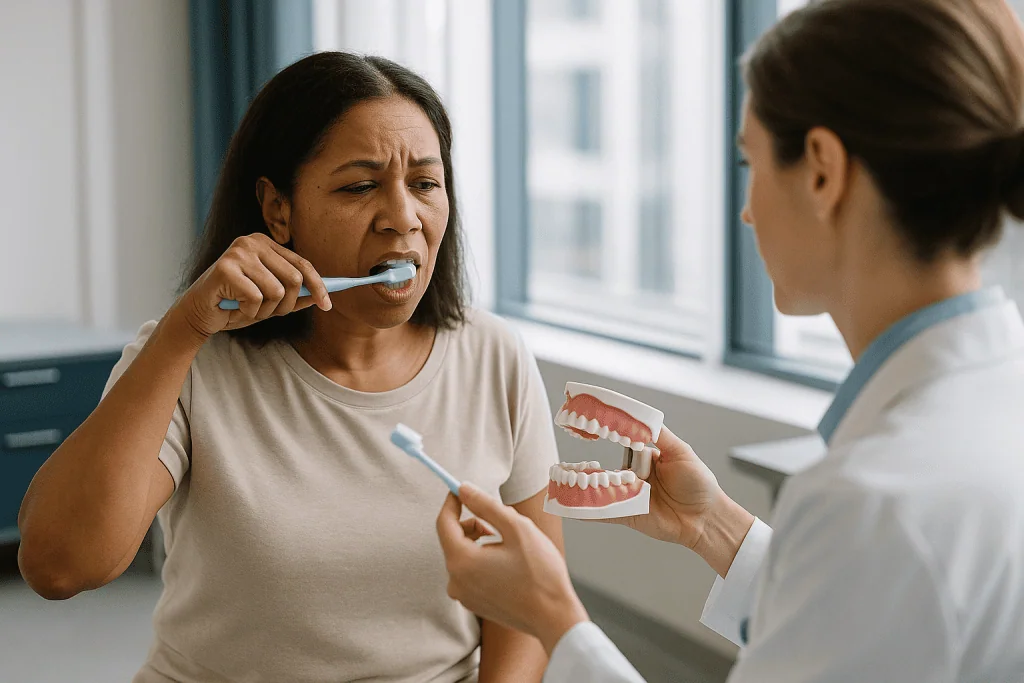
Start with the gumline. Angling the bristles toward where tooth meets gum, and using small movements rather than long scrubbing strokes, disturbs the plaque that feeds gingivitis. A soft brush does this without damaging the gum. Electric or manual is a personal choice; the NHS considers both effective when used properly.
Cleaning between the teeth is the step most often skipped. Floss or small interdental brushes reach the surfaces a toothbrush cannot, which is where much of the sulfur production happens. Bleeding during the first week or so of regular interdental cleaning is common when the gums are inflamed and tends to settle as inflammation falls; bleeding that continues beyond that deserves a dental check rather than abandonment of the habit.
Then the tongue. Gently brushing or scraping from back to front removes the coating that mouthwash only perfumes. Gagging eases with practice and with a scraper rather than a brush head.
Timing matters too. Brushing last thing at night, after the final snack, means bacteria have less to feed on overnight when saliva is at its lowest. Rinsing with water after meals, chewing sugar-free gum to stimulate saliva, and keeping dentures out of the mouth at night and clean all help.
If all of this is in place for several weeks and the odor remains, the problem is almost certainly in a place technique cannot reach. That is the point at which a dental examination stops being optional and becomes efficient.
How to tell if you have bad breath when nobody will say
Cupping your hands and exhaling tells you almost nothing, because your nose has already adapted to the smell of your own mouth. There are better ways, each imperfect, and together they give a reasonable picture.
The floss test is the most informative. Run floss between the back molars, wait a moment and smell it. The odor on the floss is close to what others detect at conversational distance. A clean wrist licked, left to dry for a few seconds and then sniffed gives a similar reading from the tongue.
A dry, pale coating on the back of the tongue when you look in the mirror under good light is suggestive. So is a persistent metallic or sour taste, or a feeling that your mouth is sticky and your saliva thick.
Asking someone you trust remains the gold standard, awkward as it is. Phrase it as a favor rather than a confession, and ask them to be honest rather than kind. Partners usually already know.
What none of these tests can do is tell you why. Bad breath has roughly the same smell whether it comes from a gum pocket, a tonsil stone or a sinus infection, which is why the question of source belongs with a clinician.
One caution worth stating clearly. Some people become convinced they have severe halitosis when others cannot detect any odor at all, a pattern sometimes called halitophobia. Mayo Clinic notes that this distress is real even when the breath is not. A dentist can assess odor objectively, and if the mouth is healthy and no smell is found, that reassurance is itself a legitimate outcome of the visit, not a dismissal.
What happens at a dentist appointment for halitosis
The first part of the visit is a conversation, and it tends to be more detailed than people expect. The dentist will ask when the odor is worst, how long it has been going on, what you have tried, whether you breathe through your mouth, how much water you drink, what medicines you take, whether you smoke, and whether you have reflux, sinus problems, diabetes or recent weight-loss dieting. Each answer narrows the list.
The examination follows. Teeth are checked for decay and failing restorations. The gums are inspected for color, swelling and bleeding, and a periodontal probe, a thin ruled instrument, is slid gently into the space between gum and tooth to measure pocket depth around each tooth. Healthy pockets are shallow; deeper readings with bleeding suggest periodontitis. The tongue, palate, throat and inside of the cheeks are examined. Dentures are removed and inspected.
X-rays are taken if decay between teeth or bone loss around roots is suspected, since neither is reliably visible to the eye.
Some practices assess odor directly. The simplest method is the clinician smelling the exhaled breath at a set distance; a few use instruments that detect sulfur compounds. Neither is essential for a diagnosis in most cases.
By the end of the appointment the dentist will usually be able to say one of three things: a dental cause has been found and here is the plan; the mouth looks healthy and the cause is probably elsewhere, so a medical review is advised; or the picture is mixed and treatment of the dental findings should come first before deciding. Honest uncertainty is a perfectly acceptable answer at this stage. The cleaning and treatment that follow are themselves a test.
Halitosis treatment a dentist can offer, compared with what you can do at home
Treatment depends entirely on what was found, which is the whole point of the examination. The table summarizes the main sources of persistent odor, what home care achieves and what professional treatment adds. None of the professional options is a guarantee; each addresses a specific cause and is reassessed afterward.
| Likely source | What home care can do | What a dentist typically adds |
|---|---|---|
| Gingivitis (early gum inflammation) | Thorough brushing at the gumline and daily interdental cleaning often reverse it | Professional cleaning to remove hardened tartar; coaching on technique |
| Periodontitis (gum pockets, bone loss) | Cannot reach into pockets; maintains gains after treatment | Deep cleaning below the gumline (scaling and root planing), sometimes in stages; periodontal referral for advanced cases |
| Tongue coating | Daily tongue cleaning from back to front | Confirms coating is the source; rules out other tongue changes |
| Decay, cracked fillings, open crown margins | None; traps persist until repaired | Restoration or replacement of the failing work |
| Dry mouth | Water, sugar-free gum, nasal breathing | Reviews medicines with the prescriber; may suggest saliva substitutes; monitors for decay risk |
| Dentures | Nightly removal and cleaning | Adjusts or remakes a poor fit |
| Tonsil stones, sinus, reflux, systemic illness | Hygiene helps little | Refers to a physician or ear, nose and throat specialist |
Antibacterial mouth rinses, some containing chlorhexidine or other agents, are sometimes recommended for a limited period as part of gum treatment. They work by reducing bacterial load, not by fixing the underlying trap, and prolonged use of some can stain teeth and alter taste, so the dentist decides whether and for how long one is appropriate. Breath-freshening products sold for daily use are cosmetic; the NHS notes they mask odor rather than remove its cause.
Bad breath when to see dentist: who is usually seen quickly and who is usually asked to wait
Dentists triage halitosis like any other complaint, and knowing where you fall on that spectrum helps you book the right kind of appointment.
People who are usually seen promptly include anyone with bleeding or swollen gums, pain, a loose tooth, a broken filling or crown, a denture sore, a persistent bad taste localized to one area, or a lump, ulcer or white or red patch in the mouth that has lasted more than three weeks. The NHS advises prompt assessment for mouth ulcers or patches of that duration because, although most are harmless, a small number need investigation. Smokers with persistent odor, people with diabetes, and anyone whose gum disease has previously been diagnosed also belong in this group, because their risk of progression is higher.
People who are often reasonably asked to try self-care first, for two to three weeks, are those with no pain, no bleeding, no visible dental problem and a short history of odor that may track with a recent change: a new medicine, a low-carbohydrate diet, a cold, a period of mouth breathing or heavy coffee intake. If the odor settles, no appointment is needed beyond the routine check-up. If it does not, the earlier triage applies.
Children are a special case. Bad breath in a child most often comes from a tongue coating, mouth breathing from blocked nasal passages, or early decay, and occasionally from a foreign object lodged in the nose, which produces a distinctive one-sided smell. Any persistent odor in a child warrants a dental check, and the common question of whether age three is too late for a first visit has a clear answer: it is not too late, though most guidance favors a first visit by the first birthday, so booking now is the right move.
When bad breath is not a dental problem at all
Mayo Clinic estimates that the great majority of halitosis originates in the mouth, but the minority that does not is worth understanding, because it explains why a healthy dental examination is useful information rather than a dead end.
The nose and sinuses are the next most common source. Chronic sinus infection, post-nasal drip and nasal polyps allow mucus and bacteria to collect at the back of the throat, producing an odor that brushing cannot touch. The tonsils can harbor stones, as described earlier.
Acid reflux brings stomach contents up the esophagus, and the resulting odor is often sour rather than sulfurous. Some digestive conditions can contribute in the same way.
Systemic illness occasionally announces itself through the breath. Uncontrolled diabetes can produce a sweet or fruity smell from ketones, the same chemistry that gives dieters on very low-carbohydrate plans a temporary odor. Advanced kidney disease can give a fishy or ammonia-like smell, and liver disease a musty one. These are uncommon causes of halitosis and almost never the first sign of the illness, but a dentist who finds nothing in the mouth will ask about them and suggest a medical review.
Medicines deserve a separate mention. Many reduce saliva as a side effect, and a few are broken down into compounds excreted through the lungs. If the dentist suspects a medicine is contributing, the correct step is a conversation with the prescriber about alternatives or saliva support. Stopping or adjusting a prescribed medicine on your own because of breath odor is never advisable.
Tobacco, in all its forms, both smells and dries the mouth and worsens gum disease. It sits in a category of its own: entirely modifiable, and rarely improved by anything other than stopping.
What the first weeks after treatment usually look like
Halitosis does not switch off the day of a cleaning, and expecting it to leads to needless discouragement. The timeline depends on the cause, but some patterns are typical.
After a professional cleaning for gingivitis, gums are often tender for a day or two and may bleed slightly when brushed. As the inflammation settles, usually over the following one to two weeks with consistent home care, bleeding reduces and the gum tightens around the tooth. Odor tends to improve in step with the bleeding.
Deep cleaning for periodontitis is more involved. It is frequently done in stages across two or more appointments, often with local anesthetic. Sensitivity to cold afterward is common and generally eases over weeks. The dentist usually reviews pocket depths again after several weeks to months, because that is how long gum tissue takes to reattach. Breath odor from deep pockets can lag behind, and some pockets may need further treatment or referral.
Repairing decay or failing dental work removes a food trap immediately, so improvement from that source is quick once the restoration is placed.
Where dry mouth is the driver, improvement follows saliva: more water, nasal breathing, sugar-free gum, and a medication review with the prescriber if one is relevant. This can take several weeks to notice.
Through all of this the home routine carries most of the weight. A professional cleaning resets the mouth; daily brushing, interdental cleaning and tongue cleaning keep it reset. Dentists often ask for a follow-up visit in a few months specifically to check that the odor has stayed away, and to catch early relapse, which is common in people who return to old habits once the problem feels solved.
Would a dentist tell you if you have halitosis?
Usually yes, if you ask. Many will not raise it unprompted. The reasons are human rather than clinical: some dentists worry about embarrassing a patient, some assume the patient already knows, and routine check-ups are short enough that unless breath odor is pronounced it may not come up.
That silence can be misread as reassurance. A patient leaves a check-up thinking that if there were a problem the dentist would have said so, when in fact the dentist focused on decay and gum health and said nothing about breath because it was not the stated reason for the visit.
The remedy is to make it the stated reason. Saying at the start of the appointment, plainly, that you are concerned about persistent bad breath and would like an honest assessment changes the whole visit. The dentist can then smell the breath deliberately, probe the gums with odor in mind, look at the tongue and tonsils, and ask the questions about diet, medicines and nasal symptoms that would otherwise go unasked.
Dental hygienists are often the most candid source. They spend longer in the mouth, see the tongue coating and bleeding points at close range, and routinely coach on technique. Asking a hygienist directly whether they noticed odor and where it seemed to come from is a reasonable and welcome question.
If you are told the mouth is healthy and no odor is detectable, take that seriously. Objective assessment by someone trained to notice is far more reliable than your own perception, and persistent conviction of an odor that others cannot detect is itself something a clinician can help with, sometimes with a referral to a physician rather than more dental treatment.
What people often get wrong about bad breath
Myths about halitosis are stubborn, partly because the subject is embarrassing enough that few people compare notes. Several deserve direct correction.
The first is that bad breath comes from the stomach. In the overwhelming majority of cases it does not; the esophagus is normally closed between swallows, and odor from the digestive tract is rare outside reflux. Mayo Clinic, the NHS and Cleveland Clinic all identify the mouth as the primary source. Probiotics and digestive supplements marketed for breath have no reliable evidence behind them.
The second is that stronger mouthwash means better results. Rinses mask odor for a short period and some reduce bacteria temporarily, but no rinse removes tartar, repairs a cracked filling or shrinks a gum pocket. Alcohol-containing rinses can also dry the mouth, which over time may make odor worse. The NHS specifically notes that mouthwash is not a substitute for brushing and interdental cleaning.
The third is that if your teeth look white and feel clean, your mouth is healthy. Gum disease is often painless until advanced, and the back of the tongue is invisible without effort.
The fourth is that halitosis is a hygiene failure that reflects on character. Some of the most fastidious brushers have the worst breath, because their problem is a deep pocket or a tonsil stone that no toothbrush could reach.
The fifth is that persistent bad breath is simply something to live with. It is a sign, not a trait. In most people it points to a treatable dental condition, and in the minority where the mouth is healthy it points toward a medical question worth asking. Either way, the answer is an examination, not resignation.
Questions to ask your care team about persistent bad breath
A list in your pocket turns a short, awkward appointment into a productive one. These questions are worth bringing to the dentist, and some to a physician if the mouth turns out to be healthy.
- Can you detect an odor, and does it seem to come from the teeth, the gums, the tongue or the throat?
- Do I have gum disease, and if so, how deep are the pockets and which teeth are affected?
- Is there any decay, a cracked filling or a crown margin that could be trapping food?
- Does my tongue have a coating, and what is the best way for me to clean it without gagging?
- Is my saliva flow normal? Could any of my medicines be drying my mouth, and should I discuss that with the prescriber?
- Do my tonsils show any stones or signs of infection?
- If you recommend a mouth rinse, what is it for, how long should I use it, and what side effects should I watch for?
- What should I expect to feel in the week after a professional cleaning?
- When should we review, and what would tell us the treatment is working?
- If everything in my mouth looks healthy, which type of doctor should I see next, and what should I tell them?
Bring your own notes as well. Write down when the odor is worst, how long it has been present, which products you have used and for how long, any recent medicine changes, and any symptoms such as nasal congestion, heartburn, thirst or dieting. Dentists make faster and better decisions with a clear history, and a patient who can say that the smell returns within an hour of brushing, mainly from the back of the mouth, has already done half the diagnostic work.
When to call your doctor
Most halitosis is a dental matter that can wait for a routine appointment. A few accompanying signs change that, and some point away from the dentist toward a physician or urgent care.
Contact a dentist promptly, within days rather than weeks, if bad breath comes with gums that bleed heavily or are swollen and painful, a tooth that is loose, throbbing or sensitive to hot and cold, facial swelling, pus or a foul taste from one area, or a mouth ulcer, lump, or white or red patch that has lasted more than three weeks.
Seek urgent medical care, same day, if there is facial swelling that is spreading toward the eye or down the neck, fever with a toothache or swollen jaw, difficulty swallowing or breathing, or inability to open the mouth fully. These can indicate a spreading dental infection that needs treatment without delay.
See a physician rather than, or as well as, a dentist if the breath has a sweet or fruity smell together with intense thirst, frequent urination or unexplained weight loss, which can signal poorly controlled diabetes; a fishy or ammonia-like odor alongside swelling, fatigue or changes in urination; persistent nasal blockage or discolored discharge; heartburn or regurgitation several times a week; or if a dental examination has found a healthy mouth and the odor continues.
In a child, a strong one-sided nasal odor with discharge from one nostril should be checked promptly, as a lodged foreign object is a common cause.
None of these signs means something serious is certain. They mean an examination should not wait, and that the decision about what comes next belongs with the clinician who sees you, not with another product from the shelf.
Frequently asked questions
How do I know if I need to see a dentist for bad breath?
See a dentist if bad breath persists for more than two to three weeks despite brushing twice a day, cleaning between your teeth and cleaning your tongue. Go sooner if gums bleed, a tooth hurts or feels loose, a denture no longer fits, or you notice a bad taste from one area. Odor confined to mornings or after strong foods is usually normal physiology.
What are the most common persistent bad breath causes?
Gum disease, tongue coating, dental decay or failing fillings and crowns, dry mouth and poorly cleaned dentures account for most cases. Tonsil stones, sinus infection, post-nasal drip and acid reflux are the next most common. Systemic illnesses such as uncontrolled diabetes or kidney disease are rare causes and are almost never the first sign of the condition.
Why do I have bad breath despite brushing twice a day?
Brushing cleans tooth surfaces but does not reach deep gum pockets, the back of the tongue, gaps under failing dental work or the tonsils, where odor-producing bacteria live in a protected film. Adding daily interdental cleaning and tongue cleaning helps many people. If odor continues after a few weeks of that routine, a dentist can find the sheltered source.
How can I tell if I have bad breath myself?
Smell a piece of floss after running it between your back molars, or lick a clean wrist, let it dry and sniff. Both give a reasonable approximation of what others detect. Cupping your hands is unreliable because your nose adapts to your own mouth. Asking a trusted person, or a dentist directly, remains the most accurate check.
Would a dentist tell you if you have halitosis?
Usually only if you ask. Many dentists avoid raising it unprompted for fear of embarrassing patients. Stating at the start of the visit that you want an honest assessment of your breath prompts a deliberate check of odor, gums, tongue and throat. Hygienists, who spend longer in the mouth, are often the most candid about where odor seems to come from.
What halitosis treatment can a dentist actually provide?
Treatment depends on the cause found. It may include professional cleaning to remove tartar, deep cleaning below the gumline for gum pockets, repair of decay or failing fillings, denture adjustment, tongue-cleaning coaching, and advice on saliva and medicines in liaison with the prescriber. Where the mouth is healthy, the dentist refers to a physician rather than continuing dental treatment.
What are some common dental problems that cause bad breath?
Gingivitis and periodontitis are the leading dental causes, followed by cavities, cracked or leaking fillings, crowns with open margins, impacted or partly erupted wisdom teeth that trap food, mouth infections and abscesses, and dentures that are not removed and cleaned nightly. Each creates a sheltered area where bacteria break down debris and release sulfur compounds.
Is 3 too late for a child's first dentist appointment?
It is not too late, but it should not be delayed further. Most guidance encourages a first dental visit around the time the first tooth appears or by the first birthday. At three, a visit lets the dentist check for early decay, assess brushing and diet, and look for causes of any bad breath, such as mouth breathing or a tongue coating.
Can mouthwash alone fix persistent bad breath?
No. Mouthwash masks odor and some types reduce bacteria for a short period, but no rinse removes tartar, repairs decay or shrinks a gum pocket. Alcohol-containing rinses can dry the mouth and worsen odor over time. Dentists sometimes recommend a specific antibacterial rinse for a limited period as part of gum treatment, with the duration set by the dentist.
When is bad breath a sign of something serious?
Rarely, but certain patterns matter. A fruity smell with intense thirst and frequent urination can indicate uncontrolled diabetes; an ammonia-like odor with swelling or fatigue can point to kidney problems. Facial swelling, fever with a toothache, or difficulty swallowing or breathing need same-day care. A mouth ulcer or patch lasting over three weeks should be examined promptly.
References
- NHS: Bad breath
- Cleveland Clinic: Bad breath (halitosis)
- MedlinePlus: Breath odor
- NIH National Institute of Dental and Craniofacial Research: Gum disease
This article is for general information only and is not a substitute for professional medical advice. Please consult a qualified doctor about your individual situation.
Add us as a Preferred Source to see more of our trusted health content across Google Search, AI Overviews and Discover.

More from the Blog
After Laser Assisted Dental Procedures: Short-Lived Sensitivity vs Swelling That Needs a Call
Mild gum tenderness, tooth sensitivity to cold, slight seepage of blood-tinged saliva and a little puffiness are common in the first two or three…

When a Night Guard Is Not Helping Bruxism: Adjustment, Replacement and Next Steps
A night guard that is not working usually means one of three things: it fits poorly or has worn out, it is the wrong…

What an Oral Health Therapy Visit Involves: Cleaning, Gum Checks and a Personal Plan
An oral health therapy appointment is a preventive dental visit led by a hygienist or oral health therapist. It usually includes a review of…

Root Canal vs Extraction and Implant: What Keeping the Natural Tooth Changes Long Term
A root canal removes infected pulp and keeps your natural tooth, root and surrounding ligament in place; extraction and implant replace the whole tooth…

What Periodontal Measurements Reveal About Gum Recession: Pocket Depths and Bone Support
Periodontal measurements translate gum recession into numbers a dental team can track. A probe measures pocket depth, the gap between gum and tooth, and…

When Do Children Get Removable Appliances? How Jaw Growth Shapes the Timing
Removable appliances for children are usually fitted during the mixed dentition years, when baby and adult teeth share the mouth and the jaws are…