

When Does Diverticulitis Need Surgery? Abscesses, Repeat Attacks and Complications

Key Takeaways
- Fewer than 5 percent of people with diverticulosis ever develop diverticulitis, and most of those are treated without an operation, according to the NIDDK.
- Surgery is urgent when a pouch perforates and causes peritonitis; it is a planned, individualized choice for abscesses that have been drained, fistulas, strictures and recurrent attacks.
- Larger abscesses are usually drained first through the skin by a radiologist, and the size threshold for drainage varies between guidelines, so ask which one your team uses.
- The old "two attacks and operate" rule has been replaced by a judgment about how much the attacks disrupt life, because repeated uncomplicated episodes do not appear to raise perforation risk.
- A Hartmann's procedure creates a temporary colostomy chosen for safety in severe or unstable cases, and Mayo Clinic describes reversal typically taking place months later once inflammation has eased.
- Mayo Clinic advises a colonoscopy about six weeks after recovering from an attack, and many surgeons want that result before committing to an elective resection.
Diverticulitis needs surgery in a minority of cases: when a pouch perforates and infection spreads through the abdomen, when an abscess cannot be drained with a needle, when a fistula or narrowing (stricture) forms, when bleeding will not stop, or when repeated attacks keep disrupting life. Most attacks settle with rest, fluids and sometimes antibiotics, so the decision rests with the treating team after a CT scan.
The CT report lands on the ward at 6 a.m., and the word that catches the eye is “abscess.” The night before, you were telling yourself this was just a bad stomach bug. Now a surgeon is standing at the foot of the bed, and the question you most want answered is the one almost everyone in that bed asks: when does diverticulitis need surgery, and is this one of those times?
The honest answer is that the operation is the exception, not the rule. Diverticulitis, the inflammation of small pouches that bulge from the colon wall, usually calms down with simple measures. Surgery enters the conversation only when the colon has done something that medicine alone cannot undo: burst, walled off a pocket of pus, tunnelled into another organ, scarred shut, or flared so often that the pattern itself becomes the problem.
Knowing which of those situations you are actually in changes everything about how the next few days feel. This explainer walks through each one, what the surgeon weighs, what the operation involves and what recovery usually looks like.
What does "need" mean when diverticulitis needs surgery?
People search “when does diverticulitis need surgery” expecting a single trigger, a line in the sand. Surgeons think in two tiers instead, and the word “need” carries a different weight in each.
The first tier is emergency need. The colon has perforated and stool or pus is leaking into the abdominal cavity, or an infection is overwhelming the body. Here there is no real alternative; the operation is a rescue, and the team will usually decide within hours. Second is elective need, which is better described as a judgment call. The acute episode has settled, but something about the pattern or the leftover damage, such as a fistula or a stricture, makes an operation the more sensible of two reasonable paths. Nobody is rushed. There is time for a colonoscopy, a second opinion and a long conversation about what matters most to you.
Most people with diverticular pouches never reach either tier. The National Institute of Diabetes and Digestive and Kidney Diseases (NIDDK) notes that fewer than 5 percent of people with diverticulosis go on to develop diverticulitis at all, and the majority of those who do are treated without an operation. Even so, the condition is common enough that experts estimate roughly 200,000 people in the United States are hospitalized with diverticulitis each year, which is why the question comes up so often on wards.
So when a clinician says you “need” surgery, it is worth asking which tier they mean. An emergency operation and a planned colectomy a few months later are different experiences, with different risks, and the word in the title covers both.
What actually happens inside the colon during an attack
Diverticula are small pockets, often described as grape or pea sized, that push outward through weak spots in the muscular wall of the large intestine. They form most often in the sigmoid colon, the S-shaped last stretch on the left side of the abdomen, where pressure inside the bowel runs highest. Having them is called diverticulosis, and by itself it causes no symptoms. Mayo Clinic describes diverticula as common, particularly after age 40.
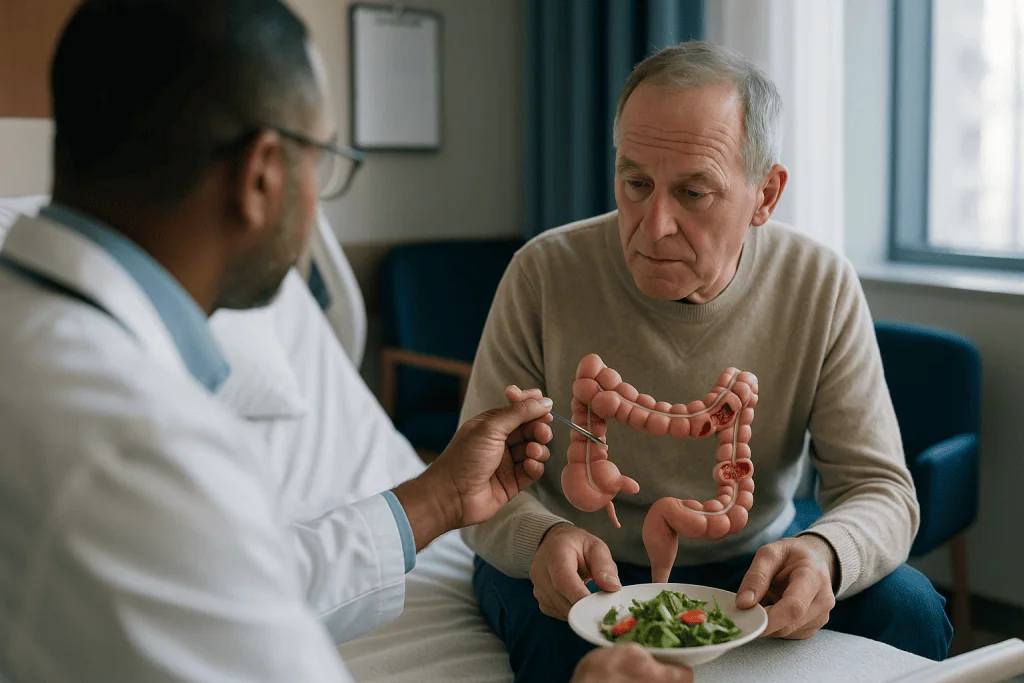
Diverticulitis begins when one pocket becomes inflamed. The leading explanation is that a tiny tear develops in the thin wall of a pouch, allowing gut bacteria to leak into the fatty tissue surrounding the colon. The body responds with inflammation: the area swells, the nearby bowel wall thickens and the person feels a steady, usually left-sided pain, often with fever and a change in bowel habit.
What happens next determines everything about treatment. In uncomplicated diverticulitis, the body contains the leak. Inflammation stays within the bowel wall and the fat around it, then gradually settles over days. The NIDDK and Mayo Clinic both describe this picture being managed with rest, a short period of clear liquids while the bowel calms, and antibiotics when the clinician judges them necessary.
In complicated diverticulitis, the containment fails in one of a few ways. Pus collects into a pocket (an abscess). A hole opens into the free abdominal cavity (a perforation), which can cause peritonitis, inflammation of the membrane lining the abdomen. Chronic inflammation tunnels into a neighboring organ (a fistula) or scars the bowel narrow (a stricture). Each of these is visible on a CT scan, which is why that scan, rather than symptoms alone, is the pivot on which the surgery question turns.
When does diverticulitis need surgery right away? Perforation and peritonitis
Perforated diverticulitis is the clearest case for an emergency operation, but even here there are gradations. Surgeons often grade severity using a scheme that runs from a small contained abscess at one end to free leakage of stool at the other. The further along that scale, the stronger the case for opening the abdomen.
A free perforation means the wall of the colon has given way and bowel contents are spilling into the abdominal cavity. Pus alone produces purulent peritonitis; stool produces fecal peritonitis, which is more dangerous because the bacterial load is far higher. Both present dramatically. The abdomen becomes rigid and exquisitely tender, the pain is no longer confined to one side, and the person may look unwell in a way that is hard to miss: pale, sweaty, fast heart rate, sometimes confused. Mayo Clinic lists peritonitis among the complications that require immediate surgery because the infection can spread rapidly through the bloodstream.
Perforated diverticulitis surgery has two broad aims. First, control the source: remove or isolate the leaking segment of colon so no more contamination occurs. Second, wash out the abdominal cavity to reduce the bacterial burden. How the surgeon reconnects the bowel, or whether they reconnect it at all during that operation, depends on how contaminated the abdomen is and how stable the patient is on the table. That choice is covered later in the section on what the operation involves.
For the person in the bed, the key point is that this tier of need is rarely ambiguous. If the scan shows free air and fluid and the clinical picture matches, the team will move quickly. The debate in these cases is about technique, not about whether to operate.
Diverticulitis abscess treatment: drain, antibiotics or operate?
An abscess is a walled-off collection of pus. In diverticulitis it forms when the body succeeds in fencing off the leak but cannot clear the infection inside the fence. Abscesses sit on the middle rungs of the severity ladder, and they are where the surgery question becomes genuinely nuanced.

Size and location drive the first decision. Small abscesses that sit close to the inflamed bowel are often treated with intravenous antibiotics alone, with repeat imaging to confirm they are shrinking. Larger collections usually need to be emptied, and the preferred first step is not an operation. Mayo Clinic describes percutaneous drainage, in which a radiologist uses CT or ultrasound guidance to pass a thin needle and catheter through the skin into the abscess, leaving the tube in place until the cavity collapses. The exact size threshold at which drainage is recommended varies between guidelines, so it is worth asking your team which cutoff they use and why.
Surgery enters the picture when drainage is not feasible, for instance because loops of bowel block the path to the abscess, when drainage fails to control the infection, or when the person deteriorates despite it. In those situations the team may proceed to remove the affected colon segment during the same admission.
Successful drainage is not always the end of the story. Many surgeons regard an abscess as a marker of a colon segment prone to further trouble, and a planned resection some weeks later is often discussed once the acute episode has settled. That recommendation is not universal, and the evidence on whether every drained abscess should lead to an elective operation remains debated. A reasonable position, and the one most mainstream sources take, is that the conversation should happen, with the final call left to the patient and the treating team.
Fistulas, strictures and bleeding: the quieter complications
Not every reason for diverticulitis surgery arrives as an emergency. Three complications develop slowly, and each can tip a case toward a planned operation.
A fistula is an abnormal tunnel between two organs. Repeated inflammation can erode a channel from the sigmoid colon into the bladder, the vagina, the small intestine or, rarely, the skin. The colon-to-bladder type is the most common, and it announces itself with unusual symptoms: air or debris in the urine, and urinary infections that keep returning. Mayo Clinic lists fistulas among the complications that typically call for surgery, because the tunnel does not close on its own and the ongoing contamination keeps causing infections.
A stricture is a scarred narrowing of the bowel. Each episode of inflammation heals with a little fibrous tissue, and over many episodes the sigmoid colon can tighten until stool struggles to pass. The symptoms creep in: narrower stools, bloating, cramping after meals and, eventually, signs of obstruction. A stricture also creates a diagnostic worry, because on imaging it can look like a tumor. Removing the narrowed segment both relieves the blockage and allows a pathologist to confirm what caused it.
Bleeding is the odd one out. Diverticular bleeding comes from a small artery stretched over the neck of a pouch and usually happens without inflammation, so it is a complication of diverticulosis rather than diverticulitis. Most episodes stop by themselves, and persistent bleeding is often controlled during a colonoscopy or by a radiologist blocking the vessel. Surgery is reserved for bleeding that cannot be stopped any other way.
None of these three is usually an overnight decision. They are reasons to sit down with a colorectal surgeon and talk through timing.
Surgery for recurrent diverticulitis: how many attacks is too many?
For decades the answer felt simple: two attacks and the sigmoid comes out. That rule rested on an assumption that each episode was more dangerous than the last and that a third would likely perforate. The evidence has since pulled that assumption apart, and the current approach is more individualized.
What the data actually show is that the first attack tends to be the most severe. People who have had several uncomplicated episodes are not, as a group, at higher risk of perforation than people having their first. Mayo Clinic now frames elective surgery for recurrent uncomplicated diverticulitis as an option for people with multiple episodes, weighed against the risks of the operation, rather than as an automatic consequence of a particular count.
So the question has shifted from “how many” to “how much is this costing you.” A surgeon considering surgery for recurrent diverticulitis will ask about frequency, severity, time off work, hospital admissions, whether symptoms ever fully clear between attacks, and how much the fear of the next one shapes daily life. Someone with three brief episodes handled at home is in a different position from someone admitted twice in a year with ongoing pain in between.
Age and immune status matter too. People whose immune systems are suppressed, whether by medication after a transplant, long-term steroid use or certain illnesses, are often counselled toward earlier surgery because an attack in that setting can be harder to contain. Conversely, older adults with other health conditions may be advised that the operation carries more risk than the disease.
There is no single correct number. The right answer is the one that emerges from an honest conversation about your pattern, your health and your tolerance for living with uncertainty.
Who is usually offered surgery, and who is usually asked to wait
Pulling the threads together, a reasonably consistent picture emerges from mainstream guidance about who tends to be steered toward an operation and who is encouraged to hold off.
Surgery is usually offered when the scan or the clinical picture shows:
- Free perforation with peritonitis, or a person who is deteriorating despite intravenous treatment.
- An abscess that cannot be drained through the skin or has not resolved after drainage.
- A fistula into the bladder, vagina or another organ.
- A stricture causing obstruction, or one that cannot be distinguished from a tumor.
- Bleeding that persists despite endoscopic and radiological attempts to stop it.
- Repeated attacks that, in the patient’s own judgment and the surgeon’s, outweigh the risks of resection.
Waiting, with monitoring, is usually advised for a first uncomplicated attack, for small abscesses responding to antibiotics, and for people whose episodes are infrequent and mild. Waiting is also the default while the inflammation is active, because operating on hot, swollen tissue raises the chance of complications; elective resection is normally planned for several weeks after recovery.
A colonoscopy sits in the middle of this timeline. Mayo Clinic advises a colonoscopy around six weeks after recovery from an attack, particularly if one has not been done in the previous year, to confirm the diagnosis and rule out other causes such as cancer or inflammatory bowel disease. Many surgeons want that result before committing to an elective operation.
People with suppressed immunity, those on long-term immunosuppressive drugs and people with chronic kidney disease are often moved up this list, because their bodies are less able to wall off infection. In every case, though, these are tendencies drawn from guidelines, not rules that bind your team. Your own history will shift where you land.
What happens in diverticulitis surgery: colectomy explained
The operation for diverticulitis is a colectomy, meaning removal of part of the colon. Because the sigmoid is almost always the culprit, the procedure is usually a sigmoid colectomy. The surgeon frees the diseased segment from its surrounding attachments, divides the bowel above and below it and removes the piece. What comes next is the fork in the road.
In a primary resection with anastomosis, the two healthy ends are joined back together immediately, either with sutures or a stapling device. An anastomosis is simply a surgical join between two pieces of bowel. The person wakes up with intestinal continuity restored and no external bag. Mayo Clinic describes this as the usual approach when inflammation is limited and the surrounding tissue is healthy enough to heal a join safely. Occasionally the surgeon protects a new join with a temporary loop of small bowel brought to the skin, a diverting ileostomy, which is reversed later.
In a Hartmann’s procedure, the diseased segment is removed but the two ends are not joined. The upper end is brought out through the abdominal wall as a colostomy, an opening (stoma) through which stool passes into a bag, and the lower end is closed off inside. This is chosen when the abdomen is heavily contaminated, when the patient is unstable, or when the tissue is too inflamed to trust a join. Mayo Clinic notes that the colostomy may be reversed in a second operation once the inflammation has eased, typically months later.
Either operation can be performed through a traditional open incision or laparoscopically, using several small cuts and a camera. Laparoscopic surgery is favored for planned operations and increasingly used in emergencies when the patient is stable; it is associated with less postoperative pain and a shorter hospital stay, though the surgeon will convert to an open approach if visibility or safety demands it.
Surgical options side by side
Seeing the choices laid out together makes the trade-offs clearer. The table below summarizes the main approaches and when each tends to be used, based on the descriptions in Mayo Clinic and NIDDK patient materials. It is a map, not a prescription; your surgeon will adapt it to what they find.
| Approach | What is done | Usually chosen when | Main trade-off |
|---|---|---|---|
| Antibiotics and bowel rest | No operation; fluids, short liquid diet, antibiotics if indicated | Uncomplicated attack, small contained abscess | Does not remove the pouches; attacks may recur |
| Percutaneous drainage | Radiologist places a catheter through the skin into an abscess | Larger abscess reachable by needle | Avoids surgery now; elective resection often discussed later |
| Primary resection with anastomosis | Diseased segment removed, ends joined immediately | Planned surgery, or emergency in a stable patient with limited contamination | Single operation, but a join can leak if tissue is unhealthy |
| Hartmann’s procedure | Segment removed, colostomy formed, lower end closed | Severe peritonitis, unstable patient, heavily inflamed tissue | Safer in a crisis, but needs a second operation to reverse the stoma |
| Laparoscopic lavage | Abdomen washed out through keyhole ports without removing colon | Selected cases of purulent peritonitis without stool leak | Less invasive, but evidence is mixed and reoperation rates are a concern |
Two things stand out. First, the non-operative rows cover the majority of real-world cases, which is reassuring if you are reading this from a hospital bed after a first attack. Second, the emergency rows are about safety under pressure, not about which operation is “better” in the abstract. A Hartmann’s procedure in a critically unwell person is the right choice precisely because it is the cautious one, even though it means living with a stoma for a time.
Laparoscopic lavage deserves a note of honesty. It attracted interest as a way to avoid resection, but trial results have been inconsistent, and many surgeons now reserve it for carefully selected cases or do not offer it. Ask directly if it is proposed.
Risks of surgery and the alternatives, in plain terms
Every operation on the colon carries risks, and a good surgeon will walk through them without softening the edges. Understanding them is what makes an elective decision genuinely yours.
The complication specific to bowel surgery is an anastomotic leak, where the join between two bowel ends fails to heal and contents escape. It is the reason surgeons sometimes choose a stoma in difficult cases, and it is the complication they watch for most closely in the first week. General surgical risks also apply: wound infection, bleeding, blood clots in the legs or lungs, pneumonia, and reactions to anesthesia. Longer term, some people experience changes in bowel habit after losing part of the colon, and a small number develop adhesions, bands of scar tissue inside the abdomen that can occasionally cause obstruction.
Emergency operations carry higher risk than planned ones, partly because the patient is sicker and partly because the tissue is inflamed. This is the single most important reason surgeons prefer, when they safely can, to cool an attack down first and operate weeks later.
The alternatives depend on the tier of need. For emergencies there is usually no realistic alternative to source control. For abscesses, drainage plus antibiotics is the alternative to immediate resection. For recurrent uncomplicated disease, the alternative to surgery is continued medical management: treating each episode as it comes, attention to diet and physical activity, and accepting that further attacks may occur. The NHS and NIDDK both describe a high-fiber diet as part of long-term management of diverticular disease, though evidence that it prevents diverticulitis specifically is weaker than evidence for its general benefits.
It is also legitimate to choose not to operate for recurrent disease and to revisit the decision later. Elective surgery can nearly always wait; the question is whether waiting costs you more than the operation would.
Diverticulitis surgery recovery time: the following days and weeks
Recovery has a rhythm, and knowing it in advance takes some of the fear out of the early days. The timelines here are typical ranges described in patient materials from Mayo Clinic and the NHS, not promises; your own course will depend on the type of operation, your general health and whether it was planned or an emergency.
The first two or three days are about the bowel waking up. After any colectomy the intestine goes briefly quiet, and the team will listen for sounds, watch for passing gas and introduce fluids and then light food in stages. Most people are encouraged to sit out of bed and walk short distances on the first day, because movement helps the bowel restart and lowers the risk of blood clots. Pain is managed with a plan agreed before surgery; decisions about medicines sit with the prescribing clinician.
Hospital stays after laparoscopic elective surgery are generally shorter than after open or emergency operations, often a few days rather than a week or more. Discharge usually depends on three things: eating, passing stool or gas, and managing pain with oral medicines.
The following weeks are about rebuilding. Fatigue is normal and often lasts longer than people expect. Lifting restrictions, typically for several weeks, protect the incisions while the abdominal wall heals. Bowel habit may be looser or more frequent at first and tends to settle over weeks to months.
If a stoma was formed, a stoma nurse will teach bag care before discharge and remain a point of contact. Reversal is a separate operation, planned once inflammation has resolved and the person has regained strength, which Mayo Clinic describes as typically happening months later. Many people find the stoma period hardest emotionally rather than physically, and asking early about support groups is reasonable.
What people often get wrong about diverticulitis and surgery
Few digestive conditions carry as much folklore, and some of it steers people toward unnecessary worry or unnecessary operations. A few corrections, grounded in what mainstream sources actually say.
“Two attacks means the colon has to come out.” This was once standard teaching, but as described above, the evidence that each attack is more dangerous than the last has not held up. Mayo Clinic frames surgery for recurrent uncomplicated disease as an individualized option, not a rule triggered by a number.
“Nuts, seeds and popcorn cause attacks.” The idea that small food particles lodge in pouches and trigger inflammation was never supported by good evidence. Harvard Health and the NIDDK both note that studies have not found a link, and there is no reason for most people to avoid these foods.
“Surgery removes all the pouches, so it can’t come back.” Resection removes the segment that caused trouble, almost always the sigmoid. Diverticula elsewhere in the colon remain, and new ones can form. Recurrence after surgery is uncommon but not impossible.
“A colostomy is forever.” In diverticulitis surgery the stoma is usually temporary, created to allow safe healing and reversed in a later operation. Permanent stomas do happen, usually when a person’s health makes a second operation unwise, but they are the minority.
“Antibiotics are always needed.” Several guidelines now describe selected mild, uncomplicated attacks being managed without antibiotics in otherwise healthy people under close observation. Whether that applies to you is a decision for your clinician, not something to attempt alone.
“Pain-free means healed.” Symptoms often fade before the inflammation has fully resolved on imaging, which is why follow-up and the post-recovery colonoscopy still matter.
Questions to ask your care team before deciding
Decisions about diverticulitis surgery go better when the patient arrives with specific questions rather than a vague sense of dread. These are the ones that tend to unlock the most useful conversations, whether you are facing an emergency operation or weighing a planned one months down the line.
- Is this an emergency, or do we have time to think? Which tier of “need” are we talking about?
- What exactly did the CT scan show: an abscess, free air, a fistula, a stricture? Can I see the report?
- If there is an abscess, is percutaneous drainage an option, and what size threshold are you using?
- If surgery is recommended now, will you try to join the bowel immediately, or is a temporary stoma likely? What would make you decide one way or the other during the operation?
- Can this be done laparoscopically, and what would lead you to convert to an open operation?
- If I have had repeated attacks, what in my particular pattern makes you lean toward or away from elective resection?
- What happens if I choose to wait? How would we monitor, and what would change your advice?
- Do I need a colonoscopy before an elective operation, and when?
- What are the specific risks for someone with my other health conditions and medicines, and who will manage those medicines around the operation?
- If a stoma is formed, who teaches me to manage it, and roughly when would reversal be considered?
- What does recovery typically look like for someone like me, and what would be a sign that something is wrong?
Write the answers down or ask someone to come with you. It is entirely reasonable to request a second opinion for an elective decision; most surgeons expect it. The aim is not to second-guess the team but to make sure the choice reflects your priorities as well as their expertise.
When to call your doctor
Diverticulitis can change course quickly, and the difference between a straightforward episode and a surgical one is sometimes a matter of hours. Whether you are at home with a known attack, recovering after drainage or healing from surgery, the following signs warrant urgent contact with your care team or emergency services rather than waiting to see how things develop.
Seek care immediately for pain that becomes severe, spreads across the whole abdomen or makes the abdomen feel hard and board-like; for a fever that climbs or returns after settling, especially with shaking chills; for repeated vomiting or an inability to keep fluids down; for a swollen, distended belly with no passage of gas or stool; for passing large amounts of blood from the rectum, or stool that is black and tarry; for a racing heart, faintness, confusion or feeling suddenly and profoundly unwell; and for air bubbles or stool-like debris in the urine, which can signal a fistula. Mayo Clinic and the NHS both list worsening pain, high fever and signs of obstruction or peritonitis as reasons for emergency assessment.
After surgery, add these to the list: increasing redness, swelling or discharge from an incision; new or worsening pain around the wound or deep in the abdomen; a stoma that turns dark, dusky or purple rather than pink; no output from a stoma for many hours together with bloating or vomiting; and calf pain, chest pain or sudden breathlessness, which can point to a blood clot.
Less urgent but still worth a prompt call: symptoms that improve and then stall, ongoing pain beyond the timeline your team described, or a new change in bowel habit that persists after recovery. None of these lists is a self-diagnosis tool. They exist so that you know when to pick up the phone and let the people who have your scans and your history make the judgment.
Frequently asked questions
What does "need" mean when a doctor says diverticulitis needs surgery?
It usually means one of two things: an emergency, where perforation or uncontrolled infection leaves no safe alternative, or an elective recommendation, where surgery is judged the better of two reasonable options for complications or repeated attacks. The first is decided in hours; the second allows weeks for imaging, colonoscopy and discussion. Ask your team directly which they mean, because the risks and timelines differ substantially.
Does recurrent diverticulitis always need surgery?
No. Mayo Clinic now frames surgery for recurrent uncomplicated diverticulitis as an individualized option rather than a rule triggered after a set number of attacks. Surgeons weigh how often episodes occur, how severe they are, whether symptoms clear in between, your other health conditions and your own priorities. Some people choose resection for predictability; others continue managing each attack medically and revisit the decision later.
What is the usual diverticulitis abscess treatment?
Small abscesses are often treated with intravenous antibiotics and repeat imaging. Larger collections are usually drained through the skin by a radiologist using CT or ultrasound guidance, with a catheter left in place until the cavity collapses. Surgery during the same admission is reserved for abscesses that cannot be reached, fail to resolve or are accompanied by worsening illness. A planned resection is often discussed afterward, though this is debated.
How is perforated diverticulitis surgery done?
The surgeon removes or isolates the leaking segment of colon, almost always the sigmoid, and washes out the abdominal cavity. If the patient is stable and contamination limited, the bowel ends may be joined immediately. In severe peritonitis or an unstable patient, a Hartmann’s procedure is more common: the segment is removed, a temporary colostomy is formed and the lower end is closed, with reversal planned months later.
What is the typical diverticulitis surgery recovery time?
Patient materials from Mayo Clinic and the NHS describe hospital stays of several days after planned laparoscopic surgery, longer after open or emergency operations, followed by several weeks before returning to normal activity and lifting. Fatigue often lingers beyond that. Bowel habit may be looser at first and tends to settle over weeks to months. These are typical ranges, not guarantees, and your surgeon will tailor expectations to your situation.
Will I need a colostomy bag after diverticulitis surgery?
Not usually, and when one is needed it is most often temporary. Planned sigmoid colectomies generally join the bowel immediately with no stoma. A colostomy is created mainly in emergencies with heavy contamination or in unstable patients, to allow safe healing. Mayo Clinic describes reversal in a second operation once inflammation has eased, typically months later. Permanent stomas occur in a minority, usually when another operation would be unwise.
Can diverticulitis come back after surgery?
It can, though it is uncommon. Surgery removes the segment that caused trouble, almost always the sigmoid colon, but diverticula elsewhere in the colon remain and new ones can form over time. Removing the sigmoid down to healthy rectum is thought to lower the chance of recurrence. Ongoing attention to diet and activity, and prompt reporting of new symptoms, remain sensible after an operation.
Why do surgeons prefer to wait before elective diverticulitis surgery?
Operating on actively inflamed, swollen tissue raises the risk of complications, particularly a leak at the join between bowel ends. Letting the attack settle for several weeks allows the tissue to heal, lets the patient regain strength and leaves time for a colonoscopy, which Mayo Clinic advises around six weeks after recovery to confirm the diagnosis and exclude other causes such as cancer or inflammatory bowel disease.
Does a fistula from diverticulitis need surgery?
Usually, yes. A fistula is an abnormal tunnel between the colon and another organ, most often the bladder, and it does not close on its own. Mayo Clinic lists fistulas among the complications that typically call for an operation, because the ongoing passage of bowel contents causes recurrent infections. The surgery removes the diseased colon segment and repairs the affected organ, normally as a planned procedure once inflammation has settled.
Do nuts, seeds and popcorn make diverticulitis worse?
The evidence does not support this long-standing belief. Harvard Health and the NIDDK both note that studies have not found a link between eating nuts, seeds or popcorn and developing diverticulitis, and there is no general reason to avoid them. Diet advice for diverticular disease centers on adequate fiber, fluids and physical activity. Any specific dietary changes, especially around an attack or surgery, should come from your care team.
References
- NIDDK (NIH): Diverticulosis and Diverticulitis
- NHS: Diverticular disease and diverticulitis
- MedlinePlus: Diverticulosis and Diverticulitis
This article is for general information only and is not a substitute for professional medical advice. Please consult a qualified doctor about your individual situation.

More from the Blog

Gut Health and Weight: What the Microbiome Does, and Does Not, Do to Body Fat
Gut bacteria influence appetite hormones, energy harvest from food and low-grade inflammation, but in humans their effect on body fat appears modest and indirect.…

How Long Does the Gut Take to Heal With Celiac Disease? What Follow-Up Usually Shows
Symptoms of celiac disease often ease within weeks of removing gluten, but the intestinal lining heals more slowly. Children's small intestines typically recover within…

How Soon Can You Walk, Drive and Lift After Gallbladder Surgery for Cholecystitis?
After keyhole gallbladder removal for cholecystitis, most people are walking within hours, driving after about a week once they can perform an emergency stop…

Ulcerative Colitis Flares: When Bleeding, Fever or Severe Pain Means Contacting Your Team Today
Contact your inflammatory bowel disease team the same day if an ulcerative colitis flare brings six or more bloody stools in 24 hours, a…

When Is ERCP Needed? Stuck Gallstones, Duct Narrowing and Bile Leaks Explained
ERCP is needed when a problem in the bile or pancreatic ducts has to be treated, not just seen. The commonest reasons are gallstones…

Dehydration During Gastroenteritis: The Signs That Mean It Is Time for Urgent Care
During gastroenteritis, dehydration becomes urgent when you cannot keep fluids down, pass little or no urine for eight hours or more, feel dizzy or…