

When Is Hallux Rigidus Surgery Considered? Stiff Shoes, Injections and the Limits of Rest

Key Takeaways
- Hallux rigidus is osteoarthritis of the big toe joint that limits upward bending, and it is distinct from a bunion, which is a sideways drift of the toe.
- Surgery is considered for symptoms, not X-ray appearance, usually after several months of stiff-soled or rocker footwear and inserts have failed to control pain.
- A steroid injection treats inflammation rather than arthritis, and Mayo Clinic notes clinicians usually limit joints to a few injections per year because repeated steroid can weaken cartilage.
- Cheilectomy removes the top bone spur and suits earlier stages with intact central cartilage, while fusion is the most reliable option for advanced bone-on-bone disease.
- After fusion, bone typically heals over roughly six to twelve weeks before weight-bearing progresses; after cheilectomy, protected walking usually starts within days and swelling settles over weeks to months.
- Smoking, poorly controlled diabetes and reduced circulation slow bone and wound healing, so teams often ask people to address them before scheduling any foot operation.
Hallux rigidus surgery is usually considered when arthritis of the big toe joint keeps causing pain and stiffness despite several months of nonsurgical care, such as stiff-soled or rocker-bottom shoes, inserts, activity changes, anti-inflammatory medicine and sometimes a steroid injection, and when that pain limits walking or daily life. Timing depends on arthritis stage, bone spurs, general health and personal goals, and the decision rests with the treating orthopedic or podiatric team.
The moment often arrives on a staircase. Not the climb, which hurts a little, but the descent, when the big toe has to bend upward as the heel lifts and the body’s weight rolls forward. A sharp catch, a quiet inhale, and a hand reaching for the rail. For many people with hallux rigidus, that is the day the question changes from how to manage the pain to whether an operation is coming.
Deciding when to have hallux rigidus surgery is rarely a single dramatic choice. It is a slow negotiation between a joint that has lost its glide, shoes that have been swapped for stiffer and stiffer soles, an injection or two that bought a quieter season, and the growing realization that rest alone has stopped working. Surgeons weigh those same pieces, and they add two more: what the X-ray shows and what the patient actually wants to get back to doing.
This explainer walks through that negotiation honestly, including the parts the glossy procedure pages tend to skip.
What is hallux rigidus, and why does one small joint matter so much?
Hallux rigidus is osteoarthritis of the joint at the base of the big toe, the first metatarsophalangeal joint, where the long bone of the foot meets the first bone of the toe. Osteoarthritis means the smooth cartilage that lets two bone ends slide over each other wears thin, the bone underneath thickens, and bony spurs grow around the edges of the joint. The Latin name translates roughly as stiff big toe, and that stiffness is the defining feature: the toe loses its ability to bend upward, the movement called dorsiflexion that every step depends on.
That upward bend is not a minor convenience. With each stride, the heel lifts, the body pivots over the ball of the foot, and the big toe is forced to flex toward the shin before pushing off. When cartilage is intact, that happens silently. When a spur sits on top of the joint like a doorstop, the bones collide at the end of the bend, and the body responds the only way it knows how: by shortening the stride, rolling onto the outer edge of the foot, or turning the foot outward to avoid the pinch. Knees, hips and the lower back often inherit the strain.
Cleveland Clinic describes hallux rigidus as the most common arthritic condition of the foot, with estimates of roughly 1 in 40 adults over 50 affected (see references). It tends to appear in middle age, sometimes earlier after an injury to the toe, and often without any single cause. Foot shape, a long first metatarsal bone, family history and years of repetitive loading all seem to contribute. It is sometimes confused with a bunion, but a bunion is a sideways deviation of the toe; hallux rigidus is a loss of up-and-down motion with a bump on the top of the joint rather than the inner side.
When to have hallux rigidus surgery: the signals surgeons actually weigh
There is no laboratory value or X-ray grade that automatically triggers an operation. Hallux rigidus is usually staged by combining three things: how much upward bend remains, how the joint looks on a standing X-ray, and when the pain occurs. Early disease hurts only at the extremes of motion, typically at push-off or when kneeling with the toes tucked. Advanced disease hurts in the middle of the range and sometimes at rest, because the cartilage loss has spread across the whole joint surface rather than just the top.

Surgeons listen for a particular shift in the story. Pain that used to arrive only after a long walk now arrives in the first block. Shoes that worked last year no longer do. Someone has quietly given up hiking, running, dancing or a job that involves kneeling. The toe may look visibly swollen over the top, and a shoe may rub on the spur until the skin reddens. That pattern of progressive loss despite reasonable nonsurgical effort is the clinical heart of when to have hallux rigidus surgery.
Guideline-level advice from NHS and Mayo Clinic for osteoarthritis in any joint follows the same logic: start with footwear, activity modification, weight management where relevant, simple pain relief and physical measures, and consider surgical referral when symptoms substantially affect quality of life and conservative options have been tried. For the big toe, a trial of several months of stiff-soled or rocker footwear is the usual yardstick, because that single change relieves a large share of people enough to carry on. Surgery is reserved for the ones it does not.
Two other factors shape timing. The first is the match between the X-ray stage and the symptoms, because a joint with early changes and a prominent top spur points toward a smaller operation than a joint with cartilage gone throughout. The second is the person’s general health, circulation, diabetes control and smoking status, all of which affect bone healing and are weighed openly before any date is set.
How do stiff shoes, rocker soles and inserts work, and what are the limits of rest?
The simplest explanation of a stiff-soled shoe is that it does the bending so the toe does not have to. A rigid sole prevents the forefoot from flexing at push-off, and a rocker-bottom profile, a sole curved like the base of a rocking chair, lets the body roll forward over the foot without the big toe ever reaching the painful end of its range. Many walking and hiking shoes already have a mild version of this built in; purpose-made rocker shoes exaggerate it.
Inserts aim at the same target from inside the shoe. A carbon fiber or spring steel plate placed under the insole stiffens a flexible shoe, and a Morton’s extension, a firm strip that runs under the big toe joint and toe, specifically blocks dorsiflexion there. A small cushion or pad under the ball of the foot can redistribute pressure away from the sore joint. NHS and Mayo Clinic osteoarthritis guidance lists supportive footwear and insoles among the first-line measures for weight-bearing joints, and foot specialists apply that directly to the big toe.
These measures are genuinely effective at reducing symptoms for many people, and they carry almost no risk, which is why they come first. What they cannot do is restore cartilage or shrink a spur. Think of them as a brace for the joint rather than a repair.
Rest deserves an honest word. Backing off a provoking activity for a week or two settles an inflamed joint, and that is sensible. Prolonged rest, though, tends to fail in two ways. The joint keeps stiffening because it is moved less, and the person loses fitness, strength and weight control, which makes every joint hurt more. Osteoarthritis guidance from NIH and NHS is consistent on this point: staying active within comfort, choosing low-impact options such as cycling or swimming, and keeping the calf and foot muscles strong serves the joint better than avoidance. When even gentle, well-shod activity stays painful, rest has reached its limit, and that is information rather than failure.
What can injections do for hallux rigidus, and what can they not do?
A corticosteroid injection places a small amount of a potent anti-inflammatory medicine directly into the joint space, often mixed with a local anesthetic. Corticosteroids work by damping the immune signals that produce swelling, warmth and pain in the joint lining. In a joint as small as the first metatarsophalangeal joint, the injection is a quick procedure, sometimes guided by ultrasound or X-ray so the needle sits exactly inside the joint.
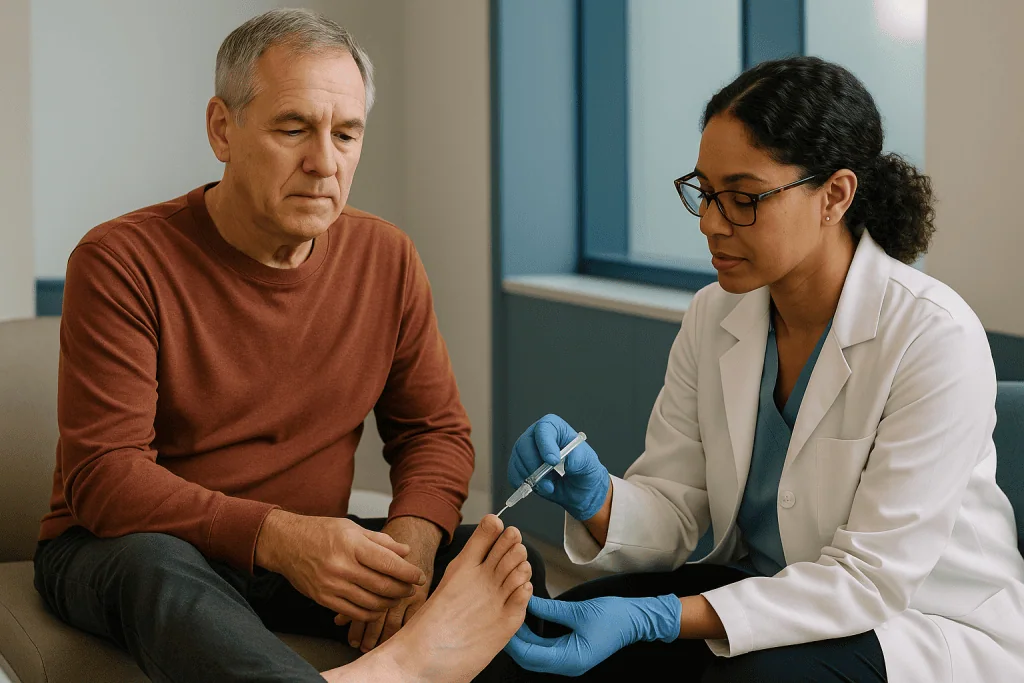
Mayo Clinic describes cortisone shots as a way to relieve pain and inflammation in a specific joint, with relief that can last from several weeks to several months, and it notes that clinicians generally limit how often a joint is injected, commonly no more frequently than every six weeks and usually no more than three or four times in a year, because repeated steroid exposure can weaken cartilage and nearby tissue over time (see references). Those limits matter in hallux rigidus precisely because the cartilage is already the problem.
Honest framing helps. An injection treats the inflammation of an arthritic joint; it does not treat the arthritis. For someone in an early stage who needs to get through a wedding, a trip or a demanding season at work, it can be a reasonable bridge. For someone with advanced cartilage loss, relief is often shorter, because mechanical bone-on-bone contact rather than inflammation is driving the pain. Many surgeons also view the response to an injection as diagnostic: if the pain vanishes for a while, the joint is confirmed as the source.
Other injectables are sometimes offered. Hyaluronic acid aims to supplement the thickened fluid that lubricates a joint; platelet-rich plasma uses concentrated components of the person’s own blood. For the big toe joint specifically, high-quality evidence is limited, and mainstream osteoarthritis guidance from NHS describes these options as not routinely recommended or as uncertain. Any decision about injections, including how many and how often, belongs with the clinician who knows the joint.
What actually happens in a cheilectomy, the most common hallux rigidus operation?
A cheilectomy is an operation that removes the bone spur from the top of the big toe joint along with the worn upper portion of the metatarsal head. The word comes from the Greek for lip, a reference to the rim of bone that forms around the joint. The aim is mechanical and modest: take away the doorstop so the toe can bend upward further before the bones collide.
The procedure is usually done as day surgery under regional or general anesthesia, often with a nerve block that numbs the foot for many hours afterward. Through a cut on the top or inner side of the joint, the surgeon trims the spur with a small saw or burr, removes loose fragments of cartilage or bone, and checks the range of motion on the table. Some surgeons use a minimally invasive technique through tiny incisions with a burr guided by X-ray; the goal is the same, the scar is smaller, and the evidence comparing the two approaches is still developing.
Cheilectomy preserves the joint, which is its central appeal. Nothing is fused, nothing artificial is implanted, and later options remain open if arthritis progresses. The trade-off is that it only addresses the part of the joint it removes. If cartilage is already gone across the lower and middle surfaces, taking away the top spur relieves the pinch at the end of the range but leaves the grinding in the middle, which is why cheilectomy is generally reserved for earlier stages where the central cartilage is still reasonable.
A cheilectomy is sometimes combined with a small wedge cut in the toe bone, a Moberg osteotomy, which tilts the toe slightly upward so that the remaining healthy range of motion is shifted to where walking needs it. Cleveland Clinic’s description of cheilectomy notes that people are usually able to bear weight in a stiff postoperative shoe early, with swelling settling over weeks to a few months (see references). Which version, if any, suits a particular joint is a judgment the surgeon makes from the X-ray and the examination.
Cheilectomy vs fusion vs joint replacement: how the choice shapes when to have hallux rigidus surgery
Three families of operation exist for hallux rigidus, and the stage of arthritis largely determines which is on the table. Arthrodesis, usually called fusion, removes what remains of the cartilage and joins the two bones permanently with a plate and screws so they heal into one. It trades the painful motion for a stable, pain-free but unbending joint, and surgeons regard it as the most reliable option for advanced disease. Arthroplasty replaces or resurfaces part or all of the joint with an implant, preserving some motion at the cost of the implant’s own uncertainties. The table below compares them in neutral terms.
| Option | What is done | Usually offered for | Motion afterward | Main trade-offs |
|---|---|---|---|---|
| Cheilectomy (with or without Moberg osteotomy) | Spur and worn upper bone removed; joint kept | Early to moderate arthritis with top spur, central cartilage largely intact | Preserved, often improved | Arthritis can progress; later operation may be needed |
| Arthrodesis (fusion) | Joint surfaces removed, bones fixed to heal as one | Advanced arthritis, failed earlier surgery, very unstable or deformed joints | None at the big toe joint | Permanent stiffness, shoe heel height limited, small risk the bones do not unite |
| Arthroplasty (resurfacing or replacement) | Implant placed on one or both joint surfaces | Selected moderate to advanced cases wanting motion | Partially preserved | Implant wear or loosening; revision to fusion can be harder |
The practical consequence for timing is subtle but real. Because cheilectomy works best while central cartilage survives, some surgeons favor earlier intervention in people with a clear top spur and end-range pain, rather than waiting until the whole joint is worn and fusion becomes the only durable choice. Others reasonably argue that if footwear controls symptoms, the joint can be left alone indefinitely. Both positions are defensible; the right one depends on the person’s symptoms, stage and priorities, and the treating team will say which applies.
Who is usually offered hallux rigidus surgery, and who is usually asked to wait?
The people most commonly offered surgery share a recognizable profile. Their pain is clearly located at the big toe joint and reproduced on examination. They have tried stiff or rocker footwear and often an insert for several months. Their X-rays show changes that match their symptoms. The pain is interfering with work, exercise or ordinary walking, and they have a specific goal, whether that is kneeling in the garden again or finishing a shift without limping. Their general health allows a safe anesthetic and reliable wound healing.
Those usually asked to wait fall into a few groups. Someone whose symptoms are new, or who has never tried a genuinely rigid shoe, is normally sent back to exhaust those options first, because a meaningful share of people settle without an operation. Someone whose pain is intermittent and manageable, even with marked X-ray changes, is often advised that surgery is for symptoms rather than pictures. People with poorly controlled diabetes, significant peripheral arterial disease, active infection anywhere, or heavy smoking are typically asked to address those first, since Mayo Clinic and NHS guidance on orthopedic surgery consistently identify them as factors that slow bone and wound healing and raise complication rates.
Timing sometimes hinges on life rather than anatomy. A caregiver who cannot be off their feet, a worker whose job requires standing from day one, or a traveler with a long trip booked may reasonably defer. Conversely, a person facing a slow progression toward fusion may choose to act while cheilectomy is still an option.
Age alone is not a deciding factor in either direction. Older adults with good health and clear goals do well; younger adults are sometimes steered away from fusion because of the decades of altered mechanics ahead, and toward joint-preserving surgery or continued conservative care. The weighing is individual, and the surgeon will explain which category applies and why.
How painful is hallux rigidus surgery, honestly?
Most people are surprised that the first day is often the easiest. A regional nerve block, an injection of local anesthetic around the nerves at the ankle or knee, typically keeps the foot numb for many hours and sometimes into the following day. Pain tends to arrive as the block wears off, usually on the first night or second day, and that transition is the part people remember most. Teams plan for it by advising oral pain relief before the block fades and by emphasizing elevation, because a dependent, swollen foot throbs.
Cheilectomy is generally considered a less painful operation than fusion because less bone is cut and no hardware is placed, though every person’s experience differs. Fusion involves broader bone surfaces and a plate and screws, and the ache tends to persist longer, especially with weight-bearing in the early weeks. Minimally invasive approaches may reduce soft tissue disturbance, but evidence on pain differences is still developing and should be described as uncertain.
Swelling, more than sharp pain, is what lingers. Foot surgery of any kind produces swelling that worsens with standing and improves overnight, and it commonly persists for weeks to months even when the wound has healed. Stiffness after cheilectomy can also surprise people: the joint that was operated on to move better feels tight at first because of swelling and scar, which is why early guided movement is usually encouraged once the wound allows.
Medicines used after foot surgery typically include acetaminophen, anti-inflammatory drugs where safe for that person, and sometimes a short course of a stronger analgesic for the first days. Mainstream guidance from NIH and Mayo Clinic emphasizes using the smallest effective amount of opioid medication for the shortest time. Which medicines, how much and for how long are decisions for the prescribing team, who will tailor them to kidney function, stomach history, other medicines and the operation performed.
Hallux rigidus surgery recovery time: what the following days and weeks usually look like
Recovery differs sharply between the joint-preserving and the fusion pathways, so the two deserve separate timelines. The ranges below are typical patterns described by Cleveland Clinic and consistent with general orthopedic guidance; they are not promises, and a surgeon’s own protocol takes precedence.
After cheilectomy, the first few days are about elevation, ice as advised and short trips in a stiff-soled postoperative shoe, which protects the wound while allowing heel or flat-foot weight-bearing. Stitches usually come out around two weeks. Gentle toe-bending exercises often begin in the first two weeks to prevent the new range from scarring shut. Many people return to a roomy sneaker within a few weeks and to desk work within one to two weeks, with standing jobs and sports taking longer, often a few months, as swelling resolves (see references).
After fusion, the priority is letting bone heal to bone. Weight-bearing is typically limited to the heel or restricted in a boot for the first weeks, with X-rays at intervals to confirm the bones are uniting. Cleveland Clinic describes bone healing after fusion over roughly six to twelve weeks, after which weight-bearing progresses and normal shoes return gradually (see references). Driving depends on which foot was operated on and on being out of a boot with full control of the pedal, and the treating team will say when that point has been reached.
Across both pathways, a few things stay constant. Swelling improves slowly, often over three to six months. Scar sensitivity fades with gentle massage once healed. People who stayed active before surgery, even on a bike or in a pool, tend to regain stamina faster. Follow-up appointments are not optional; they are where the team catches a wound that is lagging, a joint that is stiffening, or a fusion that is slow to unite, all of which are more manageable when found early.
What are the risks and complications of hallux rigidus surgery?
Every operation carries general risks, and foot surgery adds a few specific ones. The general list includes infection, bleeding, a reaction to anesthesia, blood clots in the leg, and wound healing problems, all of which are more likely in people who smoke, have diabetes or have reduced circulation. NHS and Mayo Clinic guidance on surgery describes these as the reasons preoperative assessment pays such attention to those factors.
Nerve irritation is a particular concern around the big toe, because small sensory nerves run just under the skin on the top and inner side of the joint. Numbness or tingling near the scar is relatively common and often improves over months, though some people have a permanent patch of altered sensation. Persistent swelling and stiffness are also common complaints after cheilectomy, which is why early movement is encouraged.
Each operation has its own characteristic problems. After cheilectomy, arthritis can continue to progress, and a proportion of people eventually need a second operation, often fusion; the exact proportion varies widely between studies and depends heavily on how advanced the arthritis was at the time, so any single figure should be treated cautiously. After fusion, the specific risk is nonunion, where the bones fail to heal together, which may require repeat surgery; malposition, where the toe is fused at an angle that makes shoes uncomfortable, is another. Hardware can become prominent and occasionally needs removal once the bone has healed. After joint replacement, implant loosening, subsidence into soft bone, and wear are the long-term concerns, and converting a failed implant to a fusion is technically harder than fusing a native joint.
Complex regional pain syndrome, a rare condition of persistent pain, swelling and skin changes out of proportion to the surgery, can follow any limb operation and is one reason teams watch for unusual pain patterns in the early weeks. Surgeons are expected to discuss all of these in the consent conversation, and asking directly how often each has occurred in their own practice is reasonable.
Is hallux rigidus surgery worth it? What the evidence actually shows
Worth it is a personal calculation, but the evidence gives it some structure. For cheilectomy in early to moderate disease, the published literature, summarized in reviews indexed on PubMed, consistently reports that most people experience meaningful pain relief and improved toe motion, with a minority going on to further surgery over the following years as arthritis progresses. The studies are mostly observational rather than randomized, follow-up lengths vary, and definitions of success differ, so precise percentages are not reliably comparable and this article does not quote one.
For fusion in advanced disease, the literature is similarly consistent that pain relief is reliable once the bones unite and that function in everyday walking is good, despite the loss of motion. The trade-offs are concrete: heel height in shoes is limited, kneeling with toes tucked under is awkward, and running mechanics change. People who understand those trade-offs before surgery report fewer regrets than those who learn them afterward.
For joint replacement, evidence is weaker and more mixed, with wide variation between implant designs and shorter average follow-up. Mainstream guidance tends to describe it as an option for selected people rather than a standard first choice, and that caution is worth hearing.
What makes surgery worth it, then, is alignment. A person with end-range pain, a clear spur, a cheilectomy, and a goal of walking the dog without limping has a well-matched plan. A person with bone-on-bone arthritis, a fusion, and a goal of returning to heeled shoes does not, and the honest surgeon will say so. The wider osteoarthritis evidence from NIH and NHS adds one more point: surgery does not replace the lifelong basics of activity, strength and sensible footwear, which continue to protect the rest of the foot and the other joints that have been compensating. Treated well, hallux rigidus becomes a managed condition rather than a defining one.
What people often get wrong about hallux rigidus
The first misunderstanding is that it is a bunion. The two are often grouped together because both produce a bump near the big toe, but a bunion is a sideways drift of the toe with a bump on the inner side, while hallux rigidus is a loss of upward motion with a bump on top. The operations are different, and so is the footwear advice.
The second is that rest will let the joint heal. People ask, understandably, whether a person can seriously heal from hallux rigidus. Worn cartilage does not regrow in adults, and spurs do not dissolve; what can genuinely improve is the inflammation, the pain and the way the foot is loaded. That is why footwear and activity changes work as well as they do, and why months of avoidance do not change the X-ray.
The third is that a bad X-ray means surgery is urgent. Hallux rigidus is treated for symptoms. A joint that looks dramatic on film but hurts rarely in good shoes can be left alone and reviewed. The reverse also applies: a mild-looking X-ray with a prominent top spur and disabling end-range pain can be an excellent reason to operate.
The fourth is that fusion means a disabled foot. Most people who undergo fusion walk normally in flat shoes, because the toe was already barely moving before surgery and the rest of the foot adapts. The genuine limits are heel height and tucked-toe kneeling, which should be discussed, not feared.
The fifth is that supplements fix arthritic cartilage. NIH’s Office of Dietary Supplements and NHS guidance describe the evidence for glucosamine and chondroitin in osteoarthritis as inconsistent at best, and neither is recommended as a treatment in NHS guidance. Spending on them is a personal choice, but expecting them to restore a big toe joint is not supported by the evidence.
Questions to ask your care team before deciding on surgery
A good consultation leaves you knowing not just what the surgeon recommends but why, and what the alternatives would look like. These questions help get there; writing down the answers, or bringing someone to listen, is worth the small effort.
- What stage is my arthritis on the X-ray, and does that match what you found when you examined the toe?
- Have I genuinely exhausted the nonsurgical options, including a truly rigid or rocker sole and an insert, and is there anything I have not yet tried?
- Would an injection be reasonable for me now, and what would its response tell us?
- Which operation are you recommending, and why that one rather than the others for my joint?
- If you are suggesting cheilectomy, how likely is it that I would need a further operation later, based on joints like mine?
- If you are suggesting fusion, exactly how would it change shoes, kneeling, running and the activities I care about?
- What is your own experience with this procedure, and how often have you seen infection, nerve problems, nonunion or stiffness?
- What will the first two weeks look like day by day, and when could I realistically return to my specific job?
- How long would I be in a postoperative shoe or boot, and when could I drive?
- What would you do for pain in the first days, and how do we avoid relying on stronger medicines for long?
- What signs after surgery should make me call the clinic the same day?
- If I choose to wait, what would you expect to happen to the joint, and when would you want to see me again?
The answers to the last two questions are often the most revealing. A team that describes a clear safety net and a reasonable plan for waiting is giving you a genuine choice rather than a sales pitch, and that is exactly the posture a decision like this deserves.
When to call your doctor: red-flag signs before and after hallux rigidus surgery
Before any decision about surgery, some symptoms need prompt assessment rather than another month of patience. A big toe joint that becomes suddenly hot, red, swollen and exquisitely tender, especially with fever or feeling unwell, can indicate gout or a joint infection rather than osteoarthritis, and both require urgent evaluation. Pain that follows a fall or a stubbed toe and comes with inability to bear weight should be examined for a fracture. Numbness spreading through the foot, skin discoloration, or a wound on the foot that will not heal, particularly in someone with diabetes, is a reason to be seen quickly regardless of the arthritis.
After surgery, teams usually give a written list, and the following signs on it warrant a same-day call. Increasing rather than decreasing pain after the first few days, or pain that is not controlled by the plan you were given. Redness spreading from the wound, warmth, pus, a foul smell, or the edges of the wound opening. A temperature above the threshold your team specified, or chills. Calf pain, calf swelling or tenderness in either leg, which can signal a blood clot. Sudden shortness of breath, chest pain or coughing up blood, which are emergency symptoms of a clot reaching the lungs and need emergency services immediately. Toes that turn pale, blue or cold, or that lose sensation and do not recover when the dressing is loosened. A boot or dressing that feels far too tight. A fall onto the operated foot.
Less dramatic but still important: a joint that is stiffening week by week rather than loosening after cheilectomy, a scar that is becoming intensely sensitive, or swelling that is not improving at all by the time the team said it should. These are not emergencies, but they are the problems that respond best to early attention.
None of this list is meant to diagnose. It is meant to lower the threshold for picking up the phone. Surgical teams would far rather hear about a false alarm than about a problem that waited through a weekend.
Frequently asked questions
Is hallux rigidus surgery worth it?
For people whose big toe pain limits daily life despite months of rigid footwear and other conservative care, surgery often provides meaningful relief, but the value depends on matching the operation to the stage of arthritis and to personal goals. Published studies are mostly observational and define success differently, so no single percentage is reliable. The honest test is whether the expected trade-offs fit what you want to get back to doing.
How soon can I walk after hallux rigidus surgery?
After cheilectomy, most people walk in a stiff postoperative shoe within the first days, bearing weight on the heel or flat foot as advised. After fusion, weight-bearing is usually restricted in a boot while the bones heal, typically over roughly six to twelve weeks according to Cleveland Clinic, before normal shoes return gradually. Your surgeon’s protocol takes precedence over any general timeline.
How painful is hallux rigidus surgery?
The first hours are often comfortable because a nerve block numbs the foot; pain usually peaks as the block wears off on the first night or second day and is managed with elevation and prescribed medicines. Cheilectomy is generally less painful than fusion since less bone is cut and no hardware is placed. Swelling and stiffness, rather than sharp pain, are what tend to linger for weeks.
Can a person seriously heal from hallux rigidus?
Worn cartilage does not regrow and bone spurs do not dissolve, so the joint itself does not return to normal. What genuinely improves is inflammation, pain and the way the foot is loaded, which is why footwear, activity changes and sometimes surgery can make the condition manageable for years. Hallux rigidus is best thought of as treated and controlled rather than reversed.
What is the hallux rigidus surgery recovery time for returning to work?
Desk-based work is often possible within one to two weeks after cheilectomy, while standing or manual jobs commonly take several weeks to a few months as swelling resolves. After fusion, return depends on bone healing, with many people needing six to twelve weeks before unrestricted weight-bearing, per Cleveland Clinic. Which foot was operated on and whether driving is required also shape the timeline.
Cheilectomy vs fusion: how do surgeons decide?
The main factor is how much cartilage remains across the joint. Cheilectomy, which removes the top spur and keeps the joint, suits earlier stages with pain mainly at the end of the range. Fusion, which joins the bones permanently, is favored when cartilage is lost throughout and pain occurs in mid-range or at rest. Age, activity goals and prior surgery also influence the choice.
Does big toe joint fusion mean I will limp forever?
Most people walk normally in flat shoes after a successful fusion, because the toe was already barely moving before surgery and the rest of the foot adapts. The real limitations are wearing shoes with a raised heel and kneeling with the toes tucked under. Running mechanics change but many people return to low-impact exercise once the bone has healed.
Do stiff-soled shoes really help hallux rigidus?
Yes, for many people they are the single most effective nonsurgical measure. A rigid or rocker-bottom sole does the bending so the arthritic toe does not reach the painful end of its range, and NHS and Mayo Clinic list supportive footwear among first-line osteoarthritis measures. Shoes cannot shrink a spur or regrow cartilage, but they often reduce pain enough to avoid or delay surgery.
How many steroid injections can I have in the big toe joint?
That is a decision for your clinician, but Mayo Clinic notes that joints are generally not injected more often than every six weeks and usually no more than three or four times a year, because repeated steroid exposure can weaken cartilage and surrounding tissue. In hallux rigidus the cartilage is already compromised, so most teams use injections sparingly and as a bridge rather than a long-term plan.
Will hallux rigidus get worse if I do not have surgery?
Osteoarthritis tends to progress slowly over years, but the pace varies widely and does not always track with symptoms. Some people remain comfortable in rigid footwear indefinitely, while others notice steadily shrinking tolerance for walking. Delaying surgery is medically reasonable when symptoms are controlled; the main consideration is that advanced disease narrows the options toward fusion rather than joint-preserving surgery.
References
This article is for general information only and is not a substitute for professional medical advice. Please consult a qualified doctor about your individual situation.

More from the Blog

Who Is a Good Candidate for Ankle Replacement? Arthritis Type, Alignment and Activity
A good ankle replacement candidate is usually an adult with end-stage ankle arthritis (osteoarthritis, post-traumatic or inflammatory) whose pain persists despite non-surgical care, whose…
Knee Replacement Abroad: The Verification Checklist Before You Book
Knee replacement abroad can be done safely, but only after independent verification: confirm the surgeon's annual case volume and credentials, the implant's track record…
Clubfoot Cast Warning Signs: Swollen Toes, Color Changes and When to Call the Clinic
Most clubfoot casts cause no trouble, but a few signs need a same-day call to the orthopedic team: toes that swell, turn pale, blue…

Foot Surgery Preparation Checklist: Imaging, Anesthesia Assessment and Setting Up Your Home
Foot surgery preparation usually covers three areas: imaging such as X-rays or an MRI so the surgeon can plan the operation, a pre-anesthesia assessment…

Awake or Asleep? Local Anesthesia Options for Carpal Tunnel Surgery Explained
Most carpal tunnel release operations can be done with local anesthesia alone, so the patient stays awake while the hand is numb; many centers…

How Closed Reduction Works: Realigning a Broken Bone Without an Incision
A closed reduction procedure realigns a displaced broken bone by hand, without cutting the skin. After pain control, usually a local anesthetic, sedation or…