

When Is the Right Time to Start Aphasia Therapy After a Stroke? Early vs Later Rehabilitation
Key Takeaways
- Between roughly a quarter and 40 percent of stroke survivors develop aphasia, which is why language screening is routine on stroke units.
- Guidelines recommend starting rehabilitation as soon as the person is medically stable, but caution against high-intensity therapy within the first 24 hours.
- The Cochrane review found that total amount and intensity of speech and language therapy predicted gains more than the specific day it began.
- Most spontaneous language recovery happens in the first three to six months, yet therapy still improves functional communication in chronic aphasia.
- The first speech therapist visit usually assesses swallowing safety, because dysphagia after stroke carries a risk of food entering the lungs.
- A sudden worsening of speech or understanding after a stroke should be treated as a possible new stroke and needs emergency care.
Most stroke teams begin assessing language within the first days, once a person is medically stable, and start speech and language therapy as early as the person can tolerate it, usually within the first few weeks. The largest spontaneous gains happen in the first three to six months, yet systematic reviews show that structured therapy still produces measurable improvement in chronic aphasia, so later rehabilitation is never wasted.
The whiteboard at the end of the bed says Tuesday. Your father knows exactly what he wants to say about the hospital coffee; you can see it in the lift of his eyebrows. What comes out is a single word, repeated, that is not quite the word he meant. A nurse mentions a speech therapist will stop by. You nod, and then the question that will follow you home surfaces: is it too soon for therapy, or are we already losing time?
Families searching for when to start aphasia therapy after stroke usually get two contradictory messages. One says the brain heals fastest early, so every day without therapy is a day lost. The other says rest first; the brain needs quiet. Both carry a grain of truth, and neither is the whole picture.
What follows is the evidence as mainstream guidelines and systematic reviews describe it: what happens in the first days, who is started early, who is sensibly asked to wait, and why the calendar matters less than most people fear.
When to start aphasia therapy after stroke: what the question really asks
Aphasia is a language disorder caused by damage to the parts of the brain that handle speaking, understanding, reading and writing; it is not a loss of intelligence, and it is not the same as slurred speech. Stroke is its most common cause, because the language network sits in territory supplied by the middle cerebral artery, one of the vessels most often blocked or ruptured, as the NIH’s National Institute on Deafness and Other Communication Disorders explains.
Ask a clinician when to start aphasia therapy after stroke and you will usually hear a short answer and a longer one. The short answer: as soon as the person is medically stable and awake enough to take part. The longer answer separates three things that families tend to bundle together.
The first is assessment. A speech and language pathologist, the specialist who evaluates and treats communication and swallowing problems, typically meets the patient within the first days in hospital. That early visit is less about exercises than about mapping which language skills are affected and whether swallowing is safe.
The second is formal therapy: scheduled, goal-directed sessions that work on specific language tasks. The third is the informal communication practice that happens every time a relative sits down with a cup of tea and a notepad. Each has its own sensible start point, and the second one, which generates most of the anxiety, has more flexibility than people assume.
Timing, in other words, is a set of staggered starts rather than a single gate that opens or closes. The rest of this article walks through each one in the order the care team usually approaches them.
How aphasia therapy actually works, session by session
A therapy session looks, from the outside, deceptively ordinary. Picture a table, a set of picture cards, a notebook, and two people taking turns. Underneath that calm surface is a structured attempt to rebuild connections in a damaged network, and the design follows a few principles.
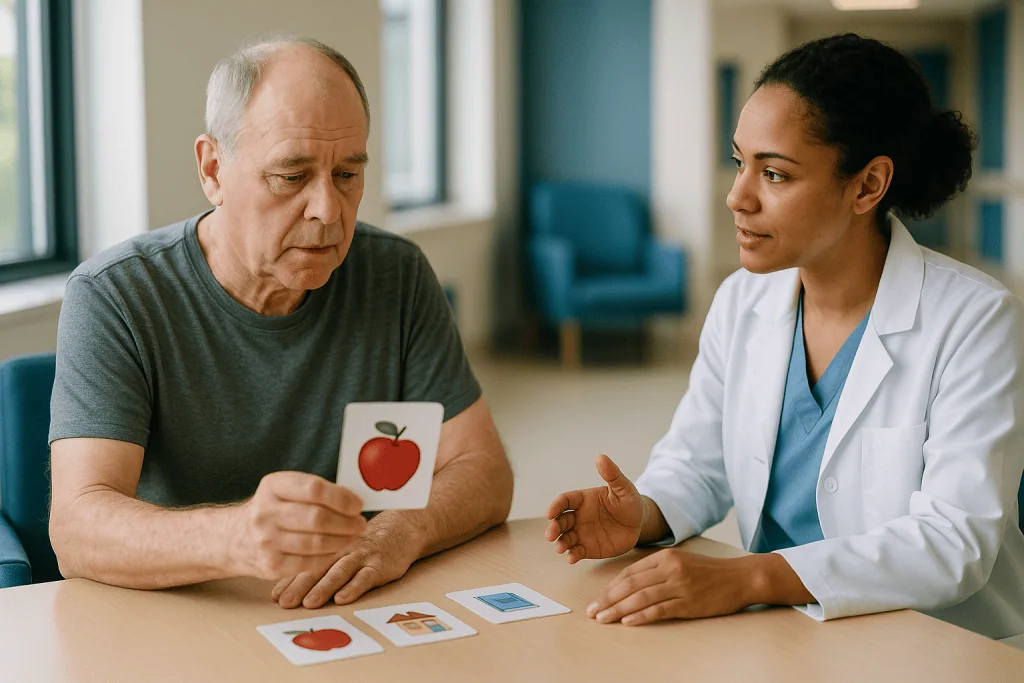
Therapists first identify where the breakdown sits. In non-fluent aphasia, the person understands reasonably well but struggles to produce words, often speaking in short, effortful bursts. In fluent aphasia, speech flows but may carry the wrong words or made-up ones, and understanding is often harder. The Mayo Clinic describes these patterns and the mixed forms between them. A plan for one would be wrong for the other.
From there, sessions use repetition and graded difficulty. Naming a picture, then naming it in a sentence, then using the word in conversation; each step is practiced until it is reliable before the next is added. The brain’s capacity to reorganise after injury, called neuroplasticity, responds to exactly this kind of frequent, meaningful, slightly challenging practice.
Some approaches aim to restore language directly. Others aim to compensate: teaching gesture, drawing, writing single key words, or using a communication board or app so that a person can get their message across while word-finding recovers. Good programs usually blend the two, and the NHS notes that both strands are standard parts of care.
Group sessions, where several people with aphasia practice conversation together, and training for family members as communication partners round out most plans. None of it requires a special machine; what it requires is time, structure and a lot of patient repetition.
What percentage of people have aphasia after a stroke?
The number surprises most families, because aphasia is rarely talked about before it arrives. The American Stroke Association, part of the American Heart Association, reports that roughly a quarter to 40 percent of stroke survivors develop some degree of aphasia, which is why speech and language assessment is a routine step on nearly every stroke unit rather than a specialist afterthought.
The NIH estimates that about one million people in the United States currently live with aphasia and that close to 180,000 acquire it each year, most of them following a stroke, according to its NIDCD aphasia overview. Those figures describe people whose aphasia persisted long enough to be counted; a larger group has milder language difficulty in the first days that settles as swelling and shock in the brain subside.
Why does this matter for timing? Two reasons. First, because aphasia is so common, stroke services are built to screen for it early; a family rarely needs to lobby for an assessment. Second, because a meaningful share of early language problems improve on their own in the first weeks, the initial assessment is often repeated. A plan written on day two can look very different from one written on day fourteen.
Severity varies enormously. Some people lose a few words under pressure; others cannot reliably say yes or no. The Cleveland Clinic notes that the location and size of the damaged area, rather than the stroke type alone, largely determines where on that spectrum a person lands. That is also the strongest single predictor of how much and how fast language returns, which brings us to the question of timing itself.
How soon after a stroke should you start speech therapy?
Guidelines are clearer here than the online debate suggests. The American Heart Association and American Stroke Association’s Guidelines for Adult Stroke Rehabilitation and Recovery recommend speech and language therapy for people with aphasia and advise that rehabilitation begin as early as is safe once the person is medically stable, ideally within an organised stroke unit where therapists are part of the daily team.

What “early” means in practice is a few days rather than a few hours. The same guideline draws on trial evidence that very intensive physical rehabilitation within the first 24 hours was linked to worse outcomes than a more measured start, and most stroke services apply that caution across all therapies. The brain in the first day or two is dealing with swelling, unstable blood pressure and sometimes a second clot risk; the priority is protecting tissue, not drilling vocabulary.
For speech therapy specifically, the NHS describes assessment beginning in hospital, with therapy continuing after discharge through community or outpatient services. In many units the first bedside session, often focused on swallowing and basic communication, happens within the first week.
The Cochrane systematic review of speech and language therapy for aphasia, indexed on PubMed, found that therapy delivered at any stage after stroke improved functional communication compared with no therapy. It did not find convincing evidence that starting on a particular day produced better results than starting a short while later; what mattered more was that therapy happened and that enough of it was delivered.
So when families ask how soon, the honest answer is: as soon as the person can engage, and without panic if that turns out to be week two rather than day two.
Why the first days are about screening and swallowing, not drills
The earliest visit from a speech and language pathologist usually has little to do with language. It concerns swallowing. Dysphagia, difficulty swallowing safely, is common after stroke and can let food or fluid enter the lungs, and the AHA/ASA rehabilitation guideline recommends a swallowing screen before anyone eats or drinks. That the same specialist handles both swallowing and language is why their name appears so early on the chart.
Once swallowing is addressed, a brief communication screen follows. The therapist checks whether the person can follow a simple instruction, name a few objects, read a short line, write their name. This is not a test to be passed; it is a baseline. Results are often skewed in the first days by fatigue, medication, and the general fog that follows a brain injury, which is why a formal, longer assessment is typically repeated once the person is more alert.
Early sessions, when they happen, tend to be short. Ten or fifteen minutes of focused work can exhaust a person on day three in a way that forty minutes will not on day twenty. Therapists expect this and plan around it.
Families sometimes read the brevity as a lack of urgency. It is the opposite. Short, frequent contact lets the team watch for change, notice whether language is improving spontaneously, and shape a plan that fits the person in front of them rather than a textbook. The MedlinePlus overview describes this staged approach as standard, and it has a practical benefit: by the time a person is ready for sustained therapy, the team already knows them.
Who is usually started early, and who is usually asked to wait
Decisions about timing are made by the treating team, and they weigh a handful of factors that families can usefully understand.
People who are typically started on structured therapy within the first week or two share certain features. They are medically stable, with blood pressure and heart rhythm under control. They are awake for reasonable stretches and can attend to a task for a few minutes. Their swallowing has been assessed. Their language difficulty is clear enough on screening that waiting would delay useful work. Mild to moderate aphasia in an otherwise recovering person often fits this picture.
Those who are usually asked to wait, or offered only brief contact at first, include people still in the acute medical phase: fluctuating alertness, a second stroke under investigation, pneumonia, significant swelling on imaging, or heavy sedation. A person who cannot stay awake for five minutes will not benefit from a thirty-minute session, and may be set back by it. The AHA/ASA guideline frames this as matching intensity to tolerance rather than to the calendar.
Severe global aphasia, where both understanding and expression are heavily affected, sits in a middle zone. Formal drills may wait, but early work on a yes-no system, gesture, or a simple communication board often begins quickly because it reduces distress for everyone.
Age alone is not a reason to delay. Neither is a poor first screening score; early scores are unreliable. Mood is watched closely, since depression after stroke is common and affects participation, as the NHS notes, but it is treated alongside therapy rather than used to postpone it.
Where a person falls on this spectrum can change within days, so the question is revisited rather than answered once.
The aphasia recovery timeline after stroke: what the following weeks usually look like
Recovery from aphasia follows a shape that most stroke clinicians recognise, even though no two people trace it identically.
The first days bring the fastest change, much of it spontaneous. Swelling eases, blood flow to the surrounding tissue stabilises, and skills that seemed lost return without any therapy at all. The NHS notes that some people recover considerably in this window; it is also when therapists are most cautious about reading too much into any single assessment.
Weeks two through roughly twelve are the period most guidelines describe as the window of greatest neuroplastic change, with the AHA/ASA rehabilitation guideline emphasising organised, goal-directed therapy during this time. Sessions grow longer and more frequent. Many people move from hospital to inpatient rehabilitation or home with outpatient therapy here, and the handover between settings is one of the points where care can quietly fall through gaps; worth asking about directly.
From three to six months, improvement typically continues but slows. Gains become more specific: a reliable set of names, a phone call completed, a reading passage finished. Therapy goals narrow accordingly.
Beyond six months, the phase usually called chronic, spontaneous change is modest, yet the Cochrane review on PubMed found therapy still improved functional communication in this period. Progress tends to come from practice rather than healing, and it is slower, but it is real.
Two caveats keep this honest. Severity at the start shapes the whole curve; mild aphasia often resolves largely within weeks, while severe aphasia may improve for years. And plateaus are common at every stage. A flat month is not a verdict.
Early vs later rehabilitation: what the evidence shows side by side
Putting the two approaches next to each other helps families see that they are complements rather than rivals. The table draws on the AHA/ASA rehabilitation guideline and the Cochrane review of speech and language therapy for aphasia.
| Question | Early therapy (first weeks) | Later therapy (months onward) |
|---|---|---|
| Main goal | Assess, protect swallowing, establish basic communication, begin targeted work as tolerated | Refine specific skills, build compensation strategies, support return to roles and activities |
| Session length | Often short, fatigue-limited | Longer, can be intensive if tolerated |
| Spontaneous recovery overlap | High, which makes individual effect hard to separate | Low, so gains more clearly reflect therapy |
| Evidence of benefit | Guideline-recommended; direct trials of very early intensive aphasia therapy are limited | Systematic review evidence of improved functional communication, including in chronic aphasia |
| Typical risk | Over-exertion in a medically unstable person | Discouragement, loss of access to services |
| Who decides | Stroke unit team | Community or outpatient team with the person |
Two points deserve emphasis. The Cochrane review compared therapy against no therapy and different types of therapy against each other; it did not identify a specific start day as superior, and it noted that higher intensity and higher total dose were associated with greater gains, with the caveat that more people dropped out of intensive programs.
The AHA/ASA guideline recommends therapy across the recovery course and rates intensive treatment as probably beneficial, while cautioning against high-intensity work in the very first day. Early and later rehabilitation are the same project at different stages; the mistake is treating either as optional.
Does intensive aphasia therapy work better than spread-out sessions?
Intensity is the variable researchers have studied most, and it is where the evidence has shifted in the past decade.
Intensive aphasia therapy generally means several hours of therapy a week concentrated into a short period, rather than one weekly session stretched over months. The Cochrane review indexed on PubMed found that higher-intensity, higher-dose therapy produced larger improvements in functional communication and in specific language skills than lower-intensity therapy. It also recorded a higher dropout rate in the intensive arms, which tells its own story: not everyone can sustain that schedule, particularly early on.
The AHA/ASA rehabilitation guideline reaches a similar conclusion, stating that intensive treatment is probably beneficial for aphasia while advising that intensity be set according to what the individual can tolerate. Fatigue after stroke is a medical symptom, not a lack of motivation, and it governs how much therapy is realistic in any given week.
How does this bear on timing? Mainly by reframing the question. If dose matters, then a person who starts therapy later but receives a concentrated block may accumulate as much useful practice as someone who started earlier at a thinner rate. Total exposure over the first year counts, and it can be built in different shapes.
Practical limits apply. Few health systems can offer daily sessions for months, and the research on intensive programs in chronic aphasia often comes from trials with more therapist time than routine services provide. Home practice, group sessions and communication-partner training are the usual ways of raising the dose without raising the number of clinical appointments, and most therapists will build these in deliberately.
Whether intensive therapy suits a particular person is a judgment the treating team makes with them, taking fatigue, mood and home support into account.
Is it ever too late? Chronic aphasia treatment beyond the first year
The belief that recovery stops at six months has done real harm. People discharged from therapy at that point often assume the door has closed, and some stop practising altogether.
The evidence says otherwise. The Cochrane review on PubMed included trials in which participants were well past the first year and still found improvements in functional communication with therapy compared with none. The NIH’s NIDCD states plainly that some people continue to improve for years, and that treatment can still help long after the acute phase.
What changes in chronic aphasia is the mechanism. Early gains lean on tissue healing; later gains rely on the brain building new routes through practice. That makes progress slower and more dependent on repetition, which is why chronic-phase programs lean heavily on home practice, group conversation and technology that lets a person work between appointments.
Goals change too. A person two years out rarely needs to relearn the word for cup; they may want to manage a phone call, read a menu, or return to a volunteer role. Therapy becomes more tailored and often more satisfying for exactly that reason.
Research into medicines and brain stimulation as add-ons to therapy in chronic aphasia is active, but no drug is currently established as a treatment for aphasia itself; if a prescribing clinician discusses any such option, it will be within a trial or on a carefully individual basis, and the decision rests with them.
If a person with aphasia has been without therapy for a long stretch, the useful question is not whether it is too late but whether a fresh assessment might identify achievable goals. Referral routes vary by region, and the person’s own doctor is the place to ask.
Can you fully recover from aphasia after a stroke? What the evidence actually shows
This is the question beneath every other, and it deserves a direct, careful answer.
Some people do recover completely, especially when aphasia is mild and the stroke small. The NHS notes that many people improve considerably and some return to their previous level of communication, while others are left with lasting difficulty. The Mayo Clinic frames it similarly: recovery depends on the cause, the extent of damage, and the person’s age and general health, and most people make at least some gains.
No guideline offers a reliable percentage for full recovery, and readers should be wary of any source that does. Studies define recovery differently, measure it at different times, and include people with very different severities. A figure quoted without those details is not a figure that applies to any individual.
What can be said with confidence is this. Severity at the outset is the strongest predictor; smaller, more localised strokes carry better language outcomes. Early improvement in the first weeks tends to predict further improvement. Therapy improves functional communication at every stage, per the Cochrane review. And many people whose language never returns completely nonetheless rebuild rich communication through a mix of recovered words, strategies and technology.
Families sometimes hear “we cannot promise” as pessimism. Therapists mean it as honesty, because they have watched people exceed expectations and others plateau unexpectedly. The sensible stance is to pursue therapy as fully as circumstances allow, measure progress in what the person can now do that they could not do last month, and let the question of “full” recovery answer itself over time.
What people often get wrong about aphasia therapy timing
Several durable myths steer families toward either panic or passivity. Each has a clear correction in the evidence.
“Every day without therapy is a day lost.” Early therapy is recommended, but the Cochrane review on PubMed did not find that a particular start day determined outcome; total amount and intensity mattered more. A week’s delay while someone is medically unstable is not a catastrophe.
“The brain needs complete rest, so wait a month.” The opposite error. The AHA/ASA guideline recommends starting rehabilitation as soon as it is safe, and the first three months are when organised therapy appears to make the most of natural recovery.
“If she is not talking by three months, that is how it will stay.” Improvement continues beyond six months and sometimes for years, as the NIDCD describes, even if the pace slows.
“Aphasia means he does not understand.” Many people with aphasia understand far more than they can express. Speaking to them as if they were absent, or discussing them across the bed, is both hurtful and clinically inaccurate.
“Speech apps can replace a therapist.” Technology can raise the practice dose between sessions, and the AHA/ASA guideline considers computer-based treatment a reasonable addition, but no app has been shown to substitute for assessment and a tailored plan.
“Louder and slower will fix it.” Aphasia is not a hearing problem. Short sentences, one idea at a time, time to respond and a pen within reach help far more than volume.
“Once discharged, therapy is over.” Discharge from one service is often an administrative event, not a clinical one. Asking about ongoing routes, including group and community programs, is reasonable at any point.
What families can do between sessions that genuinely helps
Therapy hours are scarce; the rest of the week is where much of the practice happens. The evidence supports a few specific habits over general encouragement.
Communication partner training, in which family members learn techniques for conversing with someone who has aphasia, is one of the better-studied additions to therapy and features in the AHA/ASA rehabilitation guideline as a reasonable component of care. It covers things that sound simple and turn out to be hard: asking one question at a time, offering choices rather than open questions, writing key words as you say them, and waiting, often longer than feels comfortable, for an answer.
Keeping the person in conversation matters more than correcting them. Finishing someone’s sentence saves a few seconds and removes the retrieval attempt that was the whole point. The MedlinePlus overview lists practical tips along these lines, including reducing background noise and using gesture and drawing freely.
Home practice set by the therapist is worth protecting like a medical appointment. Ten minutes twice a day, built around things the person cares about, such as the names of grandchildren or the items on a shopping list, keeps the total dose up between visits.
Watch for low mood. Depression after stroke is common, the NHS notes, and it erodes participation quietly; a person who was keen in week two and withdrawn in week six may need the team to look at mood rather than motivation.
Finally, families need their own rest. Aphasia changes relationships, and carers who are exhausted communicate worse. Group programs and peer support, where available, help both sides of the conversation.
Questions to ask your care team
Stroke wards are busy, and the moment a therapist is at the bedside is often the moment a family cannot think of a single question. Writing a few down in advance changes that. The following are the ones that tend to produce the most useful answers about timing.
- Has a swallowing assessment been done, and what were the results?
- What type of aphasia has been identified so far, and how confident are you given how early it is?
- When do you expect to start formal therapy sessions, and what is the reason for that timing in this case?
- How long will sessions be at first, and how will you decide when to increase them?
- What can we do between sessions, and is there a home practice plan we should follow?
- Is communication partner training available for us as a family?
- What happens to therapy when the move from hospital to rehabilitation or home takes place, and who coordinates that handover?
- How will progress be measured, and when will the assessment be repeated?
- Are group sessions or community programs part of the plan, and at what stage?
- What signs would make you change the plan, either to intensify or to pause therapy?
- If therapy is discharged at some point, what are the routes back in if we want a reassessment later?
Two habits make these conversations work better. Ask for the answer to be written down, since recall after a difficult day is poor for everyone, not only the person with aphasia. And include the person with aphasia in the conversation, using the same techniques the therapist uses, even when the family member is the one holding the list.
None of these questions implies distrust. Teams generally welcome them, because a family that understands the plan is a family that will carry it out at home.
When to call your doctor: red-flag signs during aphasia recovery
Recovery is rarely a straight line, and most variation is harmless. Some changes, however, need urgent attention because they can signal a new stroke, a bleed, a seizure or an infection rather than an ordinary bad day.
Call emergency services immediately if any of the following appears suddenly:
- A new or abrupt worsening of speech or understanding, especially if it comes on over minutes
- New weakness or numbness of the face, arm or leg, particularly on one side
- A sudden severe headache unlike any before
- New confusion, drowsiness that is hard to rouse, or loss of consciousness
- Sudden loss of vision in one or both eyes, or double vision
- A seizure, or jerking movements the person cannot control
The NHS and the American Stroke Association both stress that a sudden change in language after a stroke should be treated as a possible new stroke until proven otherwise; time to treatment matters.
Contact the stroke team or the person’s own doctor promptly, though not necessarily as an emergency, for:
- Coughing or choking with food or drink, a wet-sounding voice after swallowing, or a chest infection, which can indicate unsafe swallowing
- Persistent low mood, withdrawal from therapy, or expressions of hopelessness
- A steady decline in language over days rather than a plateau
- Excessive sleepiness or fatigue that is new and prevents participation
- Any concern about medicines, side effects or missed doses; the prescribing clinician, not the family, should adjust them
Everything in this article describes typical care and typical timelines. The right plan for any one person depends on their stroke, their health and their goals, and it belongs with the team treating them. If something feels wrong, asking is always appropriate, and asking early is better than waiting to see.
Frequently asked questions
How soon after a stroke should you start speech therapy?
Assessment usually begins within the first few days in hospital, and structured therapy starts as soon as the person is medically stable and alert enough to take part, often within the first one to two weeks. Guidelines recommend early rehabilitation but advise against intensive therapy in the first 24 hours. The exact start depends on the person’s condition and is set by the stroke team.
Can you fully recover from aphasia after a stroke?
Some people recover completely, particularly when the aphasia is mild and the stroke small, while others have lasting difficulty. No guideline gives a reliable percentage, because studies define recovery differently. Severity at the start is the strongest predictor, early improvement tends to predict further gains, and therapy improves functional communication at every stage, according to the Cochrane systematic review.
How long does it take to start talking again after a stroke?
There is no fixed timetable. Mild aphasia often improves substantially within the first weeks, while severe aphasia may change slowly over months or years. The first three months bring the fastest spontaneous recovery, and gains usually continue, more gradually, beyond six months. Progress is measured in specific abilities, such as reliable names or a completed phone call, rather than a single moment of talking again.
What percentage of people have aphasia after a stroke?
The American Stroke Association reports that roughly 25 to 40 percent of stroke survivors develop some degree of aphasia. The NIH estimates that about one million people in the United States currently live with aphasia and that close to 180,000 acquire it each year, most often following a stroke. Many milder early language problems improve on their own within the first weeks.
What is the aphasia recovery timeline after stroke?
Typically, the first days bring rapid spontaneous change as swelling settles; weeks two through about twelve are the window of greatest neuroplastic change where organised therapy is emphasised; months three to six bring slower, more specific gains; and beyond six months, the chronic phase, improvement continues mainly through practice. Severity at the outset shapes the whole curve, and plateaus are common at every stage.
Is intensive aphasia therapy better than weekly sessions?
The Cochrane review found that higher-intensity, higher-dose therapy produced larger improvements in functional communication than lower-intensity therapy, though more people dropped out of intensive programs. Guidelines rate intensive treatment as probably beneficial while advising that intensity match what the person can tolerate. Fatigue after stroke is a medical symptom, so the right schedule is a joint decision with the treating team.
Is chronic aphasia treatment worthwhile years after a stroke?
Yes, the evidence supports it. Trials included in the Cochrane review enrolled people well past the first year and still found improvements in functional communication with therapy compared with none. Gains in chronic aphasia come mainly from practice rather than tissue healing, so progress is slower and depends on repetition, but goals such as managing phone calls or reading a menu are realistic targets.
Why does the speech therapist check swallowing first?
Difficulty swallowing, called dysphagia, is common after stroke and can allow food or fluid to enter the lungs, causing pneumonia. Guidelines recommend a swallowing screen before a person eats or drinks. The same specialist, a speech and language pathologist, assesses both swallowing and language, which is why their first visit often concerns safe eating rather than word-finding exercises.
Does speech therapy after stroke timing matter if the person is depressed or very tired?
Both are taken seriously but neither is a reason to abandon therapy. Depression after stroke is common and reduces participation, so teams usually address mood alongside therapy rather than postponing it. Fatigue limits how long and how often sessions can run, particularly early on; therapists shorten sessions and build practice into daily routines rather than waiting for fatigue to disappear.
What can families do if therapy has been discharged but difficulties remain?
Discharge from one service is often administrative rather than a sign that recovery has ended. A reassessment can identify new, achievable goals, and community groups or communication partner training may be available. The person’s own doctor or the stroke team can advise on referral routes in their area. Continuing structured home practice in the meantime keeps the total amount of practice up.
References
This article is for general information only and is not a substitute for professional medical advice. Please consult a qualified doctor about your individual situation.

More from the Blog
Reading a Dementia Care Plan: Questions Families Ask About Medicines and Follow-Up
A dementia care plan is a written summary of diagnosis, medicines, goals, safety steps, and follow-up dates. Families most often ask what each medicine…
Traumatic Brain Injury Rehabilitation: The Stages From Intensive Care to Returning Home
Traumatic brain injury rehabilitation usually moves through several stages: emergency and intensive care to stabilize the brain, an acute hospital ward where therapy begins…
Temporal Lobectomy or Laser Ablation: How Does Each Epilepsy Surgery Reach the Seizure Focus?
A temporal lobectomy reaches the seizure focus from the outside: the surgeon opens a section of skull and removes the front of the temporal…
Is Insomnia Treated Differently in Older Adults? What Sleep Specialists Adjust and Why
Yes. Insomnia treatment in older adults still begins with cognitive behavioral therapy for insomnia, but clinicians adjust how they apply it and become far…

Migraine Myths a Neurologist Would Correct: It Is Not Just a Bad Headache
Migraine is a neurological disorder, not simply a severe headache. Attacks often unfold in phases, can occur without head pain or aura, affect men…

Which Headaches Are Expected After Brain Shunt Surgery and When to Contact Your Neurosurgeon
A dull, incision-focused headache after shunt surgery is common in the first days and usually settles as swelling fades and the brain adapts to…