

Which Female Hair Transplant Side Effects Are Normal? Redness, Scabbing and Swelling Explained
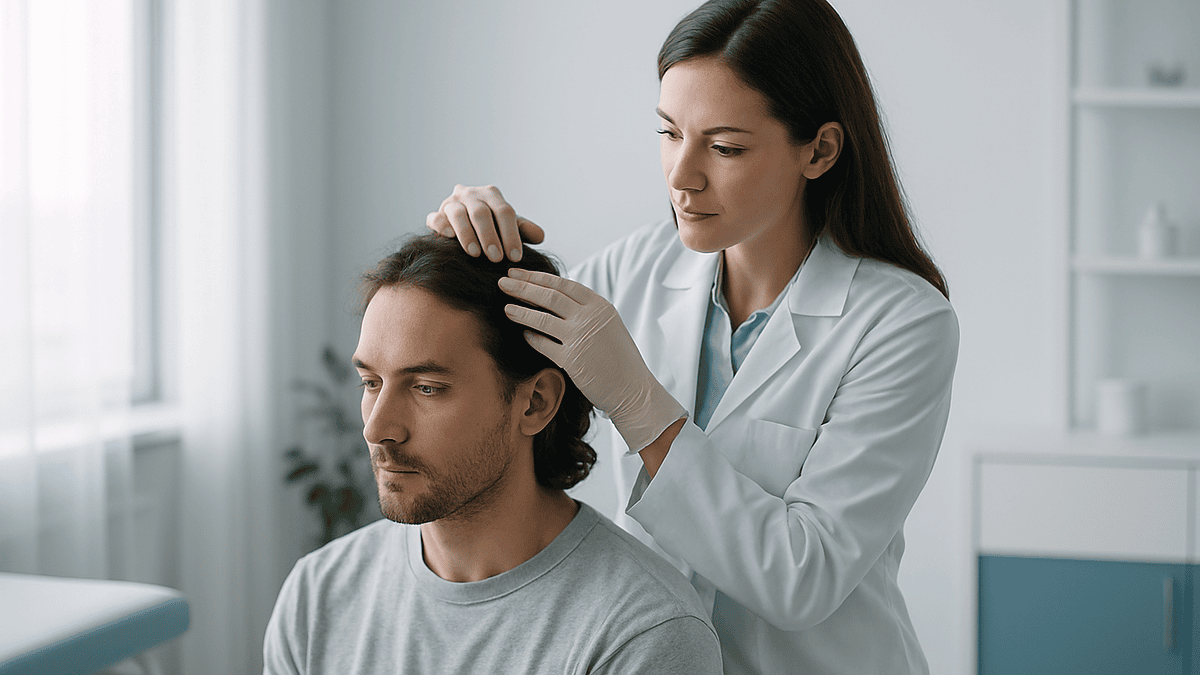
Key Takeaways
- Forehead and eyelid swelling after a hair transplant usually appears on day two, peaks around days three to four and is fluid following gravity, not a sign of facial injury.
- Scabs over the grafts typically loosen and fall away within about ten to fourteen days, and picking them off before roughly day three risks pulling out the follicle itself.
- Nearly all transplanted hairs shed between two and six weeks after surgery, with new growth usually visible from about six months and the full result judged at twelve to eighteen months.
- Women are more prone than men to shock loss of existing fine hairs near the grafts, because female pattern loss is often diffuse and the surrounding hair is already miniaturizing.
- About one-third of women experience noticeable hair loss at some point, but only patterned loss with a stable, dense donor zone is generally considered suitable for surgery.
- Spreading redness, pus, fever or pain that worsens after day three are not normal side effects and should be reported to the surgical team the same day.
After a female hair transplant, mild redness, pinpoint scabs over each graft, tightness and swelling that drifts toward the forehead are expected in the first one to two weeks, and shedding of the transplanted hairs a few weeks later is normal. Spreading redness, pus, fever, severe pain or swelling that worsens after day four are not normal and should be reported to the surgical team promptly.
The third morning after her procedure, she tilted the bathroom mirror and did not recognize her own forehead. It had puffed forward like a rising loaf, the skin taut and faintly shiny, while a scatter of tiny dark crusts dotted her new hairline. Nobody had told her the swelling would arrive two days late, or that it would look worse before it looked better.
That scene plays out in a lot of households. Women make up a growing share of people having hair restoration surgery, yet most of the recovery advice online is written for men with short hair and a shaved head. Long hair hides more, but it also traps more moisture around scabs, snags on grafts and makes the first wash genuinely nerve-racking.
This explainer sorts female hair transplant side effects into three honest piles: what almost everyone gets, what a minority gets, and the small handful of signs that mean pick up the phone today.
How a hair transplant actually works, and why the scalp reacts the way it does
A hair transplant moves hair from a part of your own scalp that keeps growing hair for life to a part that has stopped. The hair travels as follicular units, which are the natural little bundles of one to four hairs, plus the oil gland and tiny muscle that come with them. Each bundle is called a graft.
Two harvesting methods are in common use. Follicular unit excision, usually shortened to FUE, removes grafts one at a time with a small circular punch, leaving many dot-sized wounds across the donor area at the back and sides. Follicular unit transplantation, or FUT, removes a thin strip of scalp that is then divided into grafts under magnification, leaving one linear scar. In both cases the surgeon makes hundreds or thousands of tiny incisions in the thinning zone and places a graft in each one.
Do the arithmetic and the reaction makes sense. A typical session creates several thousand small wounds, all at once, on skin that is richly supplied with blood vessels and nerves. Your body responds the way it would to any injury: blood vessels widen and leak fluid, which is why the area turns pink and swells; platelets and proteins seal each opening, which is why a crust forms over every graft; and the tiny sensory nerves cut during the procedure send confused signals, which is why the scalp feels numb, tingly or itchy for a while.
The local anesthetic used to numb the scalp adds its own fluid volume, sometimes a considerable amount, and that liquid has to go somewhere. It follows gravity. The NHS describes the expected aftermath plainly: a tight, achy and swollen scalp for a few days, some bruising, and temporary scabbing where grafts were placed.
Which female hair transplant side effects are normal in the first week?
Think of the first seven days as controlled inflammation rather than something going wrong. Almost everyone experiences the following, and the surgical team will have seen it thousands of times.
Pinkness across both the recipient and donor areas is universal. Under long hair it can look alarming when you part the strands, but the color should be even, warm-pink rather than angry red, and it should not spread beyond the treated zone.
Scabbing appears within 24 hours as a fine dark grain over each graft. On a dense hairline this can look like ground pepper. It is dried blood and serum doing its job, and it is not a sign of infection.
Swelling usually starts the day after surgery and peaks around days two to four. Tightness, a dull ache and a sensation of pressure are part of that same process. Most people can return to desk-based work about three days after the procedure, according to the NHS, although many women choose to wait until the swelling has settled.
Numbness, tingling and itching arrive in overlapping waves. The itch is often the most annoying symptom of the whole recovery, and the one that tempts people to scratch grafts they were told not to touch.
Small amounts of oozing from the donor area on the first night are common with both FUE and FUT. A little blood on the pillow is expected; a soaked pillowcase is not.
Fatigue and feeling emotionally flat for a few days are also frequently reported. A long procedure, disrupted sleep and a face that looks unfamiliar in the mirror take a toll that has nothing to do with the grafts themselves.
Why does hair transplant swelling reach the forehead and eyes?
Of all female hair transplant side effects, forehead swelling generates the most anxious phone calls, partly because it shows up late and partly because it can migrate onto the face. The mechanism is not mysterious. Inflammatory fluid and leftover anesthetic solution collect in the loose tissue under the scalp. That tissue plane runs downward with nothing to stop it until it meets the bony rim above the eyes. Gravity does the rest, so fluid that began at the hairline ends up over the brow and sometimes in the upper eyelids.
The pattern has a recognizable rhythm. Little or nothing on day one, a puffy brow on day two, a peak around day three or four, then steady improvement as the lymphatic system carries the fluid away. Mayo Clinic and Cleveland Clinic both list swelling and bruising around the eyes among the expected short-term effects of hair transplant surgery. Bruising can turn yellow-green as it fades, which is normal color change, not a new problem.
Why some women swell more than others is only partly understood. A larger session, a lower hairline design, more anesthetic fluid and lying flat during sleep all appear to increase it. The face itself is not being operated on; it is simply downstream.
Surgical teams typically advise sleeping with the head elevated for the first several nights and avoiding bending forward, heavy lifting and hot showers while swelling is present. Some teams use cool compresses on the forehead, never on the grafts. Whether medicines are used to limit swelling is a decision for the surgeon, based on your medical history.
Swelling that keeps increasing after day four or five, feels hot, or is confined to one side and accompanied by increasing pain is a different matter and belongs in the red-flag section below.
Redness, pinkness and scabbing: what the timeline usually looks like
Redness and scabbing follow separate clocks, and understanding both prevents needless worry.
Scabs are short-lived. Each graft sits in an incision roughly the width of a pen tip, and the crust that seals it is small. During the first two to three days most surgeons ask patients not to touch the grafts at all, because the follicles have not yet anchored and can be dislodged. After that, gentle washing begins, often by pouring diluted, unperfumed shampoo over the scalp rather than rubbing. As the NHS describes, scabs should soften and fall away on their own over roughly the next ten to fourteen days. A crust that comes off in the wash with a hair attached usually alarms people; the follicle itself is normally already rooted beneath the skin, and the visible hair shaft was going to shed anyway.
Redness lasts longer, and this is where women with fair or thin skin need patience. Pinkness often persists for several weeks and can linger for a few months in some people, gradually fading as new capillaries recede. It is more visible on paler skin and in sun. Concealing products, hairstyles and hats all come with the same advice: check with the surgical team before applying anything to healing skin, and protect the area from direct sunlight, which can prolong discoloration.
What redness should not do is spread outward, develop a raised hot edge, or become studded with white or yellow pus-filled bumps. Those signs point toward infection or folliculitis, which is inflammation of individual hair follicles, and they change the plan.
Women with darker skin tones face a slightly different concern: post-inflammatory hyperpigmentation, meaning darker patches left behind after inflammation, which usually fades slowly but should be mentioned at follow-up.
Shock loss after hair transplant: why the new hair falls out first
Around the second to sixth week, something happens that no amount of forewarning fully prepares people for. The transplanted hairs fall out. Almost all of them. The hairline that looked promising in week one turns back into bare pink skin, and the fear that the surgery failed is immediate.
The biology here is reassuring. Hair grows in cycles, and a follicle that has been cut from its blood supply, kept cool outside the body for hours, then replanted into a fresh incision responds to that stress by dropping its hair shaft and resting. The living part, the follicle bulb beneath the skin, stays put. MedlinePlus notes that the transplanted hair typically falls out within two to three weeks, and the NHS puts the window at roughly two to six weeks, with new growth usually becoming visible after about six months.
A second kind of shedding worries women more. Shock loss, sometimes called telogen effluvium after transplant, is the temporary shedding of existing hair near the grafts or in the donor area. Telogen effluvium is the medical term for hair that is pushed prematurely into its resting phase by a stressor, and surgery counts as a stressor. Women often have finer, miniaturized hairs around a thinning crown or part, and these vulnerable hairs are the ones most likely to shed when the surrounding tissue is disturbed. Cleveland Clinic lists this among the recognized side effects.
In most people, shock-shed hairs regrow over the following months because the follicles were resting, not destroyed. Hairs that were already close to the end of their life may not return, which is one reason surgeons assess the surrounding hair carefully before recommending surgery. The interval between shedding and visible regrowth is the psychological low point of recovery; knowing that in advance helps.
Is FUE hair transplant painful? Numbness, tingling and itching explained
The honest answer is that the procedure itself is usually the least painful part. It is performed under local anesthetic, and the injections that numb the scalp are what most people remember as uncomfortable: a series of sharp stings and pressure over several minutes. Once the skin is numb, patients typically describe pressure, vibration and the sound of the punch rather than pain. Sessions can last most of a day, and stiffness from lying still often bothers people more than the surgery.
Afterward, the sensory story gets more interesting. FUE leaves many tiny wounds spread over a wide donor area, so the back of the head can feel tender and sunburned for a few days. FUT concentrates the discomfort along one line, with a tighter, pulling sensation when the neck bends. Neither is generally described as severe, and the NHS notes that most people manage with over-the-counter pain relief, which is a decision to make with the surgical team rather than on your own.
Numbness is common and can be patchy. Small sensory nerves are unavoidably cut during graft harvesting and placement, and they regrow slowly, at a rate often quoted as roughly a millimeter a day. Most people regain normal sensation over weeks to a few months; a minority notice altered sensation in a small area for longer, and the NHS lists loss of feeling in the scalp among the possible longer-lasting effects.
Itching usually begins as the scabs dry and healing skin tightens, typically toward the end of the first week. Cool compresses away from grafts, keeping the scalp clean and resisting the urge to scratch are the usual advice. Persistent itching with bumps or pus, however, is folliculitis until proven otherwise.
Hair transplant recovery for women: what the following weeks usually look like
Longer hair changes the recovery in practical ways. It hides the donor area for FUE when only a strip underneath is shaved, but it also needs washing, brushing and tying up, and every one of those actions has to be adapted for a few weeks. The table below summarizes the typical course drawn from NHS, MedlinePlus and Cleveland Clinic descriptions. Every timeframe is a usual range, not a guarantee, and your own team’s instructions take priority.
| Timing | Usual experience | Common instructions |
|---|---|---|
| Days 1–3 | Tightness, tenderness, mild oozing from donor area, swelling beginning | Do not touch grafts; sleep with head raised; avoid bending and lifting |
| Days 3–5 | Swelling peaks and may reach forehead or eyelids; scabs fully formed; itch begins | Gentle pour-over washing usually starts; no rubbing; no hats without team approval |
| Days 7–14 | Scabs loosen and fall away; swelling resolves; pinkness remains | Return to normal washing as advised; avoid sun; light exercise often permitted |
| Weeks 2–6 | Transplanted hairs shed; possible shock loss nearby; numbness fading | Hair coloring and styling products usually still restricted; check before resuming |
| Months 3–6 | Fine new hairs emerge, often light and thin at first | Routine follow-up; discuss any medicines with prescriber |
| Months 12–18 | Hair thickens and matures; final appearance assessed | Review with surgical team |
Two female-specific points deserve emphasis. Tight ponytails, clips and headbands can tug on both the grafts and the donor area and are generally discouraged until the team says otherwise. Hair dye, heat styling and chemical treatments are usually paused for several weeks because healing skin is easily irritated. The NHS indicates that the full result generally takes twelve to eighteen months to appear, so the calendar for judging the outcome is a long one.
Who is a hair transplant usually for, and who is usually asked to wait?
Hair loss in women is common. Harvard Health reports that about one-third of women experience noticeable hair loss at some point, and as many as two-thirds of postmenopausal women notice thinning or bald patches. Not all of it is suitable for surgery, and this is the single most important difference between the male and female pathway.
A transplant works only when there is a stable, permanent donor zone at the back and sides. In female pattern hair loss, the medical name for which is androgenetic alopecia, thinning often spreads diffusely across the whole scalp, including the back. If the donor hair is itself miniaturizing, moving it does not create lasting coverage. Surgeons therefore look for women whose loss is patterned and localized, such as a widened part or a receded frontal hairline, with clearly denser hair behind.
Several groups are usually asked to wait, or to pursue another route first. Women with recent diffuse shedding are typically evaluated for telogen effluvium, iron deficiency, thyroid disease and other reversible causes, because Mayo Clinic notes that hair loss from these causes frequently improves once the underlying issue is treated. Those who are pregnant, breastfeeding or within the postpartum year are generally deferred because hormonal shedding is still settling. Active scalp conditions such as alopecia areata, which is autoimmune patchy loss, or scarring alopecias, in which inflammation destroys follicles, are usually considered unsuitable while the disease is active, since grafts placed into inflamed skin may not survive.
Age matters less than stability. A woman whose pattern has been unchanged for a couple of years is easier to plan for than someone whose loss is still evolving. Medical conditions affecting healing, smoking and medicines that thin the blood all feed into the decision. The treating team weighs these factors; no article can.
Is there a downside to hair transplant? The less common complications
Yes, and an honest explainer names them. The reassuring context is that serious complications are uncommon when surgery is performed by trained clinicians in appropriate facilities; the sobering context is that the procedure is elective and its risks are borne entirely by the patient.
Infection is the complication people fear most. The NHS lists it alongside bleeding and allergic reaction to anesthetic as recognized risks of any hair transplant. It typically presents as spreading warmth, redness and pain a few days after surgery, sometimes with fever or discharge, and it requires prompt medical assessment.
Folliculitis, which is inflammation of individual follicles that looks like small red or pus-filled bumps, tends to appear weeks later as new hairs push through the skin. It is usually mild but occasionally needs treatment.
Small cysts can form where a graft was placed too deeply or where skin fragments were buried; they often resolve but sometimes need attention. Bleeding beyond the first night is unusual and more likely in people taking blood-thinning medicines.
Scarring is unavoidable in one form or another. FUT leaves a linear scar that longer hair usually covers; FUE leaves many dot scars that can become visible if the surrounding hair is later worn very short or thins further. Over-harvesting the donor area can leave it visibly sparse, a permanent trade-off.
Aesthetic problems form their own category: a hairline placed too low or too straight, grafts angled against the natural direction, or density that looks pluggy. These are technique-dependent and difficult to correct. Mayo Clinic notes that more than one session is sometimes needed, and that hair loss can continue around the transplanted area, so the picture may change over years regardless of how well the surgery went.
Medicines around a transplant: what they do, and who decides
Several classes of medicine commonly appear in the weeks around hair restoration surgery. Understanding their purpose reduces anxiety; deciding whether to use them is the prescribing clinician’s role, based on your history, and this section deliberately says nothing about amounts or schedules.
Local anesthetics numb the scalp during surgery by blocking nerve signals temporarily. The volume injected contributes to the swelling described earlier, and the fading of numbness over the first day is simply the medicine wearing off.
Pain relievers, whether over-the-counter or prescribed, are typically used for a few days. Some common types thin the blood slightly, which is exactly why surgical teams give specific instructions about which ones to use and which to avoid before and after surgery.
Antibiotics may be given as a short preventive course or reserved for treating an established infection, depending on the surgeon’s protocol and your risk factors. Their role is to reduce bacterial growth in fresh wounds, not to speed hair growth.
Anti-inflammatory medicines, including short courses of corticosteroids in some protocols, are sometimes used to limit swelling. They work by damping the inflammatory response; they also affect blood sugar and mood in some people, which is why they are not used universally.
Topical minoxidil, a generic medicine widely used for female pattern hair loss, prolongs the growing phase of the hair cycle and may increase follicle size. Harvard Health notes it typically needs six to twelve months of consistent use before an effect is judged, and that stopping it usually reverses the benefit. Anti-androgen medicines act on hormone signaling at the follicle. Whether either has a place before or after surgery, and when to start or resume one, is a conversation for the prescriber. Never begin, stop or change any of these on your own.
What people often get wrong about female hair transplant side effects
Myths cluster around this topic, and correcting them is more useful than repeating reassurance.
The first is that scabs should be picked off so the grafts can breathe. The opposite is true. Early scabs anchor and protect follicles; removing them before roughly day three risks pulling grafts out entirely. After that, gentle washing softens them so they lift on their own.
The second is that swelling on the face means the surgeon damaged something. Facial swelling is fluid obeying gravity, not evidence of injury. Its timing, peaking around days three to four and then receding, is the reassuring pattern.
The third is that shedding at week three means the transplant failed. Nearly every transplanted hair sheds before it regrows. Judging the result before six months, let alone before twelve, is judging a garden the week after planting.
The fourth is that women get fewer side effects because they usually keep their hair long. Long hair hides redness but does not reduce it, and it adds practical complications: moisture trapped against scabs, hair strands snagging grafts, and a strong temptation to tie hair back too tightly too soon.
The fifth is that a transplant stops hair loss. It does not. It relocates hair that is resistant to hormonal thinning; the hair around it remains subject to the same process, which is why Mayo Clinic cautions that loss can continue and further treatment may be needed.
The sixth is that any redness after a month is infection. Persistent pinkness on fair skin for several weeks is common. Infection announces itself differently, with heat, spreading edges, pain that worsens rather than eases, and often fever.
Finally, some assume female hair loss is always the same condition as male pattern loss. It frequently is not, and skipping the diagnostic workup is the error that leads to the most disappointing surgeries.
Is hair transplant successful in females, and what happens 10 years on?
Ask a careful surgeon this question and you will get a careful answer. Transplanted follicles taken from a genuinely stable donor zone generally continue to grow in their new location for the long term, because they carry their own biological instructions with them. That principle is well established. What no reputable source can promise is a specific percentage of graft survival or a guaranteed appearance, and this article will not either. Outcomes depend on the diagnosis being correct, the donor area being truly permanent, surgical technique, aftercare and how the untreated hair behaves over the following decade.
The last point is where women differ most from men. Female pattern hair loss tends to progress slowly and diffusely, so the hair surrounding a transplanted zone often continues to thin. Ten years after surgery, a woman may find the transplanted hairline still present while the hair behind it has become finer. That can create an uneven look and is the main reason surgeons discuss ongoing medical management alongside surgery. Mayo Clinic explicitly notes that hair loss may continue and that additional procedures are sometimes considered.
Donor scars evolve over the same period. FUT scars usually fade to a pale line; FUE dot scars can become more noticeable if the donor hair thins with age. Transplanted hair also greys and thins with age just as native hair does, because it is native hair.
Sensory changes almost always resolve within the first year. Redness is gone long before a decade passes. The honest long-term picture is therefore not about side effects at all; it is about whether the surgery kept pace with an underlying condition that does not stop. Anyone weighing surgery should ask what the plan is for year five and year ten, not only for month twelve.
Questions to ask your care team before and after a female hair transplant
Consultations run more usefully when the patient arrives with specific questions. The list below is not a checklist for self-diagnosis; it is a prompt for the conversation with the people who will actually treat you.
- What diagnosis are you treating, and how was it confirmed? Was a scalp examination, blood work or biopsy part of the evaluation?
- Is my donor area stable enough for long-term results, and how did you assess that?
- Which method do you propose for me, FUE or FUT, and why that one given my hair length and pattern?
- How much swelling, redness and scabbing do your patients typically experience, and what is your usual timeline for washing, tying hair back and resuming exercise?
- What exactly should I do on the first night if I notice bleeding, and who answers the phone after hours?
- Which of my regular medicines and supplements should I discuss before surgery, and when will you tell me to resume them?
- How will you handle my existing thinning hair around the grafts, and is medical treatment part of the plan?
- What does shock loss look like in women you treat, and how do you distinguish it from something going wrong?
- What are the signs of infection or folliculitis you want me to report, and how quickly?
- When is my first follow-up, and at what points will we assess the result?
- What would you consider a reason to postpone my surgery today?
Write the answers down. Recovery is easier when the instructions you follow are the ones your own team gave you, rather than a version pieced together from forums or from any article, including this one.
When to call your doctor: red-flag signs after a hair transplant
Most of what you will see and feel in the first fortnight belongs in the normal pile. A short list of signs does not, and each one deserves a same-day call to the surgical team rather than a wait until the scheduled follow-up.
Bleeding that does not stop with gentle pressure after ten to fifteen minutes, or that soaks through dressings or bedding, needs assessment. Pain that increases rather than eases after the first two or three days, or pain concentrated in one spot, is a warning sign. Swelling that continues to grow after day four or five, or that is hot, hard or confined to one side, is not the ordinary gravity-driven puffiness described earlier.
Redness that spreads outward beyond the treated area, develops a raised or sharply defined edge, or is accompanied by yellow or green discharge, pus-filled bumps or an unpleasant smell suggests infection or folliculitis. A fever, chills, or feeling generally unwell in the days after surgery should always be reported. Numbness that is worsening rather than slowly improving, or new weakness, also warrants a call.
Seek emergency care immediately, without waiting to reach the surgical team, if you experience difficulty breathing, swelling of the lips or tongue, a widespread rash, chest pain, a severe headache unlike any you have had before, confusion, or sudden vision changes. These are not typical transplant effects and may indicate an allergic reaction or an unrelated emergency.
When in doubt, call. Surgical teams would far rather hear about a false alarm than learn about a missed infection at the two-week review. Every decision about treatment, including whether a symptom needs to be seen, sits with the clinicians who know your case.
Frequently asked questions
Is hair transplant successful in females?
It can be, when the diagnosis is patterned hair loss and the donor area at the back of the scalp is genuinely stable. Transplanted follicles keep growing in their new location for the long term, but no reputable source can promise a specific percentage result. Because female pattern loss is often diffuse and continues around the grafts, careful selection and a long-term plan matter more than the surgery itself.
Is FUE hair transplant painful?
The most uncomfortable part is usually the local anesthetic injections, which sting for several minutes. Once the scalp is numb, most people feel pressure and vibration rather than pain. Afterward, the donor area typically feels tender or sunburned for a few days, and tightness, numbness and itching follow. Severe or worsening pain is not expected and should be reported to the surgical team.
How long does hair transplant swelling on the forehead last?
Forehead swelling usually begins the day after surgery, peaks around days three to four and then recedes steadily over the following few days as the body reabsorbs the fluid. It is caused by anesthetic fluid and inflammatory swelling draining downward under the scalp. Swelling that keeps increasing after day five, feels hot, or affects only one side should be reported promptly.
What is shock loss after hair transplant and does the hair come back?
Shock loss is temporary shedding of existing hair near the grafts or in the donor area, triggered by the stress of surgery pushing follicles into their resting phase. In most people the follicles are dormant rather than destroyed, and hair regrows over the following months. Hairs that were already severely miniaturized may not return, which is one reason surgeons assess surrounding hair carefully beforehand.
What happens 10 years after a hair transplant?
Transplanted hair taken from a stable donor zone generally keeps growing, greying and thinning with age like the rest of your hair. The bigger long-term issue is the untreated hair around it, which in women often continues to thin diffusely, sometimes leaving an uneven look. Scars fade but can become more visible if donor hair thins. Ongoing medical management is frequently part of the ten-year plan.
Is there a downside to hair transplant?
Yes. Every transplant leaves scars, either a line with FUT or many dots with FUE, and uses up a finite donor supply. Less common complications include infection, folliculitis, small cysts, prolonged numbness and aesthetic problems such as an unnatural hairline. The surgery also does not stop ongoing hair loss, so further treatment may be needed. The decision should weigh these against realistic expectations with the treating team.
How long does hair transplant recovery for women usually take?
Most women return to desk work within about three days, see swelling settle within the first week and lose their scabs within roughly two weeks. Transplanted hairs shed at two to six weeks, new growth becomes visible from around six months, and the final appearance is generally assessed at twelve to eighteen months. Restrictions on tight hairstyles, dye and heat styling usually last several weeks.
Why does my scalp itch so much after a hair transplant?
Itching typically starts toward the end of the first week as scabs dry and healing skin tightens, and as cut sensory nerves begin to recover. It is one of the most common and most irritating normal side effects. Keeping the scalp clean, using cool compresses away from the grafts and avoiding scratching are the usual measures. Itching with pus-filled bumps suggests folliculitis and should be reviewed.
Can I tie my hair back or color it after a female hair transplant?
Not straight away. Tight ponytails, clips and headbands can tug on both grafts and the donor wounds, and hair dye or chemical treatments can irritate healing skin, so surgical teams usually restrict them for several weeks. The exact timing depends on how you heal and on the method used. Ask your own team before resuming any styling routine rather than following a general rule.
How can I tell normal redness from infection after a hair transplant?
Normal pinkness is even in color, stays within the treated area and slowly fades over weeks. Infection tends to appear a few days after surgery with spreading redness, heat, a raised edge, pain that worsens rather than eases, and sometimes discharge or fever. Small pus-filled bumps appearing weeks later usually indicate folliculitis. Any of these signs should be reported to the surgical team the same day.
References
This article is for general information only and is not a substitute for professional medical advice. Please consult a qualified doctor about your individual situation.

More from the Blog
Getting Ready for a Beard Transplant: Skin Checks, Mapping the Beard Line and What to Pause
Beard transplant preparation usually spans several weeks and has three parts: a skin check of the face and donor scalp for active acne, folliculitis,…
What Female Hair Transplant Results Look Like Month by Month: From Shedding to Settled Density
A female hair transplant results timeline typically unfolds in stages: swelling and crusting in the first week, shedding of most grafted hairs between roughly…
Types of Hair Transplant: FUE, DHI, Sapphire and FUT: Which Fits Whom
The main types of hair transplant are FUT (a strip of scalp is removed and divided into grafts), FUE (follicles are extracted one by…
Beard Transplant Complications Explained: Ingrown Hairs, Pimples and Misdirected Growth
Beard transplant complications are usually minor and local: ingrown hairs, pimple-like folliculitis around new grafts, temporary swelling or numbness, small scars, and hairs that…
Hair Transplant Eligibility: The Checklist Surgeons Run Before Saying Yes
Hair transplant eligibility rests on five things surgeons weigh together: a confirmed diagnosis of pattern (androgenetic) hair loss, loss that has largely stabilized, a…

The Shedding Phase: The Scary-but-Normal Weeks After a Transplant
Yes, shedding after a hair transplant is normal and expected. Most transplanted hair shafts fall out between roughly two and eight weeks after surgery…