

Which Injuries Need Microsurgery? Nerve Repairs, Reattachment and Free Tissue Transfer
Key Takeaways
- Microsurgery covers three main jobs: repairing peripheral nerves, reattaching severed parts and moving living tissue with its own blood supply to a wound that cannot heal otherwise.
- Repaired nerve fibers regrow at roughly an inch per month, so recovery after a nerve repair is measured in months and depends heavily on how far the fibers must travel.
- A severed part should be wrapped in a clean damp cloth, sealed in a plastic bag and placed in ice water, never directly on ice, because freezing destroys the tissue.
- Thumbs, multiple fingers, hands and amputations in children are generally treated as strong candidates for replantation, while some crushed single fingers do better with careful closure.
- A free flap is fully detached during surgery and its artery and vein are reconnected under the microscope, which is why the tissue is monitored so intensely in the first days.
- Surgery for lymphedema is considered in only a small number of cases and does not replace compression, skin care and exercise, which remain the foundation of treatment.
Microsurgery treats injuries and defects too small or delicate for standard surgical tools: severed or damaged peripheral nerves, amputated fingers, hands or other body parts that may be reattached, and wounds that need living tissue moved from one part of the body to another with its own blood supply. It is also used for facial reanimation after nerve injury and, in selected cases, for lymphedema. Suitability is decided case by case by the treating team.
A carpenter arrives in the emergency department holding a sandwich bag against his chest. Inside, wrapped in gauze, is the top of his index finger. He has one question, and he asks it before anyone has taken his blood pressure: can you put it back?
The answer depends on something he has probably never heard of. Microsurgery is operating under a microscope on structures about the width of a pencil lead or finer: tiny arteries, veins and nerves that have to be sewn back together with thread thinner than a human hair. Understanding what microsurgery treats helps make sense of why one fingertip is reattached, another is closed and left to heal, and a third becomes a reconstruction using tissue from elsewhere on the body.
This explainer walks through the three big jobs of microsurgery, who is usually offered it, what the first weeks look like, and the myths that make a hard situation harder.
What microsurgery treats: the three jobs it does best
Strip away the jargon and microsurgery does three things. It repairs nerves, it reattaches body parts, and it moves living tissue from one place to another while keeping the blood flowing. Nearly every microsurgical operation is a version of one of those tasks, and most of the questions patients ask fall under one of them.
A peripheral nerve is a cable running from the spinal cord to a muscle or patch of skin; when it is cut, the two ends must be lined up and stitched so fibers can regrow across the gap. Replantation is the formal word for reattaching a fully severed part, most often a finger, thumb or hand. Free tissue transfer, usually called a free flap, means removing a block of skin, fat, muscle or bone with its artery and vein, moving it to a wound elsewhere, and reconnecting those vessels under the microscope so the tissue stays alive in its new home.
| Procedure | What is repaired | Typical situations | What success depends on |
|---|---|---|---|
| Nerve repair | Cut or crushed peripheral nerve | Knife and glass lacerations, fractures, some surgical injuries | Clean versus crushed ends, distance to the muscle, age, time since injury |
| Replantation | Severed finger, thumb, hand, rarely larger parts | Saw, machinery and crush injuries | Type of cut, how the part was stored, overall health |
| Free tissue transfer | Wounds lacking healthy coverage | Cancer removal, trauma, open fractures, breast and jaw reconstruction | Vessel quality, smoking status, blood sugar control, blood flow after surgery |
The table hides a point worth stating plainly: the same injury can land in different rows depending on the person. A clean thumb amputation in a healthy adult is a classic replantation case. The same thumb, crushed and detached for many hours in someone with poor circulation, may be better served by closing the wound now and planning a reconstruction later. Those are judgment calls, and they belong to the surgeon who has seen the injury.
How microsurgery actually works under the microscope
Picture sewing two drinking straws end to end, except the straws are the width of a grain of rice and must not leak. That is roughly the task when a surgeon joins a finger artery. The operating microscope sits above the field and magnifies it many times, so a vessel that looks like a thread to the naked eye becomes a tube with a visible wall, an inside lining and a cut edge that can be trimmed.
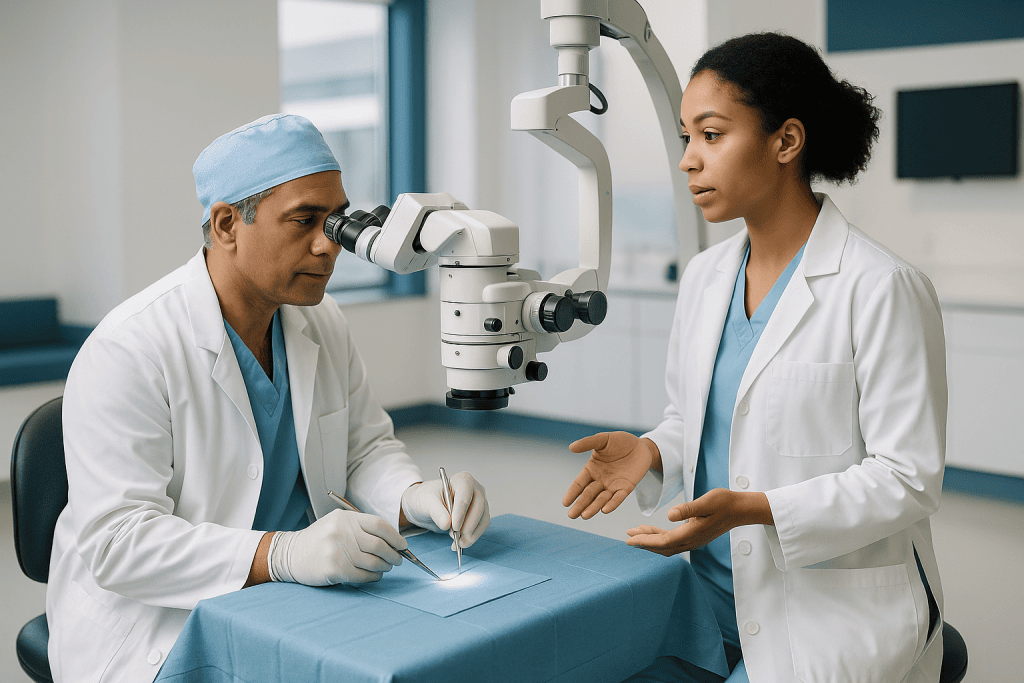
The instruments are scaled to match. Forceps have tips fine enough to grip a single stitch; needles are curved slivers of steel; the suture itself is a monofilament far finer than a hair. A surgeon places a series of evenly spaced stitches around the circumference of the vessel, releases the clamps, and watches. A good join fills and pulses. A poor one clots within minutes and has to be redone.
Nerves are joined differently. A nerve is a bundle of fascicles, each fascicle a group of fibers wrapped in connective tissue. The surgeon does not stitch the fibers themselves; those are microscopic even under magnification. Instead the outer sheath is aligned so that fascicles on one side point at their counterparts on the other, giving regrowing fibers a path to follow. The Mayo Clinic describes the practical consequence: nerve fibers regrow slowly, on the order of about an inch per month, so recovery after a nerve repair is measured in months rather than weeks.
The team around the microscope matters as much as the hands on the instruments. Anesthesia keeps blood pressure steady so freshly joined vessels stay open, the room is kept warm because cold constricts small arteries, and operations can run for many hours. Several surgical specialties use these techniques: plastic and reconstructive surgery, hand surgery, otolaryngology for head and neck reconstruction, and neurosurgery for certain nerve problems.
Microsurgery vs regular surgery: what is really different
Most operations work on things you can see. A surgeon removing an appendix or fixing a hip uses the naked eye, sometimes with magnifying loupes, and ties off blood vessels rather than reconnecting them. Microsurgery flips that logic. Its whole purpose is to keep or restore blood flow and nerve continuity in structures that conventional tools cannot handle, which changes almost everything about the experience.
Time is the first difference. Joining each vessel can take a long stretch of unhurried, deliberate work, and a single free flap may involve connecting one artery and one or two veins, then checking that the whole block of tissue is pink and refilling. Operations that run through most of a day are not unusual.
Monitoring is the second. After a knee replacement, nurses watch the wound and the patient. After a free flap or a replanted finger, they also watch the tissue itself, checking color, warmth, how quickly it refills after a gentle press, and sometimes a small handheld Doppler probe that listens for the whoosh of blood. The reason is practical: a clot in a newly joined vessel is most likely in the first few days, and a flap or finger that loses its supply can sometimes be rescued if the team returns to the operating room quickly.
The third difference is what the operation is for. Standard surgery often removes a problem. Microsurgery usually restores something: a nerve pathway, a thumb that can oppose the fingers, a jaw that can hold teeth, a breast after mastectomy. That restorative aim is also why the specialty overlaps with facial aesthetics. Reconstruction of a face after cancer or trauma is as much about how a person looks in a mirror as about how a wound heals.
Nerve repairs: when a cut nerve needs the microscope
The clearest sign that a nerve has been cut is a patch of numbness or a muscle that no longer fires. According to Johns Hopkins, peripheral nerve injuries range from a stretch or bruise that recovers on its own to a complete division that will not reconnect without surgery. Only the more severe end of that range is a microsurgical problem.
When a nerve is divided cleanly, as with a knife or glass, the ends can often be trimmed and sewn directly together. When a segment is crushed or missing, direct repair would put the join under tension, which chokes blood supply and produces scar instead of regrowth. Surgeons then bridge the gap. A nerve graft borrows a length of less important sensory nerve from elsewhere on the body, usually the lower leg, leaving a small numb patch there. A nerve transfer takes a working branch near the target muscle and reroutes it, shortening the distance fibers must travel. Conduits, small tubes that guide fibers across short gaps, are another option for small defects.
Timing is a recurring theme. The Mayo Clinic notes that repair is generally more successful when done soon after injury, and that muscles which lose their nerve supply weaken and can be permanently affected if reinnervation takes too long. That is the reason a surgeon may push for an early decision on a forearm nerve while taking a wait and see approach for a nerve that was stretched but not cut.
Recovery is genuinely slow. With regrowth of roughly an inch a month, a repair at the wrist aimed at small hand muscles can take many months before anything moves, and sensation often returns as tingling or odd sensations before it feels normal. Hand therapy during that time keeps joints supple so there is something worth reinnervating when the fibers arrive.
Reattachment after amputation: which parts can be replanted
Not every severed part can go back on, and not every part that could be reattached should be. Surgeons weigh three things: the mechanism of injury, the condition of the part, and the person it belongs to.
Mechanism comes first. A guillotine style cut leaves clean vessel ends that can be joined. A crush or avulsion, where the part is torn away, damages vessels over a length, so each end may be unusable even when the skin looks intact. Thumbs are given high priority because the hand loses a large share of its function without one, and surgeons will often attempt a thumb replantation they would not attempt for a single fingertip. Multiple finger amputations, hand and wrist amputations, and amputations in children are also generally treated as strong candidates for an attempt.
The part itself matters. Muscle tolerates loss of blood supply poorly, so a hand or forearm has a shorter usable window than a finger, which is mostly tendon, bone and skin. Cooling slows the clock, and how the part was handled on the way to hospital is often the deciding factor the surgeon cannot change.
MedlinePlus gives first aid that is worth knowing before you ever need it. Control bleeding with firm pressure on the stump. Rinse the part gently if it is dirty, wrap it in a clean damp cloth, seal it in a plastic bag, and place the bag in a container of ice water. Do not put the part directly on ice and do not use dry ice, because freezing destroys the tissue. Bring it with the person; even a part that cannot be replanted may provide skin or bone for the repair.
Who the person is completes the picture. Heavy smoking, poor circulation, uncontrolled diabetes and other serious injuries all lower the odds that a reattached part will survive and work. Sometimes a well fitted prosthesis or a shortened, well healed finger will serve a person better than a stiff, insensate replanted one.
Free flap surgery meaning: moving living tissue to where it is needed
A free flap is a piece of the body that takes its plumbing with it. Skin, fat, muscle, bone or a combination is lifted from a donor site together with the artery that feeds it and the vein that drains it. The surgeon then disconnects those vessels, carries the tissue to the wound, and reconnects artery to artery and vein to vein under the microscope. The flap is free because it is fully detached during the move; a local flap, by contrast, stays tethered to its original supply and is simply rotated into place.
Why go to such lengths? Some wounds cannot heal with a skin graft because there is nothing underneath for the graft to live on: exposed bone after an open fracture, a jaw segment removed for cancer, a chest wall after radiation. Living tissue with its own blood supply brings healing capacity to a place that has none. Bone flaps can be fixed with plates to rebuild a jaw and later hold dental implants. Skin and fat flaps from the abdomen can rebuild a breast after mastectomy. Muscle flaps fill deep cavities and resist infection.
Common donor sites include the forearm, thigh, lower leg, abdomen and the back, chosen for vessel size, the kind of tissue needed, and how well the donor area tolerates the loss. Every flap leaves two scars, one where it came from and one where it went, and both need care.
The first days after a free flap are about one thing: keeping the new vessel joins open. Teams monitor the flap frequently, keep the patient warm and well hydrated, and avoid anything that constricts blood vessels, which is why smoking and even nicotine replacement are usually off limits around surgery. A flap that turns pale, dusky or swollen is treated as an emergency, because an early return to theatre can sometimes save it.
Facial reanimation and head and neck reconstruction
Few injuries change a person as visibly as losing the nerve that moves one side of the face. Smiling becomes lopsided, the eye may not close, and food or drink can leak from the mouth. Facial reanimation is the branch of microsurgery that tries to restore movement, and it overlaps directly with facial aesthetics because symmetry at rest and in expression is the goal.
The approach depends on how long the facial muscles have been without a nerve. Early on, a cut facial nerve can be repaired or grafted much like any other peripheral nerve. If the nerve itself is unusable but the muscles are still viable, a nerve transfer can reroute a branch from a nearby nerve, such as the nerve that works the chewing muscles, to drive the smile. When the facial muscles have been denervated long enough to waste away, surgeons can bring in a small free muscle flap, often from the inner thigh, with its own nerve and vessels, and connect it so that it contracts when the person tries to smile. Learning to use that new muscle takes months of therapy, and the result is a trained movement rather than a reflex.
Head and neck reconstruction after cancer sits in the same territory. Removing a tumor of the tongue, jaw or throat can leave a defect that affects speech, swallowing and appearance at once. Free flaps from the forearm can resurface a tongue; bone flaps from the lower leg can rebuild a jaw. The aim is function first, appearance a close second, and patients are usually counselled that several stages and revisions are typical rather than a sign that something went wrong.
Microsurgery also protects the eye. When the eyelid cannot close, the cornea dries and can be damaged, so eye protection and sometimes small procedures to help closure run alongside the larger reconstructive plan.
Lymphedema surgery: a newer use for microsurgical skills
Lymphedema is swelling, most often in an arm or leg, caused by lymph fluid that cannot drain because lymph vessels or nodes have been damaged or removed. The Cleveland Clinic describes it as a chronic condition commonly linked to cancer treatment, infection or inherited differences in the lymphatic system. For most people, the mainstay of care is not surgery at all. The NHS lists compression garments, specialised massage, skin care and exercise as the core of treatment, and notes that surgery is considered only in a small number of cases.
Where surgery is used, it draws on the same microscope and the same suturing skills. Lymphaticovenous anastomosis connects tiny lymph vessels in the swollen limb directly into nearby small veins, giving fluid a new route back into the bloodstream. Vascularised lymph node transfer moves a cluster of lymph nodes with their blood supply from one part of the body to the affected area as a free flap. Liposuction, which removes the fatty tissue that builds up in long standing lymphedema, is a separate option that does not involve microsurgery but is sometimes offered alongside it.
The honest position on evidence is that these procedures are still being studied. The NHS is explicit that surgery is not suitable for everyone and does not remove the need for compression. People who have had surgery are usually asked to continue wearing garments, at least for a period, and to keep up skin care to lower the risk of cellulitis, the skin infection that is a recurring hazard with swollen limbs.
Candidates are typically those with earlier stage swelling, who have already tried non surgical care fully, who are free of active cancer and infection, and who understand that the goal is to reduce swelling and improve comfort rather than to return the limb to how it was before.
Who is usually a candidate for microsurgery, and who is asked to wait
Surgeons do not run through a tick box list, but a few themes come up in nearly every consultation. The first is whether the structure to be repaired is actually repairable: clean vessel and nerve ends, a part that was cooled properly, a wound bed with healthy vessels nearby. The second is whether the body can keep a repair alive. The third is whether the likely result is worth what the person will go through to get it.
People commonly offered microsurgery include otherwise healthy adults and children with clean amputations of the thumb, multiple fingers or hand; anyone with a sharply cut nerve that has left a clear motor or sensory loss; people whose cancer surgery or trauma has left a wound that cannot be closed by simpler means; and selected people with facial paralysis or early lymphedema who have exhausted conservative options.
Others are asked to wait, or are steered toward a different plan. Active smokers are often asked to stop for a period before elective reconstruction, because nicotine narrows small vessels and raises the chance that a flap fails. Poorly controlled diabetes, severe malnutrition and recent radiotherapy to the area all affect healing and may prompt a delay. Someone who is critically ill from other injuries may not be stable enough for a long operation, so the wound is cleaned and temporarily covered and the reconstruction scheduled later.
Age by itself is rarely the deciding factor; general fitness is. A fit older adult can do well with a free flap, while a younger person with multiple health problems may not. And for some single finger injuries, especially crush injuries of a non dominant finger, the evidence based advice is that a well closed stump often gives better function sooner than a replantation. Being told you are not a candidate is a clinical judgment about likely benefit, not a verdict on how hard you have tried to recover.
Replantation surgery recovery and what the weeks after a free flap look like
The first week is about blood flow. After a replanted finger or a free flap, you can expect frequent checks of color, warmth and capillary refill, sometimes hourly at first, and a warm room, extra fluids and strict instructions against caffeine and nicotine. Movement of the operated part is limited, the limb is elevated, and a bulky dressing or splint protects the repair. Many people find this stretch harder than they expected, not because of pain but because of boredom, broken sleep and anxiety about every nurse’s glance at the dressing.
The second phase is healing of skin and bone. Stitches at the repair and donor sites come out over the following weeks, swelling settles, and bone fixation, where fingers or a jaw were plated, needs time before it bears load. Hand therapy often starts early with gentle protected movement so tendons glide rather than scar down, then progresses as the surgeon confirms the bone and vessel repairs are secure.
Nerve recovery runs on its own clock. Because fibers regrow at roughly an inch per month according to the Mayo Clinic, sensation in a replanted fingertip or a repaired forearm nerve may take many months, and the first signs are often tingling, electric sensations or hypersensitivity rather than normal feeling. Cold intolerance, where the part aches in cold weather, is a common long term complaint after finger replantation.
Movement basics apply throughout. Long operations and bed rest raise the risk of blood clots in the legs, so early walking, calf exercises and any clot prevention measures the team prescribes matter. Return to driving, desk work and manual work are staged decisions, and anyone planning travel after surgery should arrange follow up before leaving and ask the team when a flight is reasonable.
Revisions are common and planned. Thinning a bulky flap, releasing scar, or secondary tendon surgery are frequent later steps rather than failures of the first operation.
Risks, failures and the alternatives you should hear about
The defining risk of microsurgery is that the repair stops working. A joined artery or vein can clot, usually within the first few days. When that happens to a free flap or replanted part, the tissue loses its blood supply, and unless the team can reopen the vessel quickly in the operating room, the flap or part is lost. That is why the monitoring is so intense and why patients are asked to report any change in color immediately.
Beyond that, the usual surgical risks apply: bleeding, infection, wound breakdown, anesthesia complications and blood clots in the legs after a long operation. Microsurgery adds a second wound at the donor site, with its own chance of pain, numbness, weakness or a hernia when muscle is taken from the abdominal wall. Nerve repairs carry the specific risk of a neuroma, a tender knot of regrowing fibers that can be more troublesome than the numbness it replaced.
Function is never fully restored. A replanted finger is typically stiffer and less sensitive than the original. A reanimated smile is a learned movement. A rebuilt jaw may look natural but chew differently. Honest teams say this before surgery, not after.
Alternatives deserve equal airtime. For a finger, revision amputation, meaning careful shortening and closure, gives a quick recovery and a useful hand. For wounds, a skin graft, a local flap or negative pressure dressing may be enough. For nerves that cannot be repaired, tendon transfers borrow a working muscle to perform the lost motion. For facial paralysis, static procedures can lift the corner of the mouth and help the eye close without attempting to restore movement. For lymphedema, compression and therapy remain the foundation, with surgery an addition rather than a replacement. Which path fits is a decision made with the treating team after an honest conversation about goals, risks and the time each option demands.
What people often get wrong about microsurgery
The first myth is that microsurgery means tiny incisions. It does not. The microscope magnifies what the surgeon sees, not the size of the operation. A free flap for a jaw involves long incisions in the leg and neck; a nerve graft leaves a scar on the calf. Keyhole surgery, which uses small ports and a camera, is a different idea entirely.
The second is that any severed part can be reattached if you get to hospital fast enough. Speed and cooling help, but a crushed or torn part may be unsalvageable regardless of timing, and some single finger injuries do better without replantation. A surgeon who recommends closing the wound instead is not being lazy; they are usually choosing the option more likely to leave a working hand.
The third is the search for a single success rate. People ask what percentage of microsurgery works, and the honest answer is that no one number exists. Outcomes differ enormously between a clean thumb replantation in a child and a free flap in someone who has had radiotherapy and still smokes. Published figures come from specific case series with specific selection criteria, and quoting one for all of microsurgery would mislead more than it informs. Ask your own surgeon what has happened with injuries like yours, and ask how they define success, because survival of a flap and return of function are not the same thing.
The fourth is that a successful operation means a normal result. Numbness, stiffness and cold sensitivity are expected companions of a replanted finger, and nerve recovery can take a year or more before the final picture is clear.
The last misconception is that microsurgery is painful because it is so delicate. The operation itself is done under anesthesia. Afterward, pain is usually similar to any surgery of comparable size, and the longer term challenges are more often altered sensation and slow progress than severe pain. How pain is managed is a conversation for the prescribing clinician.
Questions to ask your care team
Good questions do more than gather facts. They tell the team what matters to you, and they often change the plan. Bring them written down; the consultation before an urgent operation is short and stressful, and the one before an elective reconstruction can feel overwhelming.
- Which of my injuries actually needs microsurgery, and which could be treated another way?
- If this is a replantation, how likely is the part to survive, and separately, how well is it likely to work?
- If this is a free flap, where will the tissue come from, and what will the donor site cost me in strength, sensation or appearance?
- If this is a nerve repair, how far does regrowth have to travel, and roughly when should I expect the first signs of recovery?
- What would you recommend if I chose not to have this operation, and what would that recovery look like?
- What are the signs of a failing flap or repair, and exactly who do I call at three in the morning?
- What will I need to do before surgery, including stopping smoking or adjusting other treatments with my prescribing clinician?
- How many stages or revisions are typical for someone with my injury?
- When could I expect to drive, return to my job and travel, and how will we decide?
- How will therapy be arranged, and how often will I be seen afterwards?
Two follow ups are worth having ready. If you are given a figure, ask what group of patients it came from and whether your situation matches theirs. If you are told something is not possible, ask what would need to change for it to become possible later, because a wound that is unsuitable for reconstruction today may be suitable after it has been cleaned, after nicotine is out of the system or after a course of treatment finishes.
Finally, ask who is on the team. Microsurgery is rarely one person’s work, and knowing which surgeon, therapist and nurse owns which part of your care removes a lot of uncertainty in the weeks ahead.
When to call your doctor
Microsurgical repairs can fail quickly and sometimes silently, so the instruction after discharge is simple: if you are unsure, call. Teams would far rather hear about a false alarm than see a flap that has been dark for a day. Keep the contact number you were given somewhere you can find it half asleep, and do not wait for a scheduled appointment to report any of the following.
Call immediately, or go to the nearest emergency department, if a replanted part or flap changes color, becoming pale and white, dusky, blue or purple, or if it feels noticeably colder than the surrounding skin. The same applies if the flap or finger becomes suddenly swollen, tense or shiny, or if bleeding soaks through the dressing or does not stop with gentle pressure. These can indicate that an artery or vein has clotted, and the window for rescue is short.
Seek care the same day for fever, spreading redness, warmth or foul smelling discharge at either the repair or the donor site; for pain that is rising rather than settling despite the plan agreed with your team; for new or spreading numbness or weakness beyond what you were told to expect; or for a sudden inability to move a part that was moving before.
Some red flags have nothing to do with the repair itself. After a long operation, a swollen, painful calf, or chest pain, breathlessness or coughing up blood, can signal a blood clot and need emergency assessment. People who have had head and neck reconstruction should also report any difficulty breathing or swallowing, or bleeding from the mouth, without delay.
In the longer term, let your team know about persistent cold intolerance, a tender lump along a repaired nerve, or a swollen limb that becomes hot and painful, since each has a treatment pathway. None of these calls is an overreaction. The entire design of microsurgical aftercare assumes that the person wearing the dressing will speak up early, and your team expects it.
Frequently asked questions
What conditions does microsurgery treat?
Microsurgery treats cut or crushed peripheral nerves, amputated fingers, thumbs and hands that may be reattached, and wounds that need living tissue moved from elsewhere on the body, such as after cancer removal, open fractures or mastectomy. It is also used for facial reanimation after facial nerve injury and, in selected people, for lymphedema. Whether a given injury is suitable is decided by the treating surgical team after examining the wound and the person.
What specialty uses microsurgery?
Several specialties use microsurgical techniques rather than one. Plastic and reconstructive surgeons and hand surgeons perform most nerve repairs, replantations and free flaps. Otolaryngologists, often called ear, nose and throat surgeons, reconstruct the head and neck after cancer. Neurosurgeons handle certain nerve and spinal problems, and ophthalmologists and ear surgeons operate under microscopes routinely. The common thread is training to join vessels and nerves under high magnification.
What does a microsurgeon do during a free flap operation?
A microsurgeon lifts a block of tissue from a donor site with its artery and vein, prepares matching vessels near the wound, then joins artery to artery and vein to vein under the operating microscope using sutures finer than a hair. They check that the flap fills with blood and refills after a gentle press, shape and inset the tissue into the wound, close the donor site, and plan the monitoring that follows.
What is the success rate of microsurgery?
There is no single success rate because microsurgery covers very different operations in very different people. Survival of a replanted thumb after a clean cut, return of movement after a nerve repair and survival of a free flap after radiotherapy are measured differently and vary widely. Published figures come from specific case series, so ask your surgeon what has happened with injuries like yours and how they define success, since a surviving flap and a working hand are not the same thing.
Is microscopic surgery painful?
The operation itself is performed under general or regional anesthesia, so you will not feel it. Afterward, discomfort is generally similar to other surgery of the same size, and there is often soreness at the donor site as well as the repair. In the longer term, people more often describe tingling, hypersensitivity, stiffness or cold intolerance than severe pain. How pain is managed after surgery is a decision for your prescribing clinician.
How is microsurgery vs regular surgery different for the patient?
The biggest differences are time and monitoring. Microsurgical operations can last many hours because each tiny vessel is sewn by hand. Afterward, the repaired part or flap is checked frequently for color, warmth and blood flow, since a clot in a new vessel join is most likely in the first few days. Regular surgery usually involves shorter operations and standard wound checks. Both share the usual risks of bleeding, infection and anesthesia.
What does free flap surgery mean in plain language?
Free flap surgery means moving a piece of your own tissue, such as skin, fat, muscle or bone, from one part of your body to another while keeping it alive. The tissue is cut free along with its own artery and vein, carried to the wound, and those vessels are reconnected under a microscope so blood flows again. It is used when a wound cannot heal with a simple graft because there is no healthy base underneath.
What does replantation surgery recovery involve?
Recovery starts with several days of close monitoring of the reattached part’s color and warmth, elevation, warmth and avoiding caffeine and nicotine. Over the following weeks, bone and skin heal and hand therapy begins with protected movement to prevent stiffness. Sensation returns slowly, because nerve fibers regrow at roughly an inch per month according to the Mayo Clinic, and cold intolerance is common. Further operations to release scar or improve movement are often part of the plan.
How long does it take for a repaired nerve to recover?
Longer than most people expect. Nerve fibers regrow at about an inch per month, so a repair near the wrist that must reach small hand muscles can take many months before anything moves, and the final result may not be clear for a year or more. Early signs are usually tingling or odd sensations rather than normal feeling. Hand therapy during this time keeps joints mobile so muscles can be used when the fibers arrive.
Can microsurgery help facial paralysis?
In many cases it can, depending on how long the facial muscles have been without a nerve. Early on, the facial nerve may be repaired or grafted. Later, a nerve transfer can reroute a nearby nerve to drive the smile, and if the muscles have wasted, a small free muscle flap with its own nerve and vessels can be brought in. Results are learned movements rather than reflexes, and therapy over months is part of the process.
References
- MedlinePlus Medical Encyclopedia: Amputation – traumatic
- NHS: Lymphoedema treatment
- Cleveland Clinic: Lymphedema
This article is for general information only and is not a substitute for professional medical advice. Please consult a qualified doctor about your individual situation.

More from the Blog
What an RF Microneedling Session Involves: Numbing, Needle Depth and the Heat You Feel
An RF microneedling procedure begins with a topical numbing cream left on for 30 to 60 minutes. A handpiece then pushes insulated needles a…
RF Microneedling Downtime: Redness, Grid Marks and When You Can Wear Makeup Again
RF microneedling downtime is usually short. Redness and mild swelling typically peak in the first 24 hours and fade over one to three days,…

The Best Age for a Facelift: Why Anatomy Matters More Than Birthdays
There is no single best age for a facelift. Most patients are in their 40s through 60s, but surgeons evaluate anatomy, skin laxity, jowls,…

Reconstructive Surgery in Older Adults: How Age, Heart Health and Healing Are Weighed
Reconstructive surgery in older adults is judged on overall health, not birth date. Surgical and anesthesia teams weigh heart and lung function, frailty, medicines,…
Split-Thickness vs Full-Thickness Skin Grafts: How Surgeons Choose the Graft Type
Surgeons choose between a split-thickness and a full-thickness skin graft mainly on wound size, location, and how much the graft may shrink. Split-thickness grafts…
When Can Acne Scar Treatment Begin? Why Active Acne Must Be Controlled First
Acne scar treatment usually begins only after active acne has been controlled for several months, because every new breakout can create a new scar…