

Life After Laser Eye Surgery: Eye Rubbing, Swimming, Makeup and Sports Explained
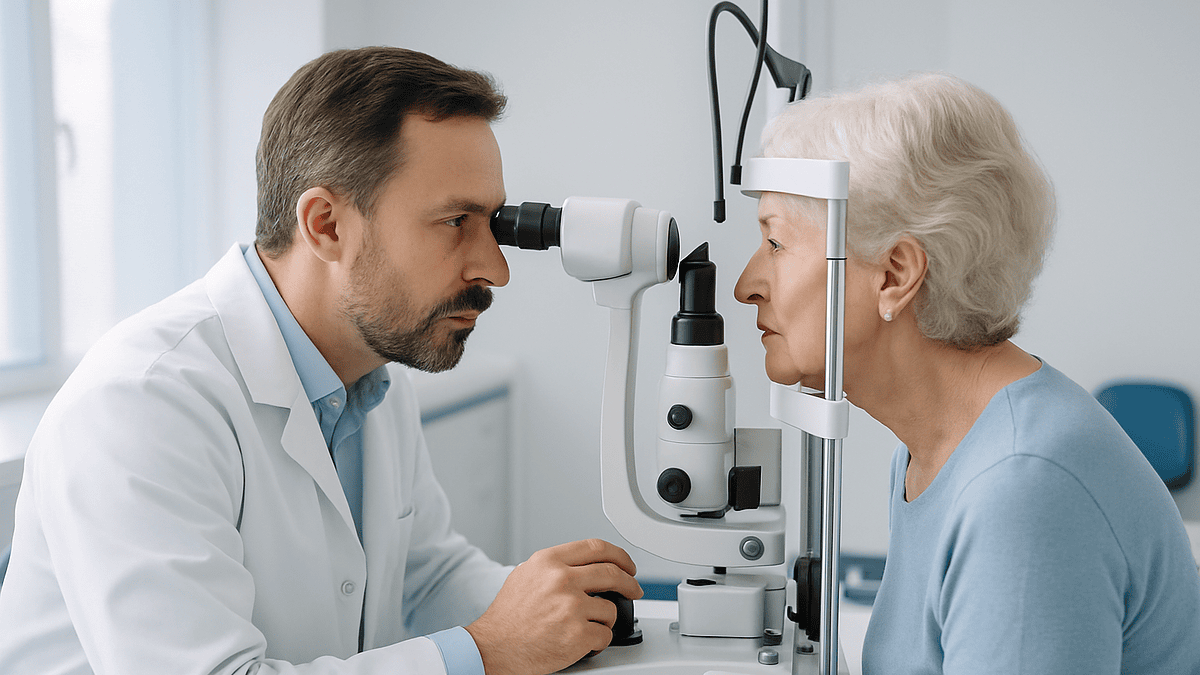
Key Takeaways
- The LASIK flap is held by suction and a thin seal of surface cells rather than stitches, which is why firm rubbing in the first day or two can shift or wrinkle it.
- A displaced flap usually produces a sudden step change in vision with a persistent gritty feeling, unlike the normal day-to-day fluctuation caused by dryness.
- Watery eyes after LASIK are most often reflex tears from an unstable, dry tear film, and lubricating drops tend to reduce the watering rather than add to it.
- Mayo Clinic notes that vision may take two to three months to stabilize and that dryness is common for roughly the first six months while corneal nerves regrow.
- Hot tubs, lakes and the sea are usually cleared later than chlorinated pools because they carry a higher microbial load, including the amoeba that causes Acanthamoeba keratitis.
- The flap interface never regains full corneal strength, so protective eyewear for contact and ball sports is typically lifelong advice rather than a temporary restriction.
After LASIK, rubbing your eyes is discouraged because the corneal flap is held in place mainly by suction and a thin layer of healing cells for the first days, and firm pressure can wrinkle or shift it. Most surgeons ask patients to avoid any eye rubbing for several weeks and to use lubricating drops for itch. A single light touch rarely causes harm, but sudden blur, pain or a gritty sensation after rubbing warrants a same-day call to the surgical team.
The itch arrives at about two in the morning. You are lying on your back as instructed, the plastic shields taped over your eyes, and your hand drifts up on autopilot before you catch it halfway. Anyone who has had laser vision correction knows that moment, and most people spend the first week relearning a reflex they have had since infancy.
The reason the warning about after LASIK rubbing eyes sits at the top of every discharge sheet is mechanical rather than mysterious. The procedure creates a hinged flap in the cornea, the clear front window of the eye, and that flap is not stitched down. For the first day or two it is held by suction and a thin seal of surface cells, which is enough for blinking but not for a knuckle grinding into the lid.
This explainer walks through what actually happens when you rub, what to do if you already did, and how swimming, makeup and sport fit into the same logic. The decisions stay with your surgeon; the goal here is to make their instructions make sense.
Why after LASIK rubbing eyes is the first warning your surgeon gives
LASIK stands for laser-assisted in situ keratomileusis, a long name for a short procedure that reshapes the cornea so light focuses properly on the retina. The cornea is the clear dome at the front of the eye, and its curvature does most of the eye’s focusing work. A refractive error, meaning short-sightedness, long-sightedness or astigmatism, is simply a mismatch between that curvature and the length of the eye (NIH National Eye Institute).
During LASIK the surgeon first creates a thin hinged flap on the corneal surface, either with a precision blade or a femtosecond laser. The flap is lifted like the cover of a book, an excimer laser removes microscopic amounts of tissue from the bed underneath, and the flap is laid back down. The whole thing typically takes well under half an hour for both eyes (Mayo Clinic).
Here is the part that matters for rubbing: no sutures. The flap settles back by capillary action, the same force that makes a wet glass slide stick to a table. Within hours, surface cells called epithelium begin growing across the flap edge, sealing it. Over weeks, deeper scar bonds form along the margin. The center of the flap, however, never fully regains its original strength, which is why cautious surgeons treat eye rubbing as a lifelong habit worth breaking rather than a two-week inconvenience.
A related question people ask is what happens if the eye moves during the laser itself. Modern platforms use an eye tracker, a camera system that follows the pupil many times per second and steers or pauses the laser if the eye drifts. Patients are also asked to look at a fixation light, and the surgeon can stop at any point. Involuntary small movements are expected and accounted for; they are not the cause of flap problems later.
What actually happens when you rub your eyes after LASIK
Rubbing does two things to a freshly made flap, and the timing decides how much either matters.

The first is shear. When the eyelid is pressed and dragged across the cornea, it applies a sideways force to the flap. In the first 24 to 48 hours, before the epithelial seal has knitted across the edge, that force can slide the flap a fraction of a millimeter or lift one edge. The result may be a fold or a microstria, a tiny wrinkle in the flap surface that scatters light and blurs vision. Surgeons describe flap problems as uncommon but recognized complications of LASIK, and they are among the reasons early follow-up visits exist (Mayo Clinic).
The second is contamination. Fingers carry bacteria, and the flap edge is a potential entry point until it seals. Rubbing can also push debris, lash fragments or makeup under the edge, which is one route to epithelial ingrowth, where surface cells grow beneath the flap instead of over it.
After the first week, shear becomes progressively less dangerous as the margin heals, but it does not drop to zero. Case reports in the ophthalmology literature describe flaps displaced months or years later by significant trauma, including a finger poke or a sports collision. That is a different scale of force from gentle pressure, but it explains why advice tends to shift from “never touch” to “never rub hard” rather than to “anything goes.”
Why does the eye itch in the first place? Partly dryness, since the nerves that signal the eye to make tears are cut when the flap is created and take months to regrow; partly the lubricating and antibiotic drops themselves, which can feel sticky as they dry on the lashes. Knowing the itch is a nerve and tear-film issue, not a sign of something stuck in the eye, makes it easier to answer it with a drop rather than a fist.
Rubbed eye after LASIK: what to do in the next hour
It happens. People wake with a hand already on their face, or a child’s elbow lands squarely on a lid. The response should be calm and methodical rather than panicked.
First, stop touching. Do not press the eye to “check” it, and do not try to look under the lid in a mirror. Second, do a simple comparison: close the untreated or less-affected eye and look at something with fine detail across the room, such as a clock face or printed text, then switch. Note whether the treated eye is roughly as clear as it was an hour ago. Third, pay attention to sensation. A flap that has shifted usually announces itself with a sudden and persistent gritty or foreign-body feeling, often with watering and light sensitivity, and vision that is noticeably more smeared or doubled than before.
If vision is unchanged and the eye feels the same within a few minutes, the most likely outcome is that nothing moved. Instill a preservative-free lubricating drop if you have been given one, keep the shield on if you are in the shield period, and mention the episode at your next scheduled check so the surgeon can examine the flap under the slit lamp, the microscope used in eye clinics.
If vision has dropped, if the gritty feeling does not settle, or if the eye becomes painful, call the surgical team the same day. Practices that perform LASIK expect these calls and will generally want to see you quickly, because a displaced flap repositioned within the first day or two usually settles well, while one left for weeks can develop wrinkles that are harder to smooth (Mayo Clinic). Do not wait for the next routine appointment, and do not attempt to “blink it back” or massage it.
One reassurance worth repeating: most light touches cause no harm. Surgeons hear about rubbing episodes constantly, and the majority end with an uneventful examination.
How do I know if my corneal flap moved after LASIK? Flap dislocation symptoms
A moved flap is not subtle, which is both the bad news and the good news. People search for lasik flap dislocation symptoms because they are worried about a silent problem, and in practice the flap rarely moves silently.
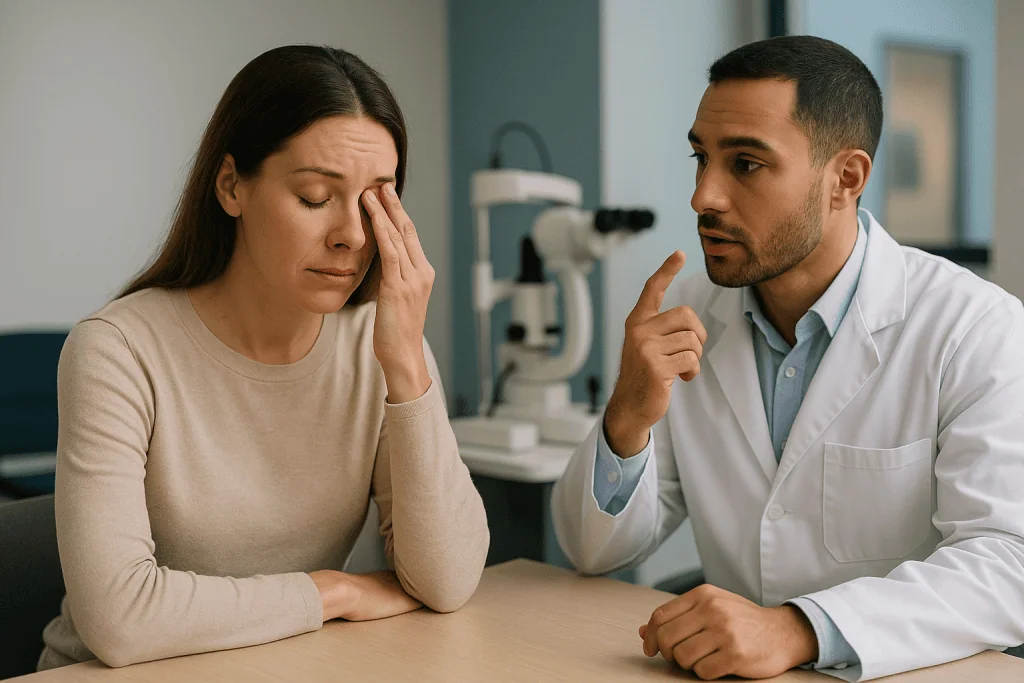
The pattern surgeons look for is a sudden change rather than the gentle fluctuation that is normal in early healing. Typical features include:
- An abrupt drop in clarity in one eye, often described as looking through smeared plastic wrap, that does not improve with blinking or a drop.
- A strong, persistent sensation of something in the eye, usually with reflex watering and an urge to keep the lid shut.
- New light sensitivity or aching in the eye, sometimes with the lid becoming puffy.
- Occasionally, ghosting or double images from one eye alone.
Compare that with normal early recovery, where vision may swing from sharp in the morning to hazy by evening as the tear film dries, and where mild grittiness responds to lubrication. Fluctuation is expected; a step change is not (Mayo Clinic).
You cannot reliably confirm or rule out a displaced flap at home, and you should not try. The diagnosis is made at the slit lamp, where the surgeon can see the flap edge, any fold lines and whether the surface cells have crept underneath. If the flap has shifted, the usual management is to lift it in the clinic, rinse the bed, smooth the flap back into position and sometimes place a soft bandage contact lens for a few days. This is a short procedure, usually under anesthetic drops, and the decision about whether and when to do it belongs to the surgeon.
The practical takeaway is simple: trust a sudden change in your own vision more than any online description. A same-day phone call is never an overreaction in the first weeks after surgery.
Who is usually cleared quickly, and who is usually asked to wait
The rules about rubbing, swimming and sport are not identical for everyone, because the procedure is not identical for everyone. Three groups tend to get different timelines.
People who had standard flap-based LASIK carry the most flap-specific restrictions, for the reasons described above. People who had PRK, photorefractive keratectomy, have no flap at all; the surface layer of cells is removed and regrows over several days, so the early risk is a raw, painful surface rather than a shifting flap, and makeup and swimming limits are often framed around infection and discomfort instead. People who had a lenticule extraction procedure, often marketed under the term SMILE, have a small incision rather than a hinged flap, and their surgeons may relax rubbing warnings somewhat sooner, though not immediately. The NHS summarizes these three families of laser surgery as broadly similar in outcome, with different recovery textures (NHS).
Beyond procedure type, surgeons commonly ask certain people to wait longer before returning to specific activities:
- Those with pre-existing dry eye, allergy-related itching or eyelid inflammation, because the itch-and-rub reflex is stronger and the surface slower to settle.
- Contact sport athletes and people in jobs with dust, chemicals or face contact, who may be steered toward PRK in the first place precisely because there is no flap to lose.
- Anyone whose early check shows a slow-sealing flap edge, loose surface cells or early epithelial ingrowth.
- People who swim competitively or dive, where the pool and open water exposure is daily rather than occasional.
None of this is a judgement on the person; it is a judgement on the forces their eyes will meet. Candidacy itself is assessed before surgery against factors such as corneal thickness, stable prescription, age and general eye health (Mayo Clinic), and the surgeon who did that assessment is the one who should set your return-to-activity dates.
What the first days and weeks after LASIK usually look like
Recovery is front-loaded. The first day is the strangest, the first week the most restricted, and the following months mostly about dryness and small fluctuations.
Day of surgery: expect burning, watering and the sense of a hair in the eye for several hours, along with blurry, hazy vision. Most people are asked to go home, keep both eyes closed as much as possible and sleep. Clear plastic shields are typically worn to bed, and this is when the rubbing warning is most literal, because the flap seal is hours old.
Days one to seven: vision is often dramatically better by the next morning, and a follow-up visit within the first day or two checks that the flap is flat and the surface healing. Antibiotic and anti-inflammatory drops are commonly prescribed for a short course, with lubricating drops used freely; how often and for how long is for the prescriber to set. Shields at night, no eye makeup, no swimming and no strenuous exercise are standard during this window (MedlinePlus).
Weeks two to four: most non-contact activity resumes, often with protective eyewear. Dryness is the dominant complaint and can make vision swing through the day. Night-time glare and halos around lights are common in these weeks and usually ease.
Months one to six: Mayo Clinic notes that it may take two to three months for the eye to heal and vision to stabilize, and that eyes may feel unusually dry for roughly the first six months as the corneal nerves regrow (Mayo Clinic). Follow-up visits are spaced out over this period, and it is only at the end of it that any discussion of enhancement, meaning a second laser treatment for residual error, usually makes sense.
These are typical ranges from patient guides, not promises; individual surgeons adjust them, and your own examinations override any calendar.
Is it normal to have watery eyes after LASIK surgery?
Yes, and the explanation is one of the more counter-intuitive pieces of eye physiology: watering is often a sign of dryness.
The eye produces two kinds of tears. Basal tears are the thin, constant film that keeps the surface smooth and comfortable. Reflex tears are the flood that arrives when something irritates the surface, whether an onion, a cold wind or a dry patch of cornea. LASIK temporarily reduces basal tear production because creating the flap cuts the fine corneal nerves that tell the tear glands how much to make. The surface then dries between blinks, the exposed nerves fire, and the eye responds with reflex tears that stream rather than coat (NIH National Eye Institute).
So a watery eye in the first weeks usually means the tear film is unstable, not that it is overproducing. The treatment logic follows from that: lubricating drops stabilize the surface, which paradoxically reduces watering. Surgeons choose preservative-free formulations for frequent use because preservatives themselves can irritate a healing cornea. For more persistent dryness, options include ointments at night, small plugs placed in the tear drainage ducts to keep tears on the eye longer, and prescription anti-inflammatory drops; which, if any, is appropriate is a decision for the eye team.
Watering is also a symptom to interpret in context. On its own, with stable vision, it is expected. Paired with sudden blur, pain or light sensitivity, it becomes one of the warning features described earlier.
The timeline matters for expectations. Mayo Clinic describes dryness as common in the first six months, improving as nerves regenerate (Mayo Clinic). Some people, particularly those who had dry eye before surgery, report symptoms for longer, which is one reason a thorough pre-operative tear assessment is standard.
Swimming after LASIK: pools, lakes, hot tubs and the sea
Swimming after lasik raises two separate concerns, and it helps to keep them apart.
The first is infection. Water is not sterile, and the organisms that worry eye surgeons most are the ones that cause corneal infections in contact lens wearers: bacteria in pools and hot tubs, and a free-living amoeba called Acanthamoeba that thrives in lakes, rivers, tap water and poorly maintained spas. Acanthamoeba keratitis is rare but serious, slow to diagnose and difficult to treat, and the CDC lists swimming and showering with lenses among its risk factors because of the same surface vulnerability a healing flap edge presents. Chlorine reduces but does not eliminate bacteria, and hot tubs are warmer and more crowded than pools, which is why they are usually the last thing cleared.
The second concern is mechanical. Chlorinated and salt water sting a healing eye, and the instinctive response to stinging is to rub. Goggles pressed on and pulled off, children splashing, and the reflex squeeze of eyelids in a wave all deliver the kind of pressure the early flap is meant to avoid.
Patient guides from major centers therefore typically advise avoiding swimming and hot tubs for around one to two weeks at minimum, with many surgeons extending open-water swimming and diving to a month or more (Mayo Clinic; MedlinePlus). When clearance arrives, sealed goggles are usually recommended for the first weeks back, and lubricating drops afterward help wash out residual chlorine and salt.
Showering is permitted from the first day in most protocols, with the practical advice to keep eyes closed, let water hit the back of the head rather than the face, and avoid soap or shampoo running into the eyes. If it does, blinking and a lubricating drop are better than a towel rubbed across the lids.
Makeup after LASIK: lashes, liner and removers
The makeup rule is less about the products and more about the two actions that surround them: applying, which brings fingers and brushes to the lid margin, and removing, which involves rubbing with a pad.
Eye makeup worn before the flap edge has sealed can shed particles of pigment, glitter or fiber into the tear film. Those particles irritate, irritation triggers rubbing, and loose particles can be pushed under a flap edge. Mascara and liner applied to the inner lash line sit directly on the openings of the oil glands that keep the tear film from evaporating, which is unhelpful when the eye is already drier than usual. Removal is the bigger issue, since even the gentlest wipe applies sideways pressure across a closed lid.
Surgeons’ instructions vary, but a common pattern is: no eye makeup at all for roughly the first week, face makeup that stays well away from the eyes allowed sooner, and old mascara and liquid liner discarded in favor of fresh products to lower the bacterial load (Mayo Clinic). When eye makeup resumes, many teams suggest skipping waterline application, avoiding glitter and fiber mascaras for a few more weeks, and removing products with a soaked pad held still against the closed lid for several seconds so the product dissolves rather than being scrubbed away.
False lashes and lash extensions deserve a separate mention. Application involves adhesive fumes close to the eye and the removal involves solvents and manipulation of the lid, so most surgeons ask for a longer gap and want to know in advance. Lash serums and eyelid creams should be paused until the team clears them, since ingredients that are fine on intact skin can sting an eye whose surface is still settling.
None of this is forever. The restrictions are about the window in which the flap edge and surface are vulnerable, and most people are back to their usual routine, with somewhat gentler removal habits, within a month.
Sports and exercise after LASIK
Exercise sits on a spectrum of risk, and the question to ask about any activity is: how likely is something to hit, press on or splash into my eye, and how sweaty will I be?
Sweat matters because it runs into the eyes, stings and provokes rubbing, and because a wristband dragged across the face is a rubbing motion. That is the reason even gentle gym sessions are usually paused for the first few days, not because walking on a treadmill is dangerous to a flap (MedlinePlus).
A rough ordering, with the caveat that your own surgeon’s timeline overrides it:
- Walking and light stationary cycling: often permitted within a day or two, with a towel for sweat and no face-wiping.
- Running, weight training and non-contact fitness classes: commonly resumed after the first week, once the early check confirms the flap is settled.
- Racquet sports, football, basketball and anything with a ball or an elbow near the face: typically later, and with protective polycarbonate eyewear, since a finger or ball to the eye is exactly the trauma that can lift a flap even after it has sealed.
- Martial arts, boxing, rugby and wrestling: the longest wait, often a month or more, and for people who do these seriously the pre-operative conversation about a flap-free procedure matters.
- Scuba diving and surfing: combine open water, mask pressure and impact, so they are usually grouped with the latest clearances.
Yoga deserves a small footnote. Inverted poses raise the pressure in the head and eyes transiently, and face-down rest positions press the eye into a mat. Neither is a major concern for a healed flap, but in the first days most teams prefer upright practice.
Eye protection is the theme that outlasts every timeline. Once cleared for contact or ball sports, people who have had LASIK are often advised to keep wearing sports goggles indefinitely. The flap’s interface never regains full strength, and goggles cost nothing in performance.
Activity-by-activity: what usually waits after LASIK and why
The table below pulls the previous sections together. The windows are typical ranges quoted in patient guides from major academic centers (Mayo Clinic; MedlinePlus; NHS); they are not promises, and individual surgeons extend or shorten them based on the procedure performed and what they see at each follow-up visit.
| Activity | Main concern | Typical wait quoted in patient guides | Usual condition on return |
|---|---|---|---|
| Rubbing eyes | Flap shear, debris under flap edge | Several weeks for any rubbing; avoid firm rubbing long term | Use lubricating drops for itch; dab lids, never grind |
| Showering, face washing | Soap and water in eye prompting rubbing | Usually permitted from day one | Eyes closed, water away from face |
| Reading, screens, driving | Dryness from reduced blinking; legal vision standard | Days; driving once the surgeon confirms vision meets the standard | Frequent breaks and drops |
| Eye makeup | Particles, bacteria, rubbing on removal | About one week or as directed | Fresh products, gentle soak-off removal |
| Gym, running | Sweat and face wiping | A few days to one week | Towel for brow only, no wiping eyes |
| Swimming pool | Bacteria, chlorine sting, goggle pressure | About one to two weeks minimum | Sealed goggles for first weeks |
| Hot tub, lake, sea | Higher microbial load, Acanthamoeba | Often a month or longer | Goggles; rinse with drops afterward |
| Contact or ball sports | Direct trauma to flap | Often a month or more | Protective eyewear, frequently long term |
Two things stand out when the list is laid out this way. First, almost every row traces back to the same two mechanisms, pressure on the flap and contamination at its edge, which is why the rubbing rule is the master rule and the rest are its applications. Second, the activities with the longest waits are the ones that combine the two: a hot tub is both warm bacterial soup and a place where people wipe their faces.
If a timeline you have been given is shorter or longer than these ranges, that is not a red flag; it reflects your procedure, your eyes and your surgeon’s experience. Ask why if you are curious, but follow the instruction you were given.
What people often get wrong about life after laser eye surgery
Myths around LASIK recovery tend to cluster at two extremes, the catastrophic and the casual. Both are worth correcting.
“If I rub my eye once, the flap will come off.” A flap does not peel away like a sticker. Light, brief contact in the first days rarely causes harm, and the overwhelming majority of rubbing confessions end with an unremarkable examination. The real risk is firm, dragging pressure in the first day or two, or significant trauma later.
“After a month, the flap is as strong as a normal cornea.” It is not. The edge seals well, but the interface beneath the flap remains a weaker plane for years. That is why protective eyewear for contact sport is lifelong advice rather than a temporary one, and why the habit of not rubbing is worth keeping.
“Watery eyes mean my eyes are not dry.” Usually the opposite, as explained above. Reflex watering is the eye’s response to an unstable tear film.
“I rubbed and nothing happened, so I can relax the rules.” An uneventful rub is luck combined with timing, not evidence that the rule was wrong. The same force on a different day, before the morning drop has coated the eye, might behave differently.
“Any blur means the flap moved.” Vision fluctuating through the day in the first weeks is normal and driven mostly by the tear film. What signals a flap problem is a sudden step change with a persistent foreign-body feeling.
“Laser eye surgery fixes vision permanently.” It corrects the prescription present at the time. Eyes continue to age; the need for reading glasses in middle age, called presbyopia, arrives regardless, and a small number of people need an enhancement later (NHS; Mayo Clinic).
“Swimming is fine if I keep my eyes shut.” Water finds its way in, and the reflex to rub afterward is the problem as much as the water itself.
Questions to ask your care team about rubbing, swimming, makeup and sport
Discharge instructions are often handed over while you are still blurry and mildly sedated, so a written list for the first follow-up visit is a good idea. Useful questions include:
- Which procedure did I have, flap-based LASIK, PRK or a lenticule extraction, and how does that change the rubbing and activity advice for me specifically?
- How long do you want me in the night shields, and is there anything about my flap at today’s check that changes that?
- If I rub my eye by accident, what is the threshold at which you want a call, and what number do I use outside clinic hours?
- Which lubricating drops do you prefer, how often may I use them, and should I switch to a thicker gel or ointment at night?
- When is it safe for me to drive, and does that depend on a vision test at this visit?
- What is my date for pool swimming, for open water, and for hot tubs, and what eyewear do you want me in when I go back?
- When may I wear eye makeup again, and are there products or application areas you would like me to avoid longer?
- Which sports do you consider contact sports for the purpose of these rules, and do you want me in protective eyewear permanently?
- What symptoms of dryness or glare are expected at this stage, and which ones would make you want to see me sooner?
- If my vision has not settled by the end of the stabilization period, what are the options, and how is that decision made?
Write the answers down, including dates. Patient guides give typical ranges, but your surgeon has seen your cornea under magnification and knows how your flap edge is healing. Their numbers beat anything printed here, and if an instruction surprises you, asking for the reasoning is both reasonable and, in most practices, welcomed.
When to call your doctor after LASIK
Most of recovery is uneventful, and most calls to a LASIK practice end in reassurance. The following symptoms, however, are the ones eye teams consider urgent, and they warrant a same-day call rather than waiting for the next scheduled visit (Mayo Clinic; MedlinePlus):
- A sudden drop in vision in one eye, especially after rubbing, a knock or a splash, that does not clear with blinking or a lubricating drop.
- A persistent sensation of something in the eye with watering and light sensitivity that lasts beyond a few minutes.
- Increasing pain rather than the mild burning expected on the first day; pain that worsens over hours is not typical healing.
- A red eye that is becoming redder, a sticky or discolored discharge, or a lid that is swelling.
- New haze, a white spot visible on the cornea, or a marked increase in glare and halos after an initial improvement.
- Any new double vision from one eye, or a shadow or curtain across part of your field of view.
- Flashes of light or a sudden shower of floaters, which relate to the back of the eye rather than the flap but need prompt assessment.
Call the surgical team first, because they know your eye and can see you quickly. If you cannot reach them and vision is falling or pain is severe, go to an emergency department or urgent eye service and tell them the date and type of your procedure.
Do not put off a call because the symptom started after something you were told not to do. Surgeons would far rather hear “I rubbed my eye and now it is blurry” within the hour than see a wrinkled flap a month later. What happens next, whether that is observation, a flap repositioning, a change in drops or simply reassurance, is a decision for the treating team, made at the slit lamp rather than over the phone.
Frequently asked questions
What happens if I rubbed my eye after LASIK?
Most light touches cause no harm, especially after the first few days. Check whether the treated eye sees as clearly as it did an hour ago and whether any gritty feeling settles within minutes. If vision has dropped or the eye stays painful or feels like something is in it, call the surgical team the same day so they can examine the flap under magnification.
How do I know if my corneal flap moved after LASIK?
A moved flap usually causes an abrupt loss of clarity in one eye, a persistent foreign-body sensation, watering and light sensitivity, often following rubbing or a knock. It is rarely silent. You cannot confirm it at home; the surgeon checks the flap edge with a slit lamp and, if needed, repositions it in the clinic.
Is it normal to have watery eyes after LASIK surgery?
Yes. Creating the flap cuts the fine corneal nerves that regulate tear production, so the basal tear film becomes unstable and the eye responds with reflex tears. Watering with stable vision is expected in the early weeks and improves with lubricating drops. Watering with sudden blur or pain is a reason to call the care team.
What happens if my eye moves during LASIK?
Modern lasers include an eye tracker that follows the pupil many times per second and steers or pauses the beam if the eye drifts, and the surgeon can stop at any point. Small involuntary movements are expected and accounted for. Looking steadily at the fixation light helps, but a brief twitch does not spoil the treatment.
What should I do after LASIK surgery on the first day?
Go home, keep both eyes closed as much as possible and rest. Wear the protective shields as instructed, use the drops prescribed, and avoid screens, rubbing, makeup and water in the eyes. Expect burning, watering and blur for several hours. Arrange transport, since you will not be able to drive until the surgeon confirms your vision.
When can I go swimming after LASIK?
Patient guides from major centers typically quote a minimum of about one to two weeks for chlorinated pools, with hot tubs, lakes and the sea often delayed a month or more because of higher infection risk. Sealed goggles are usually advised for the first weeks back. Your surgeon’s date, based on how your flap is healing, overrides any general range.
When can I wear makeup after LASIK?
Most surgeons ask for about a week without eye makeup, with face makeup kept away from the lids allowed sooner. Old mascara and liquid liner are usually discarded to reduce bacterial load. When you restart, avoid the waterline and glitter products for a few weeks, and remove makeup by holding a soaked pad still against the closed lid rather than rubbing.
What are the symptoms of LASIK flap dislocation weeks or months later?
Late displacement is uncommon and almost always follows real trauma, such as a finger poke or a sports collision. The symptoms match early displacement: sudden blur in that eye, a strong foreign-body sensation, watering and light sensitivity. Because the flap interface never regains full strength, surgeons advise protective eyewear for contact sports indefinitely.
How long after LASIK can I rub my eyes normally?
Surgeons generally ask patients to avoid any rubbing for several weeks while the flap edge seals, and to avoid firm rubbing permanently. For itch, a lubricating drop and a gentle dab of the closed lid with a clean fingertip are the usual alternatives. Persistent itching should be raised with the care team, since it may indicate dryness or allergy that can be managed.
Can I exercise and play sports after LASIK?
Light activity such as walking is often allowed within days, gym sessions after the first week once the flap check is clear, and contact or ball sports after a month or more with protective eyewear. The main early concern is sweat prompting face wiping; the later concern is direct impact. Timelines vary with the procedure and your surgeon’s assessment.
References
- MedlinePlus: LASIK eye surgery
- NHS: Laser eye surgery and lens surgery
- NIH National Eye Institute: Refractive errors
- NIH National Eye Institute: Dry eye
This article is for general information only and is not a substitute for professional medical advice. Please consult a qualified doctor about your individual situation.
Add us as a Preferred Source to see more of our trusted health content across Google Search, AI Overviews and Discover.

Planning This Treatment in Turkey
Our full guide for international patients: techniques, hospital stay, recovery and cost.
More from the Blog

What Follow-Up Imaging After Cryoablation Shows and Why the Treated Area Changes Slowly
Follow-up imaging after cryoablation checks whether the frozen zone fully covered the target and watches for any regrowth at its edge. The treated area…

Preparing for Reconstructive Surgery: Imaging, Anesthesia Review and Medication Adjustments
Preparing for reconstructive surgery usually involves three strands: imaging such as CT or MRI so the surgeon can plan bone and soft-tissue repair, an…
Skincare After Microdermabrasion: Moisturizer, Sunscreen and When Retinoids Can Restart
Skincare after microdermabrasion is deliberately simple: cleanse gently, apply a plain fragrance-free moisturizer several times a day, and wear broad-spectrum sunscreen every morning, because…

After Aesthetic Filling: Swelling, Bruising and the Days to Avoid Sauna and Hard Exercise
Swelling and bruising after dermal filler are expected and usually peak within the first 24–72 hours, then fade over one to two weeks; hyaluronic…

When Filler Results Disappoint: Adjusting, Dissolving and Waiting It Out Explained
When filler results disappoint, there are usually three routes: adjusting with a small further treatment, dissolving dermal filler with an injectable enzyme called hyaluronidase,…

Shave Removal vs Surgical Excision for Moles: Why the Method Depends on the Mole
Shave removal slices a raised mole level with the skin using a blade and needs no stitches, while surgical excision cuts out the whole…