

Skincare After Microdermabrasion: Moisturizer, Sunscreen and When Retinoids Can Restart
Key Takeaways
- Microdermabrasion removes only the stratum corneum, the dead outer layer, so routine recovery involves no open wound and the Cleveland Clinic describes redness that usually settles within about a day.
- The removed layer slows water loss and filters some UV, which is why bland moisturizer several times daily and broad-spectrum sunscreen every morning are the two aftercare steps that matter most.
- The CDC's baseline is broad-spectrum SPF 15 or higher reapplied at least every two hours outdoors, and many clinicians favor SPF 30 or above in the week after exfoliation.
- Retinoids and exfoliating acids are usually paused for several days to about a week, and the restart signal is skin that no longer flakes or stings, with the date set by your treating team.
- No major guideline recommends microdermabrasion for rosacea, because the NHS and Mayo Clinic list rubbing, stinging and exfoliating skincare among its common triggers.
- Post-inflammatory hyperpigmentation is the complication the aftercare rules exist to prevent, and risk rises with deeper skin tones, aggressive settings and unprotected sun exposure in the first week.
Skincare after microdermabrasion is deliberately simple: cleanse gently, apply a plain fragrance-free moisturizer several times a day, and wear broad-spectrum sunscreen every morning, because the freshly exposed skin loses water faster and burns more easily. Retinoids, acids and scrubs are usually paused for several days to about a week; your treating clinician sets the restart date based on how your skin recovers.
The treatment room chair tilts back up, the handpiece clicks off, and the first thing most people do is reach for a mirror. The face looking back is a little pink, faintly tight, and smoother than it was twenty minutes ago. The second thing they do is pull out a phone and start searching, because nobody wants to undo a good result with the wrong cream that evening.
That is the honest reason skincare after microdermabrasion gets more attention than the procedure itself. The treatment is quick and mild. The aftercare is where results are either protected or quietly wasted, and it is also where most of the myths live: that you should let the skin “breathe” without moisturizer, that any sunscreen will do, or that restarting a retinoid the next night will speed things up.
This explainer walks through what actually happens to the skin, what the evidence supports for the first week, and how clinicians typically decide when stronger products can return.
What is microdermabrasion and what actually happens to your skin?
Microdermabrasion is a mechanical exfoliation. A handheld device either sprays fine crystals across the skin or passes a textured tip over it while a vacuum draws the surface up into contact. The abrasion removes the stratum corneum, the thin outermost layer of dead, flattened cells that acts as the skin’s weatherproof coat. The Cleveland Clinic describes it as a minimally invasive treatment that works on this surface layer only, which is why it is sometimes called a “lunchtime” procedure.
Two things follow from that definition. First, the living layers beneath are not deliberately injured, so there is no open wound and no scab in a routine session. Second, that weatherproof coat is doing real work, and removing it has consequences for the next few days. The stratum corneum slows water escaping from the skin, a process dermatologists call transepidermal water loss, and it filters a portion of ultraviolet light before it reaches living cells. Take it away and the skin dries faster and burns more easily until it rebuilds.
The intended benefits are modest and surface-level: a smoother feel, slightly brighter tone, and better penetration of skincare products afterward. The Mayo Clinic draws a sharp line between this and dermabrasion, a far deeper procedure performed under anesthesia that removes skin down into the dermis and needs weeks of wound care. People sometimes read dermabrasion recovery timelines online and panic. Those timelines do not apply here.
A sensible way to picture microdermabrasion is a very controlled, very even version of what happens naturally every few weeks as skin sheds. The procedure compresses that shedding into minutes, and aftercare simply covers the gap until the new surface matures.
Skincare after microdermabrasion in the first 24 hours
The first day is about doing less, not more. Skin that has just lost its outer layer behaves like skin after a mild sunburn: warm, pink, slightly tight, occasionally tender to the touch. The Cleveland Clinic notes that this redness and sensitivity usually settle within hours to a day or so for most people, though individual response varies with skin type and the intensity of the session.

A practical first-evening routine looks like this:
- Cleanse once with lukewarm water and a mild, non-foaming, fragrance-free cleanser. Hot water widens surface blood vessels and prolongs flushing.
- Pat dry with a clean, soft towel rather than rubbing.
- Apply a bland moisturizer while the skin is still slightly damp, which traps more water.
- If you are going outdoors at all, add a broad-spectrum sunscreen on top.
That is the whole list. Serums, toners, exfoliating pads, masks, and anything that tingles should stay in the cabinet. A tingle after microdermabrasion is not a sign a product is “working”; it is a sign the product is reaching nerve endings that are normally insulated.
Some people notice tiny dry flakes by the evening or the next morning. This is residual surface shedding, not peeling in the chemical-peel sense, and it should not be picked or scrubbed off. Makeup is usually a judgment call set by your treating team; many ask for a clear day so that pigments and preservatives are not sitting on freshly exposed skin, but there is no single rule in the mainstream references.
Sleep on a clean pillowcase. It sounds trivial, but a pillowcase carries skincare residue, hair product, and bacteria, and the skin’s usual filter against those is temporarily thinner.
Skincare after microdermabrasion: why moisturizer matters more than usual
Moisturizer gets treated as an optional comfort step. After microdermabrasion it is closer to a functional repair step, and the reason is mechanism rather than marketing.
The stratum corneum holds water inside the skin partly through its structure, a brick-and-mortar arrangement of dead cells surrounded by lipids, and partly through natural humectant molecules within those cells. Exfoliation strips some of both. Until the layer rebuilds, water escapes faster, and dehydrated skin feels tight, looks dull, and is more easily irritated by everything that touches it. A moisturizer does three jobs at once: it supplies humectants that pull water in, emollients that smooth the gaps between cells, and occlusives that slow evaporation from the surface.
What to look for is simpler than the ingredient-list anxiety online suggests. Fragrance-free, because fragrance is among the most common causes of contact irritation on compromised skin. No added acids, retinoids, or “brightening” actives. A texture rich enough that the skin still feels comfortable an hour after application. Products that are fine for use after a sunburn or on eczema-prone skin are a reasonable benchmark, though this is about formulation type, not any particular brand.
Frequency matters more than quantity. Reapplying a thin layer two or three times a day keeps evaporation steadily in check; one thick layer in the morning does not. Clinics commonly suggest keeping this up for the first several days, until the tightness and flaking stop, which is the skin’s own signal that the barrier has reformed.
The idea that skin needs to “breathe” uncovered is a persistent myth. Skin does not take in oxygen through its surface in any meaningful way. What it needs after exfoliation is water retention, and a bare, drying surface delivers the opposite.
Sunscreen after microdermabrasion: what the evidence actually supports
If one instruction is non-negotiable after microdermabrasion, it is daily sun protection. The outer skin layer that was just removed normally absorbs and scatters a share of ultraviolet radiation. For the days it takes to rebuild, more UV reaches the living cells beneath, which raises two separate risks: a quicker sunburn, and post-inflammatory hyperpigmentation, meaning darker patches that form when irritated skin produces excess pigment. The second risk is higher in people with medium to deep skin tones and can take months to fade, which is why clinicians emphasize sunscreen so firmly.
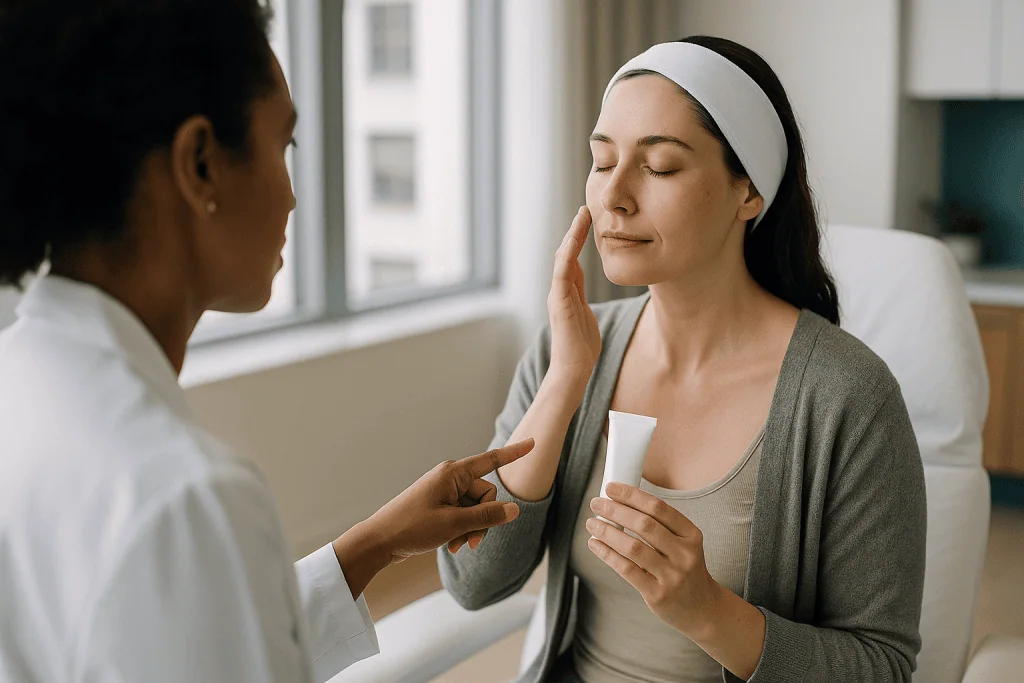
The general-population guidance from the CDC is a reasonable floor: a broad-spectrum sunscreen (one that filters both UVA and UVB) with an SPF of 15 or higher, applied generously before going outside and reapplied at least every two hours, or after sweating or swimming. Many dermatology sources favor SPF 30 or above for everyday use, and after exfoliation there is a strong practical argument for the higher number, since people reliably under-apply.
Formulation questions come up often. Mineral filters, meaning zinc oxide or titanium dioxide, sit on the surface and tend to be well tolerated on freshly exfoliated skin, which is why many clinics suggest them for the first week. Chemical filters are not forbidden, but some ingredients sting on compromised skin. If a sunscreen burns on application, that is a tolerance signal to switch, not something to push through.
Sunscreen is one layer of a strategy, not the whole strategy. The CDC also advises shade during the middle of the day, wide-brimmed hats, and UV-rated sunglasses. Direct sunbathing, tanning beds and long outdoor workouts are sensible things to postpone for the first week or so, and your treating team may extend that depending on your skin type and the season.
What not to do after microdermabrasion
The “do not” list is where most searches start, so here it is in plain terms, with the reason behind each item rather than a bare rule.
- No other exfoliation. Scrubs, cleansing brushes, exfoliating acids, enzyme masks and peel pads all remove more of a layer that is already gone. Stacking them risks raw patches and pigment changes.
- No retinoids until cleared. Covered in detail below; the short version is that they increase sensitivity and turnover on skin that has no reserve.
- No heat. Saunas, steam rooms, hot yoga, very hot showers. Heat dilates surface vessels, prolongs redness and increases swelling.
- No sun exposure without protection, and no deliberate tanning for at least the first week.
- No picking or peeling flakes. Removing flakes early exposes skin that is not ready and is a classic route to dark spots.
- No chlorinated pools or open-water swimming for a few days; chlorine and bacteria irritate a thinned barrier.
- No waxing, threading or depilatory creams on treated areas until the skin feels normal; waxing can lift fragile skin.
- No fragranced or alcohol-heavy products, including some toners and “refreshing” mists.
Two softer cautions belong here too. Heavy sweating from intense exercise is not dangerous, but sweat salts can sting and some clinicians suggest an easy day. And new products of any kind, even gentle ones, are best introduced one at a time once the skin has settled, so that if something irritates, you know what it was.
None of these prohibitions are permanent. Most lift within a week, in the order your treating team sets. The point is to avoid asking an unprotected surface to tolerate things that healthy skin shrugs off.
Microdermabrasion recovery time: what the days and weeks usually look like
People hear “no downtime” and expect zero visible change. The truth is closer to “no social downtime, but a real biological timeline.” The Cleveland Clinic describes mild redness, tenderness and sometimes slight swelling that typically resolve within a day or so, with most people returning to normal activities the same day. Beneath that, the barrier rebuilds over roughly the first week, which is the window the aftercare rules cover.
| Phase | What the skin usually looks and feels like | Typical care focus |
|---|---|---|
| Hours 0–24 | Pink, warm, slightly tight; possible mild swelling | Gentle cleanse, bland moisturizer, sunscreen; no actives |
| Days 2–3 | Redness fading; fine dry flakes; sensitivity to wind and heat | Moisturize several times daily; strict sun protection; no heat or exfoliation |
| Days 4–7 | Flaking stops; texture smooth; tolerance returning | Clinician may clear retinoids and acids toward the end of this window |
| Weeks 2–4 | Skin feels normal; glow from the session fades as surface cells accumulate again | Regular routine; a repeat session may be discussed |
The last row surprises people. Because microdermabrasion only clears the surface, the result is temporary. The Cleveland Clinic notes that benefits are not permanent and that providers often suggest a series of sessions spaced weeks apart, with maintenance after that. Whether a series makes sense for you, and at what interval, is a decision for the treating team based on your skin’s response rather than a fixed schedule.
Variation is normal. Fair skin tends to look redder on day one. Deeper skin tones may show less redness but carry more pigment risk, which shifts the emphasis toward sun protection. Dry skin flakes more; oily skin may feel the tightness less. Any timeline that deviates sharply from the table, especially redness worsening after day two, belongs in the red-flag section below.
Retinol after microdermabrasion: when retinoids can restart
Retinoids are the family of vitamin A-derived ingredients that includes over-the-counter retinol and prescription tretinoin. They work by binding to receptors in skin cells and accelerating the rate at which new cells are produced and old ones shed. MedlinePlus notes that topical tretinoin commonly causes dryness, peeling and stinging, particularly early in use, and makes skin more sensitive to sunlight. Every one of those effects overlaps with what microdermabrasion has just done.
That overlap is the whole reason for the pause. Retinoid on top of fresh exfoliation does not produce double the benefit; it produces an irritated, over-exfoliated surface with a higher chance of redness, flaking and pigment change. Most clinics ask patients to stop retinoids for a few days before a session for the same reason, so the skin arrives with some reserve.
The restart is a two-part decision. The first part is time: a commonly used window is several days to about a week after treatment. The second part, and the more reliable one, is how the skin is behaving. Clinicians generally want to see that flaking has stopped, there is no residual stinging from plain moisturizer, and sunscreen applies without discomfort before a retinoid comes back. Your treating team sets the actual date; the window above is a typical range, not a rule.
When the retinoid returns, a gradual approach is standard: a thin layer on alternate nights, applied over moisturizer if your skin was sensitive before, with the frequency built back up only as tolerated. Anyone using a prescription retinoid should follow the plan their prescriber gives rather than a generic online schedule, and should never alter a prescribed regimen without that conversation. Oral isotretinoin is a separate matter and is covered in the section on who is asked to wait.
Vitamin C, acids and other actives: when they come back
Retinoids get the headlines, but a modern routine often carries half a dozen other actives, and each behaves differently on exfoliated skin.
Hydroxy acids (glycolic, lactic, salicylic) are chemical exfoliants: they loosen the bonds between dead surface cells. On skin that has already been mechanically exfoliated they have nothing useful to remove and can reach living cells directly, which is why they sit in the same pause group as retinoids, typically returning in the same several-day-to-a-week window your team specifies.
Vitamin C is more nuanced. The common L-ascorbic acid form is formulated at a low pH to stay stable, and that acidity stings on compromised skin. Gentler derivatives often tolerate earlier reintroduction. A reasonable approach many clinicians use is to hold vitamin C for the first few days and reintroduce it once plain moisturizer causes no sensation.
Niacinamide, hyaluronic acid, ceramides and panthenol are generally the “friendly” group. They support hydration and barrier repair, and most are tolerated from day one, provided the product is fragrance-free and does not also contain acids. Reading the full ingredient list matters here more than the product’s headline ingredient.
Benzoyl peroxide and acne treatments are drying and irritating by design. People on prescription acne regimens should ask their prescriber how to bridge the week rather than stopping or restarting on their own.
The order of reintroduction usually runs: barrier-support products first, vitamin C or niacinamide next, then acids and retinoids last. Introducing one product every day or two, rather than the whole routine at once, lets you identify a culprit quickly if irritation appears. The glow from microdermabrasion is a good moment to simplify a routine, not to add to it.
Who microdermabrasion is usually for, and who is usually asked to wait
The typical candidate is an adult with generally healthy skin who wants smoother texture, a brighter surface, milder sun damage or fine lines softened, and who understands the effect is modest and temporary. Because the treatment stays in the dead outer layer, it is one of the lower-risk resurfacing options, and the Cleveland Clinic lists it as suitable for most skin types when performed appropriately.
Several situations usually lead a clinician to postpone or decline a session:
- Active skin infection or inflammation: cold sores, impetigo, a flare of eczema or psoriasis in the treatment area, or inflamed acne. Abrading infected or inflamed skin can spread the problem or deepen it.
- Open wounds, recent sunburn or recent peels and laser treatments, because the barrier is already compromised.
- Oral isotretinoin, current or recent. The Mayo Clinic advises against dermabrasion within about a year of this medicine because of impaired healing and scarring risk; many clinicians apply a cautious version of the same rule to microdermabrasion. The treating team decides case by case.
- A history of keloids or hypertrophic scars, where any skin injury carries extra risk.
- Rosacea, especially with active flushing, addressed in its own section below.
- Bleeding disorders or anticoagulant use, where pinpoint bleeding from vacuum suction is more likely; this is discussed with the prescriber, never managed by stopping a medicine.
- Pregnancy, where many providers defer purely out of caution and for pigment risk, since melasma is more common.
None of these is an absolute, permanent bar. Most are reasons to wait until the skin or the circumstances change. A good consultation covers current medicines, recent treatments, scarring history and skin-tone-related pigment risk before anything touches the face, and the final call belongs to the clinician performing the treatment.
Is microdermabrasion good for rosacea? Microdermabrasion for rosacea, honestly assessed
Rosacea is a long-term inflammatory condition in which facial blood vessels dilate too readily, producing persistent redness, flushing, visible vessels and sometimes acne-like bumps. The NHS and Mayo Clinic both describe its triggers as including heat, sun, wind, alcohol, spicy food and, notably, skincare that rubs, stings or exfoliates. Mechanical abrasion with a vacuum is close to a textbook trigger.
That is the first honest answer: microdermabrasion is not a treatment for rosacea, and no major clinical guideline lists it as one. The treatments that have evidence are quite different and are prescribed by a clinician: topical medicines that reduce inflammation or constrict vessels, certain oral antibiotics used at anti-inflammatory levels, and vascular laser or light treatments for fixed redness and visible vessels. Mechanism matters here; rosacea is a vascular and inflammatory problem, not a build-up of dead surface cells.
The second honest answer is that the picture is not black and white. Some people with very mild, well-controlled rosacea tolerate a gentle, low-suction session for texture reasons, with the treating clinician making that judgment. Others experience days of flushing and a flare of bumps after a single treatment. There is no reliable way to predict which group someone falls into from a description alone, which is why providers often decline during any active flare and proceed cautiously, if at all, otherwise.
If you have rosacea and want smoother skin, the better first conversation is with a dermatologist about controlling the condition itself. Well-controlled rosacea often looks smoother simply because there is less inflammation, and that opens up more options later. Seeking a resurfacing treatment to “fix” redness tends to disappoint and, in the worst case, makes the underlying condition more reactive.
What are the downsides of microdermabrasion? Risks in plain language
The risk profile is mild compared with deeper resurfacing, but “mild” is not “none,” and knowing what can go wrong is part of protecting the result.
Expected and short-lived: redness, mild swelling, tenderness, a sunburn-like tightness and some dry flaking. The Cleveland Clinic lists these as common and typically resolving within a day or so. Occasional tiny bruises or pinpoint bleeding can occur where suction was strong or the skin thin, particularly around the eyes.
Less common but meaningful:
- Pigment changes. Either darker patches (post-inflammatory hyperpigmentation) or, less often, lighter ones. Risk rises with deeper skin tones, aggressive settings and sun exposure in the recovery week. This is the outcome most of the aftercare rules exist to prevent.
- Infection. Rare, but a thinned barrier plus contaminated hands, towels or brushes is the usual route.
- Herpes simplex reactivation. People prone to cold sores can see a flare after any facial trauma; clinicians sometimes discuss preventive strategies with those patients in advance.
- Eye irritation from stray crystals in crystal-based systems, which is why eye protection is standard.
- Worsening of reactive conditions such as rosacea or eczema.
The honest limitation: microdermabrasion does not remove deep scars, deep wrinkles, significant pigmentation or broken vessels, because it never reaches the dermis where those sit. The Mayo Clinic is explicit that even dermabrasion, the far deeper version, cannot reliably treat all scars and birthmarks. Expecting a surface treatment to deliver dermal change is the most common route to disappointment.
Alternatives exist for different goals: chemical peels of graded depth for pigment and texture, laser and light treatments for vessels and deeper lines, prescription retinoids for gradual long-term change. Which, if any, suits you is a conversation with a clinician who has examined your skin.
What people often get wrong about microdermabrasion aftercare
The errors below come up so often that correcting them does more good than any product recommendation.
“Peeling means it worked.” Visible peeling after microdermabrasion is usually a sign the session was aggressive or the skin was dry beforehand, not a marker of effectiveness. The treatment removes cells that were already dead; the benefit is in the even new surface, not in how much comes off afterward.
“Skip moisturizer so the skin can breathe.” Addressed earlier, but worth repeating: skin does not breathe through its surface, and an uncovered exfoliated surface simply loses water faster.
“Sunscreen is only for sunny days.” UVA, the wavelength most linked to pigmentation and photoaging, passes through cloud and window glass. The CDC’s guidance on daily protection does not come with a weather clause.
“I’ll restart my retinoid the same night to double the effect.” Two exfoliating stimuli on the same day produce irritation, not acceleration. Every mainstream source describes retinoids as sensitizing in early use, and a thinned barrier magnifies that.
“More frequent sessions equal faster results.” The surface needs time to rebuild between treatments. Sessions spaced too closely leave the skin perpetually thinned and reactive, with rising pigment risk. The interval is a clinical decision, not a loyalty program.
“At-home devices are the same.” Consumer devices vary widely in abrasiveness and suction, and the person operating them cannot see their own face at the angle a clinician can. Overuse at home is a frequent cause of the raw, blotchy skin dermatologists see.
“It will fix my scars.” Only surface texture is treated; pitted or raised scars live deeper. Honest expectations prevent repeat sessions chasing a result the procedure cannot give.
Questions to ask your care team before and after a session
A ten-minute conversation before the handpiece turns on prevents most aftercare confusion. These questions are a starting list; the answers will be specific to your skin, and that specificity is the point.
Before the session:
- Which products should I stop beforehand, and how many days before? Retinoids, acids and some acne medicines are the usual candidates.
- Given my skin tone and history, what is my risk of pigment change, and what settings will you use?
- Do I have any condition today, such as a cold sore, a flare, or recent sun exposure, that means we should reschedule?
- I take these prescription medicines; does any of them change the plan? (Never stop a medicine on your own to make a cosmetic appointment possible.)
- What realistic change should I expect from one session versus a series?
After the session:
- Which cleanser and moisturizer types are appropriate for the first week, and how often should I apply them?
- What SPF and formulation do you suggest for me, and for how long is strict sun avoidance advised?
- On what day can I restart my retinoid, and how should I ease it back in?
- When can acids, vitamin C and makeup return?
- Can I exercise, swim or use a sauna this week?
- What signs mean I should contact you rather than wait?
- If you recommend further sessions, what interval, and how will we judge whether to continue?
Write the answers down or ask for them in writing. Aftercare instructions handed over verbally at the end of an appointment are the ones most often misremembered, and “a few days” means different things to different people.
When to call your doctor: red-flag signs after microdermabrasion
Routine recovery is pink, tight and a little flaky, and it improves day by day. Anything that goes the other direction deserves a call to the clinician who treated you, or to a doctor if you cannot reach them. Contact care promptly if you notice:
- Redness, swelling or pain that worsens after the first day or two rather than fading, especially if the area feels hot.
- Pus, yellow crusting, or spreading warmth and tenderness, which can indicate infection.
- Blisters or clusters of small painful sores, particularly near the lips, which may be a herpes simplex flare.
- Fever or feeling generally unwell in the days after treatment.
- Raw, weeping or bleeding patches that do not settle within a day.
- New dark or light patches appearing in the treated area over the following weeks; early assessment improves the options for managing pigment change.
- Eye pain, gritty sensation or vision change after a crystal-based session, which needs same-day assessment.
- Hives, facial swelling, wheezing or difficulty breathing after applying any product, which is a medical emergency; call emergency services.
A simple rule covers most situations: discomfort that is improving can usually be watched; discomfort that is worsening, spreading or accompanied by fever should be seen. Photographs taken at the same time each day help a clinician judge the trajectory remotely.
Do not treat worsening skin with more product, antiseptic scrubs or leftover prescription creams from a previous problem. The right next step depends on the cause, and that assessment, like every decision about further treatment, rests with your treating team.
Frequently asked questions
What should you not do after a microdermabrasion?
Avoid anything that exfoliates, heats or sensitizes the skin for about a week: scrubs, acids, retinoids, saunas, hot showers, deliberate sun exposure, swimming pools, waxing and fragranced products. Do not pick at flakes. These restrictions exist because the skin’s protective outer layer has been removed and needs a few days to rebuild; your treating team sets the exact timing for each.
What is microdermabrasion, in simple terms?
Microdermabrasion is a mechanical exfoliation in which a device with fine crystals or a textured tip, combined with suction, removes the dead outermost layer of skin. It is far shallower than dermabrasion, which reaches the deeper dermis under anesthesia. Results are a smoother, brighter surface that is temporary, so providers often discuss a series of sessions spaced weeks apart.
How long is microdermabrasion recovery time?
Visible recovery is short: the Cleveland Clinic describes pinkness, mild swelling and tenderness that typically fade within hours to about a day, and most people resume normal activities immediately. The barrier beneath takes roughly the first week to rebuild, which is why the aftercare rules on sun, moisturizer and actives usually run for that long.
When can I use retinol after microdermabrasion?
A commonly used window is several days to about a week, but the better signal is your skin: no flaking, no stinging from plain moisturizer, and sunscreen applying comfortably. Retinoids increase cell turnover and sun sensitivity, which overlaps with what the procedure just did. Ask your treating clinician for your specific restart date and reintroduce gradually.
Is microdermabrasion good for rosacea?
Generally no. Rosacea is a vascular and inflammatory condition, and the NHS and Mayo Clinic list skincare that rubs, stings or exfoliates among its triggers, which describes microdermabrasion closely. It is not a rosacea treatment in any major guideline. Some people with mild, well-controlled rosacea tolerate a gentle session, but that judgment belongs to a clinician who has examined your skin.
What are the downsides of microdermabrasion?
Short-term redness, swelling, tenderness and flaking are expected. Less common risks include pigment changes, infection, cold-sore reactivation, eye irritation from crystals and flares of reactive conditions like rosacea or eczema. The main limitation is that it treats surface texture only and cannot address deep scars, deep wrinkles or broken vessels, which sit in the dermis beneath its reach.
What sunscreen should I use after microdermabrasion?
A broad-spectrum sunscreen, meaning one that filters both UVA and UVB, applied every morning and reapplied at least every two hours outdoors, following CDC guidance of SPF 15 or higher with many clinicians preferring SPF 30 or above. Mineral filters such as zinc oxide are often suggested for the first week because they tend to sting less on freshly exfoliated skin.
Can I wear makeup the day after microdermabrasion?
Often yes, once redness has settled and the skin no longer stings, but many providers ask for a clear day so pigments and preservatives are not sitting on exposed skin. Choose fragrance-free, non-comedogenic products and apply over moisturizer and sunscreen. Clean brushes and sponges matter more than usual because the skin’s barrier against bacteria is temporarily thinner.
Why is my face peeling after microdermabrasion?
Fine dry flaking in the first few days is residual surface shedding and is common, especially on skin that was dry beforehand or after a more intense session. It should not be picked or scrubbed. Frequent bland moisturizer settles it. Heavy sheets of peeling, raw patches or peeling that worsens after day two are not typical and should be reported to your treating clinician.
How often can you have microdermabrasion?
Because the effect is temporary, providers commonly discuss a series of sessions spaced weeks apart, then maintenance. The interval is a clinical judgment based on how quickly your skin rebuilds and your pigment risk, not a fixed schedule. Sessions spaced too closely leave the barrier perpetually thinned and reactive, which raises the chance of irritation and dark spots.
References
This article is for general information only and is not a substitute for professional medical advice. Please consult a qualified doctor about your individual situation.

More from the Blog

After Aesthetic Filling: Swelling, Bruising and the Days to Avoid Sauna and Hard Exercise
Swelling and bruising after dermal filler are expected and usually peak within the first 24–72 hours, then fade over one to two weeks; hyaluronic…

When Filler Results Disappoint: Adjusting, Dissolving and Waiting It Out Explained
When filler results disappoint, there are usually three routes: adjusting with a small further treatment, dissolving dermal filler with an injectable enzyme called hyaluronidase,…

Shave Removal vs Surgical Excision for Moles: Why the Method Depends on the Mole
Shave removal slices a raised mole level with the skin using a blade and needs no stitches, while surgical excision cuts out the whole…
Before Acne Scar Treatment: Sun, Exfoliants and the Products Your Dermatologist Pauses
Preparing for acne scar treatment usually means getting active acne under control first, protecting the skin from sun for several weeks beforehand, and pausing…
Supporting Someone After a Skin Graft: Protecting the Site, Positioning and the First Weeks
Caring for someone after a skin graft means keeping the first dressing dry and undisturbed until the care team removes it, keeping the grafted…
Who Suits a Suture Suspension Lift? Mild Sagging, Skin Quality and Realistic Goals
Thread lift candidates are usually adults with mild to moderate sagging of the cheeks, jawline or brow, reasonably good skin thickness and elasticity, and…