

Which Questions Matter Before a Hair Transplant for Women? Cause, Donor Plan and Density

Key Takeaways
- A hair transplant moves hair from a protected zone but does not stop ongoing loss, so native hair around the grafts can keep thinning unless the underlying cause is managed.
- Female pattern hair loss often thins the crown and parting while sparing the frontal hairline and the back of the scalp, which is what makes some women suitable candidates.
- Diffuse thinning that includes the back of the head leaves no safe donor area, and is the most common reason women are advised against surgery.
- Transplanted hairs shed within a few weeks of surgery and regrow over months, with the NHS describing meaningful results around six months and continued improvement to a year.
- Active scarring alopecia, alopecia areata and telogen effluvium are generally reasons to treat the condition or wait rather than to operate.
- Topical minoxidil typically needs several months of continuous use before any effect shows, and the benefit is maintained only while treatment continues.
Before a hair transplant, women should ask three things first: what is actually causing the hair loss and whether it has stabilized, whether the donor area at the back and sides holds enough permanent hair to spare, and what density and hairline the surgeon realistically expects. Diffuse thinning, active scarring alopecia or an untreated medical cause usually means waiting; the treating team makes the final call.
She noticed it in a photograph before she noticed it in the mirror: the centre parting had widened into a pale stripe, and the ponytail that once needed two loops of an elastic now took three. By the time she booked a consultation she had read the forums, saved a dozen before-and-after images, and written exactly one question on her phone: how many grafts do I need?
That is the wrong first question, and the reason this guide exists. The most useful hair transplant for women questions to ask are not about graft counts at all. They are about cause, about whether the hair at the back of the head is truly permanent, and about what “density” will honestly look like a year later.
Women lose hair differently from men. The pattern is more diffuse, the causes are more varied, and the margin for error is smaller. So the consultation deserves a sharper set of questions than the one most people walk in with.
Hair transplant for women: questions to ask before anything else
Every reputable surgeon will tell you the same thing in slightly different words: a transplant moves hair, it does not stop hair loss. That single fact reorganizes the whole conversation. If the loss is still progressing, or if it is caused by something a transplant cannot touch, moving follicles around only rearranges the problem.
So the questions that matter most before a hair transplant for women fall into three groups. First, cause: has the diagnosis been confirmed by examination, and where needed by blood tests or a scalp biopsy, rather than assumed from a photograph? Second, donor plan: does the hair at the back and sides of the head come from a zone that is genetically protected from thinning, and is there enough of it? Third, density: what will the treated area realistically look like at six and twelve months, measured in hairs per square centimetre rather than in adjectives?
The order is deliberate. Cause determines whether surgery is sensible at all. Donor supply determines how much can be moved. Density expectations determine whether the result will feel worth it to the person living with it. A clinic that jumps straight to graft numbers has skipped two of the three.
Shedding itself is not the diagnosis. The NHS notes that losing roughly 50 to 100 hairs a day is normal and usually goes unnoticed, which is why a widening parting can creep up over years before it registers. What the consultation needs to establish is which of several very different processes is behind the thinning, because they lead to very different decisions.
How a hair transplant actually works, in plain language
Hair grows in small clusters called follicular units, each holding one to four hairs plus their oil gland and a tiny muscle. A transplant lifts these units from a donor area, usually the back and sides of the scalp, and places them into the thinning recipient area under local anaesthetic. MedlinePlus describes the procedure as typically taking several hours in a single sitting, with some people needing more than one session for the coverage they want.

The follicles survive the move because the back of the scalp in most people is relatively resistant to the hormone signalling that shrinks hair elsewhere. That resistance travels with the follicle. Hair moved from a protected zone keeps behaving like protected hair, which is the entire logic of the operation.
Two methods exist. Follicular unit excision (FUE) removes units one at a time with a small punch, leaving dot-like scars that are usually hidden by surrounding hair. Follicular unit transplantation (FUT), sometimes called the strip method, removes a narrow band of scalp, divides it into units under magnification, and closes the wound with a fine linear scar. Both place grafts the same way; they differ in how the donor hair is harvested.
The transplanted hair then does something that alarms almost everyone: it falls out. The NHS explains that transplanted hairs shed within a few weeks of surgery as the follicles reset, and new growth appears over the following months. Visible results build gradually, which is why surgeons talk in terms of a year rather than a season.
For women, one technical point deserves a question of its own. FUE often requires shaving the donor area; FUT can sometimes be done with the surrounding hair left long. Ask which approach the team proposes and why.
What disqualifies you from a hair transplant, and who is asked to wait
Few things disqualify a woman permanently, but many things lead a careful surgeon to say “not yet.” The distinction matters, because “not yet” often comes with a plan.
The usual candidate has a confirmed, stable pattern of loss with a clearly denser zone to harvest from. Female pattern hair loss, the hormonally driven miniaturization of follicles that Harvard Health and MedlinePlus describe as the most common cause of thinning in women, typically spares the occipital region at the back of the head. Traction alopecia from years of tight braids or extensions, scarring from surgery or burns, and hairline recession after facelift procedures can also respond well because the surrounding hair is healthy and the loss has stopped.
Those usually asked to wait, or steered elsewhere, include:
- Women with diffuse thinning across the entire scalp, including the back, because no part of the scalp is safe to harvest from.
- Anyone with an active scarring alopecia such as lichen planopilaris or frontal fibrosing alopecia; grafts placed into inflamed scalp are at high risk of failure, and surgery can provoke further activity.
- Alopecia areata, the autoimmune condition the NIH describes as causing patchy loss that can recur unpredictably, since transplanted hair is not protected from the immune attack.
- Telogen effluvium, the temporary heavy shedding that follows illness, childbirth, major weight change or severe stress; this usually recovers on its own and should not be operated on.
- Untreated thyroid disease, iron deficiency or other medical drivers, which Mayo Clinic lists among reversible causes that need correcting first.
Age and recent pregnancy also prompt caution. The decision always rests with the treating team, who weigh the diagnosis, the scalp examination and your general health together.
The donor plan: why diffuse thinning changes the math
The donor area is a budget, and it does not refill. Every follicle taken from the back of the head is one fewer for later. In men with classic pattern loss the budget is usually clear: a horseshoe of dense, stable hair with sharp borders. In women the picture is often blurrier, and that is where honest planning begins.

Female pattern hair loss tends to thin the crown and the central parting while leaving the frontal hairline largely intact, as MedlinePlus describes. In many women the back of the scalp is spared, which makes a transplant feasible. In a significant minority, however, the thinning is diffuse: the whole scalp loses density, including the supposed donor zone. Harvesting from thinning hair simply spreads a shortage around.
A good consultation therefore includes a close look at the donor area under magnification, sometimes with a handheld device that counts hairs per square centimetre and measures hair shaft diameter. Miniaturization, the gradual narrowing of hair shafts as follicles weaken, is the warning sign. If a meaningful share of donor hairs are miniaturized, the surgeon should say so plainly and explain how that limits the plan.
Questions worth asking about the donor plan include: What is the estimated density of my donor area? What proportion of those hairs show miniaturization? How much can be taken safely without visibly thinning the back? Will you reserve donor hair for a second procedure if the loss progresses?
That last question is the one most people never think to ask. Loss that has stabilized today can resume. A surgeon who plans for the scalp you may have in ten years, rather than the scalp in front of them, is practising the kind of restraint that protects you from a visibly depleted donor zone later.
Density, hairlines and what "natural" really means on a woman's scalp
Density is the word everyone uses and almost no one defines. In practical terms it is the number of hairs growing in a given area, usually expressed per square centimetre. Untreated scalp carries far more hairs than any transplant can restore in a single pass, which is why surgeons talk about “the appearance of fullness” rather than replacing what was lost hair for hair.
The appearance of fullness depends on more than count. Hair shaft thickness, curl, colour contrast with the scalp and the angle at which grafts are placed all shape how much coverage a given number of follicles produces. Dark, straight hair over a pale scalp shows thinning readily; lighter or wavier hair hides it. Two women receiving the same graft count can look quite different afterwards.
For women the goal is usually not a new hairline but a fuller parting and crown, since the frontal hairline is often preserved. Where the hairline is involved, the design question is subtle. Women’s hairlines are typically lower, softer and more rounded than men’s, with fine single-hair grafts at the front edge and small irregularities that read as natural. Ask to see the proposed design drawn on your own scalp, and ask what grafts will go where.
Useful density questions include: Roughly how many hairs per square centimetre will the treated area carry after one session? How does that compare with my current density and with the untreated areas next to it? Will the result look even under bright light and when my hair is wet? Would a second session be needed for the look I have in mind, and is donor hair available for it?
A surgeon who answers in numbers and shows you the trade-offs is giving you something more valuable than reassurance.
FUE or FUT for women: a side-by-side summary
Both harvesting methods place grafts the same way; the difference lies in how donor hair is removed and what that means for scarring, shaving and recovery. Neither is universally superior. The right choice depends on your hair length, donor density, the number of grafts planned and your tolerance for a shaved patch.
| Question | Follicular unit excision (FUE) | Follicular unit transplantation (FUT) |
|---|---|---|
| How is donor hair taken? | Individual units removed with a small punch | A narrow strip of scalp removed and divided under magnification |
| What scar is left? | Many tiny dot scars spread across the donor area | One fine linear scar hidden by surrounding hair |
| Does the donor area need shaving? | Usually yes, at least a section; partial-shave approaches exist | Often no; hair above the strip can cover the scar |
| Which suits women with long hair? | Depends on willingness to shave or use a partial shave | Frequently chosen when keeping length matters |
| Large graft numbers in one session? | Possible but longer harvesting time | Often efficient for higher counts from a dense donor |
| Wound care | Small open sites that close within days | A sutured or stapled wound needing removal at follow-up |
The NHS describes both techniques as established approaches, with the choice guided by the surgeon’s assessment rather than fashion. What should not drive the decision is marketing. A method advertised as scarless is being described loosely: both leave scars, one scattered and one linear, and both are normally concealed by hair of moderate length.
For women specifically, ask how the chosen method affects the donor area’s appearance if your hair is worn up, and whether a partial-shave FUE or an FUT approach would let you return to work without a visible change.
Do you still need medicines after a hair transplant for women?
Often, yes, and this surprises people. Transplanted follicles keep their resistance to thinning, but the native hair around them does not. If female pattern hair loss continues, the original hair between the grafts can keep thinning, leaving islands of transplanted hair in a sea that is slowly receding. Medical treatment is what addresses the ongoing process.
The most widely used option is topical minoxidil. Its exact mechanism is still debated, but it is thought to prolong the growth phase of the hair cycle and improve blood flow around follicles. Mayo Clinic notes that it typically takes several months of continuous use before any effect is visible, and that benefit is maintained only while the treatment continues. Some women are prescribed anti-androgen medicines, a class that reduces the effect of male-type hormones on follicles; these are prescription-only, carry specific precautions, and are decided case by case by a clinician.
Low-level light devices and platelet-rich plasma injections are frequently offered alongside surgery. Mayo Clinic describes the evidence for light therapy as limited and still emerging, and platelet-rich plasma remains an area where high-quality trials are few. It is fair to ask a surgeon what evidence supports any add-on they propose and whether it is standard care or an optional extra.
Questions for the prescribing clinician: Do you recommend continuing or starting a medical treatment around surgery, and for how long? What is it expected to do for the hair that is not transplanted? What are the known side effects for women? What happens if I later stop?
Never start, stop or change any medicine on the basis of an article, including this one. The point is to make sure the question is raised, so that the plan covers both the hair being moved and the hair that stays.
What the first days and weeks after a hair transplant usually look like
Recovery is quieter than most people fear and slower than most people hope. The NHS describes the typical pattern as follows: the scalp is tender and may be bandaged for a day or two, small crusts form around each graft, swelling of the forehead is common in the first week, and most people return to desk work within a few days once the dressing is off.
Washing is done gently, usually from the second or third day, with technique shown by the clinic. Crusts generally lift away within a couple of weeks. The donor area heals in parallel: FUE sites close within days, while an FUT wound has stitches or staples removed at a follow-up visit.
Then comes the part no one enjoys. Somewhere between two and four weeks after surgery, as the NHS explains, the transplanted hairs shed. The follicles have survived; the hair shafts have not. This shedding is expected and does not mean the grafts have failed. Some people also notice thinning of nearby native hair, known as shock loss, which typically recovers over the following months.
New growth usually begins a few months later, fine and sometimes lighter at first, thickening gradually. The NHS and MedlinePlus both describe a timeline in which a meaningful result becomes visible around six months, with continued improvement through a year. Photographs taken at three months tell you very little; those taken at twelve months tell you most of the story.
Practical questions for the care team: When can I wash normally, exercise, swim and colour my hair? When can I wear a hat or a tight ponytail? What should the donor area feel like at one week and one month? When are my follow-up visits, and who do I contact between them?
What are the risks of a hair transplant, and how often do they happen?
A hair transplant is minor surgery, but it is still surgery, performed over hours on skin that is richly supplied with blood. The NHS lists the common and less common problems in plain terms, and they are worth reading before the consultation rather than after.
Expected effects, which are not complications, include a tight, aching scalp for a few days, swelling that can travel to the eyes, bruising, crusting at each graft and temporary numbness where small nerves were disturbed. These usually settle over days to weeks.
Genuine complications include bleeding that is more than light spotting, infection of the scalp or donor wound, folliculitis (inflammation of hair follicles that looks like small pimples) as hair begins to regrow, patchy or disappointing growth, visible scarring, and loss of surrounding native hair that does not recover. Rarely, the donor area is over-harvested and looks visibly thin, which cannot be undone. Any procedure using local anaesthetic also carries a small risk of reaction to the anaesthetic.
The honest answer to “how often” is that published rates vary with the surgeon, the technique and the patient, and there is no single guideline figure that applies to every woman. Ask the specific team what they see in their own practice and how they handle each problem. A surgeon who says complications never happen is not being candid.
Two risks are specific to women and deserve their own question. Grafting into a scalp with an undiagnosed inflammatory condition can trigger a flare and lose the grafts. And treating diffuse loss with a transplant can thin an already fragile donor zone. Both are prevented by diagnosis before surgery, not by technique during it.
Are hair transplants worth it for women? What the evidence can and cannot say
“Worth it” is a question only the person living with the hair can answer, but the evidence can set the frame. For a woman with a confirmed, stable pattern of loss and a dense donor area, transplanted follicles behave as they do in men: they survive, grow and keep growing. The NHS describes a hair transplant as a long-term treatment in that sense, while noting that the surrounding hair may continue to thin and that further surgery can be needed.
Where the honest picture gets complicated is in how often women fit that description. Because female thinning is more often diffuse, a larger share of women who ask about surgery are told they are not suitable, or that the result would be modest. That is not a failure of the technique; it is the technique being applied carefully.
Beware of success percentages quoted without a source. Graft survival rates and satisfaction figures circulate widely online, but most come from individual practices or small series rather than from systematic reviews, and they rarely separate men from women. Mainstream references such as the NHS and MedlinePlus deliberately avoid giving a single number, which tells you how variable the outcome is.
A more useful way to think about value: Will this address the area that bothers me most? Will I still need medical treatment to protect the rest? Is my donor area robust enough that I will not regret the harvest later? Am I prepared for a year of waiting before judging the result?
If the answers are clear and favourable, many women do find surgery a reasonable option. If they are not, the alternatives covered later in this article may deliver more of what you actually want, with less risk.
What people often get wrong about hair transplants for women
The myths here are stubborn because they are half true, which makes them harder to shake than outright nonsense.
“A transplant stops hair loss.” It does not. Transplanted hair is resistant to thinning; the native hair around it is not. Progressive loss continues unless the underlying process is treated, which is why many surgeons pair surgery with ongoing medical management.
“If it works for men, it works the same for women.” The biology is shared but the pattern is not. Male loss recedes in a predictable shape with a stable donor zone. Female loss more often thins the whole scalp, including the back, and that single difference rules out a sizeable share of women who ask. Harvard Health describes this diffuse pattern as a defining feature of female pattern hair loss.
“More grafts means a better result.” Only up to a point. Density depends on hair thickness, colour contrast, placement angle and how much the donor area can spare. Over-harvesting to chase a number can leave the back of the head visibly thin, which cannot be reversed.
“The hair falling out at three weeks means it failed.” The shedding the NHS describes a few weeks after surgery is expected. The follicle has taken; the shaft resets. Growth begins months later.
“Shedding means I need surgery.” Heavy shedding after illness, childbirth, major weight loss or stress is usually telogen effluvium, which Mayo Clinic lists among causes that typically recover without treatment. Operating on it is a mistake.
“FUE is scarless.” Both methods scar. FUE leaves many small dots; FUT leaves one line. Hair of moderate length hides either.
Each of these errors has the same fix: a proper diagnosis before anyone picks up a punch.
Questions to ask your care team at a hair transplant consultation
Bring this list, and do not be shy about reading from it. A surgeon who welcomes detailed hair transplant consultation questions is showing you something about how they will treat you after the operation, when the questions get harder.
About the cause
- What is my diagnosis, and how did you confirm it? Did you examine my scalp under magnification, and do I need blood tests or a biopsy?
- Is my hair loss stable, or still progressing? How do you know?
- Could any medical condition or medicine be contributing, and has that been checked?
About the donor plan
- What is the density of my donor area, and what share of those hairs are miniaturized?
- How many grafts can be taken safely, and will you keep a reserve for the future?
- Which harvesting method do you propose for me, and why? Will the donor area need shaving?
About density and design
- What density do you expect in the treated area after one session, compared with my current density?
- Can you draw the plan on my scalp and show me where single-hair grafts will go?
- Would I need a second session, and is donor hair available for it?
About the procedure and the team
- Who performs each stage: incisions, harvesting, graft placement? What is the surgeon’s role versus the technicians’?
- How long will the procedure take, and what anaesthetic is used?
- What complications have you seen in women, and how are they managed?
About afterwards
- What medical treatment do you recommend alongside surgery, and for how long?
- What is the follow-up schedule, and who do I contact if something worries me?
- At what point will we judge the result, and what would prompt a revision?
Write the answers down. If two consultations give you different diagnoses, that is a reason to pause, not to pick the more flattering one.
What are the alternatives if a transplant is not the right fit?
Being told to wait, or that surgery would not help, feels like a door closing. In practice it usually opens several others, and some of them deliver more of what people actually want: a fuller-looking parting with less risk.
Medical treatment comes first. Topical minoxidil is the most widely recommended option for female pattern hair loss, as Harvard Health and Mayo Clinic describe, with visible effect typically taking several months and lasting only while use continues. Prescription anti-androgen medicines are used in selected women under a clinician’s supervision. For inflammatory and autoimmune conditions, the priority is to control the inflammation, which may involve topical, injected or oral treatments decided by a dermatologist; surgery, if ever appropriate, comes only once the condition has been quiet for a sustained period.
Reversible causes deserve their own category. Correcting iron deficiency, treating thyroid disease, reviewing medicines known to cause shedding and allowing time after childbirth or illness can restore density without any procedure, as Mayo Clinic notes. Changing hair practices stops traction alopecia from advancing if caught early.
Cosmetic approaches are underrated. Scalp micropigmentation, a form of tattooing that mimics the look of short hair stubble or a less visible scalp between hairs, can reduce the contrast that makes thinning obvious. Keratin fibres, tinted scalp sprays and well-fitted hairpieces or toppers give immediate change with no recovery, and many women use them alongside medical treatment.
Watch for therapies promoted with confidence the evidence does not support. Mayo Clinic describes low-level light therapy as having limited evidence, and platelet-rich plasma injections remain under study. That does not mean they never help; it means the honest answer is “uncertain,” and anything sold as proven should prompt a question about the source.
When to call your doctor
Most of what happens after a hair transplant is uncomfortable rather than dangerous, but a few signs need prompt attention. Contact the surgical team, or seek urgent care if they cannot be reached, if you notice any of the following in the days and weeks after surgery:
- Bleeding that soaks a dressing or does not stop with gentle pressure.
- Spreading redness, warmth, increasing pain or pus from the donor or recipient area, or a fever, which can signal infection.
- Swelling that is severe, worsening after the third or fourth day, or accompanied by difficulty opening the eyes.
- Pain that is not controlled by the measures your team advised, or that gets worse rather than better.
- Numbness or tingling that persists beyond the timeframe your surgeon described.
- Any sign of an allergic reaction to medicines or dressings, such as a rash, wheezing or swelling of the lips or tongue, which needs emergency care.
Before surgery, see a doctor rather than a cosmetic consultant if hair loss is sudden, patchy, accompanied by itching, burning, scaling or pain, or if it coincides with other symptoms such as fatigue, weight change or irregular periods. The NHS advises seeking medical advice when hair loss is sudden, when it comes with symptoms elsewhere in the body, or when it is causing distress. These patterns can point to inflammatory, autoimmune or medical causes that no transplant will fix and that may worsen if operated on.
In the months after surgery, patchy growth, persistent folliculitis or new thinning around the grafts are not emergencies, but they are reasons to book a review rather than wait for a scheduled visit. The team that performed the procedure is best placed to judge what is within the expected range and what needs treatment, and every decision about next steps should sit with them.
Frequently asked questions
What questions should I ask at a hair transplant consultation?
Ask what is causing your hair loss and how it was confirmed, whether it has stabilized, how dense your donor area is and what share of it is miniaturized, what density and hairline design the surgeon expects, which harvesting method is proposed and why, who performs each stage, what complications they have seen in women, and what medical treatment and follow-up they recommend afterwards. Written answers make it easier to compare consultations.
Are hair transplants worth it for women?
They can be, for a woman with a confirmed and stable pattern of loss and a dense donor area, because transplanted follicles keep growing in their new position. The honest caveat is that many women have diffuse thinning that rules surgery out or limits the result. There is no reliable guideline figure for satisfaction in women, so weigh the specific plan, the donor reserve and the need for ongoing medical treatment rather than a quoted percentage.
What disqualifies you from a hair transplant?
The usual reasons are diffuse thinning that affects the donor area, active scarring or inflammatory scalp conditions, alopecia areata, temporary shedding such as telogen effluvium after illness or childbirth, and untreated medical causes like thyroid disease or iron deficiency. Most of these are reasons to wait or to treat the cause first rather than permanent exclusions. The surgeon and, where needed, a dermatologist make that assessment.
Who is a good female hair transplant candidate?
Typically a woman whose hair loss has a confirmed cause, has stopped progressing or is controlled with treatment, and who has a clearly denser area at the back and sides of the scalp to harvest from. Traction alopecia, scarring from surgery or injury, and hairline changes after facial procedures are often suitable because the surrounding hair is healthy. Scalp examination under magnification, not a photograph, confirms this.
Is it okay to have sex or masturbate after a hair transplant?
Most teams advise avoiding strenuous activity, heavy sweating and anything that raises blood pressure sharply for the first several days, because this can increase bleeding and swelling and risks dislodging fresh grafts. Sexual activity falls under that general guidance rather than having its own rule. Follow the specific timeline your surgeon gives, avoid friction or pressure on the scalp, and ask directly if unsure; it is a routine question.
How long does it take to see results from a hair transplant?
Longer than most people expect. The NHS describes transplanted hair shedding a few weeks after surgery, new growth beginning over the following months, and a visible result around six months with continued thickening through roughly a year. Early photographs can look discouraging because fine new hairs are easy to miss. Judge the outcome at the twelve-month review rather than at three.
Will I need to shave my head for a hair transplant?
Not always. Follicular unit excision usually requires shaving at least a section of the donor area, though some surgeons offer partial-shave approaches that leave surrounding hair to cover it. The strip method can often be performed without shaving, since hair above the wound hides the scar. For women who wear their hair long, this is a legitimate factor in choosing the technique, so raise it early.
Does a hair transplant stop hair loss from getting worse?
No. The transplanted follicles are resistant to thinning, but the native hair around them is not, so progressive loss can continue and leave grafts standing out. That is why many surgeons recommend ongoing medical treatment such as topical minoxidil, which Mayo Clinic notes takes several months to show effect and works only while used. Decisions about medicines belong with the prescribing clinician.
Can a hair transplant treat alopecia areata or scarring alopecia?
Generally not while the condition is active. In alopecia areata the immune system attacks follicles unpredictably and transplanted hair is not protected. In scarring conditions such as lichen planopilaris or frontal fibrosing alopecia, grafts placed into inflamed scalp often fail and surgery can trigger a flare. A dermatologist controls the inflammation first; only after a sustained quiet period might surgery be reconsidered.
What are the risks of a hair transplant for women?
The NHS lists bleeding, infection, swelling, bruising, numbness, crusting, folliculitis, visible scarring, poor or patchy growth and loss of surrounding hair. Two risks matter particularly for women: operating on an undiagnosed inflammatory condition, and over-harvesting an already thinning donor area, which cannot be reversed. Both are prevented by careful diagnosis and conservative planning before surgery rather than by technique during it.
References
- Hair transplant (MedlinePlus Medical Encyclopedia)
- Female pattern baldness (MedlinePlus Medical Encyclopedia)
- Hair transplant (NHS)
- Hair loss (NHS)
This article is for general information only and is not a substitute for professional medical advice. Please consult a qualified doctor about your individual situation.
Add us as a Preferred Source to see more of our trusted health content across Google Search, AI Overviews and Discover.

Planning This Treatment in Turkey
Our full guide for international patients: techniques, hospital stay, recovery and cost.
More from the Blog
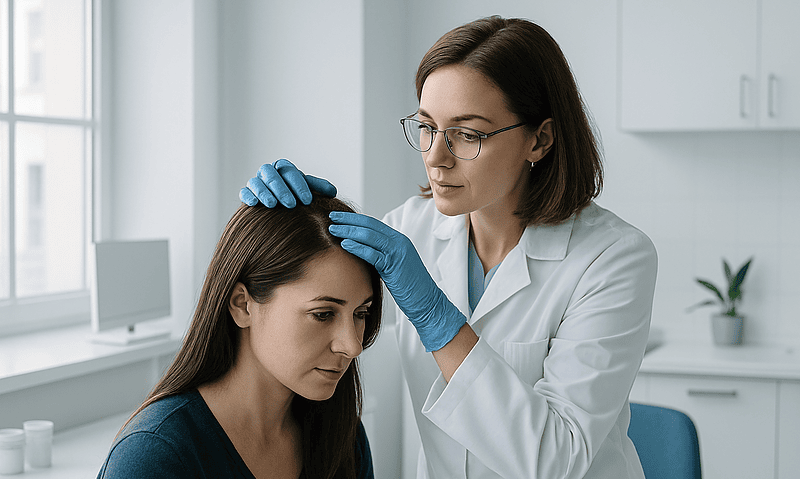
When Is a Hair Operation the Next Step? Stable Loss, Medical Therapy and the Timing Question
A hair operation is usually considered the next step only after hair loss has been diagnosed as pattern hair loss, has stayed stable for…

How Surgeons Plan a Soft, Rounded Hairline in a Hair Transplant for Women
Surgeons plan a soft, rounded female hairline by first confirming the diagnosis and that hair loss has stabilized, then marking a lower, curved line…

What Your Doctor Checks Before PRP for Hair Loss: Blood Thinners, Smoking and Alcohol
Before PRP for hair loss, a clinician usually reviews any blood thinners you take, how much you smoke and how much alcohol you drink,…
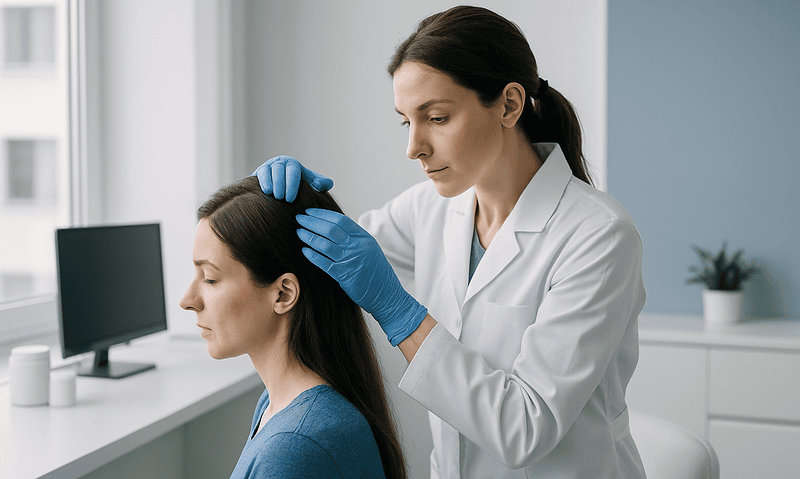
When Is a Female Hair Transplant Considered? Medical Treatment First, Then Stable Loss
A female hair transplant is usually considered only after two conditions are met: the cause of hair loss has been diagnosed and treated medically,…

Aesthetic Scalp Surgery Recovery: Dressing Days, Scalp Tightness and When Swelling Settles
Recovery after aesthetic scalp surgery, including hair transplantation, usually follows a predictable arc: any dressing comes off within the first day or two, swelling…

How to Read an FUE Treatment Plan: Zones, Graft Distribution and What the Numbers Mean
To read an FUE hair transplant plan, start with the scalp diagram: each labeled zone (hairline, frontal, mid-scalp, crown) carries a graft count and…