

How Surgeons Plan a Soft, Rounded Hairline in a Hair Transplant for Women
Key Takeaways
- Female pattern hair loss usually thins the top of the scalp and spares the frontal hairline, so a woman's hairline concern is rarely the M-shaped recession seen in men.
- Surgeons place the front row exclusively with single-hair follicular units and add deliberate irregular spacing, because an even row of multi-hair grafts is the most recognizable sign of surgery.
- Hairline height is chosen by facial proportion and the point where the forehead begins to curve, and it cannot be raised again without further surgery, so it is decided before any grafts are harvested.
- Transplanted hairs typically shed in the early weeks and regrow over months, with the NHS advising that full results are usually judged between six months and a year.
- Harvard Health notes that female pattern hair loss affects roughly one in three women over a lifetime, which is why donor hair at the back is examined under magnification for hidden thinning before any plan is made.
- Anyone with suspected frontal fibrosing alopecia or unexplained diffuse shedding is usually asked to see a dermatologist first, because grafts placed into active disease are at risk of being lost.
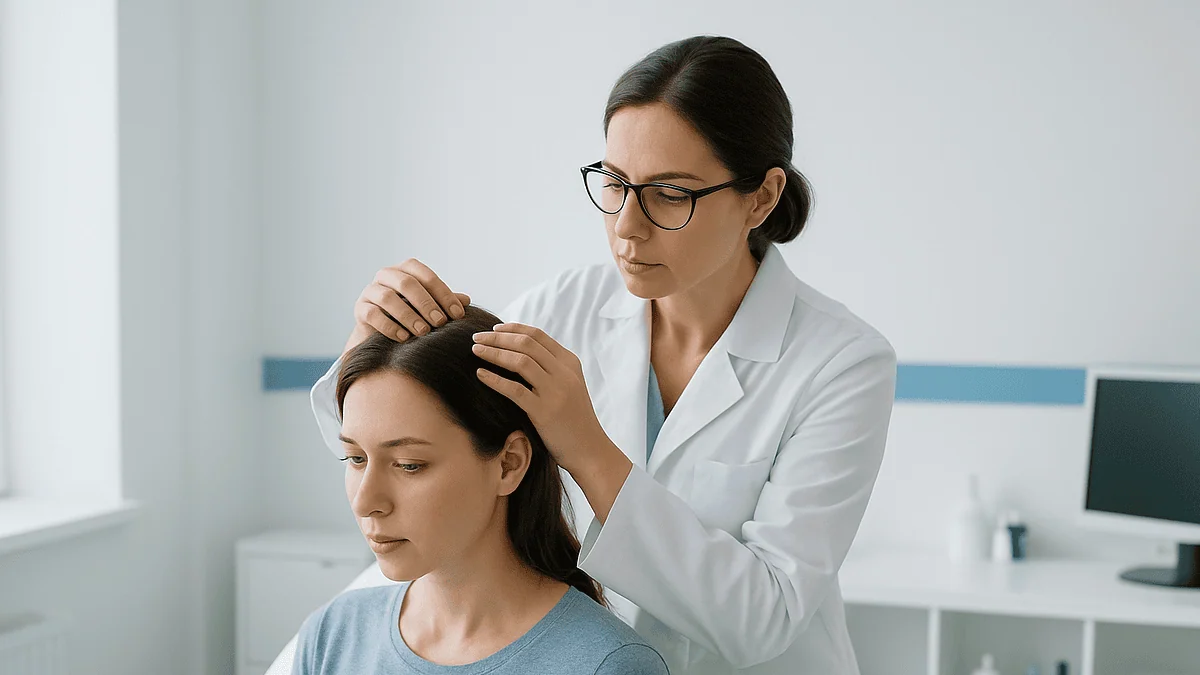
Surgeons plan a soft, rounded female hairline by first confirming the diagnosis and that hair loss has stabilized, then marking a lower, curved line with gentle temples, an optional central peak and deliberate micro-irregularity. Single-hair follicular units go at the front, density is built behind them, and each graft is angled forward so the result moves like natural hair. Final design and candidacy decisions rest with the treating team.
She has stopped wearing her hair pulled back. In photographs she angles her head so the light falls on the crown, not the forehead, and she has quietly retired the headbands that used to be her signature. What she wants to know, sitting in a consultation with a mirror in her lap, is a surprisingly technical question: how do you draw a line on a person’s face that nobody will ever notice?
That question sits at the center of female hairline design hair transplant planning. The surgical steps of moving follicles are broadly the same for anyone. The design is not. A woman’s hairline follows different rules for height, shape, texture and direction, and a plan that ignores those rules can produce hair that grows perfectly well and still looks wrong.
This explainer walks through what surgeons actually think about when they plan that curve, who tends to be a good candidate, what recovery usually looks like, and the questions worth asking before anyone picks up a marker.
What does a female hairline design hair transplant actually involve?
A hair transplant moves your own hair follicles from a place where they are plentiful, usually the back and sides of the scalp, to a place where they are thin. The follicles come out as follicular units: tiny natural bundles of one to four hairs that grow together from the same spot. Surgeons harvest them either individually through very small punches (follicular unit excision, or FUE) or by removing a narrow strip of scalp and dividing it under magnification (follicular unit transplantation, or FUT). The NHS describes both approaches as day procedures performed under local anesthetic.
The design work starts long before harvesting. In a hairline case, the surgeon studies your existing frontal hair, the way your forehead curves, where your eyebrows sit, how your hair naturally parts and falls, and old photographs from before the change. Then a line is drawn, checked from the front, from both sides and from above, redrawn, and checked again with you sitting upright and relaxed. Recipient sites, the tiny slits that will receive each graft, are then made along and behind that line at chosen angles and spacing.
Follicular units are sorted by hair count. The finest single-hair units go along the front edge. Two-hair units sit just behind. Larger units, if used at all in a hairline, stay well back where they add fullness without being visible at the border.
The MedlinePlus hair transplant entry notes that transplanted hair keeps the characteristics of where it came from, which is why surgeons care so much about matching hair caliber and curl to the frontal zone. The design is, in effect, a plan for where each of those bundles belongs so that the finished line reads as something you were born with.
Why does a woman's hairline look different from a man's?
Ask someone to sketch a receding hairline and they will draw two notches at the temples. That picture is male. Female pattern hair loss, described in the MedlinePlus entry on female pattern baldness, tends to thin the top of the scalp in a diffuse way while the frontal hairline itself is often preserved. So when a woman does have a hairline concern, it is rarely the M-shape a surgeon sees in men. It is more often an overall high or thin front, a widened part, or fine, see-through hair in the first inch behind the line.

The anatomy differs too. Female hairlines usually sit lower on the forehead, curve rather than angle, and keep closed, rounded temples with feminine temporal points, the small tufts of hair that project forward just above the ear. Many women also have a central peak or a slight asymmetry that a good design preserves rather than erases.
| Feature | Typical feminine design | Typical masculine design |
|---|---|---|
| Height on forehead | Lower, following where the forehead begins to curve | Higher, with a flatter central zone |
| Overall shape | Oval or gently rounded | More angular, often with an M or recessed corners |
| Temples | Closed, rounded, with temporal points kept or rebuilt | Open recession is accepted as natural |
| Central peak | Common, often deliberately kept | Less emphasized |
| Hair direction at the edge | Forward and slightly downward, low angle | Forward, sometimes more upright |
| Front-row grafts | Single, fine hairs with irregular spacing | Single hairs, but density often ramps up faster |
Because of these differences, a template built for male pattern loss tends to leave a woman with corners that look scooped out, or a line placed too high. The rest of this article is about avoiding exactly that.
How high or low should the new hairline sit?
Height is the first and most consequential decision, because it cannot be undone later without another operation. Surgeons generally look for the place where the forehead stops being vertical and begins to curve back toward the scalp. On most people you can feel it with a fingertip: the bone changes direction, and a hairline placed around that transition tends to look settled rather than pasted on.
Rather than working from a number, experienced planners use proportion. They consider the distance from the brow to the proposed line in relation to the distance from brow to nose base, and from nose base to chin, and they check how the line frames the face when you smile, raise your eyebrows and turn your head. A hairline drawn while you are frowning or lying flat can migrate noticeably once you sit up and relax.
There is a real tension here. Lower hairlines are more feminine and more youthful, and most women asking about the procedure want something lower than what they have. Yet every centimeter lower consumes grafts from a donor supply that is finite and may be needed elsewhere over a lifetime. A very low line on a woman whose thinning may progress across the top of the scalp can leave a dense frontal band with a sparse area behind it, which draws the eye rather than deflecting it.
Surgeons often resolve this by asking two questions: what does this face need for balance, and what will this scalp still look like if the underlying condition continues? The Mayo Clinic notes that hair loss can be caused by heredity, hormonal shifts, medical conditions and medications, so the answer to the second question depends on the diagnosis, which is why it comes first.
How the rounded shape is drawn: temples, corners and the widow's peak
Once height is settled, the surgeon builds the curve. The central portion is drawn first, then the line sweeps outward and downward toward the temples in a continuous arc. The corners, where the frontal line turns into the sides, are where feminine and masculine designs diverge most sharply. In a female plan the corners stay closed, meaning the frontal hair connects smoothly into the temporal hair without an open notch.
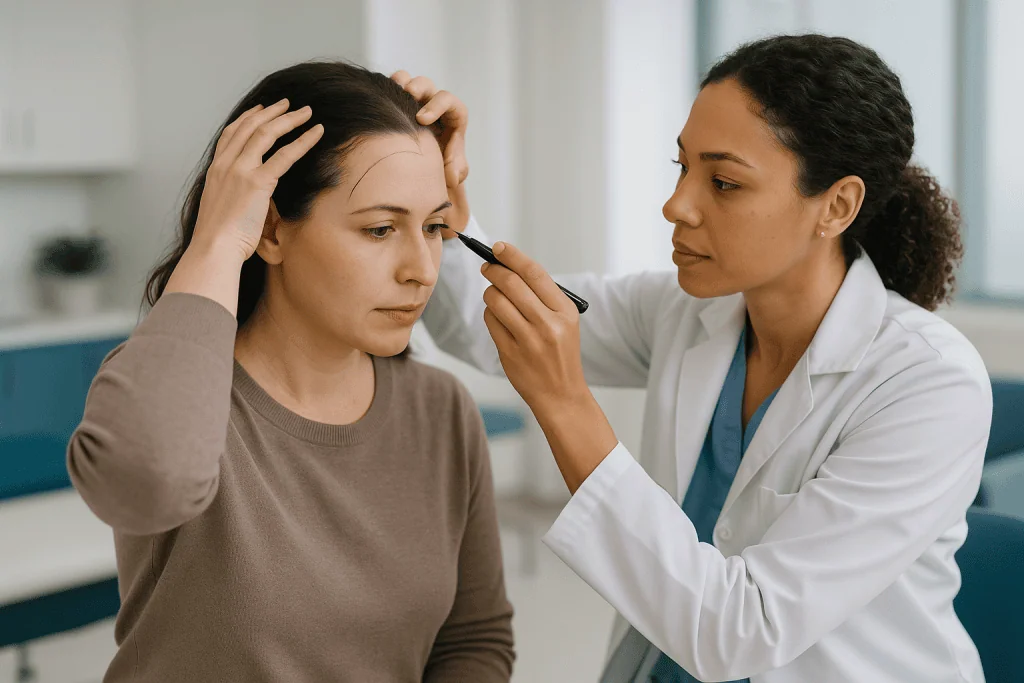
Temporal points matter more than most people expect. They are the small forward-projecting tufts above and slightly in front of the ear. When they are thin or absent, the face looks wider and the eyes appear to sit farther from the hairline, even if the frontal line itself is fine. Rebuilding them requires the finest single hairs, angled sharply downward and forward, because any hair standing up in that zone is visible from across a room.
The widow’s peak, a small V-shaped dip of hair at the center of the forehead, is another signature. Many women have a subtle version, and old photographs often show where it sat. Surgeons frequently preserve or recreate it because a perfectly symmetrical arc looks manufactured. The same goes for mild asymmetry: almost nobody has a mirror-image hairline, and copying the person’s own slight lopsidedness is part of making the result disappear.
The drawn line is not the border of the finished hairline. It is a guide behind which the transitional zone sits. In practice the surgeon plans a fuzzy band rather than a stroke, with scattered single hairs in front of the marker and rising density behind it, so that there is no exact point where forehead ends and hair begins.
Single hairs, irregular spacing, direction and density: what makes natural hairline design for women read as real
Four technical details do most of the work of making a transplanted hairline invisible, and they are worth understanding because they are what separates a careful plan from a fast one.
The first is hair count per graft. Natural hairlines begin with single hairs, not pairs, so the front rows are built exclusively from single-hair follicular units, ideally the finest ones the donor area offers. Two-hair units start a few millimeters back. Larger units stay well behind the transition. Put a three-hair graft at the front edge and it will look like a tiny plug regardless of everything else.
The second is irregularity. Real hairlines are not smooth. Under magnification they show clusters, gaps and small forward projections. Surgeons introduce deliberate micro-irregularity by varying spacing along the line and adding a few isolated hairs slightly ahead of it, sometimes called sentinel hairs. A row of evenly spaced grafts is the most recognizable sign of surgery.
The third is direction and angle. Frontal hair grows forward and lies fairly flat against the forehead, with the angle becoming steeper further back. Around the temples it turns downward. Each recipient slit is cut to match the existing hair around it, or to match what natural growth would do if none is left. Grafts placed at the wrong angle grow healthily but stand up like brush bristles.
The fourth is density gradient. Rather than aiming for uniform fullness, surgeons place a sparse transition zone in front, then increase density progressively so the eye reads a soft fade. Concentrating grafts where they are most visible, typically the central front and any zone that shows along the part, produces more visual coverage from the same number of follicles than spreading them evenly.
Who is a good candidate for female hairline design hair transplant, and who is asked to wait?
The strongest candidates share three features: a clear diagnosis, a stable pattern, and a donor area that is genuinely dense and unaffected. A woman with a naturally high hairline she has had since childhood, with no thinning elsewhere, is a common example. So is someone with traction alopecia (hair loss from years of tight styling) at the temples that has stopped progressing after the styling changed. Localized loss after surgery, burns or injury, provided the scar tissue has matured and has a good blood supply, often falls into this group as well.
Women with female pattern hair loss can also be candidates, but planning is more cautious. Harvard Health notes this condition affects roughly one in three women over a lifetime, and because it tends to thin the top of the scalp diffusely, the donor zone at the back may itself be affected. A surgeon will usually examine donor hair under magnification to check that it is not miniaturizing before promising anything.
Several groups are typically asked to wait or to pursue medical evaluation first. Anyone with recent, rapid or diffuse shedding needs a workup; MedlinePlus lists thyroid disease, iron deficiency, medications and hormonal changes among causes that should be identified. Anyone with a scarring alopecia that may still be active, especially frontal fibrosing alopecia, a condition in which inflammation progressively destroys follicles along the hairline, is usually asked to hold off until a dermatologist confirms the disease has been quiet for a sustained period, because grafts placed into active inflammation are at risk.
Transplants are also often deferred in very young patients whose pattern is still evolving, in people whose expectations exceed what the donor supply can deliver, and in anyone with uncontrolled medical conditions that would raise surgical risk. The decision to proceed, wait or choose a different path belongs to the treating team after examination.
Can a female receding hairline be fixed?
Often the honest answer is that it depends on why it receded, and the word “fixed” hides several different situations.
A hairline that has always been high is not a disease. It is anatomy, and it is one of the most straightforward situations to treat surgically because there is no underlying process to worry about. Grafts placed there behave like the donor hair they came from.
Recession from traction, typically at the temples after years of tight braids, ponytails or extensions, can often be improved once the pulling has stopped. The Mayo Clinic describes traction alopecia among hair loss causes, and dermatologists generally look for evidence that follicles are still present before recommending surgery, because long-standing traction can eventually scar. If fine regrowth appears after styling changes, a period of waiting to see how much returns on its own is common.
Recession along the front edge with a pale, shiny band of skin and loss of eyebrows may point toward frontal fibrosing alopecia. This is where caution matters most. Transplanting into an active scarring process risks losing the grafts, so the usual sequence is dermatologist first, disease control second, and any surgical discussion only after a documented quiet period. Even then, the treating team will weigh the risk of reactivation.
Diffuse frontal thinning from female pattern hair loss sits in between. Transplantation can add density, but the Mayo Clinic notes that medical treatments such as topical minoxidil, which works by prolonging the growth phase of existing follicles, typically need at least six months before their effect can be judged. Many teams prefer to see what medical therapy achieves before deciding how many grafts the front actually needs. Whether to start, continue or change any medicine is a decision for the prescribing clinician.
Female hairline lowering: transplant or forehead reduction surgery?
Women who simply want a lower hairline, without any hair loss, sometimes hear about two very different operations, and it helps to understand how they compare.
Hairline lowering by transplant means placing grafts in the bare forehead skin in front of the existing hairline. Its advantages are that it involves no long incision across the front of the head, it can create a gradual, irregular edge, and it can be shaped with great precision. Its limits are the donor supply and the fact that transplanted hair takes months to grow in. Density in the new zone will be built up, not instant.
Forehead reduction, also called surgical hairline advancement, removes a strip of forehead skin just in front of the hairline and pulls the hair-bearing scalp forward, closing the gap with an incision hidden along the new edge. It moves existing hair with its full native density in a single step. Its trade-offs include a scar along the hairline, the need for reasonable scalp laxity, and the risk of the scar widening or of numbness behind the line. Some surgeons later place a row of grafts through the scar to soften it.
Which approach suits a given person depends on how far the line needs to move, how elastic the scalp is, how the person wears their hair, and their tolerance for a linear scar versus a longer wait for growth. Neither is universally better. A consultation that discusses both, including the option of doing nothing, is a good sign that the team is planning around your face rather than around a single technique.
How the donor area limits every design decision
Behind every hairline drawing is a quieter calculation about supply. Follicles do not regenerate at the donor site. Each graft harvested from the back of the head is a one-time withdrawal from an account that has to last a lifetime, and in women that account is frequently smaller and less predictable than in men.
The reason goes back to pattern. In classic male pattern loss the occipital band at the back stays thick and hormonally resistant, which is why it is called the safe zone. Female pattern hair loss, as described by MedlinePlus, thins more diffusely, and the back and sides may be quietly miniaturizing even when they look fine to the naked eye. Surgeons therefore examine donor hair under magnification, counting hairs per follicular unit and noting how many are fine or short. Donor hair that is already thinning will keep thinning after it is moved.
Hair characteristics matter almost as much as count. Coarse, wavy hair covers more scalp per graft than fine, straight hair. Dark hair on pale skin shows every gap; hair color close to skin tone is forgiving. A design that would look full with one person’s hair might look thin with another’s at the same graft number, which is why credible planning never quotes a graft count before the examination.
These constraints shape the drawing. A surgeon working with a limited donor supply will typically prioritize the most visible zone, keep the line a little higher rather than lower, build a strong transition at the front and accept a softer density behind it. That is not a compromise on quality. It is the difference between a plan that ages well and one that looks good for a few years and then leaves nowhere to go.
What happens on the day of a female hairline transplant
The NHS describes a hair transplant as usually taking place over one day under local anesthetic, and the sequence for a hairline case follows a predictable arc.
The morning begins with photographs and the final design check. You sit upright with your hair styled the way you usually wear it, and the surgeon redraws or confirms the line while you both look in the mirror. This is the moment to say anything you are unsure about; once recipient sites are made, the height is fixed.
Harvesting comes next. With FUE, a small area at the back is trimmed short, or in women often a hidden strip is trimmed so longer hair can cover it, and follicular units are removed one at a time. With FUT, a strip is taken and the wound closed with stitches or staples, then the strip is divided into individual units by a team working under microscopes. In either method the grafts are sorted by hair count and kept in a cooled holding solution.
The surgeon then makes recipient sites along the planned zone, controlling the angle, direction and depth of each one. This step is where design becomes reality, and it is usually done by the surgeon personally. Placement follows, with single-hair units pressed into the front sites first and larger units behind. Local anesthetic is topped up as needed.
Toward the end, the team applies a light dressing or leaves the area open with a protective spray, reviews aftercare, and arranges follow-up. Most people go home the same day with someone to drive them. Expect to feel tired rather than sore; a long day of sitting still is more draining than most people anticipate.
What the following days and weeks usually look like
Recovery follows a rhythm that surprises people who have not been warned, so it helps to know the shape of it in advance. The ranges below are typical patterns described by the NHS and MedlinePlus, not promises for any individual.
In the first few days the recipient area is pink and dotted with tiny crusts around each graft. Some swelling of the forehead is common and can drift down toward the eyes before it settles. Sleeping with the head raised is usually advised. The donor area feels tight or tender, and with FUT there is a stitched line to protect. The NHS notes that most people are back to everyday activities within days, though vigorous exercise is generally paused for longer on your team’s advice.
Over the first one to two weeks the crusts loosen and fall away with gentle washing, and the grafted hairs begin to shed. This shedding is expected: MedlinePlus explains that the transplanted hairs fall out in the early weeks while the follicles beneath remain and enter a resting phase. Some existing hair near the transplanted zone can also shed temporarily, an effect called shock loss.
New growth typically becomes noticeable a few months later, initially fine and sometimes slightly wiry before the texture normalizes. The NHS advises that full results are generally judged between six months and a year. During this window the hairline can look uneven, because follicles do not all wake at once; surgeons rarely assess the design until it has matured.
Numbness along the front or at the donor site is common and usually improves over months. Any follow-up appointments, and any discussion of a second session to add density, are scheduled by the treating team based on how the first result grows in.
What people often get wrong about a hair transplant for women's hairline
Several beliefs circulate widely enough that they deserve direct correction.
“A transplant stops hair loss.” It does not. Moving follicles changes where hair grows; it does nothing to the process that caused thinning elsewhere. The Mayo Clinic groups hair transplant with other treatments precisely because it addresses appearance, not cause. Women with pattern loss are usually told to expect that the surrounding native hair may continue to thin, which is why medical management is often discussed alongside surgery.
“Lower is always better.” A hairline that is too low or too dense at the front can look heavier and older, not younger, especially as native hair behind it thins. Surgeons frequently talk women out of the lowest line they ask for.
“The result is instant.” The early weeks bring shedding, then a long quiet period. Someone judging the design at eight weeks is looking at follicles that have not yet grown.
“Any thinning at the front means I should have surgery.” Diffuse shedding can reflect thyroid disease, iron deficiency, medication effects or recent illness, all listed by MedlinePlus as causes that need identification. Transplanting into an undiagnosed process wastes grafts and can hide a treatable problem.
“Women don’t get good results.” Women with stable, localized concerns and healthy donor hair can do very well. What is true is that candidacy is more variable than in men and the evaluation needs to be more thorough.
“More grafts equals a better hairline.” Graft numbers quoted before an examination are marketing, not planning. The quality of the design, the sorting of single hairs to the front and the angles of the recipient sites matter more to the finished look than any headline count.
Questions to ask your care team before agreeing to a hairline design
A good consultation should leave you able to describe the plan in your own words. These questions tend to surface the information that matters.
- What is my diagnosis, and how confident are you that my hair loss is stable? Which tests, if any, were done to rule out other causes?
- Have you examined my donor area under magnification, and is there any sign of thinning there?
- Where exactly will the new line sit, and can we look at it drawn on me from the front, both sides and above while I am sitting upright?
- How will you keep the temples closed and the corners rounded, and will you rebuild my temporal points?
- What hair count will the front-row grafts have, and how will you create irregularity along the edge?
- How will the angle and direction of the recipient sites match my existing hair?
- Who makes the recipient sites and who places the grafts on the day?
- If my native hair continues to thin behind the new line, what does the long-term plan look like, and how much donor supply are we holding in reserve?
- Would forehead reduction, medical treatment alone, or waiting be reasonable alternatives for me, and why did you recommend this path?
- What are the specific risks in my case, including shock loss, scarring, numbness and uneven growth, and what happens if a section does not grow as expected?
- What will recovery look like for my job and my usual hairstyle, and when is the earliest you would assess the result?
- Can I see photographs of healed hairlines on women with hair similar to mine, viewed close up and from the side?
Write down the answers. If the plan you hear differs from the plan you understood at the last visit, ask for the drawing to be redone in front of you. The decision to go ahead, and every detail of the design, rests with you and the treating team together.
When to call your doctor after a hairline transplant
Most recoveries are uneventful, and mild swelling, crusting, itching and temporary numbness are expected. Some signs, however, should prompt a same-day call to the surgical team or, if you cannot reach them, urgent medical care.
- Spreading redness, increasing warmth or pain at the recipient or donor area after the first couple of days, particularly with yellow discharge or an unpleasant smell, which may indicate infection.
- Fever, chills or feeling generally unwell.
- Bleeding that does not stop with gentle, steady pressure for several minutes, or that soaks through a dressing.
- Sudden or severe swelling of the face or around the eyes, especially if it affects vision.
- Any sign of an allergic reaction to medicines or dressings, such as hives, widespread rash, swelling of the lips or tongue, or difficulty breathing; the last of these is an emergency.
- Severe pain that is not controlled by the plan your team gave you.
- A donor wound that gapes, or stitches that come apart early.
- Small pus-filled bumps that keep appearing in the grafted zone weeks later, which can signal folliculitis and is easier to manage early.
- Any new symptoms after starting a medicine your prescriber recommended, which should be discussed with that prescriber rather than stopped on your own.
Outside the surgical window, see a doctor or dermatologist before any cosmetic consultation if you notice rapid, patchy or diffuse shedding, scalp pain, itching or burning along the hairline, a shiny pale band where hair used to be, or loss of eyebrow hair. These can point toward conditions that need medical treatment first, and MedlinePlus and the Mayo Clinic both emphasize identifying the cause of hair loss before choosing how to address it.
Frequently asked questions
What is the best hairline design for a hair transplant in a woman?
There is no single best design; the right one copies the hairline your face and your old photographs suggest you were meant to have. In practice that means a gently rounded arc set where the forehead begins to curve, closed temples with feminine temporal points, an optional central peak, single-hair grafts along the edge, deliberate micro-irregularity and a soft density gradient. The surgeon tailors all of this to your hair caliber, color and donor supply.
Can you create a completely new hairline with a hair transplant?
Yes, grafts can be placed into bare forehead skin to build a hairline where none currently exists, which is how transplant-based hairline lowering works. The limits are your donor supply and hair characteristics, since every follicle moved forward is no longer available for other areas. Surgeons usually build a sparse, irregular transition zone first and increase density behind it, and the result matures over months rather than appearing immediately.
How much does a female hairline transplant cost?
This article does not give price figures, because cost varies with the number of grafts needed, the technique, the surgeon’s time and whether a second session is planned, and quoting a figure without an examination would be misleading. Ask your care team for a written, itemized estimate that lists what is included, follow-up visits and any charges if additional grafts are needed later, so you can compare plans on the same basis.
Can a female receding hairline be fixed?
Often it can be improved, but the approach depends on the cause. A naturally high hairline or stable traction alopecia at the temples is frequently suitable for transplantation. Recession from frontal fibrosing alopecia needs dermatological control first, because grafts placed into active inflammation may be lost. Diffuse thinning from female pattern hair loss may be managed medically before, or alongside, surgery. A dermatologist’s diagnosis comes first, and the treating team decides on candidacy.
What does natural hairline design for women involve at the front edge?
The front edge is built from the finest single-hair follicular units, spaced unevenly with a few isolated hairs placed slightly ahead of the drawn line so there is no crisp border. Each recipient site is angled so hair lies forward and low against the forehead, turning downward near the temples. Two-hair grafts begin a few millimeters back, and larger units stay well behind, creating a gradual fade rather than a wall.
Is female hairline lowering better done with a transplant or forehead reduction?
Neither is universally better. Transplant-based lowering avoids a long incision and allows a soft, irregular edge, but density builds slowly and depends on donor supply. Forehead reduction moves existing hair forward with full density in one step, but leaves a scar along the hairline and requires scalp laxity. The choice depends on how far the line must move, scalp elasticity, hairstyle and your tolerance for a scar versus a waiting period, decided with your surgeon.
Why does a hair transplant for women's hairline need a dermatology workup first?
Because diffuse thinning in women has many possible causes, including thyroid disease, iron deficiency, medication effects and hormonal change, all listed by MedlinePlus, and several of these are treatable without surgery. A workup also screens for scarring conditions such as frontal fibrosing alopecia, where transplantation into active disease risks graft loss. Identifying the cause protects both your donor supply and the long-term look of the result.
How long before a transplanted female hairline looks natural?
The NHS advises that full results are usually judged between six months and a year after surgery. Before that, the grafted hairs shed in the early weeks, the follicles rest, and new growth appears over the following months, at first fine and sometimes uneven because follicles do not all restart together. Surgeons generally avoid assessing the design, or planning any second session, until the hairline has matured through this window.
Will a hairline transplant stop my hair from thinning further?
No. A transplant moves follicles; it does not change the process that caused thinning elsewhere. Native hair behind or around the new line can continue to thin, which is why surgeons plan conservatively and often discuss medical management alongside surgery. Topical minoxidil, for example, works by prolonging the growth phase of existing follicles and, per the Mayo Clinic, usually needs at least six months before its effect can be judged. Decisions about medicines belong to your prescriber.
What are the main risks of a female hairline transplant?
Common effects include swelling, crusting, temporary numbness, and shedding of both transplanted and some nearby native hair in the early weeks. Less common risks include infection, bleeding, folliculitis, visible scarring at the donor site, uneven or poor growth in part of the grafted zone, and a hairline that looks unnatural if height, angle or graft selection were wrong. Your surgeon should explain how each risk applies to your case and how it would be managed.
References
This article is for general information only and is not a substitute for professional medical advice. Please consult a qualified doctor about your individual situation.
Add us as a Preferred Source to see more of our trusted health content across Google Search, AI Overviews and Discover.

Planning This Treatment in Turkey
Our full guide for international patients: techniques, hospital stay, recovery and cost.
More from the Blog
What Your Doctor Checks Before PRP for Hair Loss: Blood Thinners, Smoking and Alcohol
Before PRP for hair loss, a clinician usually reviews any blood thinners you take, how much you smoke and how much alcohol you drink,…
When Is a Female Hair Transplant Considered? Medical Treatment First, Then Stable Loss
A female hair transplant is usually considered only after two conditions are met: the cause of hair loss has been diagnosed and treated medically,…

Aesthetic Scalp Surgery Recovery: Dressing Days, Scalp Tightness and When Swelling Settles
Recovery after aesthetic scalp surgery, including hair transplantation, usually follows a predictable arc: any dressing comes off within the first day or two, swelling…

How to Read an FUE Treatment Plan: Zones, Graft Distribution and What the Numbers Mean
To read an FUE hair transplant plan, start with the scalp diagram: each labeled zone (hairline, frontal, mid-scalp, crown) carries a graft count and…
What Happens on the Day of a Hair Operation: Check-In, Hairline Drawing and Graft Placement
On the day of a hair operation, you check in, confirm consent and your medical history, and the surgeon draws and agrees the new…
How Long to Stay in Istanbul After a DHI Hair Transplant: Washing Visits and the Flight Home
There is no guideline-fixed number of days to stay in Istanbul after a DHI hair transplant. Most care teams ask patients to remain nearby…