

How Long to Stay in Istanbul After a DHI Hair Transplant: Washing Visits and the Flight Home
Key Takeaways
- No national guideline specifies a minimum number of days to stay near the surgeon after a DHI hair transplant; clinics anchor the stay to the next-day review and the first supervised wash.
- The NHS describes hair transplantation as a same-day procedure with most people returning to work after around three days, but a return-to-work date is not a flight clearance.
- The CDC lists recent surgery and flights over roughly four hours as deep vein thrombosis risk factors, so walking the aisle, calf exercises and hydration matter on the journey home.
- DHI and classic FUE share the same donor and recipient wounds, so their early aftercare and travel timing are essentially identical; the strip method is the one that changes the calendar.
- Shedding of transplanted hair between two and six weeks after surgery is expected shock loss, and the NHS advises that final results take up to a year or more to judge.
- No guideline or systematic review supports a single DHI success percentage; graft survival figures vary by surgeon and measurement, so precise marketing numbers should be treated as unverified.
There is no guideline-fixed number of days to stay in Istanbul after a DHI hair transplant. Most care teams ask patients to remain nearby until the day-after check and the first supervised wash, which commonly falls within the first few days, before flying home. The right length depends on the surgeon's protocol, graft count, healing and flight duration, so the treating team sets the date.
Picture the suitcase open on the hotel bed. On one side, a neck pillow and the printed aftercare sheet; on the other, a phone showing two possible return flights, three days apart. The scalp is still numb in patches, the donor area at the back of the head is dotted with tiny scabs, and the one question that matters tonight is not about hairlines at all. It is simply: when is it safe to go?
That question, the practical heart of dhi hair transplant stay length, gets answered online with a confidence the evidence rarely supports. Some pages promise a two-day turnaround; others warn of a fortnight. Neither is a clinical rule. What does exist is a sensible sequence of checks, a first wash, and a journey home that should not undo careful work.
This explainer walks through that sequence calmly, with the numbers that mainstream sources actually publish and honest gaps marked where they exist.
What a DHI hair transplant actually involves
Start with the vocabulary, because it shapes everything that follows. A graft is a tiny unit of scalp tissue containing one to four hair follicles. Follicular unit extraction, usually shortened to FUE, is the technique of removing those grafts one at a time from the back and sides of the head, the donor area, with a small circular punch. Direct hair implantation, or DHI, is a variant of FUE in which each graft is loaded into a spring-loaded implanter pen and placed into the recipient area in a single motion, rather than being inserted with forceps into channels the surgeon has already cut.
The donor area is chosen because hair there is typically resistant to the hormone-driven thinning that causes male and female pattern hair loss, so transplanted follicles tend to keep growing where they are placed. MedlinePlus describes the procedure as taking place under local anesthetic, with sedation available, and notes that sessions commonly last several hours depending on how many grafts are moved.
Cleveland Clinic puts the typical session at roughly four to eight hours, and larger plans may be split across more than one day. That matters for stay length: a two-day procedure plus a check and a wash already stretches the calendar before any flight is booked.
What DHI does not change is biology. Grafts need a blood supply to re-establish in their new home, and the scalp needs time to seal around them. The implanter pen alters how the graft is handled on the way in; it does not shorten the days afterward when a knock, a scrape or a hot shower could dislodge what was placed. Every realistic answer to “how long should I stay” rests on that healing window, not on the tool used.
Dhi hair transplant stay length: why there is no single number
Search for a figure and you will find one on every page, which is exactly why they cannot all be right. No national guideline from the NHS, NICE, the CDC or the WHO specifies how many nights a patient must remain near the surgical site after a hair transplant. The NHS describes hair transplantation as a same-day procedure and states that most people are able to return to work after around three days, which tells you the early recovery is short, but it does not translate into a travel rule.
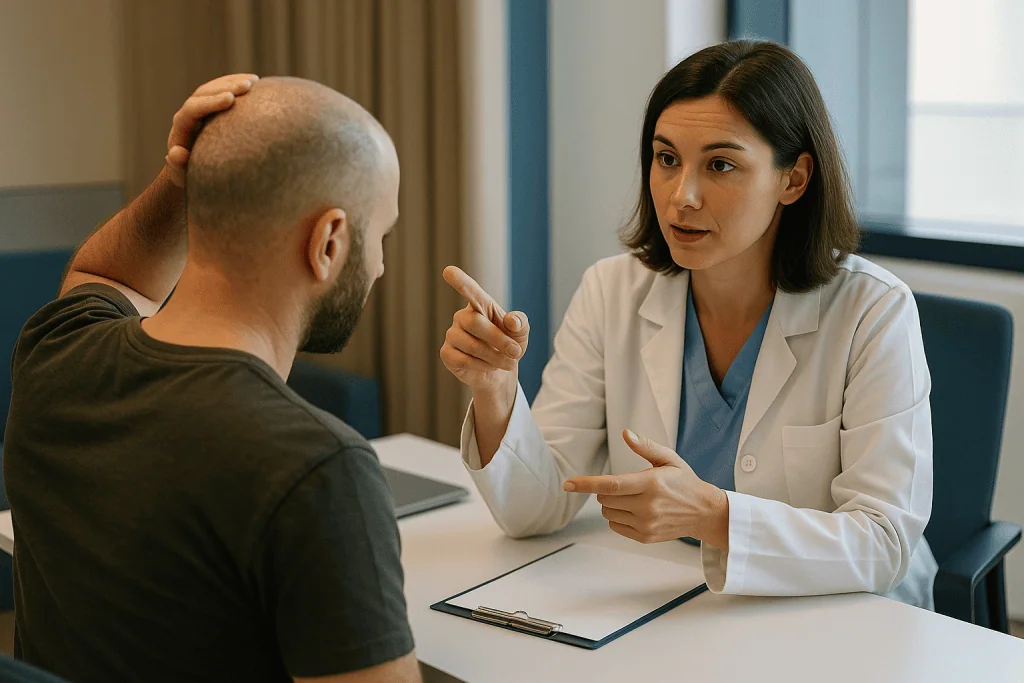
What clinics actually do is anchor the stay to events rather than to a calendar. The first event is a next-day review, when the donor dressing is removed, the implanted zone is inspected for bleeding or displaced grafts, and the patient is shown how to sleep and move. The second is the first supervised wash, which in most published aftercare schedules falls in the first few days. Once both have happened and the surgeon is satisfied, patients are commonly cleared to travel.
Several variables stretch or shorten that sequence:
- Graft count and whether the work spanned one day or two.
- Any bleeding, swelling or crusting that needs a second look.
- Flight length, number of connections and whether the patient will be sleeping upright for hours.
- The surgeon’s own protocol, which may require seeing the scalp again after the first wash.
So the honest framing is this: dhi hair transplant stay length is a clinical decision set by the operating team at the time of discharge, informed by how the scalp looks. A number quoted on a booking page is a planning estimate, never a medical clearance, and the treating team can extend it.
What happens in the first 24 hours after the procedure
The first night is less dramatic than most people expect and more fiddly. Local anesthetic wears off over a few hours, replaced by a tight, tender feeling across the donor area and mild soreness where grafts were placed. MedlinePlus notes that the scalp may be sore, that pain relief and short courses of medicine to reduce swelling or infection risk are sometimes prescribed, and that a bandage or dressing is usually worn briefly. Which medicines, if any, and for how long are decisions for the prescribing clinician; they vary by surgeon and by patient history.
Sleep is the main engineering problem. Most aftercare instructions ask for the head to be kept elevated on several pillows or in a reclining position, both to limit forehead swelling and to keep the freshly implanted zone from brushing against fabric. A travel neck pillow, usually packed for the flight, earns its place on night one.
The implanted grafts are at their most vulnerable in this window. They sit in small openings sealed by clot, and until the surrounding tissue grips them they can be displaced by friction, scratching or a sharp knock. Hence the standard advice to avoid hats that press on the recipient zone, to keep hands away from the scalp, and to skip alcohol, smoking and strenuous activity, all of which affect bleeding and healing.
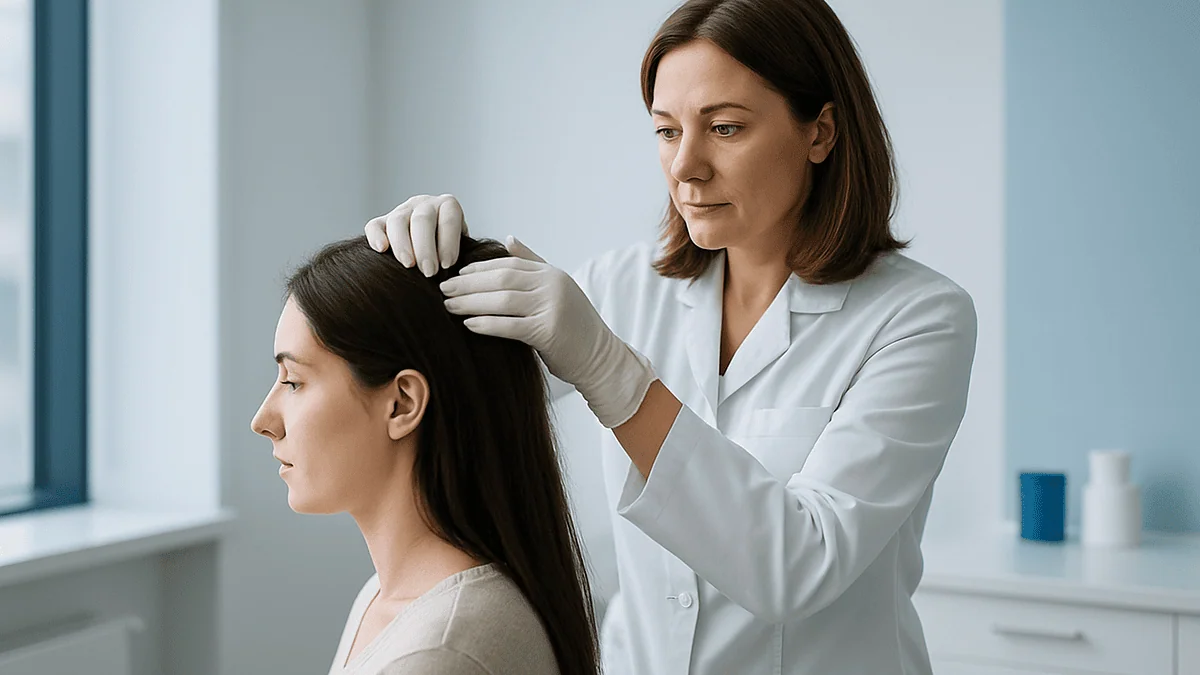
The next-day review is where the team checks for the things that would change a travel plan: oozing from the donor punches, a graft that has lifted, swelling that is spreading rather than settling. If everything looks ordinary, the patient is taught the washing routine and the countdown to departure effectively begins. If not, the sensible response is another day of observation, not a brave face at the airport.
First wash after hair transplant: what the washing visit is for
The washing visit sounds administrative. It is not. It is the first moment someone other than the surgeon puts hands near the grafts, and it is designed to teach a technique the patient will repeat alone for days.
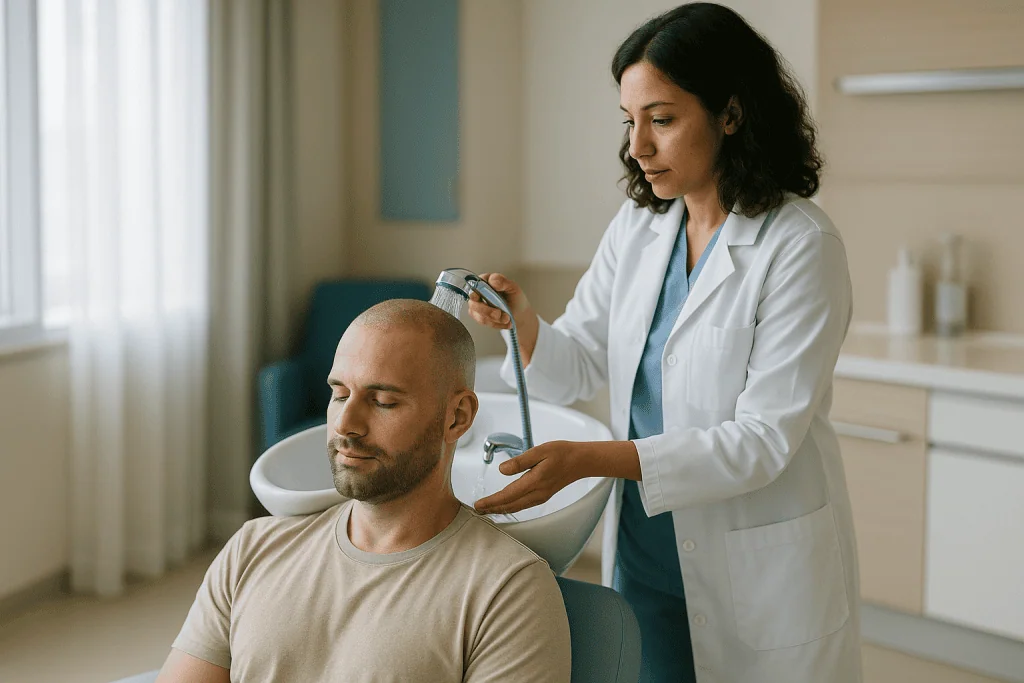
The goals are simple. Softening the small crusts that form around each graft lets them lift away gradually, without pulling the follicle with them. Removing dried blood and any residue from the donor area lowers the chance of infection. And the patient learns the pressure, water temperature and motion that are safe, because a scalp that is scrubbed like an ordinary head of hair in week one can lose grafts.
A typical supervised wash, as described in patient-information sources, involves a gentle cleanser or foam applied by dabbing, a lukewarm rinse poured rather than sprayed, and no rubbing or fingernail contact. Many teams also apply a softening lotion to the recipient area beforehand. The exact products and the number of daily washes belong to the surgeon’s protocol, and this article makes no recommendation between them.
Why does this visit anchor stay length? Because it is the last structured check before the patient is on their own. The nurse or doctor sees how crusting is progressing, confirms the donor punches are sealing, and answers the questions that only arise once someone has slept on the result. The NHS, in its guidance on cosmetic procedures carried out abroad, stresses that patients should know exactly what aftercare is included and who is responsible for it; the supervised wash is the clearest piece of that aftercare.
After it, the routine moves to the hotel bathroom and then to the home one. What changes is only the setting, provided the patient leaves with written, step-by-step instructions and a contact for problems.
How many days after a DHI hair transplant can I fly?
Here the evidence runs thin, and it is better to say so than to invent precision. Neither the NHS nor the CDC publishes a flight-specific waiting period for hair transplantation. The NHS page on cosmetic surgery abroad gives the general principle: flying soon after surgery raises the risk of blood clots, and patients should check with their surgeon and airline before booking a return. The CDC’s travel health guidance adds that recent surgery is itself a risk factor for deep vein thrombosis, the clot that forms in a leg vein during long periods of sitting, and that journeys over roughly four hours carry a modestly increased risk.
Hair transplantation is a superficial, local-anesthetic procedure, so it sits at the low end of that surgical risk spectrum. Yet the risk is not zero when someone who has just spent a full day in a chair then sits for another six hours on a plane. That is one reason care teams favor the wash-then-fly sequence rather than a dash to the airport.
Beyond clots, the practical concerns of flying with fresh grafts are mechanical and environmental:
- Cabin air is dry; the recipient area may feel tight or itchy, which invites scratching.
- Headrests and overhead bins are easy to knock against.
- Changing pressure can increase swelling slightly in anyone who is already puffy around the forehead.
- A headrest cover or loose, non-pressing hat that the surgeon approves protects the scalp.
The real answer to “how many days after a DHI hair transplant can I fly” is therefore: after the next-day review and the first supervised wash, once the surgeon has looked at the scalp and said yes. For most uncomplicated cases that is within the first few days, but the date is a clinical clearance, not a booking default, and it should be written on the discharge paperwork.
Mobility and clot prevention basics for the journey home
Deep vein thrombosis deserves its own paragraph because it is the one travel risk that is genuinely serious and genuinely preventable. The CDC’s Yellow Book describes the mechanism plainly: blood pools in the calf veins during prolonged immobility, and a clot can form, occasionally breaking off and lodging in the lung as a pulmonary embolism. Risk rises with longer flights, recent surgery, older age, obesity, pregnancy, hormone-containing medicines, a previous clot and some inherited clotting tendencies.
The protective habits are low-tech and worth doing on every long journey, not only after a procedure:
- Walk the aisle when the seatbelt sign allows, ideally every hour or two.
- Flex and extend the ankles and calves while seated.
- Drink water regularly; avoid alcohol, which dehydrates and makes scalp bleeding more likely.
- Choose an aisle seat where you can stand without climbing over someone.
- Wear properly fitted below-knee graduated compression stockings if the care team suggests them for your risk level.
Some patients with higher baseline risk are offered clot-preventing medicines around long journeys. That is a prescribing decision based on individual history; it is not routine after a hair transplant and should neither be requested nor avoided on the basis of an article.
Two further points link clots to the scalp question. First, a patient who develops a swollen, painful calf in the days after surgery needs assessment before any flight, not after. Second, prolonged sitting with the head forward over a phone encourages forehead swelling to track downward; sitting upright, head elevated, serves both the legs and the grafts.
None of this makes the trip hazardous for a healthy person who moves. It simply means the hours in the air deserve the same deliberate care the scalp has been getting on the ground.
Who DHI is usually for, and who is usually asked to wait
Hair transplantation treats the pattern of loss, not its cause, which is why candidacy depends as much on diagnosis as on desire. Mayo Clinic notes that the procedure suits people with androgenetic alopecia, the hormone-driven thinning that produces a receding hairline or crown in men and diffuse thinning in women, provided they have enough stable donor hair to move. The transplanted follicles keep their resistance to thinning; the surrounding native hair does not, so planning assumes further loss over the years.
DHI specifically tends to be chosen when the recipient area is modest in size, when the surgeon wants precise angle control along a hairline, or when a patient prefers not to shave the recipient zone fully. It is a technique preference within FUE rather than a different operation, and the choice between DHI and classic FUE sits with the surgeon’s experience and the patient’s pattern.
Some groups are commonly asked to wait or to consider alternatives first:
- People whose hair loss is still rapidly progressing, often in their late teens or early twenties, because the eventual pattern is unpredictable.
- Those with scarring alopecia, an inflammatory condition that destroys follicles, or with active scalp disease such as untreated psoriasis or infection.
- Patients with uncontrolled diabetes, bleeding disorders or medicines that affect clotting, where healing and bleeding risk need review.
- Anyone with body dysmorphic disorder or unrealistic expectations, where counseling comes before surgery.
Medical treatments for hair loss, including topical and oral agents that slow thinning, are often discussed alongside or before surgery. Whether to use them, and how, is a conversation for the treating clinician and depends on sex, age and medical history. For travel planning, candidacy matters because a patient whose eligibility was not properly assessed is more likely to face complications that extend the stay.
DHI vs FUE hair transplant: what differs for your stay length
Readers comparing techniques usually want to know whether one gets them home sooner. The short answer is that the aftercare calendar is nearly identical, because both methods leave the same two wounds: hundreds of small donor punches at the back and an implanted recipient zone at the front or crown. Where they differ is in handling, not in healing biology.
| Feature | Classic FUE | DHI (implanter pen) |
|---|---|---|
| Donor extraction | Individual punch extraction | Individual punch extraction |
| Recipient placement | Channels cut first, grafts inserted with forceps | Graft loaded into pen and placed in one motion |
| Shaving | Donor and usually recipient area | Donor area; recipient shave may be partial |
| Session length | Several hours; large plans may span two days | Similar; per-graft placement can be slower |
| Next-day review | Standard | Standard |
| First supervised wash | Within the first few days | Within the first few days |
| Visible crusting | Roughly one to two weeks | Roughly one to two weeks |
| Typical flight clearance | After review and wash, surgeon’s decision | After review and wash, surgeon’s decision |
Time ranges in the table reflect general patient-information descriptions from MedlinePlus, the NHS and Cleveland Clinic; they are typical, not guaranteed.
Three honest notes. First, claims that DHI heals faster or yields more growth are not supported by guideline-level evidence; comparative studies are small and surgeon-dependent. Second, a partially unshaven recipient area can make washing fiddlier, which is one reason some teams keep DHI patients an extra day. Third, the strip method, called FUT, where a band of donor scalp is removed and stitched, carries a longer donor healing time and a suture-removal visit, so it changes the stay calculation in a way the two FUE variants do not. For the question in this article’s title, DHI versus FUE is close to a wash.
DHI hair transplant recovery time: the days and weeks after you land
Once home, recovery follows a sequence that is reassuringly predictable, even when it does not look that way in the mirror. The figures below come from MedlinePlus, the NHS and Cleveland Clinic patient information and describe typical experience rather than individual promises.
Days 2 to 7. Crusts form around each graft and the donor punches scab over. Swelling, when it occurs, tends to appear around the forehead and sometimes the eyelids by day two or three and then settle. The NHS notes most people return to work after around three days, though desk work is easier than anything involving sweat or helmets.
Weeks 1 to 2. Crusts lift with gentle washing. Redness in the recipient area fades gradually. The donor zone, if shaved, begins to camouflage itself as surrounding hair regrows.
Weeks 2 to 6. Many transplanted hairs shed. This is shock loss, the expected shedding of the hair shaft while the follicle beneath it rests before a new growth cycle. The NHS describes transplanted hair falling out between two and six weeks after surgery; MedlinePlus gives a similar window. It is unsettling and ordinary.
Months 3 to 6. New, fine hairs begin to appear. Early growth is often uneven and softer than the final texture.
Months 6 to 12 and beyond. Density builds. MedlinePlus states that most people see a meaningful share of new growth by six to nine months, and the NHS advises that the full result can take up to a year or more to judge. Some surgeons review at twelve to eighteen months before discussing any further session.
The relevance for travel is simple: the only parts of this timeline that require physical presence near the surgeon are the first few days. Everything after that can be followed with photographs, video calls and, where arranged, a local clinician.
What are the risks of a hair transplant, and how do they change the plan?
Hair transplantation is generally safe when performed by trained surgeons in appropriate facilities, but it is surgery, and the NHS and MedlinePlus list a consistent set of complications. Knowing them helps a patient recognize the moment to pause a flight rather than board it.
- Bleeding from the donor punches or recipient sites, usually minor and settling with pressure, occasionally persistent.
- Infection, seen as spreading redness, warmth, pus or fever, more likely if crusts are picked or hygiene lapses.
- Folliculitis, small pimple-like inflamed follicles, common in the weeks after and usually mild.
- Swelling of the forehead and around the eyes, typically peaking around day two to three.
- Numbness or altered sensation in the donor or recipient area, often lasting weeks to months and usually improving.
- Poor graft survival or patchy growth, which may not be apparent for many months.
- Scarring: tiny dot scars in FUE and DHI, a linear scar with the strip method; keloid-prone patients need specific counseling.
- Shock loss of surrounding native hair, usually temporary.
- Unnatural appearance when hairline design or graft direction is poor, which is a planning rather than a healing complication.
Most of these present early enough to be caught at the next-day review or the first wash, which is the clinical logic behind staying for both. A patient with oozing at 24 hours, or with swelling that is still increasing at 72 hours, is not someone who should be navigating an airport.
The NHS also emphasizes a risk that is organizational rather than biological: when surgery happens far from home, follow-up can fall between two health systems. The remedy is to leave with written notes, photographs, a named contact and a plan for who will see the scalp if something goes wrong. That is part of risk management, not an optional extra.
What people often get wrong about DHI stays and results
Myths cluster around this topic because the people selling the procedure and the people fearing it both have reasons to simplify. A few corrections, each tied to what the evidence actually shows.
“DHI has a 98 percent success rate.” No guideline or systematic review supports a single success figure for DHI, and the term itself is undefined: does it mean graft survival, patient satisfaction, or density at one year? Published graft-survival numbers vary by surgeon, technique and measurement method. Treat any precise percentage on a marketing page as unverified. Honest teams talk about expected growth ranges and the chance of a second session, not guarantees.
“If I leave after two days I will lose my grafts.” Grafts are vulnerable to friction and trauma, not to geography. A patient who flies after review and wash, protects the scalp and follows instructions is not at inherently greater risk than one who stays a week in a hotel and scratches.
“The transplant is permanent, so the problem is solved.” Transplanted follicles usually keep growing, but surrounding native hair continues to thin with age, which is why Mayo Clinic notes that further surgery or medical treatment may be needed later. Planning for the next decade is part of good surgery.
“Shedding at week three means it failed.” Shock loss in the two-to-six-week window is expected; the follicle, not the shed shaft, is what was transplanted.
“Any clinic abroad is fine if the price is right.” This article does not discuss prices at all, and the NHS advises that cost should never be the deciding factor; surgeon qualifications, facility standards, and arranged aftercare are what determine safety.
“How long the procedure takes tells you how good it is.” Session length tracks graft count and technique, not quality. A four-hour and an eight-hour session can both be excellent or both be rushed.
Planning your DHI hair transplant stay length around follow-up at home
The most useful thing a patient can do before booking any return flight is to decide who will look at the scalp if it needs looking at. The NHS guidance on cosmetic procedures abroad is unusually direct on this point: patients should find out before surgery what aftercare is provided, whether any follow-up or corrective treatment is included, and what the plan is if a complication appears after they are home. Those questions change the stay calculation more than any generic number.
A practical pre-departure checklist, phrased in questions rather than instructions:
- Has the operating team written down the review date, the wash date and the earliest date they are content for me to fly?
- Do I have the washing routine, product list and sleeping advice in writing, in a language I read fluently?
- Is there a named person, with an email or messaging contact, who will respond to photographs in the first two weeks?
- Has my own primary care clinician been told what was done, how many grafts, and what medicines, if any, were prescribed?
- If I develop fever or spreading redness at home, do I know which local service to attend, and will they have my operation notes?
Where a complication is treated at home, having the original surgeon’s notes avoids guesswork about anesthetic, techniques and prescriptions. Photographs taken at the next-day review and at the first wash, with the date noted, give a later clinician a baseline.
Insurance matters too, though it rarely gets mentioned in forums. Standard travel policies often exclude complications of elective surgery abroad, and the NHS points out that follow-up care for problems arising from cosmetic surgery abroad may not be free in the patient’s home system. None of this argues for or against any destination; it argues for leaving only when the paperwork is as settled as the scalp.
Questions to ask your care team before you book the flight home
Good questions do two jobs: they get information, and they signal to the team that the patient will take instructions seriously. The list below is written for the pre-discharge conversation, which is the moment stay length is actually decided.
- What specifically are you checking at the next-day review, and what would make you ask me to stay longer?
- How many supervised washes do you want before I travel, and will you watch me do one myself?
- Is there anything about my graft count, bleeding tendency or medical history that changes your usual timing?
- What is the earliest flight you would be comfortable with, and does flight length or a connection alter that?
- How should I protect the scalp on the plane: headrest, hat, seat choice, cabin dryness?
- Given my age, weight and history, do I need any specific measures against blood clots on a long flight?
- Which signs over the first two weeks would you want to see a photograph of the same day?
- Which signs mean I should attend a local emergency service rather than message you?
- If a graft or a patch does not grow, how and when is that assessed, and what are the options?
- What is your expectation for shedding, first growth and final assessment, in months?
- What is my ongoing plan for the native hair around the transplant, and who manages that at home?
Write the answers down, or ask for them in writing. A team that answers readily, with ranges rather than guarantees, is behaving the way mainstream guidance expects. A team that gives a fixed departure date before examining the healing scalp is answering a logistics question when a medical one was asked.
Two questions people sometimes feel awkward raising are worth asking anyway: whether the person doing the extraction and placement is the surgeon or a technician, and what the facility’s protocol is for emergencies during the procedure. Both are legitimate, and both are routinely answered by reputable teams.
When to call your doctor: red-flag signs after a DHI hair transplant
Most of what happens after a hair transplant is uncomfortable rather than dangerous. A short list of signs, drawn from NHS and MedlinePlus guidance, separates the ordinary from the urgent. These apply whether the patient is still in a hotel, in a departure lounge or already home.
Seek care the same day if any of the following occur:
- Bleeding from the donor or recipient area that does not stop with gentle, steady pressure after several minutes.
- Spreading redness, increasing warmth, pus or a foul odor from the scalp, especially with a fever or feeling generally unwell.
- Swelling that keeps increasing after the third day, or that closes the eyes.
- Severe pain that is worsening rather than easing, or that is not controlled by what was prescribed.
- Several grafts visibly lifted or lost after a knock, with bleeding at the sites.
Seek emergency care immediately if there is:
- Swelling, pain, warmth or redness in one calf, which can indicate a deep vein thrombosis.
- Sudden shortness of breath, chest pain, coughing up blood or a racing heartbeat, which can indicate a pulmonary embolism, a clot that has reached the lung.
- Signs of a severe allergic reaction to a medicine: swelling of the face or throat, difficulty breathing, widespread rash.
Anyone with a suspected clot or breathing difficulty should not board a flight; airport medical services and emergency departments are the right first stop, and airlines will rebook.
For slower concerns, such as patchy regrowth at four months, persistent numbness, or small pimples in the recipient area, a message with photographs to the operating team or a visit to a local clinician is appropriate. Everything above is a prompt to involve a professional, not an instruction to treat anything yourself; the diagnosis and any change to medicines belong to the clinician who sees the scalp.
Frequently asked questions
How many days after a DHI hair transplant can I fly home?
Usually after the next-day review and the first supervised wash, once the surgeon has inspected the scalp and cleared you, which for uncomplicated cases commonly falls within the first few days. No guideline sets a fixed number. Flight length, graft count, bleeding or swelling, and your clot risk can all extend the timing, and the operating team makes the final call, ideally in writing on your discharge paperwork.
What is the first wash after a hair transplant and why does it matter for my stay?
The first wash is a supervised, very gentle cleaning of the donor and recipient areas, typically a few days after surgery, using dabbing and poured lukewarm water rather than rubbing. It softens crusts, lowers infection risk and teaches you the technique you will repeat at home. Because it is the last structured check before you are on your own, most teams ask you to stay until it is done.
What is the success rate of DHI hair transplants?
There is no guideline-level or systematic-review figure for DHI success, and the term itself is not standardized; it could mean graft survival, density at one year or patient satisfaction. Published graft-survival estimates vary widely by surgeon and method. Reputable teams discuss expected growth ranges, the chance of a second session and realistic hairline goals rather than quoting a single percentage, and the result is assessed over about a year.
What is the DHI hair transplant recovery time once I am home?
Crusts usually lift over one to two weeks, transplanted hair commonly sheds between two and six weeks as part of expected shock loss, fine new hairs appear from around three to six months, and the NHS advises that the full result can take a year or more to judge. The NHS notes most people return to work after around three days, though sweaty or helmeted work is delayed longer.
DHI vs FUE hair transplant: does one let me leave sooner?
Not meaningfully. Both extract grafts individually from the donor area and both leave the same recipient wounds; DHI simply places grafts with an implanter pen instead of into pre-cut channels. Next-day review, first wash and flight clearance follow the same pattern. The strip method, FUT, is the technique that changes the calendar, because the donor wound is stitched and needs a suture-removal visit.
What are the risks of a hair transplant that could delay my flight?
Persistent bleeding, infection with spreading redness or fever, swelling still increasing after day three, dislodged grafts and, rarely, a blood clot in the leg would all delay travel. More common and milder issues include forehead puffiness, folliculitis, temporary numbness and shock loss. Most early problems are caught at the next-day review or first wash, which is the clinical reason for staying for both.
How long is the hair transplant procedure itself?
Cleveland Clinic describes a typical session as roughly four to eight hours under local anesthetic, with larger graft plans sometimes split across two days. DHI can be slower per graft because each is loaded into an implanter pen individually. Session length reflects graft count and technique rather than quality, and a two-day procedure adds a day to your stay before the review and wash.
Can I wear a hat on the plane after a DHI hair transplant?
Only the type your surgeon approves, usually a loose cap or hood that does not press on the recipient area, and not in the first day or two unless instructed. Friction and pressure can dislodge grafts before the tissue grips them. Many teams suggest a clean headrest cover, an aisle seat and keeping the head upright and away from the seat back instead.
How much do 3,000 hair grafts cost in the USA?
This magazine does not publish prices for any procedure, and cost should never be the deciding factor in choosing surgery. What matters medically is whether the diagnosis is correct, whether you have enough stable donor hair for the plan, the surgeon’s training and the aftercare arranged. The NHS advises asking about qualifications, facility standards and follow-up before anything else.
What should I do if my calf swells or I feel breathless during the flight home?
Treat it as an emergency. A swollen, painful or warm calf can signal deep vein thrombosis, and sudden breathlessness, chest pain or coughing up blood can signal a pulmonary embolism. Alert the cabin crew, and on landing go directly to emergency services rather than to a hotel or onward connection. Recent surgery and long flights both raise clot risk, which is why movement and hydration matter.
References
This article is for general information only and is not a substitute for professional medical advice. Please consult a qualified doctor about your individual situation.

Planning This Treatment in Turkey
Our full guide for international patients: techniques, hospital stay, recovery and cost.
More from the Blog
Why Washing, Heat and Intense Exercise Wait After PRP for Hair Loss: The First-Day Rules
After PRP for hair loss, most care teams ask patients to keep the scalp dry and untouched for a period measured in hours to…
Beard Transplant Myths: Will Transplanted Scalp Hair Look Different on Your Face?
Transplanted scalp hair keeps the traits of its origin, a principle called donor dominance, so hair moved to the face may differ slightly in…
When Can Makeup, Threading and Tinting Restart After an Eyebrow Transplant?
Most surgeons ask patients to keep makeup off a freshly transplanted eyebrow until the grafts have anchored and the small crusts have shed, which…
Preparing for a Female Hair Transplant: Scalp Analysis, What to Pause and the Days Before
Preparing for a female hair transplant usually begins weeks ahead with a scalp analysis to confirm the cause of thinning and check the donor…
Preparing for Scalp Micropigmentation: Skin Type Review, Tanning, Alcohol and What to Pause
Scalp micropigmentation preparation usually starts with a skin type review covering tone, scarring tendency and any active scalp condition, followed by a few weeks…
How an Afro Hair Transplant Is Performed: Curved Punches, Curl-Aware Extraction and Placement
An afro hair transplant uses the same follicular unit extraction or strip principles as any hair transplant, adapted to hair that curves beneath the…