

Beard Transplant Myths: Will Transplanted Scalp Hair Look Different on Your Face?

Key Takeaways
- Donor dominance means a follicle moved from scalp to face keeps its original diameter, curl, color and growth cycle, so a transplanted beard is matched rather than transformed.
- MedlinePlus reports that transplanted hairs usually shed within two to three weeks, with roughly 60 percent of new growth visible by six to nine months.
- The NHS lists graft failure, infection, bleeding, swelling, folliculitis and lumpy scarring among the recognized risks of hair transplantation.
- Angle, direction and a soft border of single-hair grafts usually decide whether a transplanted beard looks grown rather than placed.
- Sudden smooth bald patches may be alopecia areata, which the NIH describes as unpredictable, and are generally treated before any transplant is considered.
- The same hormone that drives scalp pattern loss helps beard hair grow, which is why oral hormone-blocking medicines are not used to thicken beards.
Transplanted scalp hair keeps the traits of its origin, a principle called donor dominance, so hair moved to the face may differ slightly in thickness, curl and growth speed from native beard hair. Surgeons narrow the gap by choosing a donor area that matches the beard's caliber and by placing single follicles at natural angles. The difference usually shows more in trimming routine than in appearance, though results vary.
He has shaved every morning for twelve years and still cannot grow the beard his brother has. A patchy jaw, a bare spot the size of a coin under the lip, cheeks that stop short of the sideburns. Somewhere online he reads that surgeons can move hair from the back of the head to the face, and in the same scroll he reads that it will look like a wig stitched to his chin.
Both halves of that story contain a grain of truth, which is exactly why beard transplant myths spread so easily. Hair really can be moved from scalp to face, and it really does keep the character of where it came from. What that means for how it looks, feels and needs to be trimmed is a question worth answering slowly.
This explainer walks through the biology, the honest limits and the questions worth asking before anyone picks up a consent form.
How does a beard transplant actually work?
Strip away the marketing and a beard transplant is a relocation project. A surgeon lifts tiny bundles of hair from a place where it grows reliably and plants them where it does not. Each bundle is a follicular unit: the natural grouping of one to four hairs that share a pore, an oil gland and a tiny muscle. A graft is simply one of those units once it has been removed and prepared.
Two methods exist for harvesting. Follicular unit excision, usually shortened to FUE, takes units one at a time with a small round punch, leaving dots that fade into the surrounding hair. Follicular unit transplantation, or FUT, removes a narrow strip of scalp and separates the grafts under magnification, leaving a linear scar. The NHS describes both as day procedures done under local anesthetic, meaning the area is numbed while the patient stays awake.
On the face, the second half of the job matters as much as the first. The surgeon makes a pattern of tiny incisions across the cheeks, chin, mustache or jawline, each set at the shallow angle and direction a native beard hair would take. Grafts are then placed one by one. A beard session is a long afternoon of small decisions: single-hair units along the edges, two-hair units behind them, a slightly denser cluster where the chin naturally carries more hair.
What the procedure cannot do is create new follicles. It redistributes what the body already has. That single fact underlies most of the honest answers in this article, including the one in the title.
Will transplanted scalp hair look different on your face? The donor dominance answer
The short answer is yes, a little, and the long answer is why. Hair follicles carry their instructions with them. A follicle from the back of the head will keep producing hair of the same diameter, color, curl and growth cycle after it is moved to the chin. Surgeons call this donor dominance: the donor site, not the new home, decides what the hair looks like.
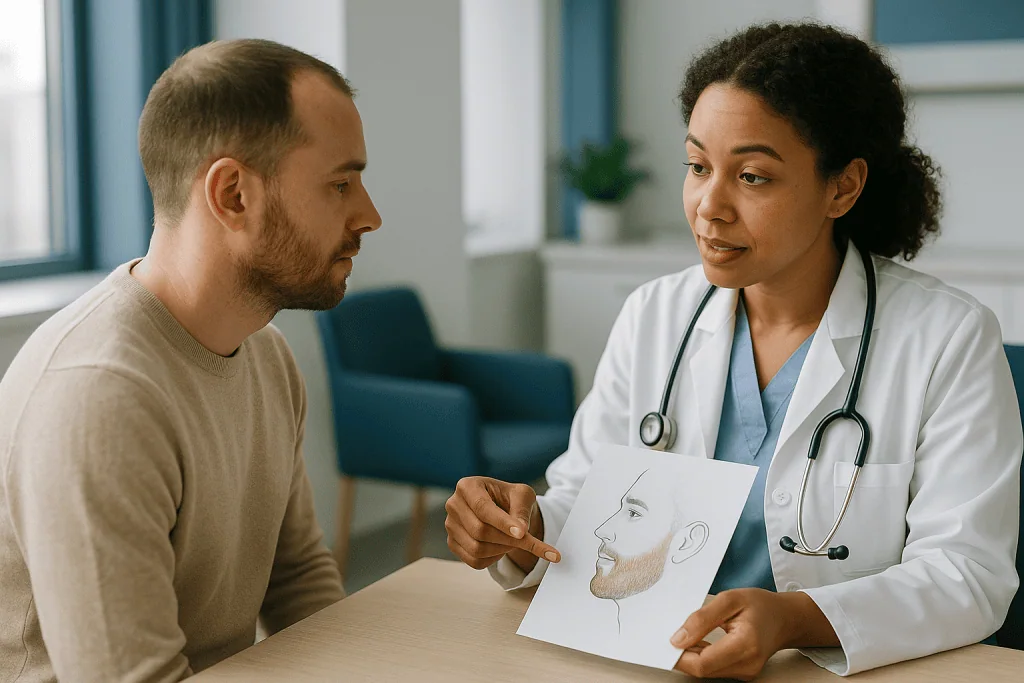
That principle is the reason transplants work at all. The follicles at the back and sides of the scalp are less sensitive to the hormone that drives male pattern hair loss, which Mayo Clinic identifies as the most common cause of thinning, so they keep growing wherever they are placed. The same rule, though, means they do not become beard hair.
Native beard hair is typically coarser than scalp hair, often curlier, and sometimes a different shade, with more red or gray in the mix. Scalp hair tends to be finer and straighter, and it cycles through a longer growth phase, which is why head hair can reach the waist while a beard stops at the chest. Put straight, fine scalp hair into a curly, wiry beard and the eye may read it as slightly softer, especially under bright light or when the beard is cropped very short.
Good planning narrows that gap. Surgeons look for the coarsest scalp hairs, usually low on the back of the head or just above the ears, and in some people they harvest from under the jaw, where beard donor hair already matches. The difference rarely disappears entirely; it is managed, not erased.
Does a beard transplant look natural? What actually decides it
Texture is only one ingredient. When people ask whether a beard transplant looks natural, the honest reply is that four other things decide the answer more often than hair type does.
Angle comes first. Beard hair lies almost flat against the skin, pointing down on the cheeks and neck and slightly outward on the chin. Grafts placed too upright look like bristles on a brush. Direction is second: a native beard swirls, with whorls under the chin and a change of flow around the corners of the mouth, and a transplant that ignores those currents reads as combed rather than grown.
Third is the edge. A natural beard does not start with a wall of hair. It fades in over a centimeter or so, with scattered single hairs before the density builds. Surgeons reserve one-hair grafts for that border and keep multi-hair units behind it. Fourth is restraint. A chin packed as densely as the back of the head would exhaust the donor supply and still look odd, because beards carry fewer hairs per square centimeter than scalps in most people.
Growth rate adds a practical wrinkle. Because the transplanted hairs keep their scalp cycle, they may lengthen a little faster and sit straighter than their neighbors, so the trimmer comes out more often, and some people find a short, uniform length hides the difference best. Cleveland Clinic notes that transplanted hair can be cut, shaved and styled like any other, which includes shaping it to blend.
None of this guarantees an outcome. It explains why two people with similar donor hair can end up with very different beards, and why the planning conversation matters more than the brochure.
Who is a beard transplant usually for, and who is usually asked to wait?
A surgeon’s first question is rarely about the beard. It is about why the beard is patchy, because the answer changes everything.
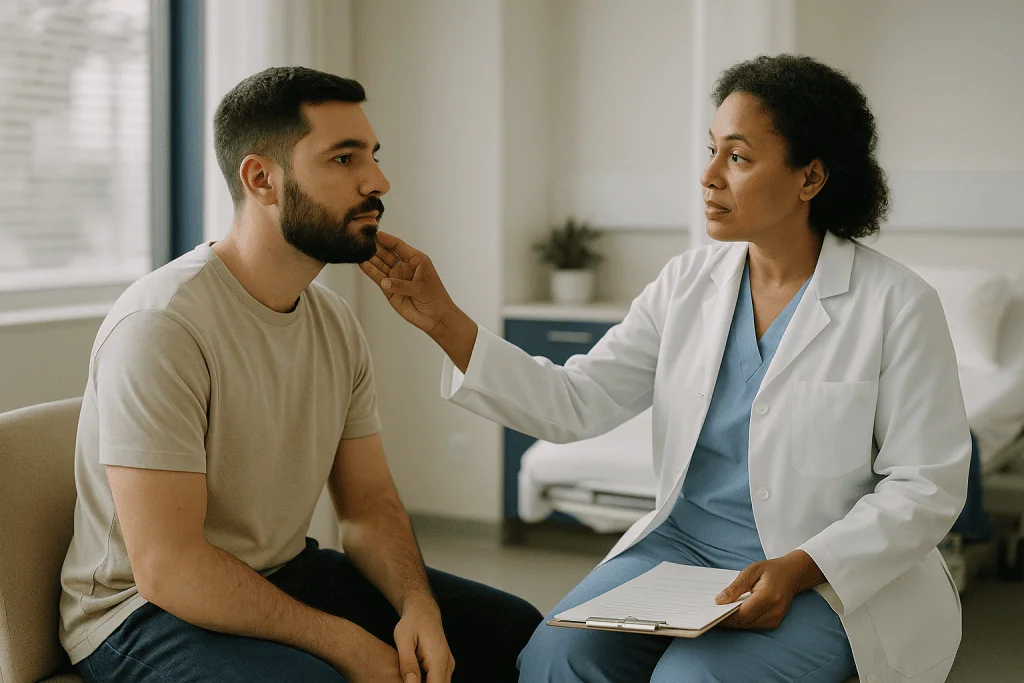
The usual candidate has a stable, lifelong pattern: thin cheeks, a gap under the lip, a jawline that never filled in, often shared with other men in the family. Scars from acne, burns or surgery that no longer grow hair are another common reason, as are people transitioning who want facial hair in a masculine pattern. In each case the skin is healthy, the pattern is not changing, and the back of the scalp has hair to spare.
Some people are usually asked to wait, or steered elsewhere first. Patchy loss with smooth, round bald spots that appeared suddenly can be alopecia areata, an autoimmune condition in which the immune system attacks follicles; the NIH’s arthritis and skin institute describes it as unpredictable, with hair that may regrow or fall out again. Transplanting into active alopecia areata risks losing the grafts, so dermatologists generally treat the condition first and watch for stability. The same caution applies to active skin infection, poorly controlled diabetes, bleeding disorders, or a scalp that is itself thinning fast, since every graft used on the face is one the head will not get back.
Age enters the conversation too. Beard growth continues to mature well into the twenties, so someone very young may be asked to give biology more time. Expectations matter as much as follicles: a person hoping for a dense, uniform beard from a modest donor supply may be gently told that the numbers do not add up.
The treating team makes that call, ideally after a skin examination rather than a photograph.
FUE, FUT, scalp donor or beard donor: a side-by-side table
Choices stack up quickly in the first consultation, and a side-by-side view helps. The table below compares the two harvesting methods and the two donor areas commonly used for the face. The NHS and MedlinePlus both describe the methods; the donor-area notes reflect widely taught surgical principles rather than a single trial.
| Option | How it is done | Typical mark left | What it means for the beard |
|---|---|---|---|
| FUE harvest | Units removed one at a time with a small punch | Scattered dots in the donor hair | Lets the surgeon select individual coarse hairs; suits short haircuts |
| FUT harvest | Strip of scalp removed, grafts separated under magnification | Single fine line hidden by hair | Yields many grafts in one session; needs enough scalp laxity |
| Scalp donor (back and sides) | Follicles resistant to pattern loss are chosen | Depends on method above | Finer and straighter than many beards; coarsest hairs preferred |
| Beard donor (under the jaw) | Units taken from existing beard hair | Faint dots under the jawline | Closest match in texture and curl; supply usually limited |
Neither harvesting method produces “better” beard hair; the hair is the same whichever tool removes it. The choice tends to follow how many grafts are needed, how the person wears their head hair, and the surgeon’s experience. Donor area is the bigger lever on appearance, and many plans combine both: beard-to-beard grafts along the visible cheek edge, scalp grafts for bulk behind them.
One honest note: the NHS lists the possibility that grafts fail to take, and that risk applies whichever row of the table a person ends up in.
Beard transplant recovery time: what the first days and weeks usually look like
The afternoon after surgery looks less dramatic than people expect and more tedious than they hope. The face is pink and dotted with tiny crusts where each graft sits; the donor area at the back of the head stings and is usually covered.
The NHS describes the following pattern after a hair transplant, and the same rhythm applies when the recipient area is the face. In the first few days the grafts are fragile and must not be touched, rubbed or soaked; sleeping slightly propped up and skipping strenuous exercise helps limit swelling, which often drifts down into the cheeks. Many people return to desk work after about three days, though the crusts remain visible for longer. By the end of the second week the small scabs have usually lifted, and the NHS notes the area starts to look more normal around then.
Then comes the part no brochure photographs. MedlinePlus explains that the transplanted hairs typically fall out within two to three weeks of surgery. This is called shock loss, a temporary resting phase triggered by the move, and the follicles stay alive beneath the skin. Weeks pass with nothing to show. New growth usually begins a few months in, fine at first and darkening over time; MedlinePlus puts it at roughly 60 percent of new growth by six to nine months, and the NHS gives six months to a year for the full effect.
Shaving usually waits until the care team confirms the grafts are secure, and the first trims are cautious. Redness fades over weeks; occasional small bumps in the recipient area are common and discussed below. Keeping every follow-up appointment is the single most useful thing a patient can do in this stretch.
Is a beard transplant permanent?
“Permanent” is the word every advertisement reaches for, and it deserves a careful look. The follicles moved from the back of the scalp are, in most people, the ones least affected by dihydrotestosterone, the hormone behind male pattern loss. Mayo Clinic describes this pattern as the most common form of hair loss, and the donor-dominance principle means the resistance travels with the follicle. In that sense, transplanted hair is expected to keep growing for decades.
Several caveats sit behind that expectation. First, the grafts have to survive the move. The NHS lists graft failure among the recognized risks, and a proportion of transplanted units in any session do not take; the figure varies with technique, handling time and aftercare, and no guideline promises a number. Second, “permanent” describes the follicle, not the beard around it. Native hair that was thinning can keep thinning, so a jawline filled today can develop new gaps years later if the underlying pattern progresses. Third, faces change. Skin loosens with age, and a border drawn for a thirty-year-old chin can sit differently at sixty.
There is also the question of whether the donor area itself is stable. If the back of the head is thinning, the hairs harvested from it may not carry the resistance the surgeon hoped for. That is why a good consultation includes a close look at the scalp, sometimes with magnification, before anyone discusses the face.
So the fair answer is: usually long-lasting, often for life, never guaranteed, and only as good as the planning that chose the donor hairs.
Beard transplant side effects and risks, in plain language
Every operation that breaks the skin carries a list of risks, and a beard transplant is no exception. The NHS, writing about hair transplants generally, names bleeding, infection, a tight or aching scalp, swelling that can affect the face, lumpy or raised scarring, folliculitis and grafts that fail to take. Folliculitis is inflammation of the hair follicle, usually from bacteria or ingrown hairs, and it tends to show as small red or pus-filled bumps as new hairs push through.
The face adds its own particulars. Swelling after facial work can settle around the eyes and cheeks for a few days. Numbness or tingling in the recipient area is common for weeks because tiny sensory nerve branches are disturbed by the incisions; it usually recovers slowly, though rare cases persist. Small pale marks at each graft site, sometimes called cobblestoning, can appear when grafts sit slightly above or below the skin surface. Ingrown hairs happen more often on the face than the scalp because the hair is placed at such a flat angle.
At the donor site, FUE leaves scattered dots that are usually hidden by surrounding hair, though over-harvesting can thin the back of the head visibly. FUT leaves a line that widens in some people. Beard-to-beard harvesting leaves faint dots under the jaw.
Then there is the cosmetic risk nobody lists as a complication: a result that looks transplanted. Hair placed too upright, too dense or in the wrong direction is a side effect of planning rather than biology, and it is harder to reverse than a bump.
Reliable numbers for each risk are not published for the face specifically, so the honest approach is to ask the care team how often each has happened in their own hands.
Beard transplant myths: what people often get wrong
Here is where the folklore gets sorted.
Myth: scalp hair turns into beard hair once it is on the face. It does not. Donor dominance means the follicle keeps its original character. Surgeons mimic beard hair by choosing coarse donor hairs and placing them well; the hair itself is unchanged.
Myth: the hair that appears in the first weeks is the final result. MedlinePlus is explicit that transplanted hair falls out within two to three weeks and regrows over months. Judging a beard at week four is like judging a garden the day after sowing.
Myth: a transplant creates new hair. It moves hair. The total number of follicles on the body stays the same, which is why donor supply limits what can be done.
Myth: it is a quick tidy-up with no downtime. Crusts, swelling and a face that looks sunburned are normal for a week or more, and the NHS advises against strenuous activity early on.
Myth: the result is finished in a single session. Some beards need a second pass to refine density or edges after the first growth matures, which usually means waiting most of a year.
Myth: any bald patch on the face can be transplanted. Patches from alopecia areata, active infection or ongoing skin disease are usually treated medically first, since the NIH notes the condition can relapse unpredictably.
Myth: transplanted hair never needs maintenance. It grows at scalp speed and may sit straighter than its neighbors, so it is trimmed more often, not less.
None of these corrections should be read as discouragement. They are the difference between a decision made with open eyes and one made from a carefully lit photograph.
Beard transplant myths about pills, lotions and famous heads of hair
A second family of beard transplant myths concerns things that are not transplants at all.
The question of what a particular billionaire or actor used to regrow his hair comes up constantly. The truthful answer is that nobody outside that person’s medical team knows, and that the options available to everyone else are the ones a dermatologist would discuss: a topical vasodilator applied to the skin, an oral medicine that lowers the hormone driving pattern loss, and surgery. Mayo Clinic describes those approaches for scalp hair loss. Guessing at a stranger’s regimen is not a treatment plan.
On the beard, the evidence thins out. Topical minoxidil, the generic name for the vasodilator, is studied and approved for scalp use; its use on the face is off-label, meaning outside the licensed indication, and the research is small. Oral finasteride acts on the same hormone that helps beard hair grow, so it is not used to thicken beards. Any decision about either belongs with the prescribing clinician, and this article gives no doses or schedules.
A quieter myth says transplanted hair needs lifelong medicine to survive. It does not; the moved follicles carry their own resistance. Some people are advised to take medicine to protect the native hair around the grafts, which is a different goal and a different conversation.
Finally, there are the products: oils, serums, vitamins and devices promising a fuller beard. The NIH Office of Dietary Supplements notes that biotin deficiency is rare and that evidence for supplements improving hair in people who are not deficient is lacking. Where a claim sounds like a guarantee, the evidence is usually missing.
How many grafts does a beard need, and why a graft count is a plan, not a shopping list
People arrive with a number in their heads. They have read that a beard takes so many grafts, or that a full head takes three thousand, and they want to know what that buys. This magazine does not publish prices, and the numbers themselves need unpacking.
A graft is a follicular unit, and units vary. One-hair units are used at the edges; two- and three-hair units go behind them. Two beards planned with the same graft count can therefore contain very different numbers of actual hairs. The count also says nothing about where the grafts go or at what angle, which, as earlier sections explain, decides whether the result looks like a beard or like a graft count.
What really sets the number is the gap between what exists and what is wanted, multiplied by the density needed to hide skin, and capped by what the donor area can spare. A thin goatee needs far fewer than empty cheeks. A plan for full cheeks, chin and mustache draws heavily on a donor supply that must also last the scalp for life, since pattern loss on the head can continue, as Mayo Clinic describes.
There is a trap in treating grafts as a unit of value. Pushing for more grafts than the face needs leads to a packed, unnatural look and depletes the back of the head. Pushing for fewer than the plan needs leaves a sparse result that invites a second session. The useful question is not “how many” but “what pattern, at what density, from where, and what does that leave behind.”
A surgeon who explains that arithmetic in those terms is giving the information the number alone cannot.
Alternatives to surgery: what the evidence does and does not support
Surgery is one route, and for a lifelong patchy beard it is often the only one with durable evidence, but the alternatives deserve a fair hearing.
For loss caused by alopecia areata, the first step is treating the condition. The NIH’s arthritis and skin institute describes corticosteroid injections or creams and, for more extensive disease, immune-modulating medicines prescribed by a dermatologist. Hair often regrows once the inflammation settles, which makes a transplant unnecessary and, while the condition is active, unwise.
For a naturally thin beard, topical minoxidil is the option most often discussed. Its evidence on the face is limited to small studies, it is off-label for that use, and any benefit depends on continued application; stop, and the gained hair tends to shed over the following months. The prescribing clinician weighs that against skin irritation and the practicalities of applying a liquid or foam to the face every day.
Non-medical options are honest in a different way. Growing the beard longer lets existing hair cover gaps. Skilled grooming, with the edges shaped to the fullest areas, changes how a patchy beard reads from a distance. Pigment tattooing can give the impression of stubble density but does not create hair and fades over time. Accepting the beard one has is also a legitimate choice, and good clinicians say so.
What has no solid evidence: biotin for people who are not deficient, as the NIH supplement office notes; oils and “growth serums”; and devices sold with testimonials rather than trials. Low-level laser caps have some data on the scalp and essentially none on the beard. When the sales page is longer than the evidence, treat that as a signal.
Questions to ask your care team
A consultation goes better with a list. These questions are chosen because the answers reveal how a surgeon thinks, not just what they offer.
- What do you think is causing my patchy beard, and have you examined the skin to rule out alopecia areata or scarring?
- Which donor area would you use for me, scalp or beard, and how closely does that hair match my existing beard in thickness and curl?
- How do you plan the angle and direction of grafts on the cheeks, chin and neck?
- Where will the edges of the beard sit, and how do you create a soft border rather than a line?
- Roughly how many grafts does the plan need, and what will that leave in the donor area for future scalp loss?
- What proportion of grafts in your hands do not survive, and what happens if the density falls short?
- Who performs each stage, and who will I see at follow-up visits?
- What do the first two weeks involve day by day, and when can I shave?
- Which complications have you seen on the face specifically, and how were they managed?
- Would you recommend waiting, treating something else first, or not operating at all?
The last question is the one that separates a clinical opinion from a sales conversation. A surgeon comfortable saying “not yet” or “not you” is giving the clearest evidence of judgment a patient can ask for.
Write the answers down. Memory after a long consultation is unreliable, and comparing notes a week later, away from the room, is often when the right decision becomes obvious. The choice to proceed, wait or decline always sits with the person and the treating team together.
When to call your doctor
Most of the first two weeks is uncomfortable rather than dangerous, but a few signs mean a call to the surgical team the same day, or urgent care if the team cannot be reached.
- Spreading redness, warmth or swelling at the face or donor site, especially with fever, which can signal infection.
- Pus or a foul-smelling discharge from graft sites or the donor wound.
- Bleeding that soaks through dressings and does not settle with gentle pressure.
- Pain that escalates rather than eases after the first two or three days, or that is not controlled by the plan the team gave you.
- Swelling that closes an eye, affects the lips, or makes breathing or swallowing difficult, which needs emergency assessment.
- Sudden loss of a large cluster of grafts after a knock, a shave or a rub.
- Numbness that is worsening instead of slowly improving, or weakness in the muscles of the face.
- A rash, hives or breathing difficulty after any medicine the team prescribed.
In the months that follow, two developments are worth a non-urgent appointment rather than a wait-and-see: new smooth bald patches appearing elsewhere on the face or scalp, which could indicate alopecia areata and need assessment; and persistent clusters of inflamed bumps that keep returning, which the NHS lists under folliculitis and which sometimes need treatment.
Uncertainty is a valid reason to call. Surgical teams would rather hear about a false alarm than a late infection. The person who did the operation knows what normal looks like for that face at that stage, and no article replaces that judgment.
Frequently asked questions
Can they do a beard transplant?
Yes, hair can be transplanted to the face using the same follicular unit techniques used on the scalp. Grafts are taken from the back of the head or from existing beard hair under the jaw and placed into tiny incisions on the cheeks, chin, mustache or jawline. Whether it suits a particular person depends on the cause of the patchiness, skin health and donor supply, which a surgeon assesses in person.
Will transplanted scalp hair look different on my face?
Slightly, in many people. Scalp hair is usually finer, straighter and faster growing than beard hair, and it keeps those traits after the move. Surgeons reduce the mismatch by selecting the coarsest donor hairs, sometimes harvesting from the beard itself, and placing grafts at flat, natural angles. The remaining difference tends to show in how often trimming is needed rather than in obvious appearance.
Does a beard transplant look natural when the beard is shaved short?
It can, but short stubble is the most demanding length because every hair’s angle and thickness is on display. Grafts placed too upright or in the wrong direction stand out at that length, while a well-angled transplant with single hairs at the border blends more easily. Many people find a short, uniform trim actually helps, since it limits the visible difference in growth rate.
How long is beard transplant recovery time before I can shave?
Crusts usually lift within about two weeks, the NHS notes, and many people return to desk work after roughly three days, but shaving waits until the care team confirms the grafts are anchored. The transplanted hairs typically shed within two to three weeks, according to MedlinePlus, before regrowing over the following months. Your surgical team sets the shaving timeline for your own healing.
Is a beard transplant permanent?
Usually long-lasting, often for life, but not guaranteed. The follicles come from areas of scalp that resist the hormone behind pattern loss, and they keep that resistance after the move. Some grafts do not survive transplantation, native beard hair around them can still thin, and the face changes shape with age. Good donor selection and a realistic plan make a durable result more likely.
What are the most common beard transplant side effects?
Swelling, crusting, redness, temporary numbness and small inflamed bumps as new hairs emerge are the usual early effects. The NHS also lists bleeding, infection, folliculitis, lumpy scarring and grafts that fail to take. On the face, ingrown hairs and small pale marks at graft sites can occur. Most settle over weeks, but spreading redness, fever, pus or escalating pain need a same-day call.
What do famous people use to regrow their hair?
Nobody outside their medical teams knows, and public guesses are not evidence. The approaches with mainstream support, as Mayo Clinic describes, are a topical vasodilator, an oral medicine that lowers the hormone driving pattern loss, and surgical transplantation. Which, if any, suits a given person depends on the cause of their hair loss and a clinician’s assessment, not on a celebrity’s reported routine.
How much do 3,000 hair grafts cost?
This magazine does not publish prices, and a graft count alone is a poor guide to what a person is actually getting. Grafts contain one to four hairs each, so the same number can mean very different amounts of hair. What matters is the pattern, the density, the donor area used and what remains for the scalp later. Ask the care team to explain the plan behind the number.
What is the regret rate for hair transplants?
No guideline or large systematic review publishes a reliable regret rate for hair or beard transplants, so any specific percentage should be treated with caution. The clinical literature links dissatisfaction to unrealistic expectations, poor hairline or beard design, mismatched donor hair and overly dense packing rather than to the procedure itself. A frank consultation that includes the option of not operating is the strongest known safeguard.
Can a beard transplant fix patches from alopecia areata?
Generally not while the condition is active. Alopecia areata is an autoimmune attack on follicles, and the NIH describes it as unpredictable, with patches that can regrow or recur. Grafts placed into active disease can be lost. Dermatologists usually treat the condition first and look for a long period of stability before any surgical discussion, and that judgment rests with the treating team.
References
This article is for general information only and is not a substitute for professional medical advice. Please consult a qualified doctor about your individual situation.

Planning This Treatment in Turkey
Our full guide for international patients: techniques, hospital stay, recovery and cost.
More from the Blog
What Happens on the Day of a Hair Operation: Check-In, Hairline Drawing and Graft Placement
On the day of a hair operation, you check in, confirm consent and your medical history, and the surgeon draws and agrees the new…
How Long to Stay in Istanbul After a DHI Hair Transplant: Washing Visits and the Flight Home
There is no guideline-fixed number of days to stay in Istanbul after a DHI hair transplant. Most care teams ask patients to remain nearby…
Why Washing, Heat and Intense Exercise Wait After PRP for Hair Loss: The First-Day Rules
After PRP for hair loss, most care teams ask patients to keep the scalp dry and untouched for a period measured in hours to…
When Can Makeup, Threading and Tinting Restart After an Eyebrow Transplant?
Most surgeons ask patients to keep makeup off a freshly transplanted eyebrow until the grafts have anchored and the small crusts have shed, which…
Preparing for a Female Hair Transplant: Scalp Analysis, What to Pause and the Days Before
Preparing for a female hair transplant usually begins weeks ahead with a scalp analysis to confirm the cause of thinning and check the donor…

Preparing for Scalp Micropigmentation: Skin Type Review, Tanning, Alcohol and What to Pause
Scalp micropigmentation preparation usually starts with a skin type review covering tone, scarring tendency and any active scalp condition, followed by a few weeks…