DHI Hair Transplant
DHI hair transplant is a minimally invasive hair restoration technique that implants individual follicles directly with a specialized pen. It supports natural-looking density and hairline design.
Quick answer
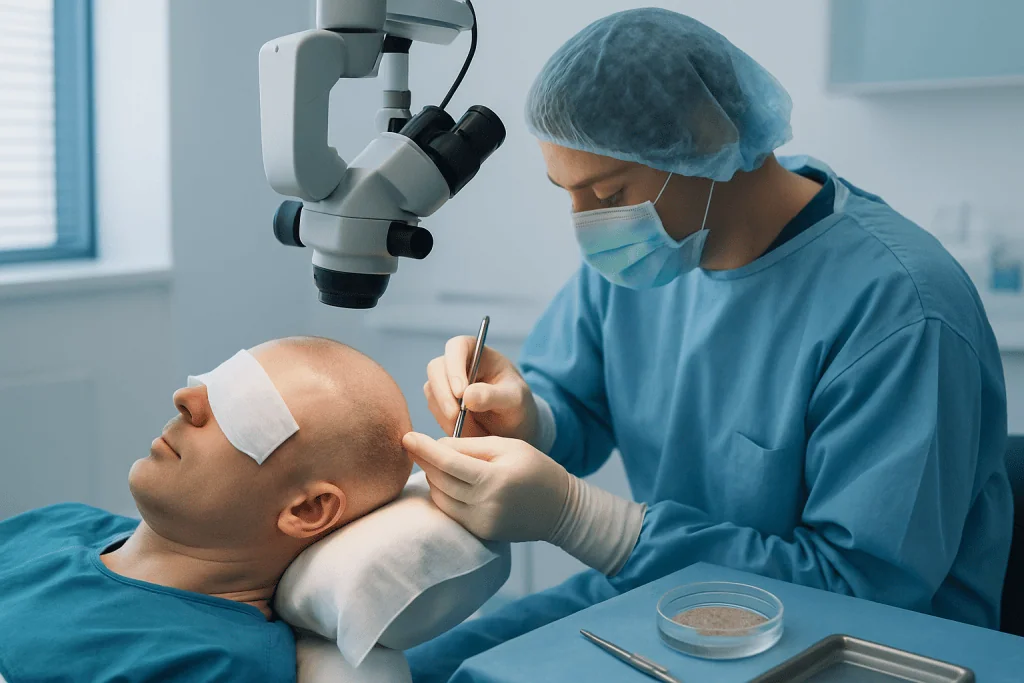
DHI hair transplant (direct hair implantation) is a surgical hair restoration technique. Healthy follicles are extracted individually from the back and sides of the scalp, then implanted straight into thinning areas with an implanter pen, without pre-made channels. Performed under local anaesthesia, it usually takes most of a day, and new growth develops gradually over the months that follow.
What Is DHI Hair Transplant?
DHI hair transplant, short for direct hair implantation, is a surgical hair restoration technique in which individual follicular units are extracted from the donor area, usually the back and sides of the scalp, and implanted directly into thinning areas using a specialised implanter pen. The follicle is loaded into the pen and placed in a single controlled motion, without opening recipient channels first. It suits men and women with pattern hair loss who have enough stable donor hair to supply the grafts. Many people weighing up a DHI hair transplant in Turkey arrive at the technique after years of trying other options, so it is worth understanding exactly what it can and cannot do before you commit to anything.
Hair loss is rarely just cosmetic. It changes how you see yourself in the mirror, how you style your hair, how you appear in photographs and how confident you feel at work or in company. By the time most people research surgery, they have already worked through medication, supplements, shampoos, laser devices or camouflage fibres. What they want now is a result that looks natural, respects their facial features and does not announce itself as a procedure. That is what a well-planned DHI hair transplant is designed to deliver: a hairline with a shape, direction, angle and density appropriate for your face and your age, blended into the hair you still have.
One point deserves stating plainly. DHI does not stop hair loss and it does not create new follicles. It redistributes healthy follicles from regions that are genetically more resistant to androgenetic hair loss into regions where density has been lost. Once the transplanted follicles heal and re-enter their normal growth cycle, they can keep producing hair for many years. Your non-transplanted hair, however, may continue to thin over time. This is why long-term planning, not just the session in front of you, sits at the centre of responsible treatment. You may also see DHI hair restoration referred to as the Choi pen method, after the implanter device that defines the technique.
How does DHI hair transplant work?
DHI works by pairing follicle-by-follicle extraction with direct implantation. Follicular units, each containing one, two, three or occasionally more hairs, are removed from the donor area with fine micro-instruments, examined, sorted by hair count and quality, and kept in controlled conditions to protect their viability. Each graft is then loaded into an implanter pen and inserted into the recipient area at an angle, direction and depth chosen by the physician. That control matters because natural hair does not exit the scalp uniformly: the frontal hairline grows at a shallow forward angle, the temples angle downward, and the crown follows a spiral. Reproducing those patterns, graft by graft, is what separates a convincing result from an obvious one. The pen is only an instrument; the plan behind it, patient selection, hairline design, donor management, graft handling and aftercare, does most of the work.
What is robotic DHI hair transplant?
Robotic DHI hair transplant is largely a marketing phrase rather than a distinct method. Some clinics use motorised or robot-assisted systems for the extraction phase, then place grafts by hand with implanter pens. The implantation step that defines DHI is manual: a clinician holds the pen and controls each placement. If a clinic advertises robotic DHI, ask precisely what is automated, who performs each stage, and how the grafts are protected between extraction and placement. Those answers tell you more than the label does.
Who Is a Candidate for DHI Hair Replacement?
DHI hair replacement suits men and women with stable or predictably progressive hair loss and enough healthy donor hair to support transplantation. The most common indication is androgenetic alopecia, male-pattern or female-pattern hair loss. Men typically notice recession at the temples, thinning at the crown or a gradually enlarging bald area. Women more often see diffuse thinning over the top of the scalp, a widening part line or fading density behind the frontal hairline.
Not everyone who is losing hair is a candidate for surgery, and a responsible programme starts with evaluation rather than scheduling. Some causes of shedding are temporary or medically treatable: thyroid disease, iron deficiency, hormonal changes, recent illness, rapid weight loss, medication effects, stress-related shedding or inflammatory scalp disease. Transplanting into a scalp with an unaddressed underlying problem wastes grafts and can produce disappointing results, so those possibilities are ruled out or managed first.
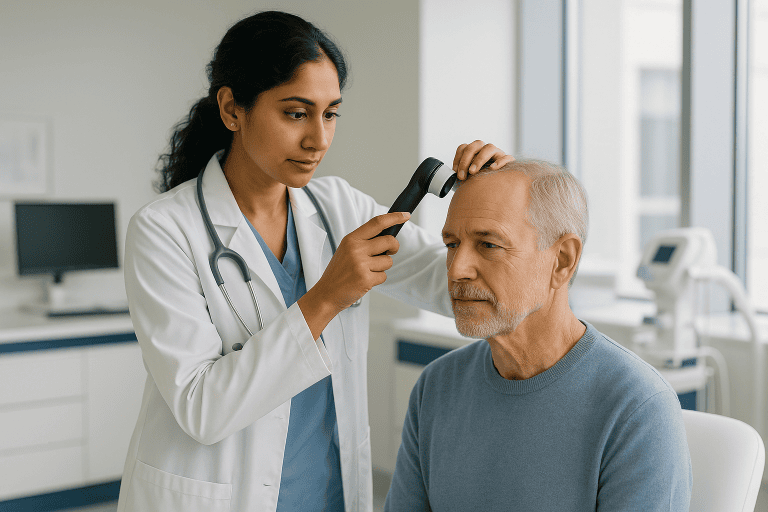
Diagnosis usually includes a detailed medical history, a review of family hair loss patterns, scalp examination and an assessment of donor density. Magnified scalp analysis or digital imaging may be used to evaluate miniaturisation, hair calibre and follicle distribution. In selected patients, blood tests or a dermatology consultation may be recommended, particularly if the loss is sudden, patchy, itchy, scaling, or does not follow a typical pattern. Women need especially careful work-up, because diffuse thinning can weaken the donor area itself.
Patients who commonly seek DHI include those with a receding hairline, thinning temples, crown thinning, a previous transplant needing refinement, traction-related loss, or localised scarring where the tissue is healthy enough to receive grafts. Some ask about DHI for beard, moustache or eyebrow restoration; candidacy and technique differ by area and need separate planning. A good candidate has realistic expectations, an adequate donor supply, stable general health and the willingness to follow aftercare instructions. The right plan is not always the maximum number of grafts. In many cases, preserving donor hair for future needs matters as much as improving the visible area today.
Conditions a DHI Hair Transplant Can Address
DHI is most commonly used for pattern hair loss. In male-pattern loss, it can restore or reshape the frontal hairline, fill temporal recessions, add density through the mid-scalp or improve crown coverage. The exact plan depends on your age, the extent of loss, donor capacity, hair characteristics and the likelihood of future progression: a design that ignores progression tends to age badly.
In female-pattern hair loss, DHI may be appropriate when thinning is localised enough and the donor area strong enough to provide viable grafts. If the donor hair itself is miniaturised, transplantation may not deliver the density you want, and it is better to know that before surgery than after. When candidacy is confirmed, DHI can reinforce the frontal zone, improve part-line density or restore areas damaged by traction hairstyles.
Selected cases of scarring after burns, surgery, trauma or previous procedures can also be treated, provided the scar is stable and has sufficient blood supply. Results in scar tissue are less predictable than in healthy scalp, and staged treatment, smaller sessions spaced apart, is sometimes the safer route.
For patients with an earlier transplant, DHI can refine the hairline, add density between older grafts or correct areas where the angle or distribution looks unnatural. These revision cases demand particular expertise, because donor reserves may already be limited and scar tissue can complicate implantation. If this describes your situation, the considerations are covered in more depth under hair transplant repair.
DHI is not appropriate for every form of hair loss. Active inflammatory scalp disease, uncontrolled medical conditions, insufficient donor hair, unrealistic density expectations or ongoing severe shedding may all need addressing before surgery is considered at all. Sometimes the honest recommendation is medical therapy first, a different technique, or waiting.
How a DHI Hair Transplant Is Performed
Consultation and treatment planning
The process begins with a detailed consultation. The physician reviews your hair loss history, medical background, medications, previous treatments, family pattern and goals. Photographs and scalp analysis document the starting point and guide the plan. For international patients, an initial remote assessment using high-quality photographs is often possible, followed by in-person evaluation before the procedure itself.
Hairline design is the step that most determines whether the result looks natural. A convincing hairline is not a straight line: it has subtle irregularities, appropriate recession and a shape that fits your forehead, facial proportions, age and future hair loss risk. A hairline set too low or packed too densely can look artificial and consumes donor follicles you may need later. The design also accounts for hair direction, curl, colour contrast with the scalp, shaft thickness and the total grafts realistically available.
Preparation before the procedure
Before DHI you receive instructions covering medications, smoking, alcohol, supplements and scalp care; your treating doctor decides anything relating to your prescriptions. Blood tests may be requested according to your history and local protocols. Tell the team about bleeding disorders, allergies, chronic illness, prior surgery and everything you take, including blood thinners. On the day, the donor and recipient areas are examined again and the final design is confirmed with you before anything begins.
Most DHI procedures are performed with the donor area trimmed, but selected cases can use a less visible shaving approach depending on hair length, graft numbers and technical feasibility: an option explained in detail under hair transplant without shaving. Local anaesthesia numbs the donor and recipient areas. Sedation may be considered for some patients, depending on clinical assessment and preference.
Extraction of hair follicles
Follicular units are removed one by one from the donor area with fine instruments. The extraction pattern is deliberately distributed to avoid overharvesting and to keep the donor region looking natural: a discipline that matters most for younger patients and those with advanced loss, since future sessions may be needed. Donor hair is a finite resource, and a plan that spends it all today leaves nothing for tomorrow.
After extraction, grafts are examined and stored in controlled conditions to protect viability. The team sorts them by hair count and quality. Single-hair grafts are typically reserved for the frontal edge, where they create a soft, natural transition; multi-hair grafts are placed further back, where they build the appearance of density.
Direct implantation with an implanter pen
In the implantation phase, grafts are loaded into implanter pens and placed directly into the recipient area, one at a time. The physician controls angle, direction and depth at every placement, following the natural exit patterns of the region being treated. Because DHI can slot follicles between existing hairs, it is often useful when the goal is added density without disturbing the surrounding hair you want to keep.
Dense packing has limits, though. Placement must be balanced against scalp blood supply and graft survival; an overly aggressive approach can compromise healing. A measured plan aims for visible, worthwhile improvement while respecting the biology of your scalp, which is a longer-lasting kind of ambition.
Technology and clinical support
Modern DHI involves magnified scalp evaluation, digital photography, fine micro-instruments for extraction, controlled graft storage solutions, specialised implanter pens and protocols that support sterility and careful graft handling. These tools help the team plan accurately, minimise tissue trauma, protect follicles while they are outside the body and place them precisely. None of it replaces clinical judgement and team coordination; it supports them.
What happens on the day, step by step
- Final examination of the donor and recipient areas, and confirmation of the agreed hairline design.
- Trimming or preparation of the donor area, according to the approach planned with you.
- Local anaesthesia of the donor region.
- Extraction of follicular units, one by one, in a distributed pattern.
- Sorting, inspection and protected storage of the grafts.
- Local anaesthesia of the recipient region.
- Direct implantation with the pen, graft by graft, following the design.
- Final checks, dressing of the donor area where needed, and a full briefing on aftercare before you leave.
Is DHI painful?
The procedure itself is performed under local anaesthesia, so the treated areas are numbed; the anaesthetic injections at the start typically sting briefly, and that is the part most patients notice. Afterwards, some soreness, tightness, tenderness or swelling is normal for a few days and is usually manageable with the measures your medical team recommends. Everyone’s threshold differs, and honest clinics say so rather than promising comfort they cannot control.
Duration and immediate recovery
A DHI hair transplant usually takes several hours and may occupy most of the day, depending on graft numbers, design complexity and whether one or more areas are treated. Large or complex cases are sometimes staged rather than forced into a single session. You can usually leave the clinic the same day with detailed written instructions.
Expect mild swelling, redness, tenderness, tightness or small crusts around the implanted grafts in the first days. You will be asked to protect the scalp, avoid touching or scratching the grafts, sleep with your head elevated for the first nights and follow the washing routine precisely. Light daily activities usually resume quickly; exercise, swimming, sun exposure and anything that causes sweating or trauma to the scalp stay off-limits for a period your medical team defines.
DHI vs FUE: How Do the Techniques Compare?
DHI vs FUE is less a contest than a question of fit, because the two techniques share their first half. Both extract follicular units individually from the donor area; they differ in how the grafts go back in. In conventional FUE hair transplant, tiny recipient channels are opened first and the grafts are then placed into them. In DHI, the graft is loaded into an implanter pen and inserted in one motion, with channel creation and placement combined.
| Aspect | DHI | FUE |
|---|---|---|
| Extraction | Individual follicular units, fine micro-instruments | Individual follicular units, fine micro-instruments |
| Recipient site | No separate channel; pen implants directly | Channels opened before grafts are placed |
| Placement control | Angle, depth and direction set at the moment of implantation | Angle and direction set when channels are created |
| Working between existing hair | Well suited; surrounding hair can often be preserved | Possible, but channel creation among existing hair needs care |
| Typical use | Refined hairline work, targeted density | Broad coverage, larger sessions |
| Session pace | Slower per graft; large cases may be staged | Often faster for high graft numbers |
Which is better, FUE or DHI?
Neither is universally better; the right choice depends on your pattern of loss, graft numbers, hair characteristics and goals. DHI tends to be favoured for refined frontal hairline work and for adding density between existing hairs with minimal disruption. FUE is often preferred when large areas need coverage in a single session, because channel-first placement can move faster at scale. Many experienced teams use both, and some plans combine them, one technique for the hairline, another for the mid-scalp or crown. The honest answer comes from an examination, not from a brochure.
Is DHI the best hair transplant method?
No single method is best for every patient, and any clinic claiming otherwise is selling rather than advising. DHI is one strong option among several, and its advantages are real in the right case: direct placement control, precise hairline work, implantation among existing hair. But outcomes depend far more on diagnosis, design, donor management, graft handling and the team’s experience than on which instrument touches the scalp. A skilled team using FUE will beat an inexperienced one using DHI every time.
What are the disadvantages of DHI?
DHI has genuine trade-offs, and you should hear them before deciding.
- It is slower per graft, so very large cases may take longer or need staging across sessions.
- It is technically demanding and depends heavily on the operator’s skill and the team’s coordination.
- It is not ideal for every scenario; extensive baldness needing maximum coverage in one session may be better served by other approaches.
- Like all transplantation, it cannot halt the progression of hair loss in untreated areas.
Does DHI hair transplant leave scars?
DHI leaves no linear scar, because no strip of scalp is removed, but it is not entirely scar-free. Extraction leaves tiny dot marks scattered through the donor area, and implantation points heal gradually in the recipient area. In practice, these marks are usually difficult to see once hair grows to normal length, though very short haircuts may reveal faint dots in some patients. Healing varies with skin type and aftercare, so ask to see donor-area photographs of healed patients when you evaluate a clinic.
Is DHI hair transplant available in the USA?
Yes. DHI is a technique, not a geographically restricted product, and searching for a hair transplant NYC practice, or clinics in other US cities, will surface surgeons who work with implanter pens. Availability and how the technique is branded vary by clinic. Turkey has become a frequent destination for patients seeking DHI abroad, and wherever you are treated, the questions worth asking are the same: who performs each stage, how grafts are handled, and how follow-up is organised.
Benefits of DHI Hair Transplant
The potential benefits of DHI are best understood in terms of how the technique supports natural design, precision and recovery when it is used for the right candidate.
| Benefit | What It Means for You |
|---|---|
| Direct follicle placement | Grafts are implanted using a specialised pen, allowing controlled angle, depth and direction for a more natural growth pattern. |
| Refined hairline design | Single-hair grafts can be placed carefully along the front edge to soften the hairline and avoid an artificial appearance. |
| Minimally invasive approach | No linear incision is used, and recovery is usually manageable with small extraction and implantation points that heal gradually. |
| Useful for targeted density | DHI may help add density in selected areas, including between existing hairs, when the scalp and donor supply are suitable. |
| Long-term planning potential | A carefully designed transplant can improve current appearance while preserving donor hair for possible future needs. |
Recovery Timeline After DHI Hair Transplant
Recovery varies with graft numbers, scalp characteristics and how closely you follow instructions, but most patients move through a recognisable pattern. Two things surprise people if nobody warns them: the shedding of transplanted hairs in the first weeks, which is a normal part of the growth cycle rather than a failure, and how gradual the visible improvement is afterwards. A more detailed breakdown is available in the hair transplant recovery timeline, day by day and month by month.
| Time Period | What Patients Can Expect |
|---|---|
| Day 1 | Mild soreness, redness, swelling or tightness may be present. The grafts are delicate, and you must avoid touching or rubbing the implanted area. |
| First week | Small crusts form and begin to loosen with proper washing. Many patients feel well enough for light activities, while exercise and sun exposure remain restricted. |
| First month | Some transplanted hairs may shed, which is a normal part of the growth cycle. The scalp continues to settle, and redness gradually fades in most patients. |
| Three to six months | Early new growth may begin to appear. Hair is often fine at first and becomes more visible as the follicles mature. |
| Longer term | Density and texture continue to improve over time. Final cosmetic assessment is usually made after the full growth cycle has progressed. |
Your own behaviour shapes this timeline more than most patients expect. Washing technique, sleeping position, sun protection and activity restrictions all influence how the grafts settle in the critical early weeks. The practical detail, what to do each day, what to avoid and for how long, is set out in the written aftercare instructions you receive, and your medical team will tailor them to your case.
Factors That Influence a Good Result
Donor area quality is one of the most important variables. Patients with strong donor density, favourable hair calibre and stable donor hair have more options than those with diffuse thinning or a limited supply. Hair characteristics matter too: curly, wavy or thicker hair creates the impression of greater coverage, while very fine, straight hair or high contrast between hair colour and scalp tone makes thinning more visible at any given density.
The stage and pattern of loss shape the plan. A younger patient with early recession may want an aggressive, low hairline, but that carries risk if the loss progresses: the transplanted frame can end up isolated as the hair behind it thins. A more conservative, age-appropriate design usually looks better across decades. Crown restoration demands particular realism: the crown consumes many grafts to create visual density, and its swirl pattern is unforgiving of careless placement.
Graft handling is the factor patients see least and depends on most. Follicles are living tissue. They must be extracted gently, kept hydrated, protected from trauma and implanted efficiently. The team’s coordination determines how long grafts sit outside the body and how consistently they are placed. Sterile technique, infection prevention and postoperative monitoring round out the clinical picture.
Your part starts the moment you leave the clinic. Scratching, smoking, early intense exercise, unapproved hair products, sunburn or careless washing can all interfere with healing. Understand in advance that growth is gradual: the early shedding phase can be distressing if unexpected, but it does not mean the grafts have failed. New growth develops over months and density continues to mature well beyond that.
Finally, long-term success depends on managing the hair loss that surgery does not touch. In appropriate patients, physicians may recommend medical therapy, scalp treatments or scheduled monitoring to help maintain non-transplanted hair; whether and how to use any medication is a decision for your treating doctor. A DHI transplant restores density where it is placed. It does not change the biology of the rest of your scalp.
Why Acting Early Can Matter
Hair loss usually progresses gradually, which makes it tempting to wait until it feels severe. Sometimes observation is reasonable, especially if shedding is recent or the diagnosis uncertain. But early evaluation has real value: it can identify treatable causes, help stabilise ongoing loss and protect your donor resources through proper planning before options narrow.
Delaying assessment can let preventable loss continue. Inflammation, nutritional deficiencies, hormonal issues or traction damage may worsen if unaddressed. In pattern hair loss, medical therapy may slow progression in suitable patients even when transplantation is planned for later: a decision made with your treating physician, not on your own. Without a long-term strategy, patients end up chasing hair loss area by area, which risks unnatural distribution and a depleted donor zone.
Acting early does not mean having surgery immediately. It means getting an accurate diagnosis, understanding your options and choosing the right moment deliberately. The cost of waiting is measured in larger areas needing coverage, fewer styling options and more complicated planning later on.
Coming to Turkey for a DHI Hair Transplant: Planning the Trip
Turkey is one of the most common destinations for this procedure, and DHI hair transplant Turkey research usually raises the same practical questions: how long to stay, what the care pathway covers and how follow-up works from another country. A typical pathway begins with a remote assessment based on clear photographs and your medical history, followed by an in-person examination on arrival, the procedure itself, an early check and first supervised wash, and then a structured aftercare plan you continue at home. Most patients plan to stay several days so that the early healing phase happens under the clinic’s eye rather than at an airport.
What should you look for in a DHI clinic?
A credible DHI clinic is transparent about who does what. Ask which stages the physician performs personally, how the team handles and stores grafts, how the hairline design is decided and documented, and how donor extraction is planned to protect future reserves. Ask to see healed donor areas, not just recipient results. Be wary of anyone who quotes a graft number before examining you, promises a specific outcome, or treats every patient as a candidate. A clinic that sometimes says no is telling you something reassuring about the times it says yes.
How does follow-up work after you fly home?
Follow-up after an international procedure is usually built around scheduled photographs and remote reviews at set intervals, so the team can track healing and growth through the months when the result develops. Before you travel home you should leave with written aftercare instructions, clarity on washing and activity restrictions, and a named point of contact for the review schedule. Broader practicalities, travel logistics, documentation, what to organise before departure, are covered in the hair transplant in Turkey treatment guide.
How Acibadem Approaches DHI Hair Transplantation
At Acibadem, DHI is treated as a personalised medical and aesthetic procedure, not a one-size-fits-all session. Planning may involve physicians experienced in hair restoration, dermatology input where needed, and coordination with other specialists when a patient’s hair loss or healing may be affected by wider health issues. That multidisciplinary perspective matters most for women with diffuse thinning, patients with scarring conditions, people with complex previous transplant histories and anyone whose loss may have a systemic cause.
Evaluation follows structured diagnostic pathways: magnified scalp examination, digital documentation and a careful medical history guide decisions about candidacy and graft planning. The surgical approach rests on evidence-informed protocols, meticulous graft handling and individualised design rather than the largest possible graft count. Sometimes the recommendation is DHI; sometimes it is medical therapy first, staged treatment, a different technique or postponement. That judgement is part of the care, and the full scope of options is described under the hair transplant unit.
International patients are supported in multiple languages, with help coordinating appointments, medical documentation, hospital processes and communication with care teams before, during and after travel. Technology, fine extraction instruments, implanter systems, imaging for planning and documentation, sterile workflow systems, is used where it contributes to accurate design, gentle tissue handling and safe recovery, not for its own sake.
Deciding With Realistic Expectations
DHI hair transplant is a strong option for patients who want natural-looking restoration with precise follicle placement and thoughtful hairline design. The most satisfying results come from careful evaluation, realistic goals, disciplined donor planning and a team that treats the procedure as both a medical intervention and an act of design. The technique cannot promise a particular density, and it cannot stop the hair loss process elsewhere on your scalp, but used well, in the right candidate, it can restore density in a way that fits your features and holds up over time.
This is a personal decision, and there is no need to make it quickly. Understand your diagnosis, understand what your donor area can realistically support, and weigh the technique against the alternatives before you commit. Patients who take that time tend to choose better, and to be happier with what grows in the year that follows.
Preparation
- A specialist evaluates hair loss pattern, donor area quality, medical history, and expectations before planning graft numbers and hairline design. Blood tests or medication review may be needed. Patients are usually advised to stop smoking, alcohol, and certain blood-thinning medicines before the procedure if medically appropriate.
Aftercare
- Mild swelling, redness, and scabbing are common in the first days and should improve gradually. Patients should follow washing instructions, avoid scratching, sun exposure, strenuous exercise, and hats until cleared by the care team. Transplanted hairs may shed before new growth begins over the following months.
Frequently Asked Questions
What affects the cost of a DHI hair transplant?
Cost is influenced by the degree of hair loss, the planned density, donor area quality, hairline design, surgeon and team involvement, clinic standards, aftercare and whether travel services are included. A specialist assessment is needed for an accurate quote.
How can I get a personalised quote?
You can request a free consultation by sharing clear scalp photos, medical history, previous hair transplant history if any, and your goals. The team can then advise on suitability, treatment plan and package inclusions.
Is a package quote the same in every country?
No. Some destinations commonly bundle hotel, transfers, translation, medication guidance and follow-up, while others itemise these services separately. Always ask what is included and what may be charged separately.
Does choosing DHI always mean a higher cost than other techniques?
Not always. DHI may require specialised instruments and detailed implantation planning, but the final cost depends on the treatment plan, graft needs, surgeon involvement and clinic model. Suitability should guide the technique choice.
Are travel and accommodation included in the treatment cost?
This depends on the provider. International patient packages in Turkey may include travel support such as hotel coordination and transfers, while other clinics may focus only on medical services. Confirm inclusions before booking.
Is this information medical or financial advice?
No. It is general educational information. A hair restoration specialist should evaluate your scalp, donor area and expectations before recommending a technique or providing a personalised quote.
Medically reviewed by the Acıbadem International Medical Board September 1, 2026
See our medical review board →
Update history
- PublishedJune 8, 2026
- Medical review approvedSeptember 1, 2026
- Last content updateSeptember 1, 2026
Read this treatment guide in your language
Planning this treatment in Turkey
Our English guides for international patients: costs, timelines, safety and travel.
Planning tools for this treatment
Indicative figures for orientation only: your written plan and quote follow a free medical review.
Trusted care for international patients
Hair transplant cost in Turkeyledger-based guide ranges, or browse the full Turkey Medical Price Index.
From the Acibadem Blog
DHI Explained: What Direct Hair Implantation Changes in Practice
DHI (direct hair implantation) is a variation of the FUE hair transplant in which extracted follicles are loaded into a spring-driven implanter pen and…
DHI Hair Transplant Risks Explained Honestly: Swelling, Folliculitis and Uneven Growth
DHI hair transplant risks are largely the same as for any follicular unit extraction procedure: temporary forehead and eyelid swelling, folliculitis around new grafts,…
DHI Hair Transplant Cost: How Implanter-Pen Precision Is Priced
A DHI hair transplant typically costs EUR 3,000-5,850 as an all-inclusive package under our guide range, against a Turkish market average of EUR 2,300-4,500.…