

When Can You Judge DHI Hair Transplant Results? What Density Looks Like at Each Stage
Key Takeaways
- MedlinePlus reports that transplanted hair usually falls out within about six weeks, and this shedding is an expected resting phase rather than graft loss.
- About 60 percent of new growth is typically visible by six to nine months according to MedlinePlus, which means a six-month view routinely underestimates the final result.
- A fair density judgment belongs at 12 months, with up to 18 months allowed for the crown, because shaft thickening continues long after new follicles stop appearing.
- DHI differs from standard follicular unit extraction only in how grafts are placed; the implanter pen does not change the hair cycle or shorten the growth timeline.
- Mayo Clinic notes that topical minoxidil needs at least six months of use before any effect on loss or regrowth appears, and it protects native hair rather than speeding transplanted growth.
- The acronym DHI is shared with unrelated organizations in engineering, finance and construction, so mixed search results reflect the letters, not a company that owns the procedure.
A DHI hair transplant cannot be fairly judged for density until roughly 12 months, and sometimes up to 18 months, after the procedure. Transplanted hairs usually shed within the first six weeks, fine new growth appears around months three to four, and MedlinePlus notes most people see about 60 percent of new growth by six to nine months. Everything before that is a snapshot, not a verdict.
Three weeks after his procedure, a man I’ll call Daniel stood under the bathroom light, tilted his head toward the mirror and felt his stomach drop. The short, bristly hairs that had looked so promising on day five were coming out on his pillow. The crown looked thinner than before surgery. Had something gone wrong?
Nothing had. He was simply standing at the most discouraging point on the dhi hair transplant results timeline, a stretch surgeons sometimes call the shedding phase, when the visible hair falls away while the follicles beneath settle in and reset their growth clock. The disappointment is almost universal, and almost always temporary.
This explainer walks through what density genuinely looks like at each stage, from the first crusts to the point where a fair judgment is possible, and separates what the medical literature supports from what forums and marketing tend to promise.
What does DHI stand for in hair transplantation?
DHI stands for Direct Hair Implantation. It is a way of performing a follicular unit extraction hair transplant, a technique in which individual follicular units (natural bundles of one to four hairs with their roots) are removed one at a time from the back and sides of the scalp. What makes DHI distinct is the placement step. Instead of the surgeon first making a field of tiny incisions and then inserting grafts with forceps, a spring-loaded implanter pen, often called a Choi pen, creates the opening and places the graft in a single motion.
A quick note on the acronym, because it causes real confusion online. The letters DHI are also used by unrelated organizations in water engineering, mortgage lending, home construction and recruitment. If a search for “DHI results” returns investor relations pages and water modeling portals, that is why. None of it has anything to do with hair, and no company owns the surgical method in the sense of a patented, exclusive procedure. Direct implantation is a technique any trained hair restoration surgeon may use, and the equipment comes from several manufacturers.
Why does the distinction matter for someone judging results? Because the biology of the graft is identical whether it is placed by pen or by forceps. The follicle is still removed from its blood supply, kept cool and moist for a period, and reconnected in a new location. It still has to survive that journey, shed its hair shaft and regrow. The implanter changes how the graft is handled and how the angle is controlled; it does not change the hair growth cycle. Understanding that one point will save you a great deal of anxiety in the months ahead.
How a DHI hair transplant works, step by step
The day begins with marking. The surgeon draws the proposed hairline and the zones to be filled, usually while you are sitting up so the design respects how your face looks in daily life rather than lying flat. The donor area, typically the back and sides of the scalp where hair tends to resist pattern balding, is trimmed and numbed with local anesthetic. MedlinePlus describes the procedure as usually done under local anesthesia in an outpatient setting.
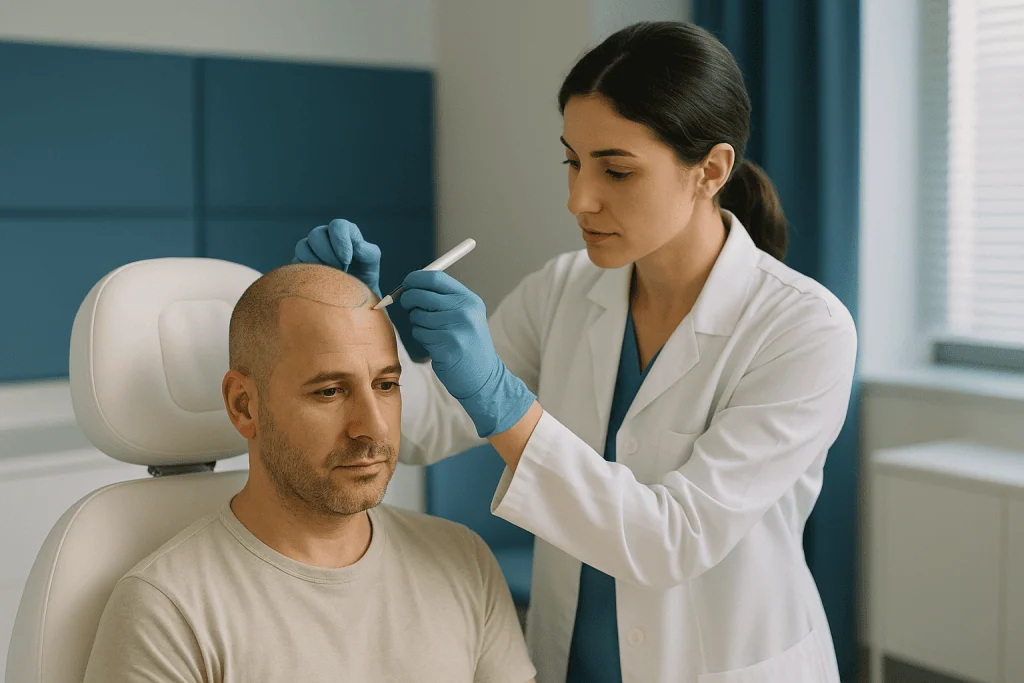
Extraction comes next. A small punch, often less than a millimeter across, cores around each follicular unit, and the unit is lifted out. Each graft contains one to several hairs, as MedlinePlus notes, and the mix of single-hair and multi-hair grafts is sorted deliberately: finer single hairs for the front edge, fuller units behind them.
Then the implanter does its work. A technician loads a graft into the hollow needle of the pen. The surgeon pushes the needle into the scalp at a chosen angle and depth, presses a plunger, and the graft slides into the channel the needle just made. One graft, one motion, repeated hundreds or thousands of times over several hours. Direction matters enormously here: native hair at the front grows forward and slightly downward, crown hair swirls, and temple hair lies almost flat. Mimicking those angles is what separates a natural result from an obvious one.
Finally the recipient area is left largely uncovered so the grafts can begin forming crusts, and the donor area is dressed. You go home the same day with instructions on sleeping position, washing and what to avoid. The surgical part is over. The biological part, which decides what you will see in a year, has just started.
Why hair growth follows a calendar you cannot rush
Every hair on your head runs on a cycle. The anagen phase is the active growth period, lasting years for scalp hair. Catagen is a brief transition of a few weeks. Telogen is a resting phase that typically lasts a few months, at the end of which the hair is released and a new one begins pushing up from below. Mayo Clinic puts normal daily shedding at 50 to 100 hairs, which is simply this cycle running quietly in the background across a hundred thousand or so follicles.
A transplant disrupts that rhythm for every graft moved. The trauma of extraction and reimplantation pushes the follicle into a premature resting phase. The hair shaft it was carrying is shed, not because the follicle died but because it has paused to repair itself and re-establish its blood supply. Only once that pause ends does a new anagen begin, and the new hair has to grow from zero.
This is why no technique, DHI included, can deliver visible density in weeks. The follicle sets the schedule. The NHS, in its guidance on hair transplants, is plain that the transplanted hair falls out in the early weeks and that new growth takes months to appear. MedlinePlus says the same: transplanted hair falls out within about six weeks and new hair grows within a few months.
There is a useful mental model here. Think of the grafts as bulbs planted in autumn. The greenery you saw at planting dies back. Nothing looks alive for a while. Then shoots appear unevenly, some beds earlier than others, and only by the following summer do you know what the garden actually looks like. Judging a transplant at week six is judging the garden in January.
DHI hair transplant results timeline: the stages at a glance
The table below summarizes what most patients can expect to see at each stage. Timeframes are typical ranges drawn from MedlinePlus and NHS patient guidance, not promises; individual follicles vary, and the crown in particular tends to lag the front.

| Stage | Typical window | What density looks like | What is happening underneath |
|---|---|---|---|
| Immediate | Days 0–10 | Short stubble visible, scalp pink, small crusts around each graft | Grafts anchoring; new blood vessels beginning to connect |
| Shedding | Weeks 2–6 | Stubble falls out; area may look as thin as before surgery | Follicles enter a resting phase after the shock of transplant (MedlinePlus) |
| Dormant | Weeks 6–12 | Little visible change; occasional pimple-like bumps | Follicles resting, then restarting growth from the root |
| Early growth | Months 3–5 | Fine, sometimes wiry or curly hairs emerging unevenly | New anagen phase begins; shafts initially thin |
| Maturing | Months 6–9 | MedlinePlus: most people see about 60% of new growth by this point | More follicles active; shaft diameter increasing |
| Final | Months 12–18 | Hair thickens, texture normalizes; fair point to judge density | Remaining late follicles active; shafts reach mature caliber |
Two features of this timeline deserve emphasis. First, the curve is not linear. Very little changes between weeks six and twelve, and then a great deal changes between months four and eight. People who photograph monthly often describe the “nothing, nothing, nothing, suddenly something” pattern. Second, density is not only a count of hairs. A hair at month four may be present but so fine that it contributes almost nothing to visual coverage. The same hair at month twelve, thicker and longer, covers far more scalp. That is why the final stage still adds apparent fullness even when very few new follicles are starting.
The first two months: crusts, stubble and the shedding phase
In the first few days, the recipient area is a field of tiny scabs with short hair shafts poking through. It looks like dense stubble, and many patients feel a surge of optimism. Enjoy it, but understand it for what it is: the old shafts, still attached to follicles that have just been through surgery. Swelling of the forehead is common in the first week, sometimes drifting toward the eyes as gravity pulls fluid down. The NHS lists swelling, tightness and scabbing among the expected early effects.
Gentle washing according to your surgeon’s instructions softens the crusts, and by around day ten most of them have lifted. Then comes the stage that upsets people most. Between roughly weeks two and six, the stubble falls out. It comes away in the shower, on the pillow, on your fingers. MedlinePlus states that the transplanted hair falls out within about six weeks of the procedure. It is expected. It is not graft loss. The follicle remains in place beneath the surface.
Some patients also notice their native hair around the transplanted zone thinning at the same time. This is called shock loss: existing hairs near the surgical site are jolted into a resting phase by the trauma and shed temporarily. In most cases these hairs regrow along with the grafts, though a surgeon should know if the thinning is extensive.
Density assessment during this window is pointless and often harmful to morale. The area may look thinner than it did before surgery. The only honest statement a clinician can make at week four is that the grafts appear to have healed in place and the shedding is proceeding as expected. Resist comparing your scalp to photographs posted by others at the same stage; lighting, hair color and skin tone distort these comparisons badly.
Months three to five: the uneven first sprouts
Somewhere around the third month, if you run a hand across the recipient area, you may feel a faint roughness before you can see anything. These are the first new shafts breaking the surface. They arrive without ceremony and without uniformity. One patch may sprout while a neighboring patch stays bare for another month. MedlinePlus describes new hair growing within a few months of the procedure; the NHS similarly notes that regrowth begins in the months after shedding.
The early hairs often look strange. They are fine, sometimes almost colorless, and may grow in curlier or wirier than the rest of your hair. This happens because the new shaft is being produced by a follicle that is still recovering and because the channel it grows through has recently healed scar tissue around it. Texture usually normalizes as the shaft thickens over the following months.
Small pimple-like bumps can appear during this stretch. Most are hairs that have curled under the skin as they emerge, a form of folliculitis, the term for inflammation of a hair follicle. A few scattered bumps are common and settle on their own or with simple measures your care team suggests. Clusters that are hot, spreading or painful are a different matter and belong in the red-flag section later.
Visually, months three to five are a half-step forward. Under a strong light, the scalp may still show through clearly. In softer light, there may be a faint shadow of coverage that was not there before. Photograph it if you like, in the same light and position each month, because the comparison you will make at month twelve is far more meaningful than any single image. What you cannot do yet is judge density. You are watching a crowd arrive one person at a time; counting the room now tells you little about how full it will be.
DHI hair transplant after 6 months: what density usually looks like
Six months is the first stage at which a meaningful, if still provisional, assessment is reasonable. MedlinePlus states that most people see about 60 percent of new hair growth after six to nine months. In practical terms, the shape of the result is visible. The hairline exists as a line rather than a scattering. Combed forward, the front usually looks noticeably fuller than before surgery. Combed back or wet, the scalp still shows more than it eventually will.
Several things are still incomplete. Shaft diameter is the big one. A hair that will eventually be as thick as its neighbors is, at six months, often half that caliber, which means it reflects less light and covers less skin. Length matters too; hair that has only been growing for two or three months is short, and short hair lies differently and covers less. Late-starting follicles, which can begin growing well after month six, have not contributed anything yet.
The crown deserves a separate mention. Hair in this region tends to run behind the front on almost every timeline because the swirl pattern exposes more scalp for a given hair count and because blood supply and healing differ. If the crown looks sparse at six months while the front looks acceptable, that pattern is typical rather than alarming.
What should you actually do at six months? This is a sensible moment for a review appointment. A clinician can look at graft survival across zones, note any areas of folliculitis or persistent redness, and discuss whether the trajectory looks as expected. What a clinician cannot honestly do is give you a final grade. If someone pronounces the result complete at six months, or declares it a failure, both verdicts are premature by the evidence.
Months nine to eighteen: thickening, texture and the fair judgment
The second half of the first year is less about new hairs and more about the hairs you have. Shafts thicken. Texture settles, so the wiry early growth softens toward your natural pattern. Length accumulates, and with it the ability to style, part and layer hair so that it covers. These changes are slow and easy to miss day to day, which is why side-by-side photographs taken at the same angle and in the same light are so valuable.
The NHS guidance notes that it can take a year or more for the full result of a hair transplant to be seen. Most hair restoration surgeons regard 12 months as the earliest point for a complete assessment and allow up to 18 months, particularly for the crown, before concluding that what you see is what you have. That range is the honest answer to the question in the title. Earlier judgments are previews.
What does a fair judgment involve? Density, measured as hairs per square centimeter under magnification, is one part. Surgeons also look at the naturalness of the hairline, the direction of growth, the match between transplanted and native hair, and whether the donor area has healed without visible thinning. Patients, understandably, look at the mirror and at photographs under harsh light.
It is worth being clear about what a transplant can and cannot restore. The number of grafts moved is finite and set by the donor supply. Surgeons generally place fewer follicular units per square centimeter than the scalp originally carried, because the goal is the appearance of coverage rather than a literal recreation of adolescent density. A result that looks full in everyday conditions but shows scalp under a bathroom spotlight or when wet is within the normal range of outcomes, and your surgeon should have discussed this expectation before the procedure.
DHI vs FUE results: does the implanter pen change the timeline?
Standard follicular unit extraction and DHI share the same extraction step. The difference lies in how grafts are placed: pre-made incisions and forceps in conventional FUE, versus a loaded implanter pen that opens and fills the channel at once in DHI. Follicular unit transplantation, the older strip method in which a band of scalp is removed from the donor area and dissected into grafts, differs further in leaving a linear scar at the back of the head.
On the question that matters here, the growth timeline, the evidence does not support a meaningful difference. The shedding phase, the dormant weeks, the early sprouting and the maturation through the first year are driven by the hair cycle, which is identical regardless of the tool used to place the graft. No mainstream patient guidance from the NHS, MedlinePlus or major academic centers describes a faster growth schedule for implanter-pen placement.
Where proponents argue DHI has advantages is in graft handling: the graft spends less time outside the body and is touched less, which in principle reduces drying and crush injury. Whether that translates into measurably higher graft survival in practice has not been settled by high-quality comparative trials, and claims of specific survival percentages should be treated with caution unless they come from a named systematic review. Implanter placement also allows transplanting into areas with existing hair without shaving the whole recipient zone, which some patients value.
Potential drawbacks are also practical rather than biological. Loading the pen is labor-intensive, so sessions can be longer or involve fewer grafts per sitting. The angle control depends entirely on the hand holding the pen; a well-trained team with forceps can achieve equally natural angles. The honest summary is that the method you choose should be a conversation about your scalp, your goals and your surgeon’s experience, not about speed of results, because speed is not on offer from any technique.
Who DHI is usually for, and who is usually asked to wait
Hair transplantation of any kind, DHI included, is typically considered for people with pattern hair loss, the hormonally driven thinning that follows a predictable shape and leaves a stable donor fringe at the back and sides. It depends on having enough healthy donor hair to move, and on the loss having settled into a pattern the surgeon can plan around. The NHS notes that a hair transplant is not suitable for everyone and that an assessment of the cause of hair loss comes first.
People who are commonly asked to wait fall into a few groups. Young adults whose pattern is still evolving are often advised to delay, because a hairline designed for a 22-year-old scalp can look out of place when the surrounding hair continues to recede, and donor supply spent early is not available later. Those with active inflammatory scalp conditions, including alopecia areata and the scarring alopecias such as lichen planopilaris, are usually not candidates until the disease is quiet, since grafts placed into active inflammation may be destroyed. Diffuse unpatterned thinning, where the donor area itself is affected, raises the question of whether moved hair will last.
Medical factors matter as well. Poorly controlled diabetes, bleeding disorders, certain medications that affect clotting, and heavy smoking all influence healing and may prompt a surgeon to defer. Mayo Clinic notes that a wide range of conditions, from thyroid disease to nutritional deficiency, can cause hair loss; where one of these is suspected, treating the underlying cause comes before any surgery.
Expectation is the final filter, and a good one. Someone seeking the density of their teenage years from a finite donor supply, or hoping a single session will finish the job for life, is likely to be disappointed by even a technically excellent result. Surgeons who spend time on this conversation are protecting the patient, and the decision to proceed, defer or decline always rests with the treating team.
How medicines and habits shape the results timeline
A transplant moves hair; it does not stop the process that thinned the original hair. Native follicles around the grafts remain subject to pattern loss, which is why surgeons often discuss medical therapy alongside surgery. Two drug classes come up most. The first is a topical vasodilator, minoxidil, whose exact mechanism is not fully understood but which appears to prolong the growth phase and enlarge miniaturized follicles. Mayo Clinic notes it takes at least six months of use to prevent further loss and begin regrowth. The second is a 5-alpha reductase inhibitor, finasteride, taken by mouth, which lowers the scalp level of dihydrotestosterone, the hormone that shrinks follicles in pattern loss. Mayo Clinic indicates that benefits, where they occur, also take months to appear and depend on continued use.
Neither medicine speeds up the transplanted hair’s own cycle. Their relevance to the timeline is indirect: by protecting native hair, they preserve the backdrop against which transplanted density is judged, and some surgeons believe they help the early shedding phase settle. Whether, when and which of these options is appropriate is a decision for the prescribing clinician, who will weigh side effects and individual circumstances. Nothing here is a recommendation to start, stop or change anything.
Habits influence healing rather than hair biology. Smoking constricts small blood vessels and is widely associated with slower wound healing, which matters in the weeks when grafts are establishing blood supply. Alcohol in the first days can increase bleeding and swelling. Direct sun on a healing scalp can cause lasting pigment changes. Vigorous exercise early on raises blood pressure and sweat, both unhelpful to fresh grafts; your surgeon will give a timeline for returning to activity. Sleep position in the first nights, usually head elevated, limits swelling. None of these change the month in which you can judge density. They change whether the grafts you paid for in effort and healing survive to be counted.
What people often get wrong about DHI hair transplant results
The first misunderstanding is that shedding means failure. It means the opposite: the follicle is alive, has entered its resting phase and is preparing to regrow. MedlinePlus and the NHS both describe this shedding as an expected part of recovery. A graft that was genuinely lost in the first days would usually have come away with its bulb, and a surgeon can often tell the difference during an early check.
The second is that DHI produces faster results than other methods. The implanter changes placement, not biology. Every mainstream source describes the same months-long schedule regardless of technique, and no patient guidance from the sources cited here claims otherwise.
The third is that the result at six months is the result. MedlinePlus’s figure of roughly 60 percent of growth by six to nine months means a substantial portion is still to come, and the thickening of existing shafts continues well past that. Judging at six months routinely underestimates the outcome.
The fourth is that more grafts always mean more density. Grafts placed too close together compete for blood supply and can reduce survival, and the donor area has limits. A surgeon declining to place a requested number is often exercising good judgment rather than caution.
The fifth is that a transplant halts hair loss. It does not. Native hair continues on its own trajectory, which is why the long-term appearance depends partly on how the surrounding hair behaves and why medical management is usually part of the conversation.
The sixth concerns the acronym itself: DHI is not a company that owns a procedure, nor a brand of result. It is a technique name shared, by coincidence, with unrelated organizations in other industries. Search results mixing hair surgery with water engineering or mortgage lending are an artifact of the letters, nothing more. Choosing a surgeon on the basis of a label rather than training, case volume and honest counseling is the error worth avoiding.
Questions to ask your care team before and after surgery
Good questions do two things: they surface information you need, and they reveal how a surgeon communicates when the answer is not flattering. Before the procedure, consider asking:
- What is the likely cause of my hair loss, and has anything other than pattern loss been ruled out?
- How stable is my pattern, and would you advise waiting? If so, how long and why?
- How many follicular units do you plan to place, over what area, and how did you decide on that density?
- Where will the hairline sit, and how will it look if my native hair continues to recede?
- What proportion of my donor supply will this session use, and what would remain for the future?
- Who will perform extraction and who will perform implantation, and what is their training?
- What results can I realistically expect at six months and at twelve months, and what would make you concerned at each point?
- What are the specific risks for someone with my medical history, and how do you manage infection, folliculitis and shock loss?
- What is your follow-up schedule, and how do I reach the team if something worries me between visits?
After surgery, the questions shift toward monitoring:
- Does the shedding I am seeing match what you expected, and is the amount of native hair shedding normal?
- Are these bumps ordinary folliculitis, or do they need treatment?
- At what point will you formally assess density, and how will you measure it?
- If some areas lag behind, when would you consider whether a further session is appropriate, and what would that depend on?
Pay attention to answers that are specific, hedged where the evidence is uncertain, and willing to say “we will know more at twelve months.” That caution is a mark of good practice, not evasiveness. The decision to proceed, to wait, or to plan further treatment belongs to you and your treating team together.
When to call your doctor
Most of what you see in the first months is expected: pinkness, crusting, swelling that drifts toward the brow, mild itching, numbness over the donor or recipient area, scattered pimple-like bumps and, of course, shedding. These settle with time and basic care. A smaller set of signs should prompt a same-day call to the surgical team or, if they are unreachable, urgent medical attention.
Contact your doctor promptly if you notice any of the following:
- Spreading redness, warmth or swelling around the recipient or donor area, especially if it worsens after the first few days rather than easing
- Thick yellow or green discharge, a foul smell, or crusts that are increasing rather than lifting
- Fever, chills or feeling generally unwell in the days after surgery
- Bleeding that soaks through dressings or does not stop with gentle pressure
- Pain that is increasing, severe or not controlled by the measures your team advised
- Clusters of hot, tender bumps that enlarge or merge, which may indicate folliculitis needing treatment rather than the ordinary scattered kind
- Numbness or tingling that is spreading or has not begun to improve over the weeks your team indicated
- Swelling around the eyes severe enough to affect vision, or a rash, hives or wheeze suggesting an allergic reaction to a medicine or dressing
Seek emergency care immediately for difficulty breathing, swelling of the lips or tongue, chest pain, or fainting. These are rare but are never something to wait on.
Beyond the acute period, call if the shedding of native hair seems extensive, if an area of the scalp remains persistently inflamed, or if by month six there is no new growth at all in a zone that was grafted. None of these necessarily means a problem, but each is something your treating team should assess rather than something to interpret alone from a mirror or a forum. MedlinePlus and the NHS both list infection, bleeding and inflammation of the follicles among recognized complications; early contact is the simplest way to keep a small problem small.
Frequently asked questions
What does DHI stand for, and who owns it?
DHI stands for Direct Hair Implantation, a technique in which grafts are placed with a spring-loaded implanter pen rather than forceps into pre-made incisions. No single company owns the surgical method; it is a technique any trained hair restoration surgeon can use with equipment from various manufacturers. The same letters are also used by unrelated organizations in water engineering, mortgage lending and home construction, which is why searches often return pages that have nothing to do with hair.
What are the dhi hair transplant growth stages month by month?
The first ten days show stubble and crusts. Weeks two to six bring shedding of the transplanted shafts, which MedlinePlus describes as expected. Weeks six to twelve are largely dormant. Fine new hairs appear around months three to five, often uneven in texture. By six to nine months most people see roughly 60 percent of new growth, per MedlinePlus. Months twelve to eighteen bring thickening and the point at which density can be fairly judged.
Is it normal to look thinner than before a DHI transplant at week four?
Yes, this is common and expected. The transplanted shafts shed in the first weeks, and native hairs near the surgical site may also shed temporarily in what is called shock loss. The follicles remain in place beneath the skin and typically begin regrowing a few months later. Judging density during this window is not meaningful; a surgeon can confirm that healing looks as expected, but a verdict on fullness has to wait.
What should a dhi hair transplant after 6 months look like?
At six months the shape of the result is usually visible: a defined hairline and noticeably more coverage when combed forward, with scalp still showing under harsh light or when wet. MedlinePlus puts typical growth at about 60 percent by six to nine months. Hair shafts are still thinner than they will become, and late-starting follicles have not yet contributed. The crown often lags the front. It is a reasonable time for a review, not a final assessment.
Does the hair transplant shedding phase mean the grafts have died?
No. Shedding is the hair shaft being released while the follicle enters a resting phase after the stress of being moved. The NHS and MedlinePlus both describe it as a normal part of recovery. A graft that was genuinely dislodged in the first few days would usually come away with its root attached and often with a little bleeding. If you are uncertain what you are seeing, an early check with your surgical team can tell the difference.
Are dhi vs fue results different in how fast hair grows?
No difference in speed is supported by mainstream patient guidance. Both methods extract follicular units the same way; DHI differs only in using an implanter pen for placement. The growth timeline is set by the hair cycle, which the placement tool does not change. Arguments for DHI concern graft handling and angle control, and claims of higher survival percentages have not been settled by high-quality comparative trials, so they should be treated with caution.
Why does the crown take longer than the hairline to show density?
The crown’s swirl pattern exposes more scalp for a given number of hairs, so the same density looks thinner there than at the front. Healing and blood supply in the crown also tend to be slower, and surgeons commonly see this region lag by several months. Many allow up to 18 months before judging crown density, compared with around 12 months for the front. A sparse crown at six months is typical rather than a sign of failure.
Can medication speed up transplanted hair growth?
No medicine shortens the transplanted hair’s own cycle. Topical minoxidil and oral 5-alpha reductase inhibitors act on native hair, and Mayo Clinic notes that minoxidil needs at least six months of use before any effect is seen. Their role is to protect the surrounding hair that frames the result. Whether either is appropriate, and for how long, is a decision for the prescribing clinician based on your history and tolerance of side effects.
Who is usually asked to wait before having a DHI hair transplant?
Young adults whose hair loss pattern is still changing are often advised to delay so the hairline design and donor supply are not committed too early. People with active inflammatory or scarring scalp conditions are usually asked to wait until the disease is quiet. Poorly controlled diabetes, bleeding disorders and heavy smoking may also prompt deferral. The NHS notes a transplant is not suitable for everyone; the treating team makes the final call.
When should I worry about bumps or redness after a DHI transplant?
Scattered pimple-like bumps around month three to five are usually ordinary folliculitis from hairs emerging through healing skin and settle on their own. Call your doctor the same day if redness or warmth is spreading, if bumps are hot, enlarging or merging, if there is yellow or green discharge or a bad smell, or if you have fever, worsening pain or bleeding that does not stop with gentle pressure. Seek emergency care for breathing difficulty or facial swelling.
References
This article is for general information only and is not a substitute for professional medical advice. Please consult a qualified doctor about your individual situation.

More from the Blog

FUE Hair Transplant Aftercare: Normal Crusting vs Folliculitis, Infection and When to Call
After FUE, thin light-colored crusts around each graft, mild redness and some itching are expected and usually settle within about two weeks. Signs that…

How Long Does Scalp Micropigmentation Last? Fading, Touch-Ups and What Changes Over the Years
Scalp micropigmentation is a cosmetic tattoo, and like any tattoo it softens over time rather than lasting forever. Practitioners generally describe the shading holding…

5,000+ Graft Sessions: What Mega-Sessions Can Do, and Their Safe Limits
A 5,000-graft hair transplant is a large "mega-session" that can cover extensive balding, roughly the front, mid-scalp, and part of the crown in advanced…

Can a Beard Transplant Cover Scars or Burned Skin? How Surgeons Test the Area Before Grafting
A beard transplant over scars or burned skin is sometimes possible, but graft survival depends on blood supply, scar thickness and skin movement, all…
Long Hair (Unshaven) Transplants: Who Qualifies and What to Expect
Long hair (unshaven) transplants are follicular unit procedures done without buzzing the recipient area, and sometimes without trimming the donor zone at all. Good…
Unshaven (U-FUE) Hair Transplant Recovery: Hiding Redness, Washing Long Hair and Work Return
Unshaven FUE recovery follows the same biology as any follicular unit extraction, but the surrounding long hair changes the practical details. Grafts typically anchor…