

Which Tests Guide a Prostate Disease Plan? PSA, Urine Tests, MRI and Biopsy Planning

Key Takeaways
- According to the NHS, about 3 in 4 men with a raised PSA do not have prostate cancer, and about 1 in 7 with a normal PSA do, so the number is a signal, not a verdict.
- The NHS advises avoiding a PSA test within 6 weeks of a urinary infection or biopsy and within 48 hours of ejaculation or vigorous exercise, because each can temporarily raise the result.
- A multiparametric prostate MRI typically takes 30 to 45 minutes and scores suspicious areas on a 1-to-5 PI-RADS scale that helps decide whether and where to biopsy.
- Urine tests rarely diagnose prostate disease directly, but they identify infection or bleeding that can explain symptoms and inflate PSA, often before imaging is needed.
- The CDC does not recommend routine PSA screening for men aged 70 and older, though symptoms at any age call for diagnostic testing regardless of that guidance.
- After a biopsy, blood in the semen can persist for several weeks and is expected, while fever or inability to urinate are red flags needing same-day care.
Tests for prostate disease usually begin with a PSA blood test and a discussion of symptoms and risk, sometimes with a physical exam. Urine tests help rule out infection or other causes. If PSA or exam findings raise concern, a prostate MRI is often done next, and only then is a biopsy planned, often targeted to suspicious areas. Your treating team decides the sequence.
He had come in for a blood pressure check. Somewhere between the cuff and the printout, his doctor asked how the nights were going, and he admitted he was getting up twice, sometimes three times, to use the bathroom. Nothing dramatic. Just enough to make him wonder, on the drive home, what a prostate problem actually looks like when it starts, and which tests would tell him anything useful.
That wondering is common, and it deserves a straight answer. Tests for prostate disease are not a single gate you pass or fail. They form a sequence, and each step is designed to answer one narrow question before anyone moves to the next. A blood test asks whether the gland is leaking more protein than expected. A urine test asks whether something else, like an infection, explains the symptoms. A scan asks where, exactly, a doctor should look. A biopsy answers what the tissue is.
Understanding that order changes how the whole process feels. It stops being a countdown and becomes a conversation you can take part in.
Why tests for prostate disease start with a conversation, not a scan
The prostate is a walnut-sized gland that sits below the bladder and wraps around the urethra, the tube that carries urine out of the body. Three quite different conditions can affect it: benign enlargement, which the NHS notes is common with age; inflammation or infection, called prostatitis; and prostate cancer. They can produce overlapping symptoms, and they need very different responses.
That is why a sensible workup begins with questions rather than machines. Your doctor will want to know how long symptoms have been present, whether there is pain or fever, whether you have had urinary infections, what medicines you take, and whether a father or brother has had prostate cancer. Family history and Black ethnicity are both recognized by the NHS and CDC as factors that raise the likelihood of prostate cancer, and they shift how eagerly a clinician will pursue testing.
Then comes the physical exam, if you agree to it. In a digital rectal examination, or DRE, the doctor inserts a gloved, lubricated finger into the rectum to feel the back surface of the prostate. It takes less than a minute. The exam can pick up hard or irregular areas, but it only reaches part of the gland, so a normal DRE does not rule cancer out and an unusual one does not confirm it.
Only after this groundwork does a blood test earn its place. Ordering a PSA without the context of symptoms, history and a shared understanding of what a result might trigger is how people end up with a number they cannot interpret and a worry they did not choose. Good care puts the conversation first, and it is worth insisting on that even in a busy appointment.
What are the first signs of prostate problems?
The honest answer is that the earliest prostate cancers usually produce no signs at all. The NHS is explicit on this point: prostate cancer often has no symptoms until the gland is large enough to press on the urethra. Most urinary changes in midlife come from benign enlargement, not cancer.
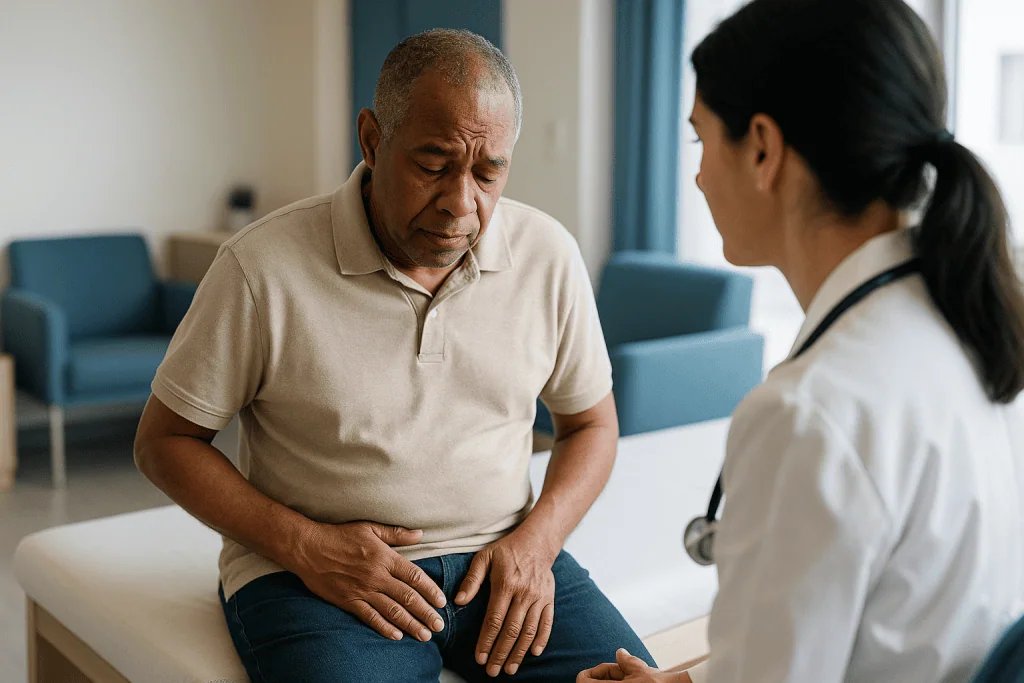
Benign prostatic enlargement, sometimes called BPH, occurs when the gland grows and narrows the channel urine passes through. People describe a weaker stream, a feeling that the bladder never quite empties, needing to go more often, or being woken at night. These changes tend to creep in over months or years rather than arriving suddenly.
Prostatitis behaves differently. Bacterial prostatitis can bring pelvic or lower back pain, burning when urinating, and sometimes fever and chills, and the acute form can make someone feel genuinely unwell within a day or two. Chronic pelvic pain syndrome, a non-bacterial form, causes lingering discomfort without infection.
Blood in the urine or semen, trouble getting an erection, or bone pain are symptoms people often fear, and they should always be reported, but they are not typical first signs of prostate cancer and far more often have other explanations.
This matters because the purpose of testing is not to match a symptom to a diagnosis at home. It is to give your clinician enough information to choose the right test. A weaker stream in a 62-year-old is a reason to talk, not a reason to conclude anything. The tests exist precisely because symptoms alone cannot separate the three conditions reliably.
How the PSA blood test actually works
Prostate-specific antigen, or PSA, is a protein made by prostate cells to keep semen liquid. Small amounts leak into the bloodstream in every man, and a PSA test simply measures that amount, reported as nanograms per milliliter. It is a standard blood draw from the arm, and MedlinePlus notes that no fasting is needed.
The key mechanism to understand is that PSA is prostate-specific, not cancer-specific. Anything that irritates, enlarges or disturbs the gland can push more protein into the blood. A larger gland makes more PSA. An infection inflames it. Recent ejaculation, vigorous cycling, a catheter, or a rectal exam can all nudge the number temporarily. Cancer cells also release PSA, often more per gram of tissue, which is why the test is useful, but they are only one of several sources.
Laboratories sometimes report refinements. Free PSA measures the fraction not bound to other proteins; a lower free fraction is associated with cancer. PSA density divides the PSA by prostate volume measured on imaging, correcting for gland size. PSA velocity tracks change over time. None of these is a standalone verdict; they are ways of sharpening the same signal.
There is no universally agreed cutoff. The NHS uses a referral threshold of 3 nanograms per milliliter for men aged 50 to 69, while noting that levels rise naturally with age. Many US clinicians use age-adjusted ranges. Your doctor interprets the value against your age, gland size, previous results and exam, which is why comparing your number to a friend’s is rarely informative.
Think of PSA as a smoke detector. It tells you something is producing smoke. It cannot tell you whether that is toast or a fire, and the next tests exist to find out.
What a raised PSA does and does not mean
A raised PSA is the single most common reason people enter a prostate workup, and the statistics deserve plain language. According to the NHS, about 3 in 4 men with a raised PSA level do not have prostate cancer. At the same time, the test misses some cancers; the NHS estimates that about 1 in 7 men with a normal PSA level do have prostate cancer. Both numbers are worth sitting with.

The first number means a high result should prompt calm repetition and context, not panic. Many clinicians will repeat the test after several weeks, especially if there was a possible infection or recent activity that could have inflated it. If a urine test shows infection, treating that and retesting is standard before anyone talks about imaging.
The second number means a normal PSA is reassuring but not a guarantee, particularly if a rectal exam felt abnormal or symptoms are marked. Doctors weigh the whole picture, and a low number does not automatically close the file.
Where the PSA falls relative to gland size is often more telling than the raw value. A moderately raised PSA in a very large benign gland may be entirely expected. The same number in a small gland is more suspicious. This is why prostate volume, usually measured on MRI or ultrasound, has become part of modern interpretation.
Guidelines increasingly discourage moving straight from one raised PSA to a biopsy. The intermediate steps, repeat testing and MRI, exist to reduce unnecessary biopsies while catching the cancers that matter. If your clinician suggests waiting and repeating, that is not delay for its own sake; it reflects how noisy a single reading can be.
What not to do before a prostate exam or PSA test
Preparation for a PSA test is mostly about avoiding things that temporarily raise the number. The NHS advises against having the test if you have had a urinary infection in the past 6 weeks, have ejaculated or exercised vigorously in the past 48 hours, or have had a prostate biopsy in the past 6 weeks. A rectal exam shortly before the blood draw can also nudge the result, so many clinics draw blood first and examine afterward.
Vigorous exercise mainly means activities that press on the perineum, such as long bike rides. A brisk walk is not a concern. Sexual activity affects PSA because ejaculation releases the protein into the bloodstream in small amounts for a day or two.
Tell your doctor about all medicines, including those for enlarged prostate. One class, 5-alpha-reductase inhibitors, shrinks the gland and roughly halves PSA over about 6 to 12 months, according to Mayo Clinic, so results have to be interpreted knowing you take one. Do not stop any prescribed medicine to prepare for a test; your clinician simply adjusts the interpretation.
For the digital rectal exam itself, there is nothing to do. No enema, no fasting, no special diet. Some people worry about being embarrassed or about needing the bathroom, and it helps to know the exam takes under a minute and that emptying your bladder beforehand is fine.
If a urine test is planned, ask whether a first-morning or midstream sample is wanted, and whether you should hold off on urinating for a period beforehand. Clinics differ, and a quick question saves a repeat visit. Above all, do not delay a visit because you think conditions are not perfect; your doctor can always reschedule the blood draw.
Which urine tests are used in prostate disease?
Urine tests rarely diagnose prostate disease directly, but they do the essential work of ruling other things in or out. The first is a simple urinalysis: a dipstick and microscope check for blood, protein, white cells and signs of infection. If white cells or bacteria appear, a urine culture identifies the organism, which matters because infection is a common and treatable cause of both urinary symptoms and a raised PSA.
Blood in the urine, visible or microscopic, changes the direction of a workup. It can come from the prostate, but also from the bladder or kidneys, so its presence may prompt imaging of the urinary tract or a look inside the bladder with a thin camera, called cystoscopy, before anyone focuses on the prostate.
For suspected prostatitis, some clinicians use a two-glass or four-glass test, collecting urine before and after prostate massage to see whether bacteria or inflammatory cells come specifically from the gland. It is less common now, but it illustrates the logic: localize the problem.
Newer urine biomarker tests measure genetic material shed from prostate cells, sometimes after a rectal exam. They are designed to help decide whether a man with a mildly raised PSA needs a biopsy. Evidence for them is still developing, they are not part of routine pathways in most guidelines, and your team will tell you if one is relevant to your situation. They are not substitutes for MRI or biopsy.
A urine flow study, in which you urinate into a machine that measures speed and volume, and a bladder ultrasound to check how much urine remains after voiding, are often added when benign enlargement is the leading concern. Together, these unglamorous tests frequently settle the question without any further imaging at all.
What does a prostate MRI show, and why do it before a biopsy?
Magnetic resonance imaging, or MRI, uses magnetic fields and radio waves to build detailed pictures of soft tissue without radiation. For the prostate, the scan is called multiparametric because it combines several image types: anatomy, how freely water moves through tissue, and how blood flows after a contrast injection. Cleveland Clinic notes the examination typically takes 30 to 45 minutes, with the patient lying still inside the scanner.
Radiologists score suspicious areas using the PI-RADS system, a 1-to-5 scale where 1 means clinically significant cancer is very unlikely and 5 means it is highly likely. This score, along with prostate volume, goes back to the urologist.
The shift toward doing MRI before biopsy is one of the more meaningful changes in prostate care in recent years, and NHS pathways now build it in. The reasoning is twofold. First, a clear scan in a man with a mildly raised PSA can let him avoid a biopsy altogether, with continued monitoring instead. Second, when the scan does show a lesion, the biopsy can be aimed at it rather than sampled blindly, which improves the chance of finding significant cancer and reduces the detection of tiny, low-risk cancers that would never have caused harm.
MRI is not perfect. It can miss some cancers and can flag areas that turn out benign, which is why the score is always combined with PSA density and clinical findings rather than read alone. People with certain metal implants or severe claustrophobia may need alternatives or adjustments. Ask whether contrast will be used and mention any kidney problems, as that affects the dye decision.
The scan does not hurt, but the noise can be startling. Ear protection is provided, and many people are surprised by how routine it feels.
When is a prostate biopsy planned, and what actually happens?
A biopsy removes small cores of prostate tissue with a fine needle so a pathologist can examine them under a microscope. It is the only test that can confirm cancer, which is why it is the last step rather than the first. It is usually planned when PSA, exam and MRI together point to a meaningful chance of significant cancer, and when knowing the answer would change what is done next.
Two routes are used. In a transrectal biopsy, the needle passes through the rectal wall guided by an ultrasound probe. In a transperineal biopsy, it passes through the skin between the scrotum and anus. Mayo Clinic describes both; the transperineal route is increasingly favored in many centers because it carries a lower infection risk, though the choice depends on local expertise and your anatomy.
Before the procedure, the team will review your medicines, particularly blood thinners, and may prescribe a short antibiotic course for transrectal approaches. Do not stop or change any medicine unless the team instructs you. Local anesthetic is injected around the gland; some centers offer sedation or general anesthesia for transperineal procedures.
The biopsy itself typically takes about 10 to 20 minutes. If an MRI showed a target, extra samples are taken from that area, often with software that fuses the MRI onto live ultrasound. Systematic samples from the rest of the gland are usually taken too, because MRI can miss some tumors.
Results go to a pathologist who assigns a Gleason score or grade group describing how abnormal the cells look. Mayo Clinic notes results are usually available within a few days, though timing varies. That report, alongside imaging and PSA, is what your team uses to discuss whether the finding needs treatment, active monitoring or nothing at all.
Tests for prostate disease at a glance: what each one can and cannot tell you
Seeing the tests side by side makes the logic of the sequence clearer. Each answers a specific question, and none replaces the others.
| Test | What it measures | What it is good at | What it cannot do |
|---|---|---|---|
| PSA blood test | Protein leaked from prostate cells | Flagging that something is stimulating the gland; tracking change over time | Distinguish cancer from enlargement or infection |
| Digital rectal exam | Texture and shape of the back of the gland | Detecting hard or irregular areas in the part it can reach | Feel the front of the gland; rule cancer out |
| Urinalysis and culture | Blood, white cells, bacteria | Identifying infection or bleeding that needs separate attention | Detect cancer directly |
| Flow study and post-void scan | Speed of urination and leftover urine | Assessing obstruction from benign enlargement | Say anything about cancer |
| Multiparametric MRI | Tissue structure, water movement, blood flow | Locating suspicious areas; measuring volume; avoiding some biopsies | Confirm cancer; detect every tumor |
| Biopsy | Cells under a microscope | Confirming cancer and grading it | Assess the whole gland; be entirely free of sampling error |
The table also shows why the order matters. PSA and urinalysis are cheap in effort and risk, so they come first. MRI adds information without a needle, so it precedes biopsy. Biopsy carries the most discomfort and risk, so it is reserved for when the earlier steps have made it worthwhile.
One implication people find reassuring: a workup that stops after a normal MRI and repeat PSA is not an incomplete workup. It is a completed one that reached a reassuring answer.
Who is usually offered tests for prostate disease, and who is asked to wait
Two very different groups walk through this pathway. The first has symptoms: urinary changes, pelvic pain, blood in the urine. For them, testing is diagnostic, aimed at explaining a problem, and there is little debate about whether to proceed. The order may vary, but a PSA, urine tests and an exam are standard opening moves.
The second group has no symptoms and is asking about screening, meaning testing to find cancer before it causes trouble. Here the guidance is more measured. The CDC, reflecting the US Preventive Services Task Force, describes PSA screening for men aged 55 to 69 as an individual decision to be made with a clinician after weighing benefits and harms. The benefit is a chance of catching a significant cancer early. The harms include false alarms, biopsies that find nothing, and detecting slow-growing cancers that might never have needed treatment.
Men at higher risk are often invited to that conversation earlier. Black men and men with a father or brother diagnosed with prostate cancer, particularly at a young age, carry a higher lifetime risk, and many clinicians begin discussing testing in the mid-40s for them.
Who is asked to wait? Men with a recent urinary infection, for one, because PSA will be unreliable until the gland settles. Men whose first result is only mildly raised are often asked to repeat the test before imaging. Men with a clear MRI and stable PSA may be placed on a surveillance schedule rather than sent for biopsy. And men with limited life expectancy from other illness are often counseled that screening is unlikely to help them and may cause harm.
Waiting, in each of these cases, is a clinical decision rather than neglect. Ask your team to explain the reasoning if a pause is suggested; a good answer will be specific to your numbers.
Should you get a PSA test after 70?
This is one of the most searched prostate questions, and it has an evidence-based answer that many find surprising. The CDC, summarizing the US Preventive Services Task Force, states that routine PSA screening is not recommended for men aged 70 and older. The reasoning is not that prostate cancer disappears at 70. It is that the balance of benefit and harm shifts.
Prostate cancers found by screening are frequently slow-growing. In an older man, such a cancer is less likely to cause problems within his remaining lifetime, while the treatments it might prompt carry real risks to continence, sexual function and general health. Screening also produces false alarms and biopsies, which are not trivial at any age.
That said, guidelines describe populations, and you are one person. A healthy, active 72-year-old with a long-lived family may reasonably decide, with his clinician, to continue testing for a few more years. Someone with significant heart or lung disease may sensibly stop earlier. Several professional bodies frame the decision around estimated life expectancy rather than a birthday.
Symptoms change everything. If a man of any age develops urinary difficulty, blood in the urine or bone pain, PSA testing is diagnostic, not screening, and the age-based screening guidance does not apply. He should be tested.
Men already diagnosed with prostate cancer and on active surveillance or after treatment continue PSA monitoring regardless of age, because there the test is tracking a known condition.
The practical takeaway is to ask your doctor a direct question: given my health and history, does continuing PSA testing help me? A thoughtful clinician will not answer with a rule but with a reason, and that reason should make sense to you.
What the days and weeks after a prostate biopsy usually look like
Most people go home the same day. The first sensation is usually a dull ache in the pelvis or perineum for a day or two, manageable with the comfort measures your team suggests. Mayo Clinic advises that you can expect some blood in the urine for a few days, and it may appear in stool after a transrectal approach for a short time as well.
Blood in the semen is the finding that alarms people most, and it is the one that lasts longest. Mayo Clinic notes it can persist for several weeks, sometimes giving semen a rusty or brown color. It is expected, it fades on its own, and it is not a sign that anything went wrong.
If antibiotics were given, finish the course exactly as instructed. Fluids help flush the urinary tract. Heavy lifting and vigorous exercise are usually paused for a few days; your team will give a specific window. Many people return to desk work the next day.
Results typically arrive within a few days to a couple of weeks depending on the laboratory. That waiting period is often harder than the procedure. It helps to schedule the results appointment before you leave, so you know exactly when you will hear.
The results conversation can go several ways. No cancer found is common and, combined with your PSA and MRI, may lead to periodic monitoring. Low-grade cancer often leads to a discussion of active surveillance, meaning regular PSA tests, scans and sometimes repeat biopsies rather than immediate treatment. Higher-grade findings open a discussion of treatment options, each with its own trade-offs.
Whatever the result, you are entitled to time, a written copy of the report, and a second appointment if the first leaves questions. The days after a biopsy are a good time to write those questions down.
What people often get wrong about prostate tests and prostate health
A high PSA means cancer. It does not. The NHS figures cited earlier show most raised results are not cancer. Enlargement, infection, recent ejaculation and cycling all raise PSA.
A normal PSA means you are in the clear. Also not quite. Some cancers produce little PSA, which is why symptoms and exam findings still count.
The rectal exam is the main test. It is a useful adjunct, but it reaches only part of the gland, and many pathways now rely more on PSA and MRI.
A biopsy spreads cancer. This fear is widespread and not supported by evidence in prostate cancer care; biopsy is standard practice worldwide precisely because it is safe in this respect.
MRI replaces biopsy. MRI decides where and whether to biopsy. Only tissue confirms a diagnosis.
There is a best over-the-counter supplement for prostate health. People ask this constantly, usually about saw palmetto, beta-sitosterol, lycopene or zinc. The evidence is thin. Well-conducted trials of saw palmetto have not shown it improves urinary symptoms better than placebo, and no supplement has been shown to prevent prostate cancer. Some products interact with prescribed medicines or, in one large trial, were associated with harm rather than benefit. If you take a supplement, tell your doctor, and do not use it as a substitute for evaluation.
Frequent urination at night is always the prostate. Fluid timing, sleep disorders, diabetes and heart conditions all cause nocturia, and a urinalysis helps sort them out.
Testing once settles it forever. PSA is most useful as a trend. A single value is a snapshot; a series is a story.
Correcting these ideas matters because each one either drives people away from testing they need or toward anxiety they do not.
Questions to ask your care team about prostate testing
A good appointment is one you leave understanding why each test is being done. These questions help get there, and none of them is too basic to ask.
- What question is this test answering, and what will we do differently depending on the result?
- Is my PSA being read against my age and prostate size, and do you want to repeat it before deciding anything?
- Should I avoid anything in the 48 hours before the blood draw?
- Could an infection or a medicine I take be affecting my number?
- Would an MRI before any biopsy make sense for me, and what would a low score allow us to skip?
- If a biopsy is recommended, which route do you use, and why?
- How many cores will be taken, and will any be targeted to MRI findings?
- What side effects should I expect afterward, and which ones should prompt a call?
- When and how will I receive results, and can I have a written copy?
- If cancer is found, is active surveillance an option, and how would that be monitored?
- If nothing is found, what follow-up schedule do you suggest?
Two habits make these questions work harder. Bring a written list of your medicines and supplements, because several affect PSA or bleeding risk. And bring someone with you, or ask permission to record the conversation, since results appointments carry more information than most people can hold at once.
Ask, too, about the option of doing nothing for now. In prostate care, watchful waiting and active surveillance are legitimate, evidence-supported paths, not consolation prizes. A clinician who can explain when waiting is appropriate is showing you how the evidence actually works.
Finally, if an answer does not make sense, say so. Medicine has its own shorthand, and translating it is part of the team’s job.
When to call your doctor: red-flag signs during prostate testing
Most of the prostate testing pathway is unhurried, and that is appropriate. A few situations, though, need prompt attention, and knowing them in advance removes the guesswork.
Seek urgent care the same day if you cannot pass urine at all, especially with a painfully full bladder. Acute urinary retention can occur with enlargement, infection or after a biopsy, and it requires a catheter to relieve it.
Call promptly if you develop fever, chills, shaking, or feel suddenly unwell in the days after a biopsy. Mayo Clinic lists these as signs of possible infection, which, though uncommon, can become serious quickly and needs treatment without delay. The same applies to fever with urinary burning at any point, which may indicate acute prostatitis or a kidney infection.
Heavy or worsening bleeding also warrants a call: urine that is deep red rather than pink-tinged, large clots, bleeding from the rectum that soaks pads, or blood that continues beyond the timeframe your team described. Light bleeding and discolored semen are expected; escalating bleeding is not.
Outside the biopsy setting, arrange to see a doctor soon rather than waiting for a routine check if you notice blood in the urine, new bone pain, particularly in the back, hips or pelvis, unexplained weight loss, or numbness or weakness in the legs. These do not usually turn out to be prostate cancer, but they should be evaluated.
Finally, if something simply feels wrong in a way you cannot name, that is reason enough to call. Testing pathways are built to be paused and adjusted. Your treating team makes the decisions about what happens next, and they can only do that well if they know what you are experiencing.
Frequently asked questions
What are the first signs of prostate problems?
Often there are none, especially with early prostate cancer. When symptoms do appear, the most common are a weaker urine stream, needing to go more often, waking at night to urinate, or a sense the bladder is not empty, and these usually reflect benign enlargement. Pelvic pain, burning and fever suggest prostatitis. Any blood in urine or semen should be reported, though it usually has other causes.
Should you get a PSA test after 70?
Routine PSA screening is not recommended for men aged 70 and older by the CDC and the US Preventive Services Task Force, because the harms of finding slow-growing cancers tend to outweigh benefits at that age. Individual health, life expectancy and preference still matter, so a healthy older man may discuss continuing with his clinician. Symptoms at any age require diagnostic testing regardless.
What not to do before a prostate exam or PSA test?
Avoid ejaculation and vigorous exercise such as cycling for 48 hours beforehand, and delay the blood test if you have had a urinary infection or prostate biopsy in the past 6 weeks, per NHS guidance. Do not stop any prescribed medicine; instead tell your doctor what you take, since some prostate medicines lower PSA. No fasting or special preparation is needed for the rectal exam.
Is a prostate MRI before biopsy always done?
Increasingly yes, and NHS pathways now include it, but not in every situation. MRI helps locate suspicious areas so a biopsy can be targeted, and a reassuring scan combined with a low PSA density may allow a biopsy to be avoided. Some people cannot have MRI because of implants or claustrophobia, and some clinicians proceed directly to biopsy when findings are already strongly suspicious.
What is the best over-the-counter supplement for prostate health?
No supplement has strong evidence for preventing prostate cancer or reliably improving urinary symptoms. Well-designed trials of saw palmetto did not show benefit over placebo for enlarged prostate symptoms, and some supplements interact with prescribed medicines. If you choose to take one, tell your doctor. Supplements should never replace evaluation of symptoms or a discussion about appropriate testing.
What does a PSA level actually measure?
PSA is a protein made by prostate cells that keeps semen liquid; small amounts enter the blood in every man. The test measures that concentration in nanograms per milliliter. Enlargement, infection, recent ejaculation, cycling and cancer can all raise it, so the value indicates the gland is producing more protein than expected, not what is causing it. Trends over time are more informative than a single reading.
Which urine tests are used for prostate problems?
A basic urinalysis checks for blood, white cells and bacteria, and a culture identifies any infecting organism. These help rule out infection, which can mimic prostate disease and inflate PSA. A flow study measures how fast you urinate and an ultrasound checks leftover urine, both useful when enlargement is suspected. Newer urine biomarker tests exist but are not routine in most guidelines.
How long does it take to get prostate biopsy results?
Results are usually available within a few days, according to Mayo Clinic, though some laboratories take up to a couple of weeks depending on workload and whether additional stains are needed. Ask your team for the expected timing and book the results appointment before you leave. The pathologist reports whether cancer is present and, if so, a grade describing how abnormal the cells look.
Does a prostate biopsy hurt, and what are the risks?
Local anesthetic is used, so most people feel pressure and brief stinging rather than sharp pain, with a dull ache for a day or two afterward. Expected effects include blood in urine for a few days and in semen for several weeks. Less common risks include infection, which is lower with the transperineal route, and temporary difficulty urinating. Fever or inability to pass urine need same-day care.
Can I have a normal PSA and still have prostate cancer?
Yes. The NHS estimates about 1 in 7 men with a normal PSA level do have prostate cancer, because some tumors release little of the protein. This is why doctors also consider symptoms, family history, rectal exam findings and, where indicated, MRI. A normal result is genuinely reassuring but is one piece of information rather than a guarantee, particularly if other findings raise concern.
References
- NHS: PSA testing for prostate cancer
- MedlinePlus: Prostate-Specific Antigen (PSA) Test
- CDC: Screening for Prostate Cancer
- NHS: Benign prostate enlargement
This article is for general information only and is not a substitute for professional medical advice. Please consult a qualified doctor about your individual situation.

More from the Blog

Which Technique Fits Which Condition in Minimally Invasive Urology? Endoscopic to Robotic
In minimally invasive urology, the condition and the organ usually decide the technique. Endoscopic procedures work through the natural urinary channel, so they suit…

Eating With Diabetic Kidney Disease: Salt, Protein and Sugar Managed Together
A diabetic nephropathy diet limits salt to protect blood pressure and reduce fluid buildup, keeps protein moderate rather than high to ease the kidneys'…

Neurogenic Bladder After Spinal Cord Injury or MS: How the Care Plan Is Built Around You
Neurogenic bladder after spinal cord injury or multiple sclerosis means the nerves that tell the bladder when to hold and when to empty are…

How Do Age and Heart Health Shape Laparoscopic Urology Surgery in Older Adults?
Age by itself rarely rules out laparoscopic urology surgery in older adults. Surgical teams weigh heart function, fitness for daily activity, frailty, kidney function…
Kidney Biopsy in Amyloidosis: How Typing AL, AA or Hereditary Forms Shapes Treatment
A kidney amyloidosis biopsy removes a small core of kidney tissue so a pathologist can confirm amyloid with Congo red staining and then identify…
Passing Stone Fragments After ESWL: What the First Days Feel Like and How Fluids Help
After ESWL, the crushed stone leaves the body as sand-like grit and small fragments in the urine, usually over the following days to weeks.…