

White Spots on Nails: What Causes Leukonychia, Common Myths and When to Have Nails Checked

Key Takeaways
- Most white spots are true leukonychia from a bump to the nail matrix three to six weeks earlier, and they grow out and are clipped away without treatment.
- Fingernails grow about 3.5 mm a month and take roughly 6 months to replace fully; toenails take 12–18 months, so any change takes that long to judge.
- Calcium deficiency is not a recognized cause of white spots; zinc or protein deficiency can affect nails only when severe and alongside other symptoms.
- Iron deficiency is linked with spoon-shaped, brittle nails and general pallor, not with discrete white dots.
- Whiteness that fades when you press the nail, sits on most nails and never moves with growth is apparent leukonychia and can reflect liver, kidney or low-protein states.
- Fungal white patches are powdery and spreading, mostly on toenails, and should be confirmed by a laboratory clipping before anyone starts months of treatment.
White spots on nails, known as leukonychia, are most often the result of a minor knock to the nail base several weeks earlier, and they grow out harmlessly as the nail lengthens. Less common causes include fungal infection, psoriasis, eczema, harsh chemicals and, rarely, internal illness that whitens most of the nail. They rarely signal a calcium or vitamin deficiency; persistent or spreading changes deserve a clinician's check.
You notice it while typing: a small white fleck on the thumbnail, about the size of a sesame seed, that was not there last week. Somewhere in memory a grandparent’s voice says it means you need more milk, or that you told a lie. You stop and wonder, why do I have white spots on my nails?
The honest answer is less dramatic than folklore. Nails are a record of what happened at their root weeks ago, and the most common entry in that record is a bump you never felt: a drawer edge, a dropped phone, an enthusiastic manicure. The nail keeps growing, carries the mark forward and eventually trims it away.
That said, nails are also one of the few places where the skin, the circulation and the body’s chemistry are visible at a glance. A few patterns of whiteness are worth knowing, not because they are common, but because they look different from the ordinary fleck and they are easy to spot once you know what to look for.
Why do I have white spots on my nails? The short answer
In most people, small white dots or streaks on a fingernail are a form of leukonychia (leuko means white, onychia means nail). The nail plate, the hard part you can see, is built from keratin cells pressed together under the cuticle in a zone called the matrix. If the matrix is nudged, the cells in that spot pack together slightly loosely, trapping tiny air pockets that scatter light. The result is a mark that looks white rather than transparent.
The NHS and MedlinePlus both list minor injury as the usual cause, and both describe these spots as harmless and self-limiting. You rarely remember the knock because it happened three to six weeks before the spot appeared, hidden under the cuticle at the time.
Fewer people have white patches because of a fungal infection, nail psoriasis, eczema, or repeated contact with detergents, solvents or nail products. Rarer still is whiteness that covers most of the nail or runs as neat horizontal bands across several nails at once; that pattern can reflect low blood protein, kidney or liver disease, or a past illness, and it is the version clinicians want to see.
No pattern of white spots is a medical emergency on its own. The practical question is not whether a spot is there, but whether it moves outward with growth, whether it is on one nail or many, and whether anything else about the nail or your health has changed alongside it.
How a nail grows, and why a bump shows up weeks later
Think of the nail as a slow conveyor belt. New keratin is laid down at the matrix, which sits roughly a quarter of an inch under the skin behind the cuticle. Fresh cells push older ones forward, so the free edge you clip is the oldest part of the plate, formed months ago.

Growth is slow and steady rather than fast. Cleveland Clinic gives typical figures of about 3.5 mm a month for fingernails and roughly 1.6 mm a month for toenails, which works out to about 6 months to replace a fingernail entirely and 12–18 months for a big toenail. The NHS, writing about fungal infection, notes that a toenail can take a year or more to grow out completely. Those figures are population averages: nails grow faster in younger people, in summer and on the dominant hand, and more slowly with age or poor circulation.
Two things follow from this. First, a white spot that appears at the base and travels toward the fingertip over weeks is almost certainly a one-off event in the matrix that is now over. Second, a spot that stays put, or whiteness that sits at the same position no matter how much the nail grows, is not being carried by the conveyor belt. It is either on the surface (polish damage, superficial fungus) or caused by changes in the nail bed beneath, which is the pink tissue the plate rests on. That distinction is the single most useful observation you can bring to an appointment.
What deficiency causes white spots on nails?
This is the question people most want answered, so here is the evidence rather than the folklore. Calcium is the classic suspect and the weakest one. Nails are made of keratin, a protein, and contain very little calcium; the NHS does not list calcium deficiency among causes of white spots, and Cleveland Clinic states plainly that the spots are not a sign of needing more calcium.
Zinc has a slightly stronger claim. The NIH Office of Dietary Supplements describes zinc deficiency as uncommon in high-income countries and lists its recognized signs as slowed growth in children, loss of appetite, hair loss, diarrhea, skin sores and impaired wound healing. Nail whiteness appears in some clinical case reports of severe deficiency, but it is not a standalone sign, and it comes with those other changes rather than in isolation on an otherwise healthy person.
Severe protein shortage can whiten nails too, but through a different route. When the level of albumin (the main protein in blood) falls very low, the nail bed changes color and paired white bands can appear. That is seen in serious malnutrition, liver disease or kidney disease, not in a person eating an ordinary diet.
The practical point: an isolated white fleck in someone who feels well is not a nutritional readout. If you have genuine reasons to suspect a deficiency, such as a very restricted diet, a bowel condition that limits absorption or symptoms like fatigue and hair thinning, a blood test ordered by your clinician answers the question properly. Supplements taken on a guess do not, and the ODS notes that high zinc intake can itself cause problems, including interference with copper.
Does white on your nails mean low iron?
Usually not, and the confusion is understandable because iron deficiency does change nails, just not this way. The nail sign linked with long-standing iron deficiency anemia is koilonychia, a thinning of the plate that leaves it flat or scooped like a spoon, sometimes with brittleness. MedlinePlus lists spoon nails among the nail changes associated with anemia. Whiteness is not the feature.

Iron deficiency does cause paleness, and nail beds can look paler because the tissue under the plate carries less red blood. That is a general pallor across the whole nail and the skin, not discrete white dots that grow out. If you press on a healthy pink nail it blanches and then refills; a pale bed from anemia simply looks washed out throughout, and the person usually has other symptoms the NHS lists for iron deficiency anemia: tiredness, breathlessness on exertion, noticeable heartbeats or headaches.
So the honest answer to “does white on your nails mean low iron” is that small white spots are not an iron signal, while spoon-shaped nails or widespread pallor might be, and only a blood count and ferritin level can confirm it. A clinician will look at the shape of the plate, the color of the bed and the rest of you before deciding whether a test is worthwhile. Starting iron on the strength of a white fleck is not supported by any guideline, and iron taken without need can cause stomach upset and, in people with certain conditions, harm.
Could a fungal nail infection be causing white patches?
Fungal nail infection, or onychomycosis, is common, and the NHS notes it affects toenails far more often than fingernails. Most cases start at the free edge with a yellow, thickened, crumbly nail. One variety behaves differently: superficial white onychomycosis, where the fungus grows on the top surface of the plate and leaves chalky, powdery white patches that can be scraped slightly with a fingernail.
Several clues separate this from an innocent spot. The patches are irregular and spreading rather than neat and fixed; the surface feels rough or soft where the white is; the toenails are involved, often alongside athlete’s foot between the toes; and the whiteness does not march steadily toward the tip because it is not inside the plate. MedlinePlus adds that fungal nails may thicken, lift from the bed or develop an odor.
Clinicians do not treat on appearance alone because psoriasis and old trauma can mimic infection. The usual next step is a clipping or scraping sent for microscopy and culture, and the NHS states that results guide whether treatment is needed at all. Many mild cases are left alone if they do not bother the person, because treatment is slow and the nail must grow out fully before you can judge success, which for a toenail means a year or more.
Where treatment is used, it falls into topical antifungal preparations applied to the nail and, for more extensive disease, oral antifungal medicines taken over months. Which, if either, is appropriate depends on how much nail is involved, which nails, and your other health and medicines; that decision sits with the prescribing clinician.
Psoriasis, eczema and other skin conditions that reach the nail
The nail unit is skin, folded and hardened, so conditions that inflame skin can inflame the nail matrix and bed. Psoriasis is the best-known example. The NHS reports that about half of people with psoriasis have nail changes, and the Cleveland Clinic lists white spots among the possible signs, alongside pitting (tiny dents like the surface of a thimble), salmon-colored patches under the plate, thickening and lifting of the nail from the bed.
What separates psoriatic whiteness from a knock is company. One white fleck on one nail rarely means psoriasis; pits plus white marks plus a scaly patch on the elbow, scalp or behind the ear makes a different picture. Nail psoriasis is also more common in people whose psoriasis involves the joints, which is why a clinician who sees nail changes will often ask about morning stiffness or swollen fingers.
Eczema (atopic dermatitis) around the fingertips and cuticles can produce ridging, rough surfaces and scattered white marks because the inflamed skin disturbs the matrix underneath. The nail changes track the skin: when the eczema flares, the marks appear at the base weeks later; when it settles, the plate grows out smooth.
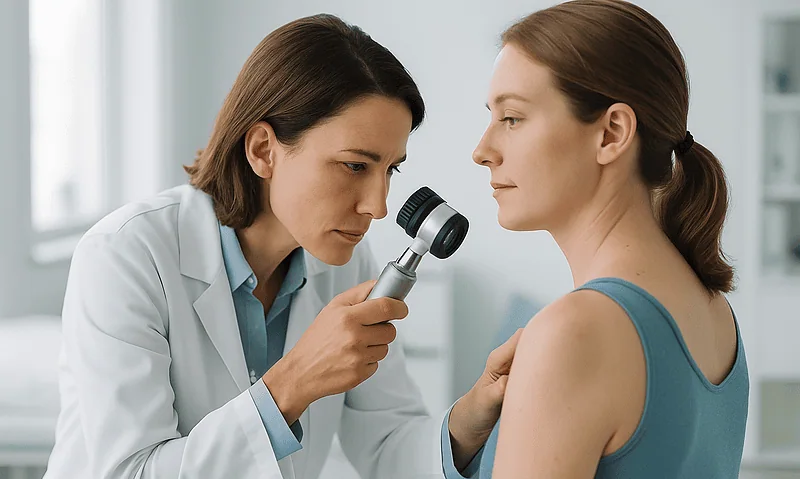
Alopecia areata, the autoimmune hair-loss condition, is another cause of fine pitting and sometimes white spots, and lichen planus can scar the matrix and whiten or thin the plate. For all of these, the nail is not treated in isolation. Managing the underlying skin condition is what allows new, clear nail to form, and a dermatologist may use dermoscopy, a handheld magnifier with polarized light, to tell psoriatic pits from fungal damage before deciding anything.
Nail polish, removers and chemicals: white patches that are not inside the nail
A surprising share of “white spots” in people who wear polish are not in the nail at all. Keratin granulation is the term for the chalky white patches that appear on the surface after long stretches of polish, gel or acrylic, especially when the product is peeled off rather than soaked off. Peeling strips the top layers of keratin with it, leaving a rough, matte white footprint that sits exactly where the polish was and does not move with growth. Cleveland Clinic includes nail products and the frequent use of removers among recognized triggers.
Repeated wetting and drying does something similar. Cleaners, hairdressers, healthcare workers and anyone with hands in water much of the day see their nails soften, dry and whiten at the surface and split at the edges. The NHS lists keeping hands dry and wearing gloves for wet work among its first-line nail advice for this reason.
The giveaways are location and texture. Product-related whiteness covers the surface in patches that match where polish sat, feels rough or powdery, and improves within weeks of leaving the nails bare, long before a matrix injury would have grown out. A true leukonychia spot is smooth, lies within the plate and cannot be buffed away.
Simple measures that mainstream guidance supports: give nails a break between applications, soak rather than peel when removing products, use a mild moisturizer or a plain emollient on the nail and cuticle, and wear cotton-lined gloves for prolonged wet work. None of this guarantees a flawless surface, but the nail will usually show the difference within a growth cycle.
When white nails point to something internal
Clinicians divide leukonychia into true and apparent. True leukonychia is in the plate and grows out; apparent leukonychia is a color change in the bed beneath, so pressing on the nail makes it fade and it stays in the same place however much the nail grows. Apparent leukonychia is the kind that can reflect internal illness, and it has recognizable patterns that MedlinePlus describes under nail abnormalities.
Terry’s nails: the nail looks white or ground-glass across almost its whole length, with only a narrow pink or brown band at the tip, on most or all nails. It is associated with liver cirrhosis, heart failure and diabetes, and it also occurs in some healthy older adults.
Half-and-half nails (Lindsay’s nails): the base half is white and the tip half pink or brown, with a sharp horizontal boundary. This pattern is linked with chronic kidney disease.
Muehrcke’s lines: paired white bands running side to side that fade when pressed, usually on several nails, associated with very low blood albumin from kidney disease, liver disease, malnutrition or certain chemotherapy medicines.
Mees’ lines are the exception in this group because they are true leukonychia: single or multiple white bands that do grow out, across several nails at once, left behind by a period of arsenic or heavy-metal exposure, severe illness or chemotherapy. Because they move with growth, their distance from the cuticle lets a clinician estimate when the insult happened.
Each of these appears across multiple nails, is symmetrical and usually arrives with other symptoms: swelling, fatigue, jaundice, weight loss or a known diagnosis. A single white dot on one fingernail belongs to none of them. The pattern matters far more than the whiteness.
Why do I have white spots on my nails? How a clinician tells the causes apart
A nail examination is short and low-tech. The clinician looks at all twenty nails, not just the one you point to, because the number involved is diagnostic on its own. They press on the plate to see whether the white fades (bed) or stays (plate), check the surface texture, look at the cuticles and the skin of the hands, feet and scalp, and ask about work, hobbies, nail products, medicines and recent illnesses. Dermoscopy may follow. If fungus is possible, a clipping goes to the laboratory. If a systemic pattern is present, blood tests for liver function, kidney function, albumin and a full blood count are typical; zinc or iron studies are added only when symptoms justify them.
| Cause | Typical features | Usual next step |
|---|---|---|
| Minor injury to the matrix | One or a few smooth dots or streaks, one or two nails, moves toward the tip over weeks | No treatment; grows out in about 6 months on fingernails |
| Nail products or wet work | Rough chalky surface patches where polish sat, fixed in place, several nails | Rest the nails, soak-off removal, gloves and moisturizer; review if persistent |
| Fungal infection | Powdery spreading white, toenails, thickening, athlete’s foot nearby | Clipping for microscopy and culture before any treatment |
| Psoriasis or eczema | Pits, ridges, lifting, skin changes elsewhere, several nails | Dermatology assessment; treat the skin condition |
| Apparent leukonychia (Terry’s, half-and-half, Muehrcke’s) | Whiteness fades on pressure, symmetrical on most nails, does not grow out, other symptoms | Blood tests for liver, kidney and albumin; follow findings |
| Mees’ lines | Horizontal white bands across many nails that grow out together | History of illness, medicines or exposure; targeted testing |
Most visits end at the first row. The table exists so you can see why a clinician’s eye goes first to how many nails are involved and whether the white moves.
How to get rid of white spots on nails: what helps and what does not
For the ordinary injury-related spot there is nothing to get rid of; the nail does it for you. Cleveland Clinic and the NHS both advise waiting for the mark to grow past the free edge and clipping it away. Filing, buffing or bleaching will not reach a mark inside the plate and tends to thin or roughen the surface, which creates new white patches of the product-related kind.
What you can do is stop making new ones. Keep nails trimmed short enough that they do not catch on things, use a soft pad or finger protection for repetitive tasks that tap the nail base, and go easy at the cuticle during manicures; pushing or cutting the cuticle hard is a common and forgotten source of matrix bumps. Give polished nails bare weeks between applications and soak products off rather than peeling.
Moisturizing is modest but real help. A plain emollient or petroleum-based ointment massaged into the nail and cuticle after hand washing reduces the drying and splitting that make surface whiteness more likely. Gloves for washing-up, cleaning and gardening protect the matrix from both chemicals and knocks.
Where the cause is fungus, psoriasis or eczema, the spots clear only when the underlying condition is managed, and that is a decision for the clinician who has examined you. The same applies to internal causes, where the nail improves as the liver, kidney or protein problem is treated and not before.
One caution is worth stating plainly: there is no evidence that calcium, multivitamin or “nail-strengthening” supplements remove white spots in people who are not deficient, and the NIH Office of Dietary Supplements notes that excess intake of some minerals carries its own risks. A balanced diet supports nail growth; a supplement bought in response to a fleck does not shorten the wait.
What people often get wrong about white marks on nails
The calcium story is the most durable myth, probably because teeth and bones are calcium-rich and nails look faintly similar. They are not built the same way. Nails are keratin, and no mainstream guideline lists calcium shortage as a cause of leukonychia. The NHS, MedlinePlus and Cleveland Clinic all point first to injury.
The second error is reading one nail as a verdict on the whole body. The patterns that do reflect internal disease, such as Terry’s or half-and-half nails, are symmetrical and involve most nails, and they come with symptoms. Clinicians are explicit that a lone spot carries no such meaning.
The third is the opposite mistake: assuming that any white on a toenail is “just fungus” and buying a product without a diagnosis. Psoriasis, old trauma and product damage are all routinely misread as infection, which is why the NHS advises confirming fungus with a laboratory sample before treatment. Months of antifungal application on a nail that was never infected is a common and avoidable frustration.
Fourth, people expect fast results. Because the plate moves at a few millimeters a month, nothing you do today is visible at the base for several weeks and at the tip for several months. A treatment or habit change judged after a fortnight has not had time to show.
Finally, old sayings about lies, luck or the number of admirers are harmless fun but have no basis in physiology. The one folk observation that holds up is timing: a spot that “appears from nowhere” did not. It records something that happened at the root roughly a month earlier, and that is a far more useful clue than any superstition.
When to see a doctor about white spots on nails
Most white spots need no appointment. Book one when the change does not fit the harmless pattern or when the nail is telling a larger story. The NHS advises seeing a GP for nail changes that are painful, spreading, affecting several nails or accompanied by other symptoms, and sooner if you have diabetes or reduced circulation, because nail and skin infections in the feet carry more risk in those groups.
Red-flag signs that should prompt a prompt assessment include:
- Whiteness covering most of the nail on several fingers, or a sharp white base with a dark tip, especially with swelling of the legs, breathlessness, yellowing of the eyes or unexplained weight loss.
- Horizontal white bands across many nails that appeared at the same time, particularly after a serious illness, a new medicine or possible chemical exposure.
- A spot that does not move toward the tip after two to three months, or that is spreading, thickening or crumbling.
- Pain, redness, pus, heat or swelling around the nail, which point to a bacterial infection of the nail fold rather than leukonychia.
- Any new dark brown or black streak running the length of the nail, or dark pigment spreading onto the skin at the base. This is not white, but it is the nail change that matters most, because MedlinePlus and the NHS both flag it as a possible sign of melanoma under the nail and it needs urgent review.
Children’s nails pick up white spots readily because small hands collide with the world constantly; the same rules apply, and a check is sensible only if many nails change together, the child seems unwell, or there is a feeding or growth concern. In pregnancy, nail changes are common and usually benign; mention them at a routine antenatal visit rather than seeking separate care unless red flags are present.
Bring a clear photograph taken a few weeks earlier if you have one. Showing a clinician whether the mark has moved can shorten the consultation more than any description.
Frequently asked questions
Are white spots on nails serious?
Usually not. A smooth spot on one or two nails that moves toward the tip over weeks is a healed injury to the nail root and needs nothing. Whiteness becomes worth checking when it covers most of several nails, fades on pressure, forms bands across many nails at once, or arrives with swelling, jaundice, fatigue or weight loss.
What deficiency causes white spots on nails?
None reliably. Calcium shortage does not cause them, despite the myth. Severe zinc deficiency and very low blood protein can whiten nails, but both are uncommon and come with other signs such as hair loss, poor wound healing, diarrhea or swelling. A blood test ordered by a clinician settles the question far better than a supplement bought on a guess.
Does white on your nails mean low iron?
Not as white spots. Iron deficiency anemia is associated with thin, brittle, spoon-shaped nails and a generally pale nail bed, usually with tiredness and breathlessness. Isolated white dots are not an iron signal. If you have symptoms of anemia, a full blood count and ferritin test are the appropriate way to find out.
How do I get rid of white spots on my nails?
For the common injury-type spot, wait for it to grow past the free edge and clip it off; buffing or filing cannot reach a mark inside the plate. Prevent new ones by keeping nails short, avoiding hard cuticle work and wearing gloves for wet or rough tasks. Spots caused by fungus, psoriasis or an internal condition clear only when that cause is managed.
Why do I have white spots on my nails if I do not remember hurting them?
Because the injury happened under the cuticle, at the matrix, three to six weeks before the spot became visible. A knock there rarely hurts. Typing, opening packaging, sports and manicures all deliver small taps to the nail base that disturb keratin packing briefly, and the nail carries the evidence forward as it grows.
How long do white spots on nails take to disappear?
Fingernails grow around 3.5 mm a month, so a spot near the cuticle typically reaches the tip in about six months; one that is already halfway up clears in roughly half that time. Toenails are slower, at about 1.6 mm a month, so a toenail mark can take a year or more. These are averages and growth is slower with age.
Can white spots on nails be a fungal infection?
Yes, in one specific form called superficial white onychomycosis, where fungus grows on the nail surface and leaves chalky, spreading patches, mostly on toenails and often with athlete’s foot. It looks and feels different from a smooth injury spot. Because psoriasis and trauma mimic it, a nail clipping sent for microscopy and culture is the standard way to confirm it.
What do white nails with a pink tip mean?
That pattern, a mostly white or ground-glass nail with a narrow pink or brown band at the end on most nails, is called Terry’s nails. It is associated with liver cirrhosis, heart failure and diabetes, though it also occurs in some healthy older adults. It differs from ordinary spots because it does not grow out and it affects nails symmetrically.
Can nail polish or gel cause white patches?
It can. Peeling off polish, gel or acrylic strips the top layers of keratin and leaves rough, matte white patches on the surface called keratin granulation. Frequent remover use and prolonged wet work have a similar effect. These marks sit where the product sat, do not move with growth and usually improve within weeks of resting the nails and soaking rather than peeling.
Should I worry about white spots on my child's nails?
Rarely. Children knock their fingers constantly, so small white spots are even more common in them than in adults and grow out the same way. A check is reasonable if many nails change at once, the child is unwell, growth or appetite is a concern, or there is pain, swelling or pus around a nail.
References
- MedlinePlus: Nail abnormalities
- MedlinePlus: Fungal nail infection
- NHS: Nail problems
- NHS: Fungal nail infection
This article is for general information only and is not a substitute for professional medical advice. Please consult a qualified doctor about your individual situation.
Add us as a Preferred Source to see more of our trusted health content across Google Search, AI Overviews and Discover.

More from the Blog

Shingles and the Risk of Serious Complications: Can It Be Fatal and Who Is Most Vulnerable
Shingles is rarely fatal, but it can be in a small number of cases, almost always when the virus spreads to the brain, lungs…

How Rosacea Treatment Is Matched to Your Pattern: Flushing, Redness, Bumps and Thickened Skin
Rosacea treatment is matched to the features a person actually has rather than to the diagnosis alone. Flushing and persistent redness are managed with…

Itchy Armpits Without a Rash: Sweat, Shaving, Skin Products and Other Triggers
Itchy armpits without a rash are most often caused by sweat trapped in a warm fold, friction, shaving regrowth, dry skin, or irritation from…

Are Chiggers Contagious? How the Bites Happen, How Long They Itch and What Calms Them
No. Chiggers are not contagious. The bites come from larval mites picked up in grass, leaf litter or brush, not from another person. A…
Why Blood Tests or a Skin Biopsy Come Before Biologic and Systemic Psoriasis Treatment
Before biologic or systemic psoriasis treatment, clinicians order blood tests and occasionally a skin biopsy for two reasons: to confirm the diagnosis when it…

Forehead Breakouts: Why Acne and Small Bumps Cluster There and What Helps Clear Them
Forehead breakouts are most often ordinary acne: oil glands in the T-zone are dense there, and pores block with oil and dead skin, then…