

Whiteheads: What Causes Them, How They Differ from Milia and What Helps Clear Them

Key Takeaways
- A whitehead is a sealed hair follicle plugged with sebum and keratin; because air never reaches the plug, it stays pale instead of oxidizing dark like a blackhead.
- The NHS reports that around 95% of people aged 11 to 30 have acne to some degree, so teenage whiteheads are close to universal rather than a sign of poor hygiene.
- Milia are hard 1–2 mm keratin cysts with no pore and no inflammation, usually near the eyes, and they do not respond to acne treatments.
- Squeezing a closed whitehead pushes its contents sideways into the dermis, which is why it so often becomes a larger red bump and can leave a scar.
- Topical retinoids, benzoyl peroxide and azelaic acid prevent new plugs from forming rather than dissolving old ones, so NHS guidance says to allow several months before judging results.
- Corticosteroids, anabolic steroids, lithium and some antiepileptic medicines are recognized acne triggers, and the prescriber, not the patient, should decide whether anything changes.
Whiteheads form when a hair follicle becomes plugged with excess oil (sebum) and dead skin cells beneath a pore opening that stays closed, which is why they look pale rather than darkening like blackheads. Hormonal shifts, family history, heavy or occlusive products and some medicines make them more likely. Milia are different: tiny, firm keratin cysts with no pore at all. Gentle cleansing plus retinoid or benzoyl peroxide treatments usually helps over several weeks.
Most people meet their first whitehead in a bathroom mirror at close range: a small, pale bump on the chin or beside the nose that was not there yesterday, feels slightly firm under a fingertip, and seems to dare you to press it. The urge is almost universal. So is the question that follows, usually typed one-handed into a phone: what causes whiteheads, and why this week?
The honest answer is less about dirt and more about plumbing. Each pore is the opening of a hair follicle with an oil gland attached, and a whitehead is that follicle sealed shut and quietly filling up. Understanding that one mechanism explains why scrubbing rarely helps, why a new moisturizer can trigger a crop of them, and why certain treatments take weeks rather than days.
This article walks through the common causes first, then the lookalikes that are not acne at all, including milia, and finishes with what mainstream guidance actually supports for clearing them.
What causes whiteheads? The short answer
A whitehead is a closed comedo: a hair follicle blocked by a plug of sebum (the skin’s natural oil) and keratin (the protein in shed skin cells) with the pore opening sealed over by skin. Because air never reaches the plug, it keeps its pale, flesh-colored or white tone. Dermatology guidance from the NHS and the National Institute of Arthritis and Musculoskeletal and Skin Diseases (NIAMS) describes the same chain of events behind every whitehead.
Three things have to go wrong at once. First, the oil gland attached to the follicle produces more sebum than usual, something androgens (the hormones that rise in puberty and fluctuate through adult life) drive directly. Second, the cells lining the follicle shed faster and stick together instead of flowing out, forming a cap. Third, the mixture sits trapped, and a bacterium that normally lives harmlessly in pores, Cutibacterium acnes, multiplies in the oxygen-poor environment. If the follicle wall then becomes irritated or ruptures, the whitehead turns red and tender and becomes a papule or pustule.
Whiteheads are not a sign of being unclean. The NHS is explicit that acne is not caused by dirt or poor hygiene, and that most of the blockage happens below the surface where washing cannot reach. That is why the most useful treatments work inside the pore rather than on top of it.
Whiteheads are not a medical emergency. The only reason to act quickly is a bump that is rapidly swelling, very painful, hot or spreading, which points to a skin infection rather than ordinary acne.
What is actually inside a whitehead
Picture the follicle as a narrow tube. Along its wall sit cells that mature, flatten and shed into the tube to be carried out with sebum. In skin prone to acne, those cells shed in clumps and the keratin binds them together; researchers call this abnormal follicular keratinization. The clumps mix with oil and form a soft, waxy plug roughly the width of a pinhead.

The NIAMS acne overview describes acne as a disorder of the pilosebaceous unit, the follicle plus its gland, and the whitehead is the earliest visible stage. Nothing is inflamed yet. The contents are mostly lipid and protein, with a growing population of C. acnes feeding on sebum. Those bacteria release enzymes that break triglycerides into free fatty acids, which irritate the follicle lining. That irritation is the bridge between a quiet whitehead and an angry red spot.
This staging matters for timing. A plug can take weeks to build before it is visible, so the whitehead you notice on Friday probably started forming well before the pizza you ate on Thursday. It also explains why treatments that normalize cell shedding, such as topical retinoids, need weeks of continuous use before the number of new whiteheads falls: they prevent plugs from forming rather than dissolving existing ones overnight.
One more detail is worth keeping in mind. A whitehead is sealed. There is no open channel for the contents to exit, so pressing on it forces material sideways into surrounding tissue rather than up and out.
Whiteheads vs blackheads: why one is pale and one is dark
Whiteheads and blackheads are the same plug with one difference: whether the pore is open at the top.
In a blackhead, an open comedo, the follicle opening is dilated and the plug sits exposed to air. The dark color comes from oxidized sebum and the skin pigment melanin, not from trapped dirt; the NHS acne page makes this point directly because so many people scrub blackheads thinking they are grime. In a whitehead, the opening is closed and the same plug stays pale.
The distinction changes how each behaves:
- Blackheads tend to persist for months, sit flat or slightly raised, and are most common on the nose where pores are larger.
- Whiteheads are more likely to become inflamed, because the sealed follicle has nowhere to vent as bacteria multiply.
- Blackheads can sometimes be eased out with a clinician’s comedone extractor; whiteheads generally cannot without breaking the skin.
Both respond to the same classes of treatment, since both are plugging problems. Benzoyl peroxide reduces the bacterial load and has a mild peeling action; topical retinoids and azelaic acid normalize the way cells line the follicle. Salicylic acid, available without prescription, loosens the keratin cap. The NHS lists these among first-line options for mild acne, and advises that they take several weeks of regular use to show an effect.
If you have both types scattered across the T-zone, that pattern is typical comedonal acne rather than two separate conditions.
Why do I get whiteheads all of a sudden?
A sudden crop usually has a trigger from the past few weeks, and the common ones are mundane.
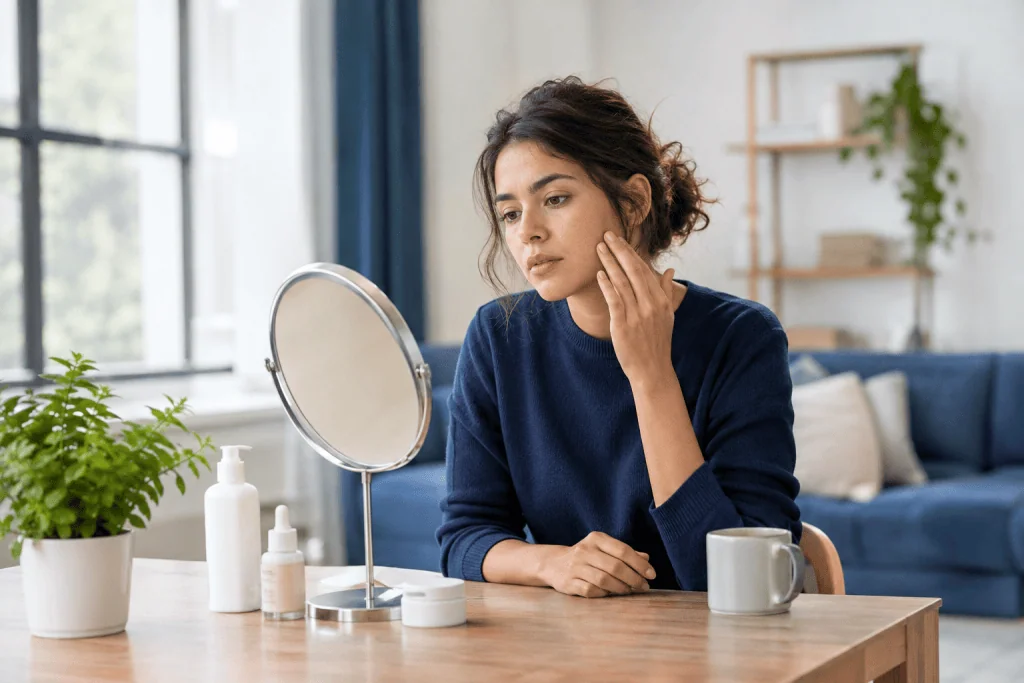
Hormonal change is the most frequent. The NHS notes that many women notice flares in the days before a period, and that pregnancy and polycystic ovary syndrome (PCOS, a condition where the ovaries produce extra androgens) can both bring acne on. Starting, stopping or switching a hormonal contraceptive can shift sebum output in either direction over a cycle or two.
Medicines are a quieter cause. Corticosteroids (taken by mouth or injected), anabolic steroids, lithium and some antiepileptic drugs appear on the NHS list of acne triggers. Steroid-related acne tends to produce many small, uniform bumps across the chest, shoulders and back. If a new prescription lines up with a new outbreak, the prescriber is the person to raise it with; never stop a medicine on your own account.
Friction and occlusion matter more than most people expect. Helmet straps, tight collars, backpack straps and masks worn for long shifts trap sweat and heat against the skin, a pattern dermatologists call acne mechanica. A thick new moisturizer, sunscreen or hair product can do the same chemically, which is covered in its own section below.
Stress is the trigger people blame most and the one with the weakest direct evidence. The NHS does not list it as a cause, though some studies link exam periods to worse acne. What the evidence shows is a modest, inconsistent association, likely through hormone pathways, not a clear cause-and-effect.
Hormones, family history and the oily-skin link
If whiteheads keep returning no matter what you change, the explanation is usually inherited sensitivity to hormones rather than anything you are doing.
Androgens such as testosterone instruct sebaceous glands to enlarge and produce more sebum. Everyone has androgens, but skin in acne-prone families responds to normal levels more strongly. The NHS acne causes page states that acne runs in families and that a family history of acne raises the likelihood of developing it. The same page notes that acne affects around 95% of people aged 11 to 30 to some degree, which is why teenage whiteheads are close to universal and no cause for alarm.
Adult acne follows the same biology at lower volume. The NHS reports that acne in adulthood is more common in women, often with a cyclical pattern on the jawline and chin, and sometimes with other signs of androgen excess such as irregular periods or unwanted hair growth. When those features cluster, a clinician may check hormone levels or scan the ovaries, because treating an underlying condition such as PCOS can improve the skin along with everything else.
Oily skin on its own is not a disease and does not need to be “fixed”. It does mean the follicles have more raw material for plugs, so gentle, consistent cleansing and non-comedogenic products carry more weight. Harsh degreasing is counterproductive: stripping the surface does not reduce what the gland produces, and the irritation can increase shedding inside the follicle, which is exactly the problem.
Can skincare, hair products or masks cause whiteheads?
Yes, though less often than hormones, and in recognizable patterns.
Comedogenic products are those with ingredients that encourage follicle plugging, typically rich oils, waxes and some emollients in thick creams, heavy foundations and ointment-style sunscreens. The NHS advises people prone to acne to choose water-based, non-comedogenic cosmetics and to remove make-up fully before bed. A tell-tale sign is a fresh scatter of small, closed, uniform bumps appearing two to six weeks after a new product enters the routine, concentrated where it is applied.
Hair products deserve their own mention. Pomades, waxes and oils migrate onto the forehead, temples and hairline during the day and overnight on pillows, producing a neat band of whiteheads along the edge of the hair. Keeping products off the skin and washing pillowcases regularly addresses the cause.
Occlusion from masks, chin straps and helmets traps humidity against the skin, and sweat plus friction accelerates plugging along the contact line. Breathable materials, washing cloth masks daily and taking the item off during breaks reduce the load.
Over-washing is the overlooked culprit. The NHS recommends washing affected skin no more than twice a day with a mild cleanser and lukewarm water, because scrubbing and very hot water irritate the follicle lining. People who wash four or five times a day with gritty exfoliants frequently see more whiteheads, not fewer, and the fix is doing less.
If you suspect a product, the only reliable test is removing it for at least a month, since whiteheads take weeks to form and clear.
Whiteheads vs milia: how to tell the difference
Milia are the most common lookalike, and the two are routinely confused because both are small and white. They are not the same thing, and acne treatments do little for milia.
A milium (plural milia) is a tiny cyst of keratin trapped just beneath the outermost layer of skin, with no connection to a follicle opening. MedlinePlus describes milia as small, pearly white or yellowish bumps, usually 1 to 2 millimeters across, that are firm to the touch. They sit most often on the cheeks, eyelids, nose and forehead. In newborns they are extremely common and clear on their own within a few weeks; in adults they can persist for months.
How a clinician tells them apart:
- Texture: milia feel like a hard grain of sand under the skin; whiteheads are softer and slightly compressible.
- Surface: a whitehead has a pore beneath it and may show a faint central point; a milium has no opening at all.
- Inflammation: whiteheads redden and swell as they progress; milia stay calm and unchanged.
- Company: whiteheads usually come with blackheads, oily skin and pimples; milia often appear alone, around the eyes, sometimes after sun damage, burns, blistering or long use of heavy creams.
- Response: whiteheads shrink with retinoids or benzoyl peroxide over weeks; milia generally do not.
Adult milia that bother someone are removed in a clinic by nicking the surface with a sterile needle or blade and lifting out the keratin pearl, or with a small heated probe. Squeezing them at home rarely works because there is no exit and the keratin is solid. A clinician can also check that a persistent bump near the eyelid is not a syringoma or xanthelasma, which can mimic milia.
Other bumps that look like whiteheads
Beyond milia, several conditions produce small white or skin-colored bumps and are managed quite differently. The table summarizes how each typically presents and what usually happens next.
| Cause | Typical features | Usual next step |
|---|---|---|
| Whiteheads (closed comedones) | Soft pale bumps, T-zone and jaw, with blackheads and oily skin; some become red | Non-comedogenic routine; over-the-counter benzoyl peroxide or salicylic acid; retinoid if persistent |
| Milia | Hard pearly 1–2 mm cysts, often eyelids and cheeks, no pore, never inflamed | Leave alone or clinic removal if cosmetically troubling |
| Sebaceous hyperplasia | Soft yellowish bumps with a central dimple, mid-face, adults over 40 | Reassurance; removal only for appearance |
| Bacterial folliculitis | Itchy or sore pustules around hairs, scalp, beard, thighs | Clean, avoid shaving over it; clinician if spreading |
| Malassezia (fungal) folliculitis | Uniform itchy small pustules on chest, back, shoulders; worse with sweat; no comedones | Clinician assessment; antifungal rather than acne treatment |
| Molluscum contagiosum | Smooth dome-shaped bumps with a central pit, often clustered, viral and spread by contact | Usually clears on its own over months; clinician for diagnosis |
| Keratosis pilaris | Rough “chicken skin” bumps on upper arms and thighs | Moisturizer; harmless and hereditary |
| Rosacea | Red bumps and pustules on flushed cheeks and nose, no blackheads, stinging skin | Clinician; acne products often worsen it |
The single most useful clue is the presence of blackheads. Comedones of either kind mean acne. Pustules without any comedones point toward folliculitis or rosacea, where a different approach is needed and where benzoyl peroxide or retinoids may sting rather than help. A clinician rarely needs tests for this; the pattern, location and age of the person usually settle it, and a gentle scrape for microscopy is used only when fungal folliculitis is suspected.
How to get rid of whiteheads: what the evidence supports at home
Mainstream guidance on mild comedonal acne is consistent and unglamorous. These are the measures the NHS acne pages support:
- Wash the affected area no more than twice a day with a mild cleanser and lukewarm water, using fingertips rather than a cloth or brush.
- Use a fragrance-free, water-based, non-comedogenic moisturizer if the skin feels tight, because dryness increases irritation and irritation increases plugging.
- Remove make-up completely each night and choose products labeled non-comedogenic.
- Keep hair products off the face and wash hair regularly if it falls across the forehead.
- Shower after exercise rather than letting sweat dry on the skin.
- Use an over-the-counter product containing benzoyl peroxide or salicylic acid on the whole affected area, not just on individual spots, and persist for at least several weeks.
Benzoyl peroxide kills C. acnes and loosens the keratin cap; it can bleach fabric and dry the skin, so starting with a lower strength and short contact time is the usual advice on the label. Salicylic acid dissolves the cement between dead cells and is gentler, with weaker evidence for inflamed spots. Adapalene, a topical retinoid, is available without prescription in some countries and is the most effective single ingredient for comedones, because it directly normalizes cell shedding in the follicle; it should not be used in pregnancy.
Expect dryness and some flaking in the first two to four weeks with any of these. The NHS advises that it can take several months before acne improves, so judging a product after a week is the main reason people conclude “nothing works”. Pick one active ingredient, use it nightly across the area, and give it a fair trial.
What treatments do clinicians use, and how long do they take?
When home measures have not cleared whiteheads after a couple of months, or when red spots and pustules join them, a primary care clinician has a graded set of options. Decisions about which one, and for how long, belong to the prescriber; what follows describes mechanisms and typical timelines from NHS guidance.
Prescription topical retinoids such as tretinoin and adapalene remain the backbone for comedonal acne. They speed the turnover of follicle-lining cells so plugs cannot form. Azelaic acid is an alternative for people who find retinoids too irritating, with antibacterial and anti-keratinizing effects and a gentler profile. Topical antibiotics are usually paired with benzoyl peroxide to limit resistance, and are aimed at inflamed spots rather than whiteheads themselves.
For moderate acne, a course of oral tetracycline-class antibiotics may be added, typically alongside a topical agent. The NHS notes these are generally used for no longer than a few months at a time. For women whose acne tracks their cycle, a combined oral contraceptive can lower sebum output through its effect on androgens; this takes several cycles to show benefit. Spironolactone, a medicine with anti-androgen effects, is used by some specialists for the same reason.
Isotretinoin, a retinoid taken by mouth, is reserved for severe or scarring acne under specialist supervision because of its side effects and because it causes serious birth defects; the NHS describes a typical course as lasting 16 to 24 weeks, with strict pregnancy prevention requirements.
Whatever the plan, the NHS advises that treatments usually need several weeks before any change is visible and several months to reach their full effect, and that a review is sensible if nothing has shifted by then.
Should you squeeze whiteheads?
No, and the reason is structural rather than moral.
Because a whitehead is sealed, pressing on it does not open a path upward. The pressure instead ruptures the follicle wall sideways, spilling sebum, keratin and bacteria into the dermis. The immune system responds to that spill with inflammation, which is why a squeezed whitehead so often turns into a larger, redder, longer-lasting bump than the one you started with. The NHS acne guidance warns that picking and squeezing can lead to scarring and dark marks, and both are harder to treat than the whitehead itself.
Fingernails add their own problem. Skin under the nails carries staphylococci and other organisms, and a broken whitehead is an entry point. A small percentage of squeezed spots become genuinely infected, with spreading redness, heat and pus, and need medical attention.
There is one legitimate version of extraction. Dermatology clinicians and trained aestheticians perform comedone extraction with a sterile loop tool after softening the skin, mainly for blackheads and sometimes for closed comedones that have been pre-treated with a retinoid. Done that way, the follicle is opened cleanly rather than torn. It is a temporary measure, since the gland underneath keeps producing, and it does not replace a daily treatment.
If a whitehead has already come to a soft, obviously fluid-filled head, the least harmful approach is to leave it to drain on its own, keep the area clean, and apply nothing abrasive. Resist the mirror.
How do I stop getting whiteheads? Prevention that actually holds up
Prevention is the same as treatment, done consistently and kept going after the skin clears. Comedones take weeks to form, so the routine that stopped them forming is still needed once they are gone; stopping a topical retinoid the week the skin looks good is the most common route to a relapse.
The habits with the strongest support:
- One active ingredient applied across the whole acne-prone area every night, chosen with a clinician if over-the-counter options have not worked.
- Twice-daily gentle cleansing, no scrubs, no very hot water.
- Non-comedogenic moisturizer and sunscreen, because retinoids and benzoyl peroxide both increase sun sensitivity and dryness.
- Hair products kept away from the skin; clean pillowcases; clean phone screens held against the cheek.
- Showering soon after sweating and avoiding prolonged occlusion where possible.
Diet is where honesty matters. The NHS states that research has not found specific foods that cause acne and that the old links to chocolate and fried food are myths. Some larger observational studies have associated high-glycemic diets and, in a few, skim milk with more acne, and a small number of trials of low-glycemic eating showed modest improvement. That is a signal worth noticing, not a prescription: a balanced diet is reasonable advice for many reasons, and cutting out whole food groups to chase whiteheads is not supported.
Supplements marketed for “clear skin” lack good evidence. The NIH Office of Dietary Supplements lists no established role for vitamin or mineral supplements in treating acne, and high doses of some, such as vitamin B12 or certain anabolic-adjacent products sold to athletes, have been reported to trigger acne instead.
What people often get wrong about whiteheads
“They mean my skin is dirty.” The plug forms below the surface from the skin’s own oil and cells. The NHS lists poor hygiene among the myths; scrubbing harder tends to add irritation on top of plugging.
“Drying the skin out will stop them.” Alcohol toners, repeated washing and harsh exfoliants damage the barrier, and a damaged follicle lining sheds faster. The gland underneath does not slow down because the surface is parched.
“Any white bump is a whitehead.” Milia, sebaceous hyperplasia, folliculitis and molluscum all look similar at arm’s length. The presence of blackheads and oily skin is the clue that it is acne; a firm pearl near the eyelid with no pore is not.
“If it has not worked in a week, it does not work.” The NHS advises that acne treatment can take several months to show results. Early dryness and even a temporary increase in visible spots as plugs surface are expected with retinoids, not evidence of failure.
“Toothpaste, lemon juice or rubbing alcohol are good spot treatments.” None has evidence of benefit and all are common causes of irritant dermatitis, which looks worse than the spot and can leave marks on darker skin.
“Adult whiteheads mean something is seriously wrong hormonally.” Usually not. Adult acne is common, particularly in women, and most of it reflects ordinary hormone sensitivity. The features that justify a hormone work-up are irregular cycles, unusual hair growth or hair thinning alongside the acne, which a clinician will ask about.
“Sun clears acne.” Tanning can mask redness briefly, but ultraviolet exposure thickens the outer skin layer and can increase comedones, while most acne treatments make burning more likely.
When to see a doctor about whiteheads
Whiteheads alone are harmless, and many people manage them without ever seeing a clinician. A routine appointment is sensible when:
- over-the-counter treatment used consistently for two to three months has made little difference;
- whiteheads are joined by many red, tender spots, deep lumps or cysts;
- any scarring or persistent dark marks are forming, since early treatment limits further damage;
- acne is affecting mood, confidence or willingness to go out, which NHS guidance treats as a reason for treatment in itself;
- in a woman, acne appears with irregular periods, excess facial or body hair, or scalp hair thinning;
- a new medicine coincides with a new outbreak;
- bumps do not fit the acne pattern: no blackheads, intense itching, clustering with central dimples, or a rash mainly on the chest and back after sweating.
Seek care promptly, the same day if possible, for red-flag signs that suggest infection rather than acne:
- a bump that is rapidly enlarging, hot, very painful or surrounded by spreading redness;
- red streaks tracking away from a spot;
- fever, chills or feeling unwell alongside a skin lesion;
- a boil-like lump on the face near the nose or eyes, where infection can spread more easily;
- a sudden widespread eruption of pustules, especially after starting a new medicine, which needs assessment as a possible drug reaction.
In children under the age of about 7, acne-like bumps are uncommon and worth a check, since they can occasionally signal a hormonal condition; newborn milia and newborn acne, by contrast, are common and settle on their own. During pregnancy, the usual advice is to mention any acne treatment to a midwife or doctor before using it, because several effective ingredients, including all retinoids, are avoided.
The examination itself is usually quick: a look at the face, chest and back under good light, a few questions about timing, products, cycles and medicines, and in some cases blood tests for hormones. Skin scrapings or swabs are reserved for suspected fungal or bacterial folliculitis. Most people leave with a plan rather than a diagnosis they did not expect.
Frequently asked questions
What causes whiteheads on the chin and jawline?
Chin and jawline whiteheads are most often hormonal. The oil glands in this zone respond strongly to androgens, which fluctuate before a period, in pregnancy, after changing contraception and in polycystic ovary syndrome. Friction from chin straps or resting a hand or phone on the chin adds occlusion. If the pattern is cyclical, clinicians often consider treatments that act on hormones alongside a topical retinoid.
How do I stop getting whiteheads?
Use one proven active ingredient, such as benzoyl peroxide, salicylic acid or a topical retinoid, across the whole acne-prone area every night and keep using it after the skin clears. Pair it with twice-daily gentle cleansing, a non-comedogenic moisturizer and sunscreen, keep hair products off the skin, and shower after sweating. Whiteheads take weeks to form, so consistency over months matters far more than any single product.
How to get rid of whiteheads fast?
There is no reliable overnight method, because the plug sits below the surface and the skin needs time to shed it. The fastest evidence-supported route is a nightly over-the-counter retinoid or benzoyl peroxide product used consistently; visible improvement typically begins within weeks and the NHS advises allowing several months for full effect. Clinician extraction can clear individual comedones sooner but does not stop new ones.
Why do I get whiteheads all of a sudden?
A sudden crop usually follows a trigger from the past few weeks: a new moisturizer, sunscreen or hair product, a hormonal shift such as changing contraception, a new medicine like a corticosteroid, prolonged mask or helmet wear, or a hot, humid spell with more sweating. Because comedones take weeks to form, look back a month rather than a day when hunting for the cause.
Should you squeeze whiteheads?
No. A whitehead is sealed, so squeezing ruptures the follicle wall and pushes oil, dead cells and bacteria into deeper skin, where they cause inflammation, a bigger spot and sometimes a scar or dark mark. Fingernails can also introduce infection. If a spot has already come to a soft head, let it drain on its own and keep the area clean. Clinicians use sterile extraction tools for a reason.
Whiteheads vs milia: how can I tell which I have?
Press gently: milia feel like a hard grain under the skin and never redden, while whiteheads are softer and may become inflamed. Milia have no pore and often sit near the eyelids or on the cheeks, sometimes after sun damage or heavy creams. Whiteheads usually come with blackheads and oily skin. If acne products have done nothing after two months, milia are more likely, and a clinician can confirm and remove them.
What causes whiteheads on the nose specifically?
The nose has the densest and largest oil glands on the face, so it produces the most sebum and plugs most easily. Open pores there usually form blackheads, while closed ones become whiteheads along the sides and crease of the nose. Heavy sunscreen, glasses resting on the bridge and touching the nose during the day all add occlusion and friction. The same treatments used elsewhere apply.
Can diet cause whiteheads?
The NHS states that research has not identified specific foods that cause acne, and chocolate and fried food are listed among the myths. Some large observational studies associate high-glycemic diets, and in a few cases skim milk, with more acne, and small trials of low-glycemic eating showed modest benefit. That is an uncertain signal, not a reason to cut out food groups. A balanced diet is reasonable advice; elimination diets are not.
Do whiteheads go away on their own?
Individual whiteheads often resolve within a few weeks as the follicle sheds its plug, but new ones keep forming while the underlying tendency persists. Teenage acne commonly settles in the early twenties as hormone levels stabilize, though NHS guidance notes it can continue into adulthood, especially in women. Treatment is about shortening the course and preventing scars, not waiting out each spot.
Are whiteheads a sign of a hormone problem?
Usually not. Most whiteheads reflect ordinary sensitivity of oil glands to normal hormone levels, which runs in families. A hormone check is considered when acne appears alongside irregular or absent periods, excess facial or body hair, scalp hair thinning or sudden adult onset, because these can point to polycystic ovary syndrome or, rarely, other conditions. A clinician decides whether blood tests or an ultrasound are useful.
References
This article is for general information only and is not a substitute for professional medical advice. Please consult a qualified doctor about your individual situation.
Add us as a Preferred Source to see more of our trusted health content across Google Search, AI Overviews and Discover.

More from the Blog
Why Does Eczema Flare? How Skin Barrier Damage and Triggers Drive the Itch-Scratch Cycle
Eczema flares when a skin barrier that is already weakened lets water out and irritants, allergens and microbes in, which switches on inflammation and…

Swollen Lump on the Buttock: Abscess, Cyst or Pilonidal Disease and How Each Is Treated
A swollen lump on the buttock is most often a boil or abscess (a pocket of pus from infected skin), an epidermoid cyst, or…

Swollen Lip: Injury, Allergy and Infection Causes, What Helps It Settle and When It Is Urgent
A swollen lip most often follows a bump, a bite, a cold sore or an allergic reaction, and it usually settles within hours to…
Itchy Skin at Night or After a Shower: Why It Flares Then and What Soothes It
Itching usually feels worse at night because the body's natural anti-inflammatory hormone, cortisol, dips after dark, skin warms and loses more moisture, and there…
How Patch Testing Finds the Cause of Contact Dermatitis: What the Days of Testing Involve
Patch testing for contact dermatitis places small amounts of suspected allergens on the skin of the back under adhesive patches, usually for about 48…

How Long Does a Pimple Take to Go Away? The Usual Healing Timeline and What Slows It Down
Most ordinary pimples go away on their own within about a week, and even a sore red spot usually settles in one to two…