

Who Can Have a Water Birth? The Eligibility Checks Maternity Teams Make Before Labor

Key Takeaways
- Standard eligibility for a water birth is a single, head-down baby at 37 to 42 weeks in a low-risk pregnancy with labor progressing normally, reassessed continuously throughout labor.
- A Cochrane review of 15 trials involving 3,663 women found first-stage immersion was associated with lower use of epidural or spinal anesthesia, with no clear effect on cesarean or instrumental birth rates.
- NHS guidance advises keeping the pool at or below 37.5°C (99.5°F) so that neither you nor the baby overheats and the newborn breathing reflex is not disrupted.
- An epidural rules out the pool because loss of lower-body sensation makes deep water unsafe, and most units require a waiting period after an opioid injection.
- Laboring in water and giving birth in water are separate decisions with separate evidence; many hospitals permit the first while asking people to leave before the second.
- Most units ask people to leave the water for delivery of the placenta because blood loss cannot be estimated accurately in a pool.
A water birth is usually offered to people with a low-risk, single, head-down pregnancy at term (about 37 to 42 weeks), whose labor is progressing normally and whose baby's heartbeat is reassuring. Maternity teams typically ask people to stay out of the pool when there is bleeding, fever, an epidural, a need for continuous monitoring, or a medical condition that raises risk. The final decision always rests with the care team on the day.
She had the birth plan folded into the back of her maternity notes: dim lights, her own playlist, and a deep pool of warm water. At the 36-week appointment she finally asked the question she had been rehearsing since the second trimester. The midwife smiled, then reached for the eligibility checklist. That checklist, not the birth plan, is where most water birth stories are actually decided.
If you have wondered who can have a water birth, you are asking the right question in the right order. Immersion in water during labor is one of the better-studied comfort measures available, and most maternity units that offer it screen for the same handful of things: how far along you are, how many babies you are carrying, which way the baby is lying, and whether anything in your pregnancy would make it safer to be on dry land with more equipment within reach.
This explainer walks through those checks one by one, including what typically rules someone out, what the evidence says about pain, and why some hospitals still say no.
Who can have a water birth? The short version of the criteria
Most maternity units answer the question who can have a water birth with a fairly consistent list. You are usually a candidate if your pregnancy is considered low risk, you are carrying one baby, that baby is head down, you have reached term, and labor is progressing without complications. Term is generally defined as 37 completed weeks onward, and units commonly stop offering the pool once a pregnancy passes 42 weeks or requires induction for being overdue, a range described in Cleveland Clinic’s overview of water birth.
Low risk is the phrase that carries the most weight, and it is worth defining. In maternity care it means there is no known condition in you or the baby that makes a sudden problem more likely or harder to manage. High blood pressure disorders of pregnancy, poorly controlled diabetes, heavy bleeding, and a baby thought to be growing slowly all move a pregnancy out of that category.
The list is not a judgement about how well you are coping or how much you want the water. It reflects a simple practical fact: a birthing pool puts a barrier between you and the equipment a team might need in an emergency. Getting a laboring person out of deep water takes time and hands. The eligibility checks exist to reserve the pool for situations where that delay is very unlikely to matter.
Two more points shape the answer. First, criteria differ between units, so what one hospital allows another may not, and a birth center may have different rules again. Second, eligibility is reassessed continuously. Meeting every criterion at 38 weeks does not guarantee the pool if your waters show meconium or your baby’s heart rate changes on the day. Think of the checklist as a door that stays open only while everything behind it stays reassuring.
How a water birth actually works, from first contraction to first breath
A birthing pool is a large, deep tub, usually filled so the water covers your belly when you sit or kneel. Depth matters more than size. Being immersed to the chest is what produces buoyancy, the sensation of weighing far less than you do, which is one reason people describe moving and changing position more easily in water than on a bed.
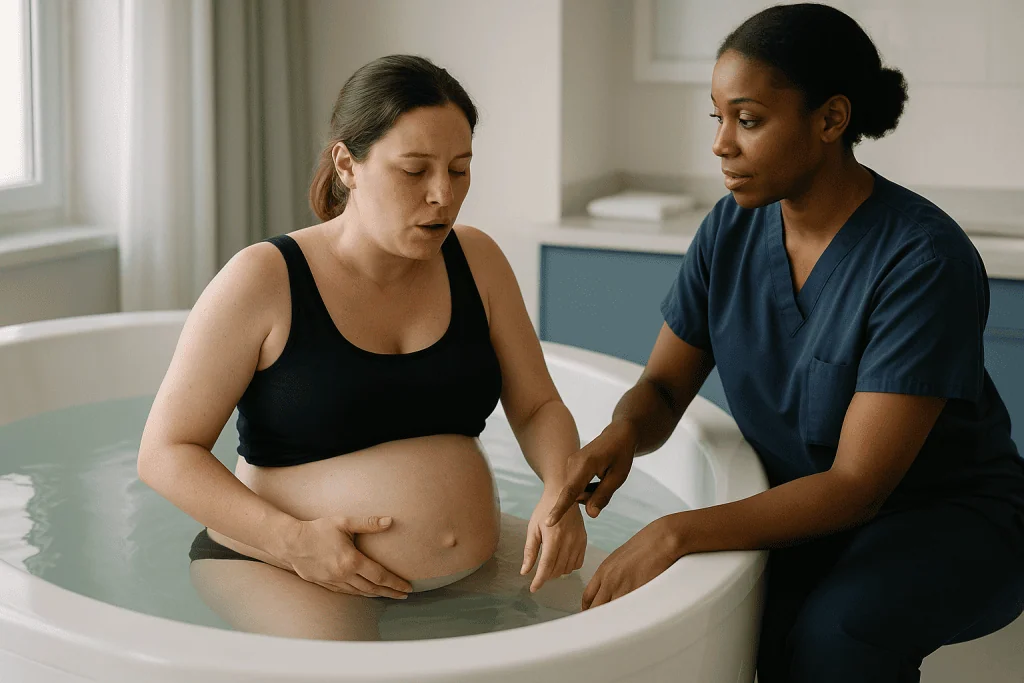
Most people enter the pool once labor is established, meaning contractions are regular, strong, and the cervix has opened to a point the midwife or doctor considers active labor. Getting in too early is discouraged in many units because there is a concern that very early immersion may slow contractions; the NHS pain relief in labor guidance notes that your midwife will advise on timing. Once in, you can labor in the water and either stay for the birth or step out for the final stage.
Water temperature is checked and recorded. NHS guidance advises keeping the pool at a comfortable temperature that does not exceed 37.5°C (99.5°F), roughly body heat, to avoid overheating you or the baby. Your temperature, pulse, and blood pressure are taken at intervals, and the baby’s heartbeat is listened to with a waterproof handheld Doppler, a small ultrasound device that detects the fetal heart.
If the baby is born underwater, the midwife or doctor brings them gently to the surface straight away, face up, into your arms. Babies do not take their first breath until their face meets air and a change in temperature and pressure triggers it; that physiology, described in the NHS guidance on where to give birth, is why an immediate, unhurried lift to the surface is the standard practice. The umbilical cord stays attached until it is clamped, and the placenta is most often delivered after you leave the water.
What are the requirements to have a water birth? The screening that starts in pregnancy
Water birth requirements are usually first raised somewhere in the late second or early third trimester, when your care team has enough information to sort your pregnancy into a risk category. Several strands of information feed into that sorting.
Your medical history comes first. Chronic high blood pressure, heart disease, kidney disease, epilepsy, and blood clotting disorders are the conditions most often flagged because each can change quickly in labor or require monitoring that does not work well in a pool. A previous cesarean birth is treated differently between units: some allow a labor in water after cesarean with continuous monitoring, others do not, because the scar carries a small risk of separating and the signs of that can be subtle.
Your pregnancy history comes next. Ultrasound scans confirm a single baby, its position, and the location of the placenta. Growth scans, if you have had them, indicate whether the baby is developing as expected. Blood tests screen for anemia and for infections such as hepatitis B and HIV, which some units treat as reasons to avoid the pool because of blood exposure in water.
Body weight is a genuinely contested criterion. Some units set a BMI ceiling, arguing that assisting a heavier person out of a pool in an emergency is harder; others have removed the limit, pointing out that buoyancy can make movement easier for larger bodies. Ask your unit for its policy and the reasoning behind it rather than assuming.
Finally there is the pregnancy itself at term. Around 36 weeks, the baby’s position is checked by hand and sometimes by scan. A breech (bottom-first) baby or a transverse (sideways) baby rules out the pool in essentially every guideline, as does a placenta lying low over the cervix. If all of these come back reassuring, most units will record you as suitable for water birth, subject to how labor unfolds.
What disqualifies you from a water birth? The situations that usually mean dry land
Being asked to wait, or to stay out of the pool altogether, almost always comes down to one of a small number of situations. Knowing them in advance takes the sting out of hearing them on the day.

Anything that requires continuous electronic fetal monitoring is the most common reason. Standard monitors use belts and wired sensors that cannot go in water. Some units have waterproof telemetry, wireless sensors sealed for immersion, but many do not, and the list of conditions that call for continuous monitoring is long: induced labor with synthetic oxytocin, a previous cesarean in many units, meconium in the waters, and any earlier concern about the baby’s heart rate.
Bleeding beyond a normal show, a temperature at or above the threshold your unit uses for maternal fever, or a raised blood pressure reading will each keep you out of the water, because each is a signal that the situation may be moving away from low risk. Preterm labor, before 37 weeks, rules out the pool because premature babies need closer observation and warmth from the moment of birth.
Pain relief interacts with eligibility. An epidural, a regional anesthetic delivered through a fine tube in the back, numbs the lower body and makes it unsafe to be in deep water. Opioid injections given for labor pain cause drowsiness; most units require a set waiting period after an injection before allowing immersion, and the length is a local policy your midwife will explain.
Twins or more, a breech or transverse baby, a low-lying placenta, active genital herpes lesions, and certain bloodborne infections round out the standard exclusions. Group B streptococcus (GBS), a common bacterium that can occasionally infect newborns, is handled differently: many units allow the pool if intravenous antibiotics have been given as planned, while others do not. A reason for exclusion is rarely permanent within a labor; if the concern resolves, the pool may become an option again.
Water birth eligibility at a glance
Policies vary, but the table below summarizes how most maternity units in guideline-following health systems approach the common questions. Treat the middle column as the typical position and the right-hand column as the reason behind it, then check your own unit’s written policy for the specifics.
| Factor | Usually allowed in the pool? | Why teams take this position |
|---|---|---|
| Single baby, head down, 37 to 42 weeks | Yes | Meets the standard low-risk definition |
| Twins or higher multiples | No | Second baby often needs rapid intervention and monitoring |
| Breech or transverse baby | No | Higher chance of an assisted birth |
| Labor before 37 weeks | No | Premature babies need immediate warmth and observation |
| Induced labor with synthetic oxytocin | Usually no | Requires continuous fetal monitoring |
| Previous cesarean | Varies | Continuous monitoring often required; waterproof telemetry needed |
| Epidural in place | No | Loss of lower-body sensation makes deep water unsafe |
| Recent opioid injection | Wait | Drowsiness risk; local waiting period applies |
| Meconium in the waters | Usually no | Signals possible fetal distress; monitoring needed |
| Maternal fever or infection | No | Warm water may raise temperature further; baby needs observation |
| Group B strep with antibiotics given | Varies | Some units allow once treatment is underway |
| High BMI | Varies | Emergency exit concerns versus buoyancy benefits |
| Bloodborne infection (hepatitis B, HIV) | Often no | Staff exposure to blood in water |
Notice how many rows say varies. That is not evasiveness. It reflects genuine differences in equipment, staffing, and the weight individual units give to evidence that is often thin in exactly these edge cases. The rows marked no are where guidelines are most consistent, because the potential need for rapid intervention is clearest.
Is a water birth less painful? What the evidence actually shows
People often expect a yes or no, and the honest answer sits somewhere more interesting. Warm water does not switch pain off the way an epidural does, but the research suggests it changes how much other pain relief people end up using.
The most rigorous summary comes from a Cochrane systematic review of immersion in water during labor and birth, which pooled 15 randomized trials involving 3,663 women. It found that laboring in water during the first stage was associated with lower use of epidural or spinal anesthesia compared with laboring out of water. It found no clear difference in rates of cesarean birth or instrumental birth, and no evidence of harm to babies from first-stage immersion. The authors were careful to rate much of the evidence as low or moderate quality, largely because trials were small and participants could not be blinded to whether they were in water.
Why might water help? Buoyancy takes weight off the pelvis and spine and makes position changes easier. Warmth relaxes muscle and may reduce the anxiety that amplifies pain perception. Being in a pool often means dimmer lighting, fewer people at the bedside, and a physical boundary that gives a laboring person more control over who touches them. Each of these is a plausible mechanism, and none has been isolated in a trial.
What the evidence does not show is that a water birth is painless, faster in a way that has been consistently demonstrated, or better for every individual. Some people find the water makes contractions feel more manageable; others get in, feel no different, and get out. Both experiences are normal. The reasonable takeaway is that immersion is a legitimate, low-intervention option for pain relief in the first stage, with a fair evidence base for reducing epidural use and a thinner one for everything else.
Why do hospitals not allow water births? Hospital water birth rules explained
It can feel arbitrary to learn that one hospital offers the pool freely while another across town does not. The reasons cluster into three groups, and understanding them helps you ask better questions.
The first is evidence, specifically the difference between laboring in water and giving birth in water. Professional bodies broadly agree that first-stage immersion is reasonable for low-risk pregnancies, based on the Cochrane evidence described above. Birth itself in water is a different matter. The same Cochrane review found too few trials of second-stage immersion to draw firm conclusions about safety for babies, and case reports have described rare newborn complications after underwater birth, including infections linked to contaminated water systems and instances of water aspiration. Some hospitals read that uncertainty as a reason to allow laboring in water but ask people to leave before the birth.
The second group is practical. Pools take space, need rigorous cleaning protocols between uses, and require staff trained in water immersion care, including how to lift someone out quickly. Waterproof monitoring equipment is an added investment. A unit with one pool and a busy labor ward may simply not be able to guarantee access.
The third is culture and liability. Obstetric units built around continuous monitoring and rapid access to surgery have historically been more cautious; midwife-led units and birth centers, which care almost exclusively for low-risk pregnancies, have adopted pools more readily. Neither approach is wrong. They reflect different populations and different tolerances for uncertainty.
If your hospital does not offer water birth, ask whether it permits laboring in water, whether there is a midwife-led unit within the same health system that does, and what the written policy says. A no is more useful when you know which of the three reasons is behind it.
Laboring in water versus giving birth in water: two decisions, not one
The phrase water birth blurs a distinction that maternity teams keep very sharp. Immersion during the first stage, when the cervix is opening, and immersion during the second stage, when the baby is being pushed out, carry different evidence and different rules.
First-stage immersion is where the research is strongest and the eligibility criteria most relaxed. Many units that will not allow an underwater birth are perfectly comfortable with a low-risk person spending hours in the pool while contractions build, then moving to a bed or birthing stool for the birth itself. If a unit describes itself as offering water for labor, this is usually what it means.
Second-stage immersion, the underwater birth people picture, is where policies diverge. The physiological argument for its safety rests on the fact that a healthy term baby does not attempt to breathe until stimulated by air, temperature change, and the pressure of the outside world, as the NHS guidance explains. The counter-argument is that a baby who is already compromised, whose oxygen supply has been interrupted during a difficult second stage, may gasp early. That is one reason meconium or a concerning heart rate leads teams to ask people out of the pool before pushing.
There is also a timing question about the third stage, the delivery of the placenta. Blood loss is harder to estimate in water, since even a modest amount colors a whole pool. Most units therefore ask people to leave the water for the placenta so that bleeding can be assessed accurately.
Deciding in advance which of these stages you hope to spend in water, and asking your unit which it permits, sets more realistic expectations than a single yes or no about water birth.
The checks maternity teams make during labor itself
Eligibility screening does not end when labor starts. Once you are in the pool, the team runs a rolling assessment that can end your time in the water at any point, and knowing what they are watching for makes the process feel less like a surprise.
Your baby’s heartbeat is the central observation. In low-risk labor it is listened to intermittently with a waterproof Doppler, typically after a contraction, at intervals set by your unit’s policy. A pattern that becomes unusually fast, slow, or slow to recover after contractions is the most common reason for being asked to leave the water, because continuous monitoring or a closer look is then needed.
Your own temperature is checked regularly. Warm water plus the physical work of labor can raise body temperature, and a maternal fever can in turn raise the baby’s heart rate and make infection harder to rule out. Cool drinks, a lower pool temperature, and time out of the water are the usual first responses. Pulse and blood pressure are recorded on a schedule as well.
The water is watched for changes in color. Meconium, the baby’s first dark green stool, appearing in the waters is a signal that most units treat as a reason to leave the pool. Fresh bleeding beyond a normal show is another.
Progress matters too. If contractions space out after entering the water, or the cervix stops opening over a period of hours, the team may suggest getting out to walk, change position, or reconsider options. Some units also ask people to step out periodically to empty the bladder and be examined. None of these interruptions is a failure. They are the same assessments any laboring person receives, adapted for a pool.
Water birth benefits and risks for the baby: temperature, breathing, and infection
Parents asking about eligibility are usually asking, underneath, whether the water is safe for the baby. The evidence supports a measured answer: first-stage immersion has not been shown to harm babies, and the risks of underwater birth are rare but real enough that teams take specific precautions.
Breathing is the first concern. As described in the NHS guidance, a healthy newborn’s first breath is triggered by contact with air and a sharp change in temperature. Babies born into warm water at close to body temperature do not usually inhale until lifted out, which is why the pool is kept near 37°C and why the midwife brings the baby to the surface immediately and calmly, face up. Water that is too hot or too cold, or a baby who is already short of oxygen, can disrupt this reflex. That is the physiological basis for the temperature limit and for excluding babies with signs of distress.
Temperature regulation is the second. Newborns lose heat quickly. Skin-to-skin contact with the water at chest level, followed by a warm towel and a dry blanket once out, are the standard steps.
Infection is the third, and the most discussed. Pools must be cleaned to a strict protocol between uses, and some units use disposable liners. Case reports have linked rare newborn infections to poorly maintained water systems, particularly where water was left standing or the pool was filled from a source that was not adequately treated. Home pools filled from a garden hose are the scenario most often cited. Ask how your unit cleans and fills its pool.
Cord snapping has also been reported, where the umbilical cord is stretched as the baby is lifted. Gentle, unhurried handling to the surface is the counter-measure. Each of these risks is uncommon; each is also the reason a specific step exists in the protocol.
Getting out: what happens right after a water birth
The moment after the baby surfaces is often quiet. Most units encourage skin-to-skin contact in the water for a short while, with the baby’s body kept warm against your chest and their head above the surface. The midwife or doctor watches color, breathing, and tone, the same immediate assessments made after any birth.
Leaving the pool tends to happen within minutes. The usual reason is the third stage. Delivering the placenta on dry land lets the team measure blood loss accurately and act quickly if it is heavier than expected; in water, even normal bleeding clouds the pool and hides the picture. Some units allow the placenta to be delivered in the water when everything is straightforward, but that is the exception rather than the standard.
Standing up from deep water after labor can bring on lightheadedness, so you will be helped out slowly, often with two people alongside. Warm towels, a dry gown, and a bed nearby are standard. If stitches are needed for a tear, they are done out of the water after the tissues have been assessed; the NHS guidance on labor notes that the perineum is checked after every birth.
Cord clamping is timed as it would be for any birth, typically after a delay of at least a minute unless there is a reason to act sooner, and the baby’s first feed, weight, and examination follow the usual pathway.
People sometimes worry that leaving the water means their water birth did not count. It did. The eligibility checks, the immersion during labor, and the underwater birth itself are the parts that the evidence and the planning concern. The transition to dry land afterward is simply the point at which the team needs a clearer view.
The days and weeks after: recovery following a water birth
Recovery after a water birth follows the same arc as recovery after any vaginal birth, because the water changes the environment of labor rather than the physiology of healing. There are, though, a few points that come up more often.
Perineal healing is the most common concern. The Cochrane review found no clear difference in rates of perineal trauma between water and land labor, and the evidence on whether water changes the severity of tears is inconclusive. If you had a tear or stitches, keeping the area clean and dry, changing pads regularly, and watching for increasing pain, swelling, or an unpleasant smell are the standard advice, described in the NHS guidance on recovering after birth.
Bleeding, called lochia, continues for several weeks and should gradually lighten in color and volume. It is not affected by having been in water, but because pool bleeding is hard to estimate, teams sometimes keep a closer eye on your pulse, blood pressure, and blood count in the first hours.
Bathing at home is often asked about. Most guidance permits gentle bathing or showering as normal after a vaginal birth; swimming pools and hot tubs are generally advised against until lochia has stopped and any stitches have healed, because of infection risk. Your midwife or doctor will confirm timings for your situation.
Emotionally, people who planned a water birth and were asked to leave the pool sometimes carry disappointment alongside relief. That reaction is common and legitimate. Postnatal check-ups are an appropriate place to talk through what happened and why, and to ask whether anything about your labor would change eligibility for a future pregnancy. The record of a first labor, including how you tolerated the water, is one of the most useful pieces of information for planning a second.
What people often get wrong about who can have a water birth
Myths gather around water birth from both directions, from people who think it is a free-for-all and from people who think it is reckless. A few corrections help.
Water birth means the baby is born underwater. Not necessarily. Many people labor in water and give birth on land, and some units only permit the former. Both count as using water in labor.
The baby could drown. A healthy term newborn does not breathe until stimulated by air, and immediate lifting to the surface is standard practice. The rare reported cases of water inhalation have generally involved babies already compromised before birth or unusual circumstances, which is exactly why signs of fetal distress rule out the pool.
Water birth is only for home births or birth centers. Plenty of obstetric hospital units offer pools. Policies differ, but the setting alone does not decide it.
If you are ruled out once, you are ruled out forever. Many exclusions are temporary. A fever that settles or a heart rate that returns to normal can reopen the pool. Eligibility is reassessed through labor, not decided once.
Water birth is painless. The Cochrane evidence supports reduced use of epidural anesthesia, not the absence of pain. People still feel contractions in water.
Hospitals that refuse water births are being unreasonable. Some refusals reflect thin evidence for second-stage immersion, some reflect equipment and staffing limits, and some reflect institutional caution. Each is a legitimate reason, and asking which one applies is more productive than assuming.
Water speeds up labor. Trials have reported mixed results on labor length, and the pooled evidence does not consistently show a shorter first or second stage. Some people find their contractions slow after getting in, particularly if they enter early.
Questions to ask your care team about water birth requirements
The most useful conversations about water birth happen before labor, when there is time to hear the reasoning behind a policy and to ask for it in writing. These questions are a starting point.
- Do you offer immersion for labor, for birth, or both? Which stages does your written policy permit?
- Based on my history and this pregnancy, am I currently considered eligible? If not, what specifically rules me out, and is that likely to change?
- How many pools are there, and what happens if one is occupied when I arrive in labor?
- Do you have waterproof monitoring equipment? If I needed continuous monitoring, would that automatically mean leaving the water?
- What is your policy on group B strep, on labor after a previous cesarean, and on BMI, and what is the reasoning behind each?
- How long after an opioid injection do you ask people to wait before entering the pool?
- What situations during labor would lead you to ask me to get out, and how is that decision made?
- How is the pool cleaned and filled between uses?
- Can my birth partner be in the water with me?
- If I leave the pool for the birth, what positions and support are available on land?
Write the answers down, and ask for a copy of the unit’s water birth policy or guideline if one exists. Policies are updated, and staff interpret them, so having the document alongside your notes reduces the chance of a misunderstanding at three in the morning. If your unit does not offer water and you feel strongly about it, ask whether the same health system has a midwife-led unit that does, and what the criteria for using it are. Making that request early is easier than making it at term.
When to call your doctor or midwife
Water birth planning happens in a healthy pregnancy, and the warning signs to act on are the same whether or not a pool is part of the plan. Contact your maternity unit or doctor without delay, day or night, if you experience any of the following before or during labor: vaginal bleeding beyond light spotting; a sudden gush or steady trickle of fluid, particularly if it is green, brown, or smells unpleasant; a marked reduction or change in the baby’s usual pattern of movements; a severe or persistent headache, visual disturbance, or sudden swelling of the face and hands; pain high under the ribs; a fever or feeling shivery and unwell; or contractions that are regular and painful before 37 weeks.
During labor, tell your midwife or doctor immediately if you feel faint, unusually drowsy, or too hot in the pool, or if you notice any change in the color of the water. After the birth, seek urgent care for heavy bleeding that soaks a pad in an hour or passes large clots, a fever, worsening pain or an offensive smell from stitches, calf pain or swelling, chest pain, breathlessness, or thoughts of harming yourself or the baby. These are red flags that need same-day assessment regardless of how the birth went.
Every decision about eligibility for water immersion, about leaving the pool, and about any medication or intervention during labor rests with the team caring for you on the day. This article describes what guidelines and evidence say; it cannot assess your pregnancy. If something feels wrong, the right response is always to call, and to keep calling until you have spoken to someone.
Frequently asked questions
What disqualifies you from a water birth?
The most common disqualifiers are anything that requires continuous fetal monitoring, an epidural, bleeding, fever, labor before 37 weeks, twins, a breech or sideways baby, meconium in the waters, and certain infections. A previous cesarean, group B strep, and high BMI are treated differently between units. Many exclusions are temporary within a labor, so a reason to leave the pool at one point does not always mean the pool is off the table for good.
Is a water birth less painful than a land birth?
Water does not remove labor pain, but pooled evidence suggests it reduces the need for other pain relief. A Cochrane review of 15 trials found people who labored in water were less likely to use epidural or spinal anesthesia. Buoyancy, warmth, and greater control over the environment are the likely mechanisms. Experiences vary widely, and some people feel no difference, which is a normal response rather than a failure of the method.
What are the requirements to have a water birth in a hospital?
Hospital water birth requirements usually include a low-risk pregnancy, one baby lying head down, a gestation of 37 to 42 weeks, spontaneous established labor, a reassuring fetal heartbeat, and no epidural or recent opioid injection. Some hospitals also require a normal temperature and blood pressure on admission and a clear plan for how you would leave the pool in an emergency. Each unit publishes its own written criteria, which are worth requesting in advance.
Why do hospitals not allow water births?
Reasons fall into three groups: uncertainty in the evidence about giving birth, rather than laboring, underwater; practical limits such as pool availability, cleaning protocols, and staff training; and institutional caution in units built around continuous monitoring. Some hospitals allow laboring in water but ask people to leave for the birth itself. Asking which reason applies at your hospital is more useful than assuming the policy is arbitrary.
Can you have a water birth after a previous cesarean?
It depends on the unit. A previous cesarean usually calls for continuous monitoring of the baby’s heartbeat, because scar separation can show up first as a heart rate change. Units with waterproof wireless monitors may allow labor in water; those without often do not. Some permit first-stage immersion but ask people to leave for the birth. Your care team can explain the local policy and the reasoning behind it.
Can you have a water birth with group B strep?
Many units allow the pool once intravenous antibiotics for group B strep have been given as planned, since the treatment addresses the main concern about the baby’s exposure. Others prefer people to labor out of water, particularly if the antibiotic has not had time to take effect. Policies vary enough that this is worth asking about specifically during pregnancy rather than assuming a yes or a no.
Can the baby drown during a water birth?
A healthy term baby does not take a first breath until the face meets air and a change in temperature and pressure triggers the reflex, which is why the newborn is lifted to the surface immediately after birth. Rare reports of water inhalation have generally involved babies already short of oxygen before birth, which is precisely why signs of fetal distress rule out the pool. Temperature limits and calm, unhurried handling are the standard safeguards.
How warm should the water be for a water birth?
NHS guidance advises keeping the pool at a comfortable temperature no higher than 37.5°C (99.5°F), close to normal body temperature. Water that is too hot can raise your temperature and the baby’s heart rate; water that is too cold can be uncomfortable and may affect the newborn’s transition at birth. Staff check and record the temperature regularly, and you can ask for it to be adjusted within that range.
Do you deliver the placenta in the water?
Usually not. Most units ask people to leave the pool for the third stage because blood loss cannot be judged accurately in water, where even a small amount colors the whole pool. Delivering the placenta on dry land lets the team measure bleeding and respond quickly if it is heavier than expected. Some units make exceptions when everything has been straightforward, but leaving the water for this step is the standard approach.
What are the water birth benefits and risks in plain terms?
The best-supported benefit is reduced use of epidural anesthesia during first-stage labor, alongside easier movement and a sense of control that many people value. Risks are uncommon but include overheating, infection from poorly maintained water, cord stretching when the baby is lifted, and the difficulty of estimating blood loss. Evidence on underwater birth itself is thinner than on laboring in water, which is why units differ on what they allow.
This article is for general information only and is not a substitute for professional medical advice. Please consult a qualified doctor about your individual situation.

More from the Blog
How Is Pregnancy Nephropathy Treated? Monitoring Kidney Problems That Appear in Pregnancy
Kidney problems that appear in pregnancy are managed by identifying the cause and treating it while protecting the baby. Care usually combines close monitoring…

After Amniocentesis: Rest, Mild Cramping and How Soon Normal Activity Resumes
Amniocentesis recovery is usually short. Most people go home the same day, are advised to take it easy and avoid strenuous activity for the…

Preparing for Amniocentesis: Bladder Instructions, Blood Thinners and Arranging a Companion
To prepare for amniocentesis, follow your unit's specific bladder instruction (full early in the second trimester, often empty later), tell the team about any…

When Can an Epidural Be Placed in Labor? Timing, Positioning and the Steps in the Room
In most maternity units, an epidural can be placed at almost any point once labor is established and the team agrees it is safe,…

Genetic Counseling Before Prenatal Genetic Diagnosis: What the Session Covers and Why
Genetic counseling before prenatal testing is a conversation with a trained specialist that reviews your family and pregnancy history, explains the difference between screening…

How Is Open vs Fetoscopic Fetal Surgery Chosen and What Does It Mean for Recovery?
Open fetal surgery and fetoscopic surgery are two ways of operating on a baby before birth. Open surgery works through an incision in the…