

Who Is a Candidate for Shock Wave Therapy? Plantar Fasciitis, Tennis Elbow and More

Key Takeaways
- Shockwave therapy is generally reserved for chronic tendon or fascia pain, typically lasting six months or more, after a genuine trial of stretching, strengthening and activity changes.
- Mayo Clinic notes that most plantar fasciitis resolves within several months with conservative care, so early heel pain is usually a reason to wait rather than to book sessions.
- The NHS reports that tennis elbow typically lasts six months to two years, and summarizes national guidance as finding shockwave therapy safe but with inconsistent evidence of effectiveness.
- Standard exclusions include pregnancy, bleeding disorders or anticoagulant use, active infection or cancer near the site, and open growth plates in growing bones.
- A typical course, per Cleveland Clinic, is around three to five weekly sessions, with benefit often emerging over the weeks after treatment rather than immediately.
- Side effects are usually limited to short-lived pain, redness, swelling and bruising, while tendon rupture is rare and mostly reported in severely degenerated or repeatedly injected tendons.
Shockwave therapy is usually considered for adults with a chronic tendon or fascia problem, most often plantar fasciitis, tennis elbow or calcific shoulder tendinopathy, that has not settled after several months of stretching, activity changes and physical therapy. People who are pregnant, have a bleeding disorder or take anticoagulants, or have infection, cancer or open growth plates near the site are usually excluded. The treating clinician makes the final call.
The first three steps out of bed are the worst. Maria, a school custodian who walks about eight miles a shift, describes her heel as a bruise that never fades. She has stretched, iced, bought the recommended insoles and cut back on her weekend hikes. Nine months in, her physical therapist mentions a machine that delivers sound pulses to the heel, and Maria goes home with a new question: is she one of the shockwave therapy candidates, or is this just one more thing to try?
The question deserves a careful answer, because shockwave therapy sits in an awkward spot. It is neither a miracle nor a gimmick. For a fairly narrow group of people with stubborn tendon and fascia pain, guidelines treat it as a reasonable option. For many others, it is the wrong tool at the wrong time.
This explainer walks through who tends to be offered it, who is usually asked to wait, what the evidence really shows, and what to ask before you say yes.
Who is a good shockwave therapy candidate? The honest short answer
The typical candidate has three things in common. The pain has lasted a long time, usually six months or more. It comes from a tendon or the plantar fascia, the thick band of tissue under the foot, rather than from a joint, a nerve or a fracture. And the standard first-line care has already been tried properly: rest from the aggravating activity, stretching, strengthening, footwear or equipment changes, and a course of physical therapy.
Mayo Clinic describes extracorporeal shock wave therapy for plantar fasciitis as an option used mainly for chronic cases that have not responded to more conservative treatment, and notes that most people with the condition recover within several months without it. That framing matters. The therapy is not a shortcut around the basics; it is what a clinician may reach for when the basics have been given a fair run and the heel or elbow still refuses to settle.
Age is rarely the deciding factor in adults, and neither is fitness level. A weekend gardener with a year of elbow pain can be as good a candidate as a marathoner. What clinicians weigh is the diagnosis, the duration, the location of the problem, and whether anything in your health history makes the pulses unsafe.
One more filter applies. Candidates need to be able to tolerate a mildly uncomfortable procedure over several sessions, and to keep doing their exercises alongside it. Shockwave therapy performs best as a partner to a rehabilitation program, not a substitute for one. If someone is looking for a single visit that ends the matter, the honest answer is that this treatment does not work that way.
The decision, in every case, rests with the treating team after a hands-on assessment and, where needed, imaging to confirm what is actually hurting.
How shockwave therapy works, in plain language
A shock wave is a very brief, high-pressure sound pulse. The same physics is used in lithotripsy, the procedure that breaks up kidney stones, though the energy levels used for tendons are far lower. A handheld applicator is pressed against the skin over the painful spot, with gel in between, and delivers hundreds to a few thousand pulses in a session.
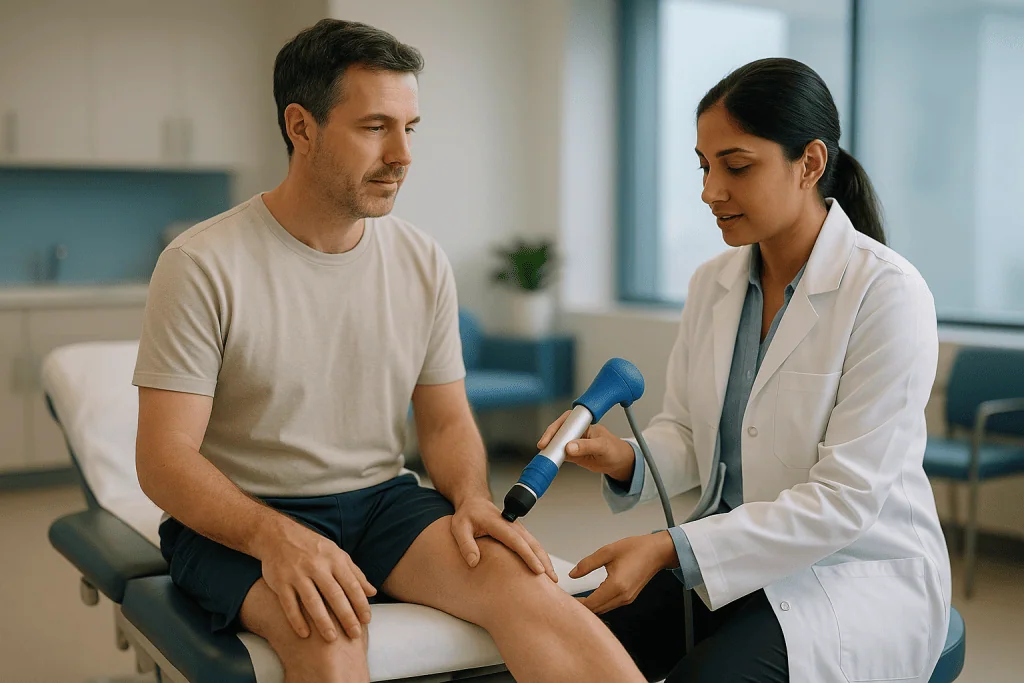
Two broad types exist. Focused shock waves are generated so that the energy converges at a set depth, which suits deeper targets such as the shoulder. Radial pressure waves spread outward from the applicator tip and lose energy with depth, which suits shallow structures such as the heel and the outside of the elbow. Both are commonly grouped under the same name in clinics, and the distinction is one worth asking about.
How the pulses help is still debated. The leading explanation is that they create a controlled micro-injury in tissue that has been stuck in a failed healing state. Chronic tendinopathy, the medical term for a painful, degenerated tendon, is less an inflammation problem than a repair problem: the tissue becomes disorganized and poorly supplied with blood. Cleveland Clinic describes the pulses as stimulating blood flow and the body’s own repair processes in the treated area.
A second proposed mechanism is on the nerves. Repeated pulses appear to dampen the local pain-signaling fibers, which may explain why some people feel relief before any structural change could plausibly have occurred. In calcific tendinopathy of the shoulder, where chalky deposits form inside the tendon, the waves may also help fragment the deposit so the body can clear it.
None of this involves cutting, needles or medication, which is the main reason clinicians consider it before surgery.
Shockwave therapy for plantar fasciitis: what the evidence actually shows
Plantar fasciitis is the best-studied use and the one most people ask about. Johns Hopkins describes it as irritation and degeneration of the plantar fascia where it attaches to the heel bone, classically felt as sharp pain with the first steps of the morning or after sitting.
The reassuring backdrop, per Mayo Clinic and MedlinePlus, is that most people improve with conservative care over a period of months: calf and fascia stretching, supportive footwear, night splints for some, activity adjustment and weight management where relevant. Shockwave therapy enters the picture for the minority whose symptoms persist beyond that window.
What does the research say? The honest summary is mixed but tilting positive. Mayo Clinic states that some studies show promising results but that the therapy has not been shown to be consistently effective. Trials vary in the type of device, the energy level, the number of sessions and whether local anesthetic was used, which makes pooled results hard to interpret. Focused devices at higher energy have tended to perform better in chronic cases than low-energy radial protocols, but head-to-head comparisons are limited.
What this means for a would-be candidate is practical rather than discouraging. A person with confirmed plantar fasciitis, symptoms lasting six months or more, and a documented attempt at stretching and strengthening is the patient for whom the evidence was gathered. Someone three weeks into heel pain is not, and offering them shockwave therapy would be treating a problem that usually resolves on its own.
Clinicians will also want to be sure the heel pain is fasciitis and not something that mimics it, such as a stress fracture of the heel bone, nerve entrapment, or a fat-pad problem. Shock waves aimed at the wrong diagnosis help nobody, and in the case of a fracture could be harmful.
Tennis elbow and shockwave therapy: a cautious yes
Tennis elbow, or lateral epicondylitis, is pain at the bony bump on the outer elbow where the forearm tendons attach. Despite the name, the NHS notes that most people who get it have never picked up a racket; repetitive gripping, lifting and computer work are more common causes.
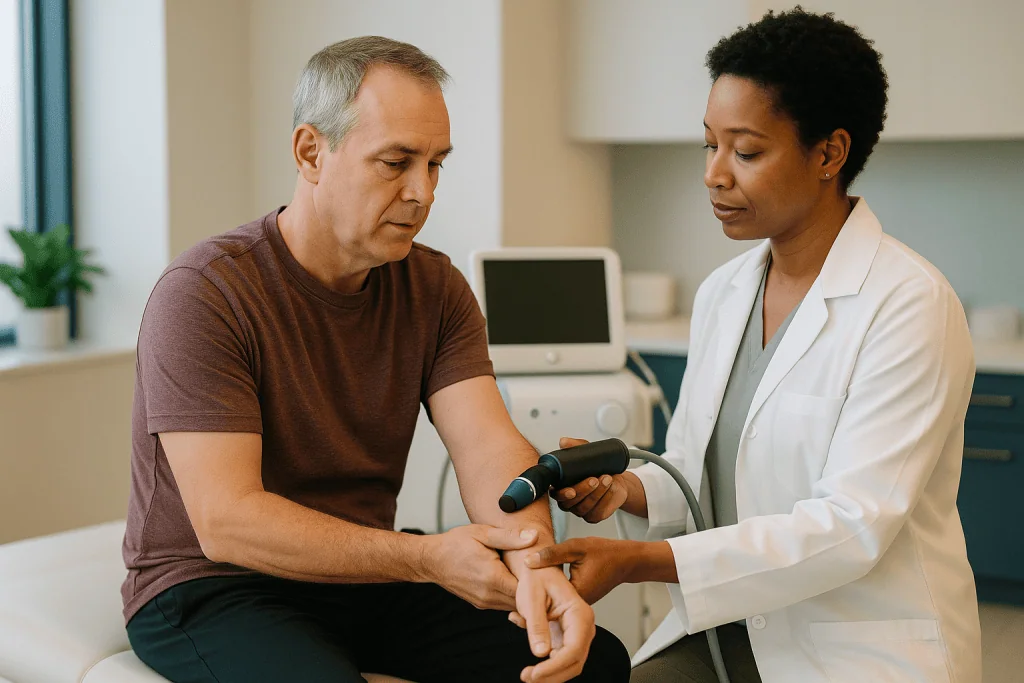
The natural history is long. According to the NHS, tennis elbow usually lasts between six months and two years, and most people recover fully within a year with rest and self-care. That timeline is central to candidacy. A clinician assessing a shockwave therapy candidate for elbow pain is asking whether the person has already given the tendon reasonable time and a proper strengthening program, particularly eccentric exercises, the slow lowering movements that load the tendon in a controlled way.
The NHS treatment page lists shockwave therapy among the options for persistent tennis elbow and summarizes the national guidance position plainly: the treatment is considered safe, with minor side effects such as bruising and skin redness, but the evidence on how well it works is inconsistent. Some trials show meaningful pain reduction compared with sham treatment; others show no difference. Studies that found benefit generally involved chronic pain and multiple sessions.
Where does that leave someone with a year of elbow pain who cannot lift a kettle without wincing? In many services, shockwave therapy is offered as a middle step between exercise therapy and more invasive options, precisely because its downside is small. Corticosteroid injections, by contrast, often give short-term relief but have been associated with worse outcomes at one year in tennis elbow research, which has pushed many clinicians toward non-injection approaches for chronic cases.
The candidate profile, then, is chronic pain, failed exercise rehabilitation, a confirmed tendon source, and a realistic expectation of gradual rather than instant change.
Which other conditions are treated with shock wave therapy?
Beyond the heel and the elbow, clinicians use shockwave therapy for a cluster of chronic tendon problems, with evidence that ranges from reasonably good to thin.
Calcific tendinopathy of the shoulder is the strongest case after plantar fasciitis. Here a calcium deposit forms within the rotator cuff tendons, and focused shock waves have a track record of reducing pain and helping the deposit resorb in people who have not improved with physical therapy. Non-calcific rotator cuff pain, by contrast, has weaker support, and clinicians are more hesitant.
Greater trochanteric pain syndrome, the deep ache on the outside of the hip caused by irritated gluteal tendons, is another frequent indication for chronic cases. Achilles tendinopathy, both in the mid-portion of the tendon and at its attachment to the heel bone, is commonly treated, usually alongside a heavy, slow strengthening program. Patellar tendinopathy, or jumper’s knee, is treated in a similar way in athletes who have not responded to load management.
Cleveland Clinic also lists slow-healing fractures, or non-unions, as an established medical use, where higher-energy waves are directed at the bone to stimulate healing.
Then there are the uses you may see advertised that sit outside mainstream musculoskeletal care. Low-intensity shock wave therapy for erectile dysfunction is an active research area, but it remains investigational; professional urology guidance treats it as unproven for routine practice. Claims for cellulite, wound healing or general muscle pain rest on small studies or none. A reputable clinician will tell you which category your condition falls into rather than folding everything into one confident pitch.
The pattern is consistent: the better the evidence, the more the condition looks like a chronic, well-localized tendon or fascia problem in an adult.
Who should not have shockwave therapy, and who is asked to wait
Contraindications, the medical word for reasons a treatment should not be given, fall into two groups: situations where the pulses could cause harm, and situations where the timing is simply wrong.
Cleveland Clinic and standard clinical practice list several firm exclusions. Pregnancy is one, because the effects of shock waves on a developing fetus have not been studied and no one intends to find out. Bleeding disorders, or treatment with anticoagulants, the class of medicines that thin the blood, raise the risk of significant bruising or deeper bleeding in the treated tissue. Active infection at or near the site is excluded, as is any known or suspected cancer in the area. Children and adolescents with open growth plates, the cartilage zones at the ends of growing bones, are usually not treated over those regions.
Anatomy imposes further limits. Clinicians avoid directing waves over the lungs, the brain and spinal cord, major nerves and blood vessels, and metal implants in some protocols. People with pacemakers or other implanted electronic devices are assessed individually, since some shock wave generators can interfere with them.
The second group is about timing. Someone with an acute tendon tear, a recent fracture, or pain of only a few weeks is asked to wait, because the injury needs conventional healing time and may resolve on its own. Many services also ask for a gap of several weeks after a corticosteroid injection into the same area, both to judge what the injection did and because steroids can weaken tendon tissue temporarily.
A less obvious reason to pause is an unclear diagnosis. If imaging has not confirmed where the pain arises, most clinicians will sort that out first. The pulses are only as useful as the aim.
Shockwave therapy candidates at a glance
The table below pulls the threads together. It is a guide to how clinicians commonly think, not a substitute for an assessment, and every row can be overridden by individual circumstances.
| Factor | Usually favors treatment | Usually means wait or avoid |
|---|---|---|
| Diagnosis | Chronic plantar fasciitis, tennis elbow, calcific shoulder tendinopathy, gluteal, Achilles or patellar tendinopathy, confirmed by examination or imaging | Unclear source of pain, joint arthritis, nerve entrapment, stress fracture, acute tendon tear |
| Duration | Symptoms for six months or longer despite care | Recent onset; conservative care not yet tried in earnest |
| Prior treatment | Completed stretching and strengthening program, footwear or equipment changes, activity modification | No structured rehabilitation attempted |
| Health history | No bleeding tendency, no active infection or cancer near the site | Pregnancy, anticoagulant therapy, bleeding disorder, infection, malignancy, open growth plates |
| Recent procedures | No injection to the area in recent weeks | Corticosteroid injection within the gap your clinic specifies |
| Expectations | Prepared for several sessions and gradual change while continuing exercises | Seeking a single-visit fix or a reason to stop rehabilitation |
Notice what dominates the left column: chronicity, a confirmed tendon or fascia source, and a genuine attempt at the basics. Notice too that the right column is mostly about safety and timing rather than permanent ineligibility. A person on anticoagulants may become a candidate if the prescribing clinician judges a temporary adjustment safe, though that decision never belongs to the shockwave provider alone. Someone three months into heel pain may qualify later if the pain persists.
If you find yourself mostly in the left column, a conversation with your clinician about shockwave therapy is reasonable. If you land in the right column, that same conversation is still worth having, because it will usually point toward the treatment you actually need first.
Is shockwave therapy painful? What a session actually feels like
People searching this question usually want a straight answer, so here it is: the treatment is uncomfortable rather than agonizing, and the discomfort ends when the applicator lifts off.
A session begins with the clinician locating the tender spot by hand, sometimes guided by ultrasound imaging, and marking it. Gel is applied so the sound waves pass into tissue rather than bouncing off air. The applicator is then pressed against the skin and the pulses begin. Most people describe a rapid tapping or snapping sensation that grows into a deep ache as the count climbs. Sensitive tissue hurts more, which is part of how the clinician confirms they are on the right spot.
Energy is usually started low and raised to a level you can tolerate. You are asked to speak up if it becomes too much, and the intensity is adjusted. The treatment portion of a session lasts only a few minutes; the whole appointment, including assessment, is typically short. Cleveland Clinic notes that people generally walk out and resume normal daily activities the same day.
Local anesthetic is generally avoided. This surprises some patients, but research has suggested that numbing the area may blunt the treatment effect, possibly because part of the benefit works through the nerves being stimulated.
A typical course, according to Cleveland Clinic, is around three to five sessions spaced roughly a week apart, though protocols vary by device, condition and clinician. Some services reassess after the third session before continuing.
Discomfort afterward is common: a bruised feeling, mild swelling or redness over the area for a day or two. Ice is not usually recommended immediately afterward in many protocols, since some clinicians prefer not to damp down the very inflammatory response the treatment is trying to provoke. Your own team will tell you what they want you to do.
What the days and weeks after shockwave therapy usually look like
The first day or two often feel slightly worse before they feel better. The treated area is tender, sometimes reddened, occasionally bruised, and a pre-existing ache can briefly sharpen. This is expected and generally settles within a couple of days. Most people go straight back to work and ordinary walking.
Vigorous loading of the treated tendon is another matter. Clinicians commonly ask you to avoid high-impact or heavy-load activity on that structure for a short period after each session, while continuing gentle mobility and the lighter parts of your exercise program. The exact instruction depends on the condition; a runner with Achilles tendinopathy will be handled differently from an office worker with tennis elbow.
Improvement, when it arrives, tends to be gradual and cumulative rather than immediate. Cleveland Clinic notes that it can take several weeks after treatment to notice a difference, and that benefits may continue to build for weeks beyond the final session as tissue remodels. Some people feel earlier relief from the nerve-dampening effect and are then disappointed when it partly fades before the slower structural change catches up. Knowing that pattern in advance saves a good deal of anxiety.
Between sessions, the rehabilitation program continues. This is not optional filler. The studies that found benefit almost always combined shock waves with stretching or progressive loading, and the treatment is best understood as a way of making a tendon more receptive to that work.
Reassessment usually happens at the end of the course and again some weeks later. Teams look at pain scores, function and, where relevant, imaging. If there has been no change at all after a full course, most clinicians do not simply repeat it; they revisit the diagnosis and the wider plan. That review is part of good care, not a sign that anyone did something wrong.
Shockwave therapy side effects: is there a downside?
The downside is real but modest, which is why guideline bodies are comfortable with the treatment even while calling the efficacy evidence inconsistent.
Common side effects, as described by the NHS and Cleveland Clinic, are local and short-lived: pain during the session, tenderness afterward, redness, swelling and bruising over the treated area. Small pinpoint bleeding under the skin, called petechiae, can appear. Numbness or tingling over the spot occasionally lasts a few days. These effects generally resolve without any intervention.
Rarer problems have been reported. Skin damage is possible if energy is set too high or the applicator is held poorly. Tendon rupture has been described in case reports, almost always in tendons that were already severely degenerated or had been repeatedly injected with corticosteroids, which is one reason clinicians ask about injection history and scan before treating. Bone bruising can occur when waves are directed near bone. In people with bleeding tendencies, hematoma, a collection of blood in the tissue, is the main concern, and the reason anticoagulant use is a standard exclusion.
The less tangible downside is opportunity cost. A person who spends a course of sessions on a misdiagnosed problem has lost time. Another who treats shock waves as permission to stop their exercises has lost the component most likely to help. And because the evidence is mixed, a proportion of well-selected candidates will simply not improve.
Compared with the alternatives further along the pathway, the profile is favorable. Corticosteroid injections carry risks of tendon weakening and skin changes; surgery carries anesthetic, infection and recovery risks and a longer time away from activity. Shockwave therapy sits between them precisely because it is low-risk and reversible. Whether it is worth trying is a conversation about probabilities that your treating team should have with you openly.
What is the success rate of shockwave therapy?
People want a number, and clinics are sometimes happy to supply one. Be wary of any figure quoted without a source and a condition attached. Success in tendon research is measured in different ways, at different time points, against different comparators, and a percentage that sounds impressive may describe a small trial with no sham control.
The more defensible summary comes from the major reference bodies. Mayo Clinic, writing on plantar fasciitis, says some studies show promising results but that the treatment has not been shown to be consistently effective. The NHS, summarizing national guidance on tennis elbow, describes the evidence as inconsistent while confirming the safety profile. Neither source offers a headline percentage, and that restraint is itself informative.
Why so inconsistent? Trials differ in the type of device, the energy delivered, whether the clinician aimed by hand or by ultrasound, the number of sessions, the use of anesthetic, and how long participants had been in pain. Higher-energy focused protocols in chronic plantar fasciitis have generally fared better against sham than low-energy radial protocols in mixed populations. Shoulder calcific tendinopathy tends to show clearer benefit than non-calcific shoulder pain. The signal exists, but it is condition-specific and protocol-specific.
Two practical implications follow for a candidate. First, ask what evidence applies to your condition, not to shockwave therapy in general. Second, treat any promise of a specific personal outcome as a red flag rather than a reassurance. Tendon healing varies with age, activity, how long the tissue has been degenerated, and how well the rehabilitation program is followed.
The realistic framing is this: for well-selected chronic cases, shockwave therapy offers a reasonable chance of meaningful improvement with a small risk, and a real chance of no benefit. A clinician who says exactly that is giving you the evidence rather than a sales line.
How shockwave therapy compares with injections, physical therapy and surgery
Candidacy makes more sense when you see where the treatment sits on the pathway, because it is rarely offered in isolation.
Physical therapy is the foundation for every condition discussed here and the comparator that shockwave therapy is usually added to rather than measured against. For plantar fasciitis, that means calf and fascia stretching and, increasingly, strengthening of the foot and calf. For the elbow, hip, Achilles and knee, it means progressive loading programs that gradually ask the tendon to tolerate more. Guidelines from the NHS and Mayo Clinic position this, with activity changes and footwear or equipment adjustments, as the first months of care.
Corticosteroid injections, anti-inflammatory medicines placed into or around the tendon, remain common for pain relief. Their benefit is often quick but frequently short-lived, and repeated injections have been linked with tendon weakening and, in tennis elbow research, with poorer results at one year than a wait-and-see approach. Decisions about injections belong with the prescribing clinician; the relevance here is that many teams now prefer to try shockwave therapy before, rather than after, a steroid injection in chronic cases.
Other injection approaches, including platelet-rich plasma, in which a person’s own concentrated blood platelets are injected into the tendon, are used in some services. The evidence base is also mixed, and clinicians differ on where it belongs in the sequence.
Surgery is the final step and is uncommon for these conditions. Mayo Clinic notes that surgery for plantar fasciitis is rarely needed and is reserved for severe, persistent cases after other measures have failed. Procedures for tennis elbow follow the same logic. Recovery times are measured in weeks to months and carry the risks of any operation.
Seen this way, shockwave therapy is a non-invasive rung between exercise and needles or knives. That position is its main appeal for candidates and its main limitation: it is neither the first thing to try nor the last resort.
What people often get wrong about shockwave therapy
Myths gather around any treatment that is hard to picture, and this one has attracted a full set.
The first is that it is a form of electrical stimulation or ultrasound massage. It is neither. Therapeutic ultrasound delivers continuous low-energy vibration; shock waves are discrete, high-pressure acoustic pulses with a fundamentally different physical profile. Confusing the two leads people to expect a gentle warming treatment and to be startled by the discomfort.
The second is that one session should do it. Every protocol with reasonable evidence involves a short course of several sessions, and Cleveland Clinic describes benefit often becoming noticeable only weeks after treatment. Judging the therapy after a single visit is judging it before it has had a chance.
The third is the mirror image: that more is always better. Repeating course after course without reassessment is not supported by evidence, and clinicians who find no response after a full course usually change direction rather than intensify.
The fourth is that a diagnosis is unnecessary because the machine simply treats pain. The therapy works, when it works, on specific tissues. Heel pain from a stress fracture, nerve compression or inflammatory arthritis is not helped and may be worsened. Aiming matters, which is why an examination and often imaging come first.
The fifth is that it replaces exercise. Trials showing benefit paired shock waves with rehabilitation. Stopping the program because the machine is now doing the work removes the element with the most consistent evidence.
The sixth is that any advertised use has the same standing. Erectile dysfunction, cellulite and general muscle soreness are marketed indications with weak or investigational evidence, and mainstream guidance does not treat them the way it treats chronic plantar fasciitis or calcific shoulder tendinopathy.
Last, that it is painless. It is tolerable and brief, and pretending otherwise sets people up for a poor first session.
Questions to ask your care team before you book
A good consultation should leave you clear on why this treatment, why now, and what happens if it does not help. These questions tend to draw out the answers that matter.
- What exactly is my diagnosis, and how confident are you in it? Has imaging been done or is it needed to confirm the tendon or fascia is the source?
- Have I completed enough conservative care to be a reasonable candidate, or would another block of physical therapy be the better next step?
- Which type of shock wave device will be used, focused or radial, and why that choice for my condition?
- What does the evidence show for my specific condition, as opposed to shockwave therapy in general?
- How many sessions are planned, how far apart, and at what point will we reassess whether to continue?
- Is there anything in my health history, medicines or recent injections that changes the safety picture?
- What should I do and avoid in the days after each session, and how should I adjust my exercise program?
- What side effects should I expect, and which ones should prompt a call?
- If I have no improvement after the full course, what is the plan?
- Who is delivering the treatment, what is their training, and who is the clinician responsible for my overall care?
Bring a short timeline of your symptoms and the treatments you have already tried, including any injections and roughly when they were given. Teams make better decisions with that history in front of them, and it keeps the conversation anchored in your case rather than in generalities.
Notice that none of these questions asks for a personal success guarantee. The most useful answer you can receive is an honest account of the odds for someone like you, delivered by the people who will manage what comes next either way.
When to call your doctor
Most after-effects of shockwave therapy are mild and fade within a day or two. A few signs mean the treated area, or something else entirely, needs prompt attention.
Contact your care team the same day if pain after a session is severe, escalating rather than settling, or accompanied by a sudden pop or snap followed by weakness. A sudden inability to push off the foot, raise the heel, or grip and lift with the treated arm can signal a tendon tear and should be assessed urgently. Rapidly expanding swelling or a large, spreading bruise, particularly if you take anticoagulants or have a bleeding tendency, also warrants a call.
Seek care promptly for signs of infection or inflammation that do not fit the expected pattern: spreading redness, heat, fever, or skin that breaks down or blisters over the treated spot. New numbness, tingling or weakness that persists beyond a few days should be reported, as should any calf swelling, warmth or pain, which can indicate a blood clot regardless of its cause.
Separately from the treatment itself, some heel and elbow pain is not tendinopathy at all. Pain that wakes you at night, pain after a fall or a sudden injury, unexplained weight loss, fever with joint pain, or pain in someone with a history of cancer needs a medical review before any shock wave treatment is considered.
If you are unsure whether a symptom is expected or concerning, call. Care teams would rather hear about a bruise that turns out to be routine than miss a torn tendon because someone waited for the next appointment. And if you have chest pain, difficulty breathing, or symptoms of a stroke, those are emergencies unrelated to this treatment; call emergency services immediately.
Frequently asked questions
Who is a good candidate for shockwave therapy?
Adults with a confirmed chronic tendon or plantar fascia problem, usually painful for six months or more, who have already completed stretching, strengthening and activity changes without enough improvement. Plantar fasciitis, tennis elbow and calcific shoulder tendinopathy are the most common indications. Candidates also need to be free of safety exclusions and willing to continue rehabilitation alongside several sessions.
Who should not have shockwave therapy?
People who are pregnant, have a bleeding disorder, or take anticoagulant medicines are usually excluded, as are those with infection or cancer near the treatment site and young people with open growth plates in the area. Clinicians also avoid directing waves over lungs, major nerves and vessels, and assess anyone with an implanted electronic device individually. Acute tears and recent fractures mean waiting.
Is shockwave therapy painful?
It is uncomfortable rather than severely painful, and the discomfort stops when the applicator is lifted. Most people feel rapid tapping that builds into a deep ache over the tender spot, with energy adjusted to what you can tolerate. Local anesthetic is generally avoided because it may reduce the treatment effect. Tenderness, redness or mild bruising afterward typically settles within a day or two.
Does shockwave therapy for plantar fasciitis work?
The evidence is mixed but leans positive for chronic cases. Mayo Clinic states that some studies show promising results while the treatment has not been shown to be consistently effective. Higher-energy focused protocols in long-standing plantar fasciitis have tended to fare better than low-energy approaches. It is considered after conservative care has been tried, since most heel pain of this type improves within months anyway.
What are the side effects of shockwave therapy?
Common effects are pain during treatment and short-lived tenderness, redness, swelling, bruising or pinpoint skin bleeding afterward, all described by the NHS and Cleveland Clinic as minor. Rare problems include skin damage, bone bruising and, in already severely degenerated or repeatedly injected tendons, tendon rupture. People on blood thinners face a higher risk of hematoma, which is why anticoagulant use is a standard exclusion.
How many shockwave therapy sessions are usually needed?
Cleveland Clinic describes a typical course as around three to five sessions, spaced roughly a week apart, though protocols vary by device, condition and clinician. Many teams reassess after the third session before continuing. Improvement often becomes noticeable only in the weeks after treatment, so a single session is not a fair test. Repeating courses without reassessment is not supported by evidence.
Can I exercise after shockwave therapy?
Ordinary walking and daily activity usually resume the same day. Clinicians commonly ask you to avoid heavy or high-impact loading of the treated tendon for a short period after each session while continuing the gentler parts of your rehabilitation program. The specific instruction depends on the condition and your own team, so follow their guidance rather than a general rule.
Does shockwave therapy work for erectile dysfunction?
Low-intensity shock wave therapy for erectile dysfunction is an active area of research, but it remains investigational and mainstream urology guidance does not treat it as an established therapy for routine use. The evidence base is much weaker than for chronic plantar fasciitis or calcific shoulder tendinopathy. Anyone considering it should discuss proven options and the current state of the research with a clinician.
Is shockwave therapy safe for children and teenagers?
Young people whose bones are still growing are generally not treated over areas with open growth plates, the cartilage zones near the ends of bones, because the effect of shock waves on that tissue is not well studied. Pediatric heel and knee pain also has different common causes than adult tendinopathy. Any decision about a child or adolescent rests with a clinician experienced in pediatric musculoskeletal care.
What happens if shockwave therapy does not help?
Most clinicians do not simply repeat the course. They revisit the diagnosis, sometimes with imaging, and review the wider plan, which may include further structured rehabilitation, other injection approaches, or in rare persistent cases a surgical opinion. Mayo Clinic notes that surgery for plantar fasciitis is uncommon and reserved for severe cases after other measures fail. A lack of response is information, not failure.
References
This article is for general information only and is not a substitute for professional medical advice. Please consult a qualified doctor about your individual situation.

More from the Blog

What Happens During a Joint Injection: Positioning, Ultrasound Guidance and the Needle
A joint injection procedure typically takes a few minutes. You are positioned so the joint space opens, the skin is cleaned with antiseptic, and…

Who May Be a Candidate for Spinal Cord Stimulation After Conservative Care Falls Short?
Spinal cord stimulation is usually considered for adults with chronic neuropathic pain, most often persistent leg or back pain after spine surgery, complex regional…

PRP Injection Cost: Per-Session Pricing and How Many Sessions Trials Use
PRP injections are priced per session. For a knee PRP injection, our guide range is EUR 450-900 per session (Turkey market average EUR 350-700),…

Interventional Pain Management: What Image-Guided Injections and Procedures Involve
Interventional pain management procedures are targeted treatments, most often injections, delivered under live X-ray or ultrasound guidance so a needle reaches a specific nerve,…

How Long Does a Cortisone Shot Last? Duration, Honestly Answered
Relief from a cortisone shot most often lasts between six weeks and six months, though the range is wide: some people feel better for…

How Long Sciatica Lasts and Whether It Goes Away on Its Own
Most episodes of sciatica ease within about four to six weeks, and the majority of people improve without surgery. Pain often fades gradually and…