

Who Needs a Scoliosis Brace? Curve Size, Growth Remaining and the Cases Where Bracing Helps
Key Takeaways
- Scoliosis is defined as a spinal curve of at least 10 degrees on a standing X-ray, and most curves under 20 degrees are simply monitored.
- Bracing is usually considered for idiopathic curves of roughly 25 to 40 degrees in a child who still has meaningful growth remaining.
- Growth remaining, judged by the Risser sign, hand X-rays and time since the first period, changes the recommendation as much as the curve size itself.
- In the largest randomized trial, 72 percent of braced adolescents versus 48 percent of observed adolescents finished growth with a curve under 50 degrees, and benefit rose with hours worn.
- A brace aims to stop progression during growth; the curve at skeletal maturity is expected to be close to where it started, not straight.
- Adults who have finished growing gain little curve control from a brace, and adult bracing is used only for short-term comfort.
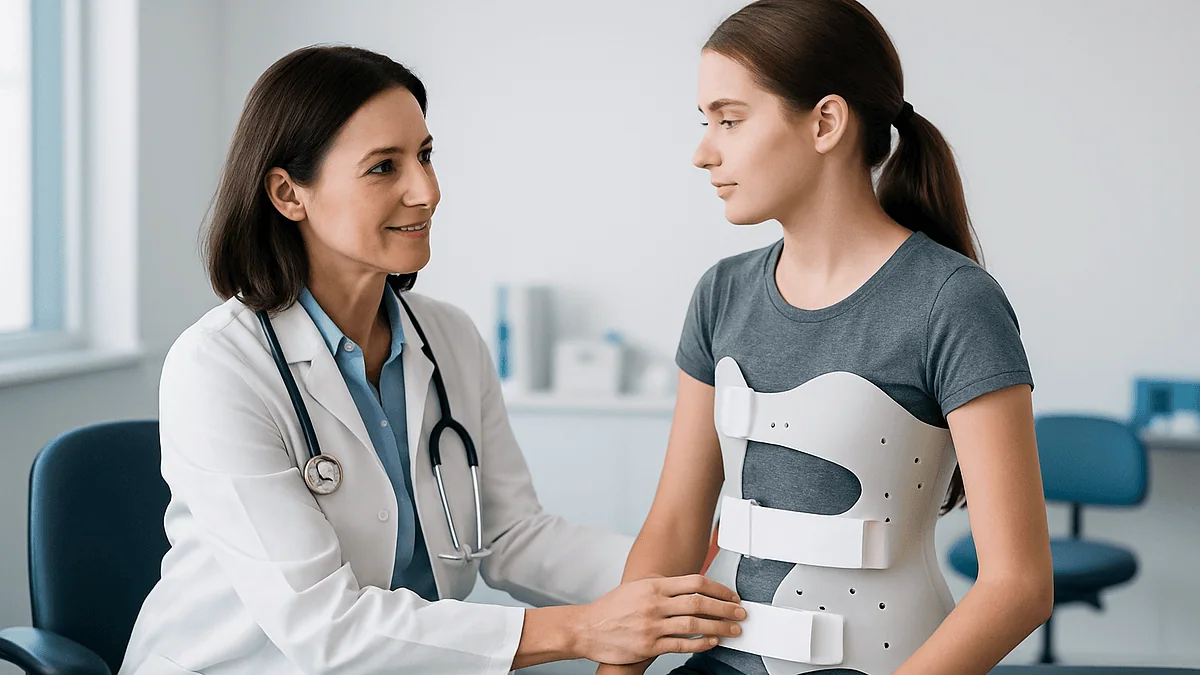
Doctors usually consider a scoliosis brace for a child or teenager who is still growing and whose spinal curve measures roughly 25 to 40 degrees on X-ray, or whose smaller curve is clearly worsening between visits. The brace aims to stop the curve from progressing during growth, not to straighten it. Adults who have finished growing are rarely braced, and the treating team weighs curve size, growth remaining and rate of change together.
The X-ray is still glowing on the wall when the orthopedist says the number out loud: twenty-eight degrees. A twelve-year-old who came in because a swim coach noticed one shoulder blade sitting higher than the other is now hearing words like Cobb angle and skeletal maturity, and her mother is already doing the math on gym class, sleepovers and a plastic shell under a school uniform.
That scene plays out in clinics every week, and the question underneath it is always the same: who needs a scoliosis brace, and who can safely be watched? The honest answer is not a single number. It is a number read alongside a growth chart, a hand X-ray and a calendar of how fast the curve has moved.
This explainer walks through the thresholds doctors actually use, what the strongest trial found, what the brace can and cannot do, and the decisions that belong to the treating team rather than a search engine.
Who needs a scoliosis brace? The short version doctors use
Strip the decision to its bones and it rests on three questions. How big is the curve? How much growing is left? Is the curve moving? A brace is most often recommended when the answers line up as moderate, plenty and yes.
Scoliosis is a sideways curve of the spine measuring at least 10 degrees on a standing X-ray, and most cases in teenagers are idiopathic, meaning no cause is found (Johns Hopkins Medicine). The word idiopathic matters because bracing evidence comes almost entirely from this group. Curves caused by a neuromuscular condition, a malformed vertebra or a leg-length difference follow different rules and are managed by the same specialists but with different tools.
For idiopathic curves, the usual bracing window sits between about 25 and 40 degrees in a child whose skeleton is still maturing (Cleveland Clinic; Johns Hopkins Medicine). Below that range, most children are simply re-measured every few months. Above it, particularly past 45 to 50 degrees, doctors begin discussing surgery because a brace cannot reliably hold a curve that large (Mayo Clinic).
Growth is the hinge. A curve tends to worsen fastest during the adolescent growth spurt and typically stops progressing meaningfully once bones finish growing (Mayo Clinic). Since the brace works by influencing how the spine grows, a person with no growth remaining has little for the brace to act on. That single fact explains why a 30-degree curve in an eleven-year-old and an identical curve in a thirty-year-old lead to entirely different conversations.
One more variable often gets overlooked: trajectory. A curve that has climbed 6 or more degrees in half a year is treated more seriously than a static one, even at the same size. The treating team looks at the film, the previous film and the child in front of them before recommending anything.
What is a scoliosis brace and how does it actually work?
A scoliosis brace is a rigid or semi-rigid shell, usually molded plastic lined with foam, that wraps the torso from under the arms to the hips. It is built from a cast or a 3D scan of the child’s trunk by an orthotist, a clinician who designs and fits medical braces, and then adjusted on the body until it presses where the spine bows outward and leaves room where the spine needs to move.
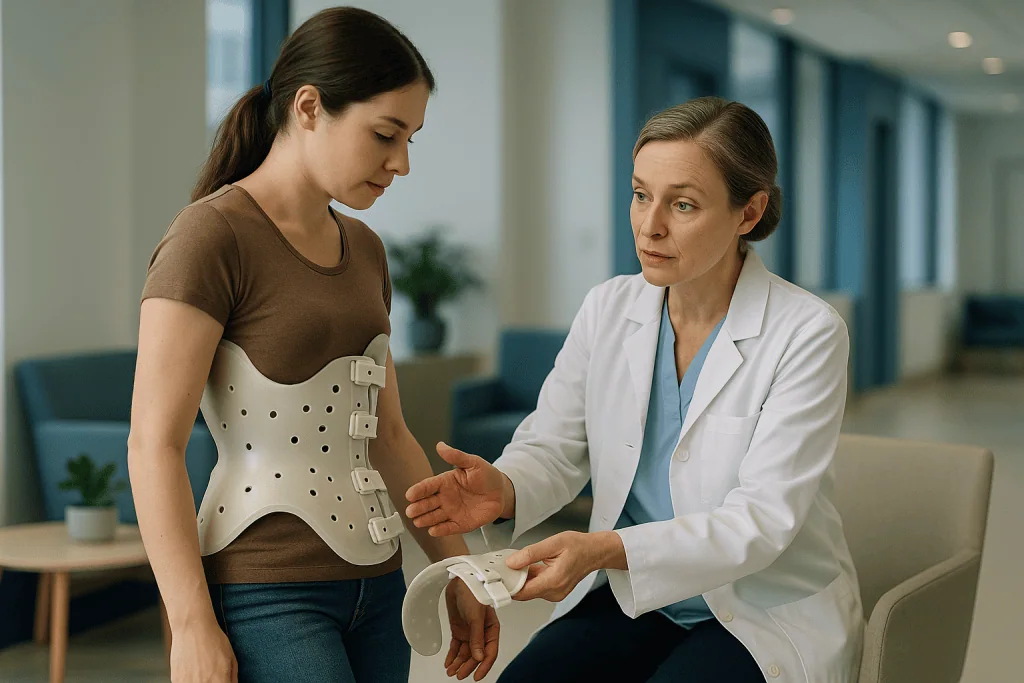
The mechanism is quieter than most families expect. The brace does not pull the spine straight the way a splint holds a broken finger. Bone grows in response to the forces on it. A growing vertebra loaded unevenly grows unevenly, which is how a small curve becomes a larger one. The brace applies steady pressure to the convex side of the curve and, in doing so, evens out that load while the child is still growing (Johns Hopkins Medicine). Think of a young tree tied to a stake: the stake does not bend the trunk back, it stops the lean from getting worse during the seasons when the wood is still soft.
Inside the shell, the spine often looks noticeably straighter on an X-ray taken while the brace is worn. That in-brace correction is a sign the brace is well fitted, not a preview of the final result. When bracing ends and the shell comes off for good, the curve usually settles back close to where it started. The realistic goal, stated plainly in guidance for families, is to prevent progression and avoid surgery, not to undo the curve (Mayo Clinic; NHS).
Because the effect depends on growth, the brace is worn through the remaining years of skeletal maturation, then weaned as growth stops. Fit is re-checked at every visit, and a growing child will typically need adjustments and, sometimes, a new brace along the way.
At what point do you need a brace for scoliosis? The Cobb angle explained
Every bracing decision starts with one measurement. The Cobb angle is the angle formed between lines drawn along the most tilted vertebra at the top of the curve and the most tilted vertebra at the bottom, measured on a standing X-ray of the whole spine. It is the standard way scoliosis is quantified and tracked (Johns Hopkins Medicine).
Ten degrees is the floor for calling a curve scoliosis at all. Many people live with curves between 10 and 20 degrees and never know it, because a curve that size rarely causes symptoms or progresses in adulthood (Cleveland Clinic). Between 20 and 25 degrees, doctors watch more closely, usually with a repeat X-ray in four to six months, since this is the zone where a curve either declares itself or stays put (Mayo Clinic).
The bracing conversation typically begins once a curve reaches about 25 degrees in a child with growth remaining, and continues up to roughly 40 degrees (Cleveland Clinic; Johns Hopkins Medicine). Some teams will brace a slightly smaller curve if it has already shown a clear jump between visits, on the logic that momentum predicts more momentum.
Two cautions about the number itself. First, measurement error of a few degrees is normal, even between experienced readers of the same film, so a change from 24 to 27 degrees may or may not be real. Clinicians look for changes of 5 degrees or more before calling a curve progressive (Johns Hopkins Medicine). Second, the same angle can look very different on the body. A 30-degree curve high in the thoracic spine may show as a prominent shoulder blade, while the same angle in the lower back may show mostly as an uneven waist.
The angle opens the door. Growth and trajectory decide whether anyone walks through it.
Why growth remaining matters more than the number alone
Ask a spine specialist which single fact changes a bracing recommendation the most and many will point not at the spine X-ray but at the pelvis or the hand. Estimating how much growth remains is the core of the decision, because progression risk rises with growth left and falls toward zero as the skeleton finishes maturing (Mayo Clinic).
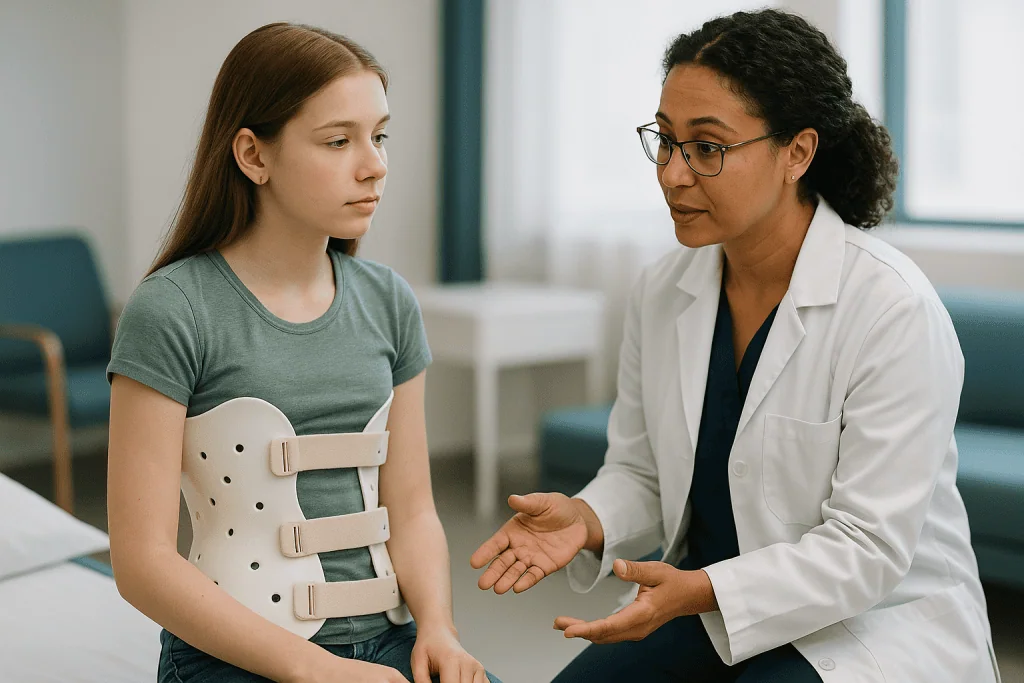
The Risser sign is the classic tool. It grades, from 0 to 5, how much of the growth cap along the top rim of the pelvis has turned to bone on the same X-ray used for the Cobb angle. A Risser 0 or 1 child has most of the adolescent growth spurt ahead; a Risser 4 or 5 teenager is close to done (Johns Hopkins Medicine). Many teams now add a hand-and-wrist X-ray, graded by how the growth plates in the fingers are closing, because it tracks the fast-growth phase more precisely than the pelvis alone.
Everyday clues count too. For girls, the first menstrual period marks the point after which growth slows, so a curve found two years after menarche carries less risk than the same curve found six months before it (Mayo Clinic). Height measured at each visit tells its own story: a child gaining several centimeters between appointments is in the window where curves move.
This is why the growth spurt just before puberty is when most idiopathic scoliosis is diagnosed and when bracing is most often started (Mayo Clinic). It is also why the same 30-degree curve draws different advice at different ages. In a nine-year-old with everything still to grow, it is a strong reason to brace. In a sixteen-year-old whose hand plates have fused, it is usually a reason to keep observing and let nature finish the job.
Girls and boys are diagnosed at similar rates for small curves, but girls face a considerably higher risk of the curve worsening to a size that needs treatment (Mayo Clinic). Sex is therefore folded into the risk estimate as well.
Who needs a scoliosis brace and who is usually asked to wait?
Picture three patients who each leave the same clinic with a different plan.
The first is a ten-year-old with a 27-degree thoracic curve, Risser 0, no periods yet, and a height that has jumped four centimeters since her last check. Every risk factor points the same way. She sits squarely in the group for whom bracing is usually recommended: moderate curve, abundant growth remaining and early signs of movement (Cleveland Clinic; Johns Hopkins Medicine).
The second is a fourteen-year-old with a 22-degree curve who started her period eighteen months ago. Her curve is below the usual bracing threshold and her growth is tapering. Most teams would ask her to wait and return for a repeat X-ray in four to six months, with bracing on the table only if the curve jumps (Mayo Clinic). Waiting here is not neglect; it is a deliberate strategy that spares many children a brace they would never have needed.
The third is a seventeen-year-old whose growth plates have closed and whose curve measures 34 degrees. A brace has little left to act on, because the mechanism depends on growth. He is observed, taught to keep his back and core strong, and told what changes in adulthood would warrant another look (Cleveland Clinic).
Beyond these three, several groups are routinely steered away from bracing or toward other options: curves already beyond about 45 to 50 degrees, where surgery is discussed instead (Mayo Clinic); curves caused by neuromuscular conditions, where a brace may be used for sitting support rather than to alter growth; and certain curve shapes, such as very high thoracic curves, that a standard under-arm brace cannot reach effectively.
None of these boundaries is absolute. A team may brace a curve slightly under 25 degrees that has already surged, or hold off in a child with a medical reason a brace cannot be tolerated. The person in the chair, not the threshold, gets the final say.
What degree of scoliosis requires a brace? A summary table
The thresholds below are the ranges most commonly cited in mainstream guidance for idiopathic scoliosis in growing children (Cleveland Clinic; Johns Hopkins Medicine; Mayo Clinic). They describe typical practice, not a rule that overrides the judgment of the treating team.
| Cobb angle | Growth remaining | What usually happens |
|---|---|---|
| 10 to 20 degrees | Any | Observation; repeat X-ray roughly every 4 to 6 months while growing |
| 20 to 25 degrees | Substantial | Closer observation; bracing considered if the curve has jumped 5 degrees or more |
| 25 to 40 degrees | Substantial | Bracing usually recommended |
| 25 to 40 degrees | Little or none | Observation; bracing adds little once growth has stopped |
| Above 45 to 50 degrees | Any | Surgical consultation typically offered; bracing alone unlikely to hold the curve |
Two things the table cannot show. The first is trajectory: a curve that has moved quickly between two films carries more weight than its size alone suggests, and some teams will begin bracing at the lower end of the range for that reason. The second is the child’s own situation. A brace only works if it is worn, and a plan that a particular teenager cannot realistically follow may be reshaped, for instance toward a nighttime-only design for a smaller curve, so that adherence is possible.
Adults do not appear in the table because the mechanism of bracing depends on growth. Adult scoliosis is managed differently, and a later section covers it.
Bring the table to your appointment if it helps frame questions, but treat it as a map, not the territory. The film, the growth markers and the conversation in the room decide the plan.
What the evidence really shows: inside the largest bracing trial
For decades bracing rested on tradition and observational studies. That changed with the Bracing in Adolescent Idiopathic Scoliosis Trial, usually shortened to BrAIST, a multicenter randomized trial published in the New England Journal of Medicine (Weinstein et al., PubMed). It enrolled skeletally immature adolescents with curves of 20 to 40 degrees and compared bracing with observation.
The trial was stopped early because the difference was clear. Success, defined as reaching skeletal maturity with a curve still under 50 degrees, the usual surgical threshold, was achieved by 72 percent of the bracing group versus 48 percent of the observation group. Wear time mattered enormously. Temperature sensors hidden in the braces showed a dose-response relationship: adolescents who wore the brace more than about 13 hours a day had success rates in the 90 to 93 percent range, while those who wore it very little did no better than the observation group (Weinstein et al., PubMed).
Two honest caveats. First, nearly half of the observation group also finished growth under 50 degrees, which is why watchful waiting remains a legitimate plan for many children rather than a failure to act. Second, the trial measured whether curves stayed below the surgical line, not whether braced teenagers felt better or lived differently decades later.
A Cochrane systematic review that pooled BrAIST with smaller trials reached a compatible conclusion: bracing very probably prevents curve progression compared with observation, though the reviewers rated the overall certainty of evidence as low to very low because of few trials and the impossibility of blinding (Negrini et al., PubMed). Evidence-graded language matters here. The direction of benefit is well supported; the precise size of the benefit for any one child is not something anyone can promise.
What the trial did not settle: which brace design is best, whether specific exercise programs add to bracing, and how to predict in advance which child will progress without it. Those remain live research questions.
Types of scoliosis braces: full-time, nighttime and how they differ
Braces are usually grouped by when they are worn and how they apply pressure rather than by brand, and the treating team chooses among them based on curve location, curve size and what the child can realistically wear.
The full-time thoracolumbosacral orthosis, often abbreviated TLSO, is the most common type. It is a molded plastic jacket that sits under the arms and extends to the pelvis, worn under clothing for most of the day and night. Because it stops below the armpits it is largely invisible under a loose shirt, which was the design goal when it replaced older braces that reached up to the neck (Johns Hopkins Medicine). Some versions open at the front, others at the back, and some are built from a scan rather than a plaster cast, but the principle is the same.
Nighttime bending braces take a different approach. They over-correct the spine, bending it past straight toward the opposite side, and are worn only during sleep. Since a child cannot stand or walk in that position, the design trades daytime hours for a stronger nightly push. Guidance generally reserves nighttime braces for smaller, single curves in the lower spine, and evidence for them is thinner than for full-time bracing (Johns Hopkins Medicine).
Braces that reach higher, sometimes with a neck ring, still exist for very high thoracic curves that an under-arm shell cannot influence. They are used far less often now.
Flexible or soft braces made of straps and elastic bands are also marketed. Mainstream guidance treats their evidence as preliminary, and a rigid brace remains the standard when bracing is recommended (Cleveland Clinic). The same caution applies to any brace advertised as reversing scoliosis: the shared, well-supported goal of bracing is to stop progression during growth, not to straighten the spine.
Whatever the type, a brace is only as good as its fit. Expect repeated adjustments as the child grows.
How long do you wear a scoliosis brace each day, and for how many years?
Two clocks run at once: hours in the day and years until growth ends.
Daily wear for a full-time brace is commonly prescribed in the range of 16 to 23 hours, with the brace removed for bathing, contact sports and sometimes physical education (Cleveland Clinic). That figure is not arbitrary. In the BrAIST trial, benefit rose steadily with wear time and was most consistent above roughly 13 hours a day, while very low wear produced results indistinguishable from no brace at all (Weinstein et al., PubMed). Doctors therefore aim high, knowing real life will subtract some hours, and many braces now include a small temperature sensor so the team can see actual wear rather than guess.
Nighttime braces are worn only during sleep, typically 8 to 10 hours, and are offered for a narrower group of smaller curves (Johns Hopkins Medicine).
The second clock is longer and less predictable. Bracing continues until the skeleton is close to finished growing, judged by the Risser sign, hand X-rays and, for girls, time since the first period (Mayo Clinic). For a child braced at ten, that can mean several years; for one braced at fourteen, perhaps one or two. Nobody can promise a date in advance because growth does not follow a timetable.
Weaning is gradual. As maturity markers appear, the team usually reduces hours in steps over months, checking X-rays out of the brace to confirm the curve holds before dropping the next block of time. Stopping abruptly on your own is discouraged; the same logic that makes wear time matter makes an unplanned stop risky while growth remains.
Families sometimes ask whether wearing the brace longer than prescribed helps. Past the point of skeletal maturity, it does not, because the mechanism has nothing left to act on (Mayo Clinic). The goal is enough hours during the years that count.
What the first days and weeks in a scoliosis brace usually look like
Nobody puts on a rigid brace for 20 hours on day one. The orthotist typically hands over a break-in schedule that starts with a couple of hours and adds time over one to two weeks, so the skin and the child adjust together (Cleveland Clinic). Those first afternoons are often the hardest part of the whole treatment, which is worth saying out loud to a teenager who assumes it will always feel like this.
Skin is the early priority. Pressure points show up as pink patches where the brace pushes hardest, by design, on the convex side of the curve. Pink that fades within 20 to 30 minutes of removing the brace is expected; redness that persists, blisters or broken skin means the shell needs adjusting, not tolerating (Cleveland Clinic). A snug, seamless cotton undershirt worn beneath the brace reduces rubbing and soaks up sweat, and most families quickly learn to keep several.
Heat is the other complaint, especially in warm weather. Loose outer layers, breathable fabrics and planned brace-off time for exercise make a difference.
Within about two to four weeks most children are wearing the full prescribed hours, and the first check-up usually includes an X-ray taken inside the brace to confirm it is doing its job. Seeing the curve look smaller on that film is a small but real morale moment, provided the team explains that in-brace correction is a fit check, not a forecast.
The social side settles more slowly. School bathrooms, sleepovers and changing rooms all require a plan, and many clinics connect new families with a nurse or a peer who has been through it. Sports mostly continue: guidance is that children in braces can take part in most activities, removing the brace for swimming or contact sports and putting it back on afterward (Mayo Clinic).
By the second or third month the brace is usually part of the furniture, complained about but rarely fought over.
What are the disadvantages of wearing a scoliosis back brace?
Any honest explainer has to sit with the downsides, because they are the reason so many prescribed braces end up in a closet.
Physical discomfort comes first. A rigid shell restricts trunk bending and twisting, presses on the ribs and hips, and traps heat. Skin irritation, chafing and occasional pressure sores are the most common complications and are usually fixable with adjustment, but they are real (Cleveland Clinic). Some children report shallower breathing or a feeling of tightness after meals early on; the team should hear about both.
The psychological load is heavier than the plastic. Adolescence is a poor time to be told your body needs a corset, and studies of quality of life during bracing consistently pick up effects on self-image and social confidence. The BrAIST investigators and later reviewers noted that adherence, not the brace itself, was the weak link, and adherence is mostly a story about how a teenager feels in the hallway (Weinstein et al., PubMed; Negrini et al., PubMed).
There is the time cost: fittings, adjustments, X-rays every four to six months and years of daily routine. Muscle deconditioning is a theoretical concern with a brace that does some of the trunk’s work, which is why most teams pair bracing with normal activity and often with core-strengthening exercise rather than rest.
Then there is uncertainty. Bracing lowers the chance of reaching the surgical threshold but does not eliminate it, and roughly a quarter of adherent adolescents in the largest trial still progressed (Weinstein et al., PubMed). A family can do everything right and still face a surgical conversation later.
Against these costs sits a single large benefit: for the right child, a well-worn brace reduces the likelihood of a major spinal operation. Whether that trade is worth it in an individual case is exactly the kind of judgment the treating team and the family make together, and it is reasonable to ask for time before deciding.
Is a scoliosis brace for adults ever recommended?
Adults type this question in large numbers, often after a curve found in childhood begins to ache in their forties. The short answer is that bracing plays a small and different role once growth is finished.
The pediatric brace works by shaping how the spine grows. With growth complete, that lever is gone, so a brace cannot be expected to slow adult curve progression the way it can in a teenager (Cleveland Clinic). Adult curves do sometimes progress, typically slowly and mostly in larger curves or where discs and joints have degenerated, but the drivers are wear and tear rather than growth.
What a brace can sometimes offer an adult is short-term support and pain relief during a flare, in much the same way a lumbar support belt is used for ordinary back pain. Guidance frames this as symptom management rather than curve control, and it is usually time-limited, because long stretches in a rigid support can weaken the trunk muscles that ultimately do the supporting (Mayo Clinic).
Adult scoliosis management leans instead on physical therapy and targeted strengthening, pain-relief approaches decided with the prescribing clinician, and for selected people with severe curves, nerve symptoms or progressive imbalance, surgical evaluation (Cleveland Clinic; Mayo Clinic). Regular monitoring with X-rays every few years is common for larger curves so that any progression is caught early.
One adult group does warrant a specific mention: young adults who have only just finished growing and whose curve was borderline in the last year of adolescence. If there is any doubt about whether growth has truly ended, a hand X-ray can settle it, and the team may complete a planned weaning rather than stop abruptly.
For most adults, then, the question is not whether to brace but how to stay strong, monitor sensibly and know which symptoms should prompt a call.
What people often get wrong about scoliosis bracing
Myths cluster around bracing because it is visible, long and imperfect. Here are the ones clinicians correct most often.
The brace will make the spine straight. It will not, and no mainstream guideline says otherwise. In-brace X-rays look straighter, but the goal is to prevent progression during growth so that the curve at maturity is roughly where it started (Mayo Clinic; NHS). Families who expect a straight spine at the finish line are set up for disappointment by nobody’s fault but the myth.
Bad posture, heavy backpacks or sports caused the curve. Idiopathic scoliosis has no known single cause, and posture and backpacks are not on the list, though genetics appear to play a role since it runs in families (Mayo Clinic). A child did not do this to herself.
A few hours a day is plenty. The largest trial found benefit scaled with wear time, and very low wear was equivalent to no brace (Weinstein et al., PubMed). Half-wearing a brace buys most of the inconvenience and little of the benefit.
If the doctor said wait, nothing is happening. Observation is an active plan with scheduled X-rays, chosen because many curves never progress. Nearly half of unbraced adolescents in the trial finished growth under the surgical threshold (Weinstein et al., PubMed).
Exercise can replace the brace. Scoliosis-specific exercise programs are being studied and may help with posture, strength and how a child feels, but current evidence does not support them as a substitute for bracing in a progressing curve (Cleveland Clinic). Most teams use them alongside, not instead.
Bracing means no sports. Guidance is the opposite: children in braces can do most activities, taking the brace off for the ones that require it (Mayo Clinic).
Adults should brace to stop progression. The mechanism depends on growth, so adult bracing is for comfort, not control.
Questions to ask your care team before starting a brace
A bracing appointment moves fast, and the questions that matter most are easy to forget once the word surgery has been mentioned as the alternative. These are the ones experienced families wish they had asked at the first visit.
- What is the Cobb angle today, and what was it at the last visit? Ask for the two numbers side by side so you can see the trajectory, not just the size.
- How much growth do you estimate is left, and which markers are you using? Risser grade, hand X-ray and time since menarche each tell part of the story.
- Why bracing now rather than another four months of observation? A good team can explain what tipped the balance.
- Which type of brace are you recommending and why is it suited to this curve? Full-time and nighttime designs are not interchangeable.
- How many hours a day are you prescribing, and how will wear be measured? Ask whether the brace has a sensor and how that data will be used in conversation, not judgment.
- What can and cannot be done in the brace? Sports, physical education, sleep position, car seats and school arrangements all deserve specific answers.
- What should the skin look like, and what counts as a problem? Ask who to call for pressure sores or fit issues between visits.
- How often will we return, and will X-rays be taken in or out of the brace? Knowing the schedule makes the years ahead feel finite.
- What would make you recommend stopping, changing or escalating treatment? Understanding the exit criteria in advance takes the mystery out of later visits.
- Is there a nurse, therapist or peer support option for the adjustment period?
Write the answers down. A brace plan lasts years, and the reasoning that felt obvious in the clinic is worth having on paper when a tired fourteen-year-old asks, at eleven at night, why she has to keep doing this.
When to call your doctor
Most of bracing is routine, but a handful of signs should prompt a call to the treating team rather than a wait for the next scheduled visit.
Call promptly if the brace has caused skin that stays red for more than about half an hour after removal, a blister, an open sore or any darkened patch over a pressure point (Cleveland Clinic). Skin breakdown is a fit problem, and adjusting the brace early is far simpler than treating a wound.
Call if there is new or worsening back pain that does not settle when the brace is off. Idiopathic scoliosis in children is usually painless, and persistent pain, especially at night or pain that wakes a child, is a reason for the team to look again rather than attribute it to the curve (Mayo Clinic).
Seek care urgently, the same day, for any numbness, tingling or weakness in the legs, trouble walking or balancing, new bladder or bowel changes, or pain radiating down a leg. These are not features of typical scoliosis and need assessment (Johns Hopkins Medicine).
Contact the team if breathing feels restricted in the brace beyond the first adjustment week, if there is chest pain, or if a child cannot eat normally because of pressure.
Let them know if the brace no longer fits after a growth spurt, if it has cracked, or if wear hours have dropped sharply for any reason. None of these is a failing; all of them change the plan.
Between visits, a visible change in shoulder height, waist asymmetry or rib prominence, particularly during a rapid growth phase, warrants an earlier appointment. The team would rather see a child early than late.
Every decision about starting, adjusting, pausing or stopping a brace, and about whether surgery should be discussed, sits with the treating team, who can see the films, the growth markers and the child together.
Frequently asked questions
At what point do you need a brace for scoliosis?
Doctors usually raise bracing when a Cobb angle reaches about 25 degrees in a child who is still growing, and continue to recommend it up to roughly 40 degrees, according to guidance from Cleveland Clinic and Johns Hopkins Medicine. A smaller curve that has jumped 5 degrees or more between X-rays may also be braced. Once growth has finished, the same curve is usually observed instead, because the brace works by influencing growth.
What degree of scoliosis requires a brace?
The range most often cited is 25 to 40 degrees in a skeletally immature child. Below 25 degrees, observation with repeat X-rays every four to six months is standard. Above about 45 to 50 degrees, surgical consultation is typically offered because a brace is unlikely to hold a curve that large, as Mayo Clinic notes. The treating team may adjust these thresholds for a fast-moving curve or a specific curve shape.
What are the disadvantages of wearing a scoliosis back brace?
The main drawbacks are skin irritation and pressure sores, heat, restricted trunk movement, and the emotional weight of wearing a visible device through adolescence. Bracing also takes years of daily routine and regular clinic visits. It lowers but does not remove the chance of needing surgery; about a quarter of adherent adolescents in the largest trial still progressed. Most physical problems are fixable with brace adjustment, and sports generally continue.
How long do you wear a scoliosis brace?
Full-time braces are commonly prescribed for 16 to 23 hours a day, removed for bathing and certain sports, and worn until the skeleton is close to finished growing, which can mean one to several years depending on the child’s age at the start. Nighttime braces are worn only during sleep for selected smaller curves. Weaning is gradual and guided by growth markers and out-of-brace X-rays, so the end date is not set in advance.
What are 5 signs of scoliosis that doctors look for?
Clinicians and school screeners typically check for uneven shoulder height, one shoulder blade that sticks out more than the other, an uneven waistline, one hip sitting higher, and a rib prominence when the child bends forward, as described by Mayo Clinic. These are screening signs, not a diagnosis; only a standing spine X-ray measuring 10 degrees or more confirms scoliosis, so any concern should be assessed by a doctor.
Can a scoliosis brace for adults stop the curve from getting worse?
Not in the way it does for children. Bracing prevents progression by shaping how a growing spine develops, so once growth ends there is little for a brace to act on, as Cleveland Clinic explains. Adults may use a support brace briefly for pain during a flare, but long-term management relies on strengthening, monitoring X-rays every few years for larger curves, and surgical evaluation only for severe or symptomatic curves.
Does a scoliosis brace fix the curve?
No. The evidence-based goal is to stop the curve from progressing during growth so that surgery can be avoided, not to straighten the spine. X-rays taken inside the brace often look straighter, but that reflects fit rather than a lasting change, and the curve usually returns close to its starting size once bracing ends, according to Mayo Clinic and NHS guidance. Anyone promising a straight spine from bracing is overstating what the research shows.
What happens if you do not wear your scoliosis brace enough?
The benefit falls sharply. In the BrAIST trial, adolescents who wore the brace very few hours had outcomes indistinguishable from those who wore no brace, while those wearing it more than about 13 hours a day had success rates in the 90 percent range. Missing occasional hours for sports or events is expected and planned for; consistently low wear is the single biggest reason bracing does not achieve its goal, so families should raise adherence problems with the team early.
Can you play sports while wearing a scoliosis brace?
Yes. Mayo Clinic guidance is that children in braces can take part in most activities, with the brace removed for swimming, contact sports or activities where it interferes, and put back on afterward. Staying active also supports trunk strength, which matters when a brace is doing some of the work. The prescribing team will confirm which activities need brace-off time and how those hours fit within the daily total.
Do I qualify for disability if I have scoliosis?
Scoliosis by itself does not automatically qualify anyone for disability benefits. Eligibility in most systems depends on documented functional limitations, such as an inability to sit, stand or work for sustained periods, or nerve involvement, rather than on the curve size alone, and the rules differ by country and program. A doctor can document the medical facts, and a social worker or benefits adviser can explain the specific criteria that apply where you live.
References
This article is for general information only and is not a substitute for professional medical advice. Please consult a qualified doctor about your individual situation.

More from the Blog

What Herniated Disc Surgery Usually Relieves: Leg Pain First, Numbness Later, Back Pain Less
Herniated disc surgery, usually a discectomy, most reliably relieves the shooting leg pain caused by a nerve root under pressure; many people notice that…
What Happens During Spinal Stenosis Surgery: How a Laminectomy Frees the Pinched Nerves
In spinal stenosis surgery, most often a laminectomy, a surgeon makes an incision over the affected part of the spine, moves the muscles aside,…
Decompression Alone vs With Fusion: How Spinal Stenosis Surgery Is Tailored
A laminectomy removes bone and ligament pressing on spinal nerves; fusion is added only when the spine at that level is judged unstable or…
Preparing for Scoliosis Surgery: Imaging, Blood Tests, Anesthesia Review and Home Planning
Preparing for scoliosis surgery usually involves four strands: fresh spinal imaging so the surgeon can plan exactly which vertebrae to fuse; blood tests that…
When Does a Damaged Disc Need an Operation? Nerve Symptoms That Change the Plan
Disc surgery is usually considered when a damaged disc presses on a nerve and causes progressive weakness, worsening numbness, or leg or arm pain…
Living in a Scoliosis Brace: School, Sport, Sleep and Skin Care Day to Day
Living with a scoliosis brace means wearing a rigid, custom-molded shell for a set number of hours each day while the spine is still…