

Who Needs Maxillofacial Prosthetics? Obturators and Facial Prostheses After Surgery Explained

Key Takeaways
- An obturator seals the opening between mouth and nose after maxillectomy, and most teams make it in three generations: surgical, interim and definitive.
- Facial prostheses are named for what they replace, ocular, orbital, auricular, nasal and midfacial, and are usually cast in pigmented medical-grade silicone.
- A removable prosthesis keeps the surgical cavity visible for recurrence checks, one reason teams sometimes choose it over a tissue flap after cancer surgery.
- Implant retention relies on osseointegration, bone growing onto titanium, and Mayo Clinic lists jawbone damage among radiation effects that make irradiated bone less predictable.
- The CDC estimates about 1 in 1,700 US babies is born with cleft palate alone and advises repair within the first 18 months, so prostheses here are for fistulas and speech, not routine care.
- Palatal lift and speech bulb prostheses treat velopharyngeal insufficiency, air escaping through the nose during speech, and are shaped with a speech-language pathologist listening.
Maxillofacial prosthetics treat openings and missing structures in the mouth, jaws and face left by cancer surgery, injury, infection or birth differences. An obturator is a custom plate that seals a gap between mouth and nose after upper jaw surgery, restoring swallowing and speech. Facial prostheses replace a lost eye, ear or nose. They are offered when tissue reconstruction is unsuitable or unwanted, a decision made with the treating team.
The first glass of water after upper jaw surgery is the one nobody warns you about. Two days out from a maxillectomy for a palate cancer, a man in his sixties tilts a cup, swallows, and feels the water run out of his nose. When he tries to say so, his voice sounds hollow, as if from inside a drum. Then a dentist he has never met presses a small acrylic plate into the roof of his mouth and asks him to count to ten. He sounds like himself again.
That plate is an obturator, one answer to what maxillofacial prosthetics treat: the openings and absences that surgery, injury and birth differences leave in the mouth and face. A roof for the mouth. An ear. A nose. An eye and the socket around it.
This explainer covers who these prostheses are for, how they are made and held in place, what the weeks after surgery usually look like, and where the honest limits lie.
What maxillofacial prosthetics treat: closing gaps a scalpel leaves behind
Maxillofacial prosthetics is the branch of dentistry and medicine that replaces missing parts of the mouth, jaws and face with custom-made artificial parts. The clinician is usually a maxillofacial prosthodontist: a dentist trained first in replacing teeth and oral structures, then further in rebuilding defects of the head and face. Think of the work less as a product and more as a bridge between surgery and ordinary life.
What maxillofacial prosthetics treat comes down to three problems that an operation alone can leave behind. The first is a breach between compartments. The roof of the mouth normally separates the mouth from the nose and sinuses; remove part of it, and fluid, food and air travel the wrong way. The second is lost function: chewing, swallowing, forming consonants, keeping eyeglasses on a face that has lost its nose. The third is appearance, which is not vanity. A visible facial defect changes how people meet your gaze, and the aim of a prosthesis is to let a conversation be about the conversation.
A fourth, quieter job is protection during treatment. Radiation stents, custom mouthpieces worn during radiotherapy, hold the tongue or cheek away from the beam or carry fluoride to teeth made vulnerable by dry mouth.
Humans have done this for a very long time. NIH MedlinePlus Magazine traces prostheses back to an ancient Egyptian wooden toe, and Cleveland Clinic groups facial and dental prostheses with artificial limbs and joints as devices that stand in for a missing body part. What has changed is precision: silicone that bends like skin, titanium posts that bone grows onto, and digital scans that mirror the unaffected side of a face to the millimeter.
Examples of maxillofacial prosthetics people actually receive
Ask a prosthodontist for examples of maxillofacial prosthetics and the list sorts itself into three drawers.

Inside the mouth:
- Obturators that close a hole in the palate after upper jaw surgery or from an unrepaired cleft.
- Palatal lift prostheses, which hold up a soft palate that moves too little to seal off the nose during speech.
- Speech bulb prostheses, which fill the space behind a soft palate that is too short.
- Mandibular resection prostheses, dentures reshaped for a lower jaw that has lost a segment and now closes off-center.
- Implant-supported dentures and bridges on jaws rebuilt with grafts or flaps.
Outside the mouth:
- Ocular prostheses, the artificial eye itself, and orbital prostheses, which also replace eyelids and surrounding skin.
- Auricular prostheses for a missing or underdeveloped ear.
- Nasal prostheses after loss of the nose to skin cancer, infection or injury.
- Midfacial prostheses combining cheek, nose and lip when a defect spans several structures.
Treatment aids:
- Radiation stents and positioning devices worn during radiotherapy.
- Fluoride carrier trays for teeth exposed to radiation-related dry mouth.
- Surgical splints that hold jaw segments in planned positions while they heal.
Two features unite this list. Every item is made for one person from a mold or scan of that person; nothing comes off a shelf. And every item is removable, which matters: the surgeon can inspect the surgical site at follow-up, and the piece can be remade as tissues settle or as a child grows. Mayo Clinic notes that mouth cancer surgery may remove part of the jaw or palate and that rebuilding can involve prosthetic replacements, while the NHS describes surgery often followed by radiotherapy, a sequence that shapes when the definitive piece is made.
What is an obturator prosthesis after maxillectomy, and how does it work?
A maxillectomy is surgery that removes part or all of the maxilla, the upper jaw bone that also forms the hard palate and the floor of the eye socket. It is a common operation for cancers of the palate, upper gum and sinus. The hole it leaves connects mouth to nasal cavity, so a sip of water can run out of the nose and the voice turns nasal because air leaks upward.
An obturator, from the Latin for ‘to stop up’, is a removable plate shaped like the roof of the mouth with a hollow bulb that rises into the cavity. The bulb seals the gap; the plate carries any replacement teeth; clasps grip remaining natural teeth or, in some people, clips onto implants. Hollow construction keeps the weight down, which is the difference between a device that stays up and one that drops when you talk.
Most teams describe three generations of the same device:
- Surgical obturator: placed in the operating room, often fixed temporarily with wire or screws, it holds the dressing in the cavity and lets a person swallow and speak early.
- Interim obturator: fitted once the packing is removed, then relined repeatedly as swelling shrinks and the cavity changes shape.
- Definitive obturator: made when tissues are stable, with final teeth, color and contour. If radiotherapy follows surgery, as the NHS notes it often does, the definitive version usually waits until that course and its acute reactions are over.
Speech tends to change noticeably once a seal is achieved, though a speech-language pathologist may still work on specific sounds. Eating returns in stages, soft to firm. The pace is set by healing and by the treating team, not by the device.
Types of facial prostheses: eye, ear, nose and midface
Outside the mouth, the vocabulary changes. The clinician who sculpts and colors these pieces is often an anaplastologist, a specialist in making lifelike artificial body parts, working with the prosthodontist and surgeon. The main types of facial prostheses are named for what they replace.
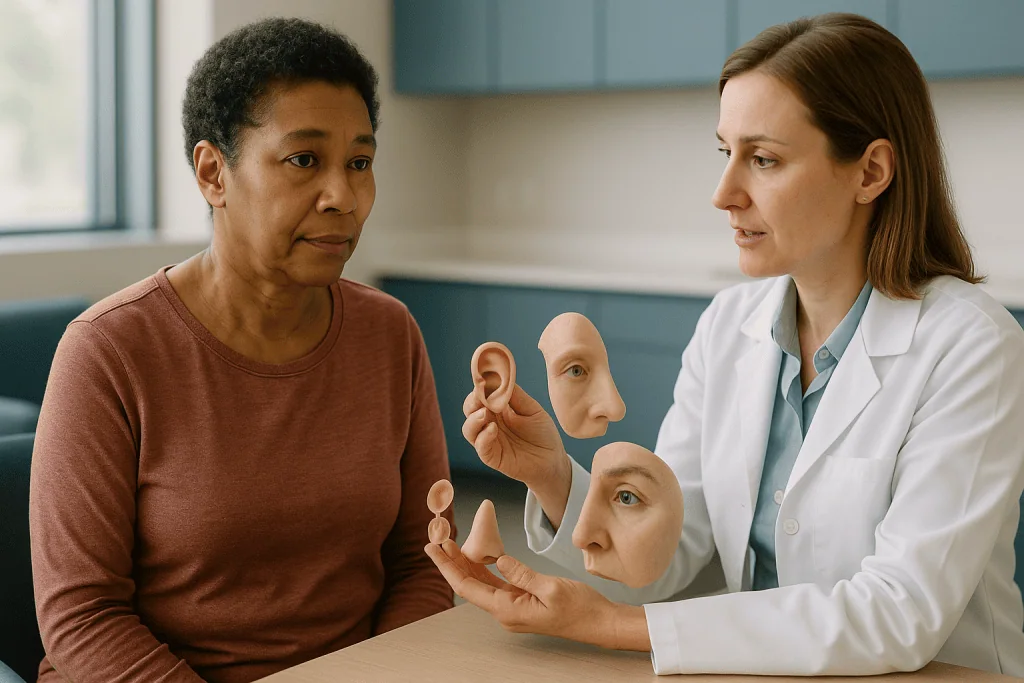
Ocular: the artificial eye alone, usually hard acrylic, worn behind the eyelids when the eyeball has been removed but lids and socket remain. Orbital: a larger silicone piece including eye, eyelids, lashes and surrounding skin, needed when the whole socket contents have been removed, often for tumors. Auricular: an ear, for people born with microtia (an ear that did not fully form) or who lost one to cancer, burns or injury. Nasal: a nose, most often after skin cancer surgery. Midfacial: a combination piece spanning cheek, nose and upper lip, sometimes joined to an obturator inside the mouth so both move as one.
Medical-grade silicone does most of the work because it flexes with the face and can be tinted from within, not merely painted on top. The maker mixes pigment into the silicone to mimic deep skin tones, adds fine fibers to imitate tiny blood vessels, and sculpts pores, freckles and wrinkles by hand or from a mirrored scan of the other side. Eyelashes and eyebrows are set hair by hair.
Honesty about limits matters here. Silicone cannot blink, blush or sweat. Edges that disappear indoors can show at a hairline angle in low sun. Pigments fade with ultraviolet light and skin oils, so pieces are remade periodically rather than lasting a lifetime. Most wearers describe the realistic goal as no longer being noticed, which is a different ambition from being invisible.
Who needs maxillofacial prosthetics, and who is usually asked to wait
The clearest candidates are people whose surgery leaves a defect that cannot be closed with their own tissue, or for whom closing it would be unwise. That includes:
- People after maxillectomy for cancers of the palate, upper gum, sinus or nasal cavity, where the cavity needs to stay visible so the team can watch for recurrence.
- People who have lost an eye and socket, an ear or a nose to cancer, severe infection, burns or trauma.
- Children and adults with congenital differences such as microtia, hemifacial microsomia (one side of the face smaller than the other) or an unrepaired cleft palate.
- People whose earlier surgical reconstruction failed, shrank or did not match well enough to be worn without comment.
- Anyone whose general health, age or wishes make another long operation with a second surgical site unattractive.
Who is usually asked to wait? Timing is almost always about tissue, not eligibility. A definitive prosthesis is rarely made while a wound is still healing, while swelling changes weekly, or during and immediately after radiotherapy, when the lining of the mouth is raw and skin reacts. An interim device may still be worn through that period. Active infection in the cavity, disease that is still progressing, or bone that has not yet shown it will hold an implant are other reasons a team delays the final piece.
A few situations call for a different route. If someone cannot insert, remove and clean a device daily because of hand weakness, vision loss or memory problems, and has no one to help, a fixed surgical reconstruction may serve better. Smoking affects healing around implants, so a team may ask about a plan to stop before implant surgery is scheduled. None of this is a verdict; it is sequencing, and the treating team sets it.
Cleft palate, speech problems and prostheses when the cause is not cancer
Not every obturator follows cancer. Cleft palate, an opening in the roof of the mouth present at birth, is among the more common birth differences; the CDC estimates roughly 1 in 1,700 babies in the United States is born with a cleft palate alone and advises surgical repair within the first 18 months of life, or earlier when possible. For most children, surgery closes the gap and no prosthesis is ever needed.
Prosthetics enter at the edges. Some teams fit a small feeding plate before repair to help an infant form suction; practice varies, and MedlinePlus describes feeding support and a multidisciplinary cleft team as the core of early care. After repair, a fistula (a small hole that reopens along the scar line) can let food into the nose; it may be closed surgically or covered with a thin obturator while a child grows.
The more common adult problem is velopharyngeal insufficiency: the soft palate is present but too short or too weak to lift and seal against the back of the throat during speech, so air escapes through the nose and consonants like p and b lose their pop. Two devices address this. A palatal lift prosthesis has a tail that physically holds the soft palate up, suited to a palate that is long enough but does not move. A speech bulb prosthesis fills the gap behind a palate that is simply too short. Both are shaped with a speech-language pathologist in the room, adjusting the acrylic in small increments while listening.
Trauma, deep facial infections and burns complete the non-cancer list. In each case the questions match those after a tumor: what is missing, what the body can rebuild on its own, and whether a removable piece or a surgical flap serves this person better.
How maxillofacial prosthetics are made: from impression to final fitting
Every prosthesis starts with a copy of the defect. Traditionally that means an impression: a soft material is placed over the area, sets within minutes, and becomes a negative mold from which a plaster model is poured. Increasingly the copy is digital, from a CT scan already taken for cancer staging or from a handheld optical scanner that records the skin surface without touching a tender site. For a missing ear or half a nose, software mirrors the intact side to produce a starting shape that already belongs to that face.
The shape is sculpted in wax, by hand or by 3D printing, and tried in place. This is the appointment where a person looks in a mirror and says ‘wider here’ or ‘my old nose turned up more’, and where the clinician checks that an obturator bulb does not press on raw tissue or block a breath. For intraoral work, bite, speech and swallowing are tested with the wax in position.
Approved wax is converted into a mold and the final material packed in: heat-processed acrylic for a palate, pigmented silicone for skin. Color is matched in daylight against the person’s own face, sometimes with a second shade for seasonal changes in skin tone. Clasps, magnets or implant clips are embedded at this stage.
Then comes delivery and adjustment, plural on purpose. Edges are thinned, pressure spots relieved, hair added. The team is wide: head and neck surgeon, maxillofacial prosthodontist, anaplastologist, dental technician, speech-language pathologist, often an oncologist and a psychologist. Expect several visits across the process rather than one; how many depends on the defect and on how quickly tissues settle, which the team watches rather than predicts.
Adhesive, implants or eyeglass frames: how a facial prosthesis stays in place
The engineering question every wearer asks first is simple: how does it stay on? Three answers exist, often combined.
Anatomy comes first. Inside the mouth, remaining teeth take clasps, and the walls of the surgical cavity can lock a bulb in place. On the face, the undercut of an eye socket or the shelf of an ear canal gives purchase. Eyeglass frames can carry a nose or an orbital piece attached at the bridge, so removing the glasses removes the prosthesis.
Medical skin adhesive is the traditional choice for ears and noses: applied each morning, dissolved with a remover each night. It works, with trade-offs in skin irritation, humidity and edge lifting.
Implants change the equation. Osseointegration is the process by which living bone grows onto a titanium post until the two are structurally joined; small implants placed in the skull or jaw then carry magnets or a bar with clips. The prosthesis snaps on in seconds and does not lift when a person sweats. The catch is bone quality: Mayo Clinic lists jawbone damage among the possible effects of radiation for mouth cancer, so irradiated bone heals less predictably and teams weigh implant placement carefully.
| Method | Usual sites | Strengths | Limits |
|---|---|---|---|
| Anatomy and eyeglass frames | Palate, eye socket, nose | No adhesive, no extra surgery, easy to remove | Depends on remaining structure; glasses must be worn |
| Skin adhesive | Ear, nose, orbit | No extra surgery; quick to start | Daily application; skin irritation; loosens with sweat |
| Implant-retained magnets or clips | Ear, nose, orbit, jaw | Firm hold; thinner edges; fast on and off | Needs surgery and healthy bone; implant hygiene; irradiated bone is a concern |
What the days and weeks after surgery usually look like
Timelines belong to the healing body, so what follows is a typical shape, not a schedule. For maxillectomy with an obturator, hospital days usually begin with the surgical obturator already in place, so swallowing can be tested early, often with a speech-language pathologist watching for coughing that would signal liquid heading toward the airway. Food is soft and cool. Talking is encouraged; it is also the test.
Once the packing comes out, the interim obturator takes over, and the following weeks are a run of short appointments. Swelling shrinks, the cavity changes shape, and the bulb is relined with soft material so the seal holds. A leak at the corner of the mouth or a returning nasal tone is a reason to book a reline, not a sign of failure.
If radiotherapy is planned, the NHS notes it often follows surgery for mouth cancer, and Mayo Clinic lists dry mouth, mouth sores, tooth decay and jawbone damage among its possible effects. Dryness in particular changes how a prosthesis fits and feels; saliva is the natural lubricant between acrylic and gum. Dental checks and fluoride carriers are often added during this period, and the definitive piece waits until acute reactions have settled.
For a facial prosthesis after an eye, ear or nose is removed, the sequence is similar but slower at the front end: skin must mature and, if implants are planned, bone must integrate before the final silicone is cast. Many people wear a temporary piece or a dressing in between.
Then comes the long tail. Tissues keep remodeling for months, children grow, silicone colors fade, and surveillance for recurrence continues. The relationship with the prosthetics team is measured in years rather than appointments.
What is dental prosthetic treatment, and what are the 'four types of prosthetics'?
Searches around this subject run together two neighboring fields, so it helps to separate them. Dental prosthetic treatment, or prosthodontics, replaces missing or damaged teeth and the structures that hold them: crowns that cap a tooth, bridges that span a gap, removable dentures, and implants that act as artificial roots for any of those. MedlinePlus notes that dentures are made to fit an individual mouth and need adjusting over time as gums and bone change. Maxillofacial prosthetics is the subspecialty that extends those skills to the palate, jaws and face.
The ‘four types of prosthetics’ question usually comes from limb prosthetics, where devices are grouped by where the limb ends: below the elbow (transradial), above the elbow (transhumeral), below the knee (transtibial) and above the knee (transfemoral). Maxillofacial work uses a different grouping, and the boundaries are useful because they map to different teams and materials:
- Intraoral: obturators, palatal lifts, speech bulbs, resection dentures.
- Extraoral: ocular, orbital, auricular, nasal and midfacial prostheses.
- Combination: a facial piece joined to an intraoral one through a shared defect.
- Treatment aids: radiation stents, fluoride carriers, surgical splints and positioning devices.
The overlap with dental implants is real, which is why this article sits in that category. The same titanium posts that hold a bridge can hold an obturator or, placed in the skull, an ear. The difference is terrain. Implants in a healthy lower jaw and implants in a radiated upper jaw are not the same proposition, and a general dentist comfortable with the former will usually refer the latter to a hospital-based prosthodontist and surgeon who plan it together with imaging.
Risks, limits and alternatives: prosthesis or surgical reconstruction?
The main alternative to a prosthesis is reconstruction with the person’s own tissue, most often a free flap: a block of skin, muscle or bone taken from the forearm, thigh or lower leg with its blood vessels, then reconnected to vessels in the neck under a microscope. The NHS and Mayo Clinic both describe reconstruction as part of mouth cancer treatment, and for many defects it is the preferred route.
Choosing between the two is a genuine clinical judgment, and reasonable teams differ. A prosthesis avoids a second wound and a longer operation, can be adjusted or remade, and keeps the cavity open to inspection, which matters when recurrence risk is high. A flap is permanent, needs no daily handling, never leaks, and tends to serve better when a defect is very large or when a person cannot manage a removable device. Hybrid plans are common: a flap to rebuild bone, then implants and a prosthesis on top.
Prosthetic risks are mostly about tissue and time rather than danger. Pressure from an ill-fitting bulb can ulcerate the cavity lining. Adhesives can inflame skin. Implants can develop infection in the soft tissue around them, loosen, or fail to integrate, with irradiated bone the recognized worry. Obturators can leak, drop, or be hard to hold in a mouth with few remaining teeth. Silicone stains and tears at thin edges.
There are psychological risks on both sides too: a prosthesis removed each night can feel like a nightly reminder, while a reconstruction that does not match can be harder to revise. A frank conversation about what you want your daily routine to look like belongs in the decision alongside the scan.
What people often get wrong about maxillofacial prosthetics
‘It is basically a denture.’ A denture replaces teeth on a jaw that still has a roof. An obturator rebuilds the roof. Dentures are routine in general practice; obturators and facial prostheses are usually planned in hospital settings with surgeons and radiation oncologists involved, because decisions about tissue, timing and implants are shared.
‘You get it once and you are done.’ Tissues change for months after surgery, children grow, silicone pigments fade in sunlight, and acrylic wears. Relines and remakes are expected, not exceptional.
‘It is only cosmetic.’ An obturator is the difference between drinking from a cup and not. A nasal prosthesis changes how air is warmed and humidified before it reaches the throat. Even pieces that are mostly about appearance are about appearance the way a voice is about communication.
‘Implants can always hold it.’ Implants need enough healthy bone in the right place. Radiation changes bone, as Mayo Clinic notes, and some skull sites are thin. Adhesive and anatomic retention remain the right answer for many people.
‘A good prosthesis is invisible.’ At conversational distance in ordinary light, many are unremarkable. Up close, in strong side light, or after a hot afternoon, edges and sheen can show. Most wearers set a more useful goal: that the first thing people notice is something else.
‘If the prosthesis fits, the cancer is handled.’ A comfortable fit says nothing about what is happening in the tissue underneath. Follow-up imaging and examinations continue on the oncology team’s schedule, and a changing fit is sometimes the first clue that something underneath has changed.
Questions to ask your care team
Bring a list; the appointments are full of new words. These questions clarify the plan without demanding promises nobody can make.
- Which structures will be removed, and will a surgical obturator or temporary piece be placed during the operation?
- Why are you recommending a prosthesis rather than a flap reconstruction for me, or the reverse, and what would change your mind?
- Will I have radiotherapy, and how will that affect the timing of the definitive prosthesis and any plan for implants?
- How will the device be held in place, and what are the daily steps to put it in, take it out and clean it?
- Who adjusts it when it leaks or rubs, and how quickly can I be seen?
- What will my speech and eating be like at each stage, and will a speech-language pathologist be part of my care?
- How often should I expect relines or a remake, and which signs mean I need one sooner?
- What should I avoid: certain foods, swimming, saunas, sun exposure for silicone?
- Who do I contact after hours for bleeding, pain or a piece I cannot insert?
- Is there a psychologist or support group for people adjusting to a facial change?
Write the answers down or ask permission to record them. Ask to see or hold a sample of a similar prosthesis so you know what to expect in your hand. If two specialists give different advice, say so out loud; a joint discussion between surgeon and prosthodontist is normal and often the point at which the best plan emerges. The decision sits with you and your treating team, informed by what the evidence shows and by how you live.
When to call your doctor
Most problems with a prosthesis are fit problems that a quick visit solves. A few signs need a same-day call to your surgical or prosthetics team, and some need emergency care.
Call the team promptly if you notice:
- New or persistent bleeding from the surgical cavity or around implants.
- A new lump, ulcer, white or red patch, or firmness inside the defect or along its edges, or pain that is new rather than familiar.
- Fever, foul odor, pus, or increasing redness and swelling around the prosthesis, cavity or implant skin.
- A prosthesis that suddenly no longer fits or cannot be inserted, since changing anatomy can signal infection, recurrence or bone change.
- Coughing, choking or a wet-sounding voice when drinking, which can mean liquid is reaching the airway.
- Trismus, a tightening of the jaw muscles that limits how far the mouth opens, especially if worsening.
- Numbness, loose teeth, exposed bone, or a wound inside the mouth that does not heal, particularly after radiotherapy.
- Unexplained weight loss or difficulty maintaining nutrition.
- Vision changes, double vision or eye pain around an orbital prosthesis.
Go to an emergency department or call emergency services for heavy bleeding that does not stop with pressure, any difficulty breathing, swelling of the tongue or throat, or a prosthesis or fragment that has been inhaled or swallowed.
Between those extremes, keep your scheduled follow-up. Head and neck cancer surveillance continues for years, and your prosthodontist often sees the tissue more frequently than anyone else. Mention anything that has changed, however small. No device decision, including whether to keep wearing one, should be made alone; your treating team is the right place to bring every one of these questions.
Frequently asked questions
What are some examples of maxillofacial prosthetics?
Common examples are obturators that close a hole in the palate, palatal lift and speech bulb prostheses for nasal-sounding speech, artificial eyes and orbital prostheses, silicone ears and noses, midfacial pieces that combine several features, and treatment aids such as radiation stents and fluoride carrier trays. Each is custom-made from a mold or scan of the individual and is removable for cleaning and inspection.
Can you give me 15 examples of prostheses?
Across the head and face alone: surgical, interim and definitive obturators; palatal lift; speech bulb; mandibular resection prosthesis; implant-supported denture; ocular prosthesis; orbital prosthesis; auricular (ear) prosthesis; nasal prosthesis; midfacial prosthesis; cranial plate; radiation stent; and fluoride carrier tray. Beyond the face, MedlinePlus Magazine and Cleveland Clinic also describe artificial limbs, joint replacements and heart valves as prostheses.
What are the four types of prosthetics?
That phrase usually refers to limb prostheses grouped by level: transradial (below elbow), transhumeral (above elbow), transtibial (below knee) and transfemoral (above knee). Maxillofacial prosthetics uses its own four groups: intraoral devices such as obturators, extraoral devices such as ears and noses, combination pieces that join both, and treatment aids worn during radiotherapy or surgery.
What is dental prosthetic treatment?
Dental prosthetic treatment, or prosthodontics, replaces missing or damaged teeth and supporting structures with crowns, bridges, dentures or implant-supported teeth. MedlinePlus notes dentures are made to fit an individual mouth and need adjustment as gums and bone change. Maxillofacial prosthetics is the subspecialty that extends these skills to defects of the palate, jaws and face after surgery, injury or birth differences.
How long does an obturator prosthesis last after maxillectomy?
There is no fixed lifespan, because the device is remade as the body changes. A surgical obturator is replaced by an interim one within weeks, which is relined repeatedly as swelling settles; a definitive obturator follows once tissues are stable and any radiotherapy is complete. Even the definitive piece is adjusted or remade over the years as gums, bone and remaining teeth change.
Can I eat and drink normally with an obturator?
Many people return to a broad diet once the seal is good, progressing from liquids and soft foods to firmer textures as the team advises. Very sticky or hard foods can dislodge or damage a device, and a leak during drinking usually means a reline is due. A speech-language pathologist and dietitian often guide this progression, and the pace depends on healing and radiotherapy.
Will a facial prosthesis look real?
At conversational distance in ordinary light, a well-made silicone ear, nose or orbital prosthesis is often unremarkable, with skin tone mixed into the material and hair set individually. Up close, in strong side light or after sweating, edges and sheen can show, and silicone cannot blink, blush or move. Colors fade over time, so pieces are remade periodically rather than lasting a lifetime.
Can dental implants hold a facial prosthesis after radiotherapy?
Sometimes, but it is weighed carefully. Implants rely on osseointegration, bone growing onto titanium, and Mayo Clinic lists jawbone damage among possible effects of radiation for mouth cancer, so irradiated bone heals less predictably. Teams consider the dose the bone received, its location and thickness, and overall health before recommending implants; adhesive or anatomic retention remains the choice for many people.
Who makes maxillofacial prostheses?
A maxillofacial prosthodontist, a dentist with extra training in rebuilding head and face defects, usually leads the work, often alongside an anaplastologist who sculpts and colors silicone facial pieces, and a dental technician who processes the materials. Head and neck surgeons, radiation oncologists, speech-language pathologists and psychologists are typically part of the same team, and planning is shared.
Is wearing an obturator painful?
A well-fitting obturator should not hurt, though a new or relined device can feel bulky for a few days while the tongue adapts. Pain, a sore spot or an ulcer under the plate means the fit needs adjusting and should prompt a call to the team rather than waiting. New pain in a cavity that previously felt fine should always be checked, because it can signal infection or recurrence.
References
This article is for general information only and is not a substitute for professional medical advice. Please consult a qualified doctor about your individual situation.

More from the Blog

How Long Do Inlays and Onlays Last? Wear, Bonding Strength and When Replacement Is Discussed
Inlays and onlays usually last many years, and patient-facing sources place comparable restorations in roughly the five-to-fifteen-year range that Cleveland Clinic gives for crowns,…
3-on-6 Dental Implants: How This Full-Arch Alternative Differs From All-on-4
3-on-6 dental implants replace a full arch of teeth using six upright implants that support three separate ceramic bridges, while All-on-4 uses four implants,…
Dental Bone Graft Warning Signs: Exposed Membrane, Persistent Swelling and When to Call
Dental bone graft failure signs include swelling or pain that worsens after the third day instead of easing, a membrane or grayish graft material…
What Happens in Dental Implant Surgery: Flap or Flapless, Drilling and Seating the Post
In dental implant surgery, the area is numbed, the jawbone is reached by lifting a small gum flap or through a small opening (flapless),…

What to Ask Before All On 4: Bridge Material, Bite Design and the Long-Term Maintenance Plan
Before a full-arch fixed bridge on four implants, ask what the bridge will be made of (acrylic on a metal frame, zirconia or metal-ceramic),…
Why Some Teeth Need a Root Canal or Core Build-Up Before a Dental Crown
A dental crown needs a solid tooth underneath to grip. When decay or an old filling has hollowed out much of the tooth, dentists…