

Why CAR-T Patients Need a Caregiver: What Companions Watch for During the First Weeks
Key Takeaways
- US prescribing information for approved CAR-T products asks patients to stay close to the treatment center for at least four weeks after infusion and to avoid driving for about eight weeks.
- Cytokine release syndrome usually begins within the first one to two weeks after infusion, and its mildest grade is defined by a temperature of 38°C (100.4°F) or higher.
- Neurologic effects (ICANS) can start as subtle word-finding trouble or shaky handwriting that the patient does not notice, which is why a companion who knows them well is essential.
- Centers screen for ICANS with a short bedside test covering orientation, naming objects, following a command, writing a sentence and counting backward from 100 by tens.
- Any fever after CAR-T is treated as urgent because clinicians cannot distinguish cytokine release syndrome from infection without assessing the patient.
- A rotating team of reliable adults can satisfy caregiver requirements, and social workers at treatment centers routinely help patients who have no obvious companion.
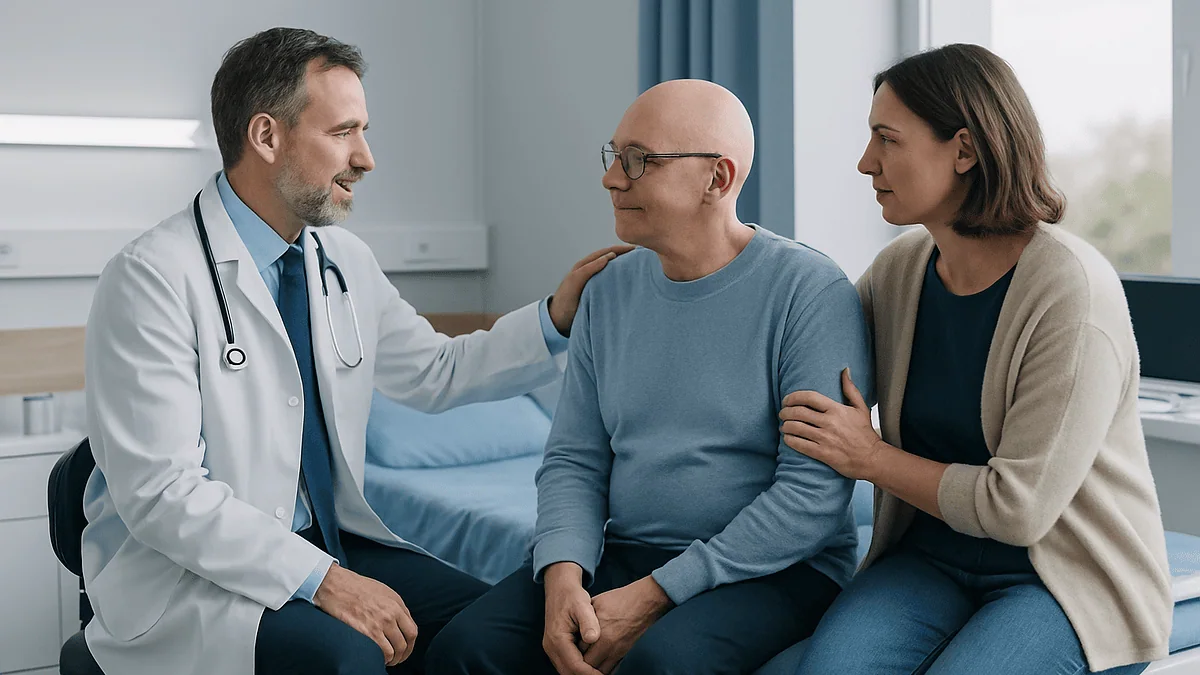
Treatment centers ask CAR-T patients to have a dedicated adult caregiver, usually for at least the first four weeks after the cell infusion, because the most serious side effects, cytokine release syndrome and neurologic changes, can start quickly and the patient may not notice them. The caregiver watches for fever, confusion and drowsiness, keeps the patient near the center, drives, and calls the team promptly.
The nurse slides a folder across the table and asks a question that lands harder than any of the consent forms: “Who will be staying with you?” For many people lining up for CAR-T therapy, that is the moment the treatment stops being a lab story about engineered immune cells and becomes a logistics problem involving a spare bedroom, a car, and someone willing to take four weeks off work.
The question is not a courtesy. CAR-T caregiver requirements exist because the first weeks after infusion can include a high fever that climbs within hours, or a subtle slide into muddled thinking that the patient themselves cannot feel. Someone else has to be the early-warning system.
This explainer walks through what that someone is actually watching for, why the rules are written the way they are, what the calendar usually looks like, and what happens when there is no obvious person to fill the role.
What are CAR-T caregiver requirements, and why do treatment centers insist on them?
Most centers that deliver CAR-T therapy will not schedule the infusion until a patient can name a responsible adult who will be with them around the clock during the early recovery period. The requirement appears in the US prescribing information for approved CAR-T products, which asks patients to remain close to the treatment center for at least four weeks after infusion and to avoid driving or operating heavy machinery for about eight weeks, according to Cleveland Clinic. A patient cannot meet those conditions alone.
The reasoning rests on two side effects that are specific to this treatment. The first, cytokine release syndrome, is a flood of inflammatory signals released as the engineered cells go to work, and it can produce fever, low blood pressure and breathing difficulty. The second is a group of neurologic effects, grouped under the term immune effector cell-associated neurotoxicity syndrome (ICANS), that can begin as mild word-finding trouble and progress to confusion or seizures. The National Cancer Institute describes both as recognized risks that teams monitor closely.
Here is the part that makes a companion non-negotiable: a person developing early neurologic changes often does not realize anything is wrong. They may answer questions a beat too slowly, write their name with a wobble, or insist they feel fine while a family member notices they have asked the same question three times. Fever can spike overnight while the patient is asleep.
A caregiver is therefore less a helper than a monitor. The team cannot observe the patient every hour once they leave the ward or clinic, so the center effectively deputizes a family member or friend, trains them in what to look for, and gives them a phone number that is answered day and night. That is what the requirement really describes.
How CAR-T therapy works, in plain language
CAR-T stands for chimeric antigen receptor T-cell therapy. A T cell is a type of white blood cell that normally hunts infected or abnormal cells; a chimeric antigen receptor is a lab-built protein attached to that cell so it recognizes a specific target on the surface of cancer cells. In short, the patient’s own immune cells are collected, re-engineered to recognize the cancer, multiplied, and returned.
The process has a recognizable sequence. Blood is drawn through a procedure called leukapheresis, in which a machine separates out white cells and returns the rest of the blood to the patient. Those cells travel to a manufacturing facility, where a harmless viral vector inserts the gene for the receptor. The modified cells are grown for a few weeks until there are enough to treat. Meanwhile the patient receives a short course of chemotherapy, often called lymphodepleting chemotherapy, whose purpose is to clear space in the immune system so the returning cells can expand. The cells are then infused through a vein, much like a blood transfusion.
Currently approved products target one of two proteins. CD19 sits on the surface of many B-cell leukemias and lymphomas; BCMA, short for B-cell maturation antigen, is found on the plasma cells involved in multiple myeloma. The National Cancer Institute notes that several CAR-T products have US approval for specific blood cancers, generally after other treatments have stopped working. Which product, if any, applies to a given person is a decision for the treating hematology team, not something a patient chooses from a menu.
Once infused, the cells can persist and keep working for months. That persistence is the point, and also the reason the side effects behave differently from those of a drug that clears the body in days.
How long does CAR-T take, from cell collection to the end of the watch period?
People searching “how long does CAR-T take” usually mean the infusion, which is the shortest part. The bag of cells typically runs in over a matter of minutes to about an hour. The full pathway is longer and has distinct phases that a caregiver needs to plan around.
Collection is usually a single outpatient day, sometimes two. Manufacturing then takes several weeks; Cleveland Clinic describes a window of roughly two to six weeks while the cells are engineered and expanded, during which some patients receive other treatment to keep the cancer in check. Lymphodepleting chemotherapy is given over a few days in the week before infusion.
The watch period begins the moment the cells go in. Many centers admit patients for the first several days, and some deliver the treatment as an outpatient with daily clinic visits; either way, the caregiver role starts at infusion. The prescribing information referenced by Cleveland Clinic asks patients to stay within reach of the center for at least four weeks, because that is when cytokine release syndrome and neurologic effects are most likely to appear. Driving is off the table for about eight weeks, which is also tied to the neurologic risk.
Added together, a realistic planning horizon runs from the first consultation to the end of the close-monitoring phase at roughly two to three months, with the most demanding stretch for the companion being the four weeks after infusion. Follow-up blood tests and imaging continue well beyond that, often for years, because the cells can suppress normal B cells for a long time and infection risk lingers.
Timelines vary with the product, the disease and how the patient responds. Treat the ranges above as a framework for arranging leave and housing, not as a schedule the team has promised.
Who CAR-T is usually for, and who is usually asked to wait
CAR-T is not a first-line treatment for most people. Approved uses in the United States, as summarized by the National Cancer Institute, cover certain B-cell acute lymphoblastic leukemias, several types of B-cell lymphoma, and multiple myeloma, generally after the cancer has returned or failed to respond to earlier therapy. Some lymphoma approvals now allow use earlier in the sequence, and that landscape continues to shift as trial data mature.
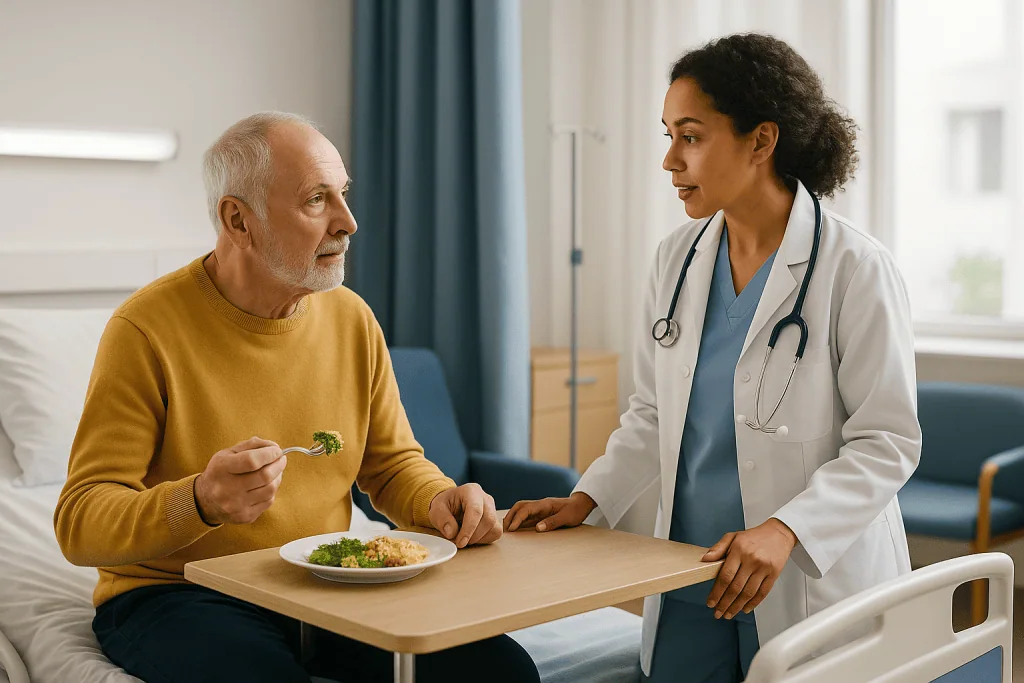
Beyond the diagnosis, teams look at the whole person. Organ function matters because cytokine release syndrome stresses the heart, lungs and kidneys. An active uncontrolled infection usually means waiting, since lymphodepleting chemotherapy lowers defenses further. Significant pre-existing neurologic conditions prompt careful discussion because they can make ICANS harder to recognize and manage. Age by itself is not a barrier; fitness and the ability to tolerate the early side effects count for more.
Then there is the caregiver question, which sits alongside the medical criteria rather than beneath them. A patient who is medically eligible but has no one to stay with them is not automatically excluded, but the team will pause until a workable plan exists. That might involve a rotating group of family members, a friend who can commit to the four-week window, or a social work referral to explore other arrangements.
People asked to wait are often told why in plain terms: the cancer may need to be controlled first with another treatment, a lung infection may need to clear, or the cell manufacturing slot may not be available yet. Waiting is frustrating, but it generally reflects an effort to time the infusion for when the body can handle what follows. Every one of these judgments belongs to the treating hematology team, who can see the full picture of blood counts, scans and prior treatments.
Cytokine release syndrome: the first thing a companion watches for
Ask any CAR-T nurse what a caregiver should fear most in week one and the answer is usually a fever. Cytokine release syndrome, often shortened to CRS, is the body’s reaction to a surge of signaling proteins called cytokines that the activated T cells release as they attack the cancer. It is, in a sense, proof the cells are working, but it has to be managed.
The international grading system used by most centers defines the mildest grade of CRS by a temperature of 38°C (100.4°F) or higher, with more severe grades marked by falling blood pressure needing medication and low oxygen needing support, as published in the consensus statement on PubMed. That threshold is why caregivers are told to check temperature at least twice a day and any time the patient feels off. A reading at or above the line is a call to the team, not a wait-and-see.
Timing is fairly predictable. Cleveland Clinic describes CRS as usually beginning within the first one to two weeks after infusion, with the earliest cases starting within days. The pattern often opens with fever and flu-like aching, sometimes with chills, headache, nausea or a racing pulse. In more severe cases the blood pressure drops, the patient feels faint on standing, and breathing becomes fast or shallow.
Treatment exists and is well rehearsed. Teams use medicines that block the main inflammatory cytokine, and sometimes corticosteroids, alongside fluids and oxygen as needed. Severe CRS is managed in hospital, occasionally in intensive care. What a caregiver can do is narrow but essential: measure, record, and report early. A fever caught at 38.1°C and called in promptly is a very different clinical situation from one discovered the next afternoon at 40°C with the patient dizzy and confused.
Neurologic effects (ICANS) and why the team may ask your companion to check your handwriting
Caregivers often find the neurologic side effects more unsettling than the fever, because they can creep in. Immune effector cell-associated neurotoxicity syndrome, known as ICANS, is a set of brain-related effects linked to the same inflammatory process that drives CRS. It can appear on its own or after CRS has started, and Cleveland Clinic lists confusion, difficulty speaking, tremor, drowsiness and seizures among the possible signs.
Centers use a short bedside assessment to catch it early. The consensus grading tool published on PubMed scores orientation (year, month, city, hospital), naming three everyday objects, following a simple command, writing a standard sentence, and counting backward from 100 by tens. Many teams send patients home with a card and ask the caregiver to run through it once or twice a day. A sentence that was neat on Monday and shaky or misspelled on Wednesday is exactly the kind of change the test is designed to surface.
What makes this hard is that the earliest sign is often a change only someone who knows the person well would notice. A talkative partner goes quiet. A precise engineer cannot find the word for “kettle.” A grandparent nods off mid-sentence in the afternoon. None of these is dramatic. All of them warrant a phone call.
Management depends on severity and commonly involves corticosteroids to dampen inflammation, close neurologic observation in hospital, and anti-seizure medication where the team judges it necessary. Most episodes resolve, but severe cases can be dangerous, which is why the driving restriction runs for about eight weeks and why patients are asked not to make major decisions, sign documents or care for small children alone during the early phase. The caregiver’s job is observation and communication; deciding what to do next is the clinical team’s.
CAR-T side effects in the first weeks: what to watch, when, and what to do
The early effects of CAR-T cluster into a few recognizable groups, each with a typical window and a specific thing the caregiver can observe. The table below is a planning aid drawn from the sources cited in this article, not a substitute for the instructions a center gives at discharge, which will be specific to the product and the person.
| Effect | Typical window after infusion | What a caregiver watches | Action |
|---|---|---|---|
| Cytokine release syndrome | Usually first 1–2 weeks (Cleveland Clinic) | Temperature 38°C or higher, chills, fast pulse, faintness, fast breathing | Call the team at the first fever; do not wait for a second reading |
| Neurologic effects (ICANS) | Often within the first 2 weeks, sometimes after CRS | Confusion, word-finding trouble, shaky handwriting, excessive sleepiness, tremor, seizure | Call immediately; if a seizure or unresponsiveness, call emergency services |
| Low blood counts | Days to weeks, can persist for months | Unusual bruising, bleeding gums, nosebleeds, breathlessness, pallor | Report new bleeding or breathlessness the same day |
| Infection | Weeks to many months | Fever, cough, sore throat, painful urination, redness at the line site | Any fever is treated as urgent regardless of cause |
| Fatigue and appetite loss | Throughout the first month | Fluid intake, weight, ability to get out of a chair | Mention at scheduled visits; call if the patient cannot keep fluids down |
Two features of the table deserve emphasis. First, fever appears in more than one row because it does not matter whether the cause is CRS or infection; the response is the same prompt call. Second, the neurologic row is the one where the caregiver’s familiarity with the patient’s normal self adds something a clinician cannot replicate. The National Cancer Institute notes that these effects are usually managed when caught early, which is the whole argument for the requirement.
CAR-T caregiver responsibilities, hour by hour and day by day
Strip away the medical vocabulary and the role is a set of concrete tasks. Being honest about them before infusion day helps the companion decide whether they can realistically commit, and helps the patient feel less like a burden.
The daily core is monitoring. That means a temperature reading morning and evening, more often if the patient feels unwell, written in a notebook or app with the time. It means running the short orientation and handwriting check the team provides. It means watching the person eat, drink and walk, and noticing when any of those gets harder.
Transport is the second pillar. Because driving is restricted for about eight weeks, per the prescribing information cited by Cleveland Clinic, the caregiver drives to every clinic visit and must be ready to drive to the emergency department at two in the morning. Keeping the car fueled and the parking details for the center saved in a phone is not trivial preparation.
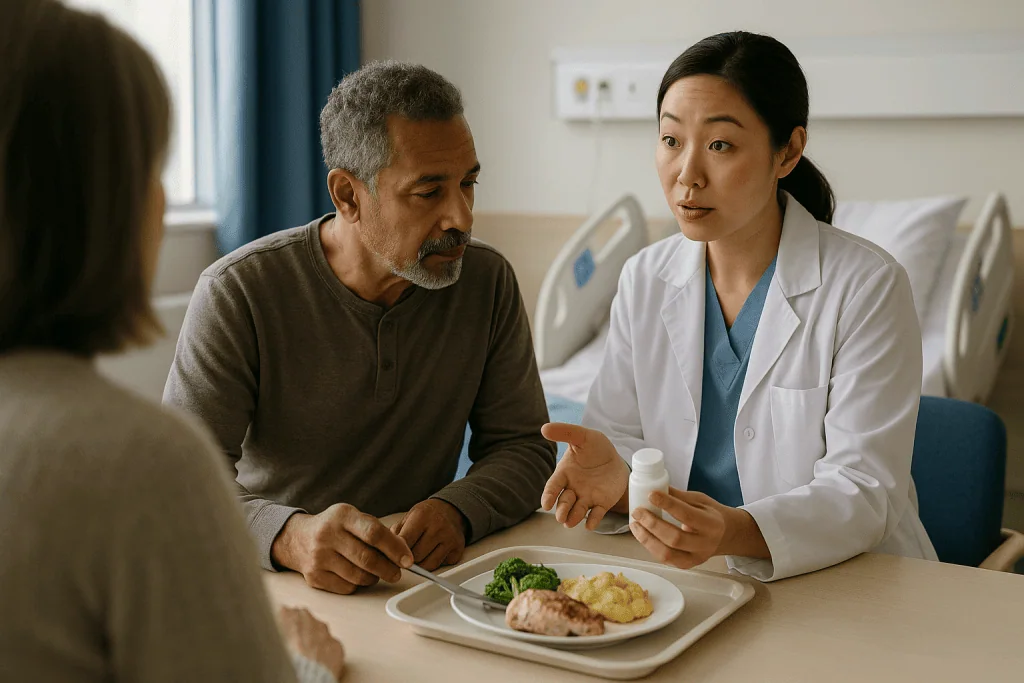
Medication oversight sits third. Patients leave with prescriptions, often including preventive antimicrobials and sometimes anti-seizure medication. A caregiver does not decide what to take; the team does. The caregiver keeps the schedule visible, confirms each dose was taken, and reports a missed one rather than improvising.
Then there is the household layer that is easy to forget: shopping, cooking food that is safe for someone with a weakened immune system, keeping visitors with colds away, maintaining a clean bathroom, and handling the paperwork that accumulates. The MedlinePlus caregivers page is a useful plain-language starting point for anyone new to this kind of role.
Finally, the companion is the communication hub. They answer the nurse’s call, relay the overnight temperature log, and ask the question the patient was too tired to ask. Done well, this role lets the patient simply recover.
What the first weeks after CAR-T usually look like
No two recoveries match, but a typical arc has a shape that caregivers find reassuring to know in advance.
Days 0 to 3 are often quiet. The infusion itself is undramatic, and many patients feel surprisingly ordinary for a day or two. Teams use this time to make sure the caregiver knows how to reach them and to confirm lodging is within the required distance. Where the center keeps patients in hospital, the caregiver may be asked to be present for much of the day anyway, partly so staff can show them the daily checks.
Days 3 to 14 are the stretch where cytokine release syndrome and neurologic effects are most likely, as described by Cleveland Clinic. A caregiver may see a fever one evening, a clinic visit the next morning, a few nights back in hospital, then discharge again. That back-and-forth is common and does not mean something has gone wrong with the treatment. Fatigue is near-universal; a walk to the mailbox can feel like a hike.
Days 14 to 28 usually bring gradual steadiness. Blood counts may still be low, so infection precautions remain strict, but the daily neurologic checks tend to become routine. Appetite often returns before energy does. The team continues scheduled visits and will typically tell the patient when they may move further from the center, which is generally after the four-week mark referenced in the prescribing information.
Beyond week four, the caregiver’s role shifts from monitor to supporter. Driving remains restricted until the team lifts it. Blood tests continue to track counts and immune recovery, and the first response assessment, usually imaging or marrow testing, happens on a schedule the team sets. Patients commonly describe this phase as the first time they let themselves believe recovery is underway.
Infections, low blood counts and why a small fever is never small
The dramatic side effects get the attention, but infection is the slower risk that shapes caregiving for months. Three things stack up against the patient. Lymphodepleting chemotherapy lowers white cells before infusion. CAR-T cells aimed at CD19 or BCMA also wipe out healthy B cells, the cells that make antibodies, and that depletion can last a long time. On top of that, the inflammation of CRS and the steroids used to manage it further blunt defenses. The National Cancer Institute lists infection among the recognized risks of the treatment.
For a caregiver this translates into a few firm habits. Hand washing before preparing food and after any outing. Keeping anyone with a cough, cold or stomach bug out of the house, including beloved grandchildren, until the team says otherwise. Cooking food thoroughly and avoiding unpasteurized products and raw sprouts, in line with the food safety advice the center provides. Checking the skin around any central line each day for redness, swelling or discharge.
Low platelets and red cells add a second layer. Bruising that appears without a bump, bleeding gums when brushing teeth, or new breathlessness on the stairs are worth reporting the same day. Some patients need transfusions in the first weeks; that is a routine support, not a setback.
The rule that unifies all of this is simple and worth repeating to every household member: a fever at or above 38°C is urgent, even if the patient feels well, even if it is a public holiday, even if it is probably a cold. The team cannot tell CRS from a bloodstream infection over the phone, and both are treated as emergencies in this population. Caregivers who internalize that rule rarely regret the call.
What if you don't have a caregiver for CAR-T?
This is one of the most searched questions about the treatment, and it deserves a straight answer: not having an obvious companion is common, and it is a problem teams expect to solve rather than a reason to say no.
Start by widening the definition. The requirement is for a responsible adult who can be present and reachable, not necessarily a spouse or an adult child. Centers routinely accept a rotating team: a sibling for week one, a friend for week two, a neighbor who covers nights. What matters is that someone is always on duty, that each person has been shown the daily checks, and that there is a written handover so nothing falls through the cracks when the shift changes.
Social workers and patient navigators at treatment centers are the next step. They deal with this situation often and may know of local arrangements, community volunteer programs, or faith-based groups that provide companions. They can also advise on employer leave schemes, since a caregiver’s ability to take time off is frequently the hidden obstacle. The MedlinePlus caregivers page links to national resources for people taking on care roles.
Some centers have adapted their models. A few deliver CAR-T largely as an inpatient treatment for people without home support, keeping the patient under observation through the highest-risk window and only discharging once a plan exists. Others use remote temperature and symptom monitoring to reduce, though not remove, the need for in-person oversight. Availability of these options varies by center and product, and the only way to know what applies is to ask the team early.
What does not work is pretending. A patient who names a caregiver who cannot actually be present puts themselves at real risk during the exact days when confusion or fever would go unnoticed. Raise the gap at the first consultation, when there is time to build a workable plan.
What people often get wrong about CAR-T caregiver requirements
Myths cluster around this treatment, partly because it is new and partly because the language is intimidating. A few deserve direct correction.
“The caregiver needs medical training.” They do not. The required skills are reading a thermometer, running a five-question check, keeping a log and making a phone call. Centers teach these before infusion. Attentiveness beats expertise.
“If the patient feels fine, the rules can relax.” Feeling fine is exactly the trap with neurologic effects. Someone developing ICANS commonly reports feeling well while failing the handwriting test. The four-week proximity rule and the eight-week driving restriction described by Cleveland Clinic apply regardless of how the patient feels day to day.
“A fever means the treatment has failed.” Often the reverse. Cytokine release syndrome is driven by the engineered cells activating, as Cleveland Clinic explains. It must be managed promptly, but it is not evidence that the cells are not working.
“Once the infusion is done, the hard part is over.” For the patient, the infusion is the easy part. The demanding phase is the two to four weeks afterward, for both patient and companion.
“Caregiving ends at week four.” The intense monitoring usually eases then, but infection precautions, driving restrictions and follow-up visits continue for weeks to months. Plan for a long tail, not a cliff edge.
“Only a family member counts.” Any reliable adult the patient trusts can fill the role, and shared rotas are widely accepted.
The thread connecting these misconceptions is a tendency to underestimate the first month and overestimate what the role demands in skill. Correcting both makes the plan more realistic and the companion more confident.
Questions to ask your care team before the infusion
The pre-infusion consultation is dense, and families often leave with the feeling they forgot to ask the obvious thing. Bringing a written list, and having the caregiver present, changes the quality of that conversation. These questions are a starting point; the team’s answers will be specific to the product and the person.
- How many days do you expect the patient to be in hospital after infusion, and will the caregiver need to be present during that time?
- How close to the center do we need to stay, for how long, and what counts as close enough?
- Exactly what should the caregiver check each day, and how often, and can we practice the neurologic test now?
- What temperature should trigger a call, and which number do we call at night and on weekends?
- Which symptoms mean call the team, and which mean call emergency services directly?
- What medicines will the patient go home with, what is each one for, and what should we do if a dose is missed?
- How long is driving restricted, and who tells us when it can resume?
- Which foods and activities are off limits while blood counts are low, and for how long?
- Can visitors come, and what rules apply to children and anyone who has been unwell?
- If our planned caregiver becomes ill or unavailable, what is the backup plan?
- Is there a social worker or navigator we can contact about leave from work or lodging?
- When will the first assessment of how the cancer has responded take place?
Ask also how the team prefers to receive the daily log, whether by phone, portal message or at visits, and whether they want it even when everything looks normal. A short written summary from the clinic of the answers to these questions, pinned to the refrigerator, becomes the caregiver’s reference during a 3 a.m. decision. Every one of those decisions still belongs to the clinicians; the list simply makes sure the companion knows how to reach them and what to say.
When to call your doctor: red-flag signs for CAR-T caregivers
Centers give each patient a direct line for the first weeks and expect it to be used. Err on the side of calling. The signs below, drawn from the risks described by the National Cancer Institute and Cleveland Clinic, are the ones that should never wait for the next scheduled visit.
Call the treatment team right away for:
- Temperature of 38°C (100.4°F) or higher, even once, even without other symptoms.
- Chills, shaking, or a pulse that feels fast at rest.
- Dizziness or faintness when standing, which can signal falling blood pressure.
- Any new confusion, trouble finding words, slurred speech, a changed or shaky handwriting sample, or unusual sleepiness.
- Tremor, new headache that does not settle, or difficulty following simple instructions.
- New bruising, bleeding that will not stop, blood in urine or stool.
- Cough, breathlessness, pain on urination, or redness and swelling at a line site.
- Inability to keep fluids down for more than a few hours.
Call emergency services, then the team, for:
- A seizure, or the patient cannot be woken.
- Severe difficulty breathing or lips turning blue.
- Chest pain.
- Sudden weakness on one side of the body or a sudden inability to speak.
When calling, state that the patient has recently had CAR-T therapy and the date of infusion; that sentence changes how quickly the person is assessed. Bring the temperature log, the medication list and the center’s contact card to any emergency department.
Caregivers sometimes worry about calling too often. Clinical teams would far rather take ten unnecessary calls than miss one early fever. The decision about what happens next, whether a clinic review, admission or reassurance, always rests with the treating team. The caregiver’s part ends with the call being made.
Frequently asked questions
What are the basic CAR-T caregiver responsibilities?
A CAR-T caregiver checks the patient’s temperature at least twice daily, runs a short daily orientation and handwriting test, keeps a written log, drives to all appointments, oversees the medication schedule the team sets, enforces infection precautions at home, and calls the team at the first sign of fever, confusion or unusual sleepiness. No medical training is needed; centers teach the checks before infusion.
How long does CAR-T take from start to finish?
The infusion itself takes minutes to about an hour, but the full pathway spans roughly two to three months. Cell collection is usually one day, manufacturing takes about two to six weeks according to Cleveland Clinic, lymphodepleting chemotherapy occupies a few days before infusion, and the closest monitoring period runs at least four weeks afterward. Follow-up blood tests continue for many months.
What is one major side effect of CAR-T therapy?
Cytokine release syndrome is the signature side effect. It is an inflammatory reaction caused by the activated CAR-T cells releasing signaling proteins, and it typically produces fever, sometimes with low blood pressure and breathing difficulty, usually within the first one to two weeks after infusion. Teams manage it with cytokine-blocking medicines, steroids and supportive care, which is why early reporting of fever matters so much.
Which CAR-T side effects appear in the first weeks after infusion?
The first weeks can bring cytokine release syndrome, neurologic effects such as confusion, tremor or drowsiness, low blood counts leading to bruising or breathlessness, infections because the immune system is suppressed, and heavy fatigue with reduced appetite. Most begin within the first two weeks, which is the period caregivers monitor most closely, though infection risk and low counts can persist for months.
What if I don't have a caregiver for CAR-T?
Tell the team at the first consultation. The requirement can be met by a rota of several reliable adults rather than one person, and center social workers and navigators regularly help patients build a plan, explore volunteer or community programs, and sort out leave from work. Some centers can keep patients in hospital through the highest-risk window when home support is limited.
Which CAR-T cell therapies are FDA-approved?
The US Food and Drug Administration has approved several CAR-T products, each targeting either the CD19 protein found on many B-cell leukemias and lymphomas or BCMA, a protein on the plasma cells involved in multiple myeloma. Approvals are tied to specific diagnoses and prior treatment history. Which product, if any, is appropriate for an individual is a decision for the treating hematology team.
How successful is CAR-T therapy for multiple myeloma?
BCMA-directed CAR-T products are approved for multiple myeloma that has returned after several earlier lines of treatment, and the National Cancer Institute notes that many patients in trials have had meaningful responses. Response rates and how long responses last vary with the product, the disease and prior therapy, so the only reliable estimate for an individual comes from the treating team reviewing their specific situation.
Why can't CAR-T patients drive for about eight weeks?
The driving restriction exists because neurologic effects such as confusion, drowsiness, tremor or seizures can appear in the weeks after infusion, sometimes without warning and sometimes without the patient noticing. Cleveland Clinic summarizes the prescribing information as advising against driving or operating heavy machinery for roughly eight weeks. The caregiver handles transport until the treating team lifts the restriction.
Does the caregiver need to stay overnight with the patient?
Usually yes, for the period the center specifies, typically the first four weeks after infusion. Fever and neurologic changes can develop overnight, and the patient may not wake or recognize the problem. If a single person cannot cover every night, a rota of adults who have each been shown the daily checks is generally acceptable, as long as someone is always present and reachable.
How do caregivers check for neurologic side effects at home?
Teams often provide a short daily test: ask the year, month, city and hospital name; have the patient name three objects; give a simple command; ask them to write a set sentence; and have them count backward from 100 by tens. Compare each day’s handwriting with the first sample. Any slip, slowness or new drowsiness should be reported the same day.
References
- Cleveland Clinic: CAR T-Cell Therapy
- Cleveland Clinic: Cytokine Release Syndrome
- MedlinePlus: Caregivers
This article is for general information only and is not a substitute for professional medical advice. Please consult a qualified doctor about your individual situation.
Add us as a Preferred Source to see more of our trusted health content across Google Search, AI Overviews and Discover.

More from the Blog
Seeking a Second Opinion on a Cervical Cancer Plan: What to Bring and What to Ask
A cervical cancer second opinion means asking a different gynecologic oncology team to review your biopsy slides, imaging, and stage and say whether they…

How Skin Cancer Treatment Is Planned: Why Type and Depth Matter More Than Size Alone
Skin cancer treatment is planned around the cancer's type, its depth and its location, not simply how wide it looks. Basal cell carcinoma, squamous…
What Tumor Markers and Scans Tell Your Team Before Testicular Cancer Surgery
Before testicular cancer surgery, three blood tests, alpha-fetoprotein (AFP), human chorionic gonadotropin (hCG) and lactate dehydrogenase (LDH), together with a scrotal ultrasound and usually…

Can You Stay on Blood Thinners for Brachytherapy? What Your Team Checks First
Many people can stay on blood thinners for brachytherapy, but it depends on which medicine you take, why you take it, and how the…

How Family Can Support Someone Through Melanoma Treatment: Appointments, Skin Checks, Morale
Family can support someone through melanoma treatment by acting as a second set of ears at appointments, helping with regular skin and scar checks…
What CA-125 and Imaging Can and Cannot Tell You Before Ovarian Cancer Treatment
A CA-125 blood test measures a protein that is often, but not always, raised by ovarian cancer; it also rises with endometriosis, fibroids, menstruation…