

Why Do Pelvic Floor Assessment and Urodynamic Testing Come Before Prolapse Surgery?

Key Takeaways
- The front wall of the vagina is also the back wall of the bladder, which is why an anterior prolapse can kink the urethra and both cause and conceal urinary symptoms.
- Occult stress incontinence is leakage that appears only when the prolapse is held back in position, and reduction testing during urodynamics is designed to reveal it before surgery does.
- A randomized trial indexed on PubMed found that adding a sling during prolapse repair reduced later incontinence but increased bladder injuries, infections and early emptying problems, so the choice is a trade-off.
- Prolapse is staged 0 to 4 on the POP-Q scale, yet no stage automatically requires surgery; symptoms and failed conservative measures drive the decision.
- A full urodynamic study typically takes 30 to 60 minutes and leaves mild burning for a few hours; severe pain is uncommon and sedation is not normally needed.
- Vaginal mesh for prolapse has been paused in UK routine practice after complications, and no new device or energy-based treatment has displaced native-tissue repair, pessaries or pelvic floor training.
Pelvic floor assessment and urodynamic testing come before prolapse surgery because a dropped bladder, uterus or vaginal wall can disguise how the bladder actually works. Lifting the prolapse may unmask stress incontinence, worsen emptying problems or leave an overactive bladder untreated. Measuring pressure, flow and leakage first lets the surgical team plan the right operation, set realistic expectations and decide whether a continence procedure should be discussed at the same time.
The appointment was supposed to be about dates. She had lived with the dragging, something-is-falling feeling for two years, had worn a pessary for one of them, and had finally said yes to an operation. Then the surgeon slid a leaflet across the desk: before anything was booked, she would need a bladder study. A catheter. Pressure readings. Coughing on command. Her first thought was that someone had decided she was not telling the truth about her symptoms.
That reaction is common, and it misses the point. Prolapse urodynamic testing is not a loyalty test. It is the closest thing medicine has to watching the bladder do its job while a prolapse is in the way, and then predicting what it will do once the prolapse is no longer in the way.
This explainer walks through what the pelvic floor assessment and the bladder study involve, what they can and cannot predict, how uncomfortable they really are, and why surgeons who have seen a few unhappy post-operative surprises tend to insist on them.
What is pelvic organ prolapse, and why does the bladder matter so much?
Pelvic organ prolapse is the downward slip of the bladder, uterus, bowel or top of the vagina out of position because the supporting muscles and connective tissue have stretched or torn. Picture a hammock that has lost its tension: the organs resting on it sag toward, and sometimes through, the vaginal opening. The NHS lists childbirth, aging, long-term straining and heavy lifting among the usual contributors, and notes that many women have some degree of prolapse without ever noticing it.
The bladder sits at the center of this story for an anatomical reason. The front wall of the vagina is also the back wall of the bladder. When that wall bulges, the bladder comes with it, a pattern called a cystocele, or anterior prolapse. The urethra, the short tube that carries urine out, is anchored to the same tissue. If the support fails, the urethra can kink, drop or lose the backstop it needs to stay closed during a cough.
That is why prolapse and bladder symptoms arrive together so often: a slow stream, the need to press on the bulge to empty, repeated urinary infections, urgency that appears from nowhere. Mayo Clinic describes these overlapping complaints as a routine part of the prolapse picture rather than a separate problem.
Here is the catch that drives the whole pre-operative pathway. A prolapse can both cause bladder trouble and hide it. The same kink that makes emptying difficult may also be pinching the urethra shut, quietly preventing leakage. Correct the kink and the leak can appear. Surgeons want to know which situation they are looking at before they change the anatomy.
What does a pelvic floor assessment for prolapse actually involve?
A pelvic floor assessment for prolapse is a structured physical examination rather than a machine-based test. It usually comes first, and its findings decide whether urodynamics is worth doing at all.

The clinician begins with the history: when the bulge is worst, whether it changes through the day, what happens with coughing, lifting and intercourse, and how the bowel behaves. Many teams ask for a bladder diary, a record over two or three days of what was drunk, how often urine was passed and any leaks. MedlinePlus describes the diary as one of the simplest tools for sorting bladder complaints into patterns.
The examination itself is done lying down and often again while standing or straining, because a prolapse that hides at rest can descend fully with a push. Clinicians commonly grade the descent with the Pelvic Organ Prolapse Quantification system, known as POP-Q, which measures specific points of the vaginal wall against the opening and assigns a stage from 0 (no descent) to 4 (complete eversion). Mayo Clinic and NIH patient material both reference this staging as the mainstream standard.
Muscle function is tested next. The clinician asks for a squeeze and a bear-down, feeling for strength, endurance and whether the contraction is coordinated. Pain on touch, scarring from previous births or surgery, and skin changes from estrogen loss are all noted. Some teams add a post-void residual, an ultrasound or catheter measurement of how much urine is left after emptying.
None of this is dramatic. Yet it answers the first big question: is the bladder symptom mechanical, muscular or neither? Only after that does anyone talk about pressure catheters.
What is prolapse urodynamic testing, and what actually happens in the room?
Urodynamic testing is a group of measurements that record how the bladder fills, how much pressure it generates, how well it empties and whether it leaks under stress. The NIH describes it as the test family used when symptoms and examination alone do not explain what the bladder is doing.
The sequence is predictable. You empty your bladder into a special toilet that records flow rate and volume, a step called uroflowmetry. A thin catheter is then passed into the bladder, and often a second, even thinner one into the rectum or vagina to measure pressure inside the abdomen. The difference between the two readings reveals what the bladder muscle, the detrusor, is doing on its own.
Sterile fluid is run slowly into the bladder while a computer traces the pressures. You will be asked to report the first sensation of filling, the first real urge and the point where you would normally hurry to a toilet. At intervals you cough or strain. If urine escapes, the trace shows exactly how much pressure it took, which is the heart of a stress incontinence diagnosis.
In prolapse urodynamic testing there is one extra move. The clinician gently holds the prolapse back in its normal position, with a finger, a swab or a pessary, and repeats the coughing. This reduction step imitates what surgery will do to the anatomy and is where hidden leakage tends to show itself.
Finally you empty again with the catheter in place, so flow and pressure are measured together. Some centers add X-ray or ultrasound imaging during the study, called video-urodynamics. Cleveland Clinic puts the whole appointment at roughly 30 to 60 minutes.
Is urodynamic testing painful? An honest account
Short answer: most people describe it as undignified and mildly uncomfortable rather than painful. The catheters used are much thinner than the ones placed for surgery, and the NIH notes that the main sensations are pressure, a brief sting as the tube passes, and a strong need to urinate as the bladder fills. That last one is deliberate; the test is trying to reach your real limits.
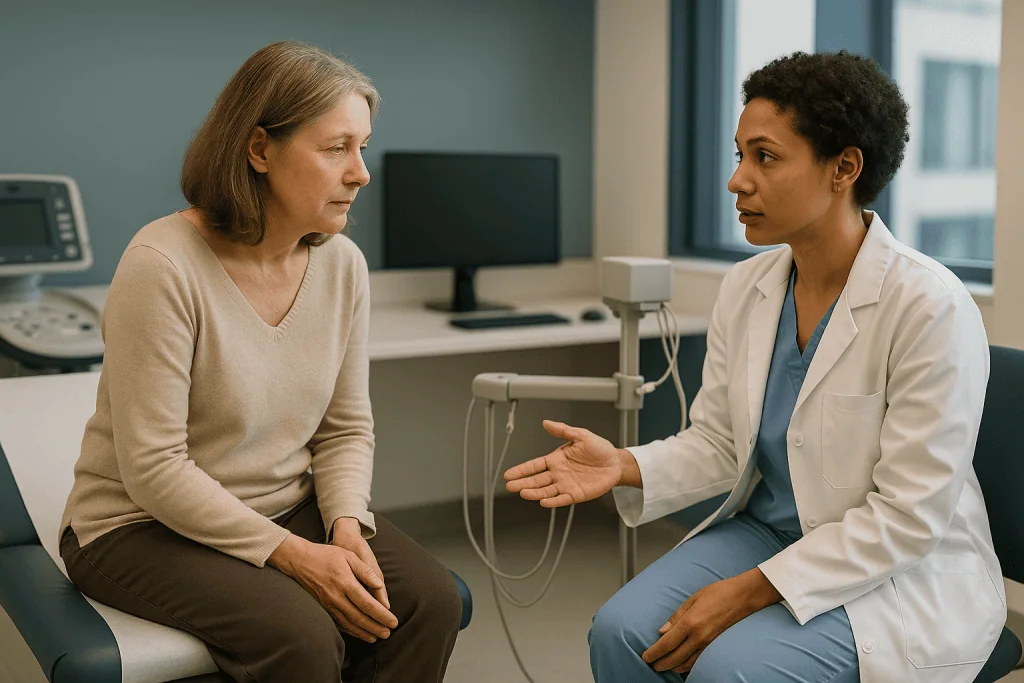
The awkward part is psychological. You are asked to cough, strain and eventually urinate with staff present and tubes in place. People who go in expecting a private procedure find this harder than the physical sensations. Teams who do these studies daily are matter-of-fact about it, and saying so out loud at the start often helps.
Afterward, a burning feeling on the first few trips to the toilet and a trace of pink in the urine are common. The NIH advises that these settle within a few hours in most cases and that drinking fluids helps flush the bladder. Some clinicians warm the bladder fluid or offer a numbing gel at the urethra; whether that is used depends on the local protocol.
How does it compare with cystoscopy? Cystoscopy is a different test in which a slim camera is passed into the bladder to look at the lining. It is shorter and does not involve filling to capacity, but the instrument is wider than a urodynamic catheter and the moment of passage is often felt more sharply. Neither is considered a painful procedure in the way an operation is, and neither normally needs sedation. Which feels worse is genuinely individual, and your team can tell you what they typically hear from their own patients.
Occult stress incontinence prolapse: the leak a prolapse can hide
Stress urinary incontinence is leakage during a cough, sneeze, laugh or lift, when a sudden rise in abdominal pressure overwhelms the urethra’s ability to stay shut. Occult, or hidden, stress incontinence is the version that only appears once a prolapse is pushed back into place. The woman has no leaks in daily life. On the examination couch, with the bulge reduced and a cough, urine escapes.
The mechanism is mechanical and almost elegant. A large anterior prolapse pulls the urethra downward and bends it, acting like a crimp in a garden hose. Pressure that would normally force urine out cannot get past the kink. Repair the prolapse, straighten the hose, and the weakness that was always present in the sphincter is suddenly exposed.
This is the scenario surgeons are most anxious to catch, because the trade feels cruel to the patient: she came in with a bulge and leaves with a bulge fixed and a new leak. MedlinePlus and Mayo Clinic both flag new-onset incontinence as a recognized consequence of prolapse repair rather than a rare fluke.
Finding occult leakage changes the conversation. The options are broadly three: repair the prolapse alone and treat any leak afterward if it appears; add a continence procedure, usually a midurethral sling (a narrow strip of material placed under the urethra for support) at the same operation; or try a pessary for a few weeks to see whether reduction produces leaks in real life before committing to anything.
None of these is automatically right. What the assessment does is replace guesswork with a measured finding, so the choice is made with the patient rather than for her.
Why is urodynamic testing before prolapse surgery done? What the evidence shows
The honest position is that urodynamics is a widely used tool whose value depends on the question being asked. For a woman with pure, demonstrable stress incontinence and no prolapse, trials have found that routine urodynamics adds little to a careful office evaluation. Prolapse is a different situation, because the anatomy about to be changed is the very thing distorting bladder behavior.
The best-known evidence on the hidden-leak problem comes from a randomized trial published in the New England Journal of Medicine and indexed on PubMed, in which women having vaginal prolapse repair, without pre-existing stress incontinence, were randomly given a midurethral sling or a sham incision at the same operation. Fewer women in the sling group had urinary incontinence at three and twelve months, but the sling group also had more bladder injuries during surgery, more urinary tract infections and more difficulty emptying in the early weeks. The trial’s take-home was a trade-off, not a free win.
That is precisely why testing earns its place. If reduction testing shows no leakage, many teams feel more comfortable doing a prolapse repair alone and avoiding the added risks of a sling the woman may never need. If leakage is clear and reproducible, the sling discussion becomes concrete rather than hypothetical.
Urodynamics also catches two other patterns that matter for planning. A bladder that contracts weakly during emptying predicts a higher chance of needing a catheter for a while after surgery. A bladder that contracts involuntarily during filling, called detrusor overactivity, warns that urgency will probably persist after the bulge is gone and needs its own management, which the NIH describes as a separate treatment track.
Who is usually offered prolapse urodynamic testing, and who is asked to wait?
Not every woman heading toward prolapse surgery needs a full bladder study, and the decision is a clinical judgment rather than a rule. Patterns do exist, though.
Testing is most often requested when the prolapse is large enough to be pushed back during examination, especially an anterior prolapse at stage 2 or beyond on the POP-Q scale, because that is where hidden stress incontinence is most likely. It is also common when symptoms do not add up: urgency without an obvious cause, emptying difficulty out of proportion to the bulge, repeated infections, or a mixture of stress and urge leakage where the team needs to know which dominates.
Women with a history of previous continence or prolapse surgery, a neurological condition such as multiple sclerosis or spinal injury, or diabetes with possible nerve involvement are frequently tested because the bladder may behave in ways the examination cannot reveal.
Who is asked to wait? Anyone with an active urinary infection is rescheduled, because infection makes the bladder irritable and the readings unreliable, and because catheterization can spread it. A recent delivery or pelvic surgery is usually allowed to settle first. Pregnancy generally defers both the study and the operation. Women who have not yet tried pelvic floor muscle training or a pessary are often encouraged to do so before testing, partly because, as the NHS notes, a meaningful proportion improve enough to delay or avoid surgery, and partly because a pessary trial doubles as a real-life reduction test.
If your team has not ordered a study, that is not neglect. It may simply mean the examination already answered the questions. Ask them to walk you through why.
How the pre-surgery tests compare
People often arrive confused about which test does what, and whether a bladder study replaces the ordinary examination. It does not. Each piece answers a different question, and the table below sets them side by side.
| Assessment | What it measures | Catheter needed? | Typical discomfort | Main question it answers |
|---|---|---|---|---|
| Pelvic examination with POP-Q | Which organs have dropped and how far, graded stage 0 to 4 | No | Pressure, mild | What is prolapsed and how severely |
| Pelvic floor muscle assessment | Strength, endurance, coordination, pain | No | Minimal | Can training help; is pain a factor |
| Bladder diary | Fluid in, urine out, frequency, leaks over 2–3 days | No | None | Pattern of symptoms in real life |
| Post-void residual | Urine left after emptying, by ultrasound or catheter | Sometimes | Minimal | Is the bladder emptying properly |
| Uroflowmetry | Speed and shape of the urine stream | No | None | Is flow obstructed or weak |
| Full urodynamics with reduction | Filling sensation, bladder pressure, leak pressure, emptying pressure, hidden leaks | Yes, thin | Mild to moderate, mostly awkwardness | How will the bladder behave once the prolapse is fixed |
| Cystoscopy | Direct view of the bladder lining and urethra | Camera instrument | Brief sharper sting on passage | Is there a structural or lining abnormality |
Two points stand out. First, most of the pathway is non-invasive; the catheter study is a single visit at the end of a longer conversation. Second, cystoscopy is not a routine part of prolapse work-up. It is added when there is blood in the urine, recurrent infections or suspicion of a fistula or stone, as the NIH outlines, and some surgeons perform it during the operation itself to check the bladder has not been injured.
Timings in the table are typical ranges from Cleveland Clinic and NIH patient guidance, not promises; local protocols differ.
At what stage of prolapse do you need surgery?
There is no stage number that automatically triggers an operation. This surprises people who expect prolapse to work like a staircase, where reaching step three means surgery. The NHS and Mayo Clinic are consistent on the principle: treatment is driven by symptoms and their effect on daily life, not by the measurement on its own.
Stage 1 and most stage 2 prolapses, where the lowest point stays within the vagina, are usually managed without surgery. Supervised pelvic floor muscle training, weight management where relevant, treating constipation and chronic cough, and vaginal estrogen in post-menopausal women (prescribed and monitored by the clinician) are the usual first steps. The NHS notes that pelvic floor exercises typically need a few months of consistent practice before benefit is judged.
Pessaries, removable silicone supports placed in the vagina, work at any stage and are the main non-surgical option when the bulge is already outside the body. Some women use one for decades; others use it as a bridge while they decide about surgery.
Surgery is usually considered when the prolapse is at or beyond the vaginal opening, when it causes bladder or bowel dysfunction that conservative measures have not controlled, when a pessary cannot be fitted or is not tolerated, or when the woman has completed her family and simply wants the bulge gone. A stage 4 prolapse that causes no bother in a frail woman may reasonably be left alone; a stage 2 prolapse that stops a runner running may reasonably be repaired.
This is also why the assessment matters at every stage: it tells the team whether the bladder, not just the bulge, is driving the symptoms, and therefore whether surgery would even address the thing that bothers you most.
What the days after testing usually look like, and how results shape the plan
The bladder study itself leaves little behind. Most people go straight back to normal activity, including driving. The NIH describes mild burning and slight pink staining for a few hours as the expected aftermath, eased by drinking normally rather than restricting fluids out of worry. Some clinicians suggest a warm bath; a few give a single preventive antibiotic dose where infection risk is higher, which is a decision for the testing team, not something to request or decline on your own.
Results are usually interpreted by the specialist and discussed at a follow-up visit, typically within a few weeks depending on local scheduling. The report will sound technical. Three findings matter most for the surgical plan.
If stress leakage appeared only with the prolapse reduced, you will be offered the conversation described earlier: repair alone with a wait-and-see approach, repair plus a continence procedure, or a pessary trial first. If the bladder emptied poorly with low pressure, the team will warn you that a catheter may be needed for days or occasionally weeks after surgery, and may teach self-catheterization beforehand so it is not a shock. If the bladder showed involuntary contractions during filling, you will hear that urgency may continue after the operation and that bladder training, fluid habits and, where appropriate, medicines that relax the bladder muscle are managed separately from the repair.
The results can also change which operation is proposed. A surgeon choosing between repairing the front vaginal wall with the body’s own tissue, suspending the top of the vagina through the abdomen, or combining procedures will weigh how the bladder is likely to respond. Occasionally a study persuades a team that surgery is not the right next step at all.
What is the newest treatment for bladder prolapse?
People searching for the newest treatment usually hope for something that avoids both pessaries and traditional surgery. The candid answer is that there has been no breakthrough that replaces the established options, and the most important recent change in bladder prolapse care has been a retreat rather than an advance.
That retreat concerns synthetic mesh placed through the vagina. For a period it was promoted as a stronger repair for anterior prolapse. Reports of chronic pain, mesh exposure through the vaginal wall and difficult revision surgery led regulators in several countries to restrict or withdraw it; the NHS now describes vaginal mesh for prolapse as paused in routine practice. Mesh placed through the abdomen to suspend the vaginal apex, a procedure called sacrocolpopexy, remains in use and is considered a separate question with a different risk profile.
What has genuinely improved is the quality of the decision rather than the hardware. Better staging, standardized outcome measures, routine pelvic floor physiotherapy before and after surgery, and the pre-operative bladder evaluation this article describes have all raised the chance that a woman gets the operation suited to her anatomy. Minimally invasive and robot-assisted approaches to abdominal suspension shorten hospital stays for some, though evidence does not show they fix the prolapse more durably than the open or laparoscopic versions.
Laser and radiofrequency devices are marketed for prolapse and incontinence. Mainstream sources, including Mayo Clinic, class these as unproven for prolapse, and no major guideline recommends them. Native-tissue repair, in which the surgeon reinforces the woman’s own supporting layers with sutures, remains the standard for most anterior repairs. If a clinic offers something described as new, ask what evidence and which guideline support it.
What people often get wrong about prolapse and bladder testing
The test is ordered because the surgeon doubts me. No. It is ordered because the prolapse may be hiding what your bladder would do without it. Your symptom history is still the single most important input.
Urodynamics tells you whether you need surgery. It does not. The decision rests on how much the prolapse troubles you and whether conservative options have been tried. The study refines how an operation is planned, not whether to have one.
If I do not leak now, I will not leak after surgery. This is the exact assumption the reduction test exists to challenge. A proportion of women with no leakage beforehand develop stress incontinence once the prolapse is corrected; the PubMed-indexed trial on slings at the time of prolapse repair was built around that reality.
A sling at the same time is always safer than waiting. The same trial showed more bladder injuries, infections and early emptying problems in the sling group. Fewer leaks came with real costs, which is why the choice is individual.
Urodynamics is agonizing. It is awkward, occasionally stinging and oddly intimate. Pain severe enough to stop the test is uncommon, and the NIH lists only a few hours of mild burning as the usual after-effect.
Fixing the bulge will fix my urgency. Sometimes. If the study shows the bladder muscle contracting on its own during filling, the urgency has a separate cause and will usually need separate treatment.
Kegels are pointless once there is a bulge. The NHS still recommends pelvic floor training as first-line care for mild and moderate prolapse, and it supports recovery after surgery even when it cannot reverse the descent.
Questions to ask your care team
Taking a short list into the appointment changes its tone. You stop being a passenger. The questions below are the ones specialists say they wish more women asked.
- What stage is my prolapse on the POP-Q scale, and which compartment is involved: front wall, top, or back wall?
- Did you check for leakage with the prolapse pushed back? If not, is that because it was not needed, or because it will happen during the bladder study?
- What specific question are you hoping the urodynamic study will answer for me?
- If hidden stress incontinence shows up, what would you recommend: repair alone, repair with a sling, or a pessary trial first? And what are the trade-offs of each in my case?
- How well did my bladder empty, and how likely is it that I will go home with a catheter after surgery?
- Did the study show involuntary bladder contractions? If so, how will that be managed separately from the repair?
- Which operation are you proposing, does it use my own tissue or mesh, and how does my bladder result influence that choice?
- What are the chances the prolapse comes back, based on guideline figures rather than general reassurance, and what would be done if it did?
- Will a pelvic floor physiotherapist see me before and after surgery?
- How long after the bladder study will we meet to go through the results, and will I receive a copy of the report?
- Is there anything in my history, such as previous surgery, diabetes or a neurological condition, that changes how you read the results?
Write the answers down. The combination of a reduction finding, an emptying measurement and your own priorities is what the final plan should rest on, and you are entitled to see how those pieces fit together.
When to call your doctor
Most of this pathway is slow and unhurried, but a few situations should not wait for the next scheduled visit.
After urodynamic testing or cystoscopy, contact the team the same day if burning on urination lasts beyond a day rather than a few hours, if urine turns frankly red or contains clots rather than a faint pink tinge, if you develop fever, chills or shaking, if you cannot pass urine at all despite feeling the urge, or if there is new pain in the lower back or side. These can signal infection or, rarely, injury, and the NIH advises prompt assessment rather than waiting it out.
While living with a prolapse, before or after any decision about surgery, seek same-day care if the bulge becomes trapped outside the body and cannot be pushed back, if the exposed tissue becomes dark, ulcerated or bleeds, or if you develop sudden complete inability to urinate. The NHS flags each of these as reasons for urgent review.
Seek emergency care if you have heavy vaginal bleeding, severe abdominal or pelvic pain, a high fever with pelvic pain, or signs of a serious infection such as confusion, rapid breathing or feeling faint.
Less urgent but still worth a call: a pessary that causes persistent discharge, odor or bleeding; new leakage that has started interfering with daily life; bowel symptoms that are getting worse; or simply the sense that your symptoms no longer match the plan you agreed. Prolapse care is iterative. A plan made from last season’s symptoms may need revisiting, and the people who ordered the tests would rather hear from you early than late.
Whatever the findings, the choice of operation, timing and any added procedure remains a shared decision with the treating team.
Frequently asked questions
How uncomfortable is urodynamic testing?
Most people rate it as awkward and mildly uncomfortable rather than painful. The catheters are very thin, so the main sensations are a brief sting as they pass, pressure as the bladder fills and a strong urge to urinate near the end. Coughing and urinating in front of staff is the part many find hardest. Mild burning for a few hours afterward is typical, according to NIH patient guidance.
Is urodynamic testing before prolapse surgery always necessary?
No. It is a judgment call. Teams most often order it when the prolapse can be reduced on examination, when symptoms are mixed or unexplained, when emptying seems poor, or when there is previous pelvic surgery or a neurological condition. If your examination and bladder diary already answer the key questions, your surgeon may reasonably skip the study. Ask them to explain their reasoning either way.
What is occult stress incontinence in prolapse?
Occult stress incontinence is leakage with coughing or straining that only shows up when the prolapse is pushed back into its normal position. The prolapse itself kinks the urethra and acts as a plug. Repairing the prolapse removes the kink and can unmask the leak. Finding it beforehand lets you and your team decide whether to add a continence procedure or watch and wait.
At what stage of prolapse do you need surgery?
There is no fixed stage. Surgery is usually considered when the prolapse reaches or passes the vaginal opening, causes bladder or bowel problems that pelvic floor training and a pessary have not controlled, or when a pessary cannot be used. A troublesome stage 2 prolapse may be repaired while a quiet stage 4 prolapse may be left alone. The NHS and Mayo Clinic both emphasize symptoms over measurements.
Which is more painful, urodynamics or cystoscopy?
It varies by person. Cystoscopy uses a wider instrument, so the moment of passage is often felt more sharply, but it is shorter and does not fill the bladder to capacity. Urodynamics uses thinner tubes but lasts longer and deliberately pushes you to a strong urge. Neither normally needs sedation, and neither is considered painful in the way surgery is. Your team can share what their patients usually report.
What is the newest treatment for bladder prolapse?
There is no new treatment that has replaced the established options. The biggest recent change is the pause on vaginal mesh for prolapse after complications, as the NHS describes. Native-tissue repair, abdominal suspension of the vaginal apex, pessaries and supervised pelvic floor training remain the mainstays. Laser and radiofrequency devices are marketed for prolapse but are not supported by major guidelines.
What does a pelvic floor assessment for prolapse include?
It includes a detailed symptom history, often a two- to three-day bladder diary, an examination lying and standing with straining, staging of the prolapse using the POP-Q system, and testing of pelvic floor muscle strength and coordination. Many teams also measure how much urine is left after emptying. These findings decide whether a full urodynamic study is needed.
Can urodynamic testing cause a urinary infection?
It can, because a catheter is passed into the bladder, though the risk is low with sterile technique. Testing is postponed if an infection is already present. Some clinicians give a single preventive antibiotic dose in higher-risk situations, a decision made by the testing team. Fever, chills, burning lasting more than a day or cloudy, foul-smelling urine afterward should prompt a same-day call.
Will fixing my prolapse also stop my urgency?
Sometimes, but not reliably. If urgency comes from the prolapse pulling on or obstructing the bladder, it may ease after repair. If urodynamics shows the bladder muscle contracting involuntarily during filling, the urgency has its own cause and usually needs separate management such as bladder training and, where the clinician judges appropriate, medicines that relax the bladder muscle.
How long after urodynamic testing will I get results?
The traces are usually interpreted by the specialist and discussed at a follow-up visit, often within a few weeks depending on local scheduling. Some teams give a brief impression on the day. The written report should explain whether leakage appeared with the prolapse reduced, how well the bladder emptied and whether involuntary contractions were seen, as these three findings shape the surgical plan.
References
This article is for general information only and is not a substitute for professional medical advice. Please consult a qualified doctor about your individual situation.

More from the Blog

Prolapse Surgery Recovery: Lifting, Constipation Prevention and When Intercourse Resumes
Prolapse surgery recovery usually unfolds over about six weeks, though heavy lifting is often restricted longer. Most surgeons advise avoiding lifting anything heavier than…

After Hysteroscopy: Heavy Bleeding, Fever or Severe Pain and When to Call Your Gynecologist
After a hysteroscopy, light spotting and period-like cramping for a few days are expected. Warning signs that need a same-day call to your gynecologist…

Is PCOS a Chronic Illness? Pain, Periods and Weight Explained
Yes. PCOS is widely classified as a chronic, lifelong hormonal and metabolic condition rather than a passing illness. It cannot be cured, but its…

Hysteroscopy Recovery: Cramping, Watery Discharge and When Normal Activity Resumes
Hysteroscopy recovery time is usually short. Most people go home the same day, and many feel able to return to ordinary activities within one…

Questions to Ask Your Gynecologist Before a Hysteroscopy: Purpose, Findings and Next Steps
Before a hysteroscopy, ask your gynecologist why it is being done, whether it is diagnostic or will also treat something, whether it will be…

Do Fibroids Cause Pain, Bleeding and Back Pain?
Yes. Uterine fibroids can cause heavy or prolonged menstrual bleeding, pelvic pain or pressure, and lower back pain, although many people who have fibroids…