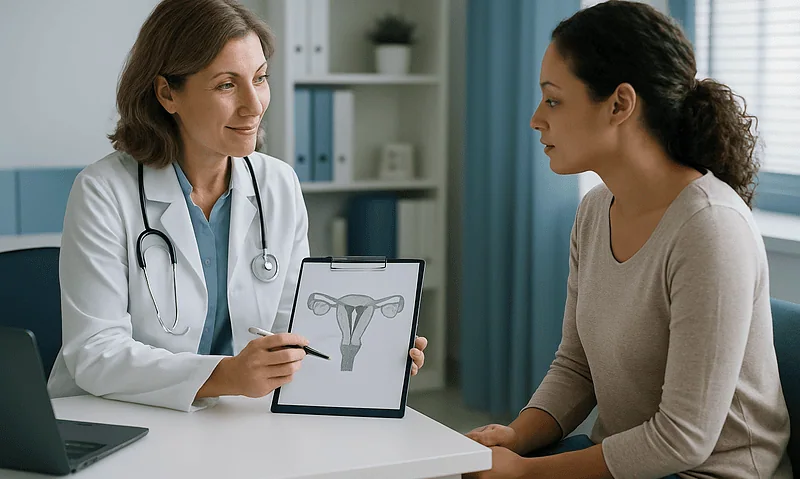
What Size of Ovarian Cyst Is Dangerous? Centimetres, Millimetres and What They Mean
There is no single size at which an ovarian cyst becomes dangerous. Most cysts are small, fluid-filled and disappear on their own within a…
Read article

Articles on the health of women: periods, fertility, pregnancy, menopause, breast and pelvic health, with clear guidance on when a symptom should be seen by a doctor.
There is no single size at which an ovarian cyst becomes dangerous. Most cysts are small, fluid-filled and disappear on their own within a…
Neither a pelvic ultrasound nor a blood test can diagnose PCOS on its own. Clinicians use the Rotterdam approach, which requires at least two…
Endometriosis treatment options are usually built in steps. Most people start with pain care, often anti-inflammatory medicines, and hormonal medicine that lowers estrogen's effect…
Most ovarian cysts are functional cysts that form during a normal menstrual cycle, reach roughly 2 to 5 centimeters, and shrink or disappear within…
In a robotic hysterectomy the robot does not operate on its own. The surgeon sits at a console a few feet from the patient…
A cystectomy removes only the cyst and leaves the ovary in place; an oophorectomy removes the whole ovary, sometimes with the fallopian tube. Surgeons…
Both tests detect the pregnancy hormone hCG. A blood test can pick it up slightly earlier, as soon as about 10 days after conception,…
vNOTES surgery candidates are usually people who need a hysterectomy, fallopian tube removal, or ovarian cyst surgery for a benign (non-cancerous) condition, whose uterus…
Before pelvic organ prolapse surgery, ask which compartments will be repaired, whether the plan uses your own tissue or mesh and why, whether the…
For most people, IVF is uncomfortable rather than severely painful. Daily hormone injections feel like a brief pinch, egg retrieval is done under sedation…
Hysteroscopy is usually recommended when a doctor needs to look directly inside the uterus rather than infer what is there. Common triggers are abnormal…
Before a gynecologic laparoscopy under general anesthesia, most hospitals ask you to stop eating about 6 hours beforehand and to stop drinking water or…
Before a vaginal infection appointment, clinicians usually ask you to stop douching and to pause any over-the-counter vaginal creams or suppositories, because both wash…
A prolapse surgery procedure restores support by re-anchoring the vaginal walls, uterus or vaginal top to strong pelvic structures, either through the vagina with…
A hysterectomy is an operation to remove the uterus (womb), sometimes together with the cervix, fallopian tubes or ovaries. It is performed for problems…
Preparing for prolapse surgery usually means three things: an anesthesia evaluation to check your heart, lungs and airway; a small set of blood tests…
An IUD insertion procedure is a short outpatient visit in which a clinician places a small T-shaped device into the uterus through the cervix…
Hysteroscopy is usually scheduled in the days just after a period ends because the uterine lining is at its thinnest then, giving the clearest…
Choose which cookies you allow. Essential cookies are always on because the site cannot work without them.