

Life After Ovarian Cyst Surgery: Cycles, Fertility Follow-Up and Long-Term Ovary Health

Key Takeaways
- Most ovarian cysts are functional, form through ordinary ovulation and resolve within two to three cycles without surgery, which is why small simple cysts are usually watched rather than removed.
- A cystectomy peels the cyst away and keeps the ovary; an oophorectomy removes the whole ovary, and only removal of both ovaries causes surgical menopause.
- One ovary, or part of one, generally keeps hormone levels normal and allows periods to continue, so cycles usually return to their previous pattern after a wobble in the first month or two.
- Shoulder-tip pain after keyhole surgery comes from carbon dioxide gas irritating the diaphragm and fades within days; walking helps the body absorb it.
- AMH and antral follicle count estimate how many eggs remain, not whether you will conceive; endometrioma surgery is the type most associated with a measurable drop.
- A new small cyst on a follow-up ultrasound is usually a sign that the ovary is ovulating normally, not that surgery failed, while a new cyst after menopause is assessed more cautiously.
Life after ovarian cyst surgery usually means a few weeks of recovery, then periods that return on roughly their previous schedule when at least one ovary is kept. Hormones generally stay stable because one ovary can do the work of two, and pregnancy remains possible for most people. Follow-up ultrasound, fertility testing when relevant and attention to new pain are the main long-term tasks.
The discharge paperwork fits on two pages. The questions do not. Somewhere between the car park and the first night at home, almost everyone who has had an ovarian cyst removed starts counting: how many days until the soreness fades, how many weeks until a period, how many months before trying for a baby feels reasonable, and whether the ovary that stayed behind is quietly fine or quietly changed.
Those questions sit at the heart of life after ovarian cyst surgery, and the honest answers are more reassuring than most late-night searches suggest. An ovary is a resilient organ. One can carry the hormonal load of two. A cycle disturbed by anesthesia and healing typically settles on its own.
What follows is the longer conversation that rarely fits into a ten-minute follow-up appointment: what the operation actually did, what the next weeks look like, what fertility follow-up can and cannot tell you, and the signs that mean a phone call rather than patience.
What actually happens during ovarian cyst surgery?
Most ovarian cyst operations today are done by laparoscopy, a keyhole technique in which a surgeon works through small abdominal incisions using a camera and slim instruments. The abdomen is gently inflated with carbon dioxide gas to create working space, which is why shoulder-tip pain is such a common, odd souvenir in the first day or two: the gas irritates the diaphragm, and the brain reads that signal as shoulder pain. The NHS describes this as an expected and temporary effect.
Two different operations hide behind the phrase ‘cyst surgery’. A cystectomy means the cyst wall is peeled away from the ovary and the healthy ovarian tissue is left in place; the ovary is then allowed to heal, sometimes with a fine stitch or gentle sealing of small bleeding points. An oophorectomy means the whole ovary is removed, usually along with the cyst inside it. Surgeons generally favor cystectomy when the cyst looks benign on ultrasound and the person may want to preserve fertility or hormone production, according to the Mayo Clinic.
A third route, laparotomy, uses a single larger incision. It is chosen when a cyst is very large, when there is concern about cancer, or when scar tissue from earlier operations makes keyhole access unsafe. Recovery is longer, but the goal is the same.
Whatever is removed goes to a pathology laboratory, where the cyst wall is examined under a microscope. This is the step that finally names the cyst: a functional cyst, a dermoid, an endometrioma or something rarer. The name matters because it shapes every piece of follow-up that comes afterwards, from how often an ultrasound is repeated to whether fertility testing is worth discussing.
Who is usually offered surgery, and who is usually asked to wait?
Surprisingly few ovarian cysts ever meet a surgeon. The NHS notes that most cysts occur naturally as part of the menstrual cycle and disappear within a few months without any treatment. These functional cysts form when a follicle, the small fluid sac that releases an egg each month, either fails to release the egg or seals over afterwards and keeps filling. The Mayo Clinic adds that such cysts typically resolve within two to three menstrual cycles, which is why the first recommendation for a small, simple cyst in someone before menopause is usually a repeat ultrasound rather than an operation.
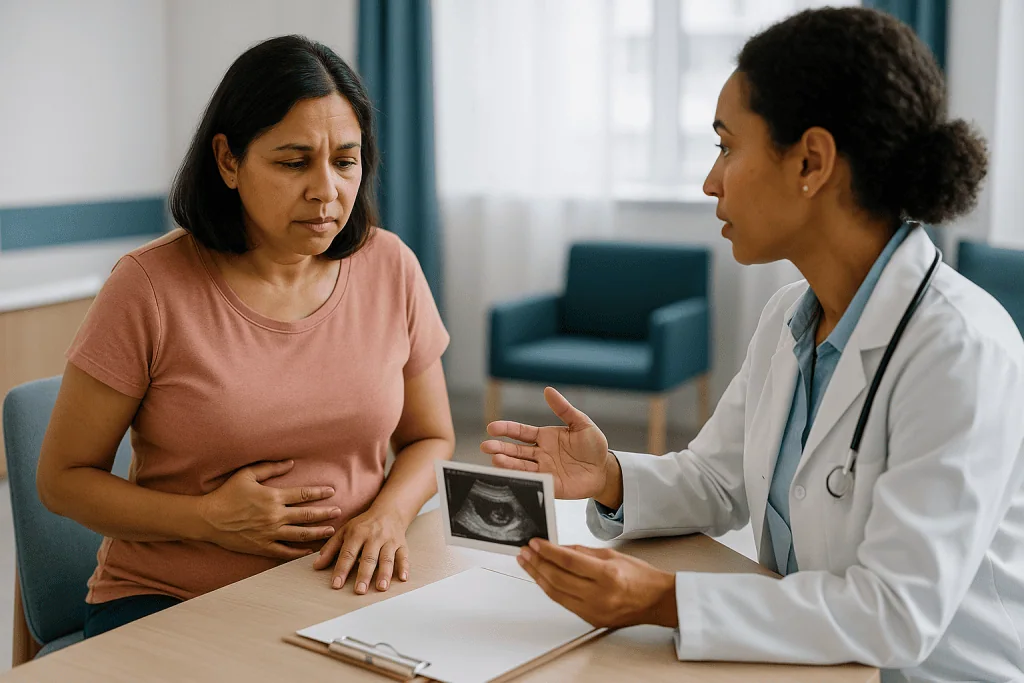
Surgery moves up the list when a cyst behaves differently. Common reasons include a cyst that is large and not shrinking, one that causes persistent pain or pressure on the bladder or bowel, one that keeps growing across repeated scans, or one whose ultrasound appearance is complex: solid areas, thick internal walls or unusual blood flow. A cyst found after menopause is also watched more closely, because new cysts are less expected once the ovaries have stopped cycling.
Emergency surgery is a separate category. Ovarian torsion, in which the weight of a cyst causes the ovary to twist on its blood supply, and a cyst that ruptures with heavy internal bleeding are both reasons to operate promptly rather than wait.
Who is asked to wait? Generally, anyone with a small, simple, painless cyst before menopause, and anyone whose cyst is likely to be functional. Waiting is not neglect; it is a recognition that the body resolves most of these on its own, and that any operation carries risk to healthy ovarian tissue. The decision always rests with the person and the treating gynecology team, weighing symptoms, scan features and plans for pregnancy.
Life after ovarian cyst surgery: what the first days and weeks look like
The first forty-eight hours are about gas, soreness and fatigue. Shoulder pain from the carbon dioxide tends to fade quickly; walking, even short laps of the hallway, helps the body absorb the gas and keeps blood moving in the legs, which lowers clot risk after any operation. Incision tenderness usually feels like a deep bruise rather than a sharp pain. Light vaginal spotting can occur, especially if the uterus was gently manipulated during the procedure to improve the view.
By the end of the first week most people after laparoscopy are showering normally, moving around the house and managing with simple pain relief as advised by their team. The NHS advises that recovery time depends on what was done, with many people returning to usual activities within a few weeks after a minor keyhole procedure. After laparotomy, the timeline stretches: lifting restrictions last longer and the wound needs more protection.
Bowel habits deserve a mention, because nobody warns you. Anesthesia, reduced movement and some pain medicines slow the gut, so constipation and bloating in week one are common and usually settle with fluids, fiber and walking. If the team prescribed a stool softener, use it as directed.
The typical sequence looks roughly like this:
- Days 1–3: gas pain, fatigue, incision soreness, light spotting.
- Days 4–7: steadier energy, short walks, return to desk-type tasks for some.
- Weeks 2–4: incisions sealed, exercise rebuilt gradually, follow-up visit to review pathology.
- Weeks 4–6 and beyond: most restrictions lifted, first post-operative period often arrives.
Every one of those ranges is a typical pattern drawn from NHS guidance, not a deadline. Someone who had a torsion untwisted, or whose cyst was large, may need longer, and that is not a sign of failure.
Periods after ovarian cyst removal: when will my cycle come back?
The first period after surgery is the one people watch most anxiously, and it is also the one least worth reading into. Anesthesia, blood loss, pain, poor sleep and the sheer stress of an operation all nudge the brain’s hormonal signaling, so the first cycle may arrive early, arrive late, or feel heavier or lighter than usual. None of that predicts the pattern that follows.

The reason cycles usually return is anatomical. Even if a cystectomy removed a piece of one ovary, the remaining tissue continues to recruit follicles and produce estrogen and progesterone. If one whole ovary was removed, the other typically compensates fully; the Mayo Clinic explains that removing a single ovary generally does not cause menopause and that menstrual periods usually continue. The ovaries do not alternate rigidly month by month; the remaining ovary simply releases an egg most cycles.
It is worth separating three situations that people often blur together:
- A functional cyst was removed: the ovary that made it was already cycling, and periods tend to resume their previous rhythm once the body recovers.
- An endometrioma was removed: endometriosis itself can make periods painful and heavy, so the pattern after surgery reflects the underlying condition and any medicine the team may suggest, not the operation alone.
- One ovary was removed and the other remains: cycles usually continue, though a brief wobble in the first month or two is common.
When should an irregular pattern prompt a conversation? If periods have not returned roughly two to three months after surgery when one ovary remains, or if bleeding becomes very heavy, prolonged or painful in a new way, that is worth raising with the gynecology team. They may check hormone levels or arrange an ultrasound. Decisions about any medicine to regulate cycles sit with the prescribing clinician.
Hormones after ovarian cyst removal: will I notice a change?
Here is the fact that dissolves most hormone worries: the ovaries produce estrogen, progesterone and small amounts of testosterone from the follicles they develop each cycle, and a single ovary holds far more follicles than a lifetime of cycles will ever use. That reserve is why one ovary can maintain hormone levels in the normal range when the other is removed or trimmed.
After a cystectomy, the healthy ovary is left with a small healing area. In the first weeks there may be a transient dip in that ovary’s output while the tissue recovers, but the opposite ovary continues working, and the pituitary gland in the brain adjusts its signals to keep the system balanced. People rarely notice this; hot flashes, night sweats or vaginal dryness after a cystectomy are uncommon and, when they do occur, deserve investigation rather than assumption.
Removal of one ovary (unilateral oophorectomy) tells a similar story: hormone production continues from the remaining ovary. The hormonal picture changes fundamentally only if both ovaries are removed, which the Mayo Clinic describes as causing immediate menopause in someone who has not yet reached it. That scenario, called surgical menopause, is not a typical outcome of cyst surgery; it tends to arise when cancer is suspected or when both ovaries are severely damaged.
What about the longer horizon? Some research suggests that people with one ovary may reach natural menopause somewhat earlier than average, but the evidence is mixed and the effect, where seen, is modest. It is a fair question to ask a clinician, especially for someone planning pregnancy later in their thirties, and it is one reason gentle surgical technique that preserves tissue is a shared priority among gynecologic surgeons.
Any discussion of hormone therapy after bilateral oophorectomy, including whether, when and in what form, belongs with the treating team, who weigh age, symptoms and personal risk factors.
Pregnancy after ovarian cystectomy: can I conceive, and how soon?
For most people, yes. A cystectomy that leaves healthy ovarian tissue, or an oophorectomy that leaves the opposite ovary, keeps the essential machinery of conception intact: an ovary releasing eggs, a fallopian tube to carry them, and a uterus to receive an embryo. The Mayo Clinic notes that surgeons aim to preserve the ovary whenever a cyst can be separated from it precisely so that fertility is protected.
‘How soon’ is the harder question, and honesty matters here. There is no universal waiting period written into major guidelines; the usual advice is to let the incisions heal and the first one or two cycles settle, then to discuss timing at the follow-up visit once the pathology result is known. That result can change the plan. A benign dermoid or functional cyst generally calls for no delay beyond physical recovery. An endometrioma may prompt a different conversation, because endometriosis itself can affect fertility and because some teams suggest trying soon after surgery, while the pelvis is at its clearest, or discussing fertility treatment if other factors are present.
What surgery cannot do is undo age or other causes of reduced fertility. If pregnancy was already proving difficult before the cyst was found, removing the cyst is unlikely to be the only step needed, and a referral to a fertility specialist may be appropriate.
A practical note: ovulation can happen before the first period returns, so contraception is a real consideration for anyone who does not want to conceive straight away. Equally, a positive pregnancy test in the first months after surgery is not a danger in itself, but it is something the gynecology team should know about so early scans can be arranged. Each of these timing decisions belongs with the person and their clinicians, not with a general article.
Fertility follow-up: what ovarian reserve testing can and cannot tell you
Ovarian reserve is the term for the pool of eggs remaining in the ovaries. It cannot be counted directly, so clinicians estimate it with proxies. The two most common are anti-Mullerian hormone (AMH), a hormone released by small developing follicles and measured in a blood test, and the antral follicle count, the number of small follicles visible on a transvaginal ultrasound early in the cycle.
Why does this matter after cyst surgery? Because any operation on an ovary removes or disturbs some tissue, and that tissue contains follicles. Evidence summarized by fertility specialists suggests that cystectomy, particularly for endometriomas, can lower AMH afterwards, while surgery for simple or functional cysts tends to have a smaller effect. The size of the change varies widely between individuals, which is why no single number can be promised or warned about in advance.
What a reserve test is good for:
- Giving a rough sense of how many eggs might be retrievable if IVF is ever considered.
- Flagging a lower-than-expected reserve so that someone who wants children can factor time into their decisions.
- Providing a baseline before any second operation on the same ovary.
What it is not good for:
- Predicting whether a specific person will conceive naturally. Plenty of people with low AMH conceive without help; the test reflects quantity, not egg quality or the odds in any given month.
- Predicting the age at which menopause will arrive with any precision.
Who should ask about testing? Anyone who had an endometrioma removed, anyone who has had more than one ovarian operation, anyone with only one ovary who is planning pregnancy in the next few years, and anyone over about thirty-five who has not yet started a family. A fertility specialist or gynecologist can interpret results in context, and the decision about what to do with them, if anything, remains theirs to guide and yours to make.
Ovarian cyst recurrence after surgery: will it come back?
Recurrence is one of the most common worries after surgery, and the answer depends almost entirely on what the pathology report said. A cyst is not a single disease; it is a shape that several different processes can produce.
Functional cysts are the easiest to understand. They arise from ordinary ovulation, so as long as a person is ovulating, a new functional cyst can form in any cycle. The operation did not remove the tendency; it removed one cyst. The NHS points out that these cysts are a normal part of the cycle and usually disappear on their own, so a new small one on a later ultrasound is not evidence that surgery failed. It is evidence that the ovary works.
Dermoid cysts (mature teratomas), which contain tissue such as skin, hair or fat, can occasionally recur in the same ovary or appear in the other, which is why some teams suggest a follow-up ultrasound at intervals. Endometriomas, cysts filled with old blood that form when endometriosis tissue grows on the ovary, have the highest recurrence tendency because the underlying endometriosis remains. Cystadenomas, benign cysts arising from the ovary’s surface cells, recur less often once completely removed.
Some practical points:
- Hormonal contraception does not shrink an existing cyst, according to the Mayo Clinic, but by suppressing ovulation it may reduce the formation of new functional cysts. Whether that is relevant is a decision for the prescribing clinician.
- Scans ordered ‘just to check’ are not a sign of concern; they are how teams distinguish a harmless new follicle from something that needs attention.
- A new cyst after menopause, when ovulation has stopped, is treated with more caution than one before menopause.
Ask the team directly which type you had and what their follow-up plan is. That one conversation replaces most of the guessing.
Cystectomy, oophorectomy or watchful waiting: how long-term ovary health compares
People often ask which option is ‘best’. There is no single answer, because each approach protects something different. The table below summarizes what mainstream guidance from the NHS and Mayo Clinic describes about each path, so the trade-offs can be seen side by side.
| Aspect | Watchful waiting | Cystectomy (cyst removed, ovary kept) | Unilateral oophorectomy (one ovary removed) |
|---|---|---|---|
| Usually considered for | Small, simple cyst before menopause; likely functional | Persistent, large or symptomatic benign cyst; fertility or hormone preservation wanted | Cyst inseparable from ovary, torsion with damaged ovary, suspicious features |
| Effect on periods | None from the cyst itself in most cases | Brief wobble, then usual pattern expected | Cycles usually continue from the other ovary |
| Effect on hormones | None | Minimal; transient dip possible while tissue heals | Generally maintained by remaining ovary |
| Effect on fertility | None directly | Preserved; some reduction in reserve possible, more so with endometriomas | Possible with one ovary; reserve reduced by roughly the removed share |
| Recurrence | New functional cysts can form any cycle | Depends on cyst type; highest with endometriomas | Cysts can still form on the remaining ovary |
| Typical follow-up | Repeat ultrasound over two to three cycles | Pathology review, symptom check, scan if indicated | Pathology review, scan of remaining ovary if indicated |
Two things stand out. First, watchful waiting is a genuine medical choice, not an absence of one; it is the evidence-based default for most small cysts before menopause. Second, the gap between cystectomy and losing one ovary is narrower in day-to-day life than many expect, because of the reserve built into a single ovary.
Where the paths diverge most is in fertility planning and in the rare situation where both ovaries are at risk. That is precisely where an individual conversation with the treating team, informed by scan findings and personal goals, replaces any table.
What is a hemorrhagic ovarian cyst, and does it change recovery?
A hemorrhagic cyst is a functional cyst into which a small blood vessel has bled, filling the sac with blood instead of clear fluid. It most often develops from the corpus luteum, the structure left behind after a follicle releases its egg; the Cleveland Clinic describes corpus luteum cysts as one of the two main functional types. On ultrasound a hemorrhagic cyst has a characteristic lacy or web-like internal pattern as the blood clots and then liquefies.
Symptoms range from nothing at all to a sudden, sharp pain on one side of the pelvis, often in the second half of the cycle. If the cyst leaks or ruptures, the blood irritates the lining of the abdomen and pain can spread or be felt in the shoulder, through the same nerve pathway that causes gas pain after laparoscopy. Most hemorrhagic cysts resolve on their own over a few cycles, so surgery is uncommon unless bleeding is heavy or the ovary has twisted.
If surgery was needed, recovery follows the same broad path as other cyst operations, with two differences worth knowing. Blood in the pelvis takes time to be reabsorbed, so a dull ache can linger a little longer than after removal of a simple cyst. And a drop in blood count from internal bleeding can leave someone unusually tired for a few weeks; a clinician may check hemoglobin at follow-up and advise on iron if needed, a decision that sits with them.
A hemorrhagic cyst is not a sign of cancer, and having one does not raise future cancer risk. It does signal that ovulation is happening, which, for anyone hoping to conceive, is quietly good news. Whether to take steps to prevent repeat episodes, for example with ovulation-suppressing medicine, is a conversation for the prescribing clinician based on how often they recur and how disruptive they are.
Do ovarian cysts hurt more during your period, and what about pain after surgery?
Many people notice that cyst pain fluctuates with the cycle, and there is a physiological reason. Around ovulation the follicle is at its largest and the ovary is more active; in the days before a period the pelvis is congested with blood flow and the uterus contracts. A cyst sitting on the ovary is jostled by all of this, so a dull ache can sharpen mid-cycle or just before bleeding starts. Endometriomas are the clearest example: because they are made of tissue that responds to the same hormones as the uterine lining, they can swell and bleed internally with each period, which is why endometriosis pain classically tracks the cycle.
After surgery, the expected pattern is different, and knowing it helps separate normal healing from something that needs attention:
- Incision pain fades steadily over one to two weeks.
- Deep pelvic soreness, from the ovary’s healing surface, can come and go for several weeks and may flare slightly around the first period.
- Shoulder-tip gas pain disappears within days.
Pain that stays mild and keeps improving, even unevenly, is the usual course. Pain that worsens after initially improving, or that arrives suddenly and severely, is not, and the next section lists the specific signs that warrant a call.
One longer-term issue is adhesions: bands of scar tissue that can form between pelvic organs after any surgery or inflammation. Most cause no symptoms. In some people they contribute to chronic pelvic discomfort or pain with intercourse months later. Minimally invasive technique and gentle handling of tissue reduce the risk but do not eliminate it. Persistent new pain beyond the expected healing window deserves a review rather than resignation; the team may suggest an examination, an ultrasound or, occasionally, a diagnostic laparoscopy to look directly. Pain relief choices, including whether any medicine is appropriate, remain with the treating clinicians.
What happens to the ovaries after menopause, and why it matters for cyst follow-up
Menopause is the point at which the ovaries have run through most of their follicles and stop releasing eggs. Estrogen and progesterone production falls to low levels, cycles end, and the ovaries themselves shrink, often to roughly the size of an almond, becoming harder to see on ultrasound. They do not switch off entirely; the stroma, the supporting tissue, continues to produce small amounts of androgens for years.
This shift changes how cysts are interpreted. Before menopause, a new fluid-filled sac on the ovary is most likely a functional cyst produced by ovulation. After menopause, ovulation has stopped, so that explanation disappears. The Mayo Clinic notes that clinicians take age and menopausal status into account when deciding how closely to monitor a cyst and whether blood tests or surgery are advisable. Small, simple postmenopausal cysts are still usually benign and are often followed with repeat scans; complex or growing ones are more likely to be investigated with surgery.
For someone who had cyst surgery earlier in life, this has two practical consequences:
- If one ovary was removed, the remaining ovary carries all later monitoring. Its history should be part of any future gynecology record.
- If both ovaries were removed before natural menopause, the usual age-related health conversations about bone density and cardiovascular risk begin earlier, and the Mayo Clinic describes these as reasons to discuss hormone therapy and other protective measures with the treating team.
Postmenopausal bleeding is never attributed to a cyst by default; it always warrants an evaluation of the uterine lining. And a cyst that appears on an incidental scan years after a successful operation is not a reason for alarm in itself, but it is a reason to ensure a gynecologist, rather than a search engine, reviews the images.
What people often get wrong about life after ovarian cyst surgery
Myths cluster around this operation because the ovaries are small, hidden and tied to identity in ways a gallbladder never is. A few corrections, with the evidence behind them.
‘My hormones will crash.’ They will not, unless both ovaries are removed. One ovary, or even part of one, maintains hormone production in the normal range for most people, as the Mayo Clinic explains. Surgical menopause is a specific consequence of bilateral oophorectomy, not of cyst surgery in general.
‘A new cyst on my scan means the surgery failed.’ A small functional cyst is what a working ovary produces. The NHS describes these as a normal part of the menstrual cycle that usually resolve without treatment.
‘I need to wait a year before trying to conceive.’ No major guideline sets such a rule. Timing depends on healing, cyst type and individual fertility factors, and is decided with the treating team.
‘The ovaries take turns, so losing one halves my chances every other month.’ Ovulation is not a strict alternation. The remaining ovary ovulates in most cycles, and the system adjusts.
‘Cysts are caused by something I did.’ Functional cysts arise from ovulation itself. Nothing about diet, exercise or stress has been shown to cause them, and nothing on a supplement shelf has been shown to dissolve them.
‘Birth control pills will shrink the cyst I have.’ The Mayo Clinic is explicit that hormonal contraception does not shrink an existing cyst; it may reduce new functional cysts by suppressing ovulation. Whether that is appropriate is for the prescribing clinician.
‘Keyhole surgery means no real recovery.’ Incisions are small, but the ovary and the pelvis still heal from the inside. Fatigue and deep soreness for a few weeks are normal, and respecting them is part of getting well.
Questions to ask your care team after ovarian cyst surgery
The follow-up appointment is short and the pathology report is often the only item on the agenda. A written list turns it into something more useful. These questions are phrased so the answers will be specific to you rather than generic.
- What exactly was removed: the cyst alone, part of the ovary, or the whole ovary? Which side?
- What did pathology show, and what type of cyst was it in plain language?
- Does this type tend to come back, and if so, what follow-up scans or visits do you suggest and how often?
- Was there any endometriosis, scar tissue or other finding seen during the operation that I should know about?
- How is my remaining ovarian tissue, and would an ovarian reserve test be worth discussing given my plans?
- Is there any medical reason to delay trying to conceive, or any reason to try sooner rather than later?
- Do I need contraception in the first weeks, since ovulation can occur before the first period?
- What pattern of periods would you consider normal over the next three months, and what would prompt you to investigate?
- Were both ovaries affected in any way, and is there anything in my results that changes how my long-term hormone health is monitored?
- If pain persists beyond the usual healing window, what is the plan to look into it?
- Who do I contact after hours, and for which symptoms?
A couple of these deserve emphasis. The first two questions are the foundation of everything else; a surprising number of people leave hospital unsure whether they still have two ovaries. And the question about contraception is not trivial for anyone whose fertility is a priority either way.
Write the answers down or ask for a copy of the operation note and pathology report. These documents travel with you to every future gynecologist, fertility specialist or emergency department, and they make the next conversation shorter and sharper.
When to call your doctor
Most of what you feel after ovarian cyst surgery is healing, and most of it improves week by week. A small set of signs point to complications that are uncommon but treatable when caught early. These are not a self-diagnosis checklist; they are the triggers for making a call rather than waiting for the next appointment.
Contact your surgical team or seek urgent care the same day for:
- Pain that is severe, sudden, or worsening after it had been improving, particularly if it is on one side and comes with nausea or vomiting; this can signal torsion, bleeding or an injury not visible at surgery.
- A temperature above the threshold your team specified, or chills and feeling unwell, which may indicate infection.
- Redness spreading from an incision, pus, or a wound that opens.
- Vaginal bleeding heavier than a normal period, or soaking through protection hourly.
- Swelling, pain or warmth in one calf, or sudden shortness of breath or chest pain: possible signs of a blood clot, which is a risk after any operation.
- Inability to pass urine, or painful urination with fever.
- Persistent vomiting, a swollen tense abdomen, or no bowel movement with worsening pain, which can indicate a bowel problem.
- Feeling faint, light-headed on standing, or a racing heart, which can accompany internal bleeding.
Over the longer term, book a non-urgent review for periods that have not returned within about two to three months when at least one ovary remains, new pain that tracks the cycle and persists beyond the expected healing window, pain with intercourse that did not exist before, or any bleeding after menopause. These are not emergencies, but they are not things to live with silently either.
The MedlinePlus guidance on ovarian cysts and the NHS laparoscopy page both reinforce the same principle: when in doubt after surgery, ask. The team that operated knows what they saw inside the pelvis, and their judgment, not a general article, decides what any symptom means for you.
Frequently asked questions
What is an ovarian cyst and what causes it?
An ovarian cyst is a fluid-filled sac that forms on or inside an ovary. Most are functional cysts caused by the menstrual cycle itself: a follicle fails to release its egg, or seals over after ovulation and keeps filling with fluid. Less common types include dermoid cysts, endometriomas linked to endometriosis, and cystadenomas arising from the ovary’s surface cells. Nothing about diet or lifestyle has been shown to cause them.
How long do periods take to come back after ovarian cyst removal?
Most people have a period within roughly four to eight weeks of surgery when at least one ovary remains, though the first one may be early, late, heavier or lighter than usual because of anesthesia and healing stress. The pattern usually settles over the following two to three cycles. If no period has arrived about two to three months after surgery, raise it with your gynecology team.
Will hormones after ovarian cyst removal change if I still have one ovary?
Generally no. A single ovary holds far more follicles than a lifetime of cycles will use and produces enough estrogen and progesterone to keep levels in the normal range. The brain’s pituitary signals adjust to the remaining tissue. Menopausal symptoms after a cystectomy or one-sided oophorectomy are uncommon; if they occur, they warrant investigation rather than being assumed to be a normal consequence of surgery.
How soon can I try for pregnancy after ovarian cystectomy?
There is no fixed waiting period in major guidelines. The usual advice is to let incisions heal and the first one or two cycles settle, then discuss timing at follow-up once the pathology result is known. Benign functional or dermoid cysts rarely require delay beyond physical recovery; an endometrioma may prompt a different plan. Ovulation can occur before the first period, so contraception matters if you are not ready.
Does ovarian cyst surgery reduce fertility?
It can reduce ovarian reserve slightly, because any operation on an ovary removes or disturbs some follicle-containing tissue, and the effect is largest with endometrioma surgery. For most people fertility remains possible, since the remaining tissue continues to ovulate. Surgery does not reverse age-related decline or other fertility factors, so if conceiving was already difficult, a fertility specialist referral may be appropriate.
How common is ovarian cyst recurrence after surgery?
It depends on the cyst type found at pathology. New functional cysts can form in any cycle because they arise from ovulation itself, so a small one on a later scan is normal. Endometriomas have the highest recurrence tendency because the underlying endometriosis remains. Dermoids occasionally recur or appear on the other ovary, and completely removed cystadenomas recur less often. Ask your team which type you had.
What is a hemorrhagic ovarian cyst and what are its symptoms?
A hemorrhagic cyst is a functional cyst, usually from the corpus luteum, into which a small vessel has bled. Symptoms range from none to sudden sharp one-sided pelvic pain, often in the second half of the cycle; if it leaks, pain can spread or be felt in the shoulder. Most resolve on their own over a few cycles and are not linked to cancer. Severe or worsening pain needs same-day assessment.
Do ovarian cysts hurt more during your period?
Often, yes. Around ovulation and just before a period the ovary is more active and the pelvis more congested, so a cyst can ache more sharply at those times. Endometriomas are the clearest example because their tissue responds to the same hormones as the uterine lining and bleeds internally with each period. After surgery, mild soreness around the first period is common, but worsening pain is not.
What happens to the ovaries after menopause?
After menopause the ovaries stop releasing eggs, shrink considerably and produce much less estrogen and progesterone, though they continue making small amounts of androgens. Because ovulation has stopped, a new cyst after menopause cannot be explained as functional, so clinicians monitor postmenopausal cysts more carefully with repeat scans and sometimes blood tests. Small simple ones are still usually benign; complex or growing ones are more likely to be investigated surgically.
What is life after ovarian cyst surgery like in the long term?
For most people it is unremarkable in the best sense: periods and hormones return to their previous pattern, fertility remains possible, and the main ongoing tasks are keeping a copy of the pathology report, attending any follow-up scans the team suggests, and reporting new cyclical pain or postmenopausal bleeding. Only removal of both ovaries changes the picture fundamentally, and that is uncommon in cyst surgery.
References
- NHS: Ovarian cyst
- NHS: Laparoscopy (keyhole surgery)
- Cleveland Clinic: Ovarian cysts
- MedlinePlus: Ovarian cysts
This article is for general information only and is not a substitute for professional medical advice. Please consult a qualified doctor about your individual situation.

More from the Blog

After Endometriosis Surgery: What Is Normal, and Which Symptoms Mean a Call to Your Surgeon?
After endometriosis surgery, mild to moderate incision soreness, bloating, shoulder-tip pain from residual gas, fatigue and light vaginal bleeding are expected for several days…

Does a Hysteroscopy Hurt? Anesthesia Options and Managing Cramping Afterward
Hysteroscopy is often described as uncomfortable rather than severely painful, most commonly as cramping similar to strong period pain while the thin scope passes…
Which Questions Help You Understand a PCOS Plan? Cycles, Skin and Future Fertility
The most useful questions about a PCOS plan ask what the plan is for, since PCOS is managed by goal rather than by a…

Hysteroscopic Fibroid Removal: Treating Fibroids Inside the Uterine Cavity Without Incisions
Hysteroscopic fibroid removal, also called hysteroscopic myomectomy, treats fibroids that grow into the uterine cavity by passing a thin camera and cutting instrument through…

Ovarian Cysts and Back Pain: Why the Lower Back Hurts
Yes, ovarian cysts can cause back ache. A cyst on an ovary can press on nearby tissue or send pain along shared nerve pathways,…

Period Pain Relief: Evidence-Ranked Options Beyond Just Rest
The best-supported options for period pain relief are over-the-counter anti-inflammatory pain relievers started at the first sign of cramps, continuous low-level heat on the…