

Groin Pain in Women: Muscle, Hernia, Hip and Gynecologic Causes and When to Get Checked
Key Takeaways
- Hip joint problems are felt in the groin far more often than on the side of the hip, which is why months-long groin pain with walking usually prompts a hip examination.
- Femoral hernias are more common in women than men, often cause pain without a visible lump, and carry a higher risk of becoming trapped than the inguinal type.
- Kidney stone pain typically starts in the back or flank and travels in waves toward the groin and labia; the NIDDK reports about 6 percent of women have a stone at least once.
- Groin pain with a positive pregnancy test, bleeding, dizziness or shoulder-tip pain needs same-day assessment to exclude an ectopic pregnancy.
- The NHS estimates endometriosis affects about one in ten women of reproductive age, and the ESHRE 2022 guideline notes that a normal scan does not rule it out.
- Mild adductor strains without red flags usually settle within a few weeks with relative rest and graded movement, and a strain that fails to improve is re-examined for hip or bone causes.
Groin pain in women most often comes from a strained adductor muscle or tendon, the hip joint, or a pelvic cause such as an ovarian cyst, endometriosis or a urinary infection; hernias are less common in women but still possible. Sudden severe pain, fever, vomiting, a bulge that will not go back in, or pain in early pregnancy needs urgent medical assessment.
It usually starts quietly. A dull pull at the top of the inner thigh after a long walk, a catch when you swing a leg out of the car, or a one-sided ache that seems to arrive with your period and then does not fully leave. The groin is a small patch of the body, roughly where the lower abdomen meets the thigh, yet it is a busy crossroads of muscle, bone, nerve, blood vessel and pelvic organ.
That crowding is why groin pain in women is so often misread. The hip joint refers pain forward into the groin. An ovary sits a hand’s width away. A ureter carrying a kidney stone runs right through the neighborhood. A clinician’s first job is not to name a treatment but to work out which of these structures is talking.
This article walks through the likely causes in order of how common they are, explains the clues that separate them, and sets out plainly which signs mean the problem should be checked today rather than next month.
What usually causes groin pain in women, and which signs are an emergency
For most women the answer is mechanical. A strained adductor (the band of muscles that pull the thigh inward), an irritated hip flexor tendon or early wear in the hip joint accounts for a large share of groin pain seen in general practice and sports medicine, according to MedlinePlus. These problems hurt with movement, ease with rest and rarely come with fever or feeling unwell.
The next group sits inside the pelvis: ovarian cysts, endometriosis, pelvic inflammatory disease and urinary tract infection. These tend to bring other clues, such as a link to the menstrual cycle, unusual discharge, burning when passing urine or pain during sex. Hernias, kidney stones, nerve entrapment and swollen lymph nodes make up the smaller remaining share.
Before any of that, the emergency signs, in plain words. Seek urgent care the same day, or call emergency services, if groin pain is sudden and severe, comes with fever and vomiting, is accompanied by a lump that is hard, tender and cannot be pushed back in, occurs with a positive pregnancy test or a missed period, or arrives with fainting, shoulder-tip pain or heavy vaginal bleeding. A twisted ovary, a trapped hernia and an ectopic pregnancy (a pregnancy growing outside the womb) can all present this way, and each is a time-critical problem.
Everything that follows assumes none of those signs is present. If one is, stop reading and get seen.
What sits in the groin: the anatomy behind the ache
Pain is easier to interpret when you know what lives where. The groin crease runs along the inguinal ligament, a tough band stretching from the bony point at the front of the pelvis to the pubic bone. Below it passes the femoral artery, vein and nerve, together with the lymph nodes you can sometimes feel as small beans under the skin. Above it lies the inguinal canal, a short tunnel through the abdominal wall that in women carries the round ligament of the uterus.

Deep to all of this sits the hip joint, a ball-and-socket joint whose front capsule lies only a few centimeters behind the groin crease. That proximity explains a rule clinicians learn early: true hip joint pain is felt in the groin far more often than on the outside of the hip or in the buttock.
Medially, the adductor muscles attach to the pubic bone, and the pubic symphysis (the cartilage joint joining the two halves of the pelvis at the front) sits in the midline. Behind and above are the bladder, the ureters, the uterus and, on each side, an ovary and fallopian tube. The intestines, including the appendix on the right, lie just above.
A consensus statement published in the British Journal of Sports Medicine, known as the Doha agreement of 2015, sorted groin pain in athletes into adductor-related, iliopsoas-related, inguinal-related, pubic-related and hip-related categories. The same map is useful for anyone, because it reminds clinicians to examine the muscles, the abdominal wall and the joint separately rather than lumping them together.
Muscle and tendon strains: the most common cause
An adductor strain is the classic groin pull. It follows a sudden sideways movement, a slip on ice, a lunge in a fitness class or simply a longer walk than usual on an unprepared body. The pain sits on the inner thigh near the pubic bone, sharpens when you squeeze your knees together or bring the leg across the body, and is tender to press. Bruising can appear a day or two later.
Iliopsoas-related pain, from the deep hip flexor that runs from the lower spine to the top of the thigh bone, feels more frontal and deeper. It flares when lifting the knee against resistance, climbing stairs or sitting for long periods with the hip bent, which is why it troubles desk workers as much as runners.
These strains usually behave predictably. Pain is worst in the first few days, improves steadily with relative rest and gentle movement, and mild cases settle over a few weeks, according to NHS guidance on sprains and strains. Longer or more severe injuries can take six to eight weeks or more.
The clue that separates a strain from something else is reproducibility. A clinician can bring on the pain by stretching or contracting the exact muscle, and nothing else is abnormal: no fever, no urinary symptoms, no lump, no link to the cycle. When a “strain” does not improve after several weeks of sensible care, the diagnosis is revisited, because hip joint problems and stress fractures of the pelvis can mimic a muscle pull in the early stages.
Hip joint causes: when groin pain in women is really the hip
Ask someone with hip osteoarthritis to point to the pain and the finger often lands in the groin, not the side of the hip. The NHS lists osteoarthritis, a condition in which joint cartilage thins and the bone underneath reacts, as a leading cause of hip pain in adults, and it becomes more frequent with age and after previous hip injury.
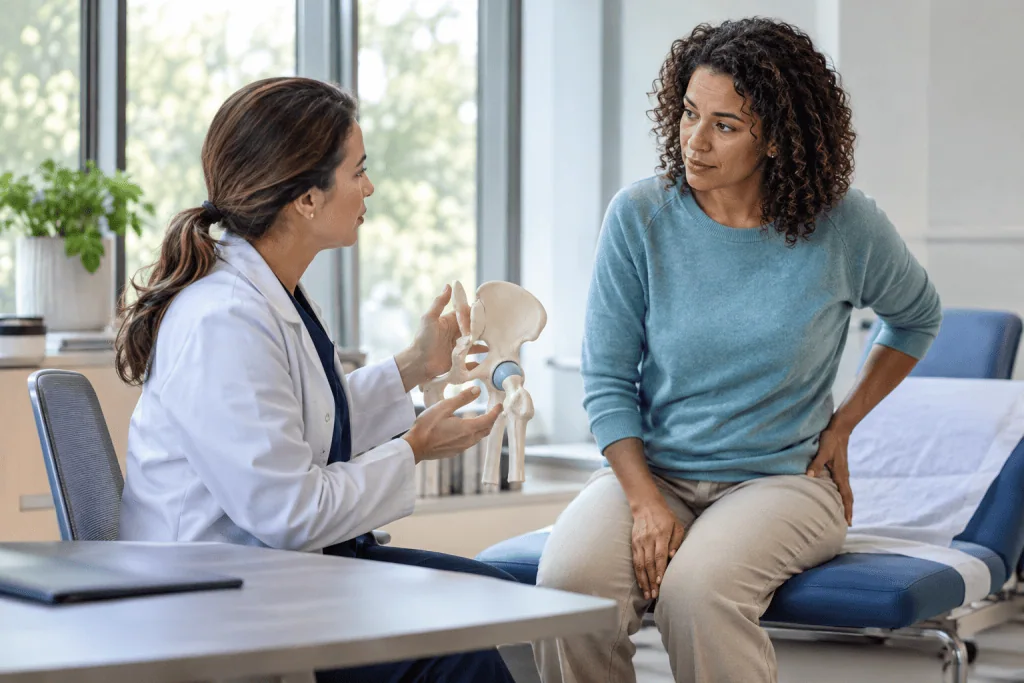
Typical features include stiffness after rest that eases with the first few steps, pain on putting on socks or getting out of a low chair, and a gradual loss of the ability to turn the leg inward. Groin pain in women when walking that builds over months rather than days points toward the joint rather than a muscle.
Younger, active women more often have a labral tear, damage to the ring of cartilage that deepens the hip socket, or femoroacetabular impingement, where the ball and socket pinch at the extremes of movement. These cause a sharp catch or click on deep bending, twisting or getting out of a car, with a background ache after sitting.
Two less common but important hip-related causes deserve a mention. A stress fracture of the femoral neck, the narrow part of the thigh bone just below the ball, can develop in runners and in women with low bone density; the pain is deep, worsens with each run and may become constant. Avascular necrosis, loss of blood supply to the ball of the hip, is linked to long-term corticosteroid use and high alcohol intake. Both show poorly on early X-rays, which is why persistent, worsening groin pain in a walker or runner often leads to an MRI.
Hernias: inguinal and femoral, and why women are different
A hernia is a loop of bowel or fatty tissue pushing through a weak point in the abdominal wall. In the groin there are two routes. An inguinal hernia comes through the inguinal canal above the crease; a femoral hernia comes through the femoral canal below it, beside the main blood vessels of the leg.
The NHS notes that inguinal hernias mainly affect men, while femoral hernias are more common in women, particularly later in life and after pregnancies. Femoral hernias matter because the opening is narrow, so the trapped tissue is more likely to become stuck (incarcerated) or lose its blood supply (strangulated), both of which need urgent surgery.
A hernia classically shows as a soft bulge that appears on standing, coughing or straining and disappears on lying down. Many are painless or cause only a dragging ache. Women, however, more often have a hernia with pain and no obvious lump, especially femoral hernias, which hide deep in the fold of the thigh. That is one reason a clinician will ask you to stand and cough during the examination and may order an ultrasound if the findings are unclear.
The warning combination is a lump that has become firm, tender and will not go back in, together with nausea, vomiting or a swollen abdomen. That picture suggests strangulation and is a same-day emergency. A hernia that is reducible and painless can usually be assessed in a routine appointment, and the surgeon and patient decide together whether and when to repair it.
Gynecologic causes: ovarian cysts, endometriosis and pelvic infection
The ovaries sit low in the pelvis, close enough to the groin that their problems are often felt there. Functional ovarian cysts, fluid-filled sacs that form as part of a normal cycle, are common and usually disappear on their own; the NHS describes most as causing no symptoms at all. When a cyst does hurt it tends to produce a one-sided ache, bloating, pressure on the bladder or pain during sex. Sudden severe pain can mean a cyst has ruptured or, more seriously, that the ovary has twisted on its blood supply, a surgical emergency.
Endometriosis is a condition in which tissue similar to the womb lining grows outside the womb, often on the ovaries, the ligaments of the pelvis and the bowel. The NHS estimates it affects around one in ten women and people assigned female at birth of reproductive age. Groin pain from endometriosis typically tracks the menstrual cycle, worsening in the days before and during a period, and can be accompanied by painful sex, painful bowel movements and difficulty conceiving. The European guideline from ESHRE in 2022 emphasizes that normal imaging does not rule the condition out, which is why symptoms are taken seriously even when scans look clean.
Pelvic inflammatory disease (PID), an infection of the womb, tubes and ovaries, usually arises when bacteria, frequently from a sexually transmitted infection, travel upward from the cervix. The NHS lists lower abdominal or pelvic pain, unusual discharge, fever, pain during sex and bleeding between periods as typical features. PID is treatable with antibiotics, and prompt treatment lowers the risk of lasting tube damage, so a sexual health or gynecology assessment is the right next step rather than waiting it out.
Groin pain in pregnancy: round ligaments and the pelvic girdle
Pregnancy brings its own set of groin complaints, most of them benign and some that need prompt review. The round ligaments, cords that run from the womb through the inguinal canal, stretch as the uterus grows. From the second trimester onward they can give brief, sharp, one- or two-sided pains in the groin on standing, rolling over in bed or coughing. The pain lasts seconds, has no bleeding or fever with it, and tends to ease with slower movements.
Pelvic girdle pain, described by the NHS as pain at the front of the pelvis over the pubic bone, in the groin or in the lower back, comes from the pelvic joints loosening and moving unevenly under hormonal and mechanical load. It makes walking, stairs, turning in bed and standing on one leg uncomfortable, and it is typically managed with physiotherapy, a pelvic support belt and pacing of activity.
Two scenarios change the urgency. First, groin or lower abdominal pain in early pregnancy, especially with vaginal bleeding, dizziness or pain in the tip of the shoulder, raises the possibility of an ectopic pregnancy and needs same-day assessment, usually with an ultrasound and a blood test for the pregnancy hormone. Second, pain later in pregnancy that comes in waves, with tightening of the abdomen, pressure or a change in discharge, may be early labor and should be reported to the maternity unit.
Medication decisions in pregnancy belong with the midwife, obstetrician or pharmacist, who weigh the stage of pregnancy against the options; this article deliberately does not list them.
Urinary and kidney causes: infection and stones
The urinary tract is a frequent and frequently overlooked source of groin pain in women. A lower urinary tract infection (cystitis) usually announces itself with burning, urgency, frequency and a dull ache low in the abdomen that can be felt toward the groin. When the infection climbs to the kidney the picture changes: pain in the flank or loin, fever, shivering and feeling unwell. That combination needs prompt assessment, because kidney infections can progress quickly.
Kidney stones produce a very different kind of pain. A stone moving down the ureter, the narrow tube from kidney to bladder, triggers waves of severe pain that start in the back or side and radiate forward into the groin and, in women, the labia. People cannot find a comfortable position, which contrasts with the stillness of someone with peritonitis. Blood in the urine, nausea and vomiting are common companions. The NIDDK reports that about 11 percent of men and 6 percent of women in the United States have a kidney stone at least once, so this is not a rare cause.
Clinicians distinguish these conditions with a urine dipstick, a sent urine culture and, if a stone is suspected, a low-dose CT scan or ultrasound. The urgent flags here are fever with flank pain, inability to pass urine, or stone pain that cannot be controlled, each of which warrants same-day care.
Nerves, lymph nodes and the less common causes
Once muscles, joints, hernias, pelvic organs and the urinary tract have been considered, a shorter list remains, and several of these conditions are easy to miss.
Nerve entrapment can cause burning or tingling in the groin and upper inner thigh. The ilioinguinal and genitofemoral nerves pass through the abdominal wall near the inguinal canal and can be irritated after cesarean section, hernia repair or other lower abdominal surgery. The pain follows a strip of skin rather than a muscle, and pressing on the scar may set it off. Obturator nerve problems, by contrast, produce pain and weakness on bringing the leg inward.
Swollen inguinal lymph nodes are usually a reaction to an infection somewhere in the leg, foot or genital area, including skin infections and sexually transmitted infections. Nodes that are tender, mobile and settle within a couple of weeks are rarely worrying; a node that is hard, painless, growing or fixed to deeper tissue needs examination and often an ultrasound, as does one accompanied by night sweats or unexplained weight loss.
Appendicitis in women can present with right-sided low pelvic or groin pain, especially when the appendix hangs low into the pelvis, and it is frequently confused with ovarian or urinary problems. Osteitis pubis, inflammation of the pubic symphysis, causes midline pain over the pubic bone in runners, soccer players and after childbirth. A pelvic stress fracture, hip joint infection and, rarely, a tumor in the bone or soft tissue round out the list. Each of these is uncommon, but each is why a groin pain that persists, worsens or comes with systemic symptoms deserves a face-to-face examination rather than reassurance by default.
Groin pain on the right or left side: does the side matter?
People search for “groin pain female right side” far more than for the left, and there is a reason. The appendix sits on the right, so right-sided pain that begins around the navel, migrates lower, and comes with loss of appetite, nausea and tenderness when the abdomen is pressed and released makes clinicians think of appendicitis first. On the left, diverticulitis of the sigmoid colon is the gut condition more often in the frame, particularly after midlife.
Beyond those two, the side mostly tells you which of a paired organ or structure is involved rather than which disease. Ovarian cysts, ovarian torsion, ectopic pregnancy, kidney stones and hip joint problems all occur on either side with similar frequency. A sharp groin pain in a woman that is strictly one-sided and sudden points toward something acute in that side’s ovary, ureter or hip; a dull, cyclical ache that shifts from side to side month to month is more typical of ovulation pain (mittelschmerz) or endometriosis.
Midline pain over the pubic bone is its own category. It suggests the pubic symphysis, the bladder or, in pregnancy, pelvic girdle pain rather than any paired organ.
The practical message is that the side narrows the list only slightly. What narrows it far more is the company the pain keeps: fever, urinary symptoms, bleeding, a lump, a link to the cycle, or a clear relationship to movement.
How clinicians tell the causes apart: a summary table
The table below condenses the pattern-recognition a clinician uses before any test is ordered. No single feature is decisive on its own, and overlap is common, which is why the examination still matters.
| Cause | Typical features | Usual next step |
|---|---|---|
| Adductor or hip flexor strain | Follows activity; tender inner thigh or front of hip; worse on squeezing knees or lifting the knee; no fever or urinary symptoms | Examination; relative rest and graded exercise; imaging only if not improving |
| Hip osteoarthritis or labral tear | Deep groin ache with walking and stairs; stiffness after rest; catching or clicking on twisting | Hip examination; X-ray for arthritis, MRI for suspected labral tear or stress fracture |
| Inguinal or femoral hernia | Bulge or ache worse on standing and coughing; femoral type may have pain without a lump | Examination standing and coughing; ultrasound if unclear; surgical referral |
| Ovarian cyst or endometriosis | One-sided pelvic ache; bloating; pain tied to the cycle or to sex | Pelvic examination; transvaginal ultrasound; gynecology referral if persistent |
| Pelvic inflammatory disease | Lower pelvic pain, discharge, fever, bleeding between periods | Swabs for infection; antibiotics guided by the clinician; partner testing |
| Urinary infection or kidney stone | Burning, frequency, blood in urine; stone pain comes in waves from back to groin | Urine dipstick and culture; ultrasound or CT if a stone is suspected |
| Ectopic pregnancy | Early pregnancy with one-sided pain, bleeding, dizziness or shoulder-tip pain | Same-day assessment: pregnancy test, blood hormone level, ultrasound |
A seasoned clinician reads the rows together with the time course. Days suggests injury or infection, weeks to months suggests the joint or endometriosis, and minutes suggests torsion, rupture or a trapped hernia.
What the examination and tests involve
The consultation begins with questions that are doing real diagnostic work: when the pain started, what you were doing, whether it is constant or in waves, how it relates to walking, sitting, coughing, periods, sex and passing urine, and whether there has been fever, weight change, a lump or bleeding. A sexual history and, where relevant, a pregnancy test are routine parts of a groin assessment in women, not an accusation.
The physical examination usually includes watching you walk, pressing along the groin crease and pubic bone, moving the hip through its range while you lie on your back, and asking you to resist as the clinician pushes against the thigh. You may be asked to stand and cough so that a hernia can be felt. A pelvic examination is offered when a gynecologic cause is possible. The abdomen is pressed to check for the appendix, the bladder and tenderness in the flanks.
Tests follow the leading suspicion rather than a fixed menu. A urine dipstick and culture take minutes to set up and answer the urinary question. Blood tests, including a count of white cells and markers of inflammation, help when infection is suspected. Ultrasound is the workhorse for pelvic organs, hernias and lymph nodes because it is quick and involves no radiation. An X-ray shows arthritis and most fractures; an MRI is reserved for suspected labral tears, stress fractures and endometriosis mapping; a CT scan is used for suspected kidney stones or appendicitis.
Reference ranges for any blood or urine result vary between laboratories, and the clinician who ordered the test is the person who interprets it against your history and examination.
How to relieve groin pain in females at home, and what the evidence supports
The fastest way to relieve groin pain depends entirely on its cause, which is why the honest first step is to rule out the emergency signs described earlier. For a simple muscle strain without red flags, mainstream guidance from the NHS and MedlinePlus supports a short list of measures.
- Relative rest for the first couple of days: avoid the movement that hurts, but keep walking gently rather than resting in bed, which stiffens the muscle.
- Ice wrapped in a cloth for short periods during the first 48 hours, then warmth if that feels more soothing as the injury settles.
- Gentle stretching and gradual return to activity once pain allows, progressing over weeks rather than days; a physiotherapist can set a program that targets the adductors and hip stabilizers.
- Supportive, low-heeled footwear and a pelvic support belt for pregnancy-related pelvic girdle pain.
- Over-the-counter pain relievers, such as acetaminophen or a non-steroidal anti-inflammatory drug, used as the packaging and a pharmacist advise, and avoided or checked first in pregnancy, kidney disease or stomach ulcers.
For pain that stems from the hip joint, the evidence favors keeping active, strengthening the muscles around the hip and managing body weight where that is relevant, rather than prolonged rest. For gynecologic and urinary causes, home measures ease discomfort but do not treat the underlying problem, and a heat pad on the lower abdomen or drinking plenty of fluids during a urinary infection should run alongside a medical review, not instead of it.
A fair summary of what the evidence shows: simple strains improve with time and movement, joint pain improves with strengthening, and anything with fever, bleeding or a lump is not a home-care problem.
What people often get wrong about groin pain in women
The first misconception is that hernias are a male problem. Inguinal hernias are indeed far more common in men, but the NHS notes that femoral hernias occur more often in women, and because they sit low and deep they are the type most likely to be missed and most likely to strangulate. “Women do not get hernias” is a belief that delays diagnosis.
The second is that pain in the groin must come from the groin. Hip osteoarthritis, a labral tear and even a stress fracture of the thigh bone present as groin pain, and a kidney stone starts in the back before it ever reaches the groin. Treating a hip problem as a muscle pull for months is a common and frustrating detour.
The third is that cyclical pelvic pain is simply part of being a woman. Period pain that keeps someone from work or school, pain during sex, or pain with bowel movements around menstruation are features the ESHRE 2022 guideline flags as warranting evaluation for endometriosis. Normal is a low bar that many people with endometriosis are talked into accepting.
The fourth is the opposite error: assuming that every groin pain needs a scan. Most strains settle without imaging, and an X-ray or MRI ordered too early often shows incidental findings that lead to worry rather than clarity. The examination, not the scan, usually decides.
The last is that swollen groin lymph nodes always signal something sinister. Most are reactive to a nearby infection and settle within a couple of weeks. Persistence, hardness, growth or systemic symptoms are what change that judgment.
When to see a doctor about groin pain in women: red-flag signs
Seek emergency care immediately if groin pain comes with any of the following:
- Sudden, severe pain that makes you double over or that started within minutes.
- A groin lump that has become hard, tender or cannot be pushed back in, especially with vomiting or a swollen abdomen.
- A positive pregnancy test or missed period together with one-sided pain, vaginal bleeding, dizziness, fainting or shoulder-tip pain.
- Fever with chills, flank pain or feeling very unwell.
- Inability to pass urine, or heavy vaginal bleeding.
- Numbness, coldness or color change in the leg below the pain.
Book a prompt appointment, within a day or two, if you have burning on passing urine, unusual discharge, bleeding between periods or after sex, pain that followed a fall or an awkward twist and is not improving, a new lump that is soft but persistent, or groin pain alongside unexplained weight loss or night sweats.
A routine appointment is reasonable when the pain is mild, clearly linked to activity, and has not settled after two to three weeks of sensible home care; when groin pain in women builds gradually over months and affects walking or sleep; or when pain tracks the menstrual cycle and interferes with daily life. Persistent symptoms deserve a diagnosis, not another round of waiting.
None of these lists can cover every situation. If something feels wrong to you, that instinct is itself a reason to be examined, and no clinician will think less of you for asking.
Frequently asked questions
What is a red flag for groin pain?
Sudden severe pain, fever with chills, vomiting, a lump that is hard or cannot be pushed back in, pain in early pregnancy with bleeding or dizziness, inability to pass urine, or numbness and color change in the leg are red flags. Each can point to a surgical or time-critical problem such as a strangulated hernia, ovarian torsion, kidney infection or ectopic pregnancy, and each warrants same-day assessment rather than watchful waiting.
When should I worry about groin pain as a female?
Worry, in the sense of acting quickly, when pain is severe or sudden, when it comes with fever, urinary symptoms, bleeding or a lump, or when you could be pregnant. Mild activity-related pain that improves over days is usually a strain. Pain that persists beyond two to three weeks, worsens, affects walking or sleep, or tracks the menstrual cycle deserves a routine appointment so a cause can be found.
What is the fastest way to relieve groin pain?
For a simple muscle strain with no warning signs, the fastest reliable relief comes from relative rest, ice wrapped in a cloth during the first two days, gentle movement rather than bed rest, and over-the-counter pain relief as a pharmacist advises. There is no single quick fix for groin pain from the hip, a hernia or a pelvic organ; those need the cause identified first, because the right treatment differs for each.
How to relieve groin pain in females at home?
Home care suits mild, movement-related pain only. Avoid the specific movement that hurts for a few days, keep walking gently, apply cold early and warmth later, stretch gradually, and wear supportive footwear. A pelvic support belt helps pregnancy-related pelvic girdle pain. Heat on the lower abdomen can ease period-related ache. If fever, urinary symptoms, bleeding, a lump or pregnancy are part of the picture, home measures are a bridge to a medical review, not a replacement.
What does groin pain in women when walking usually mean?
Groin pain that builds with walking and eases with rest most often comes from the hip joint, through osteoarthritis in older women or a labral tear or impingement in younger, active women, or from an adductor or hip flexor strain. A deep ache that worsens with every run and becomes constant can signal a stress fracture of the femoral neck. A clinician separates these by examining hip movement and, if needed, with X-ray or MRI.
Why do I have groin pain on the right side as a woman?
Right-sided groin pain can come from any paired structure on that side: the right ovary, right ureter, right hip or a right-sided hernia. The right side also raises the question of appendicitis, especially if pain began near the navel and moved lower with nausea and loss of appetite. The side narrows the list a little; the accompanying symptoms, such as fever, urinary burning, bleeding or a lump, narrow it much more.
Can a hernia cause groin pain in a woman without a lump?
Yes. Femoral hernias, which the NHS notes are more common in women, sit low in the thigh fold and often cause a dragging ache or sharp pain on standing or coughing with no visible bulge. Because the opening is narrow, trapped tissue is at higher risk of losing its blood supply. An examination while standing and coughing, with an ultrasound if findings are unclear, is how clinicians confirm or exclude one.
Can an ovarian cyst cause sharp groin pain in a female?
It can. Most functional ovarian cysts cause no symptoms and resolve on their own, but a cyst that enlarges, bleeds or ruptures produces a sharp one-sided pain low in the pelvis that can be felt in the groin. Sudden severe pain with nausea or vomiting may mean the ovary has twisted, which is an emergency. A transvaginal ultrasound is the usual test, and gynecology decides on monitoring or treatment.
Could groin pain be a urinary tract infection?
Yes, a bladder infection often causes a low abdominal ache felt toward the groin together with burning, urgency and frequency. If the infection reaches the kidney, pain moves to the flank and fever and shivering appear, which needs prompt care. A urine dipstick and culture usually settle the question, and antibiotics, chosen by the clinician based on the result, are the standard treatment for a confirmed infection.
Is groin pain normal during pregnancy?
Brief sharp pains from the stretching round ligaments and a persistent ache from pelvic girdle pain are common and usually benign in the second and third trimesters. What is not routine is groin or pelvic pain in early pregnancy with bleeding, dizziness or shoulder-tip pain, which needs same-day assessment for ectopic pregnancy, or pain in waves with tightening later on, which should be reported to the maternity unit as possible early labor.
References
This article is for general information only and is not a substitute for professional medical advice. Please consult a qualified doctor about your individual situation.
Add us as a Preferred Source to see more of our trusted health content across Google Search, AI Overviews and Discover.

More from the Blog

Breakthrough Bleeding: Why It Happens on Birth Control, How Long It Lasts and When to Call
Breakthrough bleeding is unscheduled spotting or bleeding while using hormonal birth control, most often because the hormone-thinned womb lining is fragile or hormone levels…
Breast Pain When Pressed: Hormonal, Muscular and Other Causes and When to Arrange an Exam
Breast pain when pressed is usually benign and most often comes from hormonal swelling of breast tissue, a tender rib or chest-wall muscle beneath…
PCOS in Teenagers: Why Diagnosis Is Cautious and How Early Care Is Planned
PCOS in teenagers is diagnosed cautiously because irregular periods, acne, and mild hair changes are common in the first years after a first period…

Brown, Dark or Black Period Blood: Why the Color Changes and When It Is Worth a Check
Period blood usually turns brown or black because it left the uterus slowly and had time to react with oxygen, which darkens the iron…
Vaginal and Vulvar Itching: Infections, Irritation, Itching After a Period and When to Get Checked
Vaginal itching most often comes from a yeast infection, irritation from soaps, pads, washing or friction, or hormone-related dryness, and less often from skin…
What to Expect After Endometriosis Surgery: Pain Relief, Follow-Up and Realistic Timelines
After endometriosis surgery, most people notice incision and gas-related discomfort for several days, with return to usual activities ranging from about a week after…