

Why Fever With Neutropenia Is Treated as an Emergency and What Happens at the Hospital

Key Takeaways
- Guidelines define neutropenic fever as a single temperature of 38.3°C (101°F), or 38.0°C (100.4°F) sustained for an hour, with an absolute neutrophil count under 500 cells per microliter.
- Neutrophil counts usually reach their lowest point roughly 7–14 days after a chemotherapy dose, which is when a thermometer and the oncology phone number matter most.
- Because neutrophils create the visible signs of infection, redness, pus and swelling are often absent, and a modest fever may be the only warning before sepsis develops.
- The hospital target is to draw blood cultures and start a broad intravenous antibiotic within 60 minutes of arrival, before any result is back.
- The MASCC risk score, with 21 or more points indicating lower risk, helps teams decide who needs admission and who might complete treatment at home under close follow-up.
- Fever reducers taken before assessment can hide the signal clinicians rely on, so most teams ask patients to hold them during a nadir unless told otherwise.
Fever during neutropenia is treated as an emergency because a very low neutrophil count leaves the body unable to contain bacteria, so an infection can progress to sepsis within hours. Guidelines define it as a temperature of 38.3°C (101°F) once, or 38.0°C (100.4°F) sustained for an hour, with a neutrophil count under 500. Hospitals draw cultures and start broad antibiotics quickly, ideally within an hour, then reassess daily.
It is a Tuesday night, nine days after the second round of chemotherapy, and the thermometer reads 100.6°F. Nothing else feels dramatic. A slight chill, some tiredness that could be anything. The temptation is to take something, go to bed and see how the morning looks. The instruction sheet in the kitchen drawer says otherwise, and it is right.
That instruction sheet exists because of a quiet piece of biology. Neutrophils, the white blood cells that swarm bacteria within minutes of an invasion, are among the first casualties of many cancer treatments. Without them, the usual warning signs of infection, the pus, the redness, the swelling, often never appear. A modest temperature may be the only signal that something is already moving fast.
This is why clinicians talk about a neutropenic fever emergency in the same tone they use for chest pain or stroke. This article explains what the label means, why the clock matters, what happens once you walk through the hospital doors, and which decisions remain firmly with your treating team.
What is considered a fever in a neutropenic patient?
The threshold is lower and more specific than most people expect. Guidelines summarized by the National Institutes of Health define fever in this setting as a single oral temperature of 38.3°C (101°F) or higher, or a temperature of 38.0°C (100.4°F) or higher that lasts for at least an hour. A neutropenic fever is that temperature combined with an absolute neutrophil count below 500 cells per microliter, or a count expected to fall below 500 within the next 48 hours.
Two definitions help here. A neutrophil is a type of white blood cell that engulfs and destroys bacteria and fungi; it is the body’s rapid-response infantry. The absolute neutrophil count, usually shortened to ANC, is simply the number of these cells in a given volume of blood, reported on the routine blood test your oncology team orders before each cycle.
Notice what the definition leaves out. There is no requirement for cough, sore throat, redness or any other localizing sign. That omission is deliberate. In someone with a healthy immune system, fever is a late chapter in a story that began with swelling and pus. In neutropenia, the fever is often the whole story, because the cells that produce those visible signs are missing.
Oral measurement is preferred. Rectal temperatures are generally avoided during neutropenia because the lining of the bowel is fragile and any small tear can let gut bacteria into the bloodstream. Armpit readings run low and can miss the threshold. A simple digital oral thermometer, used the same way each time, is the tool most cancer centers recommend.
One more point matters. If you have taken acetaminophen or an anti-inflammatory for another reason, the reading may be falsely reassuring. Tell the team what you took and when, because a suppressed temperature can hide the very signal they are looking for.
Why a neutropenic fever emergency is not an ordinary fever
A healthy adult carries several billion neutrophils, with a large reserve parked in the bone marrow ready to be released within hours. When bacteria breach the skin or the gut lining, these cells arrive first, wall off the site and buy time for the slower parts of the immune system to organize. The visible results are the familiar swelling, warmth and redness.

Remove that first line and the sequence changes. Bacteria that would normally be contained in a small skin crack or a gut ulcer can reach the bloodstream unopposed. From there the body’s fallback is a systemic inflammatory response, the cascade clinicians call sepsis: a dysregulated reaction to infection that can drop blood pressure, starve organs of oxygen and cause them to fail. Mayo Clinic describes sepsis as a life-threatening condition in which the immune response damages the body’s own tissues.
The speed is what turns a fever into a neutropenic fever emergency. In a person with normal counts, an infection usually declares itself over days. In deep neutropenia, particularly when the ANC is below 100, the interval between a low-grade temperature and shock can be a matter of hours. The literature reviewed in the NIH StatPearls chapter on febrile neutropenia notes that the risk of serious infection climbs steeply as the count falls and as the duration of neutropenia lengthens beyond about a week.
There is also a diagnostic problem. Because neutrophils are absent, the usual clues clinicians rely on are muted. A pneumonia may not show on an early chest X-ray. A urinary infection may produce no white cells in the urine. Even the fever itself can be blunted in older adults or in people taking steroids. This is why the response is built around presumption rather than proof: treat as though a dangerous infection is present, then adjust once tests catch up.
Low white blood cell count and fever: how chemotherapy sets the stage
Most chemotherapy drugs work by damaging cells that divide quickly. Cancer cells fit that description, but so do the cells of the bone marrow, the hair follicles and the lining of the mouth and gut. Neutrophils are especially exposed because they live only about a day in circulation and must be replaced constantly. When the marrow’s production line is interrupted, the count drops within days.
The lowest point is called the nadir, and its timing is fairly predictable. Cleveland Clinic and the NHS both describe the count typically reaching its lowest level roughly 7–14 days after a chemotherapy dose, then recovering over the following one to two weeks as the marrow rebounds. Your oncology team will often tell you which days in your particular cycle carry the highest risk, and those are the days when a thermometer belongs on the nightstand.
Not every regimen carries the same risk. Treatments for leukemia and lymphoma, and the conditioning used before a stem cell transplant, tend to produce deeper and longer neutropenia than many regimens for solid tumors. Some targeted therapies and immunotherapies rarely lower counts at all. Radiation to large areas of marrow-rich bone, such as the pelvis or spine, can add to the effect.
Chemotherapy is not the only cause. Neutropenia also occurs with certain blood cancers before treatment begins, with some autoimmune conditions, with a range of non-cancer medicines, and in rare inherited forms. Mayo Clinic notes that some people have a persistently low count with no ill effect. The emergency framing applies most sharply to neutropenia that is deep, recent and expected to last, which is why the same temperature reading can mean very different things for different people. Only your treating team can tell you which category you are in.
What are the early signs of neutropenic sepsis?
The honest answer is that the early signs can be subtle, and this is precisely why the fever threshold is set so low. Sepsis is the body’s overwhelming response to an infection, and in neutropenia it can begin before any obvious source is visible.
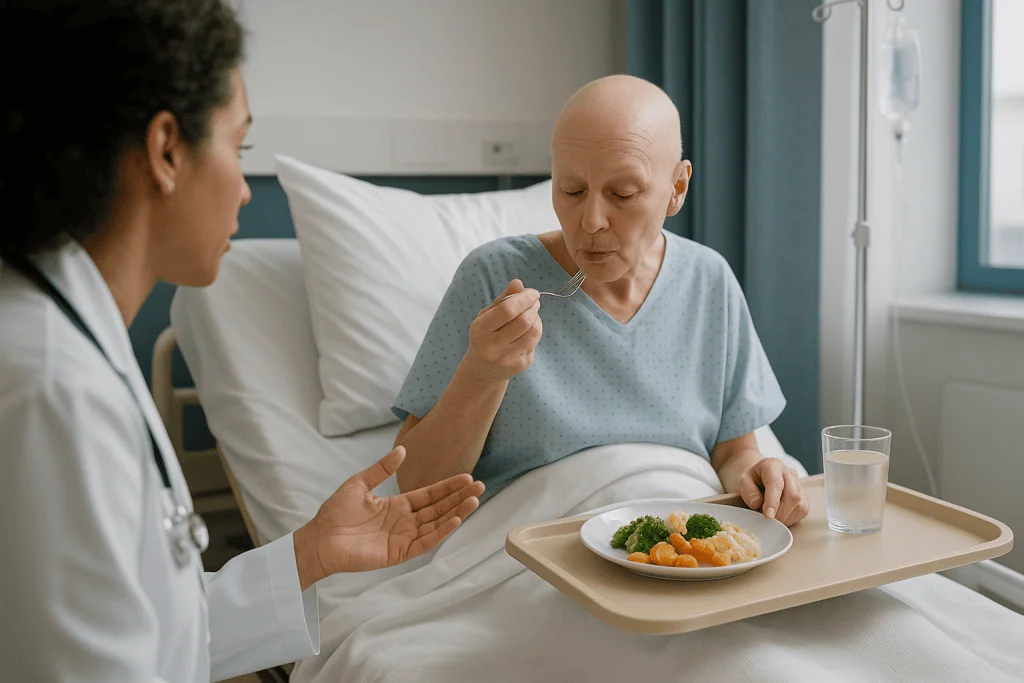
Temperature remains the anchor. A reading at or above the guideline threshold is enough on its own to trigger the emergency pathway; you do not need to wait for anything else. Shivering or shaking chills, sometimes called rigors, often accompany a rising temperature and can occur even before the thermometer crosses the line. A sudden feeling of being unwell, described by many patients as simply feeling wrong, is worth taking seriously in the nadir window.
Some people, particularly older adults and those on steroids, develop infection without a clear fever. In these cases, the body sometimes signals through the opposite direction: a temperature that drops below normal, along with a fast heartbeat, rapid breathing, cold or clammy skin, or new confusion. Mayo Clinic lists confusion, extreme discomfort, shortness of breath and a fast heart rate among the signs that sepsis may be progressing.
Localized clues, when present, point the team toward a source. Pain, redness or swelling around a central line (a long-term catheter placed in a large vein for treatment) deserves immediate attention because line infections are common in this population. Mouth ulcers that suddenly worsen, new abdominal pain, burning when passing urine, a new cough, or redness near the anus can each indicate where bacteria entered.
None of these signs is meant to be a checklist you score at home. The rule your care team will have given you is simpler: if you are in a neutropenic period and you feel feverish, chilled or unusually unwell, check your temperature and call the number you were given. Let the professionals decide how much weight each sign carries.
When to go to the ER for neutropenic fever
Go now, not in the morning. Every major cancer organization and guideline group agrees on this point, and the reasoning follows directly from the biology above. Neutropenia removes the cushion of time that a healthy immune system provides.
In practice, most oncology programs give patients a specific pathway before treatment begins. It usually involves a 24-hour telephone number, a card or letter stating that you are receiving chemotherapy and are at risk of neutropenia, and instructions on which emergency department to attend. Calling first is helpful because the team can alert the receiving department, but a phone call should never delay travel if you are feeling worse. If you cannot reach anyone within a few minutes, go directly.
Bring the card or letter. Its purpose is to move you out of the general waiting queue. Triage systems in many hospitals treat a known neutropenic fever as a high-priority presentation, in the same tier as suspected stroke or heart attack, because the guideline target is to have blood cultures drawn and the first dose of antibiotics running within 60 minutes of arrival, according to the NIH StatPearls summary of infectious disease society recommendations. Sitting in a waiting room for two hours erodes that target.
Do not take a fever reducer before you are assessed, unless your team has told you otherwise. Lowering the temperature does not lower the risk, and it can obscure the picture. Do not eat or drink heavily on the way, in case a procedure is needed. Bring a list of your medicines, the date of your last chemotherapy, and the name of your oncologist.
If you are unable to get to hospital quickly, or if someone you care for is confused, struggling to breathe, or has cold, mottled skin, call emergency services rather than driving. Those are signs that sepsis may already be affecting circulation, and paramedics can begin support on the way.
What actually happens in the first hour at the hospital
The first hour is deliberately front-loaded. Once the triage nurse recognizes the presentation, several things happen almost simultaneously rather than in sequence.
A clinician takes a focused history: which treatment, how many days ago, what the last blood count showed, any recent hospital stays, any allergies, and whether a central line is in place. The physical examination is thorough but quick, with particular attention to the mouth, skin, line sites, lungs, abdomen and the area around the anus, since these are the common entry points for bacteria.
Blood is drawn before any antibiotic is given. Two sets of blood cultures, samples incubated in the laboratory to see whether bacteria grow, are standard; if a central line is present, one set usually comes from the line and one from a vein in the arm so the team can tell whether the line itself is the source. A complete blood count confirms the neutrophil level. Kidney and liver tests, a lactate level (a marker that rises when tissues are short of oxygen, an early warning of sepsis) and sometimes a coagulation panel round out the first draw. Urine is sent for culture, and a chest X-ray is often obtained, though a clear film does not rule out early pneumonia in neutropenia.
Then the antibiotic goes in. The guideline goal described by the NIH is a first dose within 60 minutes of arrival, and many departments track this as a quality measure. Intravenous fluids are started if blood pressure or heart rate suggest the circulation is under strain.
What you will notice from the bed is a flurry of people, several tubes of blood, an intravenous line and a good deal of questioning. What you will not see is waiting for results before treatment starts. That inversion of the usual order, act first and confirm later, is the defining feature of the pathway.
Febrile neutropenia treatment: why antibiotics start broad and then narrow
Febrile neutropenia is simply the clinical term for fever with a low neutrophil count. Its treatment rests on a principle called empiric therapy: choosing an antibiotic based on the most likely culprits before the laboratory has identified any of them.
The first choice is deliberately wide. Guidelines summarized by the NIH recommend an intravenous antibiotic from a class active against a broad range of bacteria, with particular coverage for a gut organism called Pseudomonas, which is notorious for causing rapid deterioration in neutropenic patients. Classes commonly used include antipseudomonal beta-lactams and carbapenems; the specific agent depends on local resistance patterns, the patient’s allergies and kidney function, and what has been used before. These are prescribing decisions for the treating team, and the choice is often written into each hospital’s own protocol.
Additional cover is layered on only when there is a reason. If the skin or a central line looks infected, if blood pressure is unstable, or if a previous culture grew a resistant organism, an agent active against resistant gram-positive bacteria may be added. Antifungal treatment is generally considered only if fever persists for several days despite antibiotics, because fungal infections take longer to establish and are harder to diagnose.
Then the narrowing begins. Blood cultures typically show growth within 24–72 hours if bacteria are present. Once the laboratory identifies the organism and tests which antibiotics it responds to, the team can switch to a more targeted drug, reducing side effects and pressure on resistance. If cultures stay negative and the patient is stable, the broad agent may be continued until the neutrophil count recovers, or in some low-risk situations stepped down to an oral antibiotic. How long treatment continues is guided by the count, the fever curve and any identified source, and it is reviewed daily rather than fixed at the start.
Who is admitted, and who may be considered for early discharge
Nearly everyone with a neutropenic fever is assessed in hospital and receives the first antibiotic there. What differs is what happens next. Some people spend a week or more on a ward; a smaller group, after a period of observation, continues treatment at home with close follow-up.
The sorting tool most often used is the MASCC score, a points system developed by the Multinational Association for Supportive Care in Cancer. It weighs factors such as the severity of symptoms, blood pressure, whether the person has chronic lung disease, whether the cancer is a solid tumor or a blood cancer, dehydration, age, and whether the fever began while already in hospital. According to the NIH StatPearls chapter, a score of 21 or higher identifies a lower-risk group in which complications are less likely. A related tool, the CISNE score, is sometimes used for people with solid tumors who appear stable.
People usually kept in hospital include those whose neutropenia is expected to last more than a week, those with an ANC under 100, anyone with unstable blood pressure, breathing difficulty, confusion, significant abdominal symptoms, a suspected line infection, or organ dysfunction on blood tests. Blood cancers and recent stem cell transplant also generally mean admission.
Early discharge on oral antibiotics is considered only when several conditions line up: a low-risk score, a clinical picture that has stayed stable through a period of observation, the ability to swallow and keep down tablets, a phone and transport, someone at home, and the capacity to return within an hour if anything changes. Even then, the team will arrange a follow-up contact, often within 24 hours.
The scoring tools inform the decision; they do not make it. A clinician who is uneasy about a patient with a reassuring score will admit them, and that judgment call is exactly what the tools are meant to support.
Ordinary fever versus neutropenic fever: a side-by-side view
Seeing the two situations next to each other explains why the advice for one is almost the opposite of the advice for the other. The table below draws on the definitions and thresholds described by the NIH, Cleveland Clinic and Mayo Clinic.
| Feature | Fever with a normal immune system | Fever with neutropenia (ANC below 500) |
|---|---|---|
| Temperature that triggers action | Often only above 39°C (102°F), or when symptoms are severe | 38.3°C (101°F) once, or 38.0°C (100.4°F) for one hour |
| Usual first step | Rest, fluids, watch and wait | Call the oncology line and go to the emergency department |
| Visible signs of infection | Redness, swelling, pus, productive cough | Frequently absent; fever may be the only sign |
| Fever reducers before assessment | Reasonable for comfort | Generally avoided until assessed, unless the team advises otherwise |
| Time from fever to serious illness | Usually days | Can be hours, especially with ANC below 100 |
| Antibiotics | Given if a bacterial source is identified | Broad intravenous antibiotic started before results, target within 60 minutes |
| Where treatment happens | Mostly at home | Hospital assessment for everyone; admission for most |
The middle column is how most people have managed fevers all their lives, and those instincts are hard to override. The right-hand column is what your care team is asking you to follow for a defined window, typically the days around each nadir, and it applies only while your counts are low. Once the marrow recovers, ordinary rules return. Your oncology team will tell you when that is.
What the following days usually look like
After the first hour the pace slows into a daily rhythm. Each morning brings a blood draw to track the neutrophil count, kidney function and inflammatory markers, a review of the fever chart, and a check of any culture results that have matured overnight. Vital signs are recorded frequently, often every four hours, and more often if anything wobbles.
Fever commonly persists for the first two or three days even when the antibiotic is working, because it takes time for the drug to clear the bacterial load and for inflammation to settle. The team usually holds course through this period unless the patient is deteriorating. If fever continues beyond about 72–96 hours, the NIH StatPearls chapter describes a structured reassessment: repeat cultures, imaging of the chest and sometimes the abdomen, a fresh look at every line and catheter, and consideration of adding antifungal cover.
Many people also receive a growth factor. Granulocyte colony-stimulating factors, or G-CSF, are injected medicines that signal the bone marrow to release neutrophils faster; they are often given after chemotherapy to shorten the nadir, and are sometimes used during an admission for high-risk fever. They do not treat the infection itself. Whether and when to use them is a decision for the oncology team based on the regimen and the individual’s risk.
Discharge is typically considered when the fever has been absent for at least 24–48 hours, cultures are negative or the identified organism is responding to a suitable antibiotic, and the neutrophil count is rising back toward or above 500. Some people leave on oral antibiotics to complete a course; others need none.
The episode also feeds back into the treatment plan. An oncologist may adjust the timing or intensity of the next cycle, add growth factor support, or arrange prophylactic antibiotics during future nadirs. These are conversations to expect, not decisions you will be asked to make alone.
What is the survival rate for neutropenic sepsis? An honest reading of the evidence
People search this question because they want a single number, and the medical literature does not offer one that is honest for everybody. Outcomes depend heavily on which group you belong to, and the range between groups is wide.
Neutropenic sepsis is the term used when a neutropenic infection has progressed to the systemic response described earlier, with signs such as low blood pressure or organ dysfunction. The NIH StatPearls review notes that outcomes are strongly shaped by the depth and expected duration of neutropenia, the underlying cancer, whether a source is identified, the presence of shock at arrival, and how quickly antibiotics were started. Low-risk patients, as defined by the scoring tools above, have a low rate of serious complications; those who arrive with established septic shock or multi-organ failure face substantially higher risk.
Two things in that list are within reach. Time to antibiotics is one. Studies summarized in the same review associate delays beyond the one-hour target with worse outcomes, which is why hospitals monitor it. Early recognition is the other, and it sits with the patient and family: the person who comes in at 38.2°C feeling slightly off has a very different trajectory from the person who waited two days.
What the evidence does not support is any figure quoted without those qualifiers, and this article will not offer one. If you or a relative has been admitted, the most useful question is not the population number but the personal one: given this count, this cancer and today’s observations, what is the team watching for, and what would change the plan? Clinicians can answer that with far more precision than any statistic, and they will revise the answer daily as results come in.
What people often get wrong about neutropenic fever
The mistakes below are common because they are reasonable in almost any other context.
The first is treating 100.4°F as no big deal. In a person with normal counts it is a trivial reading. In deep neutropenia it meets the guideline definition for sustained fever, and clinicians would rather see ten people whose fever turns out to be nothing than miss one whose infection is accelerating. There is no such thing as bothering the team unnecessarily during a nadir.
The second is taking a fever reducer and rechecking in a few hours. Acetaminophen lowers the number on the thermometer without touching the bacteria. The delay can cost the hour that matters most, and the suppressed reading can mislead the triage nurse.
The third is assuming that feeling fine means being fine. Neutropenia removes the mechanisms that make infection feel bad early. Some patients arrive walking, talking and mildly embarrassed, and have bacteria growing in their blood by the next morning. Feeling well is reassuring but not decisive.
The fourth is thinking the emergency is over once the antibiotic starts. The first dose buys time; it does not end the risk. Deterioration in the first 24–48 hours is possible, which is why observation and repeated vital signs continue after treatment begins.
The fifth is believing that neutropenic fever means the cancer treatment has failed or must stop. It usually means the treatment is doing what it does to fast-dividing cells, marrow included. Oncologists have several ways to adjust support for the next cycle, and most people continue their planned therapy after recovery.
The last is a family member’s mistake: waiting until morning because the patient insists they are fine. If someone you care for is neutropenic and feverish, the thermometer outranks their reassurance.
Questions to ask your care team
The best time to ask most of these is before the first cycle of treatment, when everyone is calm. Write the answers down and keep them with your thermometer.
- On which days of my cycle is my neutrophil count expected to be lowest, and for how long?
- What exact temperature should prompt me to call, and which number do I call at three in the morning?
- Which emergency department should I go to, and will you send a letter or card ahead of me?
- Should I avoid taking acetaminophen or anti-inflammatories during my nadir, and what should I use for pain instead?
- Do I have a central line, and what signs at the site should worry me?
- Am I a candidate for growth factor support or preventive antibiotics during future cycles?
- If I am admitted, roughly what will each day look like, and what results will you be waiting for?
- What would make you decide I could be treated at home, and what follow-up would that involve?
- Will this episode change the timing or dose of my next treatment?
- Who is the point of contact for questions after I go home?
During an admission the questions shift. Ask what the blood cultures have shown so far and when the next result is expected. Ask what today’s neutrophil count is and which direction it is moving. Ask what specifically would prompt a change in antibiotics. These are not challenges to the team’s judgment; they are the same questions the team asks itself each morning, and hearing the answers helps you understand the plan rather than simply undergo it.
Finally, ask who at home should be briefed. A partner or adult child who knows the threshold, the phone number and the location of the hospital letter is a genuine safety measure on a night when you may not be thinking clearly.
When to call your doctor
If you are in a neutropenic period or within about two weeks of chemotherapy and any of the following apply, call your oncology emergency line immediately and, if instructed or if you cannot get through quickly, go to the emergency department.
Red-flag signs include a temperature of 38.3°C (101°F) or higher on one reading, or 38.0°C (100.4°F) or higher that persists for an hour; shaking chills or rigors, even without a confirmed fever; a temperature that falls below 36°C (96.8°F) along with feeling unwell; a heartbeat that feels fast at rest; breathing that is rapid or labored; new confusion, drowsiness or difficulty rousing; cold, pale, clammy or mottled skin; dizziness or fainting when standing; passing little or no urine over several hours; redness, swelling, pain or discharge around a central line or any wound; severe mouth ulcers that stop you swallowing; new or worsening abdominal pain; diarrhea that is severe or bloody; or a general sense of being seriously unwell that is unlike anything you have felt in this treatment so far.
Call emergency services rather than driving if the person is confused, struggling to breathe, has blue or grey lips, or cannot be kept awake. Mayo Clinic lists these among the signs that sepsis may be advancing toward shock.
Do not take a fever reducer before being assessed unless your team has specifically told you to. Do not wait for a second reading to confirm the first. Do not decide it is probably just a cold.
Outside the nadir window, or if you are unsure whether your counts are low, the same call is still worthwhile. The oncology team can check your most recent results and tell you whether the emergency pathway applies. When in doubt, the phone call costs a few minutes; the alternative can cost far more. Every decision about assessment, treatment and admission rests with the clinicians who see you, and this article is a guide to that conversation, not a replacement for it.
Frequently asked questions
When should I go to the ER for neutropenic fever?
Go immediately if you are neutropenic or within about two weeks of chemotherapy and your oral temperature reaches 38.3°C (101°F) once or 38.0°C (100.4°F) for an hour. Call your oncology line first if you can reach them within a few minutes, bring your treatment card, and do not wait until morning or take a fever reducer beforehand unless your team has instructed you to.
What are the early signs of neutropenic sepsis?
Early signs can be subtle: a temperature at or above the guideline threshold, shaking chills, a fast resting heartbeat, rapid breathing, or simply feeling suddenly and unusually unwell. Some people, especially older adults or those on steroids, show a low temperature, confusion or cold clammy skin instead of fever. Any of these during a neutropenic period warrants an immediate call to your care team.
What is the survival rate for neutropenic sepsis?
There is no single honest figure, because outcomes vary widely by risk group. The NIH review of febrile neutropenia describes low complication rates in patients classed as low risk and substantially higher risk in those who arrive with shock or organ failure. The factors most linked to better outcomes are early recognition and antibiotics started within the first hour, and your team can discuss your individual situation.
What is considered a fever in a neutropenic patient?
A single oral temperature of 38.3°C (101°F) or higher, or a temperature of 38.0°C (100.4°F) or higher that lasts for at least one hour, counts as fever when the absolute neutrophil count is below 500 cells per microliter or expected to drop below that within 48 hours. Oral readings are preferred; rectal thermometers are generally avoided because of the fragile bowel lining.
Which neutropenic fever antibiotics are used first?
The first antibiotic is an intravenous agent from a class that covers a broad range of bacteria, including Pseudomonas, usually an antipseudomonal beta-lactam or carbapenem, chosen according to hospital protocol, allergies and kidney function. Additional cover is added only for specific reasons such as a suspected line infection or unstable blood pressure. The choice and any later narrowing are decisions for the treating team.
How long does febrile neutropenia treatment usually last?
Antibiotics are reviewed daily rather than given for a fixed period. Fever often persists for two or three days even when treatment is working. Discharge is typically considered once fever has been absent for about 24–48 hours, cultures are negative or responding, and the neutrophil count is climbing back toward 500. Total duration depends on the source found and how quickly the marrow recovers.
Can neutropenic fever be treated at home?
Sometimes, but only after hospital assessment. People with a low-risk MASCC score, stable observations through a period of monitoring, the ability to take oral antibiotics, someone at home, and quick access back to hospital may be considered for early discharge with follow-up within about a day. Anyone with deep or prolonged neutropenia, a blood cancer, unstable vital signs or a suspected line infection is usually admitted.
Should I take acetaminophen for a fever during chemotherapy?
Most oncology teams ask patients not to take fever reducers during their neutropenic window until they have been assessed, because lowering the temperature can mask the one signal clinicians rely on without affecting the underlying infection. If you have already taken something, tell the triage nurse what and when. Follow the specific instructions your own team has given you.
Does a low white blood cell count with fever mean my cancer treatment has failed?
No. It usually means the chemotherapy is affecting fast-dividing cells in the bone marrow, which is an expected side effect rather than a sign the cancer is not responding. After recovery, oncologists may adjust the timing of the next cycle, add growth factor support or preventive antibiotics, and most people continue their planned treatment.
What is a growth factor and does it treat the infection?
Granulocyte colony-stimulating factors, or G-CSF, are injected medicines that prompt the bone marrow to release neutrophils faster, shortening the period of low counts. They do not kill bacteria and are not a substitute for antibiotics. Whether to use them after chemotherapy or during a fever admission is a decision the oncology team makes based on the regimen and individual risk.
References
- Febrile Neutropenia (StatPearls), NIH National Library of Medicine
- Neutropenia, Cleveland Clinic
- Chemotherapy side effects, NHS
This article is for general information only and is not a substitute for professional medical advice. Please consult a qualified doctor about your individual situation.

More from the Blog

Petechial Rash and Purpura: What the Tiny Red or Purple Spots Mean and When Care Is Urgent
A petechial rash is a scatter of pinpoint red or purple dots caused by bleeding from tiny vessels under the skin; the spots do…

Is a Specialist Second Opinion Useful in Aplastic Anemia? What a Transplant Center Adds
A specialist second opinion is widely considered useful in aplastic anemia because the condition is rare, easily confused with other bone marrow disorders, and…

Fever, Bruising or Unusual Fatigue With Myelodysplastic Syndrome: What to Report Promptly
With myelodysplastic syndrome, a temperature of 100.4°F (38°C) or higher, new or spreading bruises, bleeding that does not stop, or fatigue that suddenly worsens…

Iron Chelation in Thalassemia: Why It Accompanies Transfusions and How It Is Monitored
Iron chelation accompanies regular transfusions in thalassemia because every unit of donated red cells adds iron the body cannot excrete on its own, and…

Living With Low Counts in Aplastic Anemia: Infection and Bleeding Precautions That Matter
In aplastic anemia, low neutrophils raise infection risk and low platelets raise bleeding risk, so daily precautions focus on both. Core habits include careful…

Supporting Someone With Sickle Cell Anemia: Hydration, Warmth and Recognizing a Crisis
Supporting someone with sickle cell means helping prevent the triggers that make red blood cells sickle, chiefly dehydration, cold and infection, and knowing when…