

Why Straws and Smoking Matter After Wisdom Teeth Removal: Dry Socket Explained

Key Takeaways
- Dry socket is exposed bone after the healing clot is lost, not an infection, so antibiotics are not part of routine treatment.
- Straws, cigarettes, vapes, and forceful spitting all create negative pressure in the mouth that can pull a soft clot out of the socket.
- Nicotine constricts blood vessels, reducing the already modest blood supply to the lower jaw, which is why smokers face higher dry socket risk.
- The defining sign is pain that improves and then worsens, typically between day one and day five after extraction according to Mayo Clinic and the NHS.
- Warm salt-water rinses from the day after surgery keep the socket clean, but they have not been shown to prevent dry socket on their own.
- Dry socket does heal by itself over roughly seven to ten days, but irrigation and a medicated dressing from the dental team usually bring relief quickly.
Dry socket is a painful complication after wisdom teeth removal in which the protective blood clot in the empty socket is lost or fails to form, leaving bone exposed. Sucking on a straw or a cigarette creates negative pressure that can pull the clot loose, and tobacco chemicals slow healing. Pain that worsens a few days after surgery rather than easing should be assessed promptly by the dental team.
Day two. The swelling has peaked, the gauze is gone, and someone has just handed you a thick strawberry milkshake with a straw already in it. You hesitate. Somewhere in the fog of the discharge instructions was a line about straws, and another about smoking, and you remember thinking both sounded oddly specific for a set of rules about teeth.
They are specific for a reason. Dry socket after wisdom teeth removal is the single complication oral surgeons warn about most, and it is almost entirely a story about one small blood clot and the forces that can dislodge it. A straw, a cigarette, a vigorous rinse, even an enthusiastic spit all share the same mechanical problem: suction and pressure inside a mouth that needs stillness.
This explainer walks through what that clot is doing, why lower wisdom teeth are the riskiest site, how normal soreness differs from a socket that has lost its seal, and what actually happens when a clinician treats it. The milkshake can wait; the spoon cannot hurt you.
What is dry socket after wisdom teeth removal?
Dry socket has a formal name, alveolar osteitis, which simply means inflammation of the bony socket where a tooth used to sit. Within the first hours after an extraction, blood fills that hole and thickens into a clot. The clot is not waste; it is the scaffold on which new gum tissue and, eventually, new bone will grow. Lose the scaffold and the building stops.
When the clot is dislodged, dissolves too early, or never forms properly, the walls of the socket are left bare. Bone and the fine nerve endings inside it are exposed to air, saliva, and food debris. That exposure, not an infection, is what produces the deep, throbbing ache people describe. Mayo Clinic calls dry socket the most common complication after tooth extraction, and singles out impacted wisdom teeth as the setting where it appears most often.
How common is it? Cleveland Clinic describes dry socket as affecting a small percentage of all extractions, in the range of a few in every hundred, while noting that the rate climbs considerably after removal of lower wisdom teeth, particularly impacted ones. The reasons are anatomical. The lower jaw is denser than the upper, its blood supply to the back molars is comparatively modest, and an impacted tooth often requires bone to be removed and the gum to be lifted. More surgery means more disruption, and a socket that is farther from the tongue’s cleaning action and the cheek’s warmth.
The condition is not dangerous in the way a spreading infection can be. It is, however, miserable, and it is largely avoidable by protecting one clot for a few critical days.
How dry socket happens: the clot, the bone, and the first three days
Think of the clot as wet cement poured into a mold. In the first 24 hours it is soft, glossy, and easily disturbed. Over the following two to three days it firms up and a thin layer of granulation tissue, the pink, new tissue that precedes healing, begins to creep in from the socket edges. By the end of the first week, that tissue usually covers the bone, and the danger period has largely passed.
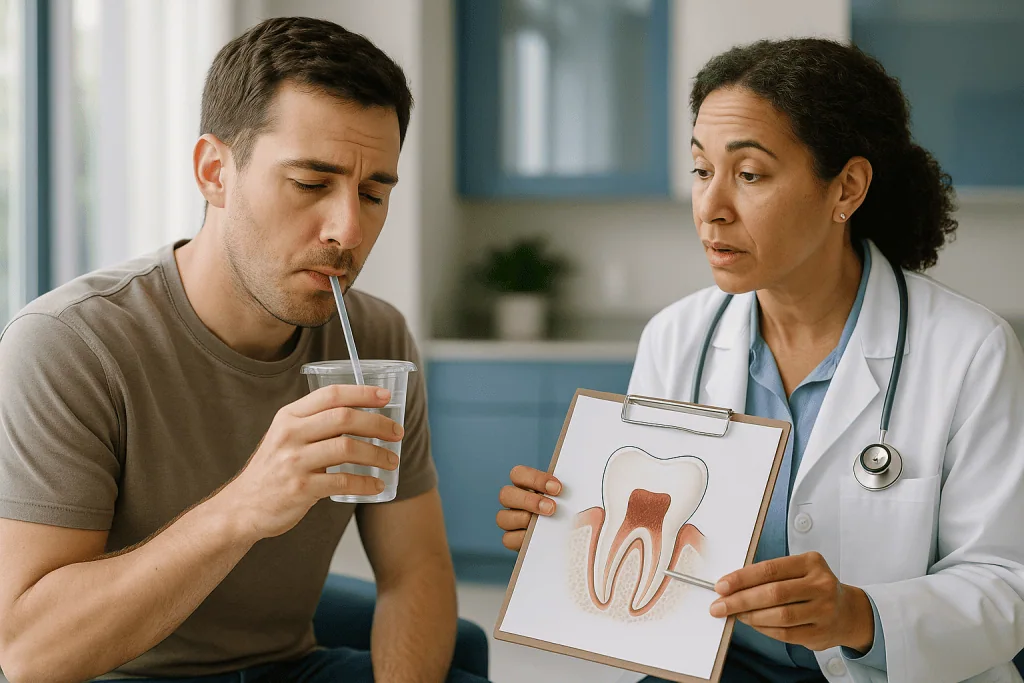
Two things can go wrong with the cement. The first is mechanical: something physically pulls it out of the mold. Negative pressure inside the mouth is the classic culprit, which is why straws, smoking, and hard spitting all appear on the same warning list. The second is chemical: the body’s own clot-dissolving system, called fibrinolysis, becomes overactive and breaks the clot down before new tissue can replace it. Bacteria in the socket, tissue trauma from a difficult surgery, and certain hormonal states are thought to speed this process along.
Timing tells the story. Mayo Clinic notes that dry socket pain typically starts one to three days after the extraction, while the NHS describes it appearing around three to five days after surgery. Either way, the pattern is the same: an ache that was settling suddenly reverses direction. Pain in the first 24 hours is expected and reflects the surgery itself; pain that begins climbing on day three, when everything else is improving, points to a socket that has lost its seal.
Once the clot is gone, the exposed bone cannot simply grow a new one. The body has to build tissue slowly from the edges inward, which is why a dry socket takes longer to settle than an ordinary extraction site.
Why straws matter after wisdom teeth removal
A straw is a small vacuum pump. To lift liquid up the tube, the tongue and cheeks drop the pressure inside the mouth below the pressure outside. That drop is modest, but it acts on everything in the oral cavity, including a soft, day-old clot sitting in an open socket at the very back of the lower jaw. Repeat the motion with every sip of a thick milkshake and the cumulative tug is real.
MedlinePlus and the NHS both advise against straws in the early recovery period for exactly this reason, alongside the related instructions not to spit forcefully or rinse vigorously during the first day. All three actions share the mechanism: pressure changes that can lift or fragment the clot. Sucking on hard candy, drinking from a sports bottle with a pull-top, or even blowing up a balloon belong in the same category, though they rarely make it onto the printed list.
How long should the straw stay in the drawer? Surgical teams vary, and the honest answer is that the highest-risk window is the first few days while the clot matures. The NHS puts full recovery from wisdom tooth removal at up to two weeks, and many teams ask patients to avoid suction until the socket is clearly closing over. Your own team will give a timeframe based on how difficult the extraction was.
The workaround is dull but effective: drink from a cup, eat soft foods with a spoon, and let gravity do the work. A milkshake tastes the same off a spoon. A lost clot does not feel the same as a normal day three.
Why smoking (and vaping) matter after wisdom teeth removal
Smoking hits the healing socket from three directions at once, which is why Mayo Clinic lists smoking and tobacco use at the top of its risk factors for dry socket.

The first is suction. Drawing on a cigarette produces the same negative pressure as a straw, and smokers tend to repeat that action dozens of times a day. The second is heat and chemistry. Smoke bathes the wound in hot gas and thousands of compounds, several of which are directly irritating to raw tissue and appear to interfere with the delicate early stages of clot organization. The third, and perhaps most important, is nicotine itself. Nicotine constricts small blood vessels, reducing the flow of oxygen and immune cells to the socket. A wound with poor blood supply heals slowly and defends itself poorly, and the lower jaw was not generous with blood supply to begin with.
Vaping deserves a specific mention because people often assume it sidesteps the problem. It does not sidestep the first or the third mechanism. Inhaling from a vape device requires the same suction, and most e-liquids deliver nicotine with its same effect on blood vessels. Evidence specific to vaping and dry socket is thinner than for cigarettes, but the mechanisms overlap enough that surgical teams generally treat them alike.
The NHS advises avoiding smoking during recovery from wisdom tooth removal, and MedlinePlus gives the same instruction after any extraction. For someone who smokes, the days after surgery are genuinely hard, and it is reasonable to ask the care team about nicotine replacement in forms that avoid suction. That is a conversation for the prescribing clinician, not a decision to make alone.
Who gets dry socket wisdom teeth most often, and who is usually asked to wait
Some people walk into an extraction with more risk than others, and knowing which group you fall into helps you take the aftercare seriously rather than treating it as boilerplate.
Mayo Clinic and the NHS between them describe a consistent cluster of risk factors. Lower wisdom teeth carry more risk than upper ones, and impacted or surgically removed teeth more than simple extractions. Smoking and tobacco use sit at the top of the list. A previous dry socket raises the odds of another. An existing infection in the tooth or surrounding gum at the time of surgery increases risk, as does not following aftercare instructions closely. Mayo Clinic also notes an association with oral contraceptives, which is thought to relate to estrogen’s effect on the clot-dissolving fibrinolytic system; this is an association worth mentioning to the surgeon, never a reason to change a prescribed medicine without discussing it.
Who is asked to wait? Surgeons commonly postpone a planned wisdom tooth extraction when there is an active, spreading infection that needs settling first, when a patient is acutely unwell, or when a bleeding disorder or certain medicines need coordination with the prescribing physician. Someone who smokes may be asked to stop for a period before and after surgery. None of these are refusals; they are sequencing decisions, and they sit with the treating team.
For the higher-risk patient, the practical difference is emphasis. The straw rule, the smoking rule, and the gentle-rinsing rule matter for everyone, but for a smoker having an impacted lower wisdom tooth removed, they are the difference between an ordinary week and a difficult one.
Dry socket vs normal healing: what the difference actually feels like
Ordinary post-extraction soreness and dry socket are both painful, and both happen in the first week, which is why they get confused. The distinction lies less in how much it hurts on any single day than in the direction the pain is traveling.
After a routine wisdom tooth extraction, discomfort is usually worst in the first day or two, then eases steadily. Swelling peaks around the second or third day and recedes. Prescribed or over-the-counter pain relief, taken as the team advised, generally keeps things manageable. The socket itself, if you glimpse it in a mirror, looks dark red or maroon because the clot is sitting in it.
Dry socket reverses that trajectory. Pain that was fading begins to climb, often abruptly, typically between the first and fifth day according to Mayo Clinic and the NHS. It is deep and throbbing rather than sharp, frequently radiates toward the ear, eye, or temple on the same side, and tends to respond poorly to the pain relief that was working fine the day before. A bad taste or odor from the site is common. Where the clot should be, there may be a grayish hollow or a glimpse of whitish bone.
| Feature | Typical healing | Dry socket pattern |
|---|---|---|
| Pain direction | Peaks early, then eases day by day | Improves, then worsens sharply |
| Timing of worst pain | First 24 to 48 hours | Roughly day 1 to day 5 (Mayo Clinic, NHS) |
| Character | Sore, tender, manageable | Deep, throbbing, radiating to ear or temple |
| Socket appearance | Dark red clot filling the hole | Empty or gray hollow, sometimes visible bone |
| Taste or smell | Mild, from the wound | Persistent bad taste or odor |
| Response to advised pain relief | Usually adequate | Often poor |
A table is a guide to a conversation, not a diagnosis. Only the clinician who can look inside the socket can confirm what is happening.
What are the warning signs of a dry socket?
The pattern clinicians recognize is remarkably consistent, and it centers on time. A person who felt they were turning the corner wakes on the third or fourth day with pain that is not just present but worse than it was at any earlier point. Mayo Clinic describes this as severe pain within a few days of the extraction, often beginning one to three days afterward, while the NHS places the usual onset at three to five days. The two windows overlap, and the lesson is the same: worsening pain in the first week is the signal.
The quality of the pain matters as much as its intensity. Dry socket pain is typically described as deep and throbbing, arising from the jawbone itself rather than the gum. Because the nerves of the lower jaw share pathways with those of the face, the ache frequently travels, so people report it in the ear, the temple, the eye, or down the neck on the same side. Someone may reach for the ear before they think about the tooth.
Two other features round out the picture. The first is an unpleasant taste or odor from the site, produced by food debris and bacteria collecting in a hollow that no longer has a clot to seal it. The second is the appearance of the socket: Mayo Clinic describes partial or total loss of the clot, leaving what looks like an empty hole, sometimes with visible bone in the base.
What dry socket usually does not produce is fever or spreading facial swelling. Those point toward infection, a different problem with a different urgency, covered in the section on when to call.
If this pattern sounds familiar, the next step is a phone call, not a mirror. The dental team would rather hear from you on day three than day six.
How do I check myself for a dry socket?
The honest answer is that you cannot reliably check yourself, and trying too hard can make things worse. The socket for a lower wisdom tooth sits far back, behind the last standing molar, at an angle that is nearly impossible to see well in a bathroom mirror. What looks like an empty hole may simply be a clot that has darkened, and what looks like a healthy clot may be food debris. Probing the area with a finger, a cotton swab, or a toothpick to “see if it hurts” risks dislodging a clot that was holding on.
Clinicians assess dry socket by looking directly into the socket under good light, sometimes gently irrigating it to clear debris, and by listening carefully to the history: when the pain began, whether it is climbing or fading, where it radiates, and how it responds to the pain relief already advised. Mayo Clinic notes that the history and examination are usually enough and that imaging is reserved for ruling out other explanations, such as a retained fragment of tooth or bone.
What you can usefully observe from home is the trajectory of your own pain, without touching anything. Is today better or worse than yesterday? Did something change abruptly? Is the pain now in the ear or temple when it was not before? Is there a taste that will not rinse away? Those observations, reported over the phone, give the team most of what they need to decide how soon to see you.
Resist two temptations. Do not pack the socket yourself with anything, and do not start vigorous rinsing in an attempt to clean it out. Both can convert a marginal situation into a definite one.
Will dry socket heal on its own?
Yes, eventually, and this is one of the more reassuring facts about the condition. Dry socket is a delay in healing rather than a failure of it. The bone is not dead, and the body will slowly grow granulation tissue from the socket edges inward until the exposed surface is covered. Cleveland Clinic describes this process as typically taking around seven to ten days once it gets underway, longer than an ordinary extraction site but not indefinite.
The catch is what those days feel like without treatment. Exposed bone hurts, and it keeps hurting until tissue covers it. Food debris collects in the hollow and prolongs inflammation. Pain relief that would suffice for a normal extraction often falls short. People who try to wait it out describe some of the worst dental pain of their lives, for a week or more, when a short appointment could have made most of it manageable.
Treatment does not speed the underlying biology very much. What it does is control pain and protect the site while that biology runs its course. Mayo Clinic notes that once treatment begins, people usually feel relief soon afterward, with symptoms continuing to improve over the following days. The socket still needs its seven to ten days to fill in, but those days are spent in comfort rather than misery.
There is one more reason not to simply wait. Worsening pain after an extraction has other possible causes, including infection and a retained root fragment, and those do not resolve on their own. A clinician can tell the difference in minutes. A patient at home cannot. “It will heal eventually” is true of dry socket; it is not a safe assumption about whatever is causing your pain until someone has looked.
How dry socket is treated: what happens at the appointment
The visit is usually short and brings faster relief than most people expect. Knowing the steps takes some of the dread out of picking up the phone.
The clinician begins by examining the socket and, if needed, gently flushing it with a sterile solution to clear out food particles and debris. This alone often reduces pain, because much of the irritation comes from material lodged against exposed bone. Mayo Clinic describes this irrigation as the first step in management.
Next comes a medicated dressing. A small piece of gauze or a soft paste containing a soothing, mildly antiseptic agent is placed into the socket. Its job is to shield the bone from air and debris and to calm the nerve endings. Relief from the dressing is usually rapid. Depending on the product and the team’s practice, the dressing may need changing every day or two until the pain subsides on its own, at which point it is left out so tissue can close over.
Pain relief is the third element. The team may recommend or prescribe medicines from the anti-inflammatory class or others, chosen for your medical history and whatever you are already taking. Which medicine, how much, and for how long are decisions for the prescribing clinician, not for a magazine article. Antibiotics are generally not part of routine dry socket management, because dry socket is not an infection; they are reserved for cases where infection is actually present.
Finally, home care is reviewed: gentle salt-water rinsing as directed, avoiding suction and smoking, and keeping the site clean without disturbing it. Follow-up is arranged so the team can confirm that granulation tissue is filling the socket as it should.
What the first two weeks after wisdom teeth removal usually look like
Recovery has a rhythm, and dry socket is easiest to spot when you know what the ordinary rhythm sounds like. The NHS describes recovery from wisdom tooth removal as taking up to two weeks, with most of the noticeable symptoms concentrated in the first few days.
The first 24 hours belong to the clot. Bleeding tapers off with gentle pressure on gauze, numbness wears off, and pain arrives as the local anesthetic fades. This is the day to avoid rinsing, spitting, straws, hot drinks, alcohol, and smoking entirely, according to both the NHS and MedlinePlus. Cold packs on the cheek help with swelling. Soft, cool food by spoon.
Days two and three are typically the peak of swelling and jaw stiffness. Bruising may appear on the cheek or neck. From the day after surgery, the NHS advises gentle warm salt-water rinses, particularly after meals, to keep the socket clean. Pain should be plateauing or beginning to ease. This is also the window in which dry socket most often declares itself, so a sudden reversal here deserves a call.
Days four through seven bring steady improvement for most people. Swelling recedes, the jaw opens more freely, and diet expands toward normal textures, though chewing on the surgical side is often still uncomfortable. Any stitches that dissolve on their own begin to loosen.
The second week is about consolidation. Soreness fades to occasional twinges, the socket edges pull together, and the gum surface closes over. The underlying bone continues to fill in for months, but from the outside the episode is essentially over. Anyone still in significant pain at this stage, or whose pain has returned, should be seen.
Does a salt water rinse prevent dry socket?
Salt water occupies a curious place in extraction aftercare: universally recommended, rarely questioned, and less studied than most people assume. It helps to separate what it clearly does from what it is often credited with.
What it does is keep the socket clean. A warm, mild salt solution loosens food debris from around the wound, is gentle on raw tissue, and does not disturb a clot when used without force. The NHS recommends gentle warm salt-water rinses starting the day after wisdom tooth removal, and MedlinePlus gives the same advice after any extraction, emphasizing that rinsing should begin only after the first 24 hours. Cleanliness reduces bacterial load in the socket, and since bacteria are thought to contribute to early clot breakdown, keeping the area clean is a sensible part of prevention.
What salt water has not been shown to do is prevent dry socket on its own. The measures with the strongest evidence for prevention are avoiding smoking and avoiding suction, meticulous surgical technique, and, in some settings, an antiseptic rinse or gel containing chlorhexidine placed or prescribed by the surgeon around the time of extraction. Mayo Clinic lists antibacterial mouthwashes or gels among the steps a surgeon may take to reduce risk. Whether that is appropriate for you is the surgeon’s call.
The way you rinse matters more than the salt. Vigorous swishing and forceful spitting in the first days generate exactly the pressure changes that dislodge clots. The technique the NHS describes is closer to tilting the head and letting the liquid move gently over the site, then leaning over the sink and letting it fall out rather than spitting. Done that way, salt water is a helpful part of aftercare. Done aggressively, it can become the cause of the problem it was meant to prevent.
What people often get wrong about dry socket
Misunderstandings about dry socket tend to fall into two camps: treating it as more dangerous than it is, and treating the rules for preventing it as less important than they are.
The first myth is that dry socket is an infection and needs antibiotics. It is not. The pain comes from exposed bone, not from bacteria multiplying in tissue. Antibiotics do not treat exposed bone, and Mayo Clinic’s description of management centers on cleaning, dressing, and pain control. Infection can occur alongside dry socket, but it is a separate diagnosis with different signs.
The second is that any pain after day two means dry socket. Ordinary post-surgical soreness can linger for a week or more, especially after a difficult impacted extraction, and stiffness in the jaw muscles is common. What distinguishes dry socket is pain that gets worse after having gotten better, not pain that is simply still present.
The third is that vaping is safe because there is no smoke. The suction and the nicotine are both still there, and both act on the clot and the blood vessels feeding the socket.
The fourth is that a straw is fine once bleeding has stopped. Bleeding stops within hours; the clot remains vulnerable for days.
The fifth is that seeing a dark or grayish socket in the mirror means the clot is gone. Clots darken as they mature, food stains them, and the angle of view at the back of the lower jaw distorts almost everything. Appearance alone, seen from a bathroom mirror, is a poor guide.
The last, and most consequential, is that dry socket is something to endure quietly. It is one of the most treatable sources of severe dental pain, and a short appointment usually changes the whole experience.
Questions to ask your care team
A wisdom tooth consultation is short, and the aftercare sheet is generic by design. A few specific questions turn it into a plan for your mouth.
- Which teeth are being removed, and are any of them impacted lower molars where dry socket risk is higher?
- Given my history, including smoking, any previous dry socket, and the medicines I take, do you consider me higher risk, and does that change your approach?
- Do you use any antiseptic rinse, gel, or other measure at the time of surgery to reduce the chance of dry socket, and is it appropriate for me?
- Exactly how long would you like me to avoid straws, spitting, and vigorous rinsing, and when may I begin gentle salt-water rinses?
- If I smoke or vape, how long before and after surgery should I stop, and can we discuss nicotine replacement options that do not involve suction?
- What should the pain trajectory look like for my particular surgery, and at what point would worsening pain concern you?
- Who do I call if pain increases on day three or four, including outside office hours, and how quickly can I be seen?
- If dry socket does develop, what does your treatment involve, and how many visits does it typically require?
- Are there signs that would indicate infection rather than dry socket, and would you want to know about them immediately?
- When is my follow-up, and what would you expect the socket to look like by then?
Write the answers down or ask for them in writing. In the first days after surgery, most people are too uncomfortable and too medicated to remember a conversation from a week earlier, and the answer to “who do I call” is the one you will need most.
When to call your doctor
Contact the dental or surgical team promptly, the same day, if pain that was easing begins to worsen in the first week after wisdom tooth removal, especially if it throbs deeply, spreads toward the ear or temple, or is not controlled by the pain relief you were advised to take. That pattern is the hallmark of dry socket, and the earlier it is dressed, the shorter the misery. A persistent bad taste or odor from the site, or the sense that the socket has emptied out, belongs in the same call.
Some signs point to something other than dry socket and warrant more urgent attention. Seek care without delay for a fever, chills, or generally feeling unwell; swelling of the face, jaw, or neck that is increasing rather than receding after the third day; difficulty opening the mouth that is getting worse; pus draining from the site; or numbness of the lip, chin, or tongue that persists beyond the anesthetic wearing off. These can indicate infection or nerve involvement and need assessment by a clinician.
Treat the following as emergencies and use emergency services: any difficulty breathing or swallowing, swelling spreading under the jaw or into the neck or the floor of the mouth, bleeding that will not stop with firm, sustained pressure on gauze, or a high fever with rapidly progressing facial swelling. Airway compromise from a dental infection is rare but serious.
Everything in this article describes what usually happens and what the evidence supports. It cannot see into your mouth. Every decision about whether to wait, to dress the socket, to change a medicine, or to prescribe anything belongs to the team that performed your surgery and knows your history. When in doubt, call; that is what the number on the aftercare sheet is for.
Frequently asked questions
What are the warning signs of a dry socket?
The key sign is pain that was easing after extraction and then worsens noticeably, usually between the first and fifth day, according to Mayo Clinic and the NHS. The pain tends to be deep and throbbing, often radiating to the ear, temple, or eye on the same side, and responds poorly to the pain relief that was previously working. A persistent bad taste or odor and a socket that looks empty are also common. Only a clinician can confirm the diagnosis.
Will a dry socket heal on its own?
Yes, given time, because dry socket delays healing rather than preventing it. New tissue grows in from the socket edges over roughly seven to ten days according to Cleveland Clinic. Without treatment, though, those days are typically very painful, and other causes of worsening pain, such as infection or a retained fragment, do not resolve by themselves. A short appointment for irrigation and a medicated dressing usually brings prompt relief while healing continues.
How do I check myself for a dry socket?
You cannot reliably check yourself, and probing the site can dislodge a clot that is still in place. The socket sits far back in the lower jaw where mirrors distort the view, and a dark or gray appearance can be a maturing clot rather than a missing one. What you can usefully track is the direction of your pain over time and whether it has begun radiating or resisting pain relief. Report those observations to your dental team rather than investigating with a finger or swab.
Does a salt water rinse prevent dry socket?
Salt water has not been shown to prevent dry socket by itself, though it is a sensible part of aftercare. The NHS and MedlinePlus recommend gentle warm salt-water rinses starting the day after extraction to keep the socket clean, which may reduce the bacterial contribution to early clot breakdown. The strongest preventive measures are avoiding smoking and suction; some surgeons also use an antiseptic rinse or gel at the time of surgery. Rinse gently, never with force.
How to prevent dry socket after wisdom teeth removal?
Protect the clot for the first several days. Avoid straws, smoking, vaping, forceful spitting, and vigorous rinsing, all of which create pressure changes that can dislodge it. Do not rinse at all for the first 24 hours, then begin gentle salt-water rinses as the NHS advises. Eat soft food with a spoon, keep the area clean without touching it, and follow your surgeon’s specific instructions, which may include an antiseptic rinse or gel. Smokers should discuss a quit plan with the team beforehand.
Can vaping cause dry socket like smoking does?
Vaping carries much of the same risk, although the evidence specific to e-cigarettes is thinner than for tobacco. Inhaling from a vape requires the same suction that can pull a clot loose, and most e-liquids deliver nicotine, which constricts blood vessels and reduces blood flow to the healing socket. Surgical teams generally advise treating vaping exactly as they treat smoking during recovery. Ask your team about nicotine replacement forms that do not involve inhaling.
How long after wisdom teeth removal can I use a straw?
The highest-risk period is the first few days while the clot firms up and new tissue begins to cover the bone, and many teams ask patients to avoid suction until the socket is clearly closing over. The NHS describes full recovery from wisdom tooth removal as taking up to two weeks. Because timing depends on how difficult your extraction was, follow the specific timeframe your surgeon gives you rather than a general rule.
Is dry socket an infection?
No. Dry socket is inflammation of exposed bone after the protective clot is lost, and the pain comes from bare nerve endings rather than from bacteria multiplying in tissue. That is why antibiotics are not part of routine management; treatment involves cleaning the socket, placing a medicated dressing, and controlling pain. Infection can occur separately and produces different signs such as fever, pus, and increasing swelling, which need prompt assessment.
Can you get dry socket a week after wisdom teeth removal?
It is uncommon. Mayo Clinic describes dry socket pain typically beginning one to three days after extraction, and the NHS places usual onset around three to five days. By the end of the first week, new tissue has generally covered the bone, so the risk falls sharply. Pain that starts or returns after a week deserves assessment, but the team will also consider other explanations such as infection, a retained fragment, or jaw muscle strain.
What happens when a dentist treats dry socket?
The clinician examines the socket, gently flushes out food debris with a sterile solution, and places a medicated dressing that shields the bone and soothes the nerve endings. Relief from the dressing is usually rapid, and Mayo Clinic notes symptoms continue improving over the following days. The dressing may be changed every day or two until pain settles. Pain relief is chosen by the prescribing clinician based on your history, and follow-up confirms that tissue is filling the socket.
References
- Cleveland Clinic: Dry Socket (Alveolar Osteitis)
- NHS: Wisdom tooth removal
- MedlinePlus: Tooth extraction
This article is for general information only and is not a substitute for professional medical advice. Please consult a qualified doctor about your individual situation.

More from the Blog
How Orthodontic Treatment Moves Teeth: Pressure, Bone Remodeling and Adjustment Visits
Orthodontic treatment works by applying light, continuous pressure to teeth through braces, aligners or other appliances. That pressure compresses the ligament on one side…

Who Is a Candidate for Clear Aligners? Bite Types, Gum Health and Wear Commitment
Most people with mild to moderate crowding, spacing or bite problems, healthy gums and a full set of adult teeth can be considered for…

How Laser Assisted Dental Procedures Work: Cleaning First, Then Precise Light Treatment
A laser assisted dental procedure uses a focused beam of light, chosen for the tissue being treated, after the tooth or gum has first…

Living With TMJ Treatment: Soft Foods, Wide Yawns to Avoid and Daily Jaw Habits
A soft diet for TMJ means choosing foods that need little chewing, such as yogurt, eggs, cooked grains, flaky fish and well-cooked vegetables, for…

What Halitosis Treatment Can Change and How Quickly Breath Usually Improves
Halitosis treatment can usually change the source of the odor rather than mask it: bacterial coating on the tongue, gum disease, dry mouth, or…

What Bruxism Treatment Can and Cannot Do: Protecting Teeth vs Stopping the Grinding
Bruxism treatment results depend on which goal you mean. Custom night guards and dental repairs reliably protect teeth from further wear, but current evidence…