

Why the Bladder Stops Emptying: Urinary Retention Causes in Men and Women and Their Care

Key Takeaways
- Urinary retention has three mechanisms, blockage of the outlet, a weak bladder muscle, or disrupted nerve signaling, and treatment depends on which has failed.
- An enlarged prostate is the leading cause of retention in men, while pelvic organ prolapse and a weak detrusor muscle are more common causes in women.
- Decongestants tighten the bladder neck and anticholinergic medicines weaken the bladder's squeeze, so a new cold remedy can tip a narrowed outlet into acute retention.
- Acute retention, being unable to pass urine with a painful swollen abdomen, is a medical emergency that is relieved with a catheter, not with fluids or waiting.
- Leaking urine without warning can be overflow from a bladder that never empties, so incontinence and retention are not opposites and a residual scan settles the question.
- Alpha-blockers relax prostate muscle and typically act within days, while five-alpha-reductase inhibitors shrink the gland over months, according to the Mayo Clinic.
Urinary retention happens when the bladder cannot empty because something blocks the outlet, the bladder muscle is too weak to push, or the nerves coordinating the two misfire. In men the most frequent cause is an enlarged prostate; in women, pelvic organ prolapse, weak bladder muscle, and nerve conditions are more common. Medicines, infection, constipation, and recent anesthesia can trigger it in anyone. Sudden inability to pass urine with a painful, swollen lower belly needs emergency care.
It is two in the morning and a man in his sixties is standing over the toilet for the third time in an hour, bladder aching, producing nothing but a few drops. Across town, a woman recovering from a hysterectomy is told by her nurse that a scan shows her bladder is still nearly full, even though she just tried to go. Neither of them has a rare disease. Both have a bladder that has, for different reasons, stopped doing its most basic job.
The causes of urinary retention sort surprisingly neatly into three buckets: something is in the way, the bladder muscle has lost its strength, or the wiring between brain and bladder is disrupted. Which bucket you fall into determines almost everything about your care, from whether you need a catheter tonight to whether you will be asked to wait and watch.
This explainer walks through those causes in men and women, how clinicians tell them apart, and what the days after a diagnosis usually look like, staying with what the evidence supports rather than what the internet promises.
How normal bladder emptying works, and where it breaks down
Think of the bladder as a muscular balloon with a valve at the bottom. The balloon wall is the detrusor, a smooth muscle that stays relaxed while urine collects and squeezes when you decide to go. The valve is made of two sphincters: an inner ring you do not control and an outer ring you do. In men, the urethra also runs straight through the prostate on its way out.
Emptying is a coordinated event. Stretch sensors in the bladder wall report fullness to the spinal cord and brain. When you give permission, the brain sends a signal down the spinal cord that tells the detrusor to contract and, at the same instant, tells the sphincters to open. Squeeze and release must happen together. If the outlet stays shut while the muscle pushes, or the muscle fails to push while the outlet opens, urine stays put.
A healthy adult bladder comfortably holds roughly two cups of urine before the urge becomes strong, according to the Cleveland Clinic. In retention that volume climbs far higher, which is why the lower abdomen can become visibly swollen and tender.
Every cause of urinary retention interrupts one link in this chain. Obstruction narrows or blocks the outlet, so the detrusor is pushing against a closed door. Detrusor underactivity means the muscle contracts too weakly or not long enough, so urine dribbles out incompletely. Neurogenic causes disrupt the messages, so squeeze and release fall out of sync. Some people have two problems at once, such as a man with an enlarged prostate whose bladder muscle has stretched and weakened over years of straining against it. Working out which link has failed is the first task for any clinician, because the fix for a blocked door is nothing like the fix for a tired muscle.
Acute versus chronic urinary retention: how long is too long?
Clinicians divide retention into two patterns that feel very different from the inside.

Acute urinary retention arrives suddenly. You cannot pass urine at all, or only a trickle, despite an urgent need to go. The lower abdomen swells and hurts, sometimes intensely. The National Institute of Diabetes and Digestive and Kidney Diseases (NIDDK) classifies this as a medical emergency because a bladder stretched beyond its limit can be damaged, and urine backing up toward the kidneys can harm them. There is no safe number of hours to wait it out at home. If you cannot pass urine and your bladder feels full and painful, the answer to “how long is too long” is: you have already waited long enough.
Chronic urinary retention is slower and quieter. The bladder empties, but never completely, leaving a residual pool behind each time. People often notice a weak stream, a feeling of not being finished, needing to go again soon after going, or waking several times a night. Some leak urine without warning because an overfull bladder simply spills over, a pattern called overflow incontinence. Because the discomfort is mild or absent, chronic retention can go unrecognized for months, and the first hint may be a urinary tract infection that keeps coming back or a routine scan that finds a stretched bladder.
The distinction matters for care. Acute retention is relieved first and investigated second. Chronic retention is investigated first, with the residual volume measured, and treated according to the cause and the risk to the kidneys. Someone with chronic retention who suddenly cannot pass anything has slipped into acute-on-chronic retention, which is treated as an emergency in the same way.
Causes of urinary retention in men: the prostate and what lies beyond it
The male urethra passes directly through the prostate, so anything that swells that gland squeezes the pipe. Benign prostatic hyperplasia, the non-cancerous enlargement that comes with age, is the single most common cause of retention in men. The NIDDK notes that acute retention is far more frequent in men than in women and becomes more likely with each decade, largely for this reason.
The prostate does not have to be huge to cause trouble. Growth in the central zone, right around the urethra, can pinch the channel while the gland’s overall size remains modest. Over years, the bladder muscle thickens to push harder against the resistance, then eventually tires and stretches, so a man may end up with both obstruction and a weakened detrusor.
Other male-specific causes include prostatitis, an inflamed or infected prostate that swells quickly and can tip a borderline stream into complete blockage. Urethral stricture, scarring that narrows the tube, can follow injury, infection, or earlier procedures involving catheters or instruments. Prostate cancer sometimes causes retention, though usually late and usually with other signs; clinicians check for it because it changes the plan, not because retention itself suggests it.
Bladder stones, blood clots after bleeding into the bladder, and, rarely, a tight foreskin that will not retract can also block the outlet. Sudden retention in an older man is often triggered by a stacked set of small factors: a cold remedy that tightens the bladder neck, a long evening of drinking, constipation pressing on the urethra, and a prostate that was already narrowing the channel. Remove one or two triggers and the system often recovers; that stacking is why the medication history is one of the first questions asked.
Urinary retention in women: pelvic organs, muscles, and nerves
Women lack a prostate, so the pattern of causes shifts away from mechanical blockage and toward the muscle and its wiring. That does not make retention rare in women; it makes it easier to miss, because the classic image of a man unable to pee does not fit.
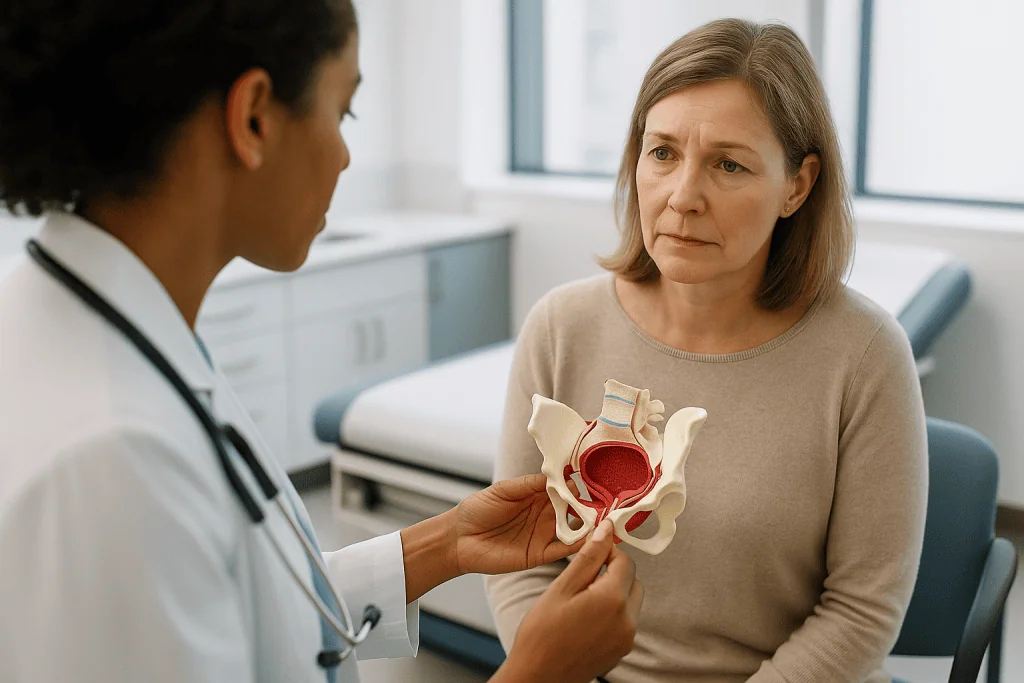
Pelvic organ prolapse is the most common structural cause. When the bladder, uterus, or rectum sags into the vaginal canal, it can kink the urethra, much like bending a garden hose. Some women find they must change position or press on the vagina to empty, a clue that points strongly toward prolapse. A large fibroid or ovarian mass, or a bladder that has dropped after childbirth, can act the same way.
Detrusor underactivity, a bladder muscle that contracts too weakly, is more frequent in women than is often assumed, particularly with age and diabetes. It produces the slow, incomplete emptying of chronic retention rather than a dramatic emergency.
Pelvic surgery is a well-recognized trigger. After hysterectomy, incontinence surgery, or vaginal repair, local swelling and disrupted nerve signaling can leave the bladder temporarily unable to empty. The same applies after childbirth, especially with an epidural or a long second stage; the NIDDK lists both surgery and anesthesia among common causes. In most of these cases function returns as swelling settles, though the bladder needs to be drained in the meantime to avoid over-stretching.
Fowler’s syndrome, in which the urethral sphincter fails to relax, is an uncommon cause seen mainly in younger women. Retention in a woman without an obvious trigger prompts clinicians to look carefully at the nervous system, because conditions such as multiple sclerosis occasionally announce themselves this way.
Medications that cause urinary retention, by class
Ask a clinician what to check first in a person who suddenly cannot pass urine and many will say the medicine cabinet. Several widely used drug classes interfere with bladder emptying, and the effect is often the tipping point on top of an existing narrowing.
Anticholinergics are the largest group. These medicines block acetylcholine, the chemical messenger that tells the detrusor to contract. Blocking it calms an overactive bladder, which is why some are prescribed for urgency, but it also weakens the squeeze. Many older antihistamines, some medicines for stomach cramps and travel sickness, certain antidepressants, and some treatments for Parkinson’s disease share this property.
Decongestants work on the opposite end of the problem. They stimulate alpha receptors that tighten the smooth muscle of the bladder neck and prostate, effectively closing the door. A man with a modestly enlarged prostate who takes a cold remedy is a textbook setup for acute retention, and the NIDDK specifically names decongestants among culprits.
Opioid pain relievers reduce the bladder’s sensation of fullness and blunt the contraction, which is one reason retention is common after surgery. Some muscle relaxants, certain blood pressure medicines, and general anesthetics have similar effects for a period after use.
None of this means a medicine you rely on is wrong for you. It means the prescriber needs the full list, including over-the-counter products and supplements, to judge whether something is contributing and whether an alternative exists. Stopping a prescribed medicine on your own can create new problems; the right move is to bring the list, or the bottles, to the appointment and let the treating team weigh benefit against risk.
Neurogenic bladder: when the message never arrives
A bladder can be structurally perfect and still fail to empty if the nerves that run it are damaged. Clinicians call this a neurogenic bladder, meaning bladder dysfunction caused by a nervous system problem rather than by the bladder itself.
The pathway is long and vulnerable. Signals travel from the bladder to the lower spinal cord, up to the brainstem and higher centers, and back down again. Damage anywhere along that route can produce retention, though the exact pattern depends on the site. Injury to the lower spinal cord or the nerves leaving it, as in a severe slipped disc, spinal tumor, or spina bifida, tends to produce a flaccid bladder that cannot contract. Damage higher up, as in multiple sclerosis or stroke, more often produces a bladder that contracts against a sphincter that will not open, so the two fall out of step.
Diabetes is the most common cause of nerve-related retention in the general population. Years of elevated blood sugar damage the small nerve fibers that sense bladder fullness, so the bladder over-fills without the person feeling it, stretches, and gradually loses contractile strength. Because sensation is dulled, people may not report any urge at all, and the retention is discovered on a scan.
Pelvic nerve injury during extensive pelvic surgery, herpes zoster affecting the sacral nerves, and heavy alcohol use over many years can also contribute. A clinician who suspects a neurogenic cause will examine reflexes and sensation in the legs and around the perineum, and may arrange imaging of the spine. Sudden retention alongside new back pain, leg weakness, or numbness in the saddle area is treated as an emergency because it can signal compression of the nerve roots at the base of the spinal cord.
Why is my body not letting me pee? Infection, constipation, and life after anesthesia
Some of the most common causes of urinary retention have nothing to do with a prostate or a spinal cord. They are ordinary events that push a functioning system past its margin.
Infection is a frequent trigger. A urinary tract infection inflames the bladder lining and urethra, and the swelling plus pain can make emptying difficult, particularly in someone whose outlet is already narrowed. In men, prostatitis does the same with a larger swollen organ. Severe genital herpes can inflame the nerves around the sacrum and produce retention that resolves as the infection settles.
Constipation is underestimated. A rectum packed with hard stool sits directly behind the bladder and urethra in women and behind the prostate in men. The pressure can compress the outlet and also disrupt the shared nerve supply of bladder and bowel. Treating the constipation frequently restores emptying, which is why clinicians ask about bowel habits in what seems like a purely urinary problem.
Anesthesia and surgery together account for a large share of hospital cases. General and spinal anesthetics dull bladder sensation and contraction for hours afterward; opioid pain relief prolongs the effect; intravenous fluids fill the bladder faster than usual; and lying flat makes emptying awkward. The NIDDK lists surgery among the leading causes, and the risk is highest after operations in the pelvis, on the hip, or involving the anal region. Postoperative retention is usually temporary, but the bladder must be drained so it does not stretch while it recovers.
Cold weather, alcohol, holding urine for many hours on a long journey, and immobility from illness can each nudge a borderline bladder over the edge. The body is not refusing to cooperate out of stubbornness; it is responding to a stack of small insults, and removing them is often part of the treatment.
Causes of urinary retention at a glance
The table below groups the main causes by the link in the chain they break, with the clues that most often point clinicians toward each. It is a map of possibilities for discussion with your care team, not a tool for self-diagnosis; several causes commonly coexist, and only examination and testing can sort them.
| Mechanism | Common causes | Typical clue in the history | Usually seen in |
|---|---|---|---|
| Outlet obstruction | Enlarged prostate, urethral stricture, prostatitis, bladder stone, pelvic organ prolapse, fibroids | Weak or hesitant stream that has worsened over months; straining | Men (prostate), women (prolapse) |
| Weak bladder muscle | Long-standing obstruction, diabetes, aging, over-distension after an untreated episode | Little urge, dribbling, large volumes left behind on scan | Both sexes, older adults |
| Nerve disruption | Spinal cord injury or disc, multiple sclerosis, stroke, diabetic neuropathy, pelvic nerve injury | Numbness, weakness, bowel changes, or a known neurological condition | Both sexes, any age |
| Medication effect | Anticholinergics, decongestants, opioids, some antidepressants, anesthetics | Sudden onset after a new medicine or a cold remedy | Both sexes; older men most vulnerable |
| Temporary trigger | Surgery, childbirth, infection, constipation, immobility | Recent operation, delivery, or illness | Both sexes |
Two patterns are worth noticing. Obstruction dominates in men and prolapse in women, yet the muscle and nerve rows are shared almost equally. And the medication row cuts across every other category, which is why a review of everything you take is part of nearly every assessment, regardless of what the underlying cause turns out to be.
How doctors work out why the bladder is not emptying
The investigation begins with questions and a physical examination, and much of the answer is often clear before any test is ordered.
The history covers how the problem started, what the stream is like, whether there is pain, how the bowels are behaving, what medicines and supplements are being taken, and any recent surgery, illness, or back trouble. The examination includes feeling the lower abdomen for a distended bladder, a rectal examination in men to judge the size and texture of the prostate, a pelvic examination in women to look for prolapse or a mass, and a brief neurological check of the legs and perineum.
The single most useful test is the post-void residual measurement: a small ultrasound probe held on the lower abdomen after you have tried to empty, which estimates how much urine remains. It is painless, takes a minute, and turns a vague complaint into a number. The NIDDK describes this bladder scan as a standard first step alongside a urine test to check for infection or blood.
Blood tests assess kidney function, because prolonged retention can raise waste products in the blood, and may include prostate-specific antigen in men when appropriate. Ultrasound of the kidneys checks for swelling from back-pressure.
When the cause remains unclear, or when surgery is being considered, urodynamic studies measure pressure inside the bladder while it fills and empties, revealing whether the muscle is weak, the outlet is tight, or the two are out of sync. Cystoscopy, a thin camera passed along the urethra, lets the clinician see a stricture, stone, or enlarged prostate directly. Not everyone needs these; the treating team chooses based on what the simpler tests have already shown.
What is the fastest way to relieve urinary retention?
For acute retention there is one immediate answer, and it is not a home remedy: the bladder is drained with a catheter. A urinary catheter is a thin, flexible tube passed through the urethra into the bladder so urine can flow out. Relief is usually rapid and often dramatic, because the pain of acute retention comes from stretch, and stretch resolves the moment the bladder empties.
If the urethra cannot be passed, for instance because of a tight stricture or a very large prostate, a suprapubic catheter can be placed through the skin of the lower abdomen directly into the bladder under local anesthetic. Both methods are routine hospital procedures.
Clinicians pay attention to how much urine drains out, because the volume helps distinguish acute from chronic retention and hints at how stretched the bladder has become. They also watch for two short-lived effects that can follow rapid emptying: a small amount of blood in the urine as the bladder lining decompresses, and a brief period of unusually high urine output in people whose kidneys had been under back-pressure. Neither is usually dangerous, but both are reasons the first drainage happens under observation.
Warm baths, running taps, relaxation, and gentle pressure on the lower abdomen are sometimes suggested for mild hesitancy. They will not open a blocked outlet, and time spent trying them while the bladder keeps filling is time in which the muscle is being stretched further. For the slow, incomplete emptying of chronic retention, there is no single fast fix; care is directed at the cause and at protecting the kidneys. The honest answer to “fastest” is a catheter for the emergency and a proper diagnosis for everything else.
Who is treated right away, and who is asked to watch and wait
Urgency depends on which kind of retention you have and what it is doing to the rest of the body.
Immediate treatment is standard for anyone with acute retention, for anyone whose retention has led to a kidney infection or reduced kidney function, and for anyone with new neurological signs such as leg weakness or saddle numbness. Retention with fever and flank pain, or with confusion in an older adult, is treated as an emergency because infection can spread to the bloodstream from a stagnant, over-full bladder.
Chronic retention with a modest residual, normal kidney function, and no infections sits at the other end. Here clinicians often propose active monitoring: measuring the residual volume periodically, checking kidney blood tests, and adjusting contributing factors such as constipation or a medicine that can be swapped. Someone with mild chronic retention and few symptoms may reasonably be asked to wait, because the risks of intervention can outweigh the risk of a stable, low-pressure bladder.
Pressure is the deciding variable. A bladder that holds a large residual at low pressure protects the kidneys and can often be watched. A bladder that generates high pressure, seen on urodynamic testing or suggested by kidney swelling on ultrasound, threatens the kidneys and is treated more actively even when symptoms are mild.
Men who have had a single acute episode with a clear trigger, such as a decongestant or post-operative anesthesia, may be catheterized briefly and then given a supervised trial without the catheter once the trigger has passed. Those whose episode happened with no trigger, with a large drained volume, or with a very enlarged prostate are more likely to be offered longer-term treatment before that trial. In every scenario the treating team, not a rule of thumb, sets the timing.
Chronic urinary retention treatment: medicines, catheters, and procedures
Once the emergency has passed, or when retention is chronic from the outset, care is matched to the mechanism.
For obstruction from an enlarged prostate, two medicine classes are commonly discussed. Alpha-blockers relax the smooth muscle of the prostate and bladder neck, widening the channel; the Mayo Clinic notes that their effect on urine flow usually appears within days. Five-alpha-reductase inhibitors work differently, gradually shrinking the gland by blocking a hormone that drives its growth; the same source describes improvement taking up to six months. Whether either suits a given man, and for how long, is a decision for the prescribing clinician after weighing side effects and other health conditions.
When medicines are insufficient, procedures can remove or reshape obstructing prostate tissue, dilate or cut a urethral stricture, or remove a bladder stone. Women with prolapse may be offered a vaginal pessary, a removable support device, or surgical repair. Each option carries its own risks, including bleeding, infection, and, for prostate procedures, changes in ejaculation or continence, which the surgical team will describe in detail.
For a weak bladder muscle or a neurogenic bladder, no medicine reliably restores contraction, and the mainstay is clean intermittent self-catheterization: the person passes a slim catheter several times a day to empty completely, then removes it. It sounds daunting and most people are surprised how quickly it becomes routine. The NHS describes it as generally preferable to a permanent indwelling catheter because it carries a lower infection risk and preserves independence.
Some people with a long-term indwelling catheter have it changed at intervals by a nurse. Newer approaches such as sacral nerve stimulation are used in selected cases of non-obstructive retention; evidence supports benefit for some, not all, and candidacy is assessed by a specialist.
What the following days and weeks usually look like
After an acute episode, most people go home with a catheter in place and a plan for a trial without it. The catheter drains into a bag strapped to the leg by day and a larger bag by night. Nurses teach how to keep the area clean, how to empty and change bags, and what signs of infection to watch for. Discomfort is usual for the first day or two; the sensation of the tube and a persistent mild urge often settle as the bladder gets used to it.
The trial without catheter is a supervised removal, usually in a clinic or ward, after which you are asked to drink normally and pass urine. A scan then measures what is left behind. If emptying is adequate, the catheter stays out and follow-up is arranged. If not, it is replaced and the team reconsiders the plan, which is a common outcome rather than a failure. The interval before the trial varies with the cause; when a medicine is started to relax the prostate, the Mayo Clinic’s timeline of a few days to reach effect often shapes the wait.
Those beginning intermittent self-catheterization spend the first week or two learning the technique with a nurse, then continue at home with a schedule based on how quickly their bladder fills. Residual volumes are re-measured over the following months.
After prostate or prolapse surgery, a catheter typically stays for a short period while swelling subsides; the surgical team will give the range for the specific operation. Blood-tinged urine and urgency are expected early on. Kidney function is rechecked where it was affected, and most people with chronic retention have at least one follow-up scan to confirm the residual is stable or improving. Bowel regularity, adequate but not excessive fluids, and a review of medicines remain part of the picture throughout.
What people often get wrong about urinary retention
The most common misconception is that drinking more water will flush the problem through. It will not. Retention is a failure of emptying, not of production; more fluid means a fuller, more stretched, more painful bladder and, in acute retention, a greater risk of damage. Normal hydration is right for chronic retention, but the bathtub cannot be drained by turning the tap on harder.
A second error is treating retention and incontinence as opposites. Overflow incontinence, where an overfull bladder leaks without warning, is retention in disguise. People sometimes cut fluids or take medicines aimed at an overactive bladder, which can worsen the underlying failure to empty. Leaking with a bladder that also feels heavy or never seems finished deserves a residual scan, not an assumption.
Many believe retention is only a man’s problem. Women develop it too, from prolapse, weak detrusor muscle, nerve conditions, and after pelvic surgery or childbirth. Because the expectation is missing, diagnosis in women is frequently delayed.
Some assume an enlarged prostate means cancer. Benign enlargement is by far the more common cause of obstruction, and while clinicians do check, the presence of retention itself does not indicate malignancy.
Another myth is that a catheter means lifelong dependence. For many people it is a bridge of days or weeks while a trigger passes or a medicine takes effect. Where a catheter is long-term, intermittent self-catheterization is often an alternative to a permanent tube.
Finally, the idea that you can simply hold on and the bladder will eventually go is dangerous in acute retention. The muscle can be stretched to the point where it recovers slowly or incompletely, turning a one-off event into a chronic problem. Painful inability to pass urine is a reason to seek help that night.
Questions to ask your care team
A retention diagnosis often arrives in a rushed setting, and the questions surface later. Writing them down before a follow-up appointment helps you leave with a plan you understand rather than a list of unfamiliar terms.
Begin with mechanism: which part of the system do you think has failed in my case, the outlet, the muscle, or the nerves? Ask how confident the team is and what test would change their view. If a residual volume was measured, ask what the number was and how it compares with what they would expect after treatment.
Move to contributing factors. Is any medicine I take, including over-the-counter products, likely to be part of this, and is there a safe alternative? Could constipation, infection, or a recent procedure explain it, and if so, is the retention expected to be temporary?
On treatment, ask what each option is designed to do, how long it typically takes to show an effect according to the evidence, and what happens if it does not work. For any procedure, ask about the specific risks for someone with your history, what the alternatives are including doing nothing for now, and how long a catheter would remain afterward.
If a catheter or self-catheterization is proposed, ask who will teach you, whom to call if it stops draining, and how supplies are arranged.
Ask about the kidneys directly: has this affected my kidney function, and how will you monitor it? And close with logistics: when is my next review, what would make you want to see me sooner, and who is my point of contact between visits? None of these questions is unusual; clinicians expect them, and a team that welcomes them is one you can work with.
When to call your doctor
Some situations should not wait for the next appointment.
Go to an emergency department or call emergency services if you cannot pass urine at all and your lower abdomen is swollen or painful; this is acute retention and needs drainage. Do the same if inability to pass urine comes with new weakness or numbness in the legs, loss of sensation around the genitals or anus, or sudden loss of bowel control, since together these can signal pressure on the nerves at the base of the spine. Fever, shaking chills, pain in the side or back, or confusion alongside urinary symptoms suggest an infection that may be spreading and also warrant emergency assessment.
Call your doctor promptly, the same day, if you have a catheter that has stopped draining, is leaking heavily, or is causing severe pain; if urine turns frankly bloody with clots; or if you develop burning, cloudy urine, or a fever after a procedure or catheter change.
Arrange a routine appointment if you notice a stream that has gradually weakened, a sense of never quite finishing, needing to go again soon after going, leaking without warning, or repeated urinary infections. These patterns are how chronic retention usually declares itself, and an early residual scan is a small test that can prevent a larger problem.
People with diabetes, a known neurological condition, or an enlarged prostate should have a lower threshold for asking, because retention in these groups can develop with little warning and few symptoms. Whatever the setting, the decisions about tests and treatment rest with the team looking after you; your job is to make sure they hear about the change early.
Frequently asked questions
What is the fastest way to get rid of urinary retention?
For acute retention, the fastest and only reliable relief is draining the bladder with a catheter, which a clinician can do within minutes. Home measures such as warm baths or running water do not open a blocked outlet and delay treatment while the bladder keeps stretching. For chronic retention there is no quick fix; care targets the underlying cause and protects the kidneys.
Does drinking more water help urinary retention?
No. Retention is a problem of emptying, not of urine production, so extra fluid fills and stretches the bladder further and increases pain and the risk of damage in an acute episode. Normal hydration is appropriate for chronic retention, but deliberately drinking more will not flush the problem through. Fluid advice should come from your care team based on your kidney function and situation.
How long is too long for urinary retention?
If you cannot pass urine and your bladder feels full and painful, you have already waited long enough; acute retention is an emergency at any duration because the stretched muscle and the kidneys can be harmed. Chronic incomplete emptying is less urgent but still warrants a doctor’s visit within days to weeks, since untreated residual urine invites infection and kidney back-pressure.
Why is my body not letting me pee?
Something is blocking the outlet, the bladder muscle is too weak to push, or the nerve signals that coordinate squeezing and opening are disrupted. Common triggers include an enlarged prostate, pelvic organ prolapse, certain medicines, infection, severe constipation, and recent surgery or anesthesia. Only an examination and a bladder scan can identify which applies to you, so persistent difficulty needs a clinician’s assessment.
What are the acute urinary retention symptoms doctors look for?
Clinicians look for a complete or near-complete inability to pass urine despite a strong urge, together with a swollen, tender lower abdomen and increasing discomfort. They also check for fever, back pain, and any leg weakness or numbness around the genitals, which point to infection or nerve compression. These features are assessed by a professional, not used for self-diagnosis, and any of them justifies emergency care.
Is urinary retention in women common?
It is less common than in men but far from rare, and it is often diagnosed late because the classic image of retention involves a prostate. In women the usual causes are pelvic organ prolapse, a weak bladder muscle linked to age or diabetes, nerve conditions, and temporary retention after childbirth or pelvic surgery. A slow stream, a sense of never finishing, or unexplained leaking deserves a residual scan.
Which medications that cause urinary retention should I mention to my doctor?
Mention everything you take, but especially anticholinergic medicines such as older antihistamines, some antidepressants, bladder relaxants, and Parkinson’s treatments; decongestants found in cold and allergy remedies; opioid pain relievers; and muscle relaxants. Do not stop a prescribed medicine on your own. The prescriber can judge whether one is contributing and whether a safer alternative exists for your circumstances.
What does chronic urinary retention treatment usually involve?
It depends on the mechanism. Obstruction from an enlarged prostate may be managed with medicines that relax or shrink the gland, or with a procedure to remove tissue; prolapse may be treated with a pessary or surgery. A weak or nerve-damaged bladder is usually managed with intermittent self-catheterization to empty completely. Kidney function and residual volumes are monitored, and the treating team sets the plan.
Can urinary retention damage the kidneys?
Yes, if it is severe or prolonged. A very full, high-pressure bladder can push urine back toward the kidneys, causing them to swell and their filtering function to decline; the NIDDK lists kidney damage among the complications of untreated retention. Stagnant urine also raises infection risk, and infection can travel upward. Prompt drainage in acute cases and monitoring in chronic cases are aimed at preventing this.
Will I need a catheter permanently?
Usually not. Many people use a catheter for days or weeks while a trigger such as a medicine, infection, or post-operative swelling resolves, then have a supervised trial without it. Those who need long-term drainage are often taught intermittent self-catheterization, which the NHS describes as generally preferable to a permanent indwelling tube because of lower infection risk. Your team will review the need at each follow-up.
References
- NIDDK (NIH) – Symptoms & Causes of Urinary Retention
- NIDDK (NIH) – Treatment for Urinary Retention
- Cleveland Clinic – Urinary Retention
- NHS – Urinary catheters
This article is for general information only and is not a substitute for professional medical advice. Please consult a qualified doctor about your individual situation.

More from the Blog

HUS in Children: How the Hospital Pathway, Comfort and Recovery Are Planned for Families
Treatment for HUS (hemolytic uremic syndrome) in children is mainly supportive hospital care: careful fluid and salt balance, close monitoring of blood counts and…

The CT Scan Before ESWL: How Stone Density and Position Predict Whether Shock Waves Will Work
A CT scan before ESWL (extracorporeal shock wave lithotripsy) lets the urologist measure a kidney stone's size, its density in Hounsfield units, its exact…

What to Expect From Prostatitis Treatment: How Long Relief Takes and Why Follow-Up Matters
Prostatitis treatment results depend on the type. Acute bacterial prostatitis usually eases within days of antibiotics, though the full course runs weeks. Chronic bacterial…

Inside Varicocele Surgery: Anesthesia, the Small Groin Incision and How Long It Takes
Varicocele surgery, or varicocelectomy, is usually a same-day outpatient procedure done under general or regional anesthesia with local numbing. Through a small incision low…

How Hydronephrosis Is Treated: Relieving the Blockage and Protecting Kidney Function
Hydronephrosis is treated by relieving whatever is blocking urine flow and protecting the kidney while that happens. If pressure or infection threatens the kidney,…

How Kidney Amyloidosis Is Treated: Controlling Amyloid Production and Protecting the Filters
Kidney amyloidosis treatment works on two fronts: shutting down the source of the misfolded protein and protecting the kidneys from further damage. For AL…