

Your Baby’s First Clubfoot Appointment: What the Orthopedic Exam Checks and What to Bring

Key Takeaways
- The NHS reports clubfoot in around 1 in every 1,000 babies, with roughly half affected on both feet.
- The pivotal decision at the first visit is whether the foot is positional and flexible or structural and fixed, because only the structural kind needs casting.
- Clubfoot is diagnosed by physical examination rather than X-ray, since newborn foot bones are still mostly cartilage and image poorly.
- Casts run from the toes to the upper thigh with the knee bent, because a below-knee cast slides straight off a well-padded newborn leg.
- The NHS describes the casting phase as typically around 5 to 8 weekly casts, followed in most babies by a minor Achilles tendon release and a final three-week cast.
- Boots and bar are worn about 23 hours a day for around three months and then during sleep until roughly age four or five, and consistent wear is the main relapse factor families control.
A baby's first clubfoot appointment is mainly a hands-on orthopedic examination. The clinician checks whether the foot is a flexible positional foot or a structural clubfoot, scores its severity, and examines the hips, spine and hands for associated conditions. Bring pregnancy scan reports, birth records, family history, feeds and loose clothing. If clubfoot is confirmed, weekly casting using the Ponseti method often begins that same day or within days.
The letter arrives with a time and a department name, and suddenly the foot you have been gently cupping in the bassinet has an appointment of its own. Your baby is eight days old, maybe ten. You have read that treatment starts early and lasts years, and you have no idea what actually happens in the room.
Here is the reassuring part: a first clubfoot appointment is mostly looking, feeling and talking. The examiner will study the shape of the foot, test how far it moves, check the rest of the body and explain a plan. In many services the first cast goes on before you head home.
This guide walks through what the orthopedic exam checks and why, who starts casting straight away and who waits, what to pack, and what the following weeks tend to look like, so you walk in with questions rather than dread.
What actually happens at the first clubfoot appointment
Most first visits follow the same shape, even when the waiting room and the faces differ. A nurse or medical assistant weighs your baby, checks temperature and asks how feeding and sleep are going. Then the orthopedic clinician, often a pediatric orthopedic surgeon or a specialist physiotherapist working alongside one, takes a history. Expect questions about the pregnancy, whether a scan flagged the foot (the NHS notes clubfoot is sometimes spotted at the ultrasound carried out between 18 and 21 weeks), the delivery, the baby’s position in the womb, and whether anyone in the family had a similar foot.
The examination itself is quiet and hands-on. Your baby lies on a padded table or on your lap while the examiner looks at both feet from the front, the side and the sole, then gently moves each joint to feel how far it will go. Nothing is forced. The point is to learn how the foot behaves, not to correct it in that moment.
After the feet, the examiner works through the rest of the body: hips, knees, spine, hands and general muscle tone. That wider look matters, because a clubfoot can occur on its own or as part of a broader condition, and the treatment plan depends on which it is.
Finally, the team explains what they found and what they propose. In many services, if the diagnosis is confirmed, the first cast is applied at this same visit; in others, casting begins at a second appointment a few days later. Either way, you should leave knowing the working diagnosis, the plan for the next few weeks and who to call if something worries you.
Positional foot or true clubfoot? The first question the examiner settles
Newborn feet are folded, curled and often turned inward after months of tight quarters. So the first thing an experienced examiner decides is whether this is a positional foot (sometimes called postural talipes), which is flexible and settles as the baby stretches out, or a structural clubfoot, in which the bones, joints and soft tissues are genuinely shaped differently.
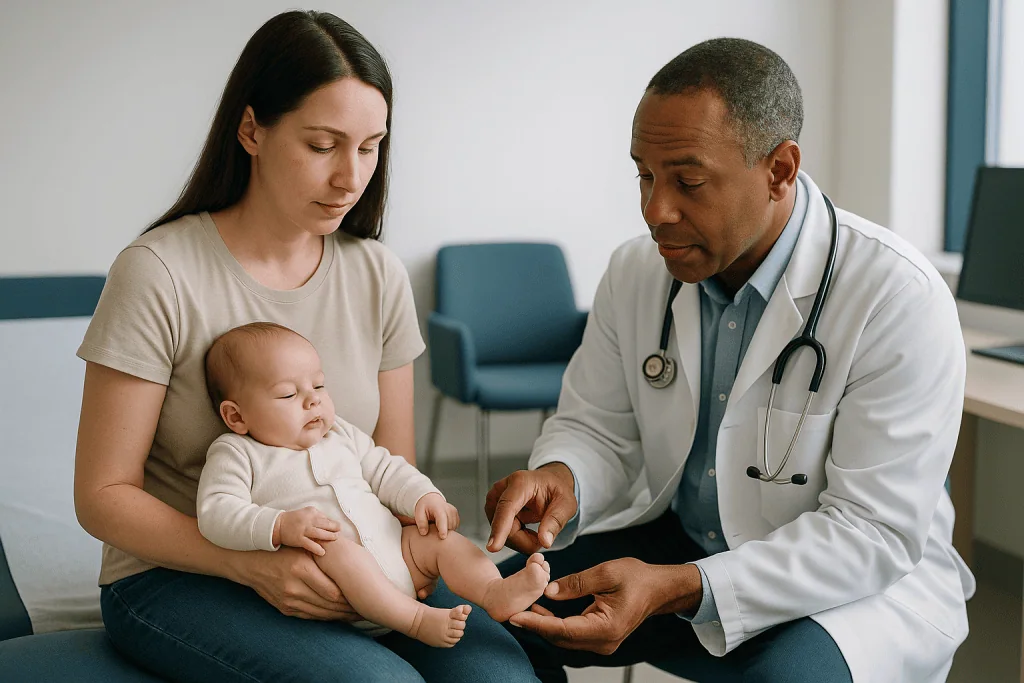
The test is simple to watch and hard to do well. The examiner supports the heel and gently pushes the foot up and outward. A positional foot glides to a normal position, and often past it. A structural clubfoot stops. The heel stays pulled up and turned in, and a deep crease often marks the inside of the midfoot or the back of the ankle. The Mayo Clinic describes true clubfoot as a foot turned down and inward that cannot easily be moved into a normal position by hand.
Why does this distinction carry so much weight? Because it steers everything that follows. A positional foot may need nothing more than gentle stretching shown to you at the visit, plus a review a few weeks later. A structural clubfoot will not straighten on its own; the Mayo Clinic is clear that untreated clubfoot persists and affects walking. That foot needs a corrective program, usually starting within the first weeks of life.
There is a middle ground, and honest clinicians will say so. Some feet are stiffer than a simple positional foot yet milder than a classic clubfoot. In those cases the team may cast a few times to see how the foot responds, or may schedule a repeat exam before committing. Ask which category your baby’s foot falls into and how confident the team feels.
How the orthopedic exam scores a clubfoot
Clubfoot is really four deformities stacked together, and the examiner checks each one in turn. Clinicians remember them with the acronym CAVE.
| Component | What it means | What the examiner looks and feels for |
|---|---|---|
| Cavus | A high arch with the front of the foot pulled downward | A deep crease across the sole and a tight instep |
| Adductus | The forefoot turned inward toward the midline | A curved outer border, a bit like a kidney bean |
| Varus | The heel tipped inward so the sole faces the other leg | How easily the heel bone can be felt through the heel pad |
| Equinus | The ankle fixed pointing downward | How far the foot comes up toward the shin; tightness behind the heel |
To make the assessment repeatable from visit to visit, most teams use a structured severity score, commonly the Pirani score, named after the surgeon who described it. The examiner grades features such as the curve of the outer border, the depth of the creases, how well the heel bone can be felt and how rigid the ankle is. Each feature is rated by look and feel, and the ratings are added together.
The number is not a verdict. A higher score means a stiffer, more severe foot at that moment, which helps the team anticipate how many casts may be needed and gives a baseline for later comparison. Watching the score fall over successive visits is one of the clearest ways families can see progress that is otherwise hard to judge by eye.
Imaging is rarely part of this first exam. The Cleveland Clinic and Mayo Clinic both describe clubfoot as a diagnosis made by physical examination; X-rays are generally unhelpful in a newborn because the small foot bones are still mostly cartilage and do not show clearly. If the team does request imaging, it is usually to look at something beyond the foot itself.
Why the exam looks at hips, spine and hands, not just the feet
A parent often arrives fixed on the foot, and understandably so. The examiner, though, is also asking a broader question: is this an isolated clubfoot, or one sign of something wider?
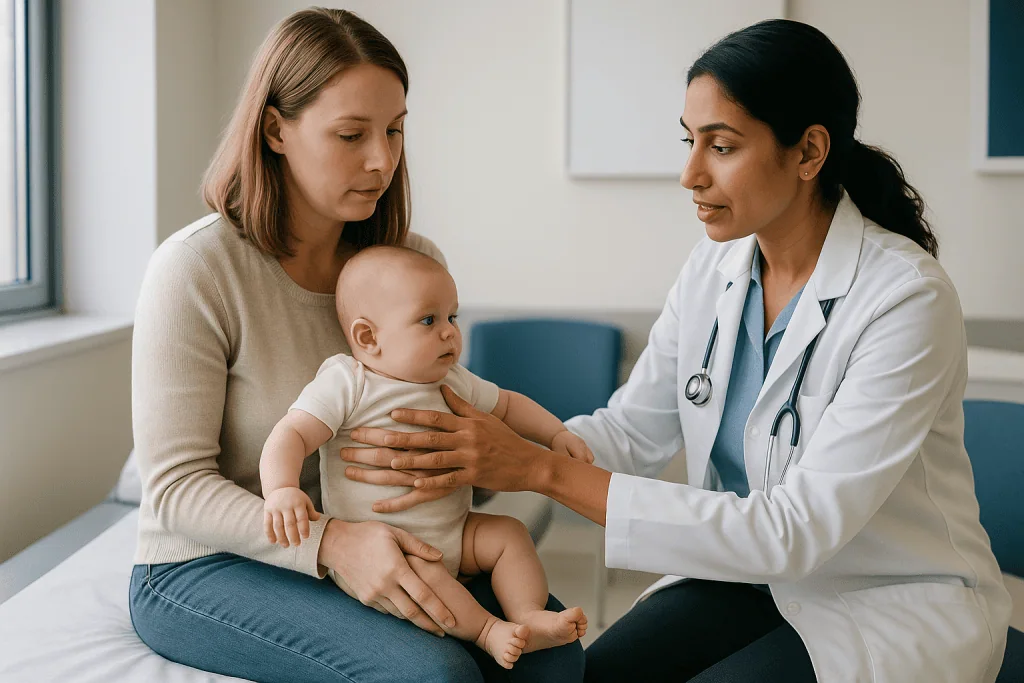
Most cases are isolated, which clinicians call idiopathic, meaning no underlying cause is found. A smaller group is linked to other conditions, including spina bifida (a difference in how the spinal column formed) or arthrogryposis (stiffness in several joints from birth). The Mayo Clinic lists these among the conditions associated with clubfoot. Those feet tend to be stiffer and may respond differently to casting, so identifying them early changes expectations and follow-up.
That is why the hips get careful attention. The examiner gently flexes and rotates each hip, feeling for stability. Developmental dysplasia of the hip, in which the ball sits loosely in the socket, is checked in babies with foot differences because both relate to position and joint development before birth. Some teams order a hip ultrasound as a precaution; ask whether yours does.
Next comes the spine. The examiner runs a hand along the back and looks at its base for a dimple, a tuft of hair or discolored skin that can hint at a spinal cord difference. The knees are checked for range of motion, and the hands for thumbs held tightly in the palm or fingers that will not fully open, which can accompany arthrogryposis.
General tone rounds it off. A baby who feels unusually floppy or stiff, or whose reflexes look uneven, may be referred to a pediatrician or neurologist for a parallel assessment. None of this means something is wrong. It means the team is ruling things out properly, so the plan for the foot rests on a complete picture.
Who starts casting at the first visit, and who is usually asked to wait
The default in most services is to begin early. The Mayo Clinic notes that treatment usually starts in the first week or two after birth, when the foot’s ligaments and tendons are at their most stretchy. A term baby with a confirmed structural clubfoot, feeding well and otherwise healthy, will often have the first cast applied before leaving that first visit.
Some babies are asked to wait, and the reasons are practical rather than worrying. A newborn still in a neonatal unit for breathing or feeding support will usually have casting deferred until they are stable and can stay warm with plaster on both legs. A baby with a suspected wider condition may be seen by other specialists first so the whole team works from the same diagnosis. Very small or premature babies sometimes wait until their legs have grown enough for a cast to hold well.
Skin matters too. Casting over a rash, a healing heel-prick site or fragile skin risks pressure sores under the plaster, so a team may postpone a week rather than gamble. A baby with an acute infection is generally rescheduled.
What about babies who present later, at several months or even after walking age? The method still applies. The Cleveland Clinic describes casting being used in older infants and toddlers, though tissues are less pliable, more casts may be needed and the plan is individualized. A late start is a reason to act, not a reason to lose heart.
Whatever your baby’s situation, the decision about when to start belongs to the treating team. If casting is delayed, ask for the specific reason and a firm date for the next review.
What to bring to your baby's first clubfoot appointment
Think of this bag as serving two purposes: keeping your baby comfortable through a longer visit than usual, and giving the team the information they need.
Start with the paperwork. Bring any pregnancy ultrasound reports, especially the anatomy scan, and the hospital discharge summary, which lists birth weight, gestation and any newborn concerns. If a pediatrician or midwife has already examined the foot, a copy of their note saves repeating the story. Your baby’s health record booklet, immunization card and identity or insurance documents should come too.
Write down family history before you arrive. The Mayo Clinic notes that having a parent or sibling with clubfoot raises the chance a baby will have it, so the team will ask. Include relatives with foot differences, hip problems or joint conditions, and anything unusual about the pregnancy, such as low fluid or a breech position.
Then the comfort kit. Pack feeds, whether that means bottles and formula or whatever you need to nurse comfortably; a swaddle blanket; two changes of clothes, because plaster is messy and legs may get wet; a pacifier if you use one; wipes and diapers; and a soft toy or something that crinkles for distraction during casting. A stroller or car seat you can rock helps during waits.
Choose loose clothing for the ride home: wide-leg pants or a gown, since casts will not fit into footed sleepsuits. A charged phone does three jobs at once: photographing the feet before the first cast, recording the team’s instructions so you can replay them later, and holding your list of questions.
Bring a second adult if you can. One person can hold and soothe while the other listens and takes notes.
How to prepare your baby on the day: feeding, clothing and comfort
Timing a feed is the single most useful preparation. Ask the clinic when they expect to apply the cast and aim to feed your baby shortly before, so they are full and drowsy rather than hungry and rigid. A relaxed baby is easier to cast well, because the cast is applied while the foot is held in a gently corrected position, which is simpler when the leg is not braced against you.
Dress your baby in layers that open fully at the legs. A front-opening vest or gown works well. Skip tights, socks and anything with elastic cuffs, and avoid lotion on the legs, which can make padding slip.
Plan for a warm room and a long visit. First appointments often run well beyond a routine check, because the history, examination, discussion and casting happen in sequence, and plaster needs time to set before you can leave. Bring more feeds than you think you need.
During casting you will usually be invited to stay close. Many teams encourage a parent to cradle the baby’s upper body, offer a finger or pacifier to suck, and talk softly. The NHS describes the manipulation as not painful; the foot is moved only as far as it comfortably goes. Some babies fuss at being held still and at the cool, wet sensation of plaster, then settle once it warms.
Ask ahead whether casting will happen the same day and whether both legs will be done, so you can adjust the car seat. Most standard seats accommodate casts, though the harness may need a wider setting and the seat may need to sit slightly more upright.
What is the clubfoot Ponseti method, and why do most teams start there?
The Ponseti method is a way of correcting clubfoot without major surgery, developed by the orthopedic surgeon Ignacio Ponseti. It is the standard approach described by the NHS, the Mayo Clinic and the Cleveland Clinic alike.
It works with newborn biology rather than against it. In the first months of life, the ligaments, tendons and joint capsules of the foot are unusually elastic, and the small bones are still largely cartilage. Hold the foot in a slightly better position under a cast, and the tissues remodel toward that position over a week. Remove the cast, move the foot a little further, cast again, and the correction accumulates.
The order of correction is deliberate. The examiner first raises the high arch, then swings the front of the foot outward around the head of the talus (the bone at the top of the ankle that acts as the pivot), which brings the heel along with it. Only after the heel has turned outward does the team address the downward-pointing ankle. Forcing the ankle up first can create a rocker-shaped sole, which is one reason casting is done by clinicians trained in the sequence.
Casts run from the toes to the upper thigh with the knee bent, so the foot cannot rotate inside. Long-leg plaster looks dramatic on a tiny baby. Families are usually relieved to hear the reason: a below-knee cast simply slides off a well-padded newborn leg.
The NHS describes the manipulation and casting phase as typically taking around 5 to 8 weeks, with casts changed weekly. Most babies then need a small tendon release behind the heel and a long period in boots joined by a bar. The next sections explain both.
Clubfoot casting: what to expect in the weeks after the first appointment
Once casting starts, life settles into a weekly rhythm. You return, usually on the same weekday, and the team removes the cast, sometimes after a soak in warm water that softens the plaster, sometimes with a small oscillating saw that buzzes loudly but does not cut skin. The foot is washed, examined and scored again, then gently stretched further and recast. The whole visit is often shorter than the first.
Between visits, your baby lives in the cast. Sleep, feeding and cuddling carry on as before; the casts are heavier than legs, yet babies adapt quickly. You will be shown how to check circulation in the toes several times a day and how to keep the top of the cast clean at diaper changes.
The NHS puts the casting phase at roughly 5 to 8 weeks for most babies, so expect a similar number of casts, though stiffer feet may need more and the team will tell you where your baby sits on that spectrum. Watching the foot emerge from each cast a little straighter is, for many families, the moment the diagnosis stops feeling abstract.
Near the end of casting, the team assesses whether the ankle can come up far enough on its own. If not, which the Mayo Clinic notes is the case for most babies, they schedule the tenotomy described below, followed by a final cast that the NHS says stays on for about three weeks while the tendon heals.
Plan practically. Weekly hospital visits with a newborn are tiring, so line up help with travel, siblings and meals before you begin. Ask whether appointment times can be fixed in advance for the whole run.
How do you care for a baby in a clubfoot cast at home?
A cast on a newborn is less fragile than it looks, but it needs daily attention. Keep it dry: sponge baths only, with the cast held clear of the water and covered if you are washing nearby. Wet plaster softens, loses its shape and can chafe. If a cast does get soaked, call the clinic rather than trying to dry it with heat.
Check the toes every few hours while your baby is awake and at each night feed. They should be pink and warm, and should pink up again within a couple of seconds after you press a nail. Gentle wiggling should be possible. Note what the toes look like at the clinic so you have a baseline to compare against.
Elevate the legs on a folded towel for the first day, which helps with swelling. Never put anything inside the cast, including powder, cream or a finger to scratch, because trapped material causes sores.
Diapers need a small change of habit. Fold the front edge down so urine does not run inside, keep the cast top above the diaper, and change promptly. Some families wrap the cast top in a strip of plastic during changes as a barrier; ask the team what they prefer.
Clothing is easiest with wide-leg trousers, pillowcase-style gowns or oversized sleepsuits with the feet cut off. Baby carriers and car seats may need adjusting for two straight, casted legs.
Tummy time, cuddles and play continue as normal. The cast does not hold your baby back developmentally; kicking looks different, but babies compensate. The most valuable thing you can do between visits is watch the toes and keep every appointment.
Will my baby need surgery? The tenotomy and the clubfoot boots and bar
Two words alarm parents at this stage: surgery and brace. Both deserve a calmer description.
The tenotomy is a release of the Achilles tendon, the thick cord at the back of the heel that in a clubfoot is too short to let the ankle come up. Through a tiny puncture, the surgeon divides the tendon, which then heals at a longer length inside a final cast. The Mayo Clinic describes this as a minor procedure, often done under local anesthetic, needed by most children near the end of casting. It is not the extensive joint surgery once common for clubfoot, and it does not open the foot.
After that final cast come the clubfoot boots and bar: a pair of open-toed boots fixed to a metal bar that holds the feet turned outward and slightly up. Correction is complete at this point. The brace exists to stop the foot drifting back while the child grows, because the same tissues that remodeled so readily also tend to tighten again.
The schedule described by the NHS is full-time wear, around 23 hours a day, for about three months, then nights and naps only until roughly age four or five. Your team will personalize this. Consistent brace wear is widely regarded as the factor most within a family’s control when it comes to preventing relapse, so the fitting appointment deserves your full attention and your questions.
Alternatives exist. Older approaches relied on extensive soft-tissue surgery, now generally reserved for feet that do not respond to casting or that relapse repeatedly. Some centers use a stretching, taping and physiotherapy approach. Your treating team will explain which options fit your child and why.
What people often get wrong about clubfoot
Myth: something in pregnancy caused this. The Mayo Clinic and the NHS both describe clubfoot as usually having no identifiable cause, with genetics and environment likely both playing a part. Sleeping position, exercise or a stressful week did not shape your baby’s foot. Smoking during pregnancy is associated with higher risk in some studies, but an association is not proof for an individual, and blame helps no one.
Myth: the foot is painful. It is not. Newborns with clubfoot are not in pain, and the NHS notes the manipulation is not painful because the foot moves only within its comfortable range. Left untreated into walking age, the position would cause discomfort and calluses, which is one reason treatment happens early.
Myth: it will straighten on its own. A truly positional foot may; a structural clubfoot will not. The Mayo Clinic is explicit that untreated clubfoot persists and affects walking.
Myth: the brace can be skipped once the foot looks right. Relapse after casting is most often linked to inconsistent brace use, which is why every major source gives the boots and bar phase as much weight as the casts.
Myth: my child will never walk normally or play sports. The NHS describes most children treated early going on to walk and take part in activities alongside their peers, though the affected foot and calf are often slightly smaller. Individual outcomes depend on severity, associated conditions and follow-up, so ask your team rather than relying on general statements.
Myth: this is rare and I am alone. The NHS reports around 1 in every 1,000 babies is born with clubfoot, with about half affected on both sides. Parent groups exist in most regions, and your team can usually point you toward one.
Questions to ask your care team
Bring these on paper or your phone, and ask the team to slow down if answers come fast. Their replies should shape your expectations for the months ahead.
- Is this a positional foot or a structural clubfoot, and how confident are you?
- What severity score did the foot receive today, and what does that suggest about the number of casts?
- Did the examination of the hips, spine and hands raise anything, and are further tests planned?
- Who will apply the casts each week, and how experienced is the team with this method?
- Will casting start today? If not, why, and when?
- How do I check circulation, and what exactly should prompt a call?
- Do you expect a tenotomy, and how is it done here?
- What brace schedule do you typically use, and who fits and adjusts the boots?
- How long will follow-up continue after bracing ends?
- Is there a specialist nurse or coordinator I can contact between visits?
Listen for a few things in the answers. A team that names the method, describes the sequence clearly and explains how it monitors for relapse is showing you its process. One that talks about the brace phase as seriously as the casting phase understands where most problems arise.
Ask about the practical side too: parking, appointment timing, whether siblings can come, and whether a spare slot can be reserved in case a cast slips midweek. Small logistics decide whether weekly visits feel manageable or overwhelming.
Finally, ask how decisions are shared. Good pediatric orthopedic care treats parents as part of the team, with the clinical calls resting on the treating clinicians and the daily care resting with you. If anything in the plan is unclear, say so at the visit rather than on the drive home.
When to call your doctor
Most cast weeks pass without drama. When something does go wrong, it usually announces itself in the toes or in your baby’s mood, and acting quickly protects both the skin and the correction. Keep the clinic’s number somewhere you can find it at 3 a.m.
Call the same day, or go to urgent care if the clinic is closed, for these red-flag signs:
- Toes that are blue, white, dusky, very pale or cold, or that do not pink up within a couple of seconds after pressing.
- Marked swelling of the toes, or toes that have disappeared back inside the cast, which suggests the cast has slipped.
- Persistent, inconsolable crying that does not settle with feeding or comfort, especially if it began after a cast change.
- A foul smell, discharge, wet patches or staining coming through the plaster.
- A cast that has become soft, cracked, badly soaked or noticeably loose, or has come off altogether.
- Fever, poor feeding, unusual sleepiness or floppiness, which need pediatric assessment regardless of the cast.
- After a tenotomy: bleeding through the cast, or any of the signs above.
- During bracing: blisters or red pressure marks on the heel or ankle that do not fade soon after the boots come off, or a foot that repeatedly slips out of its boot.
A slipped cast is not an emergency in itself, but it should be removed promptly, because a cast that has ridden down can press on the top of the foot and lose the correction gained that week. Do not try to cut it off yourself unless the team has shown you how and asked you to in a specific situation.
When in doubt, call. Teams that treat clubfoot expect these calls and would far rather see a cast that turns out to be fine than miss one that is not.
Frequently asked questions
Is clubfoot painful for babies?
No. Newborns with clubfoot are not in pain, and the NHS describes the gentle manipulation used in casting as not painful, because the foot is only ever moved within its comfortable range. Babies may cry at being held still or at the cool, wet feel of plaster, then settle once it warms. Discomfort would only become an issue if the foot were left uncorrected into walking age.
How soon after birth should the first clubfoot appointment happen?
Usually within the first week or two of life, according to the Mayo Clinic, when the foot’s ligaments and tendons are at their most elastic. Many babies are referred straight from the maternity unit. A delay of a few weeks because of prematurity, illness or referral timing does not shut the door; casting still works in older infants, though more casts may be needed.
Will my baby get a cast at the first appointment?
Often, yes. If the examination confirms a structural clubfoot and your baby is well, many services apply the first long-leg cast during that initial visit. Some prefer to complete the assessment, arrange any hip or spine checks, and start casting at a second appointment within days. Ask when you book so you can pack feeds and loose clothing accordingly.
Can clubfoot be diagnosed before birth?
Sometimes. The NHS notes that clubfoot can be picked up on the routine ultrasound carried out between 18 and 21 weeks of pregnancy, though it is often confirmed only after birth. A prenatal finding cannot show how stiff the foot is or whether it is positional, so the physical examination at the first appointment remains the decisive step.
Why does the doctor check my baby's hips at a clubfoot appointment?
Because a clubfoot can occasionally be part of a wider pattern of joint or spinal differences, the examiner routinely checks hip stability, the base of the spine and the hands. Most clubfeet are isolated with no underlying cause. The wider check is about ruling things out early, and some teams add a hip ultrasound as a precaution.
How many casts will my baby need?
The NHS describes the casting phase as typically around 5 to 8 weeks, with a new cast each week, so most babies need a similar number of casts. Stiffer feet and later starts may need more. The severity score recorded at the first visit gives the team a rough forecast, and they will update you as the foot responds.
Does every baby with clubfoot need surgery?
Most need a minor procedure rather than major surgery. The Mayo Clinic notes that the majority of babies require a tenotomy, a tiny release of the tight Achilles tendon behind the heel, near the end of casting, followed by a final cast. Extensive joint surgery is now generally reserved for feet that do not respond to casting or that relapse repeatedly.
Can I breastfeed or bottle-feed during the casting?
Usually, yes, and many teams encourage it. Feeding, sucking on a pacifier and skin contact are recognized ways of comforting newborns during minor procedures. Ask the clinic about positioning, since the clinician needs steady access to the leg. Feeding shortly before the appointment so your baby arrives full and drowsy is often just as effective.
What if our clubfoot appointment is delayed by a few weeks?
A short delay is not a reason for alarm. The casting method still works in babies who start later, as the Cleveland Clinic describes, though tissues are less pliable and more casts may be needed. Use the waiting time to gather scan reports, family history and questions, and contact the referring clinician if the wait stretches beyond what you were told.
Will my child walk normally after clubfoot treatment?
The NHS describes most children treated early as going on to walk and take part in normal activities, though the treated foot and calf are often slightly smaller and a little less flexible. Individual results depend on severity, any associated conditions and how consistently the boots and bar are worn, so your treating team is the right source for expectations about your child.
References
This article is for general information only and is not a substitute for professional medical advice. Please consult a qualified doctor about your individual situation.

More from the Blog

What Does a Trauma Surgeon Do? Stabilizing Fractures, Dislocations and Complex Wounds
A trauma surgeon is a surgeon trained to assess and treat people with sudden, serious physical injuries, such as those from crashes, falls or…

Preparing for Shoulder Replacement: Imaging, Blood Work, Fasting and the Medicine Pause
Preparing for shoulder replacement surgery usually means a pre-operative visit with X-rays and often a CT scan, blood tests and sometimes a heart tracing,…

Wrist Pain: The Common Causes From Typing to Weightlifting
Wrist pain most often comes from one of five sources: strained ligaments after a fall, overloaded tendons from repetitive or forceful use, a pinched…
Ergonomic Chairs and Desk Setup: What Actually Reduces Back and Neck Pain
An ergonomic chair reduces back and neck pain mainly by supporting the lower back's natural curve, keeping hips and knees roughly level, and letting…
Allograft vs Autograft Bone Grafting: Why Your Surgeon May Choose Donor Bone
An autograft is bone taken from your own body; an allograft is sterilized bone from a screened human donor. Autograft carries living cells and…

The Types of Arthritis Explained (and Osteoarthritis vs Rheumatoid)
There are more than 100 forms of arthritis, but seven account for most diagnoses: osteoarthritis, rheumatoid arthritis, psoriatic arthritis, gout, ankylosing spondylitis, juvenile idiopathic…