Quick answer
Malocclusion is misalignment of the teeth or jaws that can affect biting, chewing, speech, and oral health. Treatment depends on the type and severity and may include orthodontic appliances such as braces or clear aligners, tooth extraction in selected cases, or jaw surgery when skeletal problems are involved, after evaluation by dental and maxillofacial specialists at Acibadem in Turkey.
What is malocclusion?
Malocclusion is the medical term for a misalignment of the teeth or an incorrect relationship between the upper and lower jaws when the mouth is closed. The word comes from “mal,” meaning bad, and “occlusion,” which refers to the way the upper and lower teeth meet when you bite. In a healthy bite, the upper teeth sit slightly in front of the lower teeth, and the points of the molars (the broad back teeth used for grinding food) fit into the grooves of the opposing molars. When this alignment is disturbed, dentists describe the result as malocclusion. In medical coding systems, this condition is classified under ICD-10 code K07.4.
For readers asking what is malocclusion in everyday language: it simply means the teeth do not line up the way they should. This can involve crowded teeth, gaps between teeth, teeth that stick out, or jaws that do not close together evenly. Malocclusion exists on a wide spectrum. Many people have a very mild form that causes no problems at all, while others have a more significant misalignment that affects chewing, speech, oral hygiene, or the appearance of the face.
Malocclusion is extremely common and affects people of all ages. It is most often identified in childhood or adolescence, when the permanent (adult) teeth are coming in and the jaws are still growing, because this is the period when misalignment first becomes visible and when treatment is often easiest. However, adults can also seek evaluation and treatment, and in many cases orthodontic care (treatment that corrects the position of teeth and jaws) is possible at any age, provided the teeth and gums are healthy.
Dentists commonly group malocclusion into three broad classes. Class 1 means the bite relationship between the jaws is essentially normal, but individual teeth are crowded, rotated, or spaced incorrectly; this is the most common type. Class 2, often called an overbite or retrognathism, means the upper teeth and jaw project noticeably forward relative to the lower jaw. Class 3, often called an underbite or prognathism, means the lower teeth and jaw project forward past the upper teeth. Within these classes, dentists also describe specific bite problems such as open bite (front teeth that do not meet when the back teeth are closed), crossbite (upper teeth that bite inside the lower teeth), and deep bite (upper front teeth that cover the lower front teeth excessively).
Symptoms of malocclusion
Malocclusion symptoms vary widely depending on the type and severity of the misalignment. Many people with mild malocclusion have no discomfort and may only notice a cosmetic issue, or may not notice anything at all until a dentist points it out. In more pronounced cases, the misalignment can interfere with everyday functions such as biting, chewing, and speaking.
Common signs and symptoms include:
- Visibly misaligned teethteeth that appear crowded, crooked, rotated, gapped, or protruding.
- An abnormal bitethe upper and lower teeth do not meet evenly, or the front teeth do not touch at all when the back teeth are closed.
- Changes in facial appearancein more significant cases, the jaw or chin may appear to sit too far forward or too far back.
- Difficulty or discomfort when biting or chewingfood may be hard to bite through, or chewing may feel uneven.
- Frequent biting of the inner cheeks or tonguemisaligned teeth can repeatedly catch the soft tissues of the mouth.
- Speech difficultiessome bite problems, particularly an open bite, can contribute to a lisp or other speech changes.
- Mouth breathingbreathing through the mouth rather than the nose, sometimes with difficulty fully closing the lips over the teeth.
- Abnormal tooth wearteeth that grind against each other incorrectly may wear down unevenly over time.
- Jaw discomfortin some people, an uneven bite is associated with jaw muscle tension, clicking, or pain around the jaw joint (the temporomandibular joint, where the lower jaw connects to the skull).
Symptoms often differ by type. With Class 1 malocclusion, the main issue is usually crowding or spacing of individual teeth, and functional problems are often mild. With Class 2 malocclusion, protruding upper front teeth may be more vulnerable to injury, and lip closure can be difficult. With Class 3 malocclusion, biting into food with the front teeth can be awkward, and the facial profile may be noticeably affected. An open bite frequently affects speech and the ability to bite through food with the front teeth, while a deep bite can cause the lower front teeth to bite into the roof of the mouth in severe cases.
It is also worth noting that malocclusion can contribute indirectly to other dental problems. Crowded or overlapping teeth are harder to clean thoroughly, which can increase the risk of tooth decay (cavities) and gum disease over time. This is one reason dentists often recommend evaluation even when the misalignment itself is not painful.
Causes and risk factors
Malocclusion causes are usually a combination of inherited traits and environmental influences. In most people, the condition develops gradually as the teeth and jaws grow, rather than appearing suddenly.
Genetic and developmental factors are the most important cause. The size and shape of the jaws and the size of the teeth are largely inherited. If the jaw is small relative to the teeth, crowding results; if the jaw is large or the teeth are small, gaps may form. Differences in how the upper and lower jaws grow relative to each other can produce Class 2 or Class 3 bite relationships. Malocclusion also occurs more often in people born with certain conditions, such as cleft lip and palate (a birth difference in which the lip or roof of the mouth does not fully close during development).
Childhood habits can influence how the teeth and jaws develop. These include:
- Prolonged thumb or finger sucking beyond early childhood
- Extended use of a pacifier or bottle-feeding beyond the ages usually recommended
- Tongue thrusting, in which the tongue habitually pushes against the front teeth during swallowing or at rest
- Chronic mouth breathing, sometimes related to enlarged adenoids or nasal blockage, which can affect jaw and facial growth
Dental factors can also lead to malocclusion. Early loss of baby teeth, for example, due to decay or injury, can allow neighboring teeth to drift into the empty space, so the permanent tooth underneath has nowhere to erupt properly. Extra teeth, missing teeth, impacted teeth (teeth trapped in the bone or gum), and abnormally shaped teeth can all disturb alignment. Poorly fitting dental fillings, crowns, or other dental work may occasionally alter the bite, and lost adult teeth that are not replaced can allow remaining teeth to shift over time.
Injuries and other conditions are less common causes. Fractures of the jaw, especially if they heal in a misaligned position, can change the bite. Tumors or growths of the jaw, although rare, can also displace teeth.
Risk factors, in summary, include a family history of malocclusion or jaw size differences, prolonged sucking habits in childhood, early loss of baby teeth, untreated tooth decay, missing or extra teeth, and conditions that affect jaw growth. Because several of these factors act during childhood, regular dental checkups from an early age give dentists the chance to notice developing problems and, in some cases, to reduce their impact.
Diagnosis
Malocclusion diagnosis is usually straightforward and is most often made by a dentist during a routine examination, sometimes before the patient has noticed any problem. If the misalignment appears significant, the dentist typically refers the patient to an orthodontist: a dentist with additional specialty training in correcting the position of teeth and jaws, for a full evaluation.
A complete assessment generally includes several steps:
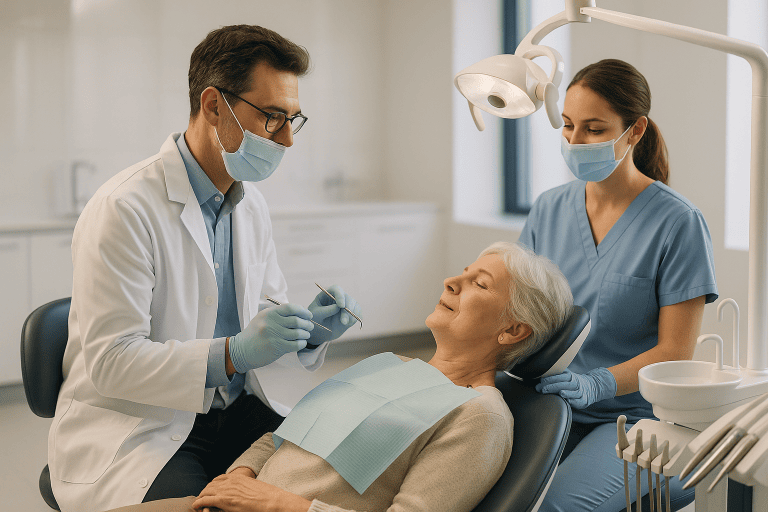
- Clinical examination. The dentist or orthodontist inspects the teeth, checks how the upper and lower teeth meet when biting, and assesses the alignment, spacing, and rotation of individual teeth. They may ask the patient to bite down, slide the jaw from side to side, and open and close the mouth to see how the bite functions.
- Medical and dental history. The clinician asks about childhood habits, previous dental treatment, tooth loss, jaw injuries, and any family history of similar problems, along with symptoms such as chewing difficulty, jaw pain, or speech concerns.
- Dental X-rays. Standard X-rays show the roots of the teeth, teeth that have not yet erupted, and the bone that supports the teeth. A panoramic X-ray, which captures the entire upper and lower jaw in one image, is commonly used. A cephalometric X-ray, a side-view image of the head, helps measure the relationship between the jaws, the teeth, and the skull, which is important for classifying the malocclusion and planning treatment.
- Dental impressions or digital scans. The clinician may take molds of the teeth or use a digital scanner to create an exact model of the bite. These models allow precise measurement of crowding, spacing, and how the teeth meet.
- Photographs. Pictures of the face and teeth are often taken to document the starting condition and to help evaluate facial balance.
- Three-dimensional imaging. In complex cases, for example, when jaw surgery is being considered or when teeth are impacted, the clinician may order cone-beam computed tomography (CBCT), a type of 3D X-ray that shows the teeth and jawbones in detail.
Based on these findings, the clinician classifies the malocclusion (Class 1, 2, or 3, along with any open bite, crossbite, or deep bite) and grades its severity. This classification guides the discussion of whether treatment is needed and, if so, which options are appropriate. Diagnosis and treatment of malocclusion are typically managed within a hospital’s Dental & Oral Health department, where dentists, orthodontists, and oral and maxillofacial surgeons (surgeons who operate on the mouth, jaws, and face) work together when needed.
Treatment options
Malocclusion treatment depends on the type and severity of the misalignment, the patient’s age, overall dental health, and personal goals. Not every malocclusion needs to be corrected, and the first step is an honest discussion with a dentist or orthodontist about what treatment can realistically achieve.
Watchful waiting
Very mild malocclusion that causes no functional problems often requires no treatment at all. In children, dentists may simply monitor the bite as the jaws grow and the permanent teeth erupt, since some minor issues improve on their own while others become clearer over time. Regular dental checkups allow the clinician to recommend intervention if and when it becomes appropriate.
Orthodontic appliances
Orthodontic treatment is the mainstay for most cases of malocclusion. The main options include:
- Fixed braces. Brackets bonded to the teeth and connected by wires gradually move the teeth into better positions. Braces remain the standard treatment for many types of malocclusion, particularly more complex ones. Treatment commonly takes one to three years, though this varies from person to person.
- Clear aligners. A series of removable, transparent plastic trays can correct many mild to moderate cases. Aligners are less visible than braces but must be worn most of the day and are not suitable for every type of malocclusion.
- Removable appliances and functional appliances. In growing children, devices that guide jaw growth or hold space for erupting teeth are sometimes used. A palatal expander, for example, gradually widens the upper jaw to correct a crossbite or relieve crowding while the bones are still developing.
- Retainers. After active treatment, retainers, removable or fixed devices that hold the teeth in their new positions, are essential, because teeth have a natural tendency to drift back toward their original positions.
Dental procedures
Some treatment plans include additional dental procedures. When crowding is severe, the orthodontist may recommend extracting one or more teeth to create space. Impacted teeth may need to be uncovered surgically so that braces can guide them into position. In milder cases, reshaping the edges of teeth or using dental restorations such as crowns may help improve how the teeth meet, though these approaches address appearance and contact points rather than moving teeth.
Jaw surgery
When the malocclusion is caused mainly by a mismatch in the size or position of the jawbones themselves, rather than by the teeth alone, orthodontics by itself may not be enough. In these cases, orthognathic surgery (corrective jaw surgery) may be considered, usually in adults or older adolescents whose jaws have finished growing. The surgery repositions the upper jaw, lower jaw, or both, and is almost always combined with orthodontic treatment before and after the operation. Jaw surgery is a significant procedure with a recovery period and potential risks, which the surgical team explains in detail; it is generally reserved for moderate to severe skeletal problems that affect function or facial balance. At hospitals such as Acibadem, this type of care is coordinated between orthodontists and oral and maxillofacial surgeons.
Managing related habits and conditions
Treatment may also address contributing factors. Children with persistent thumb sucking or tongue thrusting may benefit from habit-breaking appliances or guidance from a speech and swallowing therapist. If chronic mouth breathing is related to nasal blockage or enlarged adenoids, an ear, nose, and throat evaluation may be recommended. People who grind their teeth may be advised to use a night guard to protect the teeth while the bite is being evaluated or corrected.
Living with malocclusion and outlook
The outlook for people with malocclusion is generally good. Mild malocclusion often requires no treatment and does not shorten the life of the teeth, provided oral hygiene is maintained. When treatment is undertaken, orthodontic care corrects or substantially improves the bite in most cases, although results vary and no clinician can guarantee a specific outcome. Treatment tends to be simpler and often faster in children and adolescents, whose jaws are still growing, but adults are treated successfully as well.
Living well with malocclusion, whether or not you pursue treatment, centers on careful daily oral hygiene. Crowded or overlapping teeth trap food and plaque more easily, so thorough brushing twice a day, daily cleaning between the teeth with floss or interdental brushes, and regular professional cleanings are especially important. During orthodontic treatment, hygiene requires extra effort, because braces create additional surfaces where plaque can accumulate.
Two honest points deserve emphasis. First, orthodontic treatment takes time, often one to three years of active treatment, and requires consistent cooperation, such as wearing aligners or elastics as instructed and attending regular appointments. Second, results must be maintained. Teeth can shift throughout life, and long-term retainer wear, often at night, is usually needed to keep the corrected alignment stable. Some degree of minor movement over the years is common even with good retention.
For people who choose not to treat a mild malocclusion, the condition is usually compatible with a fully normal life. It is reasonable, however, to have the bite reviewed periodically, since problems such as uneven tooth wear or gum trouble around crowded teeth can develop slowly and are easier to manage when caught early.
Frequently asked questions
What is malocclusion in simple terms?
Malocclusion means the teeth or jaws do not line up correctly when you bite down. It includes crowded or crooked teeth, gaps, overbites (upper teeth too far forward), underbites (lower teeth too far forward), open bites, and crossbites. It is one of the most common dental conditions and ranges from barely noticeable to significant enough to affect chewing and speech.
Can malocclusion heal or fix itself?
In general, malocclusion does not correct itself, especially once the permanent teeth are fully in place. Some minor irregularities in young children improve as the jaws grow and baby teeth are replaced, which is why dentists sometimes recommend monitoring rather than immediate treatment. In adolescents and adults, however, meaningful correction usually requires orthodontic treatment such as braces or aligners.
How serious is malocclusion?
For most people, malocclusion is not a serious health threat, and mild forms may need no treatment at all. More severe misalignment can make chewing difficult, affect speech, increase the risk of tooth decay and gum disease because crowded teeth are harder to clean, cause abnormal tooth wear, and in some cases contribute to jaw discomfort. A dentist or orthodontist can assess how significant your particular bite pattern is.
What are the most common malocclusion symptoms?
The most common malocclusion symptoms are visibly crooked, crowded, or protruding teeth and an uneven bite. Some people also notice difficulty biting or chewing, frequent biting of the cheeks or tongue, speech changes such as a lisp, mouth breathing, or discomfort in the jaw. Many people with mild malocclusion have no symptoms and learn of the condition only during a dental checkup.
What is the best malocclusion treatment for adults?
There is no single best option; the right malocclusion treatment depends on the type and severity of the problem. Adults with mild to moderate misalignment are often treated with braces or clear aligners. When the jawbones themselves are significantly misaligned, corrective jaw surgery combined with orthodontics may be discussed. An orthodontist can explain which options are realistic for your specific bite and what each involves in terms of time and maintenance.
How long does treatment for malocclusion take?
Active orthodontic treatment commonly takes between one and three years, though simple cases may finish sooner and complex or surgical cases may take longer. After active treatment, retainers are typically needed long term, often nightly, to keep the teeth from drifting back. Your orthodontist can give you an estimate based on your individual diagnosis, but timelines are always approximate.
Can malocclusion be prevented in children?
Not all malocclusion can be prevented, because jaw size and tooth size are largely inherited. However, some contributing factors can be reduced: discouraging thumb sucking and prolonged pacifier use beyond early childhood, treating tooth decay promptly so baby teeth are not lost early, and arranging regular dental checkups from a young age. Early evaluation allows dentists to spot developing problems while the jaws are still growing, when guidance is often most effective.
When to see a doctor
Malocclusion itself is rarely an emergency, but it deserves professional evaluation. It is sensible to arrange a dental appointment if you or your child has visibly crooked, crowded, or protruding teeth, an uneven bite, difficulty chewing, frequent cheek or tongue biting, speech difficulties, or persistent mouth breathing. Children benefit from an orthodontic evaluation around age seven, when developing bite problems can often be identified early.
Seek prompt medical or dental attention if any of the following red-flag signs occur:
- A sudden change in your biteteeth that abruptly stop meeting the way they used to, which can signal a jaw joint problem, infection, or other condition needing evaluation.
- Jaw injuryany blow to the face or jaw followed by pain, swelling, difficulty opening the mouth, or a changed bite may indicate a fracture and requires urgent assessment.
- Severe or worsening jaw painespecially if the jaw locks open or closed, or if pain interferes with eating or sleeping.
- Swelling of the face, jaw, or gums with feverpossible signs of a dental infection that can spread and needs prompt treatment.
- A loose adult tooth or a tooth knocked out of positiontimely care improves the chances of saving the tooth.
- Difficulty swallowing or breathing related to the mouth or jawthis is a medical emergency and warrants immediate care.
- Persistent sores or ulcersareas of the cheek, tongue, or gums repeatedly injured by misaligned teeth that do not heal within about two weeks should be examined.
Even without red-flag signs, do not hesitate to discuss any concerns about your bite, tooth alignment, or jaw comfort with a dentist. Early evaluation makes it easier to decide, without pressure, whether treatment is worthwhile in your situation, and to plan it at the most suitable time.
Medically reviewed by the Acıbadem International Medical Board September 3, 2026
See our medical review board →
Update history
- PublishedJune 14, 2026
- Medical review approvedSeptember 3, 2026
- Last content updateSeptember 2, 2026