MCL Tear Treatment: How It Works, Results and What to Expect

Most isolated MCL tears heal well without surgery because the ligament has a useful blood supply. A brace, crutches when needed, and physiotherapy can protect healing tissue while restoring movement and strength.
Key Takeaways
- Most isolated MCL tears heal well without surgery because the ligament has a useful blood supply.
- A brace, crutches when needed, and physiotherapy can protect healing tissue while restoring movement and strength.
- Grade 1 injuries often improve within days to a few weeks, while severe tears or combined injuries can take months.
- Surgery is uncommon for an isolated MCL tear but may be considered for persistent instability, tissue trapped in the joint, or multiple ligament injuries.
- A safe return to sport depends on knee stability, strength, movement, and sport-specific function rather than time alone.
MCL tear treatment is usually non-surgical and combines protection of the knee, gradual movement, and targeted rehabilitation. Recovery depends on the grade of injury and whether other knee structures, such as the ACL or meniscus, are also injured.
MCL Tear Treatment: How It Works
MCL tear treatment aims to allow the medial collateral ligament (MCL) on the inner side of the knee to heal while preventing repeated stress. For most people with an isolated tear, treatment does not require an operation. The usual plan includes temporary activity modification, pain and swelling control, a hinged knee brace when appropriate, and a rehabilitation programme that progressively restores movement, strength, balance, and confidence in the knee.
The MCL connects the thighbone to the shinbone and helps resist forces that push the knee inward. It may be injured during a direct impact to the outside of the knee, a twisting movement, or a change in direction during sport. Treatment is tailored to the injury grade, the person’s daily and sporting demands, and whether there are associated injuries to the ACL, meniscus, cartilage, or other ligaments.
Early assessment is important because an MCL injury can resemble or occur alongside other knee problems. A clinician may also assess for related ACL injury or meniscal damage when symptoms and examination findings suggest these conditions.
Symptoms, Severity and Diagnosis
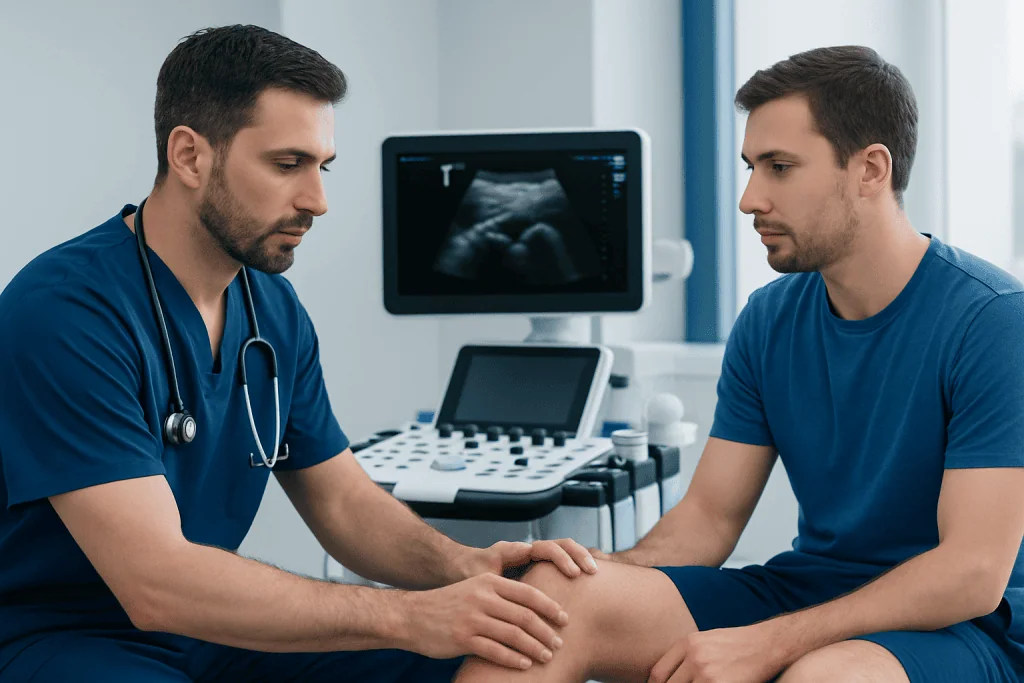
An MCL tear often causes pain and tenderness along the inner edge of the knee. Swelling, stiffness, bruising, and discomfort when turning, squatting, or walking may occur. Some people feel that the knee is unstable or gives way, particularly with a more significant tear or when another ligament is injured.
Clinicians commonly describe MCL tears by grade. A grade 1 injury involves stretching or minor fibre damage with little instability. A grade 2 tear is a partial tear and may cause more pain, swelling, and looseness. A grade 3 tear is a complete tear, which can lead to marked instability and may occur with other knee ligament injuries.
For people wondering how an MCL tear is diagnosed, the process begins with the history of the injury and a physical examination. A clinician checks tenderness, swelling, range of motion, and knee stability, including a valgus stress test. X-rays can help exclude a fracture or bone avulsion, while MRI may be used when the diagnosis is uncertain, symptoms are severe, surgery is being considered, or associated soft-tissue injuries are suspected.
Who May Need Non-Surgical Care or Surgery?

Non-surgical care is appropriate for most isolated grade 1 and grade 2 tears, and for many grade 3 tears. The MCL is outside the knee joint capsule and generally has a good capacity to heal. A doctor may recommend a hinged brace for a period of time, particularly for a grade 2 or grade 3 injury, to limit side-to-side stress while still allowing carefully guided knee movement.
Surgery is not routinely needed for an isolated MCL tear. It may be considered when there is persistent instability after structured rehabilitation, a ligament avulsion involving bone, a particular pattern in which tissue is displaced and cannot heal correctly, or a combined injury requiring reconstruction of other ligaments. The decision is individual and is usually made by an orthopaedic knee specialist after examination and imaging.
When surgery is recommended, it may involve repair of recently injured tissue or reconstruction using a graft to restore ligament stability. Combined ligament injuries may need staged or coordinated management. Knee ligament surgery can be discussed when a specialist finds that operative treatment is likely to improve knee stability and function.
What Happens During MCL Tear Treatment?
Early treatment commonly follows a protection-and-movement approach. The person may be advised to reduce painful activity, use ice wrapped in a cloth for short periods, elevate the leg, and use compression if recommended. Crutches may be helpful when walking causes a limp or significant pain. A clinician can advise whether over-the-counter pain relief is suitable based on the person’s health history and other medicines.
A hinged brace may be fitted to support the knee while allowing controlled bending and straightening. The brace is not meant to replace rehabilitation; instead, it reduces unwanted side-to-side loading during the initial healing period. Weight bearing is usually increased gradually, guided by comfort, knee stability, and the treating clinician’s instructions.
Physiotherapy is a central part of mcl tear treatment. Early exercises focus on reducing swelling, regaining full knee extension, gently restoring bending, and activating the quadriceps muscles. Later, the programme adds hip and hamstring strengthening, balance training, single-leg control, and movement drills that reflect work, daily activities, or sport.
If an operation is needed, the procedure is performed under anaesthesia. The surgeon repairs or reconstructs the damaged ligament and addresses relevant associated injuries where appropriate. Recovery after surgery generally includes bracing and a carefully progressed rehabilitation plan; the exact restrictions vary with the procedure and any additional ligament reconstruction.
How Long Until I Can Walk After a MCL Tear?
Many people with a mild MCL tear can walk soon after the injury, although they may limp for several days. Walking should be comfortable enough that it does not cause a worsening limp, substantial pain, or a feeling that the knee will buckle. Crutches may be used briefly to reduce discomfort and help restore a normal walking pattern.
With a grade 2 tear, walking may remain uncomfortable for one to several weeks, and a brace may be recommended during this period. A grade 3 tear often needs a longer period of protection, and the ability to walk normally can take several weeks or longer. The answer to “MCL tear how long to walk” also depends on swelling, strength, pain control, and whether another knee structure is injured.
A clinician or physiotherapist should guide progression from crutches to unassisted walking. It is usually safer to increase activity in small steps than to push through instability. Sudden worsening of pain, swelling, locking, or giving way warrants reassessment.
Does an MCL Tear Ever Fully Heal?
Yes. Most isolated MCL tears can heal well, and many people return to their usual work, exercise, and sport without ongoing instability. Healing does not always mean the knee feels normal immediately; stiffness, muscle weakness, reduced confidence, and altered movement patterns can persist unless they are addressed through rehabilitation.
For a mild injury, symptoms may settle in approximately one to three weeks. A partial tear often takes several weeks, while a complete tear may require six weeks or more before higher-level activity is appropriate. When people ask “MCL tear how long to heal” or “MCL tear how long recovery,” the most accurate answer is that tissue healing and return to full function are related but not identical.
Recovery may take longer when the injury is severe, the knee was unstable before treatment, rehabilitation is interrupted, or there is an associated ACL, meniscal, or cartilage injury. A return-to-sport assessment should consider pain-free range of motion, strength compared with the uninjured side, balance, hopping or agility ability when relevant, and the absence of instability.
How to Speed Up MCL Healing and What Are the Stages of MCL Rehab?
There is no safe shortcut that forces a ligament to heal faster. The most effective approach is to protect the knee from painful side-to-side stress, follow the prescribed rehabilitation plan, maintain regular sleep and balanced nutrition, and avoid returning to pivoting or contact activity before the knee is ready. Smoking cessation is also important because smoking can impair tissue healing.
The first stage of MCL rehabilitation focuses on protecting the ligament, controlling pain and swelling, restoring gentle movement, and reactivating the thigh muscles. The next stage builds full range of motion, normal walking, and progressive strength in the quadriceps, hamstrings, hips, and core. Exercises are adjusted so that they challenge the knee without repeatedly provoking pain or instability.
The third stage develops balance, single-leg control, endurance, and functional movement such as step-downs, squats, and controlled changes of direction. The final stage is a gradual return to running, jumping, cutting, or sport-specific skills where appropriate. This staged approach helps answer the question of how to speed up MCL healing: consistent, correctly progressed loading is more useful than prolonged complete rest or an overly rapid return to activity.
Rehabilitation may overlap with care for other knee conditions. For example, treatment plans for ACL reconstruction or meniscus surgery are adapted when those injuries occur together with an MCL tear.
Benefits, Risks and When to Seek Medical Care
The benefits of appropriate mcl tear treatment include improved pain control, restoration of knee stability and movement, and a safer return to daily activities and sport. The main risk of doing too much too early is recurrent pain, swelling, instability, or delayed recovery. Conversely, keeping the knee immobile for longer than advised may contribute to stiffness and muscle weakness.
Seek medical care promptly after a knee injury if the person cannot bear weight, has severe swelling or deformity, heard a crack at the time of injury, has numbness or a cold foot, or experiences severe and worsening pain. Medical assessment is also appropriate when the knee locks, repeatedly gives way, cannot fully straighten, or does not improve as expected after several days of sensible self-care.
Urgent evaluation is needed if there is fever, increasing redness or warmth around the knee, or calf pain and swelling, particularly after surgery or a period of reduced mobility. These symptoms can have causes that need timely assessment.
Acibadem International’s multidisciplinary orthopaedic, radiology, and rehabilitation specialists at JCI-accredited hospitals assess and treat knee ligament injuries for international patients, with care plans based on the individual injury and recovery goals.
Frequently asked questions
What is the usual treatment for an MCL tear?
Most isolated MCL tears are treated without surgery. Treatment commonly includes a temporary reduction in painful activity, a brace when needed, gradual return to weight bearing, and physiotherapy to restore movement, strength, and stability. Surgery is generally reserved for selected severe or combined knee injuries.
Can I walk on a torn MCL?
Some people can walk with a mild MCL tear, although pain and limping are common initially. Crutches or a brace may be needed if walking is painful, unstable, or noticeably uneven. A clinician can advise how much weight bearing is appropriate for the specific injury.
How long does an MCL tear take to recover?
A mild tear may improve in one to three weeks, while a partial tear often takes several weeks. A complete tear or an injury involving other knee ligaments may take several months before return to demanding sport is appropriate. Recovery is based on knee function and stability, not the calendar alone.
Do all grade 3 MCL tears need surgery?
No. Many grade 3 MCL tears can heal with bracing and structured rehabilitation, especially when the MCL is the only injured ligament. Surgery may be considered if there is persistent instability, an unusual injury pattern, a bony avulsion, or associated ligament damage that requires operative management.
When can I return to sport after an MCL tear?
Return to sport should happen only when swelling is controlled, full or near-full movement has returned, strength is restored, and the knee is stable during sport-specific movements. A physiotherapist or sports medicine clinician may use functional tests to help guide this decision. Returning too early can increase the risk of reinjury.
Should I use heat or ice for an MCL injury?
Ice may help with pain and swelling soon after an acute injury when used for short periods with a cloth barrier to protect the skin. Heat may be useful later for muscle stiffness in some people, but it should not be used to mask pain before demanding activity. A clinician can provide advice based on the stage and severity of the injury.
References
- American Academy of Orthopaedic Surgeons
- OrthoInfo
- American Orthopaedic Society for Sports Medicine
- National Institute of Arthritis and Musculoskeletal and Skin Diseases
This article is for general information only and is not a substitute for professional medical advice. Please consult a qualified doctor about your individual situation.
Joint and spine care in Turkey — expert assessment & treatment
JCI-accredited · board-certified surgeons · reply within 24h