

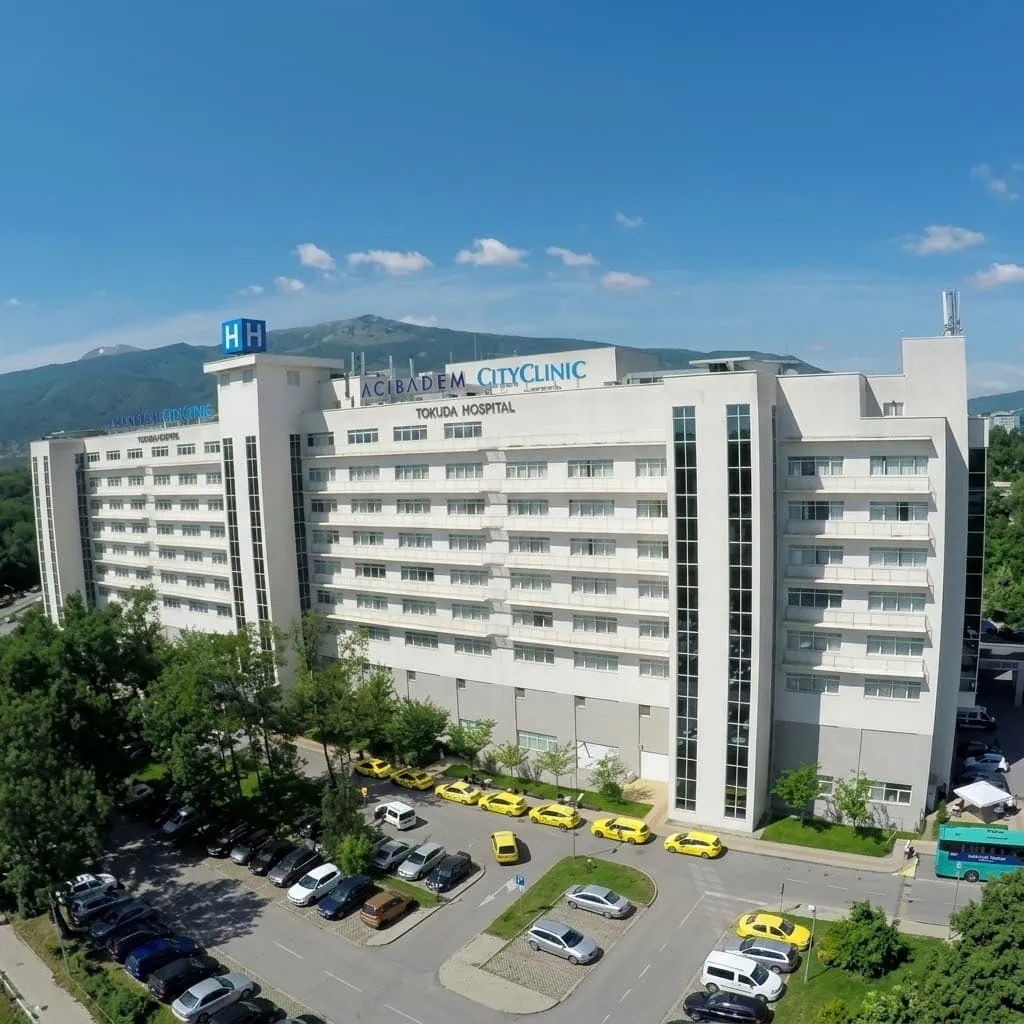
Acibadem City Clinic Tokuda Hospital
Learn about Acibadem City Clinic Tokuda Hospital in Sofia, offering multidisciplinary care for local and international patients.
Get directions →
Acibadem City Clinic Tokuda Hospital at a Glance
Acibadem City Clinic Tokuda Hospital is the heavyweight of the group's European network: a JCI-accredited, 550-bed general-purpose hospital in Sofia's Lozenets district, opened in 2006 as Bulgaria's first private hospital built with foreign investment, one hundred percent Japanese, and part of the Acıbadem group since 2016, when the City Clinic and Tokuda groups joined the family. The campus runs 22 operating theatres and a 50-bed intensive care floor divided into coronary, surgical, neonatal…
The Hospital in Numbers
Facility Highlights
550-bed general hospital with an outpatient medical centre, clinical research centre, pharmacy and care unit; Bulgaria's first foreign-invested private hospital, opened in 2006.
50 beds: 14 coronary, 22 surgical, 10 neonatal and 4 internal medicine.
22 operating theatres; da Vinci robotic surgery, digital angiography, whole-body MRI, 4D breast ultrasound, EUS, Excimer and Femto cataract lasers.
From ophthalmology and orthopedics to neurosurgery, liver-biliary-pancreatic surgery and transplantation, endourology and neonatology.
Cancer, breast health, heart health and spine health teams working across departments.
Works with every department of the Acıbadem hospitals in five countries.
Campus in the south of Sofia's Lozenetz district.
Femto laser and cataract surgery, glaucoma surgery, corneal transplant and pediatric eye surgery.
Acibadem City Clinic Tokuda Hospital, in depth
Acibadem City Clinic Tokuda Hospital is the heavyweight of the group’s European network: a JCI-accredited, 550-bed general-purpose hospital in Sofia’s Lozenets district, opened in 2006 as Bulgaria’s first private hospital built with foreign investment, one hundred percent Japanese, and part of the Acıbadem group since 2016, when the City Clinic and Tokuda groups joined the family. The campus runs 22 operating theatres and a 50-bed intensive care floor divided into coronary, surgical, neonatal and internal-medicine units, with an outpatient medical centre, a clinical research centre and a pharmacy under the same roof, and 36 departments delivering everything from da Vinci robotic surgery to cornea transplantation. For Bulgaria and its neighbours, this is the group standard at full scale, without leaving the country.
What this building is organised around
Tokuda was built to be Sofia’s complete hospital, and scale is its method: 550 beds and 22 theatres mean that almost nothing needs to be sent away. The intensive-care arithmetic reads like a flagship’s, fourteen coronary beds, twenty-two surgical, ten neonatal, four internal, and the department list runs to thirty-six, with named surgical depth in ophthalmology (femtosecond cataract surgery, glaucoma surgery, cornea transplantation, paediatric eye operations) and orthopaedics (joint replacement, scoliosis surgery, reconstructive trauma, arthroscopy). Since 2016 that scale has been wired into the Acıbadem system: the group’s protocols, records culture and five-country referral network now run through Bulgaria’s largest private hospital.
Quality and safety: the accredited frame
Acibadem City Clinic Tokuda Hospital holds JCI accreditation: the same international audit of surgical checklists, medication safety, infection control and credentialing that examines the group’s flagship campuses. Seven Acıbadem hospitals carry the JCI badge: five in Türkiye (Maslak, Altunizade, Atakent, Kent and Adana), Acıbadem Sistina in Skopje, and this City Clinic university hospital in Sofia. On this campus the badge means what it means everywhere: the systems patients cannot see from a brochure have been examined by people whose job is to doubt them, and the clinical research centre adds a second discipline, because a hospital that runs studies lives under protocol scrutiny daily.
Twenty-two theatres: the surgical floors
The theatre floor carries the range only scale allows: da Vinci robotic surgery for the urological, gynaecological and abdominal operations where precision through small incisions matters; the full ophthalmic surgical programme, from femtosecond-laser cataract and glaucoma surgery to cornea transplantation and paediatric eye operations; orthopaedic surgery across joint replacement, scoliosis correction, reconstructive trauma and arthroscopy; and the neurosurgical, general, thoracic and vascular lists of a complete hospital. Behind every list stands the 50-bed intensive-care floor, specialised by discipline, which is what turns an operation list into a safe programme.
Diagnostics and the everyday floors
The imaging arsenal matches the building: digital subtraction angiography, whole-body MRI, 4D breast ultrasonography, endoscopic ultrasound and the laser platforms of the eye programme, with the outpatient medical centre carrying the daily specialist load of a capital city, cardiology, internal medicine, gastroenterology, paediatrics, dermatology and the rest, and the campus pharmacy and laboratories closing the loop in one visit. For Sofia’s families the practical meaning is simple: the whole of everyday medicine and the whole of serious medicine share one address.
One of three City Clinic campuses, honest routing in Sofia
The group’s Sofia presence is a system, not a single building, and the honest division of labour is worth stating: Tokuda is the complete general hospital; City Clinic Mladost concentrates the dedicated cancer arsenal, Tomotherapy, TrueBeam radiosurgery, PET-CT, and City Clinic Ortopedia carries the focused orthopaedic programme, with Vitosha anchoring the cardiovascular axis. One records culture routes between them, and when a rare case genuinely belongs at an Istanbul flagship, proton-free radiosurgery planning, transplant programmes, congenital-heart surgery at Atakentthe file travels with the patient and the reason is stated.
Technology, honestly framed
The installation is stated without inflation because it does not need any: a da Vinci robot, 22 theatres, DSA, whole-body MRI, the ophthalmic laser platforms, a specialised 50-bed intensive-care floor. What this campus does not house lives one honest sentence away: the dedicated radiotherapy machines stand at Mladost across the city, and the group’s heaviest Istanbul installations remain available through the network, with transport coordinated and the reason explained, exactly as the group’s standing rule requires.
International patients in Sofia
The group’s records-first process applies exactly as at the Istanbul flagships: reports and imaging reviewed before travel, a written plan and cost estimate, interpreter support arranged through the international office, and discharge notes written for the doctor continuing care at home. Tokuda’s international patients divide honestly: Bulgaria’s own patients and Sofia’s international residents, for whom this is the national reference address; and patients from the wider region, for whom a JCI-accredited, 550-bed hospital inside the European Union, with Istanbul’s flagships behind it through one network, is a combination few cities offer.
Getting here
The hospital stands on Nikola Vaptsarov Boulevard in Sofia’s Lozenets district, south of the centre, with the full address, map link and phone in the identity card at the top of this page. Sofia’s airport connects the capital across Europe, and for planned visits the coordinators arrange transfers as standard.
How to decide whether Tokuda is your hospital
Choose Tokuda when you want complete medicine at full scale in Bulgaria: surgery across thirty-six departments under a JCI audit, robotic operations, the country’s deepest ophthalmic surgical programme, births and children’s medicine with neonatal intensive care behind them, or the everyday whole of specialist care. Choose Mladost across the city when the case is a dedicated radiotherapy course, Vitosha when it is cardiovascular by definition, and an Istanbul flagship when a programme needs installations only they house, and expect every one of those routings to be said aloud, file included. That is what belonging to a five-country group is for.
Frequently asked questions
Is Acibadem City Clinic Tokuda Hospital JCI-accredited?
Yes: it is one of the seven JCI-accredited Acıbadem hospitals, alongside five in Türkiye and Acıbadem Sistina in Skopje.
How big is the hospital?
550 beds, 22 operating theatres and a 50-bed intensive-care floor divided into coronary, surgical, neonatal and internal-medicine units: Bulgaria’s largest private hospital campus.
When did the hospital open?
In 2006, built with one hundred percent Japanese investment as Bulgaria’s first private hospital with foreign capital; it joined the Acıbadem group in 2016.
Is robotic surgery available?
Yes: a da Vinci system operates on this campus for the urological, gynaecological and abdominal procedures where robotic precision has earned its place.
What is the hospital’s ophthalmology programme?
Bulgaria’s deepest: femtosecond-laser cataract surgery, glaucoma surgery, cornea transplantation and paediatric eye operations, with the Excimer and FEMTO laser platforms on site.
What orthopaedic surgery is performed?
Joint replacement, scoliosis surgery, reconstructive trauma surgery and arthroscopy, with a dedicated sister campus, City Clinic Ortopedia, carrying the focused programme across the city.
Is there a 24-hour emergency service?
Yes, at a 550-bed general hospital’s scale, with 22 theatres and a specialised intensive-care floor behind it.
Can cancer be treated at Tokuda?
Diagnosis, surgery and systemic treatment are planned through the group’s tumour-board method; dedicated radiotherapy installations, Tomotherapy, TrueBeam radiosurgery, stand at City Clinic Mladost across Sofia, and the routing is stated openly.
Are births attended here?
Yes, with ten neonatal intensive-care beds behind the maternity floor, which is the fact that matters when a birth stops being routine.
What imaging is available?
Digital subtraction angiography, whole-body MRI, 4D breast ultrasonography, endoscopic ultrasound and the full radiology floor of a complete hospital.
What is the clinical research centre?
A dedicated unit running clinical studies on campus: a second layer of protocol discipline, because research hospitals live under daily scrutiny.
Which languages are supported?
Bulgarian and English routinely, with other languages arranged through the international office.
Do I need an appointment for the emergency service?
No, emergencies are walk-in by definition; the records-first process applies to planned care only.
How does the records-first process work?
Reports and imaging reviewed remotely, a written plan and cost estimate, and scheduling coordinated so the visit is as short as the medicine allows.
Can my insurance be used here?
The hospital works with Bulgarian public coverage in defined scopes and with private and international insurers, confirm your coverage in writing before planned care.
How does payment work?
A written estimate precedes planned care; for emergencies, treatment comes first and paperwork is sorted with you or your insurer after stabilisation.
Can my companion stay with me?
Yes, rooms accommodate companions, and the intensive-care units have their own explained visiting protocols.
How do I reach the hospital from abroad?
Via Sofia’s airport, with transfers arranged by the coordinators for planned visits; the identity card at the top of this page carries the address and map link.
What is the relationship between Tokuda and the other Sofia campuses?
One system: Tokuda is the complete general hospital, Mladost the dedicated cancer campus, Ortopedia the focused orthopaedic hospital and Vitosha the cardiovascular anchor, one records culture routing between them.
Can a case be referred to Istanbul if needed?
Yes: the five-country network moves files both ways, and when a programme genuinely needs a flagship-only installation, the coordinators arrange it and state the reason.
Can I get laboratory tests and imaging done quickly?
Yes, same-visit diagnostics through the campus laboratories and imaging floors, with results readable across the group’s network.
Do you repeat tests I already had?
Only for a stated reason, existing studies are integrated wherever usable, exactly as across the group.
Can I get a second opinion here?
Yes, including written records-based opinions without a visit; for surgical and oncological questions that is precisely the right first step.
Is there an outpatient centre?
Yes: an outpatient medical centre carries the daily specialist load, with the campus pharmacy and laboratories closing most visits in one trip.
Are children treated at Tokuda?
Yes, paediatric clinics, paediatric eye surgery among the named programmes, children’s emergencies at any hour and neonatal intensive care for the hardest first days.
What does “first private hospital with foreign investment” mean?
Tokuda was built in 2006 with one hundred percent Japanese capital: the first hospital of its kind in Bulgaria, which is why its scale and engineering stood out from the start.
Will my doctor at home receive a handover?
Always, discharge notes and planned-care summaries are written for the clinician continuing your care, with imaging and laboratory data included.
What should I bring to a planned visit?
Reports and scans in any language, a complete medication list including supplements, and your written questions: the records-first rule.
How fast is scheduling for planned care?
Coordinator-managed and quick; the honest variable is whether your records arrive before you do.
Why choose Tokuda over travelling abroad for treatment?
Because for most of medicine the answer is already in Sofia: a JCI-accredited, 550-bed hospital with robotic surgery and specialised intensive care, and for the rare case that needs more, the group’s network routes you honestly, file included.
Send your reports: a physician-reviewed plan comes back before you travel.
Free · No obligation · Reply within 24 hours