

Are Pre-Travel Tests Included in Your Turkey Treatment Cost?

Sometimes. Some Turkey treatment quotes include standard pre-admission tests; others list diagnostics separately or confirm them only after your records are reviewed. Whether pre-travel tests are included in your Turkey treatment cost depends on the procedure, your medical history, and how the provider builds its quote. Ask for a written, itemised breakdown before booking flights, including which tests may be repeated after arrival.
Before you book a flight for treatment in Turkey, one question is worth settling in writing: does your quote actually cover the tests you will need? Whether pre-travel tests are included in your Turkey treatment cost varies from quote to quote, and the difference matters for your budget, your dates, and how long you stay.
The safest approach is simple. Ask for a written, itemised breakdown before you commit to travel, so you know which tests can be done at home, which will be repeated in Turkey, and which extras could appear if your doctors need more information. This guide explains how testing usually fits into a treatment quote, why some tests sit outside it, and exactly what to confirm before you book anything.
At a glance
- Short answer: Sometimes included, sometimes billed separately. It depends on your treatment plan and how the provider builds its quote.
- What to ask for: A written breakdown showing tests before travel, tests on arrival, and what could trigger repeat or additional testing.
- Common issue: Tests done at home may be repeated in Turkey if the results are too old, incomplete, or in an unusable format.
- Best timing: Confirm your required test list and record review before booking flights and accommodation.
- Useful habit: Send full reports and image files early, and ask for confirmation that the medical team, not just the admin team, has reviewed them.
The short answer: sometimes, and it depends on the quote
If you are asking whether pre-travel tests are included in your Turkey treatment cost, the honest answer is: not always. Some quotes include a standard set of pre-admission or pre-operative tests. Others separate diagnostics from the treatment itself, so you can see clearly what is medical care, what is testing, and what is travel logistics. Neither approach is wrong, but they read very differently on paper, and comparing them without an itemised breakdown is where most confusion starts.
Do not assume that every blood test, scan, cardiology check or anaesthesia review sits inside one headline package figure. A written quote matters more than verbal reassurance, especially when you are arranging care from abroad and cannot walk into the billing office to ask a follow-up question. If the words pre-travel tests included appear nowhere in your Turkey treatment cost estimate, treat testing as an open question until someone answers it in writing.
There is a second reason the answer is rarely a flat yes. Testing is personal. Two patients booking the same procedure can need different checks depending on age, medical history, medications and previous results. A responsible provider often cannot list your final test set until it has reviewed your records, which is why some lines in a quote are marked as estimated or conditional rather than fixed.
What counts as a pre-travel test?
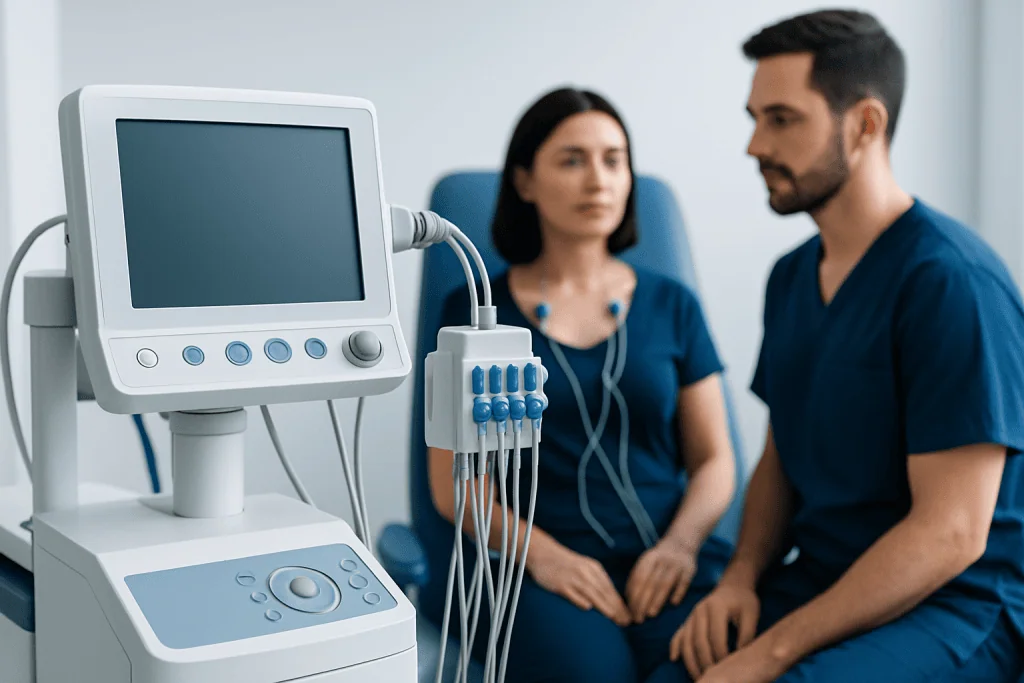
Pre-travel tests are the checks requested before you come to Turkey, or shortly after you arrive, so the care team can confirm that the planned treatment is appropriate and safe for you. Depending on the treatment, these may include blood work, urine tests, an ECG, chest imaging, pregnancy testing where relevant, infection screening, specialist consultations, or updated imaging connected to your condition.
The exact list depends on the procedure, your age, your medical history, and how recently your existing tests were done. Someone travelling for surgery is assessed differently from someone travelling for fertility treatment, oncology care, orthopaedic work or a second opinion with imaging review. Our guide on when you may need pre-travel tests before treatment in Turkey looks at this in more detail by treatment type.
Broadly, the tests fall into a few groups:
- General health tests such as blood counts and chemistry panels
- Heart and anaesthesia assessments before procedures that need them
- Imaging such as ultrasound, X-ray, MRI or CT when clinically needed
- Condition-specific specialist assessments
- Repeat tests where prior results are old, unclear or incomplete
Note the distinction between planning and admission. Your home-country results may be perfectly good enough for the medical team to plan your treatment and issue a quote, yet still not sufficient for admission on the day, because hospitals often need current results within a defined window and produced under their own protocols.
The three layers of testing, and where each is billed
It helps to think of testing in three layers, because each layer tends to appear in a different part of your paperwork.
Layer one: tests you complete at home. These are arranged and paid for in your own country, under your own health system or out of pocket. They are almost never part of a Turkish provider’s quote, because the quote covers services delivered in Turkey. Their value is in planning: good, recent records can shorten the review process and reduce what needs to be done after you land.
Layer two: tests the hospital runs after arrival. These are routine admission or pre-operative checks done in Turkey. Some quotes include them as a defined set; others list them as a separate diagnostics line. This is the layer where wording matters most, and where you should ask directly what is covered.
Layer three: additional tests that emerge from your case. If the examining doctor finds something that needs clarifying, further tests may be recommended. These are usually billed separately because they cannot be predicted in advance. They can also affect your schedule, which we cover in a separate guide on how tests after arrival can affect timing and cost.
When you ask whether pre-travel tests are included in your Turkey treatment cost, you are really asking about layers two and three. Getting each layer named in your quote is the single most useful thing you can do before booking travel.
Why tests may sit outside your package price

Even when a hospital offers a package, the package is usually built around the planned treatment itself rather than every possible preparatory step. This is normal in international healthcare, because no two patients arrive with the same history, medication list, prior imaging or risk profile.
A provider may include routine baseline tests but exclude anything that depends on your individual needs. If your history suggests an extra cardiology review or updated imaging, those additions may only be confirmed once doctors have assessed your records. That is not automatically a hidden fee; it can simply reflect individualised care. The distinction between a legitimate conditional item and a genuinely vague quote is worth learning, and our guide on how to spot hidden costs in medical travel quotes for Turkey walks through it.
Hospital safety protocols also require careful pre-treatment review, and that can mean separate billing lines for diagnostics, specialist consultations or repeated tests. The practical takeaway does not change: ask exactly which tests are included, which are estimated, and which are excluded.
How to read your quote line by line
When a treatment estimate arrives, read it as a logistics document, not just a price. Certain phrases signal where extra costs may appear, and knowing them turns a confusing document into a useful one.
| Phrase in the quote | What it usually means | What to ask |
|---|---|---|
| Included services | The defined scope of the price | Are pre-operative tests listed here by name? |
| Excluded services | Items you will pay for separately | Which excluded items apply to a typical case like mine? |
| Additional diagnostics if required | Conditional tests decided after examination | What commonly triggers these, and how are they billed? |
| Doctor evaluation upon arrival | The plan may be adjusted after in-person review | Could this evaluation change the price or the dates? |
| Subject to medical assessment | The quote is provisional until records are reviewed | When will the reviewed, firmer version be issued? |
If the quote is brief, ask for a plain-language breakdown: does the figure cover tests on admission, physician review of your outside reports, and repeat imaging if your existing results are not accepted? Also confirm whether interpreter support, transfers and accommodation coordination sit inside or outside the medical charges. For a fuller picture of what a good estimate should contain, see what is included in a medical cost estimate before you travel to Turkey. Acibadem also explains its own approach in a dedicated guide on how treatment costs are explained before you travel.
- Ask for included and excluded items in writing
- Confirm the validity period of the quote
- Check whether your outside test results can reduce repeat testing
- Ask what happens financially if extra tests are needed
- Clarify whether hotel or flight changes may follow if testing delays treatment
How much is medical treatment in Turkey?
There is no single figure, and any page that gives you one without seeing your records is guessing. The cost of treatment in Turkey depends on the procedure and its complexity, the hospital and city, the length of stay, the materials or implants involved where relevant, the diagnostics your case requires, and whether the provider quotes a bundled package or an itemised estimate.
That is why the useful question is not “how much does it cost?” but “what does my quote depend on, and what could change it?” A quote based on your actual medical records, with a stated validity period and clearly named inclusions, gives you something you can genuinely budget around. A round number quoted before anyone has seen your history does not. Testing is one of the main variables: two quotes for the same procedure can differ mainly because one includes the diagnostic work-up and the other leaves it out.
When tests done at home are repeated in Turkey
It can feel frustrating to pay for a test at home and then hear it must be repeated after arrival. In most cases this happens for practical reasons, not because your earlier test was useless. The treating team may need more recent data, a specific laboratory standard, or imaging performed in a way that matches the planned procedure.
Some results also have a limited clinical shelf life. A blood test or ECG that was acceptable for initial review may no longer be current enough on the day of surgery. If imaging quality is poor, a report lacks key details, or digital files cannot be opened, repeating the test is often the most practical route.
You can reduce the risk of duplication, though rarely to zero:
- Send your records early, before you confirm travel dates
- Provide both written reports and the actual image files, not just summaries
- Ask how recent each result must be on the day of treatment
- Ask whether reports need certified translation into English or Turkish
- Request confirmation that the medical team has reviewed the files, not merely received them
Questions to settle before you book flights
The best time to ask about testing is before you buy tickets. Once dates are fixed, a request for additional tests can mean rebooking fees, a longer stay, or a compressed schedule. A short list of targeted questions protects you from all three.
Start with which tests are required before travel and which can wait until arrival. Then ask whether home-country results are acceptable, what date range makes them valid, whether original images are needed, and in what language reports must be provided. Finally, ask what happens if a result shows something unexpected: treatment can sometimes be postponed, adjusted, or preceded by further consultation, and it is far easier to absorb that if you have discussed the possibility in advance and built a little flexibility into your itinerary.
International patient teams exist precisely to coordinate this: records review, interpreter support, scheduling across specialties, and turning a medical plan into a practical travel plan. Use them to pin down whether your pre-travel testing is already inside the quote or still to be arranged.
How to budget for the unknown without overpaying
A sensible budget includes both the quoted amount and a modest buffer for medically necessary extras. This is not about expecting hidden costs; it recognises that international treatment plans can shift slightly once doctors examine you in person and see current results.
Separate your budget into categories: treatment, diagnostics, medication, travel, accommodation, local transport and contingency. If your quote says additional tests may be required, ask for examples of the tests that commonly arise in cases like yours, so you can prepare realistically without assuming the worst. Our guide on how to budget for tests not included in your first quote gives a practical method for sizing that buffer.
Keep your travel plans somewhat flexible too. A same-day discharge can become an overnight stay, and a procedure can move by a day if a consultation or repeat test is needed. Above all, prioritise clarity over the lowest headline number. A detailed, transparent quote that explains testing, timing and possible extras is easier to plan around than a cheaper-looking figure that leaves the key questions unanswered.
Step by step
- Request a written, itemised quote. Ask for a section showing which pre-travel and pre-operative tests are included, which are excluded, and which will only be decided after doctor review of your records.
- Send your medical records early. Share recent reports, medication lists, imaging discs or upload links, and details of previous surgery before you confirm travel. Early review gives the hospital time to say whether your current tests are sufficient or likely to be repeated in Turkey.
- Confirm test validity and format. Ask how recent each test must be on the day of treatment, and whether reports need certified translation or a specific file format. This avoids arriving with documents that cannot be used for admission.
- Ask what happens if extra tests are needed. Establish whether additional diagnostics are billed separately, who will explain the reason for any extra test, how quickly results are usually available, and whether the procedure date could move.
- Build a financial and time buffer. Keep room in your budget and itinerary for medically necessary changes. Even well-planned trips sometimes involve repeat blood work, a specialist review, or an extra night’s stay.
- Reconfirm everything before departure. A few days before flying, review your schedule, required documents and expected first-day tests with your coordinator, so you arrive knowing exactly what happens and in what order.
Your checklist
- Ask for a written quote with included and excluded tests named
- Confirm which tests must be done before travel
- Check whether your home-country results will be accepted
- Verify how recent each test must be on the day of treatment
- Send reports and image files before booking flights if possible
- Ask whether any tests are routinely repeated on arrival
- Keep a budget buffer for extra diagnostics or consultations
- Bring printed and digital copies of your records
- Confirm whether translations are needed, and into which language
- Recheck the plan and schedule a few days before departure
Key takeaways
- Pre-travel tests may be included in your Turkey treatment cost, but often only some of them are, and only a written breakdown will tell you which.
- Testing happens in three layers — at home, on arrival, and case-specific extras — and each is usually billed differently.
- Tests done at home can still be repeated in Turkey if they are outdated, incomplete or in an unusable format.
- Conditional lines like ‘additional diagnostics if required’ are normal in individualised care, but they should be explained, not left vague.
- A modest contingency in both budget and itinerary absorbs most testing-related changes without stress.
Frequently asked questions
Are pre-travel tests usually included in a Turkey treatment package?
Sometimes, but not always. Many quotes include a standard baseline set, while more specific diagnostics are listed separately or confirmed only after the medical team reviews your records. The only reliable answer is a written, itemised quote for your own case.
How much is medical treatment in Turkey?
There is no single figure. The cost depends on the procedure and its complexity, the hospital, the length of stay, the materials involved where relevant, and the diagnostics your case requires. A meaningful estimate is built from your actual medical records, states its validity period, and names what is included and excluded.
Can I do my tests in my home country to save money?
Often, yes, and good recent records genuinely help with planning. However, the hospital in Turkey may still repeat certain tests if it needs newer results, a specific laboratory standard, or imaging in a format suitable for treatment planning. Ask in advance which of your results will be accepted and for how long.
Why would a hospital repeat tests I already paid for?
Usually for safety, timing or technical compatibility rather than duplication for its own sake. Results may be too old on the day of treatment, missing key details, or not performed to the hospital’s admission requirements. Sending complete files early reduces, but rarely eliminates, this possibility.
What should I get in writing before I book flights?
An itemised quote stating included tests, excluded tests, and possible conditional extras; which tests must be completed before travel; whether your existing records are acceptable and for how long; and whether any testing outcome could move your treatment date or extend your stay.
Should I budget extra even if I have a package quote?
Yes, a modest contingency is sensible. It covers additional diagnostics, consultations or schedule adjustments if doctors recommend something extra after examining you. It is a planning buffer, not an expectation of hidden fees.
Could extra tests change my treatment date?
They can, depending on the test and how quickly results come back. Sending records early, confirming validity windows, and keeping a flexible day in your itinerary are the practical ways to absorb this without disruption.
Do my test results need to be translated?
Sometimes. Hospitals typically work with reports in English or Turkish, and some documents may need certified translation. Ask which documents require translation, into which language, and whether the hospital or you arranges it, before you travel.
Add us as a Preferred Source to see more of our trusted health content across Google Search, AI Overviews and Discover.

Update history
- PublishedJune 25, 2026
- Medical review approvedAugust 31, 2026
- Last content updateAugust 31, 2026
References1
More Patient Guides

Private MRI, CT and Check-Up Costs in Turkey: How Scans Are Priced
How private MRI, CT, PET-CT and full check-up packages are priced in Turkey — modality, region, contrast, reporting — and what a…

Cataract Surgery Cost in Turkey: Per-Eye Prices and Lens Options
Cataract surgery in Turkey is priced per eye and the lens decides the quote. Biometry, both eyes on one trip, and what…

Lip Filler Cost in Turkey: Per-ml Prices Explained
Lip filler in Turkey is priced per millilitre with licensed hyaluronic acid brands and physician injectors. Volume, product, dissolving, safety and what…

Botox Cost in Turkey: Per-Area and Per-Unit Prices
How Botox is priced in Turkey — per area or per unit, brand, physician injectors, medical indications — and what a serious…