

When You May Need Pre-Travel Tests Before Treatment in Turkey

Whether you need tests before travelling depends on your planned treatment, your health history and your medications. Minor procedures may need little in advance; surgery under anaesthesia usually needs recent blood work, imaging and sometimes heart checks. Your treating team confirms the exact list, how recent each result must be, and which tests may still be repeated after you arrive in Turkey.
You have a treatment plan taking shape and a rough travel window in mind. Then the practical question arrives: is there anything you need to sort out at home first? For many international patients the answer is yes — you may need pre-travel tests before treatment in Turkey, though the list varies widely from one person to the next. This guide explains what those tests typically are, who tends to need them, why timing matters more than most people expect, and what may still be repeated after you land. Knowing this in advance helps you avoid delays, wasted appointments and unwelcome surprises on arrival.
At a glance
- Who this guide is for: International patients planning treatment in Turkey
- Main goal: Help you understand which tests may be needed before you travel, and why
- Common test types: Blood work, imaging, heart and lung checks, infection screening, medication review
- Why timing matters: Some results are only considered current for a limited period and may need repeating on arrival
- Who coordinates this: Your treating team, working with international patient services
- What to bring: Written reports, original image files, a full medication list, your passport, and translated records where required
Why you may need pre-travel tests before treatment in Turkey
Before a hospital confirms a treatment plan for someone travelling from abroad, the medical team needs a clear, current picture of that person’s health. Pre-travel tests serve three purposes. They confirm the planned treatment is suitable for you as you are now, not as you were when an older report was written. They flag anything that should be managed or stabilised first. And they let the team plan anaesthesia, length of stay and follow-up with fewer unknowns.
Not every patient needs the same tests, and some need very few. Whether you may need pre-travel tests before treatment in Turkey depends on your age, medical history, current symptoms, the medicines you take and the complexity of what is planned. A consultation or a small day-case procedure may need nothing more than a records review. Major surgery, or any treatment involving general anaesthesia, usually calls for more formal assessment in advance.
There is also a middle path that is very common in practice: you complete part of the testing at home, the hospital reviews those results remotely, and the remaining checks are done after you arrive. Hospitals that treat international patients routinely coordinate this split, so you know before you book flights which items must be arranged at home and which will be handled in the hospital. If you want a deeper look at the specific results hospitals typically ask for, see our guide to which pre-op results you may need before you travel.
One honest caveat before anything else: no article can tell you your personal test list. That comes from the doctor reviewing your case. What a guide can do is show you the categories, the logic behind them, and the questions worth asking early.
The types of tests you may be asked to complete
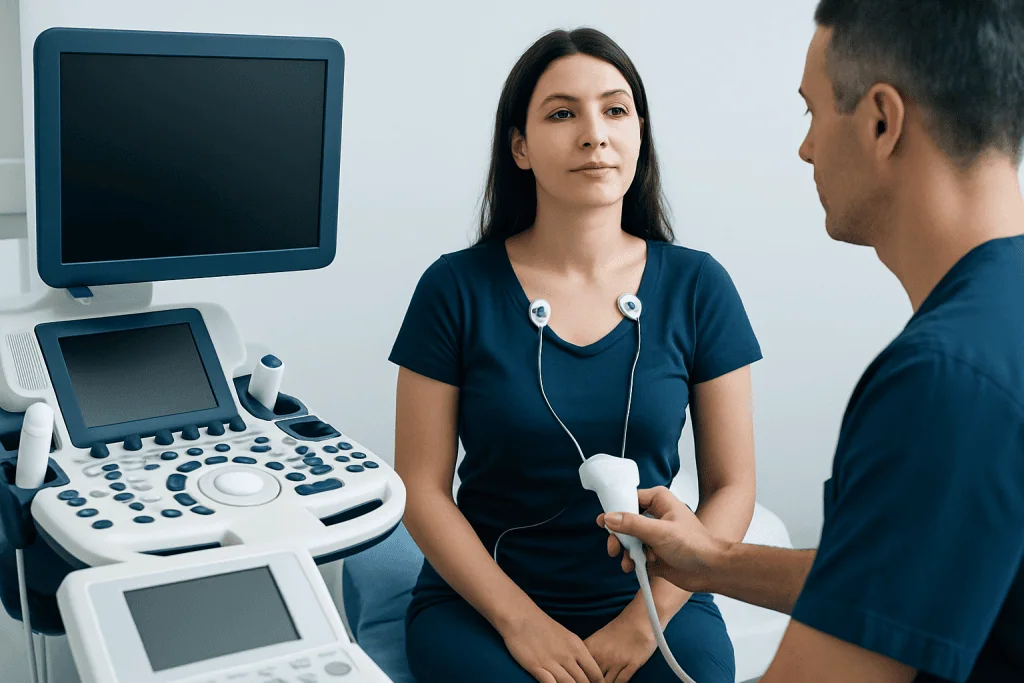
Blood and urine tests
Most pre-travel checks are routine laboratory work. Depending on your treatment, this can include a complete blood count, kidney and liver function tests, a clotting profile, blood sugar, and blood group information. Urine testing, pregnancy testing where relevant, and screening for certain infections may also be requested. None of this is unusual — it is the same baseline any hospital would want before surgery, whether you live locally or fly in.
Imaging
X-rays, ultrasound, CT, MRI or mammography may be needed to confirm a diagnosis or guide planning. If you already have recent scans, ask whether the hospital wants the original image files as well as the written report. Most specialists prefer both: the report summarises, but the images let them judge for themselves and compare against anything done later in Turkey.
Heart and lung assessment
Before surgery, or if you have an existing medical condition, cardiac and respiratory checks become more likely. Examples include an ECG, an echocardiogram, chest imaging or respiratory function testing. If a condition needs careful control — heart disease, uncontrolled blood pressure, significant asthma — the team may also ask for a clearance letter from a cardiologist, pulmonologist or other specialist in your home country.
Condition-specific assessments
Some treatments carry their own requirements: hormone panels before fertility treatment, endoscopy reports before some bariatric procedures, biopsy and pathology reports before cancer care. These are usually the tests least likely to be skipped, because the whole treatment decision rests on them.
| Test category | Why it may be requested | How current it usually needs to be |
|---|---|---|
| Basic blood work | Baseline safety before anaesthesia and surgery | Usually recent — often within weeks of treatment |
| Imaging (CT, MRI, X-ray, ultrasound) | Confirming diagnosis, planning the procedure | Varies; stable conditions tolerate older scans, changing ones do not |
| ECG and cardiac checks | Anaesthesia and surgical risk planning | Often expected to be recent for surgical patients |
| Infection screening | Hospital admission protocols, procedure safety | Frequently repeated on arrival regardless of home results |
| Specialist clearance letters | Confirming a chronic condition is well controlled | Should reflect your current medication and status |
The timeframes above are deliberately loose, because there is no universal rule. Each hospital and each treating doctor sets acceptable windows, and they differ by test. Treat the table as a way to frame questions, not as a schedule.
How your treatment type and health history shape the list

Two things drive the length of your test list: what is being done, and who it is being done to.
On the treatment side, the pattern is straightforward. The more invasive the procedure and the more it depends on anaesthesia, the more the team wants confirmed in advance. Major surgery, cancer care, fertility treatment and bariatric procedures typically require more formal evaluation than a consultation or a minor outpatient procedure. Some cases also need a face-to-face assessment before a plan can be confirmed at all — our guide on when an in-person evaluation is needed before treatment in Turkey covers where that line usually falls.
On the personal side, chronic conditions raise the bar. Diabetes, high blood pressure, heart disease, asthma, sleep apnoea, kidney problems, autoimmune disease and a history of blood clots are all reasons a team may want extra review before your trip. Previous operations and hospital stays matter too: discharge summaries from earlier admissions help the team understand risks that would otherwise only surface on arrival.
Medications deserve their own mention. Blood thinners, insulin, steroids, immunosuppressants and even some over-the-counter supplements can affect bleeding, blood sugar control, infection risk and anaesthesia planning. Give your care team a complete list — prescription medicines, over-the-counter products and herbal supplements. Any decision about continuing, pausing or adjusting a medicine before treatment belongs to your treating doctor; never make that change on your own or on the advice of a website, this one included.
Finally, some medical situations affect the journey itself rather than the treatment. Recent surgery, certain heart and lung conditions, and some stages of pregnancy can influence whether an airline expects medical clearance before you board. That is a separate question from hospital testing, and it is worth resolving early — see medical fitness to fly to Turkey for how clearance works.
Timing: why some results expire
This is the point most patients underestimate. A test result is a snapshot, and snapshots age. A clotting profile from four months ago says little about your bleeding risk next week. An MRI of a stable joint problem may stay useful for much longer than a scan of something that changes quickly. Hospitals therefore attach validity windows to results, and those windows differ by test, by treatment and by institution.
The practical consequence: do not schedule tests too early just to feel prepared. Results completed long before travel may no longer be considered current by your treatment date, which means paying for the same test twice — once at home, once in Turkey. The efficient approach is to ask for a written list stating exactly what is needed, when each test should be done, and how recent each result must be at the time of treatment. Then work backwards from your planned travel dates.
Equally, do not leave essential testing to the last days before departure. If a result raises a question — an unexpected blood value, an incidental finding on a scan — your team needs time to clarify it before your admission date, not after you have landed. A comfortable middle window, agreed with your coordinator, protects you at both ends.
Sharing results, and the language question
Once you have results, how you share them matters almost as much as having them. Hospitals reviewing international cases usually ask for documents in advance of final travel booking, precisely so gaps can be found while you are still at home. Keep everything organised in both digital and printed form: official reports, image discs or secure digital files, specialist letters, and your medication list. Carry the printed set in hand luggage, not checked baggage.
If your documents are not in English, ask early whether translation is required or whether the hospital can work with them as they are. Some records can be reviewed in the original language; others — particularly detailed pathology or operative reports — usually need translating to be genuinely useful. Our guide on medical records translation for Turkey explains which documents tend to need it and which do not.
Two small details save disproportionate trouble. First, make sure every report shows your full name, date of birth and the test date clearly — unlabelled or partially labelled results are often unusable. Second, where possible use accredited laboratories and imaging centres at home, because results from unverifiable sources are the ones most likely to be repeated on arrival.
Who pays for what: how testing fits into a quote
We will not put numbers on this, because there are none that would honestly apply to every patient. But the structure is worth understanding, because it is where confusion most often arises.
Tests you complete in your home country are arranged and paid for through your local healthcare system or out of pocket there; they sit outside any hospital quote from Turkey. Tests performed at the hospital in Turkey are typically itemised within, or added to, the treatment plan you are quoted — and whether standard admission tests are bundled into a quoted plan or listed separately varies by treatment and should be stated in the written quote itself. If it is not clear, ask for it in writing before you book travel.
The variable to watch is repeat testing. If a home result is out of date or cannot be verified, the repeat happens in Turkey and is usually charged there. This is one more reason the timing conversation earlier in this guide is worth having properly: doing the right tests at the right time, once, is the cheapest version of this process, whatever the underlying figures are in your case.
General travel health: the non-hospital checks
Alongside treatment-specific testing, ordinary travel health applies to you the same as to any visitor. Check official travel health guidance for Türkiye before you go: national sources such as the CDC’s travellers’ health pages and the UK government’s travel advice list routine vaccination recommendations and current entry requirements, and these change over time, so check close to your departure date rather than relying on older summaries.
Entry rules — visas, passport validity, any health documentation required at the border — come from government sources, not hospitals, and it is your responsibility to meet them. Your international patient coordinator can tell you what the hospital needs; only official government pages can tell you what the border needs. If a companion is travelling with you, their documents need the same attention — our guide on bringing a companion to Turkey for treatment covers the planning involved.
What may still happen after you arrive
Even with careful preparation, expect some testing on arrival. Hospitals commonly verify key results with their own laboratory, complete facility-specific admission protocols, or update anything that has aged since your last report. Imaging is sometimes repeated on the hospital’s own equipment so the treating specialists can review the study directly rather than relying on an external file. This is standard practice, not a sign that something is wrong — our guide on why blood tests and scans may be repeated in Turkey explains the reasoning in detail.
Repeat checks become more likely when there has been a gap between your last tests and your treatment date, when your symptoms or medications have changed, or when a result cannot be verified. Occasionally a repeat test surfaces something new, and the plan is adjusted or a further investigation added before treatment proceeds.
All of this argues for one simple scheduling habit: build a buffer between arrival and admission. Landing the evening before a planned procedure leaves no room for a consultation, a confirmatory test, or a quiet day to recover from the flight. A short margin turns any extra check from a crisis into an errand.
Step by step
- Ask for a personalised pre-travel test list. Once your treatment plan is under discussion, ask your coordinator or doctor for a specific written list of required tests, including how recent each result must be at the time of treatment. Vague lists produce wasted appointments; precise ones do not.
- Book home-country tests inside the agreed window. Arrange the tests you have been asked to do locally, timed so results are still current on your treatment date. Use accredited facilities where possible, and check that your name, date of birth and the test date appear clearly on every report.
- Have your records reviewed before fixing final travel dates. The hospital will normally review your reports, scan files and medication list before your dates are confirmed. Completing this review while you are still at home is what catches gaps early and keeps arrival smooth.
- Confirm what may still be repeated in Turkey. Even accepted home results can be repeated for safety or as part of admission protocols. Knowing which ones in advance lets you plan your dates — and your expectations — realistically.
- Prepare your medical file for the journey. Carry digital and printed copies of reports, original image files, prescriptions and specialist letters in your hand luggage. A file that arrives with you is worth far more than one in checked baggage or an inaccessible inbox.
- Confirm medication instructions with your treating doctor. Before travelling, confirm with the treating team what you should do about each medicine, supplement or injection around your treatment dates. Never pause or change prescribed medication on your own initiative.
Your checklist
- Written, personalised list of required pre-travel tests with validity windows
- Recent blood test reports
- Imaging reports plus original image files where available
- ECG or specialist clearance letters if requested
- Full medication and supplement list
- Allergy information
- Previous operation and hospital discharge summaries
- Translated records where the hospital has confirmed translation is needed
- Passport, visa if required, and travel itinerary
- Printed and digital copies of everything, carried in hand luggage
Key takeaways
- Whether you need pre-travel tests before treatment in Turkey depends on your procedure, health history and medications — there is no universal list.
- Common requests include blood work, imaging, heart and lung checks, infection screening and specialist clearance letters.
- Results have validity windows; testing too early can mean paying for the same test twice.
- Records are usually reviewed before final travel dates are fixed, and some tests are repeated on arrival as standard practice.
- Home-country tests sit outside a Turkish hospital quote; ask in writing how arrival testing is handled in yours.
- A buffer between arrival and admission turns any extra check into a minor errand rather than a schedule crisis.
Frequently asked questions
Will I definitely need tests before travelling to Turkey for treatment?
No. Some patients need only a consultation and a review of existing records, while others need blood tests, imaging or specialist clearance before travelling. The requirement depends on your planned treatment, your health history and your medications, and is confirmed by the treating team, not by a standard list.
Can I use tests done in my own country?
Often, yes — particularly if the results are recent, clearly labelled with your details, and from reliable facilities. The treating team may still repeat certain tests in Turkey for safety, to establish a local baseline, or because a result is no longer current by your treatment date.
How recent do my pre-travel test results need to be?
There is no single rule. Some results are accepted when weeks or months old; others, especially those relating to surgery and anaesthesia, usually need to be much more recent. The acceptable timeframe for each test should be stated on the written list your care team provides.
What if my reports are not in English?
Some documents can be reviewed in their original language, but detailed reports — pathology, operative notes, complex imaging summaries — often need translating to be genuinely useful. Ask in advance which of your documents need translation so review is not delayed.
Could a missing test delay my treatment?
Yes. If an essential test has not been done, or a result raises a question needing clarification, your consultation, admission or procedure date may move. Completing the records review while you are still at home is the best protection against this.
Do I need to bring scan images, or is the written report enough?
Bring both if you can. Specialists generally want the original image files as well as the report, so they can review the study directly and compare it with any new imaging done in Turkey. Reports alone are sometimes accepted, but images make repeat scans less likely.
Are pre-travel tests included in the treatment quote?
Tests done in your home country are paid for there and sit outside any quote from a hospital in Turkey. Tests done at the hospital may be bundled into the quoted plan or listed separately, depending on the treatment. The written quote should state which; if it does not, ask before booking travel.
Do I need vaccinations before travelling to Turkey for treatment?
Routine travel health guidance applies to medical travellers the same as any visitor. Recommendations and entry requirements change over time, so check official sources such as the CDC travellers’ health pages or the UK government travel advice for Türkiye close to your departure date.
Add us as a Preferred Source to see more of our trusted health content across Google Search, AI Overviews and Discover.

Update history
- PublishedAugust 6, 2026
- Medical review approvedSeptember 1, 2026
- Last content updateSeptember 1, 2026
References2
More Patient Guides

CyberKnife Radiosurgery in Turkey: Candidacy, Treatment Schedule, and Travel Plans
CyberKnife radiosurgery in Turkey involves eligibility review, several planning steps and short outpatient visits; international patients can arrange care in Istanbul.
8 min read
Traveling to Turkey for Biopsy Review: What Happens Before Treatment Is Confirmed
Biopsy review in Turkey helps confirm your diagnosis before treatment, using pathology slides, reports and specialist assessment in Istanbul.
8 min read
Flying to Turkey with Recent Scan Results: How to Organize Reports and Images
Organize recent scan results for travel to Turkey by bringing reports, original image files, dates, and a clear medical summary for your…
8 min read
Questions to Ask Before Signing a Consent Form for Treatment in Turkey
Ask the right consent form questions before treatment in Turkey, including risks, alternatives, costs, language support and follow-up plans.
8 min read