

CyberKnife Radiosurgery in Turkey: Candidacy, Treatment Schedule, and Travel Plans

CyberKnife radiosurgery in Turkey involves eligibility review, several planning steps and short outpatient visits; international patients can arrange care in…
If you are considering CyberKnife radiosurgery in Turkey, planning usually begins with a remote review of your scans and medical records, followed by treatment planning and scheduled outpatient visits in Istanbul. This guide explains candidacy, timing, likely travel arrangements, costs and practical questions for you and your companion.
At a glance
- Typical setting: Usually outpatient; an overnight stay is not commonly required solely for treatment.
- Treatment visits: Often 1 to 5 sessions, depending on the area being treated and your specialist plan.
- Session length: Treatment delivery commonly takes about 30 to 90 minutes, with additional time for check-in and positioning.
- Travel planning: Allow time for consultation, imaging, treatment planning and any recommended review before departure.
- International support: Acibadem International can help coordinate appointments, interpreters and practical travel arrangements.
Planning CyberKnife radiosurgery in Turkey
CyberKnife is a form of highly targeted radiation treatment that uses image guidance and a robotic delivery system to direct radiation toward a defined treatment area. It is often discussed for selected tumors or other conditions in the brain, spine, lung, liver, prostate and other parts of the body, but whether it is appropriate for you depends on details that cannot be determined from a diagnosis name alone.
For international patients, the most useful first step is a records review before you book travel. Your treating team will usually need recent imaging in its original digital format, radiology reports, pathology results where relevant, a clinical summary, your treatment history and a current medication list. This allows the specialist team to assess whether CyberKnife may be suitable, whether another radiation approach is more appropriate, and how much time you may need in Turkey.
At Acibadem International, international patient services can help you organize the document-sharing process, appointments and communication with the relevant multidisciplinary specialists. If you proceed, practical support may include interpreter coordination and guidance on local transport or accommodation, while your clinical team remains responsible for treatment recommendations.
Who is eligible for CyberKnife treatment?
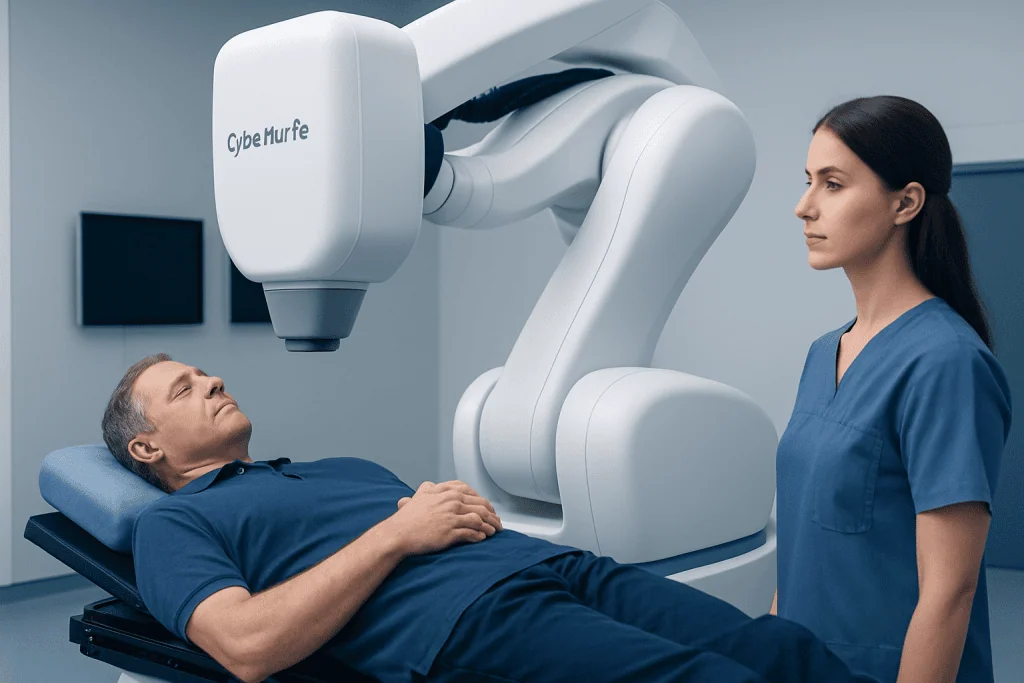
Eligibility for CyberKnife treatment is decided individually by a radiation oncology team, often in discussion with other specialists such as medical oncologists, neurosurgeons, surgeons, radiologists and physicists. You may be considered when there is a clearly visible, well-defined target that can be treated safely with focused radiation, and when the expected benefit outweighs the potential effects on nearby healthy tissue.
Your team will consider the type, size, number and location of lesions; whether the area has received radiation before; your general health and ability to lie still for treatment; and whether surgery, systemic therapy, conventional radiotherapy or observation would be more suitable. Some people are referred to CyberKnife because surgery is not advisable or is not preferred, but CyberKnife is not automatically a replacement for surgery.
Bring or send your latest scans and reports rather than relying only on written summaries. Imaging may need to be repeated if it is outdated, incomplete, not compatible with planning software or no longer reflects your current condition. A recommendation after review is more reliable than assumptions based on information found online.
- Ask whether the proposed goal is cure, local control, symptom relief or another purpose.
- Ask what alternatives are appropriate in your situation and why CyberKnife is being considered.
- Tell the team about prior radiotherapy, implanted devices, allergies and all medicines or supplements.
How long does a CyberKnife treatment session typically last?

A CyberKnife treatment session commonly lasts around 30 to 90 minutes of treatment time, although the exact duration varies. The location and complexity of the target, the number of planned radiation beams, imaging checks during treatment and your personalized plan all influence the appointment length.
You should plan for more time at the hospital than the beam-delivery time alone. Check-in, changing, positioning, safety checks and any needed preparation can extend the visit, especially on your first day. For treatment involving the head, you may use a custom-fitted mask; for body treatment, you may have positioning aids and imaging used to track movement such as breathing.
CyberKnife is generally non-invasive and you are awake during treatment. The machine moves around you, but it does not normally touch you; your team monitors you throughout and can communicate with you. You may usually return to your accommodation afterward, unless your medical team advises observation or you have another condition requiring care.
Your treatment schedule and how long to stay in Istanbul
CyberKnife is sometimes delivered in one session and sometimes divided over several sessions, commonly up to five. The number of sessions is a clinical decision based on the treatment area, size and proximity to sensitive structures, not a matter of convenience or travel preference.
Before treatment begins, you may need a consultation, planning scan, immobilization or positioning preparation, and a treatment-planning period. Your physicians, medical physicists and radiation therapists use these steps to create and verify a plan designed around your anatomy. This means there can be a gap between your planning appointment and your first treatment session.
For travel purposes, avoid booking a non-changeable return flight until you have received an individualized itinerary. Your care coordinator can provide a provisional schedule after the remote review, but it may change if further imaging, specialist input or plan adjustments are needed. It is wise to leave a buffer of several days after your final session in case your team recommends a review or your travel needs change.
- Ask whether appointments will be on consecutive weekdays or spread across a longer period.
- Arrange accommodation with easy access to the hospital and a calm place to rest.
- Build in time for arrival recovery, especially after long-haul travel or time-zone changes.
Can foreigners go to hospital in Turkey?
Yes. Foreign nationals can receive planned medical care at hospitals in Turkey, including private hospitals that serve international patients. For your visit, you will generally need a valid passport and the appropriate permission to enter Turkey based on your nationality; visa and entry requirements can change, so check official Turkish government or consular information before you travel.
For planned CyberKnife care, contact the hospital in advance rather than arriving without records or an appointment. An international patient coordinator can explain the documents needed for a clinical review, help schedule consultations and treatment visits, and discuss practical arrangements such as interpreting. At Acibadem International, this coordination can help you understand the schedule before you travel to Istanbul.
Bring originals or secure electronic copies of your passport, imaging, reports, pathology materials if requested, prescriptions and insurance information. If you are travelling with a companion, confirm whether they can accompany you to relevant areas, as access may be limited during scans or treatment for safety and privacy. Keep your travel and medical insurance provider informed, particularly if you expect to make a claim or need emergency support.
How much does CyberKnife radiation treatment cost?
The cost of CyberKnife radiation treatment cannot be quoted responsibly as one fixed amount. It varies according to your diagnosis, target area, number of sessions, required planning scans, specialist consultations, pathology or laboratory needs, anesthesia or other supportive services if needed, and whether you require additional treatment or monitoring.
Before you travel, ask for a written, itemized estimate based on the information currently available. It should clarify what is included in the clinical plan, such as consultations, planning, treatment sessions and expected follow-up, and what may be charged separately, such as additional imaging, medicines, unexpected inpatient care, travel, accommodation or companion expenses.
Acibadem International can help you request a treatment estimate after the relevant clinical review. An estimate is not a medical guarantee or a final bill: if your assessment shows that a different approach is needed, or if your plan changes, the costs and timetable may change as well. Ask how payment is handled, whether deposits are required and what documentation is available for insurance reimbursement.
Preparing for a comfortable, organized stay
Once your dates are confirmed, choose accommodation that allows straightforward travel to your hospital appointments and has flexible cancellation terms where possible. Plan airport transfers in advance, especially if you are tired, anxious or travelling with mobility needs. Istanbul traffic can be unpredictable, so allow extra time for each visit.
Pack a concise medical folder and keep essential items in your hand luggage: passport, medication, prescriptions, contact details for your home doctors, recent reports and a backup copy of scans. Bring enough regular medication for your entire stay plus a small contingency, and do not stop or change prescribed medicines unless your treating clinician specifically tells you to do so.
After each session, follow the instructions you receive from your own team. Some people feel able to continue gentle daily activities, while others need more rest; possible effects depend greatly on the area treated and any other treatments you are receiving. Seek urgent medical advice for severe or rapidly worsening symptoms, and make sure you understand whom to contact in Turkey and after you return home.
Step by step
- Send your records for an initial review. Share recent scans in the requested format, imaging reports, pathology information if relevant, treatment summaries and a medication list. A remote review can help determine whether a visit for CyberKnife assessment is reasonable and what further information may be needed.
- Discuss the recommendation and alternatives. Ask the specialist team why CyberKnife may or may not suit your case, what the intended treatment goal is and what alternatives exist. Use this conversation to understand likely benefits, limitations, possible side effects and the expected number of visits.
- Request a personalized schedule and estimate. Ask for a provisional itinerary covering consultation, planning, treatment sessions and any follow-up review before travel. Request an itemized financial estimate and clarify what is included, excluded and subject to change after in-person assessment.
- Arrange travel documents and accommodation. Check current passport, visa and entry requirements for your nationality through official sources. Book flexible flights and accommodation where possible, and plan a buffer around your treatment dates rather than scheduling an immediate return journey.
- Attend planning and treatment appointments. At the hospital, your team may perform or confirm planning imaging, create positioning supports and finalize the treatment plan. Follow fasting, medication, clothing or arrival-time instructions that are specific to your appointment.
- Keep daily plans light during treatment. Allow enough time for appointments, transport and rest, particularly during your first visits. Keep your companion and coordinator informed if you develop symptoms, have transport difficulties or need language support.
- Confirm follow-up before you leave. Before departure, ask when your next imaging and specialist review should take place and whether these can be coordinated with your home physician. Obtain copies of your treatment summary and contact details for questions that arise after you return home.
Your checklist
- Passport and confirmed entry or visa requirements for your nationality
- Recent imaging files in the requested original format and radiology reports
- Pathology report and slides or blocks, if requested by the clinical team
- Summary from your home doctor and details of previous surgery, chemotherapy or radiotherapy
- Current medication list, prescriptions and sufficient regular medication for your stay
- Written estimate, payment information and insurance or reimbursement documents
- Flexible flights, accessible accommodation and planned airport/hospital transport
- Contact details for your care coordinator, home medical team and travel companion
- A list of questions about your schedule, expected effects and follow-up plan
Key takeaways
- CyberKnife candidacy depends on your diagnosis, imaging, prior treatment and the safety of treating the target area.
- A treatment session often lasts about 30 to 90 minutes, but the full hospital visit may be longer.
- International patients can receive planned hospital care in Turkey with appropriate travel documents and advance coordination.
- CyberKnife may be delivered in one to five sessions, with additional time needed for consultation and treatment planning.
- Costs vary by the clinical plan, so request an itemized estimate after records review and before travel.
Frequently asked questions
How long should I stay in Turkey for CyberKnife treatment?
Your required stay depends on whether you need updated imaging, how long treatment planning takes and whether your plan uses one session or several. Some patients may complete the process within a relatively short visit, while others need longer. Your team should confirm an individualized itinerary after reviewing your records, and you should leave flexibility before your return flight.
Do I need a referral to have CyberKnife treatment in Turkey?
A formal referral process can vary, but you should provide medical records from your current doctors for specialist review. This helps the team understand your diagnosis, prior treatment and current imaging. Even when you contact a hospital directly, CyberKnife should be recommended only after an appropriate clinical assessment.
Is CyberKnife treatment painful?
CyberKnife treatment itself is generally non-invasive and is not usually painful. You may need to remain in one position while imaging and radiation are delivered, and some positioning devices may feel restrictive. Tell your team in advance if you have pain, anxiety, claustrophobia or difficulty lying flat so they can discuss suitable support.
Can I travel alone for CyberKnife radiosurgery in Turkey?
Some patients can travel alone, particularly when treatment is outpatient and they are otherwise well. However, a companion can be helpful for airport travel, appointments, emotional support and practical tasks, especially after a long journey. Ask your clinical team whether your diagnosis, medications or expected effects make companion travel advisable.
Will I need to stay in hospital overnight?
CyberKnife is commonly provided on an outpatient basis, so an overnight admission is often not required solely for radiation delivery. Your individual needs may be different if you have significant symptoms, other planned procedures or medical conditions that need monitoring. Your care team will tell you if observation or admission is recommended.
What records should I send before travelling to Istanbul?
Usually, you should send recent imaging files and reports, pathology information where relevant, a diagnosis and treatment summary, and a current medication list. The hospital may request additional documents depending on your condition and prior care. Sending complete records early can reduce delays and help you receive a more realistic travel plan.
Add us as a Preferred Source to see more of our trusted health content across Google Search, AI Overviews and Discover.

Update history
- PublishedAugust 27, 2026
- Medical review approvedAugust 27, 2026
- Last content updateAugust 27, 2026
More Patient Guides

Traveling to Turkey for Biopsy Review: What Happens Before Treatment Is Confirmed
Biopsy review in Turkey helps confirm your diagnosis before treatment, using pathology slides, reports and specialist assessment in Istanbul.

Flying to Turkey with Recent Scan Results: How to Organize Reports and Images
Organize recent scan results for travel to Turkey by bringing reports, original image files, dates, and a clear medical summary for your…

Complications During Treatment Abroad: How International Patients in Turkey Can Prepare
Complications during treatment abroad can be managed with planning, clear contacts and follow-up support for international patients in Turkey.

At Acibadem, How to Send Medical Records Securely from Abroad
Send medical records securely from abroad by using encrypted portals, clear file names, and identity checks before sharing with Acibadem in Turkey.