

Implants, Prostheses, and Devices: What to Ask If They Affect Your Treatment Price

Implants, prostheses, and devices can be one of the largest parts of a treatment price, and the exact device is often confirmed only after a full medical review. Before you accept a quote, ask whether the device is included, which type or category the price is based on, how many units are assumed, and how any change to the plan would be communicated and billed.
You have a quote in your hand, and somewhere in your treatment plan there is an implant, prosthesis, mesh, stent, lens, plate or screw. Will it change the price? Often, yes, and by more than many patients expect.
This guide explains why implants, prostheses, and devices affect treatment quotes, which questions to ask before you book anything, and how to compare offers from different hospitals without being misled by the headline number. It cannot tell you what your final bill will be. No honest guide can, because device decisions depend on your medical assessment. What it can do is show you where the uncertainty sits, so you can plan around it.
At a glance
- Best time to ask: Before you accept a quote or book flights
- Main cost drivers: Device type, category or brand, size, quantity, and the surgical plan
- What to confirm: Which parts of the quote are fixed, which are estimated, and what could change them
- Documents to request: A written quote in English, a list of inclusions, and the quote’s validity period
- Common pattern: Broad estimate first, precise quote after your records or imaging are reviewed
Why implants, prostheses, and devices change a treatment quote
Not every treatment price is driven mainly by the hospital stay or the surgeon’s fee. For some procedures, the implant, prosthesis, or device is itself one of the largest single items in the total. That applies to orthopaedic joint implants, spinal hardware, dental implants, cardiac devices such as pacemakers and stents, intraocular lenses, surgical mesh, and the plates, screws and fixation materials used in many operations.
Devices are not interchangeable, and neither are their costs. The price of the same category of device can vary with the manufacturer, the material, the size, whether one or several units are needed, and whether a backup option must be held ready in the operating theatre. Two treatments with the same name can carry very different quotes because the device plan behind them is different. This is one of several variables covered in our broader guide to what affects the final treatment price in Turkey.
There is a second reason quotes move: device needs are often confirmed late. A surgeon may only settle on the exact size, model or quantity after reviewing your imaging, blood tests, previous reports, or your anatomy in person. An early estimate is therefore often deliberately broad, and it narrows as the medical picture becomes clearer. If you are travelling for care, understanding which parts of your quote are still provisional, before you book, is the single most useful thing you can do for your budget.
Implants, prostheses, and devices: what the terms actually mean
The words are often used loosely, which makes quotes harder to read. A few working definitions help.
An implant is placed inside the body, usually surgically, and stays there: a hip or knee implant, a dental implant fixed into the jawbone, a pacemaker, a stent inside an artery, an intraocular lens, a cochlear implant, or the plates and screws that stabilise a fracture. These are all examples of implanted devices, and each carries its own cost logic.
A prosthesis replaces a missing body part. Some prostheses are external, such as artificial limbs; others are internal and overlap with implants, such as a joint prosthesis or an implant-supported dental prosthesis. External limb prostheses are traditionally grouped into four main types by the level of limb loss: transradial (below the elbow), transhumeral (above the elbow), transtibial (below the knee), and transfemoral (above the knee). Each involves different components, socket, joint mechanisms, and terminal device, which is why prosthetic quotes are itemised differently from surgical implant quotes.
A medical device is the broadest term and can include anything from a hearing aid to a mesh used in hernia repair. In a hospital quote, “device” usually refers to the specific hardware or material used in your procedure, plus any related consumables.
Why does the vocabulary matter for pricing? Because a quote that says “prosthesis included” may mean the main unit only, not the fixation materials, liners, leads or attachments around it. Knowing which category your treatment involves helps you ask about the right supporting items.
What exactly to ask about the implant, prosthesis, or device
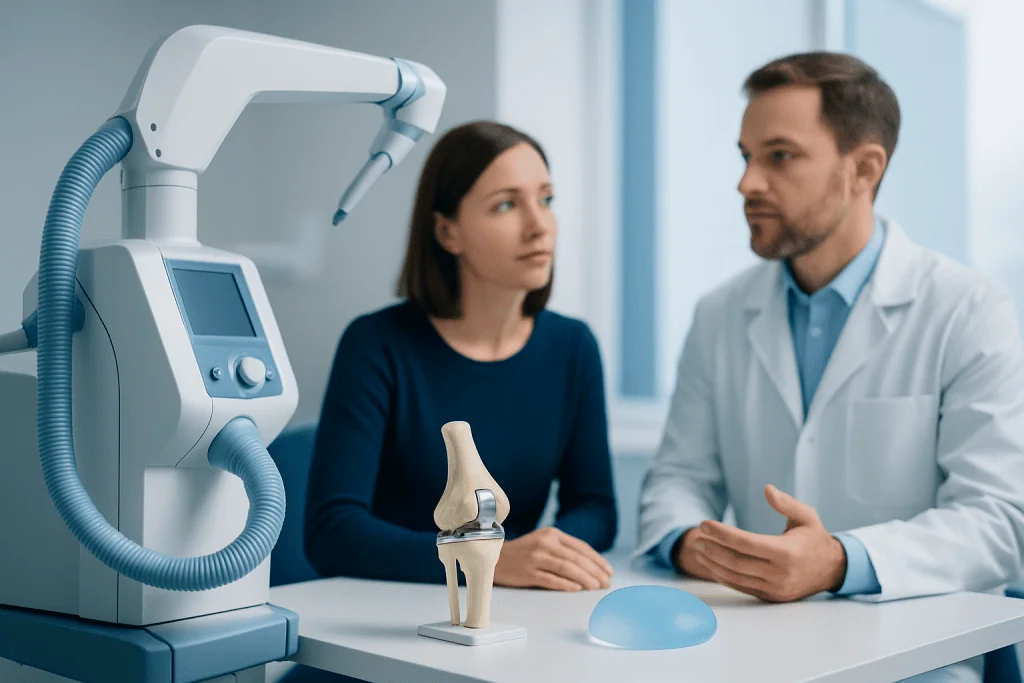
Start with the most practical question: is the device included in the quote, or listed separately? Some hospitals give one total package price; others separate professional fees, hospital stay, and device costs into their own lines. Neither approach is wrong, but you cannot compare the two fairly until you know which one you are looking at.
Next, ask what the price is actually based on. A quote may be tied to a specific brand and model, to a general category (“a standard intraocular lens”, “a titanium dental implant”), or to nothing yet, pending assessment. Each is legitimate, but they carry different levels of certainty, and you should know which level you have.
It also helps to ask whether clinically acceptable alternatives exist that would change the price. You are not asking your doctor to choose on cost alone. You are asking to understand your options: if more than one suitable device could be used, what would lead the team to choose one over another, and would that change the bill?
Useful questions include:
- What device is currently planned for my treatment?
- Is the quote based on a named brand, a model, or a category?
- How many units does the quote assume?
- Could the number, size or type change during evaluation or during the operation?
- If it changes, how will I be informed, and how will the difference be billed?
- Are consumables, accessories, attachments and fixation materials included?
These questions matter most when you are comparing hospitals in Turkey. Two quotes may differ not because one hospital is simply “more expensive”, but because one includes a higher-specification device, more supporting materials, or more realistic assumptions about what your case will need.
How to read a quote without missing hidden differences

When a quote arrives, look past the total. A useful quote helps you see what is included and what may still move. If a device is part of your care, ask for a written breakdown, or at minimum a written list of inclusions. You do not need every technical specification: you need enough detail to put two quotes side by side and know you are comparing the same thing.
Watch for wording such as “starting from”, “estimated”, “subject to doctor assessment”, or “device excluded”. None of these phrases means a quote is unreliable. They mean the plan is not yet fixed, which is often the honest position before a full medical review. The problem is not provisional wording; the problem is not knowing which lines are provisional.
Ask specifically whether the following are included:
- The implant, prosthesis, or device itself
- Additional pieces: attachments, liners, leads, screws, cages, or fixation materials
- Pre-operative planning, sizing, or device-specific imaging
- Intraoperative consumables related to the device
- Replacement or extra units if clinically needed
- Post-operative checks or imaging to confirm placement
If a quote is explained to you verbally or through an interpreter, ask for the written version as well. A document you can read at your own pace, and show to someone you trust, is worth more than the clearest verbal explanation, especially when you are reading financial paperwork in a second language.
What can make the device cost change later
Even with a careful quote, some things are only known after full assessment. Imaging may show a different size is needed. More than one unit may be required. Your anatomy may call for a different approach than first expected. In orthopaedic and spinal surgery, the amount of hardware can vary once the surgeon sees the detailed scans. In ophthalmology, the lens option depends on precise eye measurements. In cardiac care, the final device plan may depend on findings during evaluation. Sometimes the assessment itself expands: our guide on unexpected tests and how they affect timing and cost explains why.
A good question to put to the care team is: what are the most common reasons my final cost could increase or decrease? This gives you a realistic range of scenarios without asking anyone to guarantee a figure before they have enough medical information, which no responsible team will do.
Ask about non-medical reasons for change too. These include currency timing, updated supplier pricing, insurance approval limits, and changes to your treatment schedule. It is sensible to ask how long the quote remains valid and whether a deposit fixes any part of the plan.
Dental implants: a common example of device-driven pricing
Dental treatment shows the pattern clearly, because a single treatment name covers several device plans. A dental implant is the fixture placed in the jawbone; the visible tooth is a separate prosthetic component. Implant prosthetics range from a single crown on one implant, to a bridge supported by several implants, to a full-arch fixed prosthesis, to a removable denture that clips onto implants. Each option involves a different number of fixtures and different prosthetic parts, so each produces a different quote, even when patients describe the treatment with the same words.
Anatomy changes the plan as well. Patients with limited bone volume may be assessed for mini implants, which use narrower fixtures, or for zygomatic implants, which anchor in the cheekbone when the upper jaw cannot support standard fixtures. These are clinical decisions, not upgrades to be chosen from a menu, but they illustrate why a dental quote often firms up only after imaging.
On technology: the most visible recent developments are in planning and manufacturing rather than in a single “newest implant”. Digital workflows: 3D imaging, computer-guided surgical planning, and CAD/CAM-milled prosthetic components, are now widely used, and material options such as zirconia sit alongside titanium for some indications. Whether any of these suit your case is a clinical judgement based on your scans and oral health, and each carries its own cost structure, which is exactly why the questions in this guide apply.
How to compare quotes from different hospitals fairly
Comparison only works when you compare like for like. If one quote includes the device, hospital stay, tests and follow-up, while another covers only the procedure fee, the lower quote may not be cheaper in the end. Build a simple checklist and set each item side by side. Our guide on comparing surgery packages beyond the headline price walks through this method in detail.
Compare the process as well as the price. Ask who reviews your records, whether a multidisciplinary team may be involved, and how changes to the plan are communicated to you. In complex care, coordination has real value: when more than one specialty touches a device decision, a clear communication chain reduces the chance of a surprise on the bill.
When comparing options, focus on:
- Is the same type or category of device being quoted?
- Are the same tests and follow-up visits included?
- Is the same expected length of stay assumed?
- Are interpreter services or care coordination included?
- What happens financially if the device plan changes?
A more complete quote can be easier to budget for than a lower estimate surrounded by undefined extras. The first number you see is rarely the number that matters.
Practical planning if you are travelling for treatment in Turkey
If you are coming to Turkey for treatment, try to settle device-related questions before booking flights. Ask for a written quote, its validity period, and a note of any items that still depend on in-person assessment. That information helps you decide whether to arrange a financial buffer, flexible travel dates, or additional nights in your treatment city.
Complete records make estimates more accurate. Recent scans, specialist reports, previous operation notes, your medication list, and implant cards for any device you already have all directly affect whether the plan, and the price, stays as first estimated. Existing devices also raise travel questions of their own; see what to prepare before flying to Turkey with medical devices or implants. And if your treatment adds a new implant or prosthesis, it is worth reading about flying home with medical implants or prostheses after treatment before you fix your return date.
Questions to settle before you say yes
Before approving treatment, get the final practical points in writing: what is confirmed, what is provisional, and who answers questions if something is unclear. If the quote was explained verbally or translated on the spot, ask for a written English version so you can review it calmly, at your own pace.
It is reasonable to ask whether a financial consent process exists for the situation where a more expensive device becomes necessary. In urgent or intraoperative situations, the medical team will always prioritise safety over paperwork, but most hospitals can explain in advance how such decisions are usually handled, when you or your companion would be informed, and how any additional charge is documented afterwards. Knowing the process beforehand is what makes it manageable.
Your goal is not to control clinical decisions. It is to understand the financial framework around them, so you can plan responsibly. One clear conversation now saves considerable stress later, especially when treatment involves specialised implants, prostheses, and devices.
Step by step
- Send complete records early. Share recent scans, reports, previous operation notes and your medication list as early as possible. The more complete the medical review, the more realistic the estimate for any implant, prosthesis, or device.
- Ask whether the device is included. Do not assume the quote covers the implant or device unless it says so clearly. Ask whether it is part of the package, billed separately, or pending final assessment.
- Confirm the planned type and possible alternatives. Ask what device is currently expected and whether clinically suitable alternatives exist. If they do, ask what would change the choice and whether that would change the price.
- Request a written list of inclusions and exclusions. A short written list prevents most misunderstandings. Ask which items are confirmed, which are estimated, and what extra costs could appear if the plan changes.
- Check how changes are approved and billed. Ask what happens if the device size, quantity or model must change after evaluation or during treatment, and how the hospital documents additional charges.
- Compare quotes side by side. Use the same checklist for every hospital: device details, hospital stay, tests, follow-up and support services, not just the headline total.
- Plan a financial buffer. Some variables cannot be confirmed in advance. A modest buffer makes the trip and the recovery period less stressful.
Your checklist
- Written quote received in English
- Device or implant clearly marked as included or excluded
- Planned type or category of device explained
- Possible reasons for price change discussed
- Hospital stay, tests, and follow-up inclusions confirmed
- Quote validity period checked
- Payment timing and deposit requirements understood
- Medical records and prior imaging sent before travel
Key takeaways
- Implants, prostheses, and devices can be one of the largest parts of a treatment price.
- Always ask whether the device is included in the quote and whether the quote is final or estimated.
- Compare quotes by inclusions and assumptions, not by the lowest total.
- Device costs can change after imaging review or full medical assessment, ask which scenarios are most likely.
- Written clarification of what is fixed and what is provisional is the foundation of a realistic budget.
Frequently asked questions
What are the four main types of prosthetic devices?
External limb prostheses are traditionally grouped by the level of limb loss: transradial (below the elbow), transhumeral (above the elbow), transtibial (below the knee), and transfemoral (above the knee). Each type uses different components, socket, joints and terminal device, which is why prosthetic quotes are itemised rather than given as a single flat figure.
What are examples of implanted devices?
Common examples include hip and knee joint implants, spinal hardware, dental implants, pacemakers, coronary stents, intraocular lenses, cochlear implants, surgical mesh, and the plates and screws used in fracture repair. Each category has its own range of manufacturers, materials and sizes, so each affects a treatment quote differently.
What are the different types of implant prosthetics in dentistry?
The implant is the fixture in the jawbone; the prosthetic part on top varies. Options include a single crown on one implant, a bridge supported by several implants, a full-arch fixed prosthesis, and a removable denture retained by implants. The number of fixtures and the prosthetic design differ between these, which is why quotes for treatments with similar names can vary widely.
What is the newest technology for dental implants?
Recent developments are mostly in planning and manufacturing: 3D imaging, computer-guided surgical planning, and CAD/CAM-designed prosthetic components, alongside material options such as zirconia in addition to titanium. Whether any of these suit a particular case is a clinical decision based on imaging and oral health, and each option has its own cost structure.
Can my final bill change after I arrive in Turkey?
Yes, it can, particularly if the exact device, size, quantity or approach is confirmed only after in-person evaluation or additional imaging. Ask in advance which parts of the quote are fixed and which may change, so you can plan with a realistic buffer rather than a single figure.
Should I ask for the brand or model of the implant or device?
Yes, where it is available at the quote stage. You do not need every technical detail, but knowing whether the price is tied to a specific device, a general category, or nothing yet tells you how firm the quote really is and makes comparison between hospitals meaningful.
Is a lower quote always the better option?
Not necessarily. A lower quote may exclude the device, rest on different assumptions about your treatment plan, or leave significant costs undefined. Compare what is actually included, what is assumed, and how each hospital handles changes before judging which offer is genuinely lower.
What if the doctor needs a different device during treatment?
In urgent or intraoperative situations, the medical team prioritises safety. Hospitals differ in how they document and bill such changes, so ask before treatment how these decisions are usually recorded, when you or your companion would be informed, and how any additional charge would be presented afterwards.
Add us as a Preferred Source to see more of our trusted health content across Google Search, AI Overviews and Discover.

Update history
- PublishedJuly 8, 2026
- Medical review approvedSeptember 13, 2026
- Last content updateSeptember 12, 2026
References2
- Artificial Limbs: MedlinePlus medlineplus.gov
- Dental Implants: MedlinePlus Medical Encyclopedia medlineplus.gov
More Patient Guides

Private MRI, CT and Check-Up Costs in Turkey: How Scans Are Priced
How private MRI, CT, PET-CT and full check-up packages are priced in Turkey, modality, region, contrast, reporting, and what a…

Cataract Surgery Cost in Turkey: Per-Eye Prices and Lens Options
Cataract surgery in Turkey is priced per eye and the lens decides the quote. Biometry, both eyes on one trip, and what…

Lip Filler Cost in Turkey: Per-ml Prices Explained
Lip filler in Turkey is priced per millilitre with licensed hyaluronic acid brands and physician injectors. Volume, product, dissolving, safety and what…

Botox Cost in Turkey: Per-Area and Per-Unit Prices
How Botox is priced in Turkey, per area or per unit, brand, physician injectors, medical indications, and what a serious…