

LASIK Recovery: Day by Day
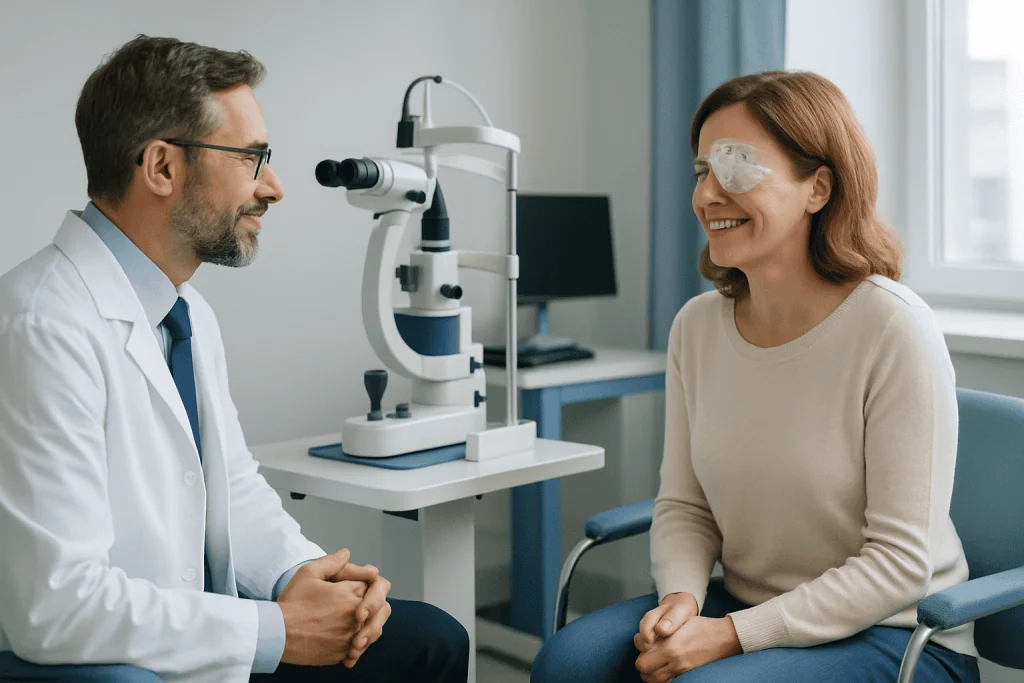
LASIK is an outpatient laser procedure under local anaesthetic that takes about 10 to 30 minutes, with no overnight stay. Most people walk, eat and drink normally the same day, wash carefully within a day or two, and resume most activities within 1 to 7 days. The earliest flight home is usually within the first week after a follow-up check. Vision typically stabilises over 2 to 4 weeks.
Key Takeaways
- LASIK is an outpatient procedure under local anaesthetic, usually taking 10 to 30 minutes, with no overnight stay.
- Mild burning, watering, light sensitivity or blur are common in the first hours and usually ease quickly.
- Use prescribed eye drops exactly as directed and never rub your eyes while the flap settles.
- Most activities resume within 1 to 7 days; vision typically stabilises over 2 to 4 weeks.
- The earliest flight home is usually within the first week, after a follow-up check and fitness-to-fly clearance.
- Sudden vision loss, severe pain, spreading redness or discharge need immediate contact with your care team.
What recovery from LASIK actually involves
LASIK is a laser vision correction procedure that reshapes the cornea so that light focuses accurately on the retina, reducing dependence on glasses or contact lenses for nearsightedness, farsightedness or astigmatism. A thin corneal flap is created, an excimer laser removes microscopic amounts of tissue underneath, and the flap is repositioned without stitches. The procedure is done under local anaesthesia, usually takes 10 to 30 minutes, and is an outpatient treatment with no overnight stay. You can read how the treatment itself is planned and performed on the LASIK procedure page.
Recovery is short compared with most surgery, but it follows a pattern. In the first hours, mild burning, watering, light sensitivity or blurred vision are common. Vision often improves within a day or two, most everyday activities are usually possible within 1 to 7 days, and vision typically stabilises over 2 to 4 weeks. The two rules that matter most throughout are simple: use the prescribed eye drops exactly as directed, and do not rub your eyes. Your surgeon’s instructions always take precedence over any general timeline.
Recovery timeline
The day of the procedure
- Pain and comfort: The eye is numbed with drops, so the procedure itself is usually not painful. Afterwards, mild burning, a gritty feeling, watering and light sensitivity are common for the first hours. Prescribed drops and keeping the eyes closed and rested are the main controls. Ask your team before taking any painkiller.
- Moving and lifting: You can walk normally. Because vision is blurred and the eyes are light sensitive, you should have someone accompany you from the hospital.
- Wound and stitches: There are no stitches and no dressing in the usual sense. The corneal flap is repositioned and left to settle. Your team will tell you if any protective eye cover is to be worn and for how long.
- Eating and drinking: Local anaesthesia does not affect eating. You can eat and drink normally once you feel ready.
- Washing: Avoid getting water, soap, makeup, lotions or perfume near the eyes on the day of the procedure.
- Sleeping: Rest with your eyes closed as much as you can. Sleep on your back or as advised so that nothing presses on the eyes.
- Driving: Do not drive on the day of the procedure.
- Work: Take the day off.
The first 24 hours
- Pain and comfort: Burning and watering usually ease within the first hours. Light sensitivity may persist; sunglasses help outdoors and in bright rooms. Continue drops exactly as prescribed.
- Moving and lifting: Normal walking is fine. Avoid bending with your head low, straining or anything that might lead to a knock to the face.
- Wound: No stitches to care for. Do not touch or rub the eyes, even if they feel itchy or gritty.
- Eating and drinking: Normal diet.
- Washing and showering: Most people can shower with care, keeping face and eyes away from the direct stream and using no soap or shampoo near the eyes. Confirm the exact timing with your team.
- Sleeping: Avoid sleeping face down. Use any protective cover your team gave you if advised.
- Driving: Not yet. Vision is usually still settling and your first follow-up visit has not happened.
- Screens and reading: Short periods are usually acceptable if comfortable, but frequent rests reduce dryness and strain.
Days 2 to 3
- Pain and comfort: Discomfort is typically minimal by now. Dryness and fluctuating clarity are common and are managed with the prescribed drops. Vision often improves noticeably within a day or two of the procedure.
- Moving and lifting: Light daily activity and gentle walking are usually fine. Avoid heavy lifting, contact sports and anything dusty or smoky.
- Wound: The flap is still settling. Continue to avoid rubbing. No stitches, so nothing needs removing.
- Eating and drinking: Normal.
- Washing: Showering with eyes closed and water kept off the face is usually acceptable. Avoid eye makeup, swimming pools, saunas and hot tubs.
- Driving: Many people are told at their first follow-up whether vision is good enough to drive. Do not drive until your surgeon confirms it.
- Work: Desk work is often possible within this window if vision is comfortable and your surgeon agrees. Jobs involving dust, chemicals or physical risk to the eyes usually wait longer.
Days 4 to 7
- Pain and comfort: Most people have little or no discomfort. Dryness may continue and drops remain important.
- Moving and lifting: Everyday activity is usually back to normal. Light exercise such as walking or a stationary bike is often permitted; ask before returning to gym work.
- Wound: Still no rubbing. Avoid situations where something could strike the eye.
- Washing: Normal showering is usually fine with eyes closed. Eye makeup is usually still off limits until your team clears it.
- Sleeping: Any protective cover is usually stopped within this period if your surgeon agrees.
- Driving: Usually possible once your surgeon has confirmed adequate vision at follow-up, and only if you feel comfortable, especially at night.
- Work and sport: Most activities resume within 1 to 7 days. Swimming, contact sports and water sports usually wait longer.
Weeks 2 to 4
- Pain and comfort: Discomfort is typically absent. Some dryness or mild fluctuation in clarity can persist as vision stabilises over 2 to 4 weeks. Drops may be tapered as directed.
- Activity and sport: Most exercise is usually resumed. Swimming and contact sports are usually cleared later in this window or beyond, depending on your surgeon.
- Wound: The flap continues to strengthen. Rubbing the eyes should still be avoided.
- Washing: Normal, with eye makeup only once approved.
- Driving and work: Usually fully resumed, including night driving if glare and halos are not a problem.
- Follow-up: A check in this period is important to monitor healing and visual recovery.
Months 2 to 3
- Comfort: Dryness has usually settled or is manageable with lubricating drops if your team recommends them.
- Activity and sport: Full activity, including contact and water sports, is usually permitted if your surgeon has confirmed the eye has healed.
- Vision: Vision has typically stabilised by now. If you notice any change, arrange a review rather than assuming it will settle.
- Follow-up: Remote follow-up continues as arranged with your operating team.
When it is safe to fly home
Because LASIK is an outpatient procedure under local anaesthesia, the earliest window for flying home is usually within the first week, after a follow-up examination has confirmed that the corneal flap is in place and healing is on track. Some surgeons prefer a slightly longer stay so that a second check can be done in person. The operating team gives the final clearance; do not book a fixed return date before discussing it.
Flying matters for several reasons. Cabin air is very dry, which can worsen the dryness and gritty sensation common after LASIK. Pressure changes are not usually a concern for the cornea itself, but any pressure or rubbing of the eyes during a long flight must still be avoided. On long-haul routes, sitting still for many hours raises the general risk of blood clots in the legs, which applies to anyone recently treated.
A fitness-to-fly assessment before the return flight is part of the discharge process. For LASIK it typically covers the healing of the flap, the level of vision, any dryness or light sensitivity, your drop schedule for the journey, and general fitness for travel. Choose a seat where you can stand and walk the aisle every hour or two, keep your legs moving, and drink water regularly. In hand luggage carry all prescribed eye drops, a written drop schedule, sunglasses, any protective eye cover you were given, your discharge summary, and the contact details of your operating team in case of a problem at your destination.
Warning signs, when to contact your care team immediately
- Sudden or worsening loss of vision, or vision that becomes blurred again after having improved
- Severe or increasing eye pain, or pain that is not controlled by the measures your team advised
- Increasing redness of the eye, or redness spreading across the white of the eye
- Discharge from the eye, sticky eyelids, or increasing swelling of the lids
- Burning, watering or light sensitivity that worsens or persists well beyond the first hours
- You rubbed, knocked or poked the eye, or feel that something has shifted in it
- Fever
- Calf pain, swelling or warmth in one leg
- Breathlessness or chest pain
Recovering in Türkiye and then at home
Since there is no overnight stay, you will recover in accommodation rather than a ward, so choose somewhere close to the hospital that allows you to reach follow-up visits easily without driving. Plan for someone to accompany you on the day of the procedure. At Acibadem, the procedure is performed within the Ophthalmology departments of the group’s İstanbul hospitals, and the international patient team coordinates your prior reports and imaging, arranges appointments and organises the hospital visit and the follow-up after you return home. Interpreters can be arranged if you need one.
Before you leave, a follow-up appointment with the operating team confirms healing and forms the basis of your fitness-to-fly clearance. Once home, follow-up is done remotely with the operating team, so agree in advance how and when you will be in contact and what you should report. Take home your discharge summary, the results of your pre-operative eye examination including corneal thickness and refraction, a list of your eye drops with the tapering schedule, and written instructions on activity restrictions. Your local optometrist or eye doctor will need these records for future care.
Questions to ask your surgeon before you fly out
- How many days do you want me to stay in İstanbul before flying, and what will you check before clearing me?
- Exactly how long should I use each eye drop, and how should I taper them?
- When can I drive, return to my type of work, exercise, swim and wear eye makeup?
- Do I need a protective eye cover at night, and for how long?
- What symptoms should make me seek urgent care where I live, and whom do I contact first?
- How will remote follow-up work, and what should I send you from home?
- When should I stop wearing contact lenses before surgery, and can I wear them again afterwards?
- Which records should I take home for my local eye doctor?
Add us as a Preferred Source to see more of our trusted health content across Google Search, AI Overviews and Discover.

Update history
- PublishedSeptember 9, 2026
- Medical review approvedSeptember 10, 2026
- Last content updateSeptember 9, 2026
More Patient Guides

Septoplasty Recovery: Week by Week
Learn what to expect after deviated septum surgery: a week-by-week septoplasty recovery timeline, when it is usually safe to fly home, and…

Gallbladder Surgery Recovery: Week by Week
Learn what to expect after gallbladder surgery: a week-by-week recovery timeline, pain, diet, wound care, when it is safe to fly home…
Robotic Hysterectomy Recovery: Week by Week
Recovery from robotic hysterectomy week by week: pain, lifting, wounds, driving, flying home safely, warning signs and questions to ask before you…

Breast Reconstruction Recovery: Week by Week
DIEP flap recovery week by week: hospital stay, drains, pain, walking, showering, driving, when it is usually safe to fly home, and…