

Why Your Glasses Quote May Cost More Than Expected in Turkey

A first glasses quote often assumes basic single-vision lenses, a standard frame range and no coatings. Once your actual prescription, lens material, coatings, measurements and fitting services are confirmed, the total can rise. The way to protect yourself is an itemised written quote that names the frame, lens design, lens index, each coating and every service item, so you compare like with like.
You were given one figure for glasses in Turkey, and the number in front of you now is higher. In most cases, nothing underhand has happened. The first figure described a simpler product than the one you actually need. This guide explains where the difference usually comes from, what a proper quote should list, and which questions settle the matter before you pay.
It applies whether you are buying from an optical retailer in Istanbul, an eye clinic, or a hospital-based service where testing and eyewear sit inside a wider care plan. The mechanics of the quote are the same in each setting; only the packaging differs.
At a glance
- Best for: International patients comparing glasses quotes before or during a trip to Turkey
- Main cost drivers: Lens design, prescription strength, lens material and index, coatings, frame compatibility, testing, fitting and remake terms
- What to request: A written, itemised quote naming the frame, lens design, lens index, each coating, service items and production time
- Common surprise: The first number often covers only basic single-vision lenses and may exclude examination, measurements and fitting
- Useful to bring: Your current prescription, your existing glasses, your pupillary distance if you know it, and any previous eye reports
Why your glasses quote may cost more than expected in Turkey
A glasses quote usually starts from a base configuration: standard single-vision lenses, a mid-range frame, no optional coatings. That base configuration is legitimate, but it describes the simplest possible pair. If your glasses quote costs more than expected in Turkey, the gap between that base configuration and your actual needs is almost always the reason.
Three things widen the gap. First, your prescription. A stronger prescription, astigmatism, or a significant difference between the two eyes can make thinner high-index lenses or a more customised design sensible, and those cost more than standard materials. Second, your lens type. Progressive and bifocal designs are more complex to manufacture than single-vision lenses, and progressive designs come in tiers of sophistication. Third, the extras. Coatings, treatments and frame upgrades are often chosen after the first figure has been given, which is precisely why the second figure looks different.
There is also a definitional problem. Providers in Turkey, as anywhere, do not all mean the same thing by a “quote”. One optical shop may fold the eye test, measurements, fitting and later adjustments into its price. Another may quote the frame and lenses alone and add services afterwards. The first can look more expensive while the final amounts end up similar, or reversed. This is the same pattern that affects medical quotes generally, and the guide on why a medical quote can be higher than expected covers the broader version of it.
One more distinction matters if eyewear is part of a wider hospital visit. In a hospital setting such as Acibadem, a quote may reflect a structured pathway: specialist review, diagnostic testing, coordination and interpreter support, and then the glasses themselves. That structure can be genuinely useful, but it is a different product from a retail transaction, and it should still be set out in writing so you can see which line is clinical, which is service, and which is the eyewear.
The biggest factors that change the final price

Lens design and prescription
Lenses are usually the single biggest reason a quote rises. Single-vision lenses correct one focal distance and are the simplest to make. Bifocals add a second zone. Progressive lenses provide a graded transition between distance and near vision, and their designs range from standard to individually customised, with prices to match. Occupational lenses, designed for desk and screen work, sit in their own category again.
Prescription strength interacts with all of this. Higher prescriptions in standard material produce thicker, heavier lenses. High-index materials keep the same correction in a thinner, lighter lens, which many people find more comfortable and better-looking, at a higher price. If your prescription includes meaningful astigmatism or differs substantially between the two eyes, the recommendation becomes more individual and less likely to match a base-price assumption.
Coatings and treatments
Coatings are the quiet multiplier in most eyewear quotes. Anti-reflective coating, scratch resistance, UV protection, blue-light filtering, photochromic darkening and polarisation can each carry a charge. Some providers bundle two or three together as standard; others list every one separately. A quote can look modest until these are selected, and two quotes can only be compared once you know which coatings each one actually includes.
Frames and compatibility
Frames vary more than most buyers expect: material, hinge quality, weight, brand and design all move the price. Compatibility matters as much as taste. Very thin, rimless or semi-rimless frames do not suit every prescription, because thicker or heavier lenses need adequate support. A provider may steer you towards a different frame for durability or lens-thickness reasons, and that advice can shift the total in either direction.
- Lens design: single vision, bifocal, progressive, occupational
- Lens material: standard, polycarbonate, trivex, high-index
- Coatings: anti-reflective, scratch-resistant, UV, blue-light, photochromic, polarised
- Frame choice: brand, material, weight, fit, compatibility with your lens type
- Service items: eye examination, measurements, fitting, adjustments, remake terms
What may be included in Turkey and what may be extra
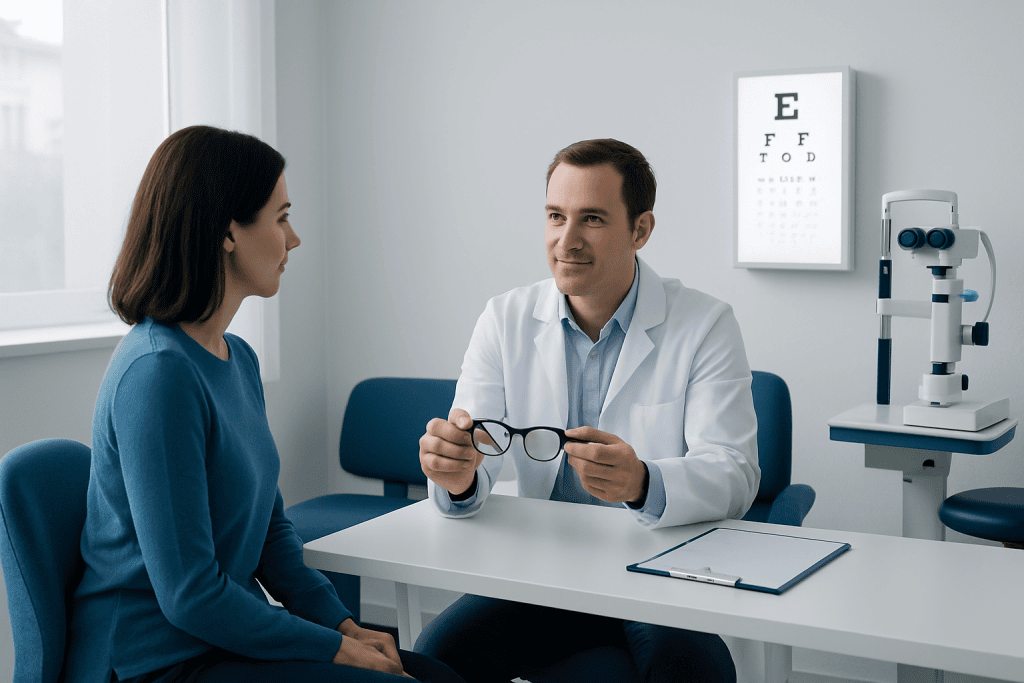
Eyewear quotes in Turkey can come from three kinds of provider: optical retailers, eye clinics, and hospital-based services. Each packages testing differently. Some include a basic refraction test in the price of the glasses. Others recommend a full ophthalmology consultation first, particularly when a prescription is old or vision has changed, and bill it as a separate clinical item. Neither approach is wrong; they are simply different scopes, and the quote should say which one you are getting.
Measurements are the part most often assumed and least often confirmed. Accurate pupillary distance, fitting height for progressive lenses, and frame alignment on your face are essential for comfortable, clear vision. Poor measurements are a common reason a technically correct prescription still feels wrong. These steps may be included in the price, or they may not, and a brief or verbal quote rarely says. Ask directly whether measurements, initial fitting and follow-up adjustments are covered.
Then there are the service items that surround the glasses without being part of them. Interpreter support, appointment coordination and help with timing across a short stay are practical matters that a hospital’s international patient team can arrange. At Acibadem, that coordination exists to keep testing, ordering and collection workable within one visit. It is worth knowing about, but it belongs on its own line in your thinking: separate the clinical charges, the service support and the eyewear itself, and each becomes easy to compare. The pattern of items that sit outside a headline figure is covered in more depth in the guide to common extra costs not shown in medical quotes.
How to compare quotes without missing hidden differences
The single most useful request is itemisation. A complete written quote names the frame, the lens design, the lens material or index, each coating individually, any testing fees, and whether fitting and later adjustments are included. Without that level of detail, two quotes may describe two quite different products, and the cheaper-looking one may simply be the emptier one. The broader technique is the same for any treatment quote, and the guide on comparing treatment quotes from Turkey without missing hidden costs walks through it line by line.
Ask whether the quote rests on your confirmed prescription or on an estimate. If the provider has not examined you, the final lens recommendation may change after testing. That is normal, not a warning sign, but it means the first number is provisional and should be treated as such. How providers move from a preliminary estimate to a confirmed figure is explained in how final cost quotes are calculated in Turkey.
Pay close attention to remake and exchange terms. Progressive lenses take adaptation, and not everyone adapts to the first design tried. If the glasses feel uncomfortable, or the prescription needs refining, the policy determines whether the correction is covered or charged again. Some providers offer one remake within a defined window under stated conditions; others charge for any lens change. This matters more for a traveller than for a local buyer, because you may be home before a problem becomes obvious. A very low headline price with restrictive remake terms can be a poor bargain, a pattern examined in when a low treatment quote in Turkey may cost more later.
Questions worth asking before you agree
Direct questions get direct answers. Ask whether the quote covers the exact frame and the exact lenses recommended for you, or a basic version of each. Ask for every coating to be listed by name. Ask whether the eye examination is included or billed separately, and whether measurements, fitting and adjustments are part of the price.
If progressive lenses are recommended, ask which design category is being quoted and what adaptation support is offered. If your prescription is strong, ask whether thinner high-index lenses are being proposed and what the practical benefit is in your case. If your travel window is short, ask how long manufacturing takes, whether an express option exists, and what happens if the glasses are not ready before you leave Turkey.
In a larger system, you can also ask a patient coordinator to set out the sequence of appointments and charges before anything begins. That overview is most valuable when diagnostics and eyewear are being combined, because it stops you making a purchasing decision in the corridor between two consultations.
- What exactly does this quote include, item by item?
- Is it based on my confirmed prescription or an estimate?
- Which coatings are included, and which are optional extras?
- Are measurements, fitting and adjustments included?
- What is the remake or exchange policy, and what conditions apply?
- How long will production take, and is there an express option?
Planning your budget and travel timing calmly
Before you travel, share your current prescription with the provider, along with a photo of your existing glasses if asked for one. If you know your pupillary distance or your previous lens type, include that too. The more complete the information a provider has, the more realistic the preliminary estimate, and the less likely you are to find that your glasses quote costs more than expected in Turkey once testing is done.
Build flexibility into your budget rather than anchoring on the first figure. If examination shows your prescription has changed, the recommended lenses may differ from what you planned for. The goal is not to secure the cheapest line on paper but to understand the reasoning behind each recommendation and decide which upgrades genuinely serve your daily use, comfort and durability, and which you can decline.
Timing deserves the same discipline. Lenses take time to manufacture, custom designs take longer, and a remake takes longer still. Order early in your stay rather than on the last day, and confirm the collection date against your return flight before you commit. Finally, do not pay in full until the written quote and timeline are clear to you. Confirm accepted payment methods, any deposit, the refund terms, and whether itemised receipts and documentation can be provided if you intend to seek insurance reimbursement. Asking for a quote itself normally carries no obligation, a point covered in do medical quotes cost money in Turkey.
Step by step
- Share your current prescription and needs. Send your latest prescription if you have one, and describe how you use your glasses: work, reading, driving, screens. Mention anything uncomfortable about your current pair, because that changes the lens recommendation and therefore the quote.
- Ask for an itemised written quote. Request a quote that separates the frame, lenses, coatings, tests and fitting services onto their own lines. This is the only reliable way to see why one quote is higher than another and to avoid comparing incomplete numbers.
- Confirm whether an eye examination is needed. If your prescription is old or your vision has changed, a fresh examination may be recommended before lenses are ordered. Ask whether it is included in the quote or billed separately, especially when you are fitting several appointments into a short stay.
- Review the lens recommendation carefully. Ask why a particular material, design or coating is being suggested for you. If a thinner or progressive lens raises the cost, you should understand the practical benefit before you decide, and you are entitled to decline an upgrade.
- Check timing and follow-up terms. Confirm the production time against your return travel, and ask what happens if you need an adjustment, a remake or remote support after you leave Turkey. Get the remake conditions in writing.
- Clarify payment and receipts. Before paying, confirm the deposit, the timing of the final balance, and the accepted payment methods. If you may claim reimbursement, ask for detailed receipts and the final prescription at the time of payment, not afterwards.
Your checklist
- Bring your current prescription and previous eye reports if available
- Carry your existing glasses and sunglasses to show what works for you
- Ask for the frame name, lens design and lens material or index in writing
- Confirm which coatings are included and which are optional
- Check whether the quote covers testing, measurements and fitting
- Ask about production time before booking your return travel
- Review remake, adjustment and exchange terms before paying
- Keep copies of receipts and the final prescription
Key takeaways
- A low starting quote often describes basic single-vision lenses with limited services, not the pair you will actually be recommended.
- Lens design, prescription strength, lens material, coatings and frame compatibility are the usual reasons a total rises.
- An itemised written quote is the only fair basis for comparing providers.
- Confirm testing, measurements, fitting, production time and remake terms before paying anything.
- Treat any pre-examination figure as provisional, and separate clinical charges, service support and the eyewear itself when you compare.
Frequently asked questions
Why is my glasses quote in Turkey higher than the first estimate?
The first estimate was probably based on basic single-vision lenses and a standard frame range. Once your prescription, measurements and lens needs are confirmed, the quote can rise because of high-index materials, a progressive design, coatings, or testing and fitting services that were not in the base figure.
Are eye examinations usually included in a glasses quote?
Not always. Some providers include a basic refraction test in the eyewear price, while others bill a full ophthalmology consultation or additional diagnostic tests separately. Ask for this to be stated in writing before your appointment so the scope of the quote is clear.
What are the most common extras that increase the price?
Anti-reflective coating, blue-light filtering, photochromic treatment, thinner high-index lenses and progressive lens designs are the most common. Frame upgrades and additional fitting or adjustment services can also raise the total.
Can I compare quotes from different clinics or optical shops fairly?
Yes, provided each quote is itemised the same way. Ask every provider to name the exact frame, lens material, lens design, coatings and service items. Only then are you comparing like with like rather than two top-line numbers describing different products.
What if I am only in Istanbul or Turkey for a short trip?
Tell the provider your travel dates before you commit. Ask about manufacturing time, whether express options exist, and what support is available if adjustments or a remake are needed after you return home. Ordering early in your stay leaves room for corrections.
Why do progressive lenses raise a quote so much?
Progressive lenses are more complex to design and manufacture than single-vision lenses, and they come in tiers from standard to individually customised. Accurate fitting-height measurement and adaptation support add service work too, so both the product and the process cost more.
Should I simply choose the cheapest quote?
Not automatically. The better question is whether the quote matches your confirmed prescription, your daily needs and reasonable remake terms. A cheaper quote may exclude coatings, testing or services that become important once the glasses are made, which can cost more overall.
Add us as a Preferred Source to see more of our trusted health content across Google Search, AI Overviews and Discover.

Update history
- PublishedJuly 8, 2026
- Medical review approvedSeptember 13, 2026
- Last content updateSeptember 12, 2026
References2
- MedlinePlus: Eye Wear medlineplus.gov
- MedlinePlus: Refractive Errors medlineplus.gov
More Patient Guides

Private MRI, CT and Check-Up Costs in Turkey: How Scans Are Priced
How private MRI, CT, PET-CT and full check-up packages are priced in Turkey, modality, region, contrast, reporting, and what a…

Cataract Surgery Cost in Turkey: Per-Eye Prices and Lens Options
Cataract surgery in Turkey is priced per eye and the lens decides the quote. Biometry, both eyes on one trip, and what…

Lip Filler Cost in Turkey: Per-ml Prices Explained
Lip filler in Turkey is priced per millilitre with licensed hyaluronic acid brands and physician injectors. Volume, product, dissolving, safety and what…

Botox Cost in Turkey: Per-Area and Per-Unit Prices
How Botox is priced in Turkey, per area or per unit, brand, physician injectors, medical indications, and what a serious…