Kt Tape Shoulder: An Evidence-Based Guide for Patients

KT tape on the shoulder may reduce discomfort for some patients, but evidence shows mixed and usually modest benefits. It does not repair a torn tendon, dislocation, fracture, or other structural shoulder problem.
Key Takeaways
- KT tape on the shoulder may reduce discomfort for some patients, but evidence shows mixed and usually modest benefits.
- It does not repair a torn tendon, dislocation, fracture, or other structural shoulder problem.
- Correct skin preparation and proper application matter for comfort and safety.
- Persistent, severe, or traumatic shoulder pain should be assessed by a qualified clinician.
- The most effective care plan often combines exercise therapy, load management, and treatment of the underlying cause.
KT tape shoulder support may provide mild pain relief, a sense of stability, and better movement awareness for some people with shoulder discomfort. It is not a cure for injury, and it works best as a short-term aid alongside an accurate diagnosis, activity modification, and a guided treatment plan.
Overview: What KT Tape on the Shoulder Can and Cannot Do
KT tape shoulder applications are commonly used by people with sports injuries, overuse pain, or minor strain around the shoulder. The tape is a stretchy cotton-based adhesive product designed to move with the skin. Some patients report that it makes the shoulder feel more supported, reminds them to avoid painful movements, or reduces discomfort during activity.
Current evidence suggests that kinesiology tape may offer short-term symptom relief for some people, especially when combined with exercise or rehabilitation. However, the overall effect is often small, and results vary from person to person. The tape is best understood as a supportive tool rather than a primary treatment.
Importantly, KT tape does not fix the underlying cause of pain. It cannot heal a torn rotator cuff tendon, reposition a dislocated shoulder, treat a fracture, or reverse significant inflammation on its own. If pain continues, interferes with daily life, or follows trauma, a medical evaluation is important to find the true source of the problem, which may include shoulder impingement syndrome or other shoulder conditions.
How KT Tape May Work
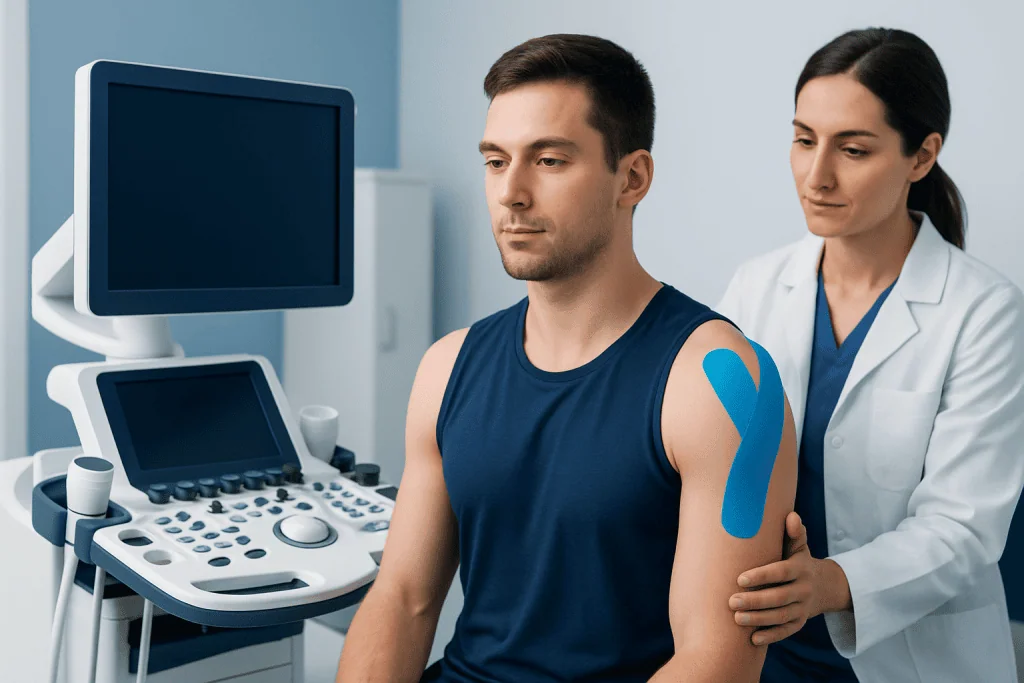
Researchers believe kinesiology tape may work through several mechanisms, although none are fully proven. One idea is that the tape stimulates skin receptors, which may change how the nervous system processes pain. Another is that it improves body awareness, helping a person move the shoulder in a more controlled way.
Some clinicians also use taping to encourage posture or guide shoulder blade movement. In this sense, the tape can act as a reminder rather than a brace. Unlike rigid athletic tape, kinesiology tape does not strongly immobilize the joint, so it is not suitable when true stabilization is required after a serious injury.
Because shoulder pain has many causes, taping results differ. A person with mild muscle strain may feel temporary relief, while someone with a substantial tendon tear may notice little change. This is why tape should be chosen based on symptoms, function, and diagnosis rather than used as a one-size-fits-all solution.
When It May Help and When It Usually Will Not

KT tape may be worth considering for mild to moderate shoulder discomfort related to overuse, sports activity, posture-related strain, or recovery exercises. It may also be used as part of rehabilitation for conditions involving the rotator cuff or shoulder blade muscles, provided a clinician has confirmed that taping is appropriate. In some cases, people with rotator cuff tear symptoms use tape for temporary comfort while awaiting assessment or continuing supervised therapy.
It is less likely to help when there is a major structural injury or a medical condition that needs specific treatment. Severe weakness, inability to lift the arm, visible deformity, suspected dislocation, fracture, infection, or nerve-related symptoms should not be managed with tape alone. Persistent nighttime pain or pain that worsens despite rest also deserves professional assessment.
KT tape should also not be used as a way to push through significant pain during sports or work. Masking symptoms can delay diagnosis and sometimes worsen an injury. If there is concern for tendon damage, frozen shoulder, arthritis, or instability, treatment should focus on the cause rather than the tape itself.
Common Shoulder Problems Linked to Taping
Shoulder pain often comes from the muscles, tendons, bursae, or the way the shoulder blade and upper arm move together. Common problems include rotator cuff irritation, tendon overload, bursitis, impingement-related pain, and strain around the upper back or neck. Because the shoulder is highly mobile, symptoms can come from more than one structure at the same time.
Some people use KT tape after exercise-related irritation, repetitive overhead activity, or return to sport. Others try it when they have discomfort reaching overhead, fastening a seatbelt, sleeping on one side, or lifting objects. Taping may feel supportive in these situations, but it should not replace assessment when pain keeps returning.
When doctors evaluate ongoing shoulder pain, they may recommend imaging or specialist care depending on the history and physical examination. In selected cases, treatment may involve physical therapy and rehabilitation to improve strength, flexibility, and shoulder mechanics. For more complex problems, orthopedic review may be needed.
How to Use KT Tape More Safely
Before applying tape, the skin should be clean and dry. Oils, lotions, and heavy body hair can reduce adhesion and increase skin irritation. The tape should never be placed over broken skin, active rash, sunburn, or areas of known adhesive allergy. If there is a history of very sensitive skin, patch testing on a small area may be helpful.
For shoulder use, the tape is often applied in strips over the front, side, or back of the shoulder depending on the intended goal. Exact taping patterns vary, and no single method works for everyone. Many patients benefit from learning the technique from a physiotherapist or clinician first, because poorly placed tape may be uncomfortable or simply ineffective.
General safety points include:
- Do not stretch the ends of the tape aggressively.
- Stop using it if itching, burning, blistering, or increasing redness develops.
- Remove it gently, ideally after bathing or using oil to loosen the adhesive.
- Do not rely on tape to continue an activity that clearly worsens pain.
If symptoms continue despite careful self-care, a clinician may suggest a fuller evaluation and, in selected cases, additional treatment options such as shoulder arthroscopy when a structural problem is confirmed.
Diagnosis: Why the Cause of Shoulder Pain Matters
Shoulder pain is a symptom, not a diagnosis. A proper evaluation usually begins with questions about when the pain started, whether there was an injury, which movements trigger it, and whether there is weakness, tingling, stiffness, or neck pain. The pattern of pain often helps narrow down the likely cause.
A physical examination checks range of motion, strength, tenderness, shoulder stability, and the movement of the shoulder blade. Doctors also assess whether pain might be coming from the neck, which can sometimes refer discomfort into the shoulder and arm. In this situation, taping the shoulder may not address the real problem.
Imaging is not always required, but X-rays, ultrasound, or MRI can be helpful when symptoms persist, follow trauma, or suggest tendon tear or joint damage. If surgery is being considered, accurate diagnosis is especially important. Some patients with persistent symptoms may eventually need evaluation for orthopedic surgery, although many shoulder problems improve with nonsurgical care.
Treatment Beyond Tape
The most effective treatment plan depends on the cause of shoulder pain. In many patients, first-line care includes activity modification, a temporary reduction in aggravating movements, guided exercises, and gradual strengthening. Improving shoulder blade control, rotator cuff endurance, and posture can reduce strain on painful tissues.
Other conservative options may include ice or heat for comfort, supervised rehabilitation, and medications recommended by a doctor when appropriate. Some patients benefit from a staged program that begins with pain control and gentle mobility, then progresses to strengthening and return to activity. This approach is usually more effective than relying on taping alone.
When a tendon tear, instability, severe impingement, or another structural issue is found, treatment may include injections or surgery in selected cases. At the end of a thorough diagnostic process, multidisciplinary specialists at Acibadem International and its JCI-accredited hospitals can assess and treat shoulder conditions for international patients when more advanced care is needed.
When to Seek Medical Care
Medical care is recommended if shoulder pain starts after a fall, collision, sudden lifting injury, or any event that causes immediate loss of motion or strength. A doctor should also assess symptoms such as visible deformity, severe swelling, numbness, fever, chest-related symptoms, or pain that is intense and unexplained.
Non-urgent but important reasons to seek care include pain lasting more than a few weeks, recurring pain with overhead activity, weakness when lifting the arm, and pain that wakes a person from sleep. These patterns can suggest tendon injury, frozen shoulder, arthritis, or another condition that needs targeted treatment.
Patients should also seek help if KT tape irritates the skin, does not provide any meaningful relief, or seems to encourage overuse of an already painful shoulder. Early assessment often helps people recover more comfortably and return to normal activity with a safer plan.
Frequently asked questions
Does KT tape really help shoulder pain?
It may help some people feel more comfortable and supported for a short time, especially during activity or rehabilitation. Evidence suggests the benefit is usually modest, and it should be seen as an add-on rather than a stand-alone treatment.
Can KT tape heal a shoulder injury?
No. KT tape does not repair tendons, bones, or joint damage. It may help with symptom management, but the underlying problem still needs proper evaluation and treatment.
How long can KT tape stay on the shoulder?
Many people wear it for several days if the skin tolerates it well, but this can vary by product and individual sensitivity. If itching, rash, burning, or discomfort develops, it should be removed sooner.
Is it safe to use KT tape during exercise?
It is often used during exercise, but it should not be used to ignore significant pain or continue an activity that is clearly worsening symptoms. If movement causes sharp pain, weakness, or instability, medical advice is more appropriate than taping alone.
Who should avoid KT tape on the shoulder?
People with broken skin, active rashes, adhesive allergies, or very sensitive skin should use caution or avoid it. It is also not suitable as the only treatment for suspected fracture, dislocation, major tendon tear, or severe nerve-related symptoms.
Should I see a doctor before trying KT tape?
Not always, especially for mild temporary soreness after activity. However, if pain is severe, follows an injury, keeps returning, causes weakness, or limits normal daily tasks, a medical assessment is the safer choice.
References
- American Academy of Orthopaedic Surgeons
- National Institute for Health and Care Excellence
- American Physical Therapy Association
- American College of Sports Medicine
- National Library of Medicine
This article is for general information only and is not a substitute for professional medical advice. Please consult a qualified doctor about your individual situation.
Joint and spine care in Turkey — expert assessment & treatment
JCI-accredited · board-certified surgeons · reply within 24h