Treatment for Dislocated Shoulder: How It Works, Results and What to Expect

A suspected shoulder dislocation needs urgent medical assessment; it should not be forced back into place at home. Clinicians usually reduce the joint, check nerves and circulation, and use X-rays to assess for fractures or other injuries.
Key Takeaways
- A suspected shoulder dislocation needs urgent medical assessment; it should not be forced back into place at home.
- Clinicians usually reduce the joint, check nerves and circulation, and use X-rays to assess for fractures or other injuries.
- A sling is often used briefly, followed by guided exercises to restore motion, strength and shoulder control.
- Surgery may be considered for recurrent instability, significant soft-tissue damage, fractures or some high-demand athletes.
- Recovery may take weeks to months, and return to contact sports should follow an individual medical and rehabilitation plan.
Treatment for dislocated shoulder aims to safely return the upper arm bone to its socket, relieve pain, identify associated injuries and support recovery through rehabilitation. Most people recover good everyday function, although the outlook depends on age, activity level, direction of dislocation and whether the shoulder becomes unstable again.
Overview: how treatment for dislocated shoulder works
Treatment for dislocated shoulder begins with urgent assessment and a procedure called reduction, in which a trained clinician gently guides the upper arm bone back into the shoulder socket. Pain relief, muscle relaxation when needed, and imaging help make this process as safe and comfortable as possible. The shoulder is then protected for a short period and rehabilitated to restore movement, strength and stability.
A shoulder dislocation occurs when the head of the humerus moves completely out of the glenoid socket. Most are anterior dislocations, meaning the arm bone moves forward. This can happen after a fall, sporting injury, collision or sudden force applied to the arm. A partial displacement is called a subluxation and may also cause pain, a feeling of slipping and instability.
Prompt care is important because a dislocation can be accompanied by damage to the labrum, ligaments, rotator cuff, bone, nerves or blood vessels. Although many first-time dislocations can be managed without surgery, a tailored follow-up plan helps lower the chance of repeat dislocation and supports a safe return to usual activities.
When to seek medical care
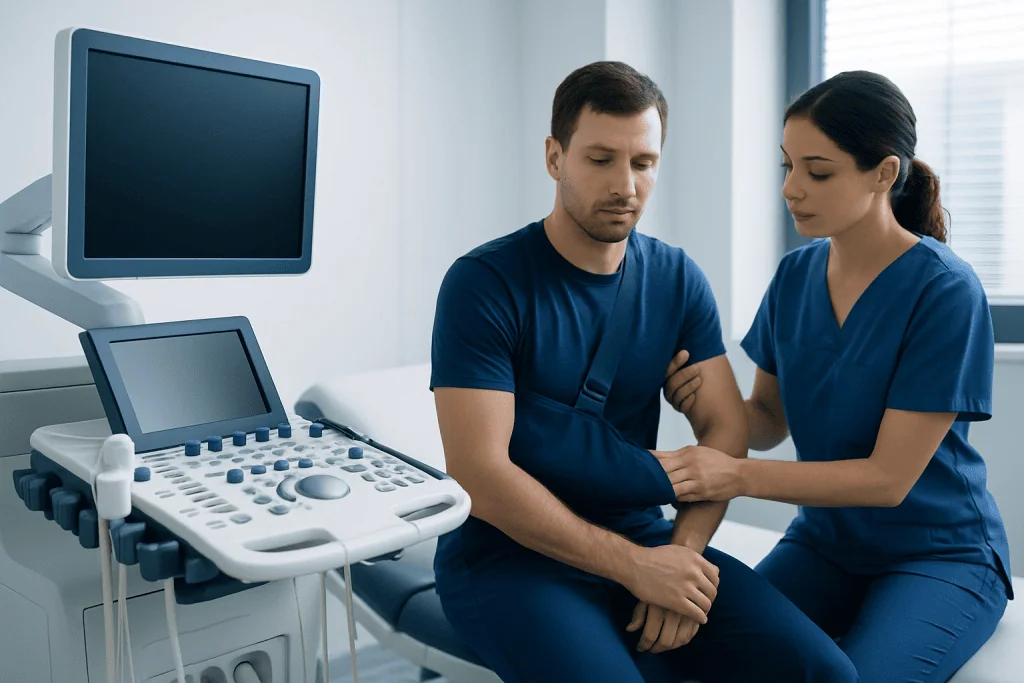
A shoulder that looks out of shape, cannot be moved normally, or causes sudden severe pain after an injury should be assessed urgently. Other warning signs include swelling, bruising, numbness, tingling, weakness, a cold or pale hand, or an absent pulse in the wrist. These symptoms may indicate injury around the joint that needs immediate attention.
Emergency evaluation is also needed if a person believes the shoulder has moved back into place on its own. The joint may still have a fracture, tendon injury or other damage. Until medical care is available, the arm should be supported in the most comfortable position, ice may be wrapped in a cloth and applied briefly, and the person should avoid food or drink in case sedation becomes necessary.
It is not safe to try to relocate a shoulder at home or allow an untrained person to do so. Pulling or twisting the arm can worsen a fracture or injure nerves and blood vessels. Emergency services should be contacted after major trauma, or when there are circulation or nerve symptoms.
Assessment and candidacy for different treatments

At the first assessment, the clinician asks how the injury happened, examines the shoulder and checks sensation, strength, pulses and blood flow in the arm. X-rays are commonly taken before reduction when practical, and again afterward to confirm the joint is aligned and to look for fractures. Ultrasound, CT or MRI may be arranged later if there is concern about bone loss, a rotator cuff tear, labral injury or persistent symptoms.
Closed reduction is appropriate for many uncomplicated acute dislocations. It means the joint is put back in place without an incision. The care team considers the person’s pain level, time since injury, X-ray findings, medical history and whether the injury is a first dislocation or a recurrence when choosing pain control and the reduction technique.
Orthopedic review is especially important for associated fractures, an inability to reduce the joint, nerve or blood-vessel injury, persistent weakness, recurrent episodes or high-risk instability. Younger people who play contact or overhead sports may have a higher likelihood of repeat dislocation, while adults over 40 may be more likely to have a rotator cuff injury after a first dislocation. These factors can influence whether surgery is discussed.
- First-time, uncomplicated dislocations often respond well to reduction and rehabilitation.
- Recurrent instability may require a detailed assessment of the labrum, ligaments and bone.
- Fracture-dislocations or major tendon tears can need early surgical treatment.
Step by step: reduction, protection and rehabilitation
Before reduction, the clinician checks the arm’s nerve and circulation status and reviews imaging. Pain-relieving medicine may be given, and some people need procedural sedation or a local anesthetic technique to reduce pain and allow the shoulder muscles to relax. The choice depends on the injury, the person’s health and local clinical practice.
During closed reduction, the clinician uses controlled positioning and gentle traction or rotation to guide the humeral head into the socket. There are several accepted techniques; the goal is a smooth, safe reduction rather than one particular method. Relief can be rapid once the joint is aligned, though soreness remains common. The shoulder is examined again and a post-reduction X-ray is usually performed.
Afterward, a sling or shoulder immobilizer may be used for comfort and short-term protection. Its duration varies because prolonged immobilization can cause stiffness, particularly in older adults. Guided exercises typically begin in stages: first protecting the healing tissues and maintaining safe movement, then rebuilding range of motion, rotator cuff strength, shoulder-blade control and confidence with daily tasks.
When an operation is needed, it may repair or stabilize damaged structures such as the labrum and ligaments, address bone loss, or repair a torn rotator cuff. The approach can be arthroscopic or open depending on the injury. Shoulder surgery is generally considered after careful imaging, examination and discussion of the person’s instability pattern and activity goals.
Benefits, limits and possible risks
The immediate benefit of reduction is restoration of joint alignment, which usually improves the visible deformity and much of the acute pain. Early assessment also identifies injuries that could affect treatment. Rehabilitation can improve shoulder control and help a person regain confidence in lifting, reaching and sport-specific movement.
Even with appropriate care, some people experience ongoing stiffness, weakness, pain or a sense that the shoulder may slip out. Recurrent instability is more common in younger, very active people and after certain traumatic injuries. A rehabilitation plan cannot eliminate every recurrence risk, but it can address strength, movement patterns and a return-to-activity strategy.
Closed reduction is generally successful, but potential complications include fracture, soft-tissue injury, nerve irritation and rarely blood-vessel injury. Sedation also has risks, which the clinical team considers carefully. Surgical stabilization may reduce recurrent instability for selected patients, but has its own potential complications, including infection, stiffness, nerve injury, recurrent instability and the need for further treatment.
Follow-up is particularly important if pain does not improve, the arm remains weak, numbness persists, or the shoulder feels unstable. These concerns may signal an injury that needs additional imaging or specialist management.
Recovery timeline and self-care
Recovery after a dislocated shoulder is individual. Pain and swelling often begin to settle over the first days to weeks, while return of comfortable movement and strength takes longer. Some people resume light daily activities within a few weeks; return to demanding work, overhead activity or contact sports commonly takes several months and should be guided by an orthopedic clinician or physiotherapist.
Early care usually includes using the sling as advised, taking prescribed or clinician-recommended pain relief, and applying a wrapped cold pack for short periods if appropriate. Keeping the hand, wrist and elbow gently moving may help prevent stiffness, but shoulder exercises should follow the treating team’s instructions. Sleeping slightly upright or with pillows supporting the arm can be more comfortable initially.
Rehabilitation normally progresses from protected movement to range-of-motion work, then strengthening of the rotator cuff and muscles around the shoulder blade. Return to sport is based on function rather than time alone: the shoulder should have near-normal motion, adequate strength, good control and no feeling of instability. Shoulder pain that continues after the expected early recovery period should be reassessed rather than ignored.
Acibadem International’s multidisciplinary specialists and JCI-accredited hospitals assess and treat shoulder injuries for international patients, with orthopedic, imaging, anesthesia and rehabilitation input when needed.
Common questions about pain, outcome and rehabilitation
Can you recover 100% from a shoulder dislocation? Many people regain excellent or near-normal shoulder function after a first dislocation, particularly when there is no major fracture, tendon tear or recurrent instability. However, “100%” varies by the demands placed on the shoulder, and some people have lingering stiffness, weakness or apprehension in certain positions. Completing rehabilitation and attending follow-up appointments give the best opportunity to identify and manage problems early.
How painful is a dislocated shoulder on a scale of 1 to 10? Pain is personal and cannot be assigned one reliable number. Many people describe an acute dislocation as severe, often in the higher part of a 0-to-10 pain scale, because the joint is out of alignment and muscles may spasm. Sudden severe shoulder pain with deformity or inability to move the arm should be treated as urgent.
How painful is fixing a dislocated shoulder? Reduction can be painful if the surrounding muscles are tight, which is why clinicians use pain medication, local anesthetic techniques or sedation when appropriate. The goal is to minimize discomfort while safely relaxing the muscles and restoring alignment. Pain often improves substantially after successful reduction, though the shoulder may stay sore afterward.
How long is rehab for a dislocated shoulder? Rehabilitation often starts with early protected movement and continues for several weeks to months. The exact duration depends on age, associated injuries, surgery, sporting demands and whether instability recurs. A physiotherapist or orthopedic clinician can set milestones for safe progression rather than relying on a fixed timetable.
Frequently asked questions
What should a person do immediately after a shoulder dislocation?
The arm should be kept supported in the most comfortable position, and urgent medical assessment should be arranged. A wrapped cold pack may help with swelling, but the shoulder should not be pushed, pulled or forced back into place.
Does every dislocated shoulder need surgery?
No. Many first-time dislocations are treated with reduction, short-term support and rehabilitation. Surgery is more likely to be considered when there are repeated dislocations, important fractures, substantial soft-tissue injury, bone loss or particular activity demands.
Can a shoulder dislocate again after treatment?
Yes, recurrent instability can occur, especially in younger active people and in those with certain labral or bone injuries. A structured rehabilitation program and specialist review can help assess and reduce the individual risk.
How soon can a person drive after a shoulder dislocation?
Driving should wait until the person is no longer using sedating pain medicines, can control the vehicle safely and can perform emergency maneuvers without pain or restriction. The treating clinician can give advice based on the injury, sling use and recovery progress.
What symptoms after reduction need prompt review?
Increasing pain, numbness, tingling, weakness, a cold or discolored hand, fever, marked swelling, or a renewed feeling that the shoulder has slipped out should be assessed promptly. Persistent inability to lift the arm can also require evaluation for tendon or nerve injury.
Can exercises be started while wearing a sling?
Some hand, wrist and elbow movements are often encouraged, but shoulder exercises should begin only as directed by the treating team. Starting the wrong movement too early may aggravate injured tissues, while waiting too long can contribute to stiffness.
References
- American Academy of Orthopaedic Surgeons
- American College of Emergency Physicians
- National Institute of Arthritis and Musculoskeletal and Skin Diseases
- American Physical Therapy Association
This article is for general information only and is not a substitute for professional medical advice. Please consult a qualified doctor about your individual situation.
Joint and spine care in Turkey — expert assessment & treatment
JCI-accredited · board-certified surgeons · reply within 24h
Add us as a Preferred Source to see more of our trusted health content across Google Search, AI Overviews and Discover.

More from the Health Library



Related Specialists

Fzt. İsmail Ateş
Physical Medicine and Rehabilitation
Prof. Dr. Handan Onur Topuzlu
Medical Oncology
Dr. Fatmanur Yildirim
Physical Medicine & Rehabilitation
Asst. Prof. Dr. Hülya Kuşoğlu
Infectious Diseases & Clinical Microbiology