Sternoclavicular Injection: How It Works, Results and What to Expect

The sternoclavicular joint connects the collarbone to the upper breastbone and can become painful after injury, arthritis, or inflammation. Because important blood vessels and structures lie behind the joint, sternoclavicular injections are commonly performed with imaging guidance.
Key Takeaways
- The sternoclavicular joint connects the collarbone to the upper breastbone and can become painful after injury, arthritis, or inflammation.
- Because important blood vessels and structures lie behind the joint, sternoclavicular injections are commonly performed with imaging guidance.
- Temporary pain relief from local anaesthetic can support the diagnosis, while steroid medicine may provide longer-lasting reduction in inflammation.
- Recovery is usually quick, but strenuous upper-body activity is commonly limited for a short period after the procedure.
- New chest pressure, breathing difficulty, fever, or rapidly worsening swelling needs urgent medical assessment.
A sternoclavicular injection is an image-guided procedure that places local anaesthetic, corticosteroid medicine, or both into the sternoclavicular (SC) joint. It may help identify whether this small joint is causing pain and may reduce inflammation-related symptoms for a period of time.
Overview: What Is a Sternoclavicular Injection?
A sternoclavicular injection is a targeted procedure for pain arising from the sternoclavicular (SC) joint, where the inner end of the collarbone meets the breastbone. A clinician injects a small amount of local anaesthetic, corticosteroid medicine, or both into or around the joint. It can be used both as a diagnostic tool and as a treatment for inflammation-related pain.
The SC joint is small but important. It helps the shoulder girdle move and transfers forces from the arm to the chest. Pain in this area may be felt directly over the joint, near the base of the neck, upper chest, shoulder, or collarbone. Since several conditions can cause pain in these regions, a carefully targeted injection may help clarify whether the SC joint is the source.
Unlike some larger-joint injections, an SC joint injection is usually performed with ultrasound or computed tomography (CT) guidance. Imaging helps the clinician position the needle accurately and avoid nearby structures. The procedure is generally considered after a clinical assessment and, when appropriate, imaging or other conservative care has not provided enough relief.
How It Works, Benefits and Candidacy
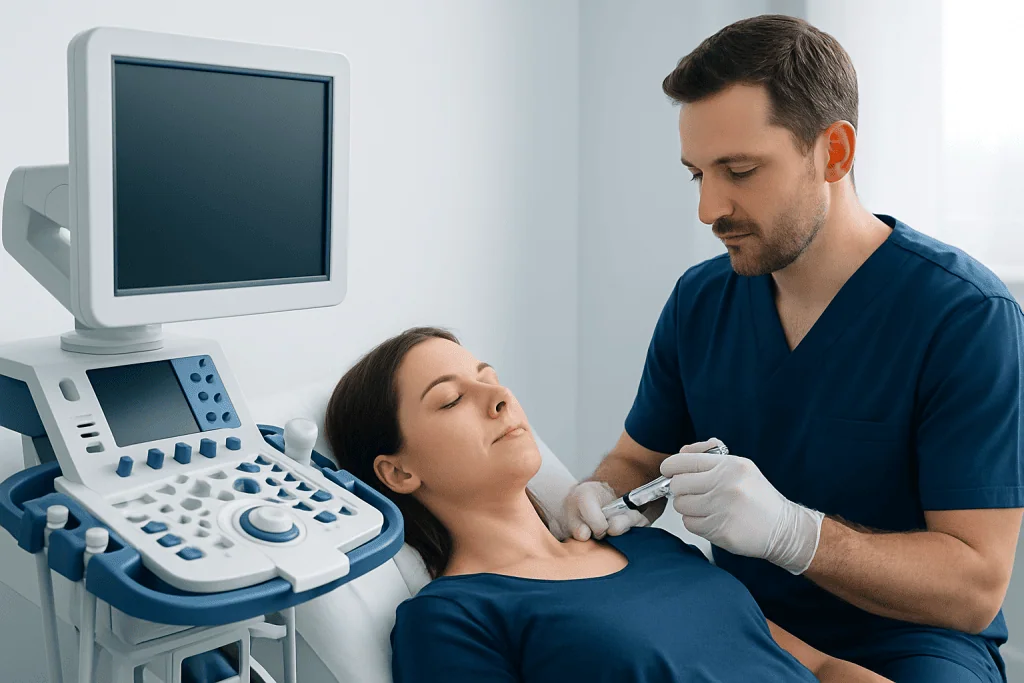
Local anaesthetic temporarily numbs the injected area. If pain improves substantially soon after the injection, this may indicate that the SC joint is contributing to symptoms. Corticosteroid medicine works differently: it aims to reduce inflammation and may ease pain and stiffness over the following days. The degree and duration of relief differ between individuals and depend on the underlying cause.
A sternoclavicular injection may be considered for persistent, localised SC joint pain associated with osteoarthritis, inflammatory arthritis, joint irritation after injury, or selected cases of joint instability-related inflammation. It may also be helpful when a clinician needs more information before recommending a rehabilitation plan, medication changes, or surgery.
It is not appropriate for every type of collarbone or chest pain. A clinician will first consider conditions such as fracture, infection, significant joint displacement, heart or lung causes of chest symptoms, and referred pain from the neck or shoulder. People who take blood-thinning medicines, have diabetes, are pregnant, have an active infection, or have an allergy to injection medicines should discuss this before scheduling the procedure.
- Possible benefits: temporary pain reduction, improved ability to move the shoulder, and useful diagnostic information.
- Limitations: an injection does not repair a fracture, correct major instability, or treat an infection.
- Best results: often come when pain relief is paired with an individually planned rehabilitation programme and activity adjustment.
Step by Step: What Happens During the Procedure?

Before the procedure, the clinician reviews symptoms, medical history, medicines, allergies, and previous imaging. The skin over the joint is examined for redness, warmth, wounds, or swelling that could suggest infection. Patients may be asked whether they have had recent illness, fever, or changes in blood-thinning medication.
The patient usually lies on their back or in a slightly reclined position. The skin is cleaned with antiseptic solution and covered with sterile drapes. A small local anaesthetic injection may be used to numb the skin. Ultrasound or CT imaging is then used to guide a fine needle toward the joint with precision.
After confirming needle position, the clinician injects the planned medicine. Some people feel pressure or brief discomfort, but the procedure is usually short. Sedation is not commonly required, although individual arrangements vary. The needle is removed and a small dressing is placed over the injection site.
Patients are generally observed briefly before going home. They should arrange transport if they have received sedating medicine or if discomfort makes driving unsuitable. For persistent joint pain, an orthopaedic or pain-management assessment may include orthopaedic care alongside rehabilitation and image-guided procedures where appropriate.
Recovery Timeline and Expected Results
Most people return home on the day of a sternoclavicular injection. Mild soreness, bruising, or a feeling of fullness around the injection site can occur for one to two days. Applying a wrapped cold pack for short periods may be advised, provided the treating team has not given different instructions.
If local anaesthetic was used, pain may improve within minutes to hours. This early response can fade as the anaesthetic wears off. When corticosteroid medicine is included, relief may begin after several days, sometimes up to one or two weeks. Some people notice a short-lived increase in soreness before symptoms settle.
The duration of benefit varies. Relief may last weeks or longer for some people, while others may experience little change. The result depends on factors such as the diagnosis, the degree of joint degeneration or inflammation, activity demands, and whether other pain sources are present. A follow-up appointment helps the clinician interpret the response and plan next steps.
For the first day or two, patients are often advised to avoid heavy lifting, repeated overhead movement, contact sport, and demanding upper-body exercise. Gentle daily movement is usually preferable to complete immobility unless a clinician advises otherwise. A tailored physical therapy and rehabilitation programme may help restore comfortable movement and shoulder control once symptoms allow.
Risks and Safety Considerations
Sternoclavicular injections are generally performed safely by experienced clinicians, particularly when imaging guidance is used. However, all injections carry potential risks. These include temporary pain flare, bruising, bleeding, skin colour change, infection, allergic reaction, and incomplete or short-lived symptom relief.
Corticosteroid-related effects can include temporary facial flushing, sleep disturbance, mood changes, or a temporary increase in blood glucose levels, particularly in people with diabetes. Repeated steroid injections into the same area may not be suitable for everyone, so the expected benefits and alternatives should be reviewed before each procedure.
The SC joint lies near important structures in the upper chest and lower neck. This is one reason a clinician may recommend ultrasound or CT guidance rather than a landmark-only technique. Serious complications are uncommon, but the procedure should be performed by a qualified clinician who understands the local anatomy and has appropriate imaging support.
Patients should follow their clinician’s aftercare instructions and report unusual symptoms rather than assuming they are a normal effect of the injection. A new treatment plan may also include assessment of related shoulder, neck, or chest-wall conditions if the injection does not provide the expected diagnostic or therapeutic response.
How Long Does It Take for a Sternoclavicular Joint to Heal?
Healing time for a sternoclavicular joint problem depends on its cause and severity. A mild sprain or soft-tissue irritation may improve over several weeks with relative rest and guided rehabilitation. More significant sprains, dislocations, fractures, inflammatory disease, or advanced osteoarthritis may require a longer recovery period and specialist follow-up.
A sternoclavicular injection may reduce inflammation-related pain, but it does not by itself heal damaged ligaments or realign a dislocated joint. When injury is suspected, a clinician may recommend imaging and a structured recovery plan that considers shoulder movement, work demands, sport, and the need to protect the joint while it recovers.
Symptoms that persist, worsen, or recur with activity should be reassessed. Early expert evaluation is especially important after a significant impact to the chest or shoulder, visible deformity near the joint, or difficulty using the arm.
How Long Does It Take for an SI Joint Injection to Start Working?
An SI joint injection refers to an injection into the sacroiliac joint in the lower back and pelvis. It is different from a sternoclavicular injection, which treats the joint between the collarbone and breastbone. The timing of medication effects is broadly similar when local anaesthetic and corticosteroid are used, but the conditions and anatomy are not the same.
Local anaesthetic in an SI joint injection may provide relief within minutes or hours and can help confirm whether the sacroiliac joint is a pain source. Steroid medicine may take several days to begin working and occasionally up to one or two weeks for its fuller effect. A brief pain flare in the first days can occur.
It is important not to judge the final result too early. Patients should use the pain and activity diary, if provided, and attend follow-up so the treating clinician can interpret both immediate and delayed changes in symptoms.
How Do You Know If a Steroid Injection Is Working?
A steroid injection may be working when pain becomes less intense, movement becomes easier, sleep is less disrupted, or daily tasks can be performed with less limitation. Improvement is often gradual rather than immediate. For an injection that also contains local anaesthetic, clinicians may ask about pain changes in the first few hours as well as in the days that follow.
Meaningful benefit does not always mean that all pain disappears. A useful response may allow a person to begin or progress rehabilitation, return to selected activities, or reduce the need for other pain-relief measures under medical guidance. It is helpful to note changes in pain location, intensity, movement, and functional activities rather than relying on a single pain score.
If symptoms are unchanged after the expected period, or if they worsen, the treating clinician should review the diagnosis and plan. Persistent pain may come from more than one structure, including the shoulder, cervical spine, muscles, or chest wall.
What Can You Not Do After SI Joint Injections?
After an SI joint injection, people are commonly advised to avoid strenuous activity for the rest of the day and to limit heavy lifting, high-impact exercise, bending and twisting, or prolonged driving if these worsen symptoms. Specific restrictions depend on the technique used, the medicines given, and the person’s overall health, so the treating team’s instructions take priority.
Normal gentle walking and light daily activity are often acceptable if comfortable. People should not drive or operate machinery if they received sedation or feel numb, weak, dizzy, or otherwise unable to react safely. They should also avoid soaking the injection site in a bath, pool, or hot tub until the clinician says it is safe.
These practical precautions are similar to those often advised after an SC joint injection, though the affected body area differs. A gradual return to activity, rather than immediate intensive exercise, gives the injection site time to settle and makes it easier to monitor the response to treatment.
When to Seek Medical Care
Prompt medical assessment is important for severe or unexplained pain at the sternoclavicular joint, particularly after trauma. Emergency care is needed for chest pressure, shortness of breath, trouble swallowing, new voice changes, fainting, marked weakness, or a noticeable deformity after an injury. These symptoms may indicate a problem beyond routine joint inflammation.
After an injection, patients should contact the treating team urgently if they develop fever, spreading redness, drainage from the injection site, rapidly increasing swelling, severe pain that does not settle, or signs of an allergic reaction such as widespread hives or breathing difficulty. People with diabetes should follow their clinician’s advice about monitoring blood glucose after steroid treatment.
Acibadem International’s multidisciplinary specialists and JCI-accredited hospitals assess and treat bone and joint concerns for international patients, including image-guided procedures and rehabilitation when clinically appropriate. A qualified clinician can determine whether SC joint symptoms require an injection, further imaging, rehabilitation, or another form of care.
Frequently asked questions
Is a sternoclavicular injection painful?
Patients may feel a brief sting from numbing the skin and pressure as the medication is injected. Imaging guidance and local anaesthetic are used to improve accuracy and comfort. Mild soreness at the injection site for a day or two is possible.
How long does a sternoclavicular steroid injection last?
The duration of benefit varies considerably. Some people have relief for weeks or longer, while others have limited or no improvement. The underlying diagnosis, joint condition and activity level all affect the result.
Why is imaging guidance used for sternoclavicular injections?
The sternoclavicular joint is small and lies close to important structures in the upper chest and lower neck. Ultrasound or CT guidance helps place the needle more accurately. It also supports a safer, more precise procedure.
Can I drive after a sternoclavicular injection?
Many people can drive after a simple injection if they feel well and have not received sedation, but this should be confirmed with the treating clinician. Driving should be avoided if there is numbness, weakness, dizziness or significant discomfort. Arranging transport home is often sensible.
Can a sternoclavicular injection diagnose the cause of pain?
Yes, it can provide useful diagnostic information. Short-term pain relief after the local anaesthetic may suggest that the SC joint is contributing to symptoms. However, the result is interpreted alongside the examination, imaging and medical history.
How often can a steroid injection be repeated?
There is no single schedule that suits everyone. The decision depends on the benefit from the first injection, the joint condition, other health factors and potential steroid-related risks. A clinician should decide whether repeating an injection is appropriate.
References
- American Academy of Orthopaedic Surgeons
- American College of Radiology
- Radiological Society of North America
- National Institute of Arthritis and Musculoskeletal and Skin Diseases
This article is for general information only and is not a substitute for professional medical advice. Please consult a qualified doctor about your individual situation.
Joint and spine care in Turkey — expert assessment & treatment
JCI-accredited · board-certified surgeons · reply within 24h
Add us as a Preferred Source to see more of our trusted health content across Google Search, AI Overviews and Discover.

More from the Health Library



Related Specialists

Prof. Dr. Ethem Kumbay
Cardiology
Prof. Dr. Bülent Karabulut
Medical Oncology
Dr. İnci Okan
Internal Medicine
Prof. Dr. Zeynep Yezdan Fırat
Otorhinolaryngology