

Fibroids, Weight Gain and Bloating: Why It Happens and What Treatment Can Change
Key Takeaways
- Fibroids add weight only through their own mass; they do not change metabolism, so a fibroid described in millimeters on ultrasound is not the reason for a ten-pound gain.
- The NHS puts fibroid size anywhere between a pea and a melon, and clinicians often size an enlarged uterus by comparing it to a stage of pregnancy.
- Fibroid-related swelling is typically low, central and firm, while fat is soft and spreads to the flanks, back and limbs as well.
- Constipation from a fibroid pressing on the bowel is the main driver of true bloating, which is why fiber, fluid and walking help even before the fibroid is treated.
- Heavy bleeding can cause iron-deficiency anemia, and the resulting fatigue is often the real reason exercise and healthy eating feel impossible.
- Fibroids usually shrink after menopause because they depend on estrogen and progesterone, so watchful waiting is a recognized option for women nearing that stage.
Fibroids can add weight directly, but usually only when they are large. Most fibroids are small and add very little, while a very large fibroid or an enlarged uterus can weigh several pounds and push the lower abdomen outward. Fibroids do not change metabolism. Bloating, constipation, heavy bleeding and fatigue linked to fibroids can make weight feel harder to manage, and treating the fibroids can relieve that pressure.
The scale said the same number it had said for three years. The jeans disagreed. That is the moment many women describe when they first suspect something other than cake is going on: a lower belly that feels firm rather than soft, a waistband that pinches by mid-afternoon, and a vague sense of being full without having eaten much.
Fibroids sit in a strange corner of women’s health. They are extraordinarily common, mostly harmless, and yet they get blamed for almost everything from tiredness to trouser size. Some of that blame is fair. A fibroid is a solid mass of muscle tissue that occupies space, and space in the pelvis is limited. Some of it is not fair at all, and the confusion leads people to chase the wrong fix.
This piece separates the two. It looks at what fibroids physically weigh, why they make an abdomen look and feel different, how they tangle with appetite, bowels and energy, and what different treatments can realistically change about your midsection.
Can fibroids cause weight gain?
Yes, though not in the way most people imagine. A fibroid is a benign growth of smooth muscle and connective tissue that develops in or on the wall of the uterus. It has mass, so it registers on a bathroom scale in exactly the same way a bag of flour would. What it does not do is alter your metabolism, hormones or appetite in a way that makes the rest of your body store more fat. There is no evidence in mainstream guidance that fibroids slow calorie burning.
The distinction matters because the two kinds of weight behave differently. A fibroid’s weight is concentrated in one spot, low in the abdomen, and it stays there whether you eat well or badly. Fat gain spreads across the body and responds, slowly, to changes in diet and activity.
Size is the deciding factor. Fibroids range from the size of a pea to the size of a melon, according to the NHS, and the Mayo Clinic describes them growing from seedlings undetectable by the human eye to bulky masses that distort and enlarge the uterus. A pea contributes nothing you would notice. A melon is a different story, and a uterus carrying several large fibroids can grow to the dimensions seen in mid-pregnancy.
Most people with fibroids sit at the small end. Cleveland Clinic estimates that 40 to 80 percent of people with a uterus have fibroids, and the majority never know, which tells you how often they are too small to add measurable weight. When weight gain is the main complaint and the fibroids are small, the evidence points to looking elsewhere for the cause.
How many pounds can a fibroid actually weigh?
The honest answer is: it depends entirely on size, and the range is enormous. A fibroid the size of a grape weighs a few grams. One the size of a grapefruit weighs roughly what a grapefruit does, about a pound. Cleveland Clinic notes that large fibroids can weigh several pounds, and medical literature contains rare case reports of masses far heavier than that, though those are exceptional rather than typical.
Because fibroids are dense muscle rather than fluid, they weigh more than a fluid-filled cyst of the same dimensions. That density is also why a fibroid belly tends to feel firm to the touch rather than soft.
A more useful way to think about it is the whole uterus rather than a single fibroid. A woman rarely has just one; the Mayo Clinic describes single and multiple fibroids as both common. Clinicians often size a fibroid uterus by comparison to pregnancy, describing it as, say, the size of a 12-week or 20-week pregnancy. That comparison gives a rough feel for the added volume and weight, and also explains why some women are asked if they are expecting.
What this means for the scale is modest for most and significant for a few. If your fibroids are described as small on an ultrasound report, they are almost certainly not responsible for a ten-pound change. If your uterus has been described in terms of a pregnancy month, the extra weight is real and will disappear if the fibroids are removed or shrink.
What does a fibroid tummy look like?
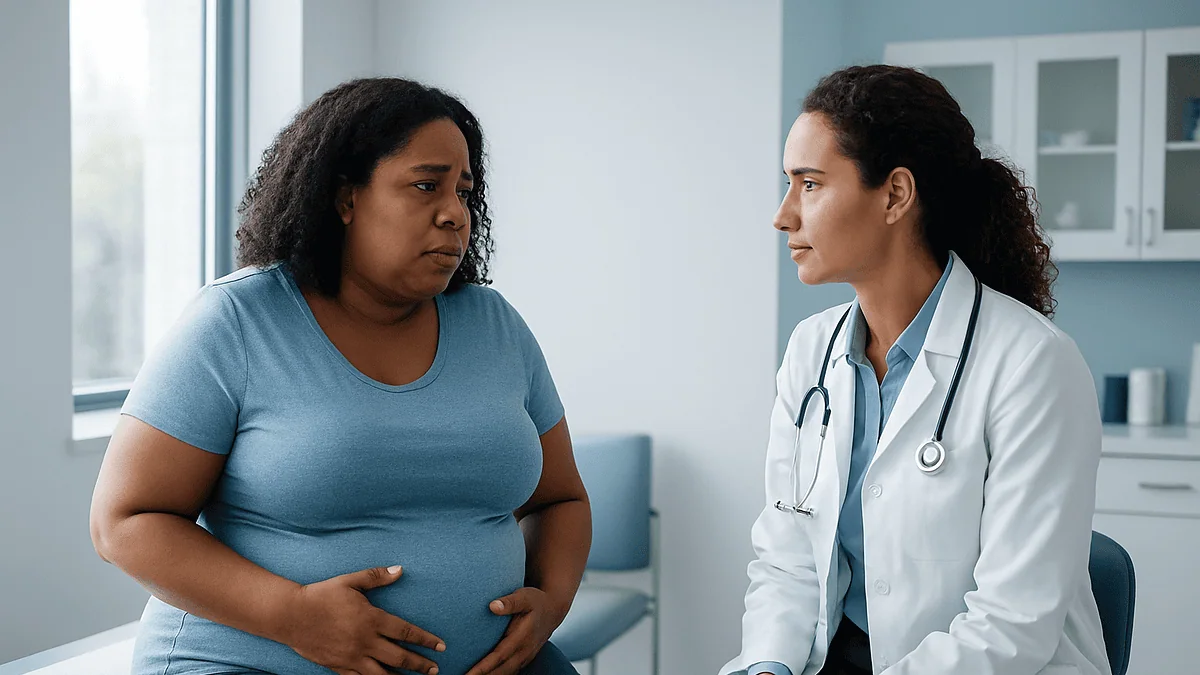
Picture a swelling that starts low, just above the pubic bone, and sits mostly in the center rather than spreading around the flanks and back. It tends to feel firm when you press it, sometimes with a distinct edge you can trace. It does not soften much when you lie down, and it does not shift from day to day the way gas-related bloating does. Some women notice it is slightly asymmetrical, leaning to one side, because fibroids grow where they grow.
Fat around the abdomen behaves differently. It is soft and yielding, it wraps around the whole midsection including the back and hips, and it changes gradually over months in step with the rest of the body. A person gaining fat generally notices it in the face, arms and thighs too.
Fibroid-related swelling can also come with companions that fat does not bring. The Mayo Clinic lists pelvic pressure, frequent urination, difficulty emptying the bladder, constipation and backache among fibroid symptoms, all of them consequences of a firm mass pressing on the bladder in front and the bowel behind. The NHS adds lower back pain and discomfort during sex.
None of this is diagnostic on its own. Plenty of women carry a mix of the two, and a firm lower-belly swelling can have several causes besides fibroids, including ovarian cysts. The description above is meant to help you notice a pattern worth mentioning to a clinician, not to replace an examination and an ultrasound.
Why do fibroids cause bloating?
Bloating from fibroids is really two separate things that happen to feel similar. The first is not bloating at all; it is displacement. A fibroid takes up room, and the intestines, bladder and pelvic floor have to accommodate it. The result is a constant sense of fullness or pressure that does not rise and fall with meals. Women often describe it as feeling like the tail end of a large dinner, all day, every day.
The second is true digestive bloating, and fibroids drive it indirectly. When a fibroid on the back wall of the uterus presses on the rectum or lower colon, stool moves more slowly. Slower transit means more time for gut bacteria to ferment food and produce gas, and it means constipation, which the Mayo Clinic and NHS both list as a recognized fibroid symptom. Trapped gas and a backed-up bowel expand the abdomen further, layered on top of the fibroid itself.
Hormonal timing adds a third layer. Many women retain fluid in the days before a period regardless of fibroids, and heavy, prolonged periods, the hallmark fibroid symptom, stretch that window. The belly can feel tightest in the week before and during menstruation, then ease slightly afterwards.
Bloating is also one of the most nonspecific symptoms in medicine. Irritable bowel syndrome, food intolerances, constipation from other causes and ovarian conditions all produce it. Persistent bloating that is new, worsening or paired with feeling full quickly deserves a proper assessment rather than an assumption.
Do fibroids make it hard to lose weight?
Not directly, but they can make the effort feel like pushing against a locked door. The reason is arithmetic. Suppose you carry fibroids adding three pounds and you lose three pounds of fat through months of steady effort. The scale shows no change, and the belly, dominated by a firm mass, looks the same. It is easy to conclude that nothing is working when in fact the fat loss happened and was simply masked.
Beyond the arithmetic, fibroids can undermine the behaviors that weight management depends on. Heavy periods can cause iron-deficiency anemia, which the Mayo Clinic identifies as a fibroid complication, and anemia brings fatigue and shortness of breath on exertion. A woman who is exhausted and breathless walking up stairs is not going to feel like a brisk evening walk. Pelvic pressure and backache make exercise uncomfortable. Bloating and cramps reduce the appeal of a full, balanced meal in favor of whatever is quick and soothing.
Sleep suffers too. Frequent nighttime urination from bladder pressure fragments rest, and short or broken sleep is consistently associated with harder weight regulation in general medical guidance.
So the fibroid itself is inert, but the constellation around it is not. This is why a clinician’s advice is rarely just to eat less and move more when fibroids are symptomatic. Addressing the bleeding, the anemia or the mass often restores the energy and comfort that make everyday healthy habits possible again.
Does weight gain cause fibroids, or the other way around?
The arrow runs in both directions, and the more important one is the direction people rarely mention. Obesity is listed by the Mayo Clinic as a risk factor for developing fibroids, alongside age, family history, early onset of menstruation, vitamin D deficiency and a diet higher in red meat and lower in green vegetables and fruit. Black women are more likely to develop fibroids, and to develop them at younger ages and with larger size, according to the same source.
Why would body weight matter? Fibroids appear to grow under the influence of estrogen and progesterone, the Mayo Clinic notes, containing more receptors for these hormones than normal uterine muscle. Fat tissue is not metabolically silent; it converts other hormones into estrogen. More fat tissue means more circulating estrogen, which may provide a richer environment for fibroids to develop and grow. The evidence here is observational, meaning it shows an association rather than proof of cause, and the precise mechanism is still being studied.
Fibroids also tend to grow during the reproductive years and shrink after menopause, when hormone levels fall, according to the NHS. That pattern fits the hormonal explanation neatly.
The practical takeaway is not to blame anyone for their fibroids. Family history and age are the strongest factors and are outside anyone’s control. What the evidence does support is that healthy weight and a diet rich in vegetables and fruit are associated with lower fibroid risk, which happens to be the same advice that protects the heart and reduces diabetes risk.
Fibroids, heavy periods and fatigue: the hidden weight link
Ask a room of women with fibroids what bothers them most and weight rarely comes first. Bleeding does. Periods that last more than a week, soak through protection in an hour, or come with clots are the symptom most likely to send someone to a doctor, and the Mayo Clinic describes heavy menstrual bleeding as the most common fibroid complaint.
Chronic heavy bleeding drains iron faster than a normal diet can replace it. Iron-deficiency anemia follows, and its signature symptoms, tiredness, weakness, breathlessness, dizziness and a racing heart on exertion, quietly reshape a life. Exercise feels impossible. Cooking feels like too much effort. Cravings for quick energy rise. The MedlinePlus overview of fibroids lists anemia among the consequences of heavy bleeding, and it is the mechanism by which a uterine condition ends up affecting appetite, activity and, eventually, the scale.
Fluid shifts add a smaller but noticeable effect. Around menstruation many women retain water, and the number on the scale can swing by a couple of pounds within a single cycle. With prolonged or irregular bleeding, that puffy phase feels longer and the true baseline weight gets harder to read.
A simple blood count is often the first test a clinician orders when fibroids and fatigue appear together, because correcting anemia changes how a person feels within weeks, long before any decision about the fibroids themselves. If you have heavy periods and unexplained tiredness, that conversation is worth having regardless of what your waistband is doing.
How do doctors work out whether fibroids are behind your symptoms?
It usually starts with hands. During a pelvic examination a clinician can often feel that the uterus is enlarged or irregular in shape, which the Mayo Clinic describes as a common way fibroids are first discovered, sometimes incidentally during a routine check-up. From there the workhorse test is ultrasound, performed over the abdomen or through the vagina, which shows the size, number and position of fibroids and confirms that a mass is uterine rather than ovarian.
Blood tests come next if bleeding is heavy. A full blood count checks for anemia, and further tests can look at iron stores or, where periods are irregular, thyroid function and other hormones, since those can produce overlapping symptoms.
When more detail is needed, particularly before a procedure, MRI gives a precise map of each fibroid and helps the treating team judge which options suit the anatomy. A saline-infusion ultrasound or hysteroscopy, in which a thin scope is passed through the cervix, can clarify fibroids that bulge into the uterine cavity and are most likely to drive bleeding.
For the weight and bloating question specifically, the ultrasound report is the piece worth reading closely. If it describes a uterus enlarged to a size comparable to a pregnancy stage, the mass is contributing to your shape. If the fibroids are measured in millimeters, they are probably not, and the bloating deserves a separate look at bowel habits, diet and, if it persists, the ovaries.
Which treatment options exist, and what each can realistically change
Fibroids that cause no symptoms generally need no treatment, and both the NHS and Mayo Clinic describe watchful waiting as a reasonable first step, particularly for women approaching menopause when fibroids typically shrink. When symptoms do warrant action, the options fall into three families, and each affects weight and belly shape differently.
| Approach | What it does | Effect on belly and weight |
|---|---|---|
| Medicines that manage bleeding | Regulate the cycle or reduce menstrual blood loss; do not remove the fibroid | Little change to size; may ease anemia-related fatigue and cyclical fluid retention |
| Medicines that lower estrogen and progesterone | Create a temporary menopause-like state so fibroids shrink; typically used short-term, often before surgery | Shrinkage while taking them; fibroids regrow after stopping |
| Uterine artery embolization | Blocks the blood vessels feeding fibroids so they shrink over time | Gradual reduction in mass over months; uterus remains |
| Focused ultrasound or ablation techniques | Destroy fibroid tissue with heat while leaving the uterus in place | Gradual shrinkage; suits selected fibroid types |
| Myomectomy | Surgically removes fibroids, preserving the uterus | Immediate removal of mass; new fibroids can develop later |
| Hysterectomy | Removes the uterus entirely | Permanent removal of the mass; the only definitive treatment |
The Mayo Clinic notes that hormone-lowering medicines are usually prescribed for no more than three to six months because of side effects such as hot flashes and bone thinning, and that fibroids regrow once the drug is stopped. Which option fits depends on fibroid size and position, age, whether future pregnancy matters and personal preference, and that decision sits with you and your treating team.
Will my belly get flat after fibroid removal?
Flatter, often. Flat, not necessarily, and it is kinder to know that going in. Removing a fibroid uterus the size of a five-month pregnancy takes away a large, firm mass, and women who have had that experience frequently describe a striking difference in how clothes fit within weeks of recovery, once swelling from surgery settles. What surgery cannot do is remove abdominal fat, tighten skin that has been stretched, or retrain core muscles that have been pushed outward for years.
Timing depends on the route. After myomectomy or hysterectomy the mass is gone immediately, but post-operative swelling and bruising take several weeks to resolve, and the abdominal wall needs time before it looks like its new self. After uterine artery embolization or focused ultrasound, the fibroids are still present at first and shrink gradually, so the change in shape unfolds over months rather than days; the Mayo Clinic describes embolization as causing fibroids to shrink and die over time.
Two further honest points. Abdominal surgery leaves the core weak for a while, and a belly that has been supporting a heavy uterus may have a degree of muscle separation that persists even after the load is removed. A physiotherapist or clinician can advise on rebuilding it once healing allows. And a small proportion of women have an abdomen that was always more fat than fibroid, in which case the post-surgical result is a relief in pressure and bleeding rather than in silhouette.
Does weight change after a hysterectomy or embolization?
The mass comes off the scale, and that part is straightforward. If your fibroid uterus weighed three pounds, you weigh three pounds less on the day it is removed. Beyond that, the evidence for the procedures themselves changing body weight in either direction is thin, and much of what women report is better explained by what surrounds the operation.
Recovery involves weeks of reduced activity, which can mean a little fat gain in the short term. Conversely, resolution of heavy bleeding means anemia corrects over the following months, energy returns, and many women find themselves moving more than they have in years. The direction the scale goes depends far more on that second factor than on the procedure.
Hysterectomy carries one nuance worth understanding. If the ovaries are removed at the same time, menopause begins immediately, and menopause is associated with changes in fat distribution toward the midsection in general medical guidance. If the ovaries are left in place, which is common when surgery is for fibroids, hormone production continues and that shift does not occur abruptly. The Mayo Clinic notes that removing the ovaries has long-term consequences worth discussing before surgery.
Embolization leaves the uterus and ovaries in place, so no hormonal shift is expected, though the Mayo Clinic notes that complications can occur if the blood supply to the ovaries is affected. As with every option here, the trade-offs are individual, and the treating team is the right place to weigh them.
What actually helps with bloating day to day
While the bigger decisions are being made, the bloating still has to be lived with, and the most effective everyday measures target the bowel rather than the fibroid. Constipation is the amplifier, so anything that keeps stool soft and moving reduces the gas and distension layered on top of the mass itself.
Fiber and fluid do most of the work. Vegetables, fruit, oats, beans and whole grains add bulk and feed the gut bacteria that keep transit regular, and they only work when paired with enough water. The Mayo Clinic’s dietary observations on fibroids point the same way: diets higher in green vegetables and fruit are associated with lower risk. Increasing fiber gradually rather than overnight avoids a temporary worsening of gas.
Movement is the second lever. Walking after meals stimulates the colon, and regular activity of any kind is associated with more predictable bowel habits. It does not need to be vigorous; comfort matters more than intensity when there is pelvic pressure.
Meal pattern helps some women. Smaller portions eaten more slowly leave less for a compressed stomach and bowel to handle at once. Carbonated drinks and very large meals late at night are common triggers for a tighter belly the next morning.
Iron-rich foods matter for anyone with heavy periods, and a clinician may check whether an iron supplement is appropriate; that call depends on blood results and should be made with them rather than on instinct. Keeping a simple diary of bloating, bowel habits and cycle timing for a month often reveals a pattern that makes the next conversation with a doctor far more productive.
When to see a doctor about fibroids, weight or bloating
Fibroids are common and mostly benign, so the aim is not to panic over every full feeling. It is to recognize the handful of patterns that warrant an appointment and the smaller number that warrant one urgently.
Make a routine appointment if you have periods that last longer than seven days or soak through pads or tampons every hour or two, bleeding between periods, pelvic pain or pressure that does not settle, difficulty emptying your bladder, persistent constipation, or a lower-abdominal swelling that is new, firm or growing. The Mayo Clinic also flags unexplained anemia, so unusual tiredness, breathlessness or dizziness alongside heavy periods belongs on this list.
Bloating on its own needs assessment when it is persistent rather than coming and going, when it arrives with feeling full quickly after small meals, loss of appetite or unexplained weight loss, or when it begins after menopause. These features overlap with ovarian conditions and should not simply be attributed to fibroids without an examination and ultrasound.
Seek prompt care, the same day, for sudden severe pelvic or abdominal pain, which can signal a fibroid twisting on its stalk or outgrowing its blood supply; for very heavy bleeding with faintness, a racing heart or breathlessness; for a fever with pelvic pain; or for being unable to pass urine. Any vaginal bleeding after menopause needs to be checked without delay, as the NHS advises, whatever your history of fibroids.
Trust a change in your own baseline. A belly that has grown noticeably over a few months, rather than years, is the single most useful observation you can bring to a clinician.
What happens to fibroids at menopause?
For many women the story ends quietly. Fibroids depend on estrogen and progesterone to grow, and when the ovaries stop producing those hormones at menopause, fibroids usually shrink, according to both the NHS and Mayo Clinic. Symptoms driven by size and pressure often ease along with them, and the heavy bleeding stops when periods do. This is why watchful waiting is a legitimate option for a woman in her late forties with tolerable symptoms; the finishing line may be closer than treatment.
Shrinkage is not the same as disappearance. Large fibroids may become smaller and softer but remain palpable, and the belly may not return entirely to its pre-fibroid shape, particularly if it is now also carrying the shift in fat distribution that accompanies menopause more generally. Women who took menopausal hormone therapy should know that supplying estrogen can, in some cases, keep fibroids from shrinking as expected, which is a point to raise with the prescribing clinician.
Two things should not happen after menopause and deserve attention if they do. Fibroids should not grow, and there should be no vaginal bleeding. New growth of a pelvic mass or any bleeding after periods have stopped for a year is not typical of fibroids and needs prompt investigation to rule out other causes.
The larger lesson from menopause is reassuring. Fibroids are a condition of the reproductive years, tied tightly to hormones, and their tendency to fade with age is one more reason that the decision to treat can be made calmly, on symptoms and quality of life, rather than under pressure.
Frequently asked questions
Can fibroids cause weight gain?
Yes, but only through their physical mass. A fibroid is solid muscle tissue, so a large one or a uterus enlarged by several fibroids adds pounds in the same way any object would. Fibroids do not slow metabolism or make the body store fat. Small fibroids, which are the majority, add too little to notice. Bloating, constipation and fatigue linked to fibroids can make weight harder to manage indirectly.
Do fibroids make it hard to lose weight?
Not directly, but they can hide progress and sap the energy needed for it. Fat loss elsewhere can be masked on the scale by a fixed fibroid mass, and the belly may look unchanged because the mass dominates it. Heavy periods can cause anemia and exhaustion, pelvic pressure makes exercise uncomfortable and nighttime urination disrupts sleep, all of which undermine the habits weight management depends on.
What does a fibroid tummy look like?
It usually appears as a firm swelling low in the abdomen, centered above the pubic bone and sometimes leaning to one side. It does not soften much when lying down and does not fluctuate through the day like gas. It is often accompanied by pelvic pressure, frequent urination or constipation. Fat, by contrast, is soft and spreads around the flanks, back and hips. Only an examination and ultrasound can confirm the cause.
How many pounds can a fibroid weigh?
Anything from a few grams to several pounds, depending on size. A grape-sized fibroid weighs almost nothing; a grapefruit-sized one weighs roughly a pound. Cleveland Clinic notes that large fibroids can weigh several pounds, and rare case reports describe far heavier masses. Because fibroids are dense muscle, they weigh more than a fluid-filled cyst of the same dimensions, which is also why they feel firm.
Will my belly get flat after fibroid removal?
Flatter, often noticeably so once surgical swelling settles over several weeks, but not always completely flat. Removing the fibroids takes away the firm mass; it cannot remove abdominal fat, tighten stretched skin or restore core muscles that have been pushed outward. After embolization or focused ultrasound the change is gradual over months as fibroids shrink. Rebuilding core strength after healing, with clinical guidance, improves the final result.
Why do fibroids cause bloating?
Partly because they occupy space, creating a constant fullness that does not change with meals, and partly because a fibroid pressing on the bowel slows stool, causing constipation and gas. Prolonged or heavy periods can also extend the premenstrual fluid retention many women experience. Since bloating has many other causes, persistent or worsening bloating, especially with feeling full quickly, should be assessed rather than assumed to be fibroids.
Does being overweight cause fibroids?
Obesity is listed by the Mayo Clinic as a risk factor for fibroids, alongside age, family history, early menstruation and diet. Fat tissue converts other hormones into estrogen, and fibroids appear to grow in response to estrogen and progesterone. The evidence is observational, showing association rather than proof, and family history and age remain the strongest factors. A vegetable-rich diet and healthy weight are associated with lower risk.
Do fibroids go away on their own?
They usually shrink after menopause, when estrogen and progesterone levels fall, and symptoms often ease with them, according to the NHS and Mayo Clinic. They do not typically disappear during the reproductive years without treatment, though some stop growing. Because of this pattern, watchful waiting is a recognized approach for women with tolerable symptoms who are approaching menopause. Growth or bleeding after menopause is not typical and needs assessment.
Will I gain weight after a hysterectomy for fibroids?
The procedure itself removes weight, since the enlarged uterus comes out. Longer-term changes depend mostly on recovery and hormones. Reduced activity during healing may add a little, while resolution of anemia often restores energy and activity. If the ovaries are removed too, menopause begins immediately and fat distribution can shift toward the midsection; if they are kept, which is common for fibroids, that abrupt change does not occur.
When should I see a doctor about fibroids and bloating?
Book an appointment for periods lasting over seven days or soaking protection hourly, bleeding between periods, persistent pelvic pressure, trouble emptying your bladder, or a firm lower-belly swelling that is new or growing. Seek same-day care for sudden severe pelvic pain, very heavy bleeding with faintness or breathlessness, fever with pelvic pain, or inability to pass urine. Any bleeding after menopause should be checked promptly.
References
This article is for general information only and is not a substitute for professional medical advice. Please consult a qualified doctor about your individual situation.

More from the Blog

Can You Prevent Gestational Diabetes, and Does It Go Away?
You cannot guarantee prevention, but you can meaningfully lower your risk of gestational diabetes by entering pregnancy near a healthy weight, staying physically active…
The Placenta: When It Forms, When It Takes Over and What It Does
The placenta starts forming at implantation, roughly a week after fertilization, and gradually takes over the pregnancy-sustaining hormone work of the corpus luteum by…
Does Endometriosis Go Away? What Happens Over Time, After Menopause and with Treatment
Endometriosis rarely goes away on its own. It is a long-term condition driven largely by estrogen, so symptoms often settle after menopause, when estrogen…

Why Mammogram Results Can Take Two Weeks: What Happens Between the Scan and the Letter
Mammogram results often take up to two weeks because screening images are interpreted after your visit by a radiologist — sometimes two, working independently…
Can You Choose the Baby’s Sex with IVF? The Law in the UK, EU and Turkey
Technically, yes: embryo testing during IVF can reveal whether an embryo carries XX or XY chromosomes. Legally, in the UK, across the EU and…
Can Endometriosis Cause Cancer, or Be Life-Threatening?
Endometriosis is not cancer, and it does not turn into cancer in the vast majority of people who have it. Large population studies show…