

Is Mohs Surgery Painful? Local Anesthesia, the Waiting Stages and Discomfort Afterward

Key Takeaways
- The sharpest moment of Mohs surgery is usually the local anesthetic injection, a burning pinch that fades within seconds as the medicine numbs the skin.
- Each laboratory stage takes about an hour to freeze, slice, stain and read, which is why a procedure with a few minutes of cutting can fill a whole day.
- Most people need one to three stages, but the final wound can be larger than the visible spot because tumor roots often extend beneath normal-looking skin.
- Ache peaks the evening of surgery and over the next two days, with facial stitches typically removed after about a week and body stitches within two.
- Keeping the wound moist and covered with ointment, rather than letting a scab form, is current standard advice because it speeds healing and softens scarring.
- Prescribed blood thinners are generally not stopped for Mohs surgery; the surgeon coordinates with the prescribing clinician because clot risk usually outweighs bleeding risk.
Mohs surgery is usually not very painful. The area is numbed with a local anesthetic, so the main discomfort is the brief sting of the numbing injection; most people feel pressure or tugging, not sharp pain, while tissue is removed. The long waits between stages are tedious rather than painful. Afterward, soreness is typically mild and manageable, though larger or facial wounds can ache for a few days.
The appointment letter has a line that stops most people cold: “Plan to be here for most of the day.” A few lines down, the reassurance that the procedure is done while you are awake somehow makes it worse. Awake, for hours, while someone works on your nose? The spot itself is the size of a lentil. It has never hurt. And now the first thing you type into your phone is the question almost everyone asks: is Mohs surgery painful?
The honest answer is less dramatic than the imagination supplies. Mohs is a slow procedure, not a harsh one. Most of the day is spent in a chair with a bandage on, waiting for a laboratory to look at slides, and the sharpest moment is usually over in the first few minutes.
What follows is an evidence-first walk through what your body will actually feel, from the numbing needle to the itch of a healing scar weeks later, and where the real discomforts hide.
Is Mohs surgery painful? The honest short answer
Ask people who have been through it and the same three words come up: sting, pressure, boredom. Very rarely does anyone say agony.
The reason sits in the design of the procedure. Mohs surgery, also called Mohs micrographic surgery, removes a skin cancer one thin layer at a time and checks each layer under a microscope before taking any more. Because the surgeon only ever works on a small, numbed patch of skin, the operation is performed under local anesthesia, which means the nerves in that patch are temporarily switched off while the rest of you stays fully awake and comfortable. Mayo Clinic describes the procedure as an outpatient one done with local anesthetic, and notes that pain afterward is usually mild enough to be handled with over-the-counter relief.
So what does hurt? Two things, honestly. The first is the numbing injection itself, a burning pinch that lasts a few seconds and then fades as the medicine works. The second is the ache that arrives the evening of surgery, once the anesthetic wears off, particularly if the wound is on the nose, lip, ear or scalp, where skin is tight and richly supplied with nerves.
Between those two moments, the experience is dominated by waiting. Each layer removed has to be frozen, sliced, stained and read, and that takes time. Patients often say the hardest part of the day was not pain but sitting still with a pressure bandage on their face, wondering whether they would be called back for another stage.
None of this is a promise that your day will be painless. Pain thresholds vary, some sites are more sensitive than others, and a large or deep tumor means a larger wound. It is a realistic picture, and it is the one most guideline sources describe: uncomfortable in places, tolerable throughout, and far gentler than the word surgery suggests.
What actually happens during Mohs surgery, in plain language
Picture peeling an onion, but stopping to inspect every layer before deciding whether to peel again. That is the whole idea.
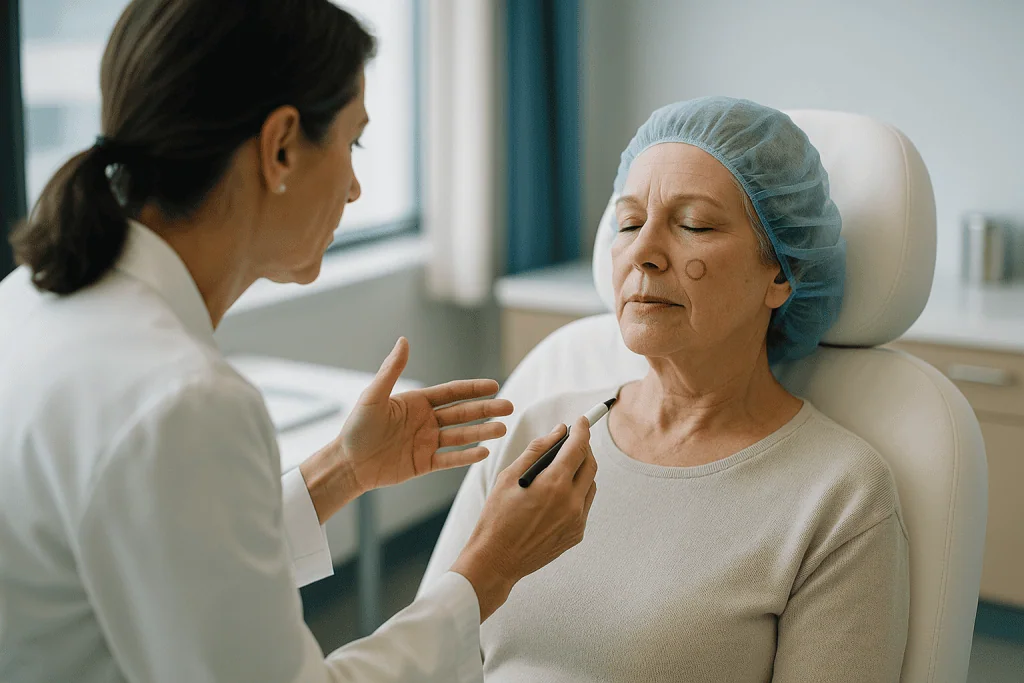
After the skin is cleaned, the surgeon injects local anesthetic around the visible tumor. Once the area is numb, a thin, saucer-shaped layer of skin is removed with a scalpel, including the tumor and a very narrow rim of surrounding tissue. The surgeon marks the edges with tiny nicks and colored inks so the piece can be mapped back to your skin like a puzzle. A temporary dressing goes on, and you go back to the waiting area.
The removed tissue is taken to an on-site laboratory, frozen, cut into slices thinner than a sheet of paper, stained and placed on glass slides. This is called a frozen section, a way of examining tissue within the hour rather than sending it away for days. The surgeon, who is also trained to read the slides, examines the entire undersurface and edges of the specimen.
Two outcomes follow. If the edges are clear, no more skin is taken and the wound is repaired. If cancer cells appear at one edge, the map shows exactly where, and the surgeon removes another thin layer from only that spot. Johns Hopkins Medicine explains that this targeted approach spares healthy skin that a conventional excision, which removes a set wider margin all at once, would take on faith.
The cycle repeats until the margins, meaning the edges of the removed tissue, are free of cancer under the microscope. Most people need one to three stages, according to Cleveland Clinic, though a tumor with roots spreading further than expected can require more. Only after the final clear stage does the conversation turn to closing the wound.
Does the numbing injection hurt? Local anesthesia explained
Yes, for about ten seconds. Then it stops, and that is the part people remember least fairly.
The anesthetic most commonly used is lidocaine, a local anesthetic that blocks the sodium channels nerves use to send pain signals. It is usually mixed with epinephrine, a substance that narrows small blood vessels so the numbing lasts longer and bleeding is reduced. The initial sting has two causes: the needle entering skin, and the slightly acidic solution spreading through tissue. Surgeons soften both with a very fine needle, slow injection and, in many settings, a buffered solution that stings less. A few practices also apply a cold spray or vibrating device to distract nerves during the injection.
Within a couple of minutes, sensation in the area changes to a heavy, rubbery nothing. You will still feel touch, pressure and movement in the surrounding skin, which is why patients often describe tugging rather than pain during the procedure. That sensation is normal and not a sign the anesthetic has failed.
Local anesthetic does wear off, typically over a few hours, and if a second or third stage is needed, more may be added. Tell the team immediately if you feel anything sharp. Topping up is quick and routine, and no one expects you to grit your teeth.
Some people feel their heart race or become jittery shortly after the injection. This is usually the epinephrine, not an allergy, and it settles within minutes. Mention any history of reactions to dental anesthetic beforehand so the team can plan.
Because you are awake, you avoid the grogginess, nausea and breathing risks of general anesthesia, which is one reason Mohs is offered to many older adults and people with heart or lung conditions who might not be good candidates for a full anesthetic.
Who Mohs surgery is usually for, and who is usually asked to wait
Mohs is a precision tool, and like any precision tool it is chosen for particular jobs rather than every job.

The technique is used most often for basal cell carcinoma and squamous cell carcinoma, the two most common skin cancers, especially when they sit somewhere that makes sparing healthy tissue matter. Mayo Clinic lists the typical situations: tumors on the face, ears, scalp, hands, feet or genitals, where every millimeter of skin affects function or appearance; cancers that have come back after earlier treatment; tumors with ill-defined edges; large or fast-growing lesions; and aggressive subtypes seen on the original biopsy. It is also considered for some less common skin cancers and, in selected cases, for certain melanomas, though that use varies by center and tumor type.
Not everyone with a skin cancer is steered toward Mohs. Small, well-defined basal cell carcinomas on the trunk or limbs are often treated just as appropriately with a standard excision, scraping and heat treatment, prescription creams or radiation, and the NHS describes these alternatives for non-melanoma skin cancer. Choosing Mohs for a low-risk spot on the back would spend a long day for little gain.
Who is asked to wait? A few common examples. Someone with an active skin infection at the site is usually treated first. A person on blood-thinning medicines is not told to stop them; instead the surgeon coordinates with the prescribing clinician, because the bleeding risk from a small skin wound is generally considered lower than the clot risk from stopping. People with pacemakers or defibrillators may need adjustments to how bleeding is controlled. Pregnancy, a recent heart attack or a poorly controlled medical condition can also shift timing.
None of these are barriers so much as scheduling questions, and the final call sits with your treating team.
How long does a Mohs procedure usually take?
Longer than the cutting suggests, and almost all of the extra time is spent in a chair.
Mayo Clinic advises patients to block out several hours, noting that the procedure can take around four hours and sometimes longer, with no reliable way to predict in advance. The active surgical portions are short. Removing a layer typically takes a few minutes. Repairing the wound at the end may take twenty minutes to over an hour depending on its size and the type of closure. The rest is laboratory time.
Each stage of processing, from freezing the tissue to the surgeon reading the slides, takes about an hour according to Cleveland Clinic. So a person whose first layer comes back clear may be finished in two to three hours, while someone who needs three stages plus a complex repair can be there for most of the working day.
Several things stretch the timeline. A tumor whose roots extend further than the visible edges adds stages. A busy day means several patients’ specimens are moving through the same laboratory. A repair involving a flap, where nearby skin is loosened and moved to fill the defect, or a graft, where skin is borrowed from elsewhere, takes longer than a straight-line closure.
Timing also affects discomfort in a small way. Each additional stage means the anesthetic may need topping up, and each pressure dressing sits on the wound a little longer. People sometimes report a dull, tight ache late in the day that is less about the surgery than about hours of bandage pressure and a stiff neck from waiting.
Plan for the whole day, bring a companion who can drive if you prefer not to, and treat any early finish as a bonus rather than the expectation.
What the waiting stages feel like, and how to make them easier
Nobody warns you that the most memorable part of Mohs surgery might be the vending machine.
After each layer is removed, a bulky bandage is applied and you are sent back to wait. The area is numb, so there is rarely pain. What people describe instead is a strange sensory mix: pressure from the dressing, a slight throb if the bandage is snug, and the odd experience of a numb face when sipping coffee. Because most Mohs sites are on the head and neck, the bandage may be visible, and sitting in a waiting room with a wad of gauze taped to your nose is its own small test of composure.
Anxiety tends to peak during the waits rather than in the operating chair. Each time a name is called, everyone looks up, and the thought that your margins might not be clear circles round. Mayo Clinic explicitly recommends bringing something to occupy the time, and patients who plan for the wait usually rate the day as easier.
A few practical points that come up repeatedly in patient education from Cleveland Clinic and Mayo Clinic:
- Eat breakfast and bring snacks unless told otherwise; a local anesthetic does not require fasting, and low blood sugar makes anyone shaky.
- Bring reading material, headphones, a charger and a light layer, since waiting rooms run cold.
- Wear a shirt that buttons or zips so it can come off without brushing a facial dressing.
- Take your usual morning medicines unless your team has said otherwise.
- Skip makeup, lotion or jewelry near the site.
Tell the staff if the bandage feels too tight, if numbness is fading, or if you feel faint. Between stages is precisely the time to speak up, because adjustments are easy and you are their patient for the day, not a number in a queue.
Closing the wound: stitches, flaps, grafts or healing on its own
Once the last slide is clear, the surgeon looks at the hole left behind and makes a decision that shapes the next few weeks of comfort more than anything that came before.
The simplest option is to let the wound heal on its own, called second-intention healing. This suits small, shallow defects in concave areas such as the inner corner of the eye or the temple. There are no stitches to remove, but the open wound needs daily dressing changes and takes longer to close, and it can weep and feel raw for a week or two.
A straight-line closure, where the edges are brought together with stitches, is the most common repair. Small round defects are usually lengthened into an ellipse so the skin lies flat. This heals quickly and the resulting line is often placed along a natural crease.
Larger defects, or those on a tight surface like the nose, may need a flap, where adjacent skin is lifted and rotated to cover the wound while still attached to its own blood supply. Flaps involve more cutting and more stitches, and patients commonly report more swelling, bruising and a heavier ache for the first few days. A graft uses a patch of skin taken from another area, often behind the ear or the collarbone, so there are two wounds to heal, and the graft site can look purple or crusted for weeks while it establishes blood flow.
Occasionally the wound is bandaged and repaired a day or two later by another surgeon, for example when the defect involves the eyelid and a specialist reconstruction is planned. Cleveland Clinic describes all of these paths as routine parts of Mohs planning.
The team will explain which closure they chose and why. Ask, because the answer tells you how much aftercare to expect.
Mohs surgery aftercare: discomfort in the first 48 hours
The anesthetic usually fades a few hours after you get home, and this is the window when the question of pain becomes real.
For most people, the sensation is a steady ache or throb, worse when bending over or lying flat, easing when the head is propped up on pillows. Mayo Clinic notes that over-the-counter pain relief is typically sufficient. Acetaminophen is the option most often suggested because it does not affect clotting; medicines in the aspirin and ibuprofen family can increase bleeding, so ask your team which is appropriate rather than reaching for whatever is in the cabinet. Never stop or restart any prescribed medicine, including blood thinners, without checking with the clinician who prescribed it.
Bleeding is the most common early nuisance. A little oozing into the dressing is expected. If it soaks through, standard instructions are to press firmly and continuously on the area for a set period, usually described as around fifteen to twenty minutes, without peeking. Repeating this once more is reasonable; persistent bleeding after that is a reason to call.
Swelling and bruising peak around the second day, and on the face gravity pulls them downward. A wound on the forehead can produce a black eye; one on the cheek may swell toward the jaw. This looks alarming and is usually harmless. Cool packs wrapped in a cloth, used in short intervals over the dressing rather than directly on the wound, help.
The first dressing typically stays on for a day or two, then daily cleaning and a fresh layer of petroleum-based ointment and a bandage begin. Keeping the wound moist and covered, rather than letting it dry into a scab, is now the standard advice, because moist wounds heal faster and scar less.
Rest, avoid heavy lifting or bending, and treat these two days as genuinely restorative rather than an inconvenience.
What the following days and weeks usually look like
Discomfort after Mohs follows a fairly predictable arc, and knowing the shape of it makes each phase easier to tolerate. The ranges below are typical, drawn from Mayo Clinic and Cleveland Clinic patient guidance, and your own timeline will depend on wound size, location and how it was closed.
| Timeframe | What is typical | What usually helps |
|---|---|---|
| Day of surgery | Numbness, then ache as anesthetic wears off; slight oozing | Head elevated, over-the-counter relief as advised, pressure for bleeding |
| Days 1 to 3 | Peak swelling and bruising; throbbing when bending; tightness at stitches | Cool packs over dressing, daily wound care, no strenuous activity |
| Week 1 to 2 | Ache fades to tenderness; itching begins; stitches removed (face about a week, body up to two weeks) | Keep wound moist and covered; avoid picking |
| Weeks 3 to 8 | Scar red, firm, sometimes raised; numbness or tingling around site | Gentle massage once cleared; sun protection |
| Months 3 to 12 | Scar softens, flattens and fades toward skin tone | Patience; scar review if concerns |
Itching in the second week catches people off guard. It is a sign that nerve endings and new skin are regrowing, not infection, though scratching can pull at stitches. A tight or lumpy feeling under the scar, especially after a flap, is scar tissue and generally softens over months.
Numbness beyond the wound edges is common and can last weeks or longer. Fine sensory nerves in the skin are cut during any surgery and regrow slowly. Most sensation returns, though a small permanently numb patch is possible with larger repairs.
Activity restrictions usually ease after stitches come out, but scars remain fragile for several weeks. Sun exposure on a fresh scar darkens it permanently, so covering it or using sunscreen once the wound has closed is one of the few things fully within your control.
What are the downsides of Mohs surgery?
Every treatment trades one set of problems for another, and it helps to see the Mohs ledger clearly.
The most obvious cost is time. A day spent largely waiting is inconvenient, and people who need multiple stages may find the fatigue of the day more draining than the surgery.
Scarring is unavoidable with any surgery that removes skin. Mohs typically produces a smaller wound than a conventional excision for the same tumor, because no healthy margin is taken speculatively, but the final defect can still be larger than the visible spot, sometimes surprisingly so, when a tumor’s roots spread beneath normal-looking skin. Patients occasionally feel misled when a pea-sized lesion leaves a repair several centimeters long. The size reflects the cancer, not the technique.
Complications are uncommon but real. Mayo Clinic and Cleveland Clinic list bleeding, infection, temporary or permanent numbness from cut nerves, weakness if a motor nerve lies near the site, pain or tenderness at the scar, and, less often, a raised or thickened scar. Wound edges can occasionally separate or a graft may fail to take, requiring further care. Any of these risks rises with wound size, smoking, diabetes and some medicines.
Mohs is also not the right tool for every tumor. Low-risk skin cancers on the trunk and limbs are often handled just as appropriately with simpler methods, and the NHS outlines standard excision, scraping with heat treatment, freezing, topical creams, photodynamic therapy and radiotherapy as alternatives for non-melanoma skin cancer, each with its own profile of convenience, scarring and follow-up. Radiation, for instance, avoids a wound entirely but requires multiple visits and leaves its own long-term skin changes.
Finally, no procedure removes the risk of new skin cancers elsewhere. Someone who has had one is at higher risk of another, which is why lifelong skin checks remain part of the plan regardless of how the first was treated.
Should I be nervous about Mohs surgery?
A little, and that is allowed. But the specific fears people carry into the day rarely match what the day delivers.
The most common worry is pain, and as earlier sections show, the sharpest moment is the numbing injection. The second is being awake. Yet being awake is precisely what makes the procedure safe for so many people: no airway tube, no grogginess, no nausea, and you can tell the team if anything feels off. Many patients end up chatting with staff or listening to music.
Fear of the result runs deeper. Skin cancer on the face touches identity in a way a spot on the shoulder does not. Surgeons who perform Mohs also perform reconstruction, and their training focuses on placing scars along natural lines and preserving function. Ask to see what the repair might look like. Ask how the scar is expected to change over a year. Realistic expectations, set before surgery, are a strong predictor of how people feel afterward.
Anxiety management is practical, not soft. Breathing slowly and steadily during the injection reduces the sting for many people. Eating beforehand prevents the lightheadedness that anxious, fasting patients often mistake for a reaction. Bringing a companion gives you someone to talk to during waits and to remember instructions when you are tired at the end.
If anxiety about medical procedures is severe, say so when the appointment is booked. Teams can allow extra time, explain each step as it happens, or discuss with your prescribing clinician whether a mild calming medicine is appropriate; that decision, and anything about how it would be used, rests with them, not with an article.
Nerves before surgery are normal. Dread is usually a sign that questions have gone unasked, and the next sections are designed to help you ask them.
What people often get wrong about Mohs surgery
Myths gather around any procedure with an unusual name, and Mohs, named after the surgeon who developed it, has collected several.
Myth: it is a kind of laser or chemical treatment. No. Mohs is scalpel surgery. The precision comes from the microscope, not from a device.
Myth: being awake means feeling everything. Local anesthesia numbs the area completely for pain. Pressure and tugging are felt; cutting is not. Mayo Clinic and Cleveland Clinic both describe the procedure as done under local anesthetic with minimal pain.
Myth: you will be put to sleep for the repair. Reconstruction, even a flap or graft, is almost always done under the same local anesthetic in the same room. Sedation or general anesthesia is reserved for unusually complex cases.
Myth: a small spot means a small scar. The visible part of a skin cancer is sometimes only the tip. Final wound size depends on how far the tumor extends beneath the surface, which no one can know until the slides are read.
Myth: a scab is a sign of good healing. Modern wound care keeps the site moist and covered with ointment. Wounds allowed to dry out heal more slowly and scar more visibly.
Myth: once Mohs is done, skin cancer is behind you. The procedure addresses one tumor. People who have had a skin cancer remain at higher risk for others, and ongoing skin checks are standard.
Myth: you must stop blood thinners beforehand. Most guidance now advises against stopping prescribed anticoagulants for skin surgery because the clot risk outweighs the bleeding risk. The surgeon and prescribing clinician coordinate this; it is never a decision to make alone.
Myth: the day is exhausting because the surgery is hard on the body. The fatigue is mostly from waiting, anxiety and skipped meals. Plan for those and the day gets easier.
Questions to ask your care team
The pre-operative visit or phone call is the moment to trade vague worry for specific answers. Bring a list; people forget half their questions the moment a clinician walks in.
- Why is Mohs recommended for my particular skin cancer rather than a standard excision, cream or radiotherapy, and what are the trade-offs in my case?
- Roughly how long should I plan to be there, and is there any way to estimate how many stages I might need?
- What type of anesthetic will be used, and what should I tell you about past reactions to dental or local anesthetics?
- Should I take my usual medicines, including blood thinners, the morning of surgery? Have you spoken with the clinician who prescribes them?
- Which over-the-counter pain relievers are appropriate for me afterward, and which should I avoid?
- How will the wound most likely be closed, and what would change that plan?
- What does the scar typically look like at one week, one month and one year for a repair like mine?
- Who will change the first dressing, and exactly how should I care for the wound at home?
- When will stitches come out, and when can I shower, exercise, drive and return to work?
- What signs of bleeding or infection should prompt a call, and what number do I use after hours?
- Will I lose sensation or movement around the site, and is that likely to recover?
- How often will I need skin checks afterward, and with whom?
Write down the answers or ask a companion to. Discomfort is far easier to tolerate when it is expected, and a clear picture of what the team considers normal is the best defense against a frightening evening spent guessing.
When to call your doctor
Most recoveries from Mohs surgery are uneventful, and mild ache, oozing, bruising and itching are expected. A handful of signs, though, mean the team wants to hear from you promptly rather than at the next scheduled visit.
Call the same day if bleeding soaks through the dressing and does not stop after two rounds of firm, uninterrupted pressure of about fifteen to twenty minutes each. Call if pain escalates after the second day instead of easing, or if it is not controlled by the over-the-counter relief your team suggested. Watch the skin around the wound: spreading redness, warmth, increasing swelling, thick yellow or green discharge, or a foul smell can point to infection, which is far easier to treat early. A fever or chills after skin surgery also warrants a call.
Seek urgent care, or emergency services if it is severe, for any of the following:
- A rapidly enlarging, tense, painful swelling under the wound, which may be a hematoma, a collection of blood that sometimes needs to be released.
- Sudden difficulty breathing, swelling of the lips or tongue, hives or faintness, which could signal an allergic reaction.
- New weakness in the face, drooping, or inability to close an eye on the side of the surgery.
- Wound edges pulling apart, or a skin graft turning black.
- Chest pain, severe headache or confusion.
These red flags are uncommon. Cleveland Clinic and Mayo Clinic both describe serious complications as rare, and the purpose of listing them is not to alarm but to remove the guesswork from a worrying evening.
When in doubt, call. The team that operated would far rather reassure you over the phone than see a small problem grow. Every decision about your wound, your medicines and your follow-up belongs with them, and reaching out is part of the care, not an interruption to it.
Frequently asked questions
Does Mohs surgery hurt more than a regular skin cancer excision?
Not in most cases; both are done under the same kind of local anesthetic, so the sensation during surgery is similar. The differences lie elsewhere. Mohs takes longer because of the laboratory stages, and repeated topping up of anesthetic may be needed. Afterward, discomfort depends on wound size and closure type rather than on which technique was used, and Mohs often leaves a smaller wound for the same tumor.
How long does Mohs surgery take from start to finish?
Plan for several hours. Mayo Clinic advises that the procedure can take around four hours and sometimes longer, with no reliable way to predict the number of stages beforehand. Each stage of tissue processing takes about an hour, and the repair at the end may add twenty minutes to over an hour. Someone whose first layer is clear may finish far sooner, so treat an early finish as a bonus.
What is the typical Mohs surgery recovery time?
Most people return to light daily activity within a day or two, with the worst ache and swelling in the first two to three days. Stitches on the face usually come out after about a week and on the body within two weeks, according to Cleveland Clinic. Strenuous exercise is generally paused until then. Scars continue to soften and fade for up to a year, so full cosmetic recovery is measured in months.
What does Mohs surgery aftercare involve at home?
Aftercare usually means keeping the first dressing dry and in place for a day or two, then cleaning the wound gently once daily, applying a thin layer of petroleum-based ointment and covering it with a fresh bandage. Keeping the head elevated, avoiding bending and lifting, and using cool packs over the dressing reduce swelling. Your team will give written instructions specific to your closure, and those override any general advice.
What do people wish they knew before Mohs surgery?
Three things come up repeatedly: bring food and entertainment for the long waits, expect the wound to be larger than the original spot, and know that bruising on the face travels downward and looks worse than it feels. Patients also say they wished they had asked what the scar would look like at one month and one year, because knowing the arc of healing made the early redness far less distressing.
Can I drive myself home after Mohs surgery?
Often yes, because local anesthesia does not impair alertness, but it depends on the site and repair. A bulky dressing near the eye can block vision, a long day can leave you tired, and any sedative medicine your team may have discussed would rule out driving. Many people prefer a companion regardless, both for the drive and to help remember aftercare instructions given at the end of a long day.
Will I need general anesthesia for the reconstruction?
Almost never. Flaps and grafts after Mohs are routinely performed under the same local anesthetic in the same room, often topped up before the repair begins. General anesthesia or sedation is reserved for unusually large or complex reconstructions, or for people who cannot tolerate being awake for medical reasons. If reconstruction requires another specialist, the wound may be dressed and repaired a day or two later, still typically under local anesthetic.
Why is my Mohs wound so much bigger than the spot I could see?
Skin cancers, particularly basal cell carcinomas, often send fine extensions beneath skin that looks normal on the surface. The microscope reveals these roots one layer at a time, and each positive edge requires a little more tissue. The final defect therefore reflects the true footprint of the tumor, not the technique. A conventional excision would have removed a fixed wide margin all at once, sometimes taking more skin than needed.
Is it normal for the area to be numb or itchy weeks after Mohs surgery?
Yes. Fine sensory nerves in the skin are cut during any surgery and regrow slowly, so numbness or tingling around the scar can last weeks or months and occasionally a small patch stays numb permanently after larger repairs. Itching in the second and third weeks is a sign of new skin and nerve growth. Scratching can pull stitches or thicken the scar, so a cool compress is a safer response.
Should I be nervous about Mohs surgery if I hate needles?
It is reasonable to be nervous, and worth telling the team in advance. The numbing injection is the only needle most people feel, and surgeons use fine needles, slow injection and often buffered solutions to lessen the sting. Slow breathing, looking away and having a companion present all help. If procedural anxiety is severe, your team and prescribing clinician can discuss options; that decision belongs with them rather than with a checklist.
References
This article is for general information only and is not a substitute for professional medical advice. Please consult a qualified doctor about your individual situation.

More from the Blog
What a Sentinel Lymph Node Biopsy Tells Your Team About Melanoma Spread
A sentinel lymph node biopsy for melanoma removes the first one or two lymph nodes that drain the skin where the melanoma grew, so…

How Long Does Mastectomy Recovery Take? Drains, Arm Exercises, Driving and Work Milestones
Most people need about four to six weeks to recover from a mastectomy, and closer to six to eight weeks when reconstruction is done…