

Recovering After Testicular Cancer Surgery: Activity Limits in the First Weeks
Key Takeaways
- Testicular cancer surgery is done through the groin, not the scrotum, because the testicle's lymph drainage runs to the back of the abdomen and a scrotal cut could open a second spread pathway.
- Most people go home the same day or the next, and pain typically peaks in the first two to three days before easing over one to two weeks.
- Heavy lifting, straining and strenuous exercise are commonly restricted for roughly two to four weeks because the deeper abdominal wall layers heal long after the skin has closed.
- Walking a little and often from day one lowers the combined clot risk of surgery, cancer and immobility and also helps constipation, swelling and lung recovery.
- One healthy remaining testicle usually keeps testosterone in the normal range and can produce sperm, though sperm banking is raised before surgery because the cancer and later treatments can lower counts.
- Rapidly tightening scrotal swelling, worsening pain, spreading redness, fever, or a swollen painful calf are the signs that need a same-day call rather than watchful waiting.
After an inguinal orchiectomy for testicular cancer, most people go home the same or next day, feel sore for about a week, and are commonly asked to avoid heavy lifting, straining and strenuous exercise for roughly two to four weeks while walking daily from day one. The exact orchiectomy recovery timeline depends on your surgeon's instructions, your job, and whether further treatment or surveillance follows.
The ride home is where it usually sinks in. He is in the passenger seat, holding the seatbelt an inch away from his groin, a bag of gauze and a folded discharge sheet on his lap. Yesterday the word was ‘mass’. Today it is ‘we removed it’, and the next question is startlingly ordinary: can I carry the groceries in?
The orchiectomy recovery timeline is shorter than most people fear and slower than most people want. The operation itself is brief. The soreness is real but usually manageable. The hard part is the middle stretch, when you feel nearly normal, the bruising has turned yellow, and the temptation to lift, run or get back to a physical job arrives two weeks before your tissues are ready.
This explainer walks through what actually happens in surgery, what the first hours and weeks tend to look like, which limits genuinely matter and which are folklore, and the specific signs that should send you to the phone.
What actually happens during an orchiectomy for testicular cancer
An orchiectomy is the surgical removal of a testicle. When the reason is a suspected testicular cancer, surgeons almost always perform a radical inguinal orchiectomy, which means the testicle and its spermatic cord are removed together through a cut in the groin rather than through the scrotum (Mayo Clinic). The spermatic cord is the bundle of blood vessels, nerves and the sperm-carrying tube that runs from the testicle up into the abdomen.
The groin route is not a stylistic choice. The lymph channels that drain the testicle travel upward to nodes at the back of the abdomen, while the skin of the scrotum drains to nodes in the groin. Cutting through the scrotum could open a second potential pathway for cancer cells, so the cord is clamped and divided high, near where it enters the abdominal wall, and the whole specimen is delivered out through the groin incision.
The operation is done under general anesthesia or, sometimes, a spinal anesthetic that numbs the lower body. It is typically completed within about an hour (Cleveland Clinic). If you want a testicular prosthesis, a soft saline- or silicone-filled implant that restores the look and feel of the scrotum, it can often be placed during the same operation or later.
One detail surprises many patients: there is no biopsy beforehand. Because sampling a testicular tumor through the scrotum carries the same spread concern, the removal itself is both the diagnosis and the first treatment. The tissue goes to a pathologist, and the report that follows, alongside blood tests called tumor markers, tells the team what type of cancer it was and whether anything more is needed. Most people go home the same day or the day after (NHS).
Is orchiectomy a major surgery?
Honest answer: it is a real operation with a real incision under anesthesia, but on the spectrum of cancer surgery it sits toward the smaller end. No body cavity is opened. No organ other than the testicle is disturbed. Compared with retroperitoneal lymph node dissection, the abdominal operation some people with testicular cancer need later, an inguinal orchiectomy is short, usually an overnight stay at most, and rarely requires intensive monitoring (Mayo Clinic).

That does not make it trivial. The recognized risks are the ones shared by most groin operations: bleeding into the scrotum forming a hematoma, wound infection, reaction to anesthesia and, later, a small chance of a groin hernia at the incision site (Cleveland Clinic). A nerve that runs alongside the cord, the ilioinguinal nerve, supplies feeling to the inner thigh and part of the scrotum. Bruising or division of it can leave a patch of numbness or tingling that fades over months in many people and persists in some.
Where the operation is undeniably major is in what it represents. It is a cancer diagnosis confirmed in a single afternoon, a change to the body that is visible in the mirror, and the opening move in a pathway that may involve surveillance scans, chemotherapy or radiation. Patients often describe the physical recovery as the easy part and the two-week wait for the pathology report as the hard one.
A useful way to hold both truths: treat the incision like the minor surgery it is, with sensible limits and early walking, and treat the diagnosis like the major event it is, with follow-up appointments kept and questions written down before each one.
Who is usually offered orchiectomy, and who is asked to wait
Orchiectomy is the standard first step for almost anyone whose ultrasound shows a solid mass inside the testicle that looks like cancer, regardless of age or how far the disease may have spread (Mayo Clinic). Testicular cancer is uncommon overall but is most frequent in men aged 15 to 49 (NHS), so the typical patient is younger than most people undergoing cancer surgery and often has fertility, work and sport high on the list of concerns.
Testicles are also removed for reasons unrelated to testicular cancer, including as a way of lowering testosterone in advanced prostate cancer, after severe trauma or twisting of the blood supply, and in some gender-affirming care. The recovery basics overlap, but the follow-up pathway described here is specific to testicular cancer.
A short wait is sometimes deliberate. Sperm banking, when a person wants it, is usually arranged before surgery, because the remaining testicle may not produce normal numbers and later chemotherapy can lower counts further (MedlinePlus). That may add a day or two. Anesthesia teams may also ask for uncontrolled diabetes, a chest infection or certain blood-thinning medicines to be addressed first, decisions that sit with the treating team.
In a small number of people with widespread, rapidly progressing disease, oncologists may begin chemotherapy before the testicle is removed, then perform the orchiectomy afterward. This is guideline-level practice for particular situations, not a sign that something has gone wrong.
A testicle-sparing operation, removing only the mass, is occasionally considered when a mass is small and the person has only one testicle or tumors in both. It carries its own trade-offs and is a specialist discussion, not a default.
Orchiectomy recovery timeline: the first 48 hours at home
Expect to feel groggy on the first evening, with a groin that aches and pulls when you sit up, and a scrotum that begins to swell and bruise over the following day. Both are ordinary. The team will usually have you in snug, supportive underwear or a jockstrap before you leave, and keeping the scrotum lifted rather than dangling is one of the simplest ways to reduce throbbing.
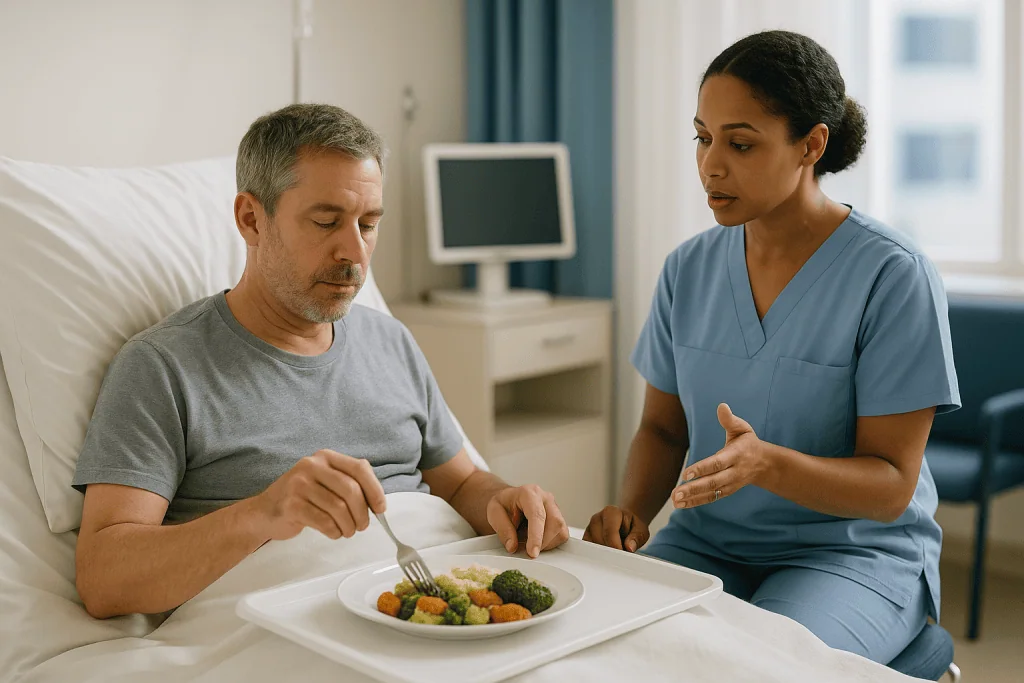
Someone should be with you for the first night. You will not be driving, and anesthesia can leave your judgment and balance off for the rest of the day. Move, though. Getting up to the bathroom, walking a lap of the house every couple of hours while awake, and changing position in bed all help your lungs, your bowels and your circulation. Sitting propped up on a sofa often feels easier than lying flat.
Cold packs wrapped in a cloth and placed over the groin, never directly on skin, ease swelling in the first day or two. Follow the timing on your discharge sheet. Most teams allow showering once the dressing rules permit, often within a day or two, with the incision patted dry afterward; soaking in a bath or pool waits until the wound has sealed (Cleveland Clinic).
Appetite may be poor and constipation is common after anesthesia and pain medicines. Fluids, fruit, fiber and walking do more than most people expect. Straining on the toilet pulls directly on a fresh groin incision, so it is worth taking seriously.
Keep the paperwork handy. Your pathology appointment and the phone number for the ward or surgical team are the two things you will want to find without searching.
How painful is an orchiectomy?
Most people describe moderate soreness rather than severe pain: a deep ache in the groin, a pulling sensation when standing from a chair or climbing stairs, and sharper twinges with coughing, sneezing or laughing. The discomfort typically peaks in the first two or three days and eases steadily over the first week or two (Cleveland Clinic). Pressing a folded towel or pillow against the incision when you cough splints the area and takes the edge off.
Two sensations catch people off guard. The first is a dull ache low in the abdomen or flank on the operated side. The testicle shares nerve pathways with the lower abdomen, and the divided cord can refer discomfort upward for a while. The second is numbness or tingling across the inner thigh and part of the scrotum from irritation of the ilioinguinal nerve, described above. It is not dangerous, and sensation often improves over months.
Pain control is usually built on simple, non-opioid pain relievers, either acetaminophen or an anti-inflammatory, with a short course of a stronger medicine offered to some people for the first days. Anti-inflammatories reduce swelling as well as pain, which is why teams often favor them when there is no medical reason to avoid them. Which medicines, how much and for how long is a decision for your prescribing clinician, and the instructions on your discharge sheet override anything you read online, including this article.
The pattern matters more than the intensity. Pain that improves, plateaus, then improves again is normal healing. Pain that was settling and then escalates, especially with a rapidly tightening scrotal swelling, fever or spreading redness, is a signal to call.
What not to do after an orchiectomy
The limits are few, and each has a reason.
- Do not lift heavy things or strain. Groin incisions run through the same abdominal wall layers that can weaken into a hernia. Many surgical teams advise avoiding heavy lifting and strenuous exercise for roughly two to four weeks (Cleveland Clinic). A practical rule many people are given: if you have to brace your abdomen or hold your breath to lift it, it is too heavy for now.
- Do not drive while taking sedating pain medicines, or until you can stamp on a brake pedal without hesitation. Ask your team when that is likely and check whether your insurer has its own requirement.
- Do not soak the incision. Showers are usually fine early; baths, hot tubs and swimming wait until the skin has fully closed.
- Do not resume sexual activity, including masturbation, before your team says so. Arousal and ejaculation increase blood flow and muscle tension around a healing scrotum. Several weeks is a common guide, but the surgeon’s word is the one to follow.
- Do not cycle, ride, or play contact sport until cleared. A saddle or a knee to the groin on a healing wound is a setback nobody enjoys.
- Do not peel off skin glue or adhesive strips. They lift on their own as the skin renews.
- Do not smoke if you can possibly avoid it. Nicotine narrows the small blood vessels that new tissue depends on.
- Do not skip the follow-up appointment. The pathology report and tumor marker results decide everything that comes next.
Notice what is not on the list: lying in bed, avoiding stairs, or staying off your feet. Gentle daily movement is part of the treatment, not a threat to it.
Orchiectomy recovery timeline week by week
Timelines are patterns, not promises. Two people with identical operations can be a week apart in how they feel, and the person with a physical job or a complication will run slower. What follows reflects typical guidance from mainstream surgical sources and is meant to help you plan, not to replace your team’s instructions.
| Stage | What it commonly feels like | Typical activity guidance |
|---|---|---|
| Days 0 to 2 | Groggy, groin ache, swelling and bruising starting | Home same or next day (NHS); short walks around the house; supportive underwear; no driving |
| Days 3 to 7 | Pain peaking then easing; bruising spreading and darkening | Longer walks outdoors; showering as instructed; desk-type tasks from home if comfortable |
| Week 2 | Soreness with stairs and rising; incision itchy; bruising yellowing | Many return to sedentary work; driving once off sedating medicines and able to brake hard |
| Weeks 3 to 4 | Occasional twinges; numbness patch may remain; swelling settling | Heavy lifting and strenuous exercise still commonly restricted (Cleveland Clinic); light exercise as cleared |
| Weeks 4 to 6 and beyond | Near-normal comfort; scar firm and pink | Gradual return to full activity, sport and physical work once the team confirms healing |
Two things sit outside this table. The pathology result, usually available within a couple of weeks, may open a new chapter of surveillance scans, chemotherapy or radiation with its own timeline. And the emotional recovery rarely follows the tidy staircase above; a hard day in week five is common and does not mean anything has gone wrong.
Why walking matters: swelling, clots and the case against bed rest
The single most useful thing you can do after an orchiectomy is also the least dramatic: walk, a little and often, from the first day.
Start with the clot risk. Blood clots in the deep veins of the leg, and the more dangerous clots that break off and travel to the lungs, become more likely when three things stack up: a recent operation, a cancer diagnosis and time spent still (CDC). An orchiectomy patient has all three for a while. The calf muscles act as a pump, squeezing blood back toward the heart each time you take a step. Lying on the sofa for a week switches that pump off. In some higher-risk people, teams also prescribe a short course of a blood-thinning medicine; whether you need one is a clinical judgment made before you leave the hospital.
Walking does quieter work too. It keeps the lungs expanding after anesthesia, which lowers the chance of a chest infection. It stimulates the bowel, which matters when constipation and a groin incision are a painful combination. It keeps the hip and groin from stiffening around the scar, and it gives the swelling in the scrotum somewhere to drain rather than pooling.
The pattern to aim for is frequency over distance. In the first days, a slow lap of the house every hour or two while you are awake beats one long march. By the second week most people are managing comfortable walks outdoors and can lengthen them as the pulling sensation allows. Keep fluids up, because dehydration thickens blood and slows healing.
Bed rest feels like recovery. Physiologically, it is closer to the opposite.
Wound care, bruising and what a normal scar looks like
The incision sits in or just above the groin crease on the operated side, a few inches long, closed with dissolving stitches under the skin and often a layer of skin glue or adhesive strips on top. Keep it clean and dry, let water run over it in the shower once permitted, and pat rather than rub. Loose cotton underwear over a supportive layer is more comfortable than anything with a hard waistband pressing on the scar.
Bruising is the part that alarms people. Gravity pulls blood downward, so a scrotum that looked ordinary on day one can be purple, swollen and startling by day three, sometimes with color tracking toward the inner thigh. The colors then march through the familiar sequence, purple to green to yellow, over a week or two. Swelling recedes more slowly, over several weeks (Cleveland Clinic). A firm ridge you can feel under the scar is healing tissue, not a lump you need to worry about, and it softens with time.
What is not normal: a scrotum that becomes rapidly larger, tense and very painful in the first days, which may signal bleeding into the sac (a hematoma) and needs same-day assessment; redness that spreads outward from the incision, skin that is hot to touch, pus or cloudy fluid, or a fever, which point to infection; or an incision that opens.
The scar itself fades from red to pink to pale over many months. A small patch of numb skin around it or on the inner thigh, from the nerve discussed earlier, may outlast the scar’s color change.
What happens to a man after an orchiectomy? Hormones, fertility and sex
The short version: one healthy testicle usually does the work of two. Testosterone, the hormone that governs sex drive, energy, muscle and mood, is made by the remaining testicle, and for most men with one normal testicle levels stay in the normal range without treatment (NHS). If both testicles are removed, or the remaining one does not function well, hormone replacement becomes a conversation with your team.
Fertility is more nuanced. The remaining testicle can produce sperm, but men with testicular cancer often have lower sperm counts even before surgery, and chemotherapy or radiation, if needed, can lower them further, sometimes temporarily and sometimes not (MedlinePlus). That is why sperm banking is raised before the operation rather than after, and why it is worth asking about even if children feel a long way off.
Sexual function is mechanically unchanged by losing one testicle. Erections, orgasm and ejaculation depend on nerves and blood vessels that an inguinal orchiectomy does not touch. The operation that can affect ejaculation is the later abdominal lymph node surgery some patients need, and surgeons use nerve-sparing techniques where possible. Desire may dip for reasons that have nothing to do with anatomy: pain, fatigue, worry about results, feeling different in your own skin.
Appearance is a personal matter. Some men want a prosthesis, some are indifferent, some decide months later. All three are reasonable.
The emotional aftermath deserves the same attention as the incision. Grief for a part of the body, anxiety while waiting for pathology, and a sense of being suddenly a ‘patient’ are common. Partners feel it too. Talking, whether to your team, a counselor or others who have been through it, is part of recovery, not a detour from it.
Going back to work, driving and sport after testicular cancer surgery recovery
Work depends almost entirely on what your work involves. People with desk-based jobs commonly return within one to two weeks, sometimes part-time or from home first (Cleveland Clinic). Jobs that involve lifting, ladders, long periods on your feet or vibration behind a wheel typically wait until the heavy-lifting restriction lifts, which many teams set at around four weeks, and sometimes longer for the most physical roles. Ask your surgeon for a written note if your employer needs one; being specific about what you can and cannot do beats a vague ‘light duties’.
Driving has two gates. The first is medicines: no driving while taking anything that makes you drowsy. The second is function: you must be able to perform an emergency stop, twisting to check mirrors and braking hard, without hesitating because of pain. For most people that is a matter of days to a couple of weeks. Some insurers have their own rules, so a quick call avoids an unpleasant surprise.
Sport comes back in layers. Walking is encouraged from day one. Gentle jogging and stationary cycling without a hard saddle often follow once the groin no longer pulls, typically after the first few weeks. Contact sports, weightlifting, cycling on a road saddle and anything with a risk of a blow to the groin wait for the team’s clearance and a fully healed incision. A protective cup is a sensible habit afterward for sports that involve contact, and many men continue self-examination of the remaining testicle monthly.
Layered over all of this is the follow-up plan. Surveillance scans and blood tests may simply need appointments kept. Chemotherapy or radiation, if recommended, brings its own fatigue and its own advice about activity, and your oncology team will set that pace.
What people often get wrong about orchiectomy recovery
‘I should stay in bed for a week.’ Rest is not stillness. Clots, constipation, stiffness and chest infections all thrive on immobility (CDC). Short frequent walks are part of the healing plan.
‘One testicle means low testosterone and no children.’ A single healthy testicle usually maintains normal hormone levels and can produce sperm (NHS). Fertility can be affected by the cancer itself and by later treatments, which is exactly why banking is discussed beforehand, not because removal of one testicle ends it.
‘They must have done a biopsy to know it is cancer.’ No. The whole testicle is removed and examined, because sampling through the scrotum risks altering how the cancer could spread. The operation is the diagnosis.
‘The scrotal bruising means something went wrong.’ Dramatic discoloration that appears over the first few days and drifts downward is gravity at work. The warning signs are rapid tightening, escalating pain, heat, pus or fever, not color.
‘Once the testicle is out, the cancer part is over.’ Surgery is the first step. Pathology and tumor markers determine whether surveillance, chemotherapy or radiation follows, and testicular cancer is among the most treatable cancers largely because that follow-up is done carefully (Mayo Clinic). Missing appointments is the most common way to undo a good start.
‘Sex will be different.’ Erections, orgasm and ejaculation do not depend on the number of testicles. What changes early is comfort and confidence, both of which return.
‘If I feel fine at two weeks, I am healed at two weeks.’ Skin closes long before the deeper abdominal wall layers regain their strength. The lifting limit exists for what you cannot see.
‘Deciding about a prosthesis is now or never.’ It can be placed later. There is no deadline.
Questions to ask your care team
Appointments after cancer surgery move quickly, and the questions you meant to ask tend to surface in the car park. Writing them down helps. These are the ones patients most often wish they had raised, grouped by moment.
Before surgery
- Is sperm banking something I should arrange first, and how quickly can it be done?
- Will you place a prosthesis if I want one, and can I decide later instead?
- Which of my usual medicines or supplements should stop before the operation?
Before you go home
- What exactly can I lift, and for how many weeks? Can you put that in writing for my employer?
- When may I shower, bathe and swim?
- When can I drive, and when can I resume sex?
- Do I need a blood-thinning medicine, and what clot symptoms should I watch for?
- Which pain medicines am I taking, in what order, and what should I do if they are not enough?
- Which number do I call at 2 a.m. if something worries me?
At the results appointment
- What type of testicular cancer was it, and what stage?
- What are my options now: surveillance, chemotherapy, radiation or further surgery, and what does each involve?
- How often will I need scans and blood tests, and for how long?
- How might further treatment affect my fertility, energy and work?
- Is there someone I can talk to about the emotional side, for me or my partner?
None of these has a universal answer. That is the point of asking. Your team’s responses, tailored to your operation and your pathology, are the instructions to follow when anything here seems to differ.
When to call your doctor
Most recoveries are uneventful, but a short list of signs should prompt a call to your surgical team the same day, or emergency care if they are severe.
Call your surgical team promptly if you notice:
- Scrotal swelling that is enlarging quickly, feels tense and hard, and is increasingly painful, particularly in the first few days, which may indicate bleeding into the scrotum
- Pain that had been improving and is now clearly worsening despite your prescribed medicines
- Redness spreading outward from the incision, skin that is hot to touch, pus or cloudy drainage, or a wound that has opened
- A fever or shaking chills
- Inability to pass urine, or burning and blood when you do
- Persistent nausea and vomiting, or no bowel movement for several days despite fluids and movement
Seek emergency care immediately for possible blood clot signs (CDC):
- Swelling, pain, warmth or redness in one calf or thigh
- Sudden shortness of breath, chest pain that is worse when breathing in, a racing heartbeat, or coughing up blood
Also reach out, without waiting for a physical symptom, if:
- Low mood, anxiety or sleeplessness is making the days hard to get through
- You have questions about your results, your follow-up schedule or your medicines that cannot wait for the next appointment
Calling about something that turns out to be normal is never a waste of anyone’s time. Teams would far rather reassure you at noon than treat a complication at midnight.
Frequently asked questions
How long is orchiectomy recovery time?
Most people are home within a day, feel sore for about a week, return to desk work within one to two weeks, and are asked to avoid heavy lifting and strenuous exercise for roughly two to four weeks (Cleveland Clinic). Full return to physical jobs and contact sport typically waits for the surgeon’s clearance. The timeline shifts if complications occur or further cancer treatment follows.
What happens to a man after an orchiectomy?
Physically, one remaining healthy testicle usually maintains normal testosterone and can produce sperm, and erections, orgasm and ejaculation are not affected by the surgery itself (NHS). The scrotum swells and bruises, then settles over weeks. The pathology report then guides whether surveillance, chemotherapy or radiation follows. Emotionally, grief, anxiety and adjustment to a changed body are common and worth discussing with the care team.
What not to do after an orchiectomy?
Avoid heavy lifting and straining for the period your surgeon sets, commonly two to four weeks; do not drive while on sedating medicines or before you can brake hard; do not soak the incision until it has sealed; hold off sex, cycling and contact sport until cleared; and never skip the follow-up appointment where results are discussed. Bed rest is not on the list; daily walking is encouraged.
How painful is an orchiectomy?
Most people report moderate groin soreness and a pulling sensation rather than severe pain, worst over the first two to three days and easing over one to two weeks (Cleveland Clinic). Referred aching in the lower abdomen and a numb patch on the inner thigh are common and usually improve. Pain that worsens after improving, especially with tight swelling or fever, should be reported.
Is orchiectomy a major surgery?
It is a genuine operation under anesthesia but is generally considered less extensive than most cancer surgery: no body cavity is opened, it usually takes about an hour, and most people go home the same or next day (NHS, Cleveland Clinic). Risks include bleeding, infection, nerve numbness and later hernia. Its greater weight is often emotional, as a confirmed cancer diagnosis.
When can I drive after testicular cancer surgery?
Once you are no longer taking medicines that cause drowsiness and can perform an emergency stop, twisting and braking hard, without hesitation from pain. For many people that is a matter of days to a couple of weeks, but your surgeon’s guidance is the one to follow, and some insurers set their own waiting requirements worth checking.
When can I have sex after an orchiectomy?
Most teams ask people to wait several weeks until the incision has fully healed and scrotal swelling has settled, because arousal and ejaculation increase blood flow and muscle tension around the wound. Ask your surgeon for a specific timeframe. Sexual function itself is not changed by removing one testicle; comfort and confidence usually return with healing.
Will losing one testicle affect testosterone or fertility?
Usually not for testosterone: a single healthy testicle typically keeps levels in the normal range (NHS). Fertility is more variable, because men with testicular cancer often have lower sperm counts beforehand and later chemotherapy or radiation can lower them further (MedlinePlus). That is why sperm banking is offered before surgery, and why it is worth asking about even if children feel distant.
Why is the incision in the groin rather than the scrotum?
Because the testicle’s lymph vessels drain upward to nodes at the back of the abdomen, while scrotal skin drains to groin nodes. Cutting through the scrotum could create a new route for cancer cells to spread, so surgeons remove the testicle and its cord together through a groin incision, clamping the cord high (Mayo Clinic). This is also why no biopsy is done first.
How long does swelling and bruising last in testicular cancer surgery recovery?
Bruising usually appears over the first few days, can look dramatic as it tracks down the scrotum and inner thigh, and fades through purple, green and yellow over one to two weeks. Swelling settles more slowly, over several weeks (Cleveland Clinic). Rapidly increasing, tense, painful swelling in the first days is different and needs same-day assessment.
References
- NHS — Testicular cancer: Treatment
- MedlinePlus — Testicular Cancer
- CDC — About Venous Thromboembolism (Blood Clots)
This article is for general information only and is not a substitute for professional medical advice. Please consult a qualified doctor about your individual situation.

More from the Blog
Why Brachytherapy for Cervical Cancer Is Usually Paired With External Beam Radiation
Brachytherapy for cervical cancer is usually paired with external beam radiation because each does a job the other cannot. External beam treats the whole…

What a Sentinel Lymph Node Biopsy Tells Your Team About Melanoma Spread
A sentinel lymph node biopsy for melanoma removes the first one or two lymph nodes that drain the skin where the melanoma grew, so…

How Long Does Mastectomy Recovery Take? Drains, Arm Exercises, Driving and Work Milestones
Most people need about four to six weeks to recover from a mastectomy, and closer to six to eight weeks when reconstruction is done…

Is Mohs Surgery Painful? Local Anesthesia, the Waiting Stages and Discomfort Afterward
Mohs surgery is usually not very painful. The area is numbed with a local anesthetic, so the main discomfort is the brief sting of…