

AI in Healthcare: What It Already Does in Hospitals, and Where It Falls Short
Key Takeaways
- A Swedish randomized trial of more than 80,000 women found AI-supported mammography reading detected more cancers while cutting radiologist screen-reading workload by about 44 percent.
- A sepsis early-warning system studied across roughly 590,000 patient encounters detected about 82 percent of cases and was associated with an 18.7 percent relative reduction in deaths when alerts were acted on within three hours.
- An externally validated proprietary sepsis model caught only about a third of cases while flagging 18 percent of all admissions, showing that tools in the same category can perform very differently.
- A care-coordination algorithm that used past spending as a proxy for illness flagged about 18 percent Black patients when an unbiased version would have flagged about 47 percent, with no mention of race in the code.
- The WHO's January 2024 guidance on large multi-modal models issued more than 40 recommendations and named fabricated answers and training-data bias as core risks.
- General-purpose chatbots are not covered by US medical privacy law, so symptoms typed into them are handled under the app's terms rather than the rules that protect your hospital record.
AI in healthcare currently helps hospitals read medical images, flag patients at risk of deterioration such as sepsis, draft clinical notes from recorded visits, and handle scheduling and coding tasks. The evidence is strongest for narrow imaging tools tested in randomized trials and weakest for general-purpose chatbots. These systems support clinicians rather than replace them, and every AI output still requires review by a licensed professional.
The radiologist had two screens open. On the left, a mammogram. On the right, a small heat map, glowing amber over a region she had already circled in her mind. “It agrees with me,” she said, then paused. “Which is exactly when I slow down.”
That instinct captures why ai in healthcare has surged in search interest as of early 2026. Hospitals are rolling out ambient listening tools that write visit notes, randomized trial results from Sweden’s mammography program have been published, and the World Health Organization has issued formal ethics guidance for large language models in medicine. At the same time, viral posts claim chatbots “outperform doctors,” and a well-publicized study found one widely deployed sepsis algorithm missed most of the cases it was meant to catch.
So which is it: revolution or overpromise? The honest answer is both, depending on which tool you mean. This piece walks through what is actually running inside hospitals right now, how strong the evidence is for each use, and where a machine still has no business making the call.
What changed recently in AI in healthcare
Three developments explain the current wave of attention, and each has a date attached.
In January 2024, the WHO published guidance specifically on large multi-modal models, the class of AI that can process text, images and sound together. A large language model is software trained on enormous amounts of text to predict and generate plausible sentences. The WHO document set out more than 40 recommendations for governments, developers and health systems, and it named risks bluntly: fabricated answers, bias baked in from training data, and the temptation to deploy tools before they are tested in the settings where they will be used.
In July 2022, two studies in Nature Medicine from a Johns Hopkins team reported on a sepsis early-warning system evaluated across five hospitals and roughly 590,000 patient encounters. Sepsis is the body’s runaway response to infection, and each hour of delayed treatment raises the risk of death. The system caught about 82 percent of sepsis cases, and when clinicians confirmed an alert within three hours, in-hospital deaths fell by a relative 18.7 percent compared with cases where the alert was not acted on. That was real-world observational data at scale, not a lab demonstration.
The third shift is quieter. Over the past two years, ambient documentation tools, which record a consultation with the patient’s permission and draft the clinical note, have moved from pilots into routine use across many US health systems. Surveys and early observational studies suggest clinicians using them spend less time typing after hours, though the effect size varies widely between specialties and individuals.
Put together: a regulator setting rules, a rigorous outcome study, and a practical tool patients now encounter in the exam room. That combination, not a single breakthrough, is why the phrase is trending.
How is AI used in healthcare right now? Start with the scans
If you want to see AI doing something clinically meaningful today, look at radiology. Medical images are digital, standardized and abundant, which makes them ideal training material for machine learning, the branch of AI in which software learns patterns from examples rather than following hand-written rules.
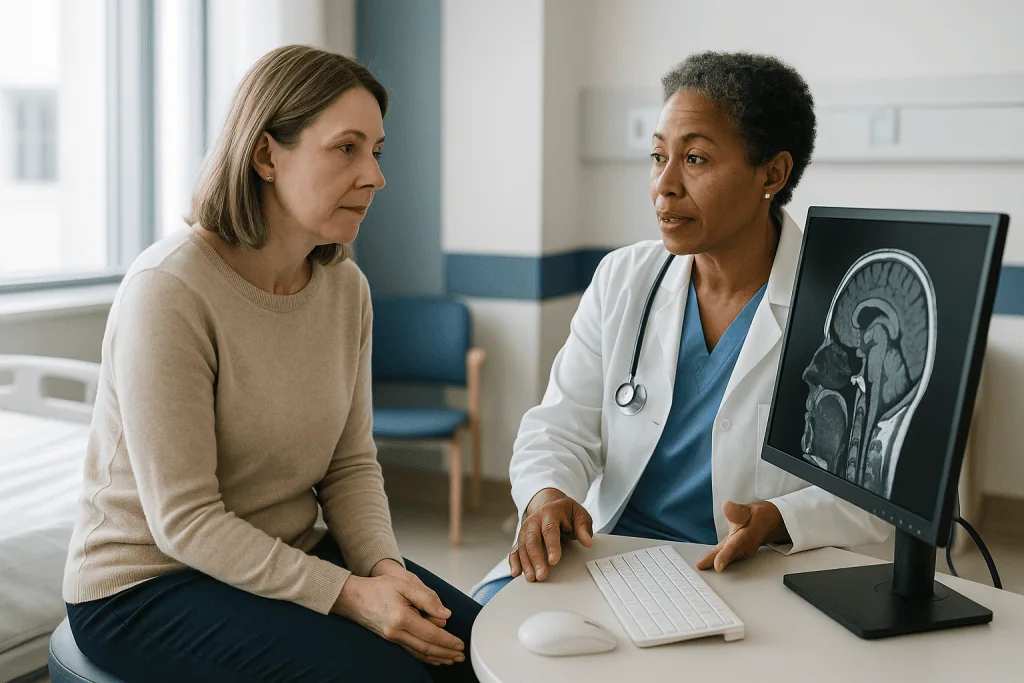
The most rigorous test so far comes from Sweden. In a randomized trial of more than 80,000 women attending routine breast screening, half had their mammograms read by one radiologist plus an AI system, and half had the standard two-radiologist double reading. The AI-supported arm detected more cancers, including more small invasive tumors, without increasing false positives, and it cut the radiologists’ screen-reading workload by roughly 44 percent. That is the kind of design, randomized with a proper comparison group, that lets you trust the result.
Elsewhere the picture is more mixed. AI tools that flag possible strokes on brain CT so that a specialist is paged sooner are in wide use, with observational studies showing shorter door-to-treatment times. Tools that spot lung nodules, fractures and pneumothorax/">pneumothorax on X-rays exist in the hundreds; the US regulator’s public list of AI-enabled devices passed a thousand entries in 2024, and most are imaging tools. Yet a 2019 meta-analysis in The Lancet Digital Health found that while deep learning matched clinicians on average, only a minority of studies tested the software on data from a different hospital than the one that trained it. Performance often drops when the scanner, population or workflow changes.
The practical takeaway: in imaging, AI is a strong second reader and an excellent prioritization tool. It is not, in any mainstream hospital, the final reader.
Ambient scribes: the AI your doctor may already be using
The tool patients most often meet is the one they may not notice. An ambient scribe is software that, with your consent, records the conversation during a visit, transcribes it, and drafts a structured clinical note for the clinician to edit and sign.
The appeal is easy to understand. Studies of electronic health record use have repeatedly found physicians spending one to two hours on documentation for every hour of direct patient care, plus what many call “pajama time” charting at home. Burnout surveys consistently rank documentation burden near the top of the list.
What does the evidence show? Mostly observational data and before-and-after comparisons, which are useful but cannot rule out other explanations. Several large health systems have reported reductions in after-hours charting and improved clinician satisfaction scores after rollout. Some studies found the time saved was modest, on the order of minutes per note rather than hours per day, and that a meaningful share of clinicians stopped using the tool. A few reported that patients felt their doctor made more eye contact. Randomized trials are still scarce.
The risks are specific. Language models can insert plausible-sounding details that were never said, a failure known as hallucination. They can mis-hear medication names or laterality (left versus right). For that reason, every credible deployment requires the clinician to review and attest to the note. Your name, voice and story are also now data; hospitals using these tools should tell you the recording is happening and let you decline without penalty.
If your clinician asks permission to use one, a reasonable question is simply: “Do you read it over before it goes in my chart?” The answer should be an unhesitating yes.
Predicting who will get worse: sepsis alerts and early-warning scores
Hospitals have long used simple scoring systems, adding points for a fast heart rate, low blood pressure or confusion, to flag patients heading toward trouble. AI versions do the same job with hundreds of variables pulled continuously from the electronic record: lab trends, nursing notes, vital-sign patterns over hours rather than at a single moment.
Sepsis is the flagship example because timing matters so much. The Johns Hopkins system described earlier is the best-studied success: high detection rates across five hospitals, adoption by clinicians who confirmed the alert in most cases, and a measurable association with lower mortality when alerts prompted action.
The cautionary example arrived a year earlier. In 2021, researchers externally validated a proprietary sepsis model that had been installed in hundreds of US hospitals. Tested on about 27,000 admissions at one academic center, it identified only around one-third of sepsis cases, fired alerts on roughly 18 percent of all hospitalizations, and often triggered after clinicians had already started treatment. Same disease, same category of tool, opposite result.
Why the gap? Three reasons recur across the literature. First, how the model was trained: one used the moment of diagnosis coding as its target, which teaches the software to recognize sepsis after doctors already have. Second, validation: a model tested only on its developer’s data tells you little about your hospital. Third, workflow: an alert that no one is assigned to act on saves no one.
The lesson is not that prediction fails. It is that a prediction model is a medical intervention, and it needs the same scrutiny as a new drug: independent testing, transparent performance figures, and monitoring after launch to catch the slow decay known as data drift, when the population or practice patterns shift and the model quietly stops fitting.
AI in healthcare examples: the 10 most common applications, ranked by evidence
People searching for “10 common applications” usually get a list with no sense of which ones are proven. Here is the same list with an evidence grade attached. “Randomized” means a randomized controlled trial, the study design in which patients or sites are assigned by chance to AI-supported or standard care, which is the strongest way to prove a tool changes outcomes.
| Application | Where it runs | Strength of evidence | Main limitation |
|---|---|---|---|
| Mammography second reading | Screening programs | Randomized trial (Sweden) | Tested in one national system |
| Diabetic eye screening | Primary care, clinics | Prospective validation; regulator-cleared autonomous use | Poor-quality photos are ungradable |
| Stroke triage on CT | Emergency departments | Observational time-to-treatment data | Few outcome trials |
| Sepsis early warning | Inpatient wards | Large observational; mixed results by product | Alert fatigue, false alarms |
| Ambient clinical notes | Outpatient visits | Before-and-after studies | Hallucinated details, review burden |
| Skin lesion classification | Dermatology, apps | Reader studies; some randomized | Underperforms on darker skin |
| ECG interpretation | Cardiology, wearables | Large validation cohorts | Unclear benefit of incidental findings |
| Drug interaction and dosing checks | Pharmacy systems | Long-standing rule-based tools; AI upgrades observational | Over-alerting |
| Scheduling, coding, billing | Administration | Operational data, not clinical trials | Errors propagate at scale |
| Patient-facing chatbots | Portals, apps | Mostly expert opinion and small studies | Confident wrong answers |
Two patterns jump out. The best-supported tools are narrow: one image type, one question. The least-supported are the broadest, the conversational assistants that feel most like “AI” to the public. That inverse relationship between how impressive a tool seems and how well it is proven should shape how much weight you give any claim you read.
Which AI is best for healthcare? Why the question has no single answer
It is one of the most-searched questions on this topic, and it rests on a misunderstanding worth untangling. There is no “best AI” for medicine in the way there might be a best blood pressure cuff, because AI is not one product. It is a family of very different techniques.
An algorithm is simply a set of instructions a computer follows. Rule-based systems, the oldest kind, encode expert knowledge directly: if the potassium is above a threshold and the patient is on this drug class, alert the pharmacist. These have run in hospitals for decades and remain reliable precisely because they are transparent.
Deep learning uses layered artificial neural networks, loosely inspired by brain cells, to find patterns in images, waveforms or signals without being told what to look for. This is what powers mammography readers and ECG interpreters. Its strength is accuracy on well-defined tasks; its weakness is that even its designers cannot fully explain why it flagged a particular pixel cluster.
Large language models generate text. They are good at summarizing, drafting and translating jargon into plain words. They are not designed to be factually reliable, and they will produce a fluent, confident sentence whether or not it is true.
So the useful question is not “which AI is best” but “which tool has been tested for this task, in a population like mine, with results published somewhere I can check.” The WHO guidance makes the same point in policy language: evaluate each system for its intended use, in its intended setting, before and after deployment.
For patients, a simpler heuristic works. The more specific the job, the more likely the evidence is solid. The more general the promise, the more skepticism it deserves.
What the evidence actually says, graded honestly
Medical evidence comes in tiers, and AI claims deserve to be sorted into them rather than lumped together.
Strongest: randomized trials with patient-relevant outcomes. A handful exist. The Swedish mammography trial showed more cancers detected with less radiologist time. A randomized trial of AI-assisted colonoscopy found more precancerous polyps detected per procedure, a finding replicated in several trials, though whether that translates into fewer cancers years later is not yet known. A cluster-randomized study of an AI stroke-triage tool reported faster treatment times. These are real, and they are few.
Moderate: large prospective validation studies. The autonomous diabetic eye screening tool cleared by US regulators in 2018 was tested prospectively in primary care clinics against a reference standard, reporting sensitivity around 87 percent and specificity around 90 percent. Sensitivity is the share of true cases the test catches; specificity is the share of healthy people it correctly clears. Those are good numbers for a screening tool, and they came from a proper prospective design.
Weaker: retrospective and observational data. This is where most published AI research sits. Retrospective means the software was tested on old records, which cannot show how it performs live or whether anyone acts on its output. The sepsis literature shows how the same tool category can look excellent or poor depending on design and setting.
Weakest: expert opinion and demonstrations. A chatbot passing a licensing exam, or answering forum questions in a way graders preferred, is interesting. It is not clinical evidence. A 2023 study found a chatbot’s written answers to patient questions were rated higher in quality and empathy than physicians’ brief forum replies in most comparisons, and Harvard Health’s commentary on it was measured: it tells us about written tone, not about diagnosis or safety.
The honest summary: strong evidence for a short list of narrow tools, thin evidence for the broad promises.
The real benefits of AI in healthcare, without the hype
Strip away the marketing and a few genuine advantages remain, each grounded in how the technology actually works.
The first is tirelessness. A radiologist reading the 200th screening mammogram of the day is human; attention drifts, and studies of reader fatigue document more misses late in a session. Software applies the same scrutiny to image one and image two hundred. Used as a second reader, it catches the small percentage of findings a fatigued human overlooks, which is precisely what the Swedish trial measured.
The second is speed at the front door. When a stroke-triage tool flags a large-vessel occlusion on CT within minutes and pages the interventional team directly, the patient can bypass a queue. Observational studies report door-to-treatment reductions measured in tens of minutes, and in stroke, about 1.9 million neurons are lost each minute blood flow is blocked.
The third is reach. Diabetic retinopathy, damage to the retina from long-term high blood sugar, is a leading cause of preventable vision loss, yet many people with diabetes skip their annual eye exam because it means a separate specialist visit. An autonomous camera-plus-software system in a primary care office lets the check happen the same day. The bottleneck shifts from specialist availability to whether anyone follows up on a positive result.
The fourth is time returned to conversation. If ambient scribes deliver even a fraction of what early studies suggest, the payoff is not efficiency for its own sake but a clinician looking at you instead of a screen.
Notice what is missing from this list: diagnosis without a doctor, treatment chosen by an algorithm, or anything a chatbot does alone. The benefits are real because they are bounded.
Disadvantages of AI in healthcare: bias, drift and the automation trap
The failures of medical AI are rarely dramatic. They are quiet, statistical and unevenly distributed, which is what makes them dangerous.
Bias. A 2019 study in Science examined an algorithm used by health systems to identify patients who would benefit from extra care coordination. It used past healthcare spending as a proxy for illness. Because Black patients had historically received less care, and therefore generated lower costs, at any given risk score they were considerably sicker than white patients. Correcting the proxy would have raised the share of Black patients flagged from about 18 percent to about 47 percent. Nothing in the code mentioned race. The bias came from the data.
Skin-lesion classifiers trained mostly on lighter skin perform worse on darker skin. Pulse oximeters, though not AI, offer a parallel lesson: devices validated on one population can mislead in another. The fix is deliberate: diverse training data, performance reported by subgroup, and audits after launch.
Drift. A model trained on 2019 hospital data met a 2020 pandemic population it had never seen. Practice patterns change, lab assays change, coding habits change. Without monitoring, a tool that was accurate at launch can degrade unnoticed for years.
Automation bias. This is the human tendency to trust a machine’s suggestion over one’s own judgment. Reader studies have shown that when AI is wrong, clinicians who see its output are more likely to be wrong too. The radiologist in the opening scene had it right: agreement is the moment to double-check, not relax.
Alert fatigue. A sepsis tool flagging 18 percent of all admissions trains staff to dismiss alerts. The tool that cries wolf costs lives indirectly.
None of these is a reason to abandon the technology. Each is a reason to demand the same evidence and oversight we expect of any other intervention.
Should you trust an AI chatbot with your symptoms?
Millions of people already type symptoms into general-purpose chatbots, so the practical question is not whether but how.
What these tools do well is explain. Ask what a lab abbreviation means, what a procedure involves, or how to phrase a question for your appointment, and a large language model will usually produce a clear, patient-friendly answer. The 2023 comparison study that found chatbot replies rated as more empathetic than physicians’ terse forum posts captured something real: the writing is patient and unhurried.
What they do poorly is know when they are wrong. A language model does not check facts; it predicts likely words. Independent evaluations have found chatbots inventing citations, misstating drug interactions, and giving different answers to the same question asked twice. They cannot examine you, order a test, or notice that your voice sounds breathless. They do not know your history unless you type it, and they may not weigh it correctly if you do.
Symptom-checker apps built specifically for triage have been studied more formally. A 2020 evaluation of several found they listed the correct diagnosis first in roughly a third to half of test cases and gave appropriate urgency advice in about half to two-thirds. Better than a coin flip, well short of a clinician.
Reasonable ground rules: use a chatbot to prepare for a visit, not to replace one. Never use it to decide whether to take, skip or change a prescribed medicine; that decision belongs to the prescriber who knows your history. Treat any confident statement about your specific case as a hypothesis to raise with a human, not a conclusion. And if a chatbot tells you a symptom is nothing to worry about, remember it has no way to know that.
What jobs will AI replace in healthcare? A grounded look
In 2016 a prominent computer scientist suggested medical schools should stop training radiologists because software would soon read scans. Nearly a decade later, radiology residency applications are up and many departments report vacancies. The prediction failed because it confused a task with a job.
Reading an image is one task. A radiologist also protocols the study, talks to the referring surgeon, decides whether an incidental finding matters for this particular 78-year-old, performs image-guided biopsies, and takes responsibility when something is missed. AI has automated a slice of the first task. It has not touched the rest.
The pattern repeats across the hospital. Medical coders are seeing software draft billing codes from notes; the job is shifting toward auditing those drafts. Transcriptionists have been displaced in many systems by speech recognition, a real loss for that workforce and one worth acknowledging honestly. Pharmacists spend less time on routine interaction checks and more on complex medication reviews. Nurses using early-warning tools are not doing less; they are being asked to respond to more alerts, which is why alert quality matters so much.
The roles most exposed are those built almost entirely on a single, well-defined information task: transcribing, first-pass coding, scheduling. Roles built on judgment, physical care, procedures and accountability are being reshaped rather than removed.
The WHO’s guidance frames this as a governance question: health systems adopting AI should plan for retraining and should not use the technology to justify unsafe staffing. That is a policy position, not a prediction, and it reflects the evidence we have. In every setting where outcomes have improved, a human was still in the loop, and usually the improvement came from that human getting information sooner.
Common myths about AI in healthcare, corrected
Viral claims travel faster than trial results. Here are the ones that recur, and what the evidence supports instead.
“AI is more accurate than doctors.” On some narrow, well-defined image tasks, tested on data similar to its training set, deep learning has matched or slightly exceeded average specialist performance. On new populations, unusual presentations and anything requiring context, it has not. The meta-analyses that produced the “as good as doctors” headlines also noted most studies lacked external validation.
“A chatbot passed the medical exam, so it can practice medicine.” Exams test recall and pattern recognition on written vignettes. Practice involves examining a person, tolerating uncertainty, and being accountable. Passing the exam is a language benchmark, not a license.
“AI is objective because it has no opinions.” Models learn from human decisions and inherit human patterns. The care-coordination algorithm that under-identified Black patients had no opinions either.
“If a hospital uses AI, the machine is making decisions about me.” In mainstream practice, AI outputs are recommendations, flags or drafts that a clinician reviews. The autonomous eye-screening tool is a rare exception, and even it refers positive results to a human specialist.
“AI will make care impersonal.” The opposite is plausible. Early data on ambient scribes suggest clinicians look at patients more when they type less. Whether that holds at scale is an open question, not a settled fear.
“Regulators have not looked at any of this.” Hundreds of AI-enabled devices have been through US review, and the WHO has published two rounds of governance guidance. Oversight is uneven and evolving, but it exists.
The thread running through every myth is the same: treating “AI” as one thing. It is many things, and each deserves its own verdict.
What happens to your health data when a hospital uses AI?
Every tool described so far runs on patient data, and patients reasonably want to know where theirs goes.
In the United States, health information held by hospitals and clinicians is protected under federal privacy law, which restricts how it can be used and shared. AI tools integrated into a hospital’s electronic record generally operate inside that protected environment, under contracts that bind the vendor to the same confidentiality rules. Your CT scan being analyzed by a stroke-triage tool is, legally, similar to it being read by a contracted teleradiology service.
The gray zones are elsewhere. A general-purpose chatbot you use on your phone is usually not a covered health entity; what you type may be stored, reviewed or used to improve the model according to its own terms, not medical privacy law. The same goes for many wellness apps. If you would not want a sentence to appear outside your medical record, do not type it into a consumer tool.
De-identification, the removal of names, dates and other identifiers so data can be used for research or model training, is standard practice. Researchers have shown that re-identification is sometimes possible when de-identified data are combined with other sources, which is why the WHO guidance emphasizes governance, not just technical anonymization.
You have rights. You can ask your clinician whether an ambient scribe is recording and decline it. You can request a copy of your record and see what was documented. Under US law you can request an accounting of certain disclosures.
A fair-minded view: the hospital-integrated tools are governed by the same rules as the rest of your chart. The consumer tools you reach for at midnight are not, and the difference matters more than most people realize.
When to see a doctor: AI is not a substitute for urgent care
Every section above ends in the same place: a human clinician makes the call. This one is about when to make that call quickly, regardless of what any app or chatbot has told you.
Seek emergency care immediately, by calling your local emergency number, for:
- Chest pain or pressure, especially with shortness of breath, sweating, or pain spreading to the arm, jaw or back.
- Sudden weakness or numbness on one side, facial drooping, trouble speaking or understanding, or sudden severe headache. Stroke treatment is time-critical.
- Difficulty breathing, blue or gray lips, or a severe allergic reaction with swelling of the face or throat.
- Signs of sepsis: fever or chills with confusion, very fast breathing, a racing heart, or skin that is mottled, cold or clammy, particularly in someone with a known infection.
- Thoughts of harming yourself. In the US, call or text 988.
Contact your clinician promptly, within a day or two, if a symptom is new, persistent or worsening, if an AI tool or screening test has flagged a finding you do not understand, or if you are unsure whether something matters. Bring the printout or screenshot; clinicians would far rather review a false alarm than miss a real one.
Never use an AI output, from a chatbot, a wearable or a hospital portal message, as a reason to stop, start, skip or change a prescribed medicine. If a tool has raised a concern about a drug you take, the person to ask is the prescriber, who knows your history and can weigh the risks of changing course against the risks of staying on it. That decision belongs to them and to you, together.
The technology is improving. The rule does not change: when in doubt, a human who can examine you is the right next step.
How to be a well-informed patient in an AI-assisted hospital
The most useful thing a patient can bring to this new landscape is not technical knowledge but good questions.
When a clinician mentions that AI helped read your scan or flagged your chart, it is entirely reasonable to ask three things. Did a person review it? What does the tool tend to get wrong? And would you have made the same call without it? A confident clinician will welcome those questions, and the answers tell you how thoughtfully the tool has been deployed.
If you are asked to consent to an ambient scribe, ask whether the recording is deleted after the note is written and whether you can read the note afterward. Both should be yes. If you are handed a triage result from an app in a waiting room, treat it as the first opinion, not the last.
For your own use, keep a clear line between explanation and decision. Chatbots are genuinely helpful for decoding a discharge summary, drafting questions before an appointment, or understanding what a test measures. They are not appropriate for deciding whether a symptom is serious or whether a medicine is right for you.
Keep perspective on the pace of change. As of early 2026, the tools with the strongest evidence are still the narrow ones: a second reader for mammograms, an eye camera in a diabetes clinic, a sepsis flag on a hospital ward. The conversational assistants that dominate headlines have the weakest clinical footing. That gap will narrow as trials are completed, and honest reporting will say so when it does.
Until then, the radiologist’s habit is the right one for all of us. When the machine agrees, slow down. When it disagrees, ask why. And when it is silent, remember that silence from software is not the same as reassurance from someone who has examined you.
Frequently asked questions
How is AI being used in healthcare now?
Today’s most common uses are reading medical images as a second opinion, flagging hospitalized patients at risk of sepsis or deterioration, drafting clinical notes from recorded visits, screening for diabetic eye disease in primary care, prioritizing suspected strokes on CT, and handling scheduling and billing codes. In nearly all of these, a clinician reviews the output before any decision is made. Patient-facing chatbots exist but have the weakest evidence.
What are the main ai in healthcare examples with proven benefit?
The best-proven examples come from randomized trials: AI-supported mammography reading in Sweden detected more cancers with less radiologist time, and AI-assisted colonoscopy found more precancerous polyps in several trials. Prospectively validated autonomous diabetic eye screening reported sensitivity around 87 percent and specificity around 90 percent. Stroke-triage and sepsis tools have large observational support, with results varying by product and setting.
What jobs will AI replace in healthcare?
Roles built on a single, well-defined information task, such as medical transcription and first-pass billing coding, have been most affected, and transcription has already been widely displaced by speech recognition. Clinical roles involving judgment, procedures, physical care and accountability are being reshaped rather than removed; radiology vacancies remain common despite a decade of predictions. In every setting where AI improved outcomes, a human clinician was still making the decisions.
Which AI is best for healthcare?
There is no single best AI because the term covers very different technologies: rule-based alerts, deep learning for images, and large language models for text. The right question is which tool has been tested for a specific task, in a population like yours, with published results. Narrow tools such as mammography readers have the strongest evidence; general conversational assistants have the weakest, despite being the most visible.
What are the benefits of AI in healthcare for patients?
The concrete benefits are consistent attention on every image regardless of reader fatigue, faster routing of time-critical cases like stroke to the right team, wider access to screening such as diabetic eye checks in primary care, and potentially more face-to-face time when clinicians type less. These gains are real because they are bounded; none involves a machine diagnosing or treating anyone without a clinician involved.
What are the disadvantages of AI in healthcare?
The main disadvantages are bias inherited from training data, performance drift as populations and practices change, automation bias in which clinicians over-trust machine output, and alert fatigue from tools that flag too many patients. Language models can also fabricate plausible details. Each of these is manageable with diverse data, independent validation, subgroup reporting and post-launch monitoring, but each has caused documented harm when ignored.
Can an AI chatbot diagnose me?
No. A chatbot generates likely-sounding text; it cannot examine you, order tests, or reliably check its own facts, and studies have found chatbots inventing citations and giving inconsistent answers. Dedicated symptom-checker apps listed the correct diagnosis first in roughly a third to half of test cases in one evaluation. Use these tools to understand terms or prepare questions, and see a clinician for any actual diagnosis.
Is it safe to let my doctor use an AI scribe during my visit?
In mainstream deployments, yes, provided the clinician reviews and signs the note and the hospital has told you the recording is happening. The tool drafts; the clinician is responsible for accuracy. Known risks include mis-heard medication names or inserted details, which is why review is mandatory. You can decline without affecting your care, and you can ask to read the resulting note in your record.
Does AI in hospitals make decisions about my treatment?
In standard practice, no. AI systems produce flags, drafts or recommendations that a licensed clinician reviews before acting. The rare exceptions, such as autonomous diabetic eye screening, are narrowly cleared for one task and still refer any positive result to a human specialist. Treatment decisions, including anything about your medicines, remain with your treating clinician, and you should never change a prescription based on an AI output.
Is my health data protected when hospitals use AI?
Data used by AI tools integrated into a hospital’s electronic record fall under the same federal privacy protections as the rest of your chart, with vendors bound by confidentiality contracts. Consumer chatbots and many wellness apps are not covered by medical privacy law, so what you type is governed by their own terms. You retain the right to see your record and to decline recording tools.
References
- WHO: Ethics and governance of artificial intelligence for health
- WHO: WHO releases AI ethics and governance guidance for large multi-modal models (January 2024)
- NIH / PMC: Artificial intelligence in healthcare: transforming the practice of medicine
This article is for general information only and is not a substitute for professional medical advice. Please consult a qualified doctor about your individual situation.

More from the Blog

Home Blood Pressure Monitors: Wrist vs Arm and How to Take a Reading That Counts
For most adults, the best home blood pressure monitor is an automatic upper-arm cuff that has passed independent validation testing and fits your arm…
Telehealth: What Can Be Diagnosed on a Video Call and What Cannot
Telehealth can reliably assess conditions a clinician diagnoses mostly by history and by looking: many rashes, mental health concerns, medication follow-ups, chronic disease check-ins…

Recovering from Radiotherapy: How Long Until You Feel Better
Most people start to feel noticeably better within a few weeks of their last radiotherapy session, although side effects such as fatigue and skin…

Patient Portals: How to Read Your Own Lab Results Without Panicking
A patient portal is the secure website or app your health system uses to show you appointments, messages, and test results, and since 2021…

Over-the-Counter CGMs: What Glucose Data Means for People Without Diabetes
Over-the-counter continuous glucose monitors such as Stelo and Lingo show adults without diabetes how blood sugar rises and falls through the day. For most…

Smart Rings Compared: Galaxy Ring, Ultrahuman and Oura: What They Measure Well
The Samsung Galaxy Ring, Oura Ring and Ultrahuman Ring Air all use an optical sensor on the finger to track resting heart rate, nighttime…