

AI in Surgery: From Robotic Assistance to Predicting Complications

Key Takeaways
- Every robotic surgical system in clinical use today moves only when the surgeon at the console moves; no autonomous robot is cleared to operate on human patients.
- Randomised trials in rectal and prostate surgery found robotic and conventional keyhole approaches produced broadly similar outcomes, with robotic cases often taking longer.
- Machine-learning risk models often reach discrimination scores of 0.80 to 0.90 in retrospective data, but accuracy frequently drops when a model is moved to a different hospital.
- One widely deployed sepsis prediction tool, independently evaluated in 2021, caught only about a third of cases while generating alerts for many patients who never developed sepsis.
- Computer vision can recognise the critical view of safety in gallbladder surgery with expert-level agreement, yet no large trial has shown it reduces actual bile duct injuries.
- The WHO's 2021 and 2024 guidance names bias, lack of transparency and loss of human oversight as the principal hazards of AI in health, and requires validation for each specific clinical use.
AI in surgery currently means software that helps surgeons rather than replacing them: algorithms that estimate a patient's risk of complications before an operation, computer vision that flags anatomy during keyhole procedures, robotic systems that steady and scale a surgeon's hand movements, and monitoring tools that watch for trouble afterward. Evidence is strongest for surgeon-controlled robotics and weakest for fully autonomous operating, which remains experimental.
The clip is short, silent and oddly calming: a pair of robotic instruments peel a gallbladder away from the liver of a pig specimen, clip the duct, and finish the job with no human hand on the controls. It travelled far beyond surgical circles when researchers published it, and it has pulled a wave of search traffic toward one question: is this what my next operation will look like?
As of early 2026, the honest answer is no, not yet, and probably not for years. Yet the broader story of ai in surgery is very real. Hospitals are already running algorithms that score a patient’s complication risk before the first incision, camera software that recognises anatomy in real time, and bedside monitors that spot deterioration hours before a nurse would. The World Health Organization has issued two rounds of guidance on how such tools should be governed, the most recent in January 2024.
So this is a good moment to separate what the technology does today, what it might do soon, and what remains laboratory theatre.
What changed recently: why ai in surgery is trending now
Three threads braided together over the past few years, and the viral video is only the newest.
The first is autonomy research. In January 2022, a team at Johns Hopkins reported that its Smart Tissue Autonomous Robot had joined two ends of pig intestine, in living animals, without a surgeon guiding each stitch. That was a landmark because joining bowel is one of the fiddliest tasks in abdominal surgery; a leaking join is a leading cause of serious complications. The same group followed up in 2025 with a system that completed a gallbladder removal on specimen tissue by watching and imitating recorded human operations, pausing to ask for guidance when uncertain. Both studies were preclinical, which means no human patient was involved.
The second thread is governance. The WHO published its first guidance on the ethics and governance of artificial intelligence for health in June 2021, setting out six principles including transparency, accountability and human oversight. In January 2024 it added specific guidance on large multimodal models, the class of systems behind modern chatbots, warning that they can produce confident but wrong answers and must be validated for each clinical use.
The third thread is quieter and more consequential: ordinary hospitals have moved prediction software from pilot projects into daily use. Risk scores that once lived in research databases now appear in electronic records at the moment a surgeon books a case. None of this made headlines, but it is the part of ai in surgery most likely to touch you.
What has not changed is the regulatory picture for autonomous operating. No fully autonomous surgical robot is cleared for independent use on human patients in any major health system.
What does ai in surgery actually mean?
The phrase covers four quite different technologies, and conflating them is the root of most confusion.
Machine learning is software that finds patterns in large sets of past data and uses them to make predictions about new cases. In surgery it powers risk calculators: feed in a patient’s age, kidney function, diabetes status and the planned operation, and the model estimates the probability of, say, a wound infection or an unplanned return to theatre.
Computer vision is machine learning applied to images and video. Trained on thousands of recorded operations, these systems can label the stage of a procedure, outline a blood vessel on the screen, or flag that a surgeon has not yet achieved a safe view before cutting a duct.
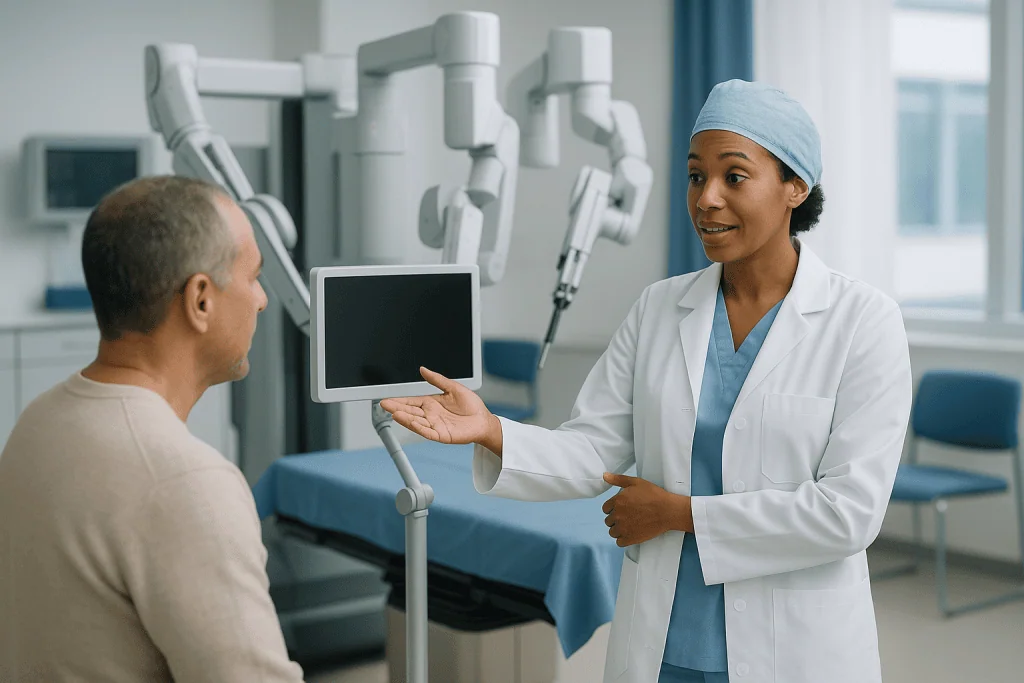
Robotic assistance is the most visible and the least “intelligent”. A surgical robot is a set of instruments controlled from a console a few metres away; the surgeon’s hand movements are filtered to remove tremor and scaled down for precision. Most systems in use today contain little or no decision-making software. The robot moves only when the surgeon moves.
Autonomy sits at the far end: a system that plans and performs a task, or an entire procedure, on its own. This is the part that exists in animal studies and engineering labs, not in hospital wards.
A useful mental model is the car. Lane-keeping assistance, collision warnings and cruise control arrived long before anything resembling a self-driving vehicle, and each required separate testing. Surgery is following the same sequence, with the added constraint that a wrong turn inside a human body cannot be undone by braking.
Robotic surgery vs traditional surgery: what the robot actually does
Picture the surgeon not at the table but seated at a console in the corner of the room, forehead resting against a viewer, fingers in loops that resemble small handles. Three or four robotic arms stand over the patient, each holding a thin instrument or a camera inserted through incisions about the width of a pencil.
Every movement at the console is translated to the instruments in real time. The software does three things along the way. It removes the fine tremor present in every human hand. It can scale movements, so that a centimetre at the console becomes a few millimetres at the tip. And it allows the instrument tips to rotate through a greater range than a human wrist, which matters when suturing deep in the pelvis or chest.
The camera delivers a magnified, three-dimensional view. Surgeons describe operating this way as sitting inside the anatomy rather than peering at it.
Robotic surgery is therefore a form of keyhole, or laparoscopic, surgery, meaning operations performed through small incisions using a camera rather than through one long cut. The benefits patients experience, smaller scars, less blood loss and typically a shorter hospital stay, are largely the benefits of keyhole surgery itself. According to MedlinePlus and Mayo Clinic, robotic approaches are now routine for prostate removal, hysterectomy, some heart valve repairs, kidney surgery and certain bowel operations.
What the robot does not do is choose where to cut. It has no model of the patient, no plan, and no ability to recognise an unexpected finding. If the surgeon stops, the instruments stop. That distinction matters enormously when weighing claims about ai in surgery, because most “robotic” headlines describe a very sophisticated tool, not a decision-maker.
Can AI predict surgical complications before they happen?
This is where the technology is most mature and, arguably, most useful.

Surgeons have estimated risk for decades using scoring systems built from statistics: a patient’s physical status grade, frailty indices, and large registries that pool outcomes from hundreds of hospitals. Machine learning extends this by handling far more variables at once, including laboratory trends, medication lists and free-text notes, and by updating as new data arrive.
In published studies, models predicting outcomes such as postoperative kidney injury, prolonged ventilation, surgical site infection or 30-day mortality often achieve discrimination scores between 0.80 and 0.90. Discrimination, usually reported as the area under the curve, measures how well a model ranks a patient who will have the complication above one who will not; 0.50 is a coin toss and 1.00 is perfect. Scores in that range are good, and sometimes modestly better than traditional calculators.
The catch is in the word “published”. Most of these results come from retrospective analyses, meaning the model was tested on historical records rather than used on real patients in real time. Performance frequently drops when a model trained in one hospital is applied in another with different patients, coding habits and equipment. A widely deployed sepsis prediction tool, when independently evaluated across a large hospital system in 2021, identified only about a third of sepsis cases while generating alerts for a large share of patients who never developed it.
The mature view is that these tools are good at prompting a conversation. A high predicted risk might lead to a pre-operative anaesthetic review, a prehabilitation program, or a frank discussion about whether to operate at all. The prediction does not make the decision; it makes the decision better informed.
Inside the operating room: computer vision and real-time guidance
Gallbladder removal is one of the most common operations in the world, and it carries a rare but serious hazard: injuring the main bile duct, which lies close to the smaller duct that must be clipped. Surgical teaching addresses this with the “critical view of safety”, a defined arrangement of structures that must be clearly seen before anything is cut.
Researchers have trained computer vision systems on thousands of recorded gallbladder operations to recognise whether that view has been achieved. In validation studies the software agrees with expert reviewers most of the time, and can display a green or amber indicator on the operating screen. Similar systems outline blood vessels, nerves and the ureter in colorectal and gynecological surgery, or identify which phase of an operation is under way so that the team can prepare the next instrument.
None of this is autonomous. The display is advisory, closer to a spell-checker than an author. The surgeon can agree, disagree or ignore it.
Early evidence suggests such overlays may shorten the time to reach a safe view and may help less experienced surgeons, but studies are small and mostly from single centers. Whether they reduce actual injuries is unproven, partly because bile duct injury occurs in roughly one in several hundred cases, so demonstrating a reduction would require trials involving many thousands of patients.
A second, less glamorous use is operating-room logistics. Algorithms that predict how long a case will take, based on the surgeon, the procedure and the patient, help schedule theatres more accurately. That sounds administrative, yet overrunning lists are a real cause of cancelled operations and fatigue-related error, so better forecasting has a plausible safety dividend.
After the operation: AI monitoring and early warning on the ward
Most surgical deaths do not happen on the table. They happen two, three or five days later, when a leaking join, a clot or an infection begins quietly and is recognised late. Hospitals have long used early-warning scores that add up abnormal vital signs; machine learning versions ingest the same data continuously and look at trajectories rather than snapshots.
Consider a patient whose heart rate has climbed from 72 to 96 over six hours while blood pressure drifts down and urine output falls. Each reading might sit within “normal” limits. A trend-based model recognises the pattern as early deterioration and alerts the team.
Wearable sensors extend this beyond the ward. Studies of patients discharged after major surgery have used step counts, heart rate and sleep data from wrist devices to flag those at risk of readmission. Some centers use smartphone photographs of wounds, analysed by image-recognition software, to triage which patients need a clinic visit.
The evidence here is mixed but improving. Several before-and-after studies report fewer cardiac arrests or intensive care transfers after deploying continuous monitoring with algorithmic alerts. Randomised trials are fewer, and some have found no difference, often because the alert arrived but the response pathway was unclear or staff were overwhelmed by notifications.
That last problem, alert fatigue, is the central lesson of the whole field. An algorithm that fires too often is switched off or ignored. The systems that appear to work are those paired with a defined human response: who gets paged, within how many minutes, with what authority to act. Software without a workflow is just noise.
AI in surgery today versus tomorrow: a summary table
Readers often ask for a single view of what is routine, what is emerging, and what remains research. The table below reflects mainstream clinical practice and published evidence as of early 2026; local availability varies widely.
| Application | What it does | Where it stands | Strength of evidence |
|---|---|---|---|
| Surgeon-controlled robotic systems | Tremor filtering, motion scaling, 3D magnified view | Routine for many urological, gynecological, colorectal and some cardiac procedures | Multiple randomised trials versus conventional keyhole surgery; broadly similar outcomes |
| Pre-operative risk prediction | Estimates probability of specific complications | In daily use at many centers via electronic records | Large retrospective studies; few prospective trials showing changed outcomes |
| Computer vision guidance | Labels anatomy and procedure phases on screen | Early clinical use, mostly in research-active hospitals | Small validation studies; no large trials of injury reduction |
| Ward and remote monitoring | Continuous deterioration alerts, wound-image triage | Expanding, uneven adoption | Mixed; before-and-after data positive, randomised data limited |
| Autonomous task execution | Robot performs suturing or dissection on its own | Animal and specimen studies only | Preclinical; no human use |
| Fully autonomous operations | Robot plans and performs an entire procedure | Not in clinical use anywhere | None in humans |
Two patterns stand out. First, the technologies with the strongest evidence are the least “intelligent”, and the most intelligent have the least evidence. Second, nowhere in the table does an algorithm make a final decision alone. That is by design, not by accident, and it reflects both regulatory requirements and the professional consensus that accountability for an operation must rest with a named human.
What the evidence actually says, graded honestly
Grading evidence means asking how a claim was tested, not just whether it sounds plausible. Randomised controlled trials, in which patients are assigned by chance to one approach or another, sit at the top. Observational studies, comparing outcomes in patients who happened to receive different care, sit below because the groups may differ in ways that explain the result. Expert opinion and laboratory demonstrations sit at the bottom.
Robotic versus conventional keyhole surgery: high-quality but unexciting. Randomised trials in rectal cancer surgery and prostate removal have found no meaningful difference in major outcomes such as cancer clearance, conversion to open surgery, or urinary and sexual function at a year. Robotic cases often take longer. The honest summary is that robotics is a reasonable way to do keyhole surgery, not a demonstrably better one, with the possible exception of operations in very confined spaces where surgeons report ergonomic advantages.
Risk prediction: moderate for accuracy, low for impact. Models reliably rank patients by risk in retrospective data. Whether showing a surgeon that number changes what happens to the patient is far less studied, and the few prospective trials have shown modest or no effect.
Computer vision: low to moderate. Accuracy studies are encouraging; outcome studies barely exist.
Autonomy: preclinical. The 2022 and 2025 Johns Hopkins demonstrations are rigorous engineering achievements, published in peer-reviewed journals, but they involved animals or tissue specimens in controlled conditions. Translating them to a living, bleeding, anatomically variable human in an emergency is a different order of problem.
None of this means the technology is hype. It means the burden of proof has not yet been met for the most dramatic claims, and the field knows it.
Can AI reduce surgical errors, or just describe them?
Surgical error is not one thing. Some errors are technical: a stitch placed too shallow, a vessel nicked. Others are judgment errors: operating on a patient too frail to recover, or choosing the wrong procedure. Still others are system errors: a wrong-site operation because a checklist was skipped, or a missed deterioration because a result was not seen. AI addresses each differently, and unevenly.
For technical error, surgeon-controlled robotics removes tremor and improves visualisation, which plausibly helps, though trials have not shown fewer complications overall. Computer vision warnings may prevent a subset of anatomical misidentifications, but evidence is preliminary.
For judgment error, risk prediction has the clearest theoretical case. If a model flags that an 84-year-old with heart failure has a one-in-five chance of a major complication, the surgical team can plan differently or decide with the patient that surgery is not the right path. Observational data suggest formal risk assessment is associated with better outcomes, but attributing that to the algorithm rather than to the careful teams that adopt it is difficult.
For system error, the quiet wins may be largest. Software that cross-checks consent forms against the booked procedure, verifies that antibiotics were given within the right window, or audits video to confirm that a safety step occurred can catch lapses that humans miss when tired. Video review in particular is changing surgical training: algorithms can now index hours of footage and identify moments where technique deviated from the expert norm, giving trainees specific feedback rather than general impressions.
So the fair answer is: AI can reduce certain errors, probably already does in well-run systems, and has not yet been shown to reduce the overall complication rate of surgery. Those are compatible statements.
Autonomous robotic surgery: how close are we really?
The engineering milestones are genuine. The 2022 intestinal anastomosis study showed a robot placing sutures with more consistent spacing than expert surgeons, using a camera that tracked the moving tissue in three dimensions. The 2025 gallbladder work went further: rather than following a pre-programmed plan, the system learned from recorded human operations and could adapt when the anatomy did not match expectations, even accepting spoken corrections mid-task.
Why, then, is autonomous robotic surgery still described as years away?
Living human tissue is unpredictable. Specimens do not bleed; patients do. Anatomy varies far more than training datasets capture, and the rare variant that an algorithm has never seen is precisely the one most likely to cause harm. Emergency surgery, where the need is greatest, is also where conditions are least controlled.
Regulation requires evidence of safety in humans, which means staged trials: first with a surgeon’s hand hovering over an override, then with supervision at a distance, and only eventually, if ever, without. Each stage takes years. The medical-device frameworks in the United States, Europe and the United Kingdom currently have no clear pathway for approving a system that makes irreversible physical decisions without human confirmation.
Liability is unresolved. When a surgeon operates, responsibility is clear. When software acts, the question of who answers for a bad outcome, the hospital, the manufacturer or the supervising clinician, has no settled legal answer.
The realistic trajectory is incremental: autonomous execution of narrow, well-defined subtasks such as suturing or camera positioning under continuous supervision, perhaps within the next decade, with full autonomy for complete procedures remaining speculative. Anyone promising otherwise is describing a lab, not a hospital.
The risks nobody puts in the press release: bias, drift and the black box
Every algorithm learns from the past, and the past was not fair. If a risk model is trained on data from hospitals that historically under-treated certain groups, it may learn that those patients “do worse” and recommend less aggressive care, hardening the disparity it was meant to correct. Pulse oximeters, the finger clips that measure oxygen, are known to overestimate levels in people with darker skin; any model that ingests those readings inherits the error. The WHO’s 2021 guidance names bias as one of the principal hazards and calls for datasets that reflect the populations a tool will serve.
Drift is subtler. A model validated in 2021 may silently lose accuracy as practice changes, new drugs arrive, or patient demographics shift. Unlike a scalpel, software degrades without looking different. Responsible deployment includes ongoing monitoring, which many hospitals are only beginning to resource.
The black-box problem refers to models whose internal reasoning cannot be inspected. A deep neural network may produce an accurate prediction without any human being able to say why. Clinicians are rightly uneasy about acting on advice they cannot interrogate, and patients are entitled to an explanation of decisions about their bodies. Explainability research is active but imperfect; a plausible-sounding explanation generated after the fact is not the same as understanding.
Finally there is automation bias, the well-documented tendency to defer to a confident machine even when it is wrong. In aviation and radiology, studies show that a false negative from software makes humans more likely to miss the finding themselves. In surgery, where a misidentified structure can be cut in a second, that tendency is dangerous. The safeguard is cultural: teams must be trained to treat algorithmic output as one opinion in the room, not the final word.
Common myths about ai in surgery, corrected
Myth: Robots now perform operations by themselves. Not on human patients. Every robotic system in clinical use is controlled moment to moment by a surgeon at a console. The autonomous demonstrations that went viral were performed on animals or tissue specimens under laboratory conditions and are explicitly described by their authors as research.
Myth: Robotic surgery is always safer than traditional surgery. Randomised trials comparing robotic with conventional keyhole surgery have mostly found similar complication rates and similar long-term results. Both are generally gentler than open surgery for suitable patients, but that advantage belongs to the keyhole approach, not to the robot specifically. Surgeon experience with any given technique remains a stronger predictor of outcome than the equipment.
Myth: An AI risk score tells you whether your operation will go well. A score is a probability drawn from similar patients, not a forecast for you. A predicted 10 percent risk means roughly one in ten comparable patients had that complication; it cannot say which one.
Myth: Chatbots can advise you on whether to have surgery. General-purpose language models are not validated medical devices, can state falsehoods fluently, and have no access to your examination findings or imaging. The WHO’s 2024 guidance specifically cautions against relying on them for individual clinical decisions.
Myth: AI will make surgeons obsolete. Nothing in the current evidence or regulatory landscape supports this. The realistic shift is in what surgeons spend their time on: less on repetitive subtasks and documentation, more on judgment, communication and the unexpected.
Myth: Older hospitals without AI tools are unsafe. Surgical safety rests overwhelmingly on team training, checklists, volume and systems. A high-volume unit with excellent processes and no algorithms will outperform a poorly run one with every gadget.
What is the future of surgery? Honest predictions, not science fiction
Ask a room of surgeons and you will get a spread of answers, but a few predictions enjoy broad support because they extend trends already under way.
Pre-operative planning will become more personalised. Imaging will be reconstructed into three-dimensional models of the individual patient, with software suggesting incision sites and highlighting unusual anatomy before the first cut. Some centers already print or project these models; the next step is integrating them with the live camera view during the operation.
Risk prediction will shift from a single number to a conversation tool, showing patients and surgeons how different choices, such as losing weight, optimising diabetes control or choosing a less extensive procedure, change the odds. The goal is shared decision-making grounded in data rather than instinct.
Robotic systems will shrink and multiply. Smaller, cheaper platforms for specific procedures are entering use, and instruments that can bend around corners will reach places rigid tools cannot. Supervised autonomy for narrow tasks, suturing being the obvious candidate, is the plausible frontier within a decade.
Training will change profoundly. Video analysis already lets trainees review their own technique against annotated expert footage; simulation will become more realistic and more individualised, shortening the learning curve that currently exposes early patients to a surgeon’s inexperience.
Recovery will be monitored at home. The combination of wearables, image-based wound checks and algorithmic triage means shorter hospital stays with a safety net that follows the patient out of the door.
What probably will not change is the core act: a trained person, accountable to the patient in front of them, deciding whether and how to operate. The future of surgery looks less like a robot replacing that person and more like that person seeing further and sooner.
When to see a doctor, and what to ask about AI before your operation
Technology changes how surgery is planned and performed, but the signs that something is wrong after an operation have not changed, and no algorithm replaces your own judgment about your body. Contact your surgical team the same day, or seek emergency care, if you notice any of the following after surgery:
- A fever above 38°C (100.4°F), shaking chills, or feeling suddenly and markedly unwell.
- Pain that is worsening rather than easing, or new pain in the chest, calf or shoulder.
- Shortness of breath, rapid breathing, or coughing up blood, which can signal a clot in the lung.
- A wound that is increasingly red, hot, swollen, leaking pus or opening up.
- Persistent vomiting, inability to keep fluids down, or a swollen, hard abdomen.
- Bleeding that soaks through dressings, or black or bloody stools.
- Confusion, fainting, very little urine, or a heart rate that stays fast at rest.
If your hospital uses remote monitoring or an app, use it, but never wait for an alert before calling about symptoms that worry you. Monitoring tools are a supplement to clinical judgment, not a substitute.
Before an operation, reasonable questions to ask your surgeon include: Will a robotic system be used, and how many of these procedures have you performed with it? Was an AI risk score part of planning my care, and what did it show? Will my operation be recorded or used to train software, and can I decline? How is my data protected? Who do I call if I feel unwell at home, and how quickly will someone respond?
Any decision about which approach to use, whether to proceed, and how to prepare belongs to you and your treating clinicians together. Information about AI should sharpen that conversation, not replace it.
Frequently asked questions
What is the future of surgery?
The near future of surgery is more data, not fewer surgeons. Expect personalised three-dimensional planning from your own scans, risk scores that show how preparation changes your odds, smaller robotic platforms, supervised autonomy for narrow tasks such as suturing, and recovery monitored at home through wearables. Fully autonomous operations on humans remain speculative and face unresolved regulatory and liability questions. The accountable human surgeon is likely to stay at the center of the decision for the foreseeable future.
Is there a medical AI like the chatbots people use every day?
Medical versions of large language models exist and are being tested for tasks such as summarising records and drafting discharge letters, but none is approved to make individual surgical decisions. The WHO’s 2024 guidance on these models warns that they can produce fluent, confident, incorrect answers and must be validated for each specific use. They cannot examine you or see your imaging. Use them for general understanding if you wish, and bring questions to your clinician.
Which jobs in the operating room will survive AI?
On current evidence, all of them, though their content will shift. Surgeons will spend less time on repetitive subtasks and documentation and more on judgment, communication and managing the unexpected. Anaesthetists, nurses and technicians will work alongside monitoring algorithms rather than be replaced by them, since every deployed system requires a defined human response. The roles most changed are likely to be in planning, scheduling and training, where software already does the heavy lifting.
What are the top 3 riskiest surgeries?
Among planned operations, those with the highest published complication and mortality rates are typically major pancreatic surgery, removal of the oesophagus, and complex open heart or aortic procedures, because they are long, involve critical structures and are often performed on patients who are already unwell. Emergency abdominal surgery in frail older adults also carries high risk. Risk prediction tools are most valuable exactly here, informing whether, when and where such operations should take place.
What are the benefits of ai in surgery for patients right now?
The tangible benefits today are better-informed planning and earlier detection of problems. Risk prediction helps teams identify who needs extra preparation or a different approach. Computer vision can prompt a surgeon to pause before a critical step. Continuous ward monitoring can flag deterioration hours earlier than periodic checks. Robotic systems offer steadier instruments and magnified views for keyhole surgery. None has yet been shown to lower overall complication rates in large trials, so the benefits are real but incremental.
Does the robot ever operate without the surgeon?
Not in clinical practice. Surgical robots in use today are teleoperated, meaning every instrument movement originates from the surgeon’s hands at the console, filtered to remove tremor and scaled for precision. If the surgeon stops, the instruments stop. Autonomous demonstrations, such as the Johns Hopkins intestinal suturing study in 2022, were performed on animals under research conditions and have not been used on human patients. Your surgeon can tell you exactly how the system in your hospital works.
Is robotic surgery safer than traditional open surgery?
Robotic surgery is a form of keyhole surgery, and keyhole approaches generally mean smaller incisions, less blood loss and shorter hospital stays than open surgery for suitable patients. Compared with conventional keyhole surgery, randomised trials have found robotic surgery delivers broadly similar outcomes rather than clearly better ones. The surgeon’s experience with the chosen technique is a stronger predictor of safety than the equipment. Not every operation or patient is suited to a keyhole approach; your surgical team will advise.
Can I refuse to have AI used in my care?
In most health systems you can ask what tools are being used and discuss alternatives, and you can usually decline to have your operation recorded for research or training purposes. Some software, such as risk calculators built into the electronic record, operates in the background and informs the team rather than replacing their judgment. Asking directly is reasonable and welcome. The decisions about your surgery remain with you and your treating clinicians, whatever the software suggests.
How is my surgical data used to train AI?
Training data typically comes from anonymised electronic records and, increasingly, from recorded operative video with identifying details removed. Reputable programs require ethics approval and governance consistent with privacy law and the WHO’s guidance on transparency and accountability. You are entitled to ask whether your data or video will be used, how it is de-identified, who can access it, and whether you can opt out. Policies vary between institutions and countries, so ask your own hospital.
Will AI replace surgeons?
No credible evidence or regulatory pathway points to that outcome in the coming years. Current systems assist with prediction, visualisation and precision; they do not plan or take responsibility for an operation. Autonomous research has achieved narrow tasks in animals, which is far from managing a bleeding, anatomically unusual human in an emergency. The more realistic prospect is a surgeon whose attention is freed for judgment and communication while software handles pattern recognition and routine measurement.
References
- MedlinePlus: Robotic surgery
- WHO: Ethics and governance of artificial intelligence for health
- WHO: Ethics and governance of AI for health, guidance on large multi-modal models
- NHS: Laparoscopy (keyhole surgery)
This article is for general information only and is not a substitute for professional medical advice. Please consult a qualified doctor about your individual situation.

More from the Blog

Consumer Genetic Health Reports: What DNA Kits Can Tell You in 2026, and Who Owns the Data
A 23andMe health report uses genotyping, which reads a few hundred thousand selected DNA positions, to flag a limited set of variants linked to…
Skin Cancer Apps: Can Your Phone Check a Mole? What Studies Found
Skin cancer apps can photograph a mole and estimate whether it looks concerning, but studies show they miss a meaningful share of melanomas and…
Hearing and Vision Test Apps: How Accurate Are Phone Screenings?
Hearing test apps and vision test apps are useful screening tools, not diagnoses. In validation studies, smartphone hearing tests taken with the recommended headphones…
Immunotherapy for Cancer: What It Is, Who Qualifies and How It Is Given
Immunotherapy for cancer is a group of treatments that help a person's own immune system recognize and attack cancer cells, rather than killing those…
Smart Scales and Bioimpedance: How Accurate Is Your Body Fat Reading?
Bioimpedance (BIA) smart scales estimate body fat by sending a tiny electrical current through the body, and they are moderately accurate at best. For…

How a Pacemaker Works and How It Is Fitted
A pacemaker is a small battery-powered device placed under the skin near the collarbone and connected to the heart by thin wires called leads.…